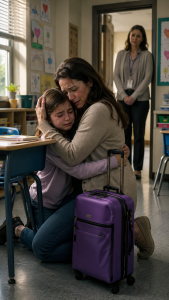
Her teacher, Ms. Albright, stood a few feet away, her arms crossed, looking deeply concerned.
“Ava,” I said, my voice barely carrying across the room.
She looked up. The moment our eyes met, a cold dread washed over me. It wasn’t a loud, chaotic kind of trouble. It was the quiet kind. The kind that hides in the corners of a room, waiting until the lights go out.
“Hey, baby,” I said, forcing my face into a practiced, reassuring smile as I approached her desk. “What’s going on?”
She hesitated, her gaze dropping to the purple fabric. “I packed some things.”
“I see that, sweetie,” I replied, kneeling down so we were eye-to-eye. “But why did you bring it to school?”
Ms. Albright took a subtle step backward, giving us a fragile illusion of privacy.
Ava’s voice dropped to a fragile whisper. “In case I couldn’t come back home.”
The words felt like a physical blow to my chest. “What do you mean, Ava?”
She picked at the metal zipper, refusing to look at me. “Last night, you were talking on the phone in the kitchen. You were crying. You said you didn’t know how we were going to keep the house.”
My stomach bottomed out.
I remembered the call. It was late, past midnight, with the bank. I had been whispering, drowning in a sea of past-due notices and rising interest rates. I thought she was fast asleep.
“I thought…” her voice cracked, a single tear finally spilling over, “I thought maybe the bank was going to take it today while I was at school. So I packed my things. Just in case we had to find somewhere else to sleep tonight.”
I felt something vital break inside me.
“Oh, Ava, no,” I choked out, pulling her small body into my arms. “No, sweetheart. That’s not what’s happening. Oh god, I’m so sorry.”
She buried her face in my shoulder, but kept talking, her words muffled. “I packed your framed picture from the nightstand. And my favorite chapter book. And the patchwork blanket Grandma made for me. I didn’t want to leave anything important behind.”
I couldn’t breathe. My nine-year-old daughter had quietly, methodically prepared herself to become homeless. And she had carried that terrifying weight all morning, entirely alone.
“We are not leaving our house today,” I said fiercely, squeezing her tight enough to anchor her to the earth. “I promise you. You are coming home with me, to your room, to your bed. Everything is going to be okay. Mom is going to figure it out.”
She nodded against my shoulder, but I could feel the residual tremors of her fear. It doesn’t just disappear, that quiet kind of terror. It lingers.
Behind us, I heard Ms. Albright quietly sniffle and step out into the hallway to give us a moment.
I stayed on the floor with Ava for a long time, just holding her, trying to absorb her fear into my own bones. Eventually, I reached down and pulled the zipper shut on the suitcase.
“Come on,” I said softly, wiping her cheeks. “Let’s go home.”
She gripped my hand with a desperate, white-knuckled intensity as we walked out of the classroom. But as we stepped through the school’s exit doors and into the bright afternoon sunlight, I stopped dead in my tracks.
There were people gathered near my car.
At first, I thought it was just the usual dismissal crowd, but school wasn’t out yet. There were a dozen of them. Neighbors. Parents from Ava’s soccer team. Even Mr. Lewis from two doors down—the retired mechanic who usually only communicated in grunts.
“What’s going on?” I murmured, my defensive walls immediately going up.
Mrs. Carter, who lived directly across the street from us, stepped forward. She had a gentle, knowing look in her eyes. “We heard, Sarah.”
My chest tightened defensively. “Heard what? How?”
She glanced back toward the school office. “When Ava arrived this morning, she told Ms. Albright why she had the suitcase. Ms. Albright called the principal, and well… the PTA text chain moves fast when one of our own is hurting.”
I froze, humiliated, waiting for the pity or the judgment.
Instead, Mr. Lewis stepped forward. He cleared his throat gruffly, thrusting a heavy, unmarked white envelope toward me. “This isn’t charity,” he growled, though his eyes were suspiciously bright. “It’s just a bridge. Neighbors take care of neighbors. You’d do the same for us.”
I stared at the envelope, my voice trapped in my throat. “I can’t accept this…”
“Yes, you can,” Mrs. Carter said firmly, placing her hand over mine and closing my fingers around the paper. “Because nobody is supposed to carry a house on their back alone.”
Other parents stepped up, offering warm hugs, casseroles wrapped in foil, and words of quiet solidarity.
Ava looked up at me, her wide brown eyes darting between the crowd and the envelope in my hand. “Mom? What is everybody doing?”
A tear slipped down my face, but for the first time in months, it wasn’t born out of panic.
“This,” I whispered, kneeling back down to her level, “is what a home actually looks like.”
I had spent weeks drowning in silence, convinced that admitting my struggle was a sign of ultimate failure. I thought I was successfully protecting my daughter by hiding the truth, not realizing that the silence was what terrified her the most. By bringing her little purple suitcase to school, she had inadvertently exposed the fracture lines—and our community had rushed in to fill them.
I looked at the heavy suitcase sitting on the asphalt.
“I don’t think we need to roll this anymore today, baby,” I smiled.
She nodded, a genuine, relieved smile finally breaking across her face.
Sometimes, the hardest thing you can do is let people see you break. But it’s only when the pieces fall away that others can see exactly where you need help putting things back together.
Be kind to one another. Pay attention to the quiet signs. Because sometimes, the people who seem to be holding it all together are secretly packing a suitcase you can’t see—and all they need is a little help to finally unpack.