
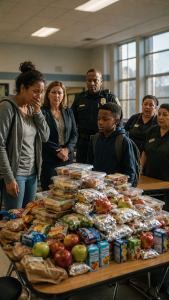
Marcus was standing near the long folding tables, his backpack still strapped to his shoulders, looking incredibly small under the harsh fluorescent lights. In front of him stood two cafeteria workers and a mountain of… *stuff*.
“Marcus,” I breathed.
He looked up. He didn’t look terrified, and he didn’t look guilty. He just looked profoundly worried. And the moment his eyes met mine, I realized he wasn’t worried about what was going to happen to him. He was worried about what this would do to me.
“I’m sorry, Mom,” he said quietly. “I didn’t think they’d call the police.”
I walked over, my eyes finally focusing on the table. It wasn’t weapons or contraband. It was a meticulous, massive hoard of food. Dozens of plastic Tupperware containers. Sandwiches wrapped tightly in tin foil. Apples, granola bars, juice boxes, and bags of chips. It looked like a grocery delivery had exploded on the table.
“I don’t understand,” I said, looking from my son to Mrs. Alvarez.
“We’ve had an issue for the past three weeks,” the principal explained gently. “Food has been disappearing from the bulk storage pantry. Cases of juice, loaves of bread, fruit. We thought it was an inventory error. But twenty minutes ago, our morning custodian caught Marcus in the back pantry, loading his backpack.”
A cold weight settled in my gut. As a single mother scraping by on minimum wage, pride is sometimes the only thing you have left. The thought of my son stealing—stealing *food*, of all things—felt like a public verdict on my failure to provider for him.
“Marcus,” I said, my voice dropping an octave. “Tell me the truth right now. Why did you take this?”
“I didn’t take it for me, Mom,” he said, his voice steady despite the tear that finally leaked down his cheek. “I took it for the kids who don’t eat.”
The cafeteria grew entirely still. Even the officer shifted his weight, his leather duty belt creaking in the silence.
“What do you mean?” I asked.
“There are three kids in my class, and a bunch in the lower grades,” Marcus said, pointing at the juice boxes. “They don’t bring lunch. When the bell rings, they sit at the end of the table and say they aren’t hungry, or that their stomachs hurt. But I see them looking at everyone else’s trays. I tried bringing extra from our fridge, but…” He looked down, his voice cracking. “…we didn’t have enough. And the school has so much. I didn’t think the school would miss it.”
My eyes filled with hot tears. “Marcus… you can’t just take things that don’t belong to you. That’s stealing.”
“I know,” he whispered. “I was going to tell someone. I just… I didn’t want them to get in trouble for being poor. I didn’t want people to laugh at them.”
Mrs. Alvarez pulled out a cafeteria chair and sat down heavily, as if the weight of the confession had pulled her down.
“You’ve been doing this for weeks?” I asked, kneeling so I was eye-to-eye with him. “Why didn’t you just tell me?”
He looked at his sneakers. “Because you work all night, Mom. You’re always tired, and you’re always counting dollars at the kitchen table. I didn’t want to give you another problem to fix.”
That was the phrase that broke me. Not the embarrassment of the police call, nor the fear of suspension. It was the realization that my ten-year-old boy was carrying a burden of empathy so heavy that he felt he had to shield his own mother from it.
I pulled him into my arms, burying my face in his hair, uncaring of the principal, the officer, or the kitchen staff watching us. “You don’t have to carry the world by yourself, Marcus,” I murmured. “That’s my job.”
From behind the counter, Ruth, the head cafeteria manager, stepped out. She had a stern reputation among the kids, but right now, her eyes were bright with unshed tears.
“The kids he’s talking about… I know who they are,” Ruth said quietly. “They qualify for the free lunch program, but they have to sign a specific roster at the register. A lot of the older elementary kids would rather starve than let their friends see them stand in that separate line. It’s a pride thing. We’ve been trying to figure out how to bridge the gap without embarrassing them.”
She looked at Marcus, a soft smile finally breaking through her tough exterior. “This boy found the gap.”
The officer crossed his arms and looked at the principal. “So, what’s the play here, doc? We making an arrest, or are we solving a problem?”
Mrs. Alvarez stood up, a newfound determination in her posture. “There won’t be any arrests. And there won’t be a suspension.” She looked at Marcus. “But you *are* in trouble for breaking the rules, Marcus. Which means your punishment is that you have to help us fix this the right way.”
By that afternoon, an email went out to the entire school district announcing the launch of the “Falcon Share Table.”
It was a simple, elegant solution. A decorated table placed near the cafeteria exit where any student could leave unopened, extra items from their lunch—or pick something up. No sign-in sheets. No separate lines. No questions asked.
The school also partnered with a local food pantry to keep the table discreetly stocked every morning with grab-and-go items.
Marcus wasn’t branded a thief. Instead, he was appointed the student coordinator for the table. Every morning, he gets to school twenty minutes early. He doesn’t sneak into pantries anymore; instead, he proudly arranges apples, granola bars, and juices, making sure the display looks appealing, normal—like it belongs there, rather than looking like charity.
Last night, as I was packing his lunch for the next day, I watched him slide a second turkey sandwich into his bag.
He caught me looking and gave a small, sheepish shrug. “Just in case,” he said.
I looked at my son, a boy who sees the things the rest of the world trains itself to look past.
If this story had happened differently—if a different custodian had caught him, or a less understanding administration had handled it—the headline would have been simple and ugly: *Local Youth Apprehended for School Theft.* The internet would have judged us in seconds, typing furious comments about a lack of discipline and failed parenting.
They wouldn’t have seen the quiet heart of a boy trying to fix a broken system with the only tools he had.
We spend so much time teaching our children to follow lines, obey boundaries, and respect the rules. But maybe, just maybe, we need to start paying closer attention when they point out the people the rules have left behind.
Marcus was wrong to take the food. I make sure he remembers that. But he was right about the hunger. And sometimes, if you’re lucky, the world doesn’t just punish the mistake—it listens to the reason behind it