
PART 2
I want to tell you who Padre was before he was Padre.
Anthony Reyes grew up in a trailer park on the east side of El Paso in the 1970s and 1980s. His father worked construction. His mother cleaned hotel rooms. He was the third of five kids, the only boy, and from the time he was twelve years old he was the kid in the family his mother counted on to be home when she was not.
He got into trouble at sixteen. He got into worse trouble at nineteen. He went to county for the first time at twenty-one on a charge that he will tell you, if you ask him about it directly, was “fair, brother. I did it. I deserved it.” He did eighteen months.
He got out in 1996. He met Carmen six weeks later at a diner off Mesa Street where she was working the breakfast shift. He proposed at twenty-four. They got married in a courthouse in 1998. They moved to Knoxville the same year because Carmen had a sister there and Anthony needed to be a thousand miles from the names and the streets and the men who had put him in county for eighteen months at twenty-one.
He found our charter in 2001. Reverend was thirty years younger then. Reverend was also a man who had done some time. Reverend saw something in Anthony Reyes that he was willing to put a hand on. Anthony prospected for eleven months. He earned his patch in May of 2002.
Carmen was pregnant with Esperanza when he got his bottom rocker.
Esperanza was born in October of 2008. Lucia in June of 2010.
I want you to understand what those two little girls did to my Vice President.
Anthony Reyes had spent the first thirty-five years of his life — by his own description on a back porch with me one summer night a long time later — “trying very hard to be the kind of man my old man never managed to be, and never quite getting there.” He had been a good husband. He had been a sober brother. He had been a working man. He had not yet figured out, until October of 2008, what the rest of him was for.
Esperanza was forty minutes old when the nurse handed her to him in the maternity ward at the University of Tennessee Medical Center. Anthony — six foot four, two hundred and ninety pounds, prison time, prison ink, six years patched, a body built like he was carved out of a piece of mesa rock in El Paso — Anthony Reyes held that six-pound nine-ounce baby girl in two huge tattooed hands, looked at his wife in the bed, and said, in a voice that Carmen tells me still gets her every time she thinks about it:
“Carmen. I’m gonna be a different man now.”
He has been.
For sixteen years he has been a different man.
The name Padre — which is the Spanish word for father — was given to him by Reverend at the dinner the charter threw for him after Esperanza was born. Reverend stood up at the head of the table with a beer in his hand and said:
“Brother. You ain’t Anthony anymore. You’re Padre now.”
He has been called Padre ever since.
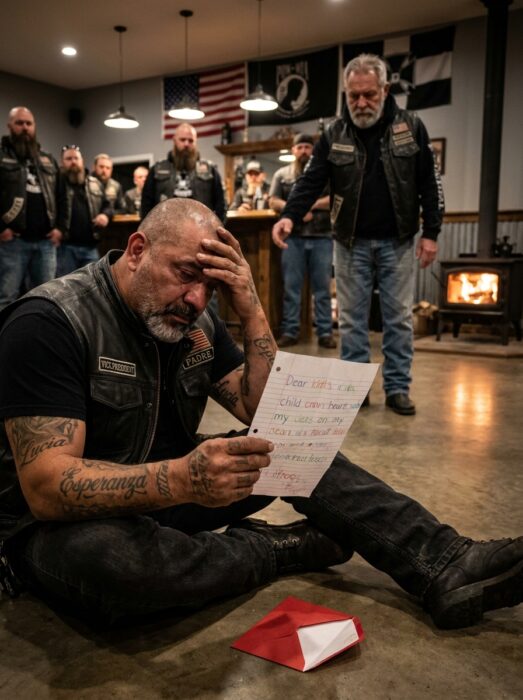
The small embroidered photograph patch on the inside of his cut over his heart — the one Carmen sewed for him in 2014 — is a picture of Esperanza at six years old and Lucia at four years old, in pink dresses, on Easter morning, holding hands on the front porch of their small house in Knoxville.
He has worn that patch every day for eleven years.
That patch is going to matter in a minute.
PART 3
Morgan County Correctional Complex is in Wartburg, Tennessee. It is about forty-five miles northwest of Knoxville. It is the kind of facility that, when you pull into the visitor lot, you understand that you are not in your own country anymore. The fence is twenty-five feet high. The razor wire on top has not been replaced in any way I could detect. The guard towers are still manned.
Padre rode out there alone on the Tuesday before Christmas. He took the Road Glide. He took his cut. He took a folded copy of Sophia’s letter in the inside pocket of his cut. He took a printed photograph of Sophia, which Mrs. Lattimore had given him from the school yearbook, and a printed photograph of his own two daughters, which he had taken off the fridge that morning.
He pulled into the visitor lot at nine forty-five a.m.
He walked up to the visitor processing desk. He told the corrections officer at the window — a woman in her thirties, brown hair, name tag NEELY — that he wanted to arrange a five-minute video call between an inmate and the inmate’s seven-year-old daughter on Christmas morning.
Officer Neely looked at him.
Officer Neely said, very politely: “Sir. You are not on this inmate’s approved visitor list. I cannot arrange that.”
He said: “Ma’am. I’m not asking to be on his visitor list. I am asking for five minutes. The little girl is gonna be holding the phone. I am just gonna be holding it up to her face.”
She said: “Sir. The answer is no. I’m sorry.”
She closed the small sliding window.
Padre walked back to his Road Glide. He sat on it. He did not start it. He took the letter out of his cut. He read it again.
Then he walked back to the visitor processing desk and he asked, very politely, if he could speak to the warden of the facility.
Officer Neely said: “Sir. The warden does not see drop-ins.”
He said: “Ma’am. I’ll wait.”
He sat in the plastic chair in the corner of the visitor processing room.
He waited for six hours.
He did not eat. He did not get up except to use the bathroom once. He sat with his cut folded across his lap and the letter in his hand and his eyes on the floor. Officer Neely came on shift and went off shift. The replacement officer — a man named Reeves, sixty-one, who had been working the desk at Morgan County for nineteen years — Officer Reeves watched Padre sit in that chair for the last three hours of his shift.
At three forty-eight p.m. — eighteen minutes before the warden was scheduled to leave for the day — Officer Reeves walked into the warden’s office without knocking. He did not say anything to Padre on the way in.
He came out four minutes later.
He walked over to Padre. He said:
“Brother. The warden will see you. You got ten minutes. Don’t waste ’em.”
The warden of Morgan County Correctional Complex is a man named Hollis. Fifty-seven years old. White, gray hair cut short, navy suit, gold cross on a chain over his tie. He stood up when Padre walked in. He shook his hand. He gestured to a chair.
Padre did not sit down.
Padre laid Sophia’s letter on the warden’s desk.
He said: “Sir. I’m asking for five minutes of video call on Christmas morning. The little girl is seven. Her name is Sophia. Her daddy is Marcus Hill, inmate at this facility. She didn’t ask Santa for a toy this year, sir. She asked for him.”
The warden read the letter.
He read it twice.
He set it back down on the desk.
He sat down in his chair. He took off his reading glasses. He looked at Padre.
He said: “Mr. Reyes. How did you get here today?”
Padre said: “Sir. I rode.”
The warden said: “From where?”
Padre said: “Knoxville.”
The warden said: “You sat in that lobby for six hours, in December, in a leather vest, to ask me for a five-minute phone call for a child you have never met.”
Padre said: “Yes, sir.”
The warden was quiet for a long time.
He said: “Mr. Reyes. I have a daughter who is eight years old. Her name is Hannah.”
He picked up his desk phone.
He said: “You’ll have your five minutes.”
PART 4
I want to tell you what Christmas morning looked like.
Sophia lived with her mother and her grandmother in a small rental house on the east side of Knoxville off Magnolia Avenue. The house was painted pale yellow. The front yard was a strip of dead grass with a chain-link fence around it. There was a small plastic Santa decoration leaning against the front porch railing that had been there, Sophia’s grandmother told us later, since 2019, because Sophia had picked it out at a Dollar General when she was three and would not let her grandmother throw it away.
We rode in at seven thirty-five a.m. on Christmas morning.
Twenty-five Harleys. In formation. Down Magnolia Avenue. The sun was just up. It was thirty-one degrees. Every brother had two pairs of socks on.
We parked along the curb in front of the yellow house in a long row that stretched four full blocks down Magnolia. We cut our engines one after another. The sound of twenty-five V-twins shutting down at seven thirty-five a.m. on a Christmas morning is something I will not forget for the rest of my life.
We took off our helmets. We tucked them under our arms. We did not say anything.
Padre walked up the front walk alone.
He had a small box in his hands. Wrapped in red paper with a white bow. Inside the box was a small pink stuffed unicorn that Sophia had also mentioned in her letter as her second wish, after the wish about her father.
He knocked on the door.
Sophia’s mother answered. Her name was Renee. She was twenty-eight years old. She was holding her seven-year-old daughter on her hip in pink pajamas with reindeer on them. She had been told the bikers were coming. She had not been told what they had arranged.
Padre said: “Ma’am. Merry Christmas. May I come in for two minutes?”
She let him in.
He sat down on the couch. He set the present down on the coffee table.
He took his phone out of his cut.
He looked at Sophia.
He said: “Sophia. My name is Padre. Santa got your letter.”
Sophia looked at him.
Padre said: “Santa couldn’t bring your dad home today, sweetheart. Santa is sorry about that. He is working on it. But Santa got him on the phone for you. Right now. For five minutes. Is that okay?”
Sophia looked at her mother.
Her mother nodded.
Sophia looked back at Padre.
She said one word: “Yes.”
Padre tapped the phone. The video call connected.
On the screen was Marcus Hill.
He was thirty-one years old. He was wearing a beige correctional uniform. His hair was cropped close to his head. His eyes were red. He was sitting in a small room with cinderblock walls. He had a Christmas tree paper cutout taped to the wall behind him that an officer named Reeves had put up at six that morning.
Sophia saw her father’s face on the screen.
She did not say anything for about three seconds.
Then she said: “Daddy?”
Marcus said: “Baby.”
He said: “I’m so sorry, mija.”
He said: “I love you.”
Sophia started to cry.
Marcus started to cry.
Padre — six foot four, two hundred and ninety pounds, twenty-three years patched — held the phone steady with one shaking hand and he started to cry too.
Outside, on the dead grass of the front yard, twenty-five patched brothers in leather cuts and full beards stood in formation in the cold December sunlight with their helmets tucked under their arms and their heads slightly bowed.
Nobody said anything for five minutes.
Then the call ended.
PART 5
I want to back up and tell you the things you did not know you were hearing.
The small embroidered photograph patch on the inside of Padre’s cut — the picture of Esperanza and Lucia in pink dresses on Easter morning in 2014 — was the patch I told you Carmen sewed for him in 2014.
It was sewn in May of 2014.
In April of 2014, Padre had almost gone back to prison. He had gotten into a thing in a bar in Knoxville with two men he should have walked away from. He had not walked away. He had spent eight hours in a Knox County holding cell. He had been released, after Reverend made some phone calls and a witness changed his statement, with a citation and a fine and an understanding that the next time would be the last time.
He had come home at eleven that night to a house with two sleeping daughters and a wife who had not slept. He had sat on the edge of their bed. He had looked at Carmen.
He had said, in a voice he did not recognize as his own:
“Carmen. I almost left my kids tonight.”
Carmen had said: “Anthony. You can’t.”
He had said: “I won’t. Not again. Mi vida. I swear.”
The next week, Carmen sewed the patch onto the inside of his cut. She put it directly over his heart. She told him, on the porch, the night she gave it to him:
“Anthony. You wear this. Every day. So you remember what you’d be leaving behind.”
He has worn that patch every day for eleven years. He has not been arrested again. He has not raised a hand to anybody in eleven years. He has been on every parent-teacher conference, every recital, every soccer game, every birthday.
The reason Padre sat in the lobby of Morgan County Correctional Complex for six hours in December — the reason he did not get up — is that Padre knew, in a way most of the rest of us did not, what it was to be a man on the wrong side of a chain-link fence on Christmas morning with a little girl on the other side who needed her father.
He had come within two phone calls and one witness statement of being Marcus Hill.
He had walked back from that line.
Marcus had not.
Padre did not see Marcus Hill on the phone screen that morning. Padre saw the man Padre would have been on April 28th, 2014, if Reverend had not picked up the phone, and if a witness had not changed his statement.
He held the phone steady for that man’s daughter.
Because somebody had once held the line for his.
PART 6
Padre rode home alone that afternoon.
He did not come back to the clubhouse for the brothers’ Christmas dinner. We did not call him. We knew where he was going.
He went home to Carmen and Esperanza and Lucia.
Esperanza was sixteen. She was sitting on the couch in pajama pants reading a book about marine biology. Lucia was fourteen. She was in the kitchen helping Carmen with the rice for the dinner. The Christmas tree was lit. The Mexican carols Carmen plays every December were on the speaker. The house smelled like tamales.
Padre came in the back door. He took off his boots. He took off his cut. He hung the cut on the chair by the door — the inside facing out, the way he always hangs it, the way that lets the embroidered patch of his daughters in pink dresses face the kitchen.
He walked into the living room.
He sat down on the couch next to Esperanza. He sat down without saying anything.
He put one arm around her shoulders.
Esperanza put her book down.
Lucia came out of the kitchen.
She sat down on his other side.
He put his other arm around her shoulders.
The three of them sat there on the couch for almost two minutes without saying anything.
Then Padre — six foot four, two hundred and ninety pounds, twenty-three years patched, Vice President of an independent motorcycle charter — Padre lowered his face into the top of Esperanza’s hair and he cried.
Esperanza did not move.
Lucia did not move.
Carmen, in the doorway of the kitchen, with a wooden spoon in her hand, did not move.
After a while Carmen walked over. She knelt down in front of the couch. She put her hands on her husband’s knees.
She said, very quietly: “Anthony. What happened today?”
He lifted his head.
He looked at her.
He said one sentence. The one I am writing this whole story to give you.
He said: “Carmen. Today I figured out — the most valuable thing I have is not the Harley. It’s that I get to be home on Christmas. And that there are two people in this house who call me Dad.”
That was the whole sentence.
Carmen put her head against her husband’s knee.
The tamales kept steaming in the kitchen.
PART 7
Marcus Hill has six years left on his sentence.
The warden at Morgan County — a man named Hollis, with a daughter named Hannah, age eight — Warden Hollis has approved a video call between Marcus Hill and his daughter Sophia for every Christmas morning until he is released.
Padre will deliver the phone every year.
He has told the warden he will deliver it every year for as long as the warden is willing to allow it. He has told Marcus, through the warden, that the only thing Marcus has to do is be ready at seven thirty-five a.m. on December 25th.
Marcus has been ready every year since.
This Christmas was the third one.
Twenty-five Harleys rolled down Magnolia Avenue at seven thirty-five a.m. on December 25th. We cut our engines. We took off our helmets. We stood on the dead grass with our heads slightly bowed.
Padre walked up the front walk alone.
The pink plastic Santa was still on the porch.
He knocked on the door.
She is ten now.
She answered it herself.
Follow the page for more stories about the bikers America thinks it knows — and the Christmas mornings they ride twenty-five miles to make sure happen.