PART 2
His name was Caleb Voss.
Thirty-six years old. Born in Bend, Oregon, in 1988. Eleanor’s only grandson. The son of Eleanor’s only daughter Margaret, who had cut him out of the family in 2014, on a Sunday afternoon at a Thanksgiving dinner, over an argument I am only going to give you the broad strokes of because the specifics are not mine to give.
Caleb had been in trouble in his twenties. Drugs. A short stint in county. A bad few years between twenty-two and twenty-six where he was, in his own words years later, “not somebody anybody should have had to be related to.”
He got clean in 2013.
He joined an independent motorcycle charter in Bend in 2014.
He earned his patch in 2016.
In all the years between then and the afternoon he came through the doors of Cedar Ridge, he had been steadily, quietly, undramatically clean and sober. He worked at a machine shop off Boyd Acres Road. He owned a small house in the Aubrey Butte neighborhood. He rode a 2009 Harley-Davidson Dyna that he had paid off with his own money over four years.
He had tried to make peace with his mother three times. She had not answered any of the three attempts.
He had tried to find his grandmother twice.
Both times, he had been told by his mother — through a cousin — that Eleanor did not want to see him. He had been told that Eleanor blamed him. He had been told that the family had decided he was not welcome.
None of that was true.
Eleanor had not known her grandson was trying to find her. Margaret had been intercepting the letters. Margaret had been deleting the voicemails. Margaret had not told Eleanor that Caleb had gotten clean. Margaret had not told Eleanor where Caleb lived. Margaret had also not told Caleb where Eleanor had moved when she had been placed at Cedar Ridge in 2019, because Margaret had decided — for her own reasons, which I am going to give to you straight without judging them — that her son did not deserve to be in her mother’s life and that her mother did not need the disruption.
For five years, Eleanor sat in room 214 thinking her grandson had abandoned her.
For five years, Caleb thought his grandmother had abandoned him.
Both of them were wrong.
On the morning of the Tuesday I dialed 911, Caleb woke up at six fifteen with a feeling in his chest he could not name. He told me, much later, sitting in a folding chair in the parking lot of Cedar Ridge with a paper cup of coffee, that he had not had that feeling since the morning of his uncle Frank’s heart attack in 2011.
It was not a thought. It was not a hunch. It was a pressure in his sternum that would not let go.
He sat on the edge of his bed for ten minutes.
He drank a glass of water. The feeling did not go away.
He got dressed. He put on his cut. He walked out to the garage. He looked at the Dyna.
He thought about his grandmother for the first time in three months.
He had not done a search for her recently. He had given up. But for some reason — for some reason, he kept saying when he told me this — for some reason he went back to his laptop on the kitchen counter. He typed her full name into a public records site. He typed it into a senior care directory.
The senior care directory came up with a hit.
Eleanor M. Voss. Cedar Ridge Care Center. Bend, OR.
Three miles from his house.
He stared at the screen for a long time.
He told me — and I will tell you the way he told me, which was flat and without embellishment, the way bikers tell things that matter — he told me he sat in his kitchen and said out loud, to nobody, “She’s been here. The whole time. She’s been three miles from me.”
He grabbed his keys.
He rode the three miles to Cedar Ridge faster than he should have. He cut his engine at one forty-five in the parking lot. He sat on the bike for about ninety seconds. He told me he could not, for the life of him, explain why he did not stop at the front desk to ask for her room number.
He just walked in.
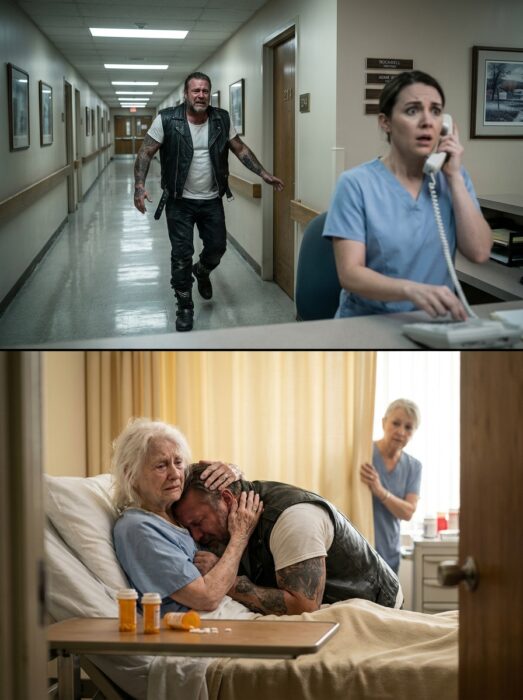
He walked past the front desk. He walked past me. He walked down the south hallway. He went to the third door on the left without thinking about it.
It was room 214.
To this day, neither of us has been able to explain that part.
PART 3
When I pushed open the door of room 214, this is what I saw.
Eleanor Voss was sitting up in her hospital bed with her knees bent under the thin pink blanket. Her hair was unbrushed. Her eyes were closed. Her mouth was slightly open. Her face was the color of paper.
In her right hand, resting on top of the blanket, palm up, was a small plastic medication cup.
The cup was empty.
On the rolling tray table next to her bed were three empty pill bottles. Their lids were off. The lids were sitting in a small neat row at the edge of the tray, the way somebody arranges things when they have decided to do a careful thing carefully.
There were tablets — round white tablets, several different kinds — scattered across the tray. Some of them were on the floor. One was caught in the fold of the pink blanket. I could see it from the doorway.
I knew immediately what those bottles were because I had handed them to her myself two hours earlier on the eleven a.m. medication pass. They were her morning meds. They were the meds she was supposed to take one or two at a time. She had palmed them. Every single one of them. For days, maybe weeks. She had been saving up.
The biker — Caleb, although I did not know his name yet — was leaning over the bed with both his enormous tattooed hands on her shoulders, and he was shaking her gently but firmly, and he was saying her name.
“Grandma. Grandma. Come on. Grandma. Open your eyes.”
She was not opening her eyes.
He was crying. Not silent crying. The kind of crying a man does when he has been holding it for years and a door has just opened up. He had his forehead pressed against her white hair. He was shaking her shoulders the way you shake somebody you cannot lose.
I crossed the room in three steps. I hit the code blue button on the wall above her bed. I yelled for the floor nurse. I yelled for the cart.
Caleb did not let go of his grandmother’s shoulders.
He kept saying her name.
“Grandma. Grandma. It’s me. It’s Caleb. Open your eyes, Grandma. It’s me.”
Eleanor opened her eyes.
She had not swallowed.
She had been about to. She had the pills in her mouth, dry, with the cup of water she had been holding in her left hand for thirty seconds, building up the nerve to swallow them — that was the part she told me later, that was the part she could not bring herself to do — and her grandson Caleb had come through the door and seen her on the bed with her eyes closed and the cup in her hand and he had thought he was already too late.
He had not been too late.
When Eleanor opened her eyes and saw the face above hers — bearded, wet, tattooed, broken — she did the thing an eighty-four-year-old woman who has not been touched by family in five years does when family finally shows up.
She spit the pills out into her own hand.
She closed her hand around them.
She looked at her grandson.
She said: “Caleb?”
He said: “Grandma.”
He sat down on the edge of the bed. He put his head on her chest. The big man with the patches and the boots and the tattoos put his head on his eighty-four-year-old grandmother’s chest and he cried like a child.
She put her one free hand on the back of his head. The other hand, the one with the pills in it, she opened and let the pills fall onto the floor next to the bed.
She said: “You came back.”
He said: “You wouldn’t answer my calls.”
She said: “What calls.”
That was the moment I understood that I had walked into something I did not understand.
PART 4
I want to tell you what Caleb said to her next, because what he said to her next is the part of this story that I have repeated to every new charge nurse I have ever trained.
He lifted his head off her chest. He took both her hands. He looked her in the eye. He said:
“Grandma. You haven’t answered my calls in ten years.”
Eleanor said: “Caleb. I never got any calls. I never got any letters. They told me you didn’t want to see me.”
He said: “They told me the same thing.”
They looked at each other.
Eleanor — who had been an English teacher for thirty-one years at a high school in Redmond, who had raised one daughter alone after her husband died of cancer in 1989, who had been a careful and intelligent woman her entire life — Eleanor closed her eyes.
She said: “Margaret.”
He said: “Yeah, Grandma. Margaret.”
She held his hands in both of hers. Her hands were thin and spotted and shaking just slightly. She held him like he was going to evaporate.
She said: “I’m sorry, mijo. I’m so sorry. I didn’t know.”
He said: “I know, Grandma. I know now. It’s okay. I’m here.”
That was when I realized that the door to room 214 was still open behind me, and that the floor nurse — a woman named Patricia who has worked at Cedar Ridge for nineteen years — was standing in the doorway with the crash cart and was not moving and was not saying anything.
Patricia was not moving because Patricia was reading the room.
Patricia, in the doorway, had taken one look at the bed and at the biker and at the eighty-four-year-old woman holding both of his hands, and Patricia had understood — the way nurses with nineteen years understand things in twelve seconds — that the medical emergency in room 214 was already over and that something else, something we did not have a protocol for, was happening instead.
Patricia held up her hand to the two CNAs behind her.
She said, very quietly: “Hold on. Just hold on a second.”
She set the crash cart against the wall.
She closed the door of room 214 most of the way. She left a six-inch crack.
Then Patricia, who is fifty-eight years old and has seen everything, walked back to the nurses’ station and got on the phone and canceled the 911 call I had placed eleven minutes earlier.
She came back. She put her hand on my shoulder. She said: “Jenna. Come on. Let’s give them a minute.”
We stepped out of the room.
I have not, in five years of nursing since that afternoon, ever called the police on a biker again.
PART 5
I want to tell you what we found out, in the hours and days afterward, about the pills.
Eleanor had been saving them for forty-three days.
She had a small pillowcase with a hidden inside pocket — sewn by her own mother in 1962 — that she had brought with her from Redmond. She had been palming her morning pills. Half of them. Sometimes all of them, on the days she could fake it. She had been keeping them in the inside pocket of that pillowcase, under her actual pillow, in a small plastic baggie she had taken from a nurse’s supply cart in the spring.
The pills on the rolling tray that afternoon were the ones she had decided would be enough.
She had been planning the date for two weeks.
She had picked the Tuesday because Patricia was off on Tuesdays and the substitute nurse, who was me, would not know her well enough to recognize the signs.
She had been wrong about that — I had been planning to bring her a cup of decaf and sit with her at three that afternoon because she had seemed quieter on Monday than usual — but she had not known that, and she had picked her Tuesday, and at one forty-seven in the afternoon she had been thirty seconds away from a thing nobody at Cedar Ridge had even seen coming.
The reason she had picked this particular Tuesday — and the reason I am telling you any of this — was because the day before, on Monday, her daughter Margaret had finally come to visit her for the first time in eight months, and Margaret had told Eleanor that Caleb had relapsed.
Caleb had not relapsed.
Caleb had been clean for eleven years by then.
But Margaret had told Eleanor that Caleb had relapsed, and Margaret had told Eleanor that Caleb was likely never going to be a part of any of their lives, and Margaret — who Eleanor by then understood, in some quiet old-woman way, was not always telling her the truth about Caleb — Margaret had been the last piece of the only family Eleanor had left.
That night, Eleanor had decided she was done.
She had told the social worker on duty Monday evening that she felt a little tired but otherwise fine. She had eaten her dinner. She had washed her face. She had counted the pills she had saved. She had gone to bed at nine.
She had woken up Tuesday morning. She had eaten breakfast. She had let me give her her real medication at the eleven a.m. pass. She had thanked me. She had said, “Jenna, honey, you take care of yourself today, all right?” I remember it because she put her hand on my wrist when she said it.
I did not catch it.
She had set the pills out at one forty-five in the afternoon.
Her grandson — three miles away, in a kitchen in Aubrey Butte, with a feeling in his chest he could not name — got on his Harley at one forty-three.
She put the pills in her mouth at one forty-seven.
He came through her door at one forty-eight.
PART 6
Eleanor lived eight more years.
She died on a Thursday in October of 2025 at the age of ninety-two, in her sleep, in the same bed in room 214, with a small framed photograph on her nightstand of her grandson Caleb and his wife Hannah and their two-year-old daughter Margaret-Rose.
Margaret-Rose was named for Eleanor’s daughter, who Eleanor had never stopped loving, even after she understood what her daughter had done.
Caleb had visited her every Tuesday and every Saturday for those eight years. Two hundred and eight Tuesdays. Two hundred and eight Saturdays. The staff at Cedar Ridge — including me — got used to the sound of his Dyna in the parking lot. He would cut the engine at one forty-five every Tuesday afternoon. He would walk through the front doors. He would sign in at the desk now. He would say hello to whoever was on shift. He would walk down the south hallway. He would knock on the door of room 214 with two knuckles.
Eleanor would say, every single time, “Come in, mijo.”
He would come in.
He would sit in the brown vinyl chair next to her bed for two hours. They would talk. They would not talk. They would watch the small TV in the corner. They would look at photographs on his phone. He would read her the paper. He brought her flowers on her birthday and on Mother’s Day and on the anniversary of his grandfather’s death. He brought Margaret-Rose to meet her in 2023. Eleanor held that baby for forty-five minutes the first time. She did not let go.
The relationship between Caleb and his mother Margaret did not get repaired. I do not want to lie to you about that. Margaret never came back to Cedar Ridge after the Monday she told Eleanor that her grandson had relapsed. Eleanor wrote her one letter, which Caleb mailed for her, and Margaret never responded. Eleanor stopped asking about her after about a year. She did not stop loving her. She just stopped expecting.
But Eleanor got eight years she was not supposed to have.
She got them because her grandson woke up on a Tuesday morning in June with a feeling in his chest he could not name and got on a Harley and rode three miles to the nursing home he did not know his grandmother was in, and walked through a door he did not know which room number to walk through, and shook a woman awake who had a cup of water in one hand and her morning meds in her mouth.
He used to tell me, on the Tuesdays I worked the desk and he came in: “Jenna. I don’t know what made me come that day.”
I would say: “Caleb. I don’t either.”
He would say: “That’s okay, sister. We don’t have to know.”
PART 7
We buried Eleanor on a Saturday in late October.
The service was small. Twelve people. Eleanor had asked, in the will she had written six years earlier with Caleb’s help, that there be no big crowd. She had asked for the readings to be short and for the music to be quiet.
In the parking lot of the cemetery, after the service was over, I counted twenty-three Harley-Davidson motorcycles in formation along the gravel road.
Caleb’s charter had ridden in.
They had not come into the church. They had stood with their bikes outside. They were waiting.
When the casket came out, they cut their engines. Twenty-three V-twins going silent in a row.
Caleb walked his grandmother to her grave behind a single piper.
He did not cry at the grave.
He had done his crying eight years and four months earlier, in a bed in room 214, with his head on her chest.
The bikes rolled out at sundown.
The V-twins faded down Highway 20.
She got eight more years.
Follow the page for more stories about the bikers America thinks it knows — and the people they ride three miles to save without knowing why.