I never planned to floor a man in the middle of a grocery store.
The fluorescent lights buzzed over aisles of cereal and canned soup. I was just there to grab motor oil. But the second I turned down aisle seven, I saw her—Emma. My six-year-old niece, pigtails crooked like her mom always tied them, little pink backpack straps clutched in both hands.
And holding her hand was him.
The man my sister had a protective order against. The man who wasn’t supposed to be within a hundred yards of her, let alone touching her.
My chest went cold.
He was leaning down, saying something into her ear, and Emma’s face was blank—too blank. That look she gets when she’s scared and trying to disappear inside herself. I know that look. I’d seen it the last time he was in their lives.
I didn’t think. I just moved.
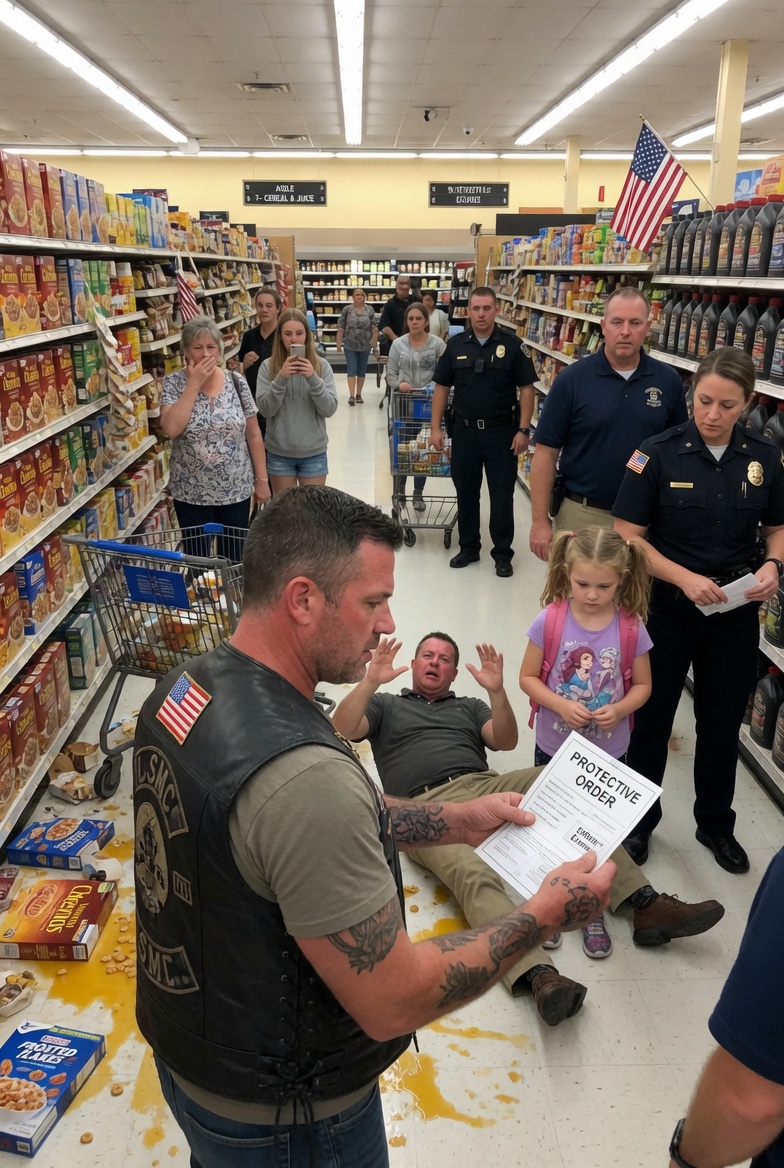
My boots ate up the linoleum. I grabbed his shoulder, spun him, and shoved him with everything I had. He crashed into the shopping cart, which tipped sideways, scattering cereal boxes like hail. A bottle of juice burst open, sticky orange spreading across the white tile. Emma screamed—not hurt, just shock, that high thin sound that cuts through everything.
“What the hell is wrong with you?!” the man on the floor shouted, scrambling up. His polo shirt twisted, face flushed.
Every shopper in the aisle froze. A woman gasped. A teenager pulled out a phone.
“He just attacked that man!”
“Call security!”
“Look at him—he’s dangerous!”
I felt their eyes on my sleeveless vest, the ink crawling up my arms, my close-cropped hair, the years of hard living written on my knuckles. I knew exactly what they saw. A violent biker. A threat.
The man—the father, they thought—staggered to his feet, fury blazing. “You touch me again and I’ll press charges! This is my daughter!”
Emma flinched when he said the word daughter.
I saw it. He didn’t. He was too busy playing the victim.
“Get away from that kid!” somebody yelled.
He reached for her wrist again. I stepped between them. No punch, no shout—just a wall of muscle and a heart hammering so loud I could barely hear the sirens starting to wail outside.
The store manager appeared. Security guards, radios crackling. The father pointed a trembling finger at me, voice cracking with righteous anger. “He assaulted me! In front of my child!”
Emma’s knuckles were white on her backpack strap. She wouldn’t look at him. She wouldn’t look at me. Just stared at the floor, tiny and stiff.
The first officer rounded the corner, hand near his belt. “What’s going on here?”
The father spoke before I could. “This man attacked me. I was shopping with my little girl.”
The officer’s gaze swept over me—tattoos, leather, jaw tight—and I could see him making the same calculation everyone else had. Threat. Danger. Arrest.
“Sir?” he said to me, tone careful.
I reached slowly into my vest. Every muscle in the aisle tensed. A woman near the canned vegetables sucked in a breath.
I pulled out a folded piece of paper.
Didn’t hand it over. Not yet.
“Ask him,” I said, my voice steady in a way that surprised even me.
The father’s expression flickered—just a heartbeat—before hardening again. “Ask me what? This is insane!”
The officer crouched slightly, looking at Emma. “Sweetheart, are you okay?”
She nodded. Too fast. The kind of nod you give when you’ve learned not to make waves.
He straightened, eyes narrowing at me. “You related to the child?”
I hesitated. “Yes.”
“How?”
A beat of silence that felt like a gunshot. “I’m her uncle.”
The air shifted. The father surged forward, voice desperate. “He’s lying!”
I unfolded the paper. The protective order, signed and stamped, still active. The one my sister had clutched like a lifeline when the courts finally listened.
The officer took it, brow furrowing as he scanned the page. The shouting around us dimmed, replaced by a heavy, uncertain hush. I could hear the hum of the refrigerators. The squeak of a distant cart wheel.
The father laughed too loudly. “That’s old! Temporary! It was dismissed—”
The officer flipped to the second page. The expiration date stared up at him, months away from being over. His expression changed. Just slightly. But I saw it.
“Sir,” he said, voice quieter now, “can you explain this?”
The man’s face drained of color.
And Emma, my niece, the reason I’d thrown myself into a situation that could have ended with handcuffs on me, finally spoke. Her voice barely a whisper.
“Mom said not to go.”
Every head turned. The officer crouched again. “Go where?”
She stared at the floor. “With him.”
The father’s composure cracked, something ugly slipping through. “Don’t you put words in her mouth!”
I didn’t move. My hands stayed at my sides, but my pulse roared in my ears. One wrong breath and the crowd would remember they’d already branded me the villain. They didn’t know about the late-night calls, the threats, the bruises my sister hid under long sleeves. They didn’t know that the man calling himself a victim had been hunting this moment for weeks, waiting for a chance to snatch her back.
All they saw was a biker who’d shoved a father in front of his kid.
But now the officer was looking at me differently. At the paper. At Emma, still frozen, still clutching that backpack like a shield.
And I knew, in that moment, the whole store was about to flip inside out.
The officer’s eyes didn’t leave mine. Not yet. He was still holding the protective order, thumb pressed against the judge’s signature like he was trying to rub it off and find a forgery underneath. The paper trembled slightly—not from his hand, but from the air conditioning vent rattling overhead, a mechanical wheeze that filled the silence while everyone waited for the world to make sense again.
Emma still hadn’t moved. She stood there, a tiny statue in a pink jacket, her backpack straps twisted in her fists. Her father—the man with the polo shirt and the carefully rehearsed outrage—was breathing hard through his nose, the way men do when they’re trying to control something that’s slipping.
The second officer, a younger guy with a buzz cut and a name tag that read OFFICER MARTINEZ, stepped closer to the father. Not touching him, but close enough that the threat of containment hung in the air like smoke.
“Sir, I need you to take a step back,” Martinez said. His voice was calm, professional, the kind of calm that meant he’d seen a dozen domestic situations go sideways and wasn’t about to let this be number thirteen.
The father—his name was Derek, I knew it all too well, but I hadn’t said it yet—laughed again. It was the laugh of a man who’d spent years convincing people he was the reasonable one. “This is a misunderstanding. My ex-wife is… she’s unstable. She’s been poisoning my daughter against me for months.”
I felt my teeth grind together, a physical clench that started in my jaw and radiated down my neck. I’d promised my sister, Janine, that I wouldn’t let him get under my skin. That I’d be the calm one. But calm didn’t mean silent.
“Her name is Emma,” I said, my voice low but cutting through the fluorescent hum. “And she’s standing right there. Maybe don’t talk about her like she’s a piece of furniture.”
Derek’s head snapped toward me, and for a split second, the mask slipped. I saw it—the flash of pure, undiluted fury that he usually kept locked behind a smile and a firm handshake. I’d seen it once before, two Thanksgivings ago, when Janine had accidentally knocked over a glass of wine. He’d smiled at the table, laughed it off, but later, in the kitchen, I’d walked in on him gripping her arm so hard his knuckles were white, his mouth pressed against her ear, whispering things I couldn’t hear but understood completely.
She’d told me it was fine. She’d told me she’d tripped.
I didn’t believe her then. I sure as hell didn’t believe him now.
The older officer, the one with the protective order, looked up from the paper. His name tag read SULLIVAN. He had the tired eyes of a man who’d spent twenty years sorting out messes other people made, and he was doing the math in his head, recalibrating everything he’d assumed the moment he walked in.
“This order is active,” Sullivan said slowly, his gaze shifting between me and Derek. “It states that Mr. Derek Harmon is prohibited from unsupervised contact with the minor child, Emma Harmon. And that he is to remain at least one hundred yards from the child’s primary residence and her mother, Janine—”
“That’s my sister,” I cut in, because I wanted it on the record, wanted every phone camera still rolling to catch it. “Janine Harmon. She’s on her way.”
Derek’s face went through a series of expressions, none of them flattering. “You called her? Of course you called her. You’ve always been the one stirring things up, haven’t you, Ray? The big bad biker brother, riding in to save the day.”
I didn’t take the bait. Instead, I looked at Emma. Her eyes were wet but she wasn’t crying, not really. She was holding it in, the way kids do when they’ve learned that crying makes things worse. I’d seen that look on her face too many times, and every single time it made me want to punch a hole through drywall.
“Emma,” I said gently, and the change in my voice must have startled some of the onlookers because I heard a woman behind me murmur something to her husband. “Your mom is coming. She’s going to be here really soon. Okay?”
Emma nodded. That same too-fast nod. But this time she looked at me, and I saw something flicker behind the fear. Relief, maybe. Or hope. I didn’t deserve either, but I’d take them.
Martinez radioed dispatch, confirming the protective order’s status. The crackling voice that came back confirmed what Sullivan already held in his hands: valid, enforceable, no expiration for another four months. Derek’s face went from flushed to pale, like someone had pulled a drain plug somewhere inside him.
“This is nonsense,” he said, but the conviction was bleeding out of his voice. “I have rights. I’m her father.”
“Yes, sir,” Sullivan said, folding the paper carefully and handing it back to me. “But right now, those rights are restricted. You know that. You were served this order six weeks ago.”
Six weeks. That was when Janine had finally found the courage to file. After the incident with the lamp. After she’d locked herself and Emma in the bathroom and called me at two in the morning, her voice so small I’d barely recognized it. I’d driven three hours through the rain, walked into that house, and told Derek that if he ever touched either of them again, I’d make sure the next protective order was for his hospital room.
He’d laughed at me then, too. Told me I was just a washed-up mechanic with a motorcycle and a savior complex. And maybe he was right about the motorcycle. But I wasn’t wrong about him.
“I was just taking her for ice cream,” Derek tried, his voice shifting into something softer, more wounded. “She’s my little girl. I missed her. Is that a crime?”
“When there’s a court order saying you can’t, yeah,” I said, and Sullivan shot me a look that told me to shut up. I shut up.
“Sir, we’re going to need to continue this conversation outside,” Sullivan said to Derek. “Officer Martinez, can you escort Mr. Harmon to the front of the store? We’ll get this sorted out.”
It wasn’t an arrest. Not yet. But it was a separation, and that was enough for now. Derek opened his mouth, probably to protest, but Martinez put a hand on his elbow—not rough, not aggressive, just firm—and began guiding him toward the end of the aisle. Derek stumbled slightly on a box of Cheerios that had scattered across the floor, and the absurdity of it—this man who’d terrorized my sister for years, now tripping over breakfast cereal—almost made me laugh.
I didn’t laugh. I watched him go, every muscle in my body still coiled tight, waiting for him to spin around and lunge. He didn’t. He just walked, shoulders hunched, the performance of the wronged father slipping away with every step.
And then the automatic doors at the front of the store slid open, and Janine ran through them.
She was still wearing her work scrubs, pale blue with little cartoon animals on them. Her hair was escaping from a ponytail, and her face was blotchy from crying. She scanned the store wildly, and when she saw Emma, she made a sound I’d never heard before—a sob and a laugh and a prayer all tangled into one breathless note.
“Emma!”
Emma broke.
She didn’t run dramatically into her mother’s arms the way they do in movies. She just… collapsed forward, like a puppet whose strings had been cut, and Janine caught her, sinking to her knees on the sticky linoleum, wrapping her arms around her daughter so tight I thought she might never let go.
I looked away. Not because I didn’t care, but because it felt too private, too raw. This wasn’t for me. This wasn’t for the crowd still lingering at the end of the aisle, phones half-lowered, unsure if the show was over.
Sullivan cleared his throat. “Ma’am, are you Janine Harmon?”
Janine looked up, still clutching Emma. “Yes. Yes, I’m her mother. I have— I have the order. It’s—”
“We’ve seen it,” Sullivan said, and his voice softened in a way that surprised me. “Your brother showed us. We’re… we’re handling it.”
Janine looked at me then, and I saw a thousand things in her eyes. Gratitude. Fear. Exhaustion. A tiny spark of anger, maybe, that I’d put myself in this position, that I’d been the one to confront Derek instead of calling and waiting. But mostly, I saw relief.
“Ray,” she breathed.
“I’ve got you,” I said. It was the same thing I’d said to her when we were kids, when our old man came home drunk and mean. “I’ve got you, Janey.”
She closed her eyes and pressed her face into Emma’s hair.
The store manager, a nervous man in a red vest with a name tag that read GREG, was hovering nearby, wringing his hands. “Is— is everything okay? Do we need to close the store? I can make an announcement—”
“No,” Sullivan said. “We’ll clear out of here shortly. Just give us a few minutes.”
The crowd was beginning to disperse now, shuffled away by a mix of awkwardness and the realization that they’d nearly filmed an innocent man getting arrested for trying to protect a child. I saw the teenager who’d said I looked dangerous. He wouldn’t meet my eyes. The woman who’d gasped and called for security was fumbling with her purse, suddenly very interested in her shopping list. A man who’d been shouting about biker gangs now stood with his mouth slightly open, looking like he’d just swallowed a lemon.
I didn’t feel vindicated. I just felt tired.
Martinez came back from the front of the store, his expression unreadable. “Mr. Harmon is sitting on the bench outside. He’s not under arrest, but he’s not free to leave. We’re waiting on a supervisor to advise.”
Janine flinched at the word “Harmon.” She still used his name, legally. It was one of the things she said she was going to change, along with everything else. A new name, a new start. I hoped she’d do it. She deserved a name that didn’t feel like a bruise.
“Can I take Emma home?” Janine asked, her voice steadier now. She stood up, lifting Emma onto her hip even though Emma was getting too big to carry. The kid wrapped her legs around her mother’s waist and buried her face in her neck.
“We’ll need a statement from you,” Sullivan said. “But that can wait. You can take her home. We’ll follow up.”
Janine nodded. Then she looked at me. “Ray, can you… can you come with us? Just for a little while? I don’t— I don’t want to be alone.”
The question hit me in a soft place I usually kept locked behind three layers of leather and a permanent scowl. My sister, who’d spent years pretending everything was fine, who’d flinched at her own shadow, was asking for help. Out loud. In front of witnesses.
“Yeah,” I said. “I’ll follow you on my bike.”
Janine gave me a watery smile. Then she turned to Sullivan. “Officer, the man you’re talking to outside— his name is Derek Harmon. He’s my ex-husband. He’s been physically and emotionally abusive for most of our marriage. The protective order was granted because he threatened to take Emma and disappear. He said he’d drive to another state and I’d never see her again. That’s not paranoia. That’s what he does. He makes threats and then he pretends he’s the victim.”
Sullivan’s jaw tightened. “We’re taking this very seriously, ma’am.”
“I hope so,” Janine said quietly. “Because the last time I called the police, they told me it was a civil matter. They told me to work it out.”
The silence that followed was the heavy kind, the kind that carries all the failures of a system that too often waits for someone to get hurt before it acts. Sullivan didn’t apologize. Maybe he couldn’t. Maybe he was one of the good ones who’d seen too many bad outcomes to make promises. He just nodded, a short, professional dip of his chin, and wrote something down in his notebook.
Janine carried Emma toward the front of the store. I walked a few steps behind them, my boots crunching on the scattered cereal. The store manager, Greg, was already directing an employee to clean up the mess. A teenager in a green apron appeared with a broom and dustpan, eyeing me nervously. I gave him a nod that I hoped looked reassuring. He flinched. Maybe I wasn’t as reassuring as I thought.
Outside, the afternoon sun was blinding after the artificial glare of the grocery store. Derek was sitting on a wooden bench near the sliding doors, his head in his hands, the picture of a broken man. But I’d seen that picture before, and I knew it for what it was: a pose. A carefully curated performance designed to generate sympathy. The moment he sensed Janine and Emma passing, he lifted his head, his eyes red-rimmed.
“Janine,” he said, his voice cracking. “Please. We can talk about this. I just wanted to see her. I’m her father. You can’t keep her from me forever.”
Janine didn’t stop walking. She didn’t look at him. She just held Emma tighter and kept moving, her sneakers squeaking slightly on the hot pavement. I saw Emma’s fingers curl into the fabric of her mother’s scrubs, and I saw Janine’s shoulders shake once, then steady.
Derek started to rise. Martinez put a hand on his shoulder, not hard, but enough to remind him that he wasn’t going anywhere. “Sir, stay seated.”
“This is my family!” Derek’s voice pitched higher, desperate. “She’s brainwashed them! All of them! That’s my daughter!”
I stopped. I turned around. Sullivan was standing near the bench, his arms crossed, watching me with a caution that said he wasn’t sure what I was about to do. I wasn’t sure either, honestly. But I walked back toward Derek, slowly, my hands visible, my posture as non-threatening as I could make it.
“You want to know why I shoved you?” I said, my voice low enough that only he and the officers could hear. “It wasn’t because I hate you. I do, but that’s not why. It’s because when I walked down that aisle, you were holding her hand too tight. Her fingers were turning white. And she was looking at the floor, and she had that look— the one she gets when she’s scared. I’ve seen that look every time you show up. Every single time. So yeah, I shoved you. And I’d do it again.”
Derek’s face contorted. “You’re a liar.”
“Maybe,” I said. “But the protective order isn’t. And the cameras aren’t.” I pointed up at the security camera mounted above the entrance, a small black dome that had recorded everything. “I’m guessing the store footage will show exactly how she looked when you were holding her hand. So go ahead. Keep playing the victim. It won’t change what’s on that tape.”
I turned and walked away. Behind me, Derek started to say something else, but Martinez cut him off. I didn’t look back.
Janine was loading Emma into the back seat of her car, an older Honda with a dent in the rear bumper and a sticker on the window that read “PROTECT TRANS KIDS”—a leftover from her college days, before Derek had slowly stripped away every piece of her identity like peeling paint. She’d told me once that the sticker was one of the only things she’d refused to take down, even when he’d screamed at her about it. It was a small rebellion, but it mattered.
I walked to my bike, a black Harley Softail I’d rebuilt from scraps over three long winters. It was the one thing in my life that had never let me down, the one thing that responded to care and attention with reliability. People saw a machine and thought “dangerous.” I saw it and thought “faithful.”
Janine rolled down her window. “Ray?”
“Yeah?”
She hesitated. Her eyes were still wet, but her voice was steady now. “Thank you. For— for being there. For not waiting.”
I nodded. “Always, Janey.”
She pulled out of the parking lot, and I followed on my bike, the engine a low rumble beneath me. The roads were dry, the traffic light. I kept one eye on her car and one eye on the world around us, a habit I’d learned in Afghanistan, and never quite unlearned after coming home. Hypervigilance, the VA counselors called it. I called it staying alive.
We drove past strip malls and fast-food joints, past a park where kids were playing soccer, their shouts thin and distant under the roar of my engine. Normal life, happening all around us. It felt surreal, like we were characters in a movie that had accidentally crossed genres. A family drama inserted into a suburban landscape that didn’t know what to do with it.
Janine’s apartment was on the second floor of a faded complex with a cracked parking lot and a pool that had been drained for repairs since before Emma was born. She’d moved there after leaving Derek, scraping together a deposit from her job as a veterinary technician. It wasn’t much, but it was hers. No one yelled at her there. No one grabbed her arm in the kitchen. No one told her she was worthless and then apologized with flowers and a smile.
I parked my bike next to her car and killed the engine. The sudden silence felt heavy, like a blanket thrown over the world. Emma climbed out of the back seat, still clutching her backpack, still too quiet. Janine unlocked the front door and ushered us inside.
The apartment smelled like vanilla candles and slightly burnt coffee. The furniture was secondhand but clean, arranged with the careful attention of someone who’d never been allowed to decorate her own space before. There were photos on the wall: Emma as a baby, Janine and me as kids, our mother before she’d gotten sick. No pictures of Derek. Janine had cut him out of every frame, leaving jagged holes in some of the older collages. It was a visual history of survival.
Emma dropped her backpack by the door and climbed onto the couch, pulling a worn blanket over her lap. She still hadn’t said much beyond those few words in the store. I knew that silence. I’d lived it, after our father’s rages, after his fists and his words and his unpredictable swings between affection and fury. You learned to be quiet. You learned to wait for the storm to pass.
Janine sat down next to her, pulling her close. “You’re safe now, baby. You’re safe.”
“I know,” Emma whispered. But she didn’t sound convinced.
I stayed by the door for a moment, feeling like an intruder. This was their space, their healing. I was just the guy who’d shoved a man in a grocery store. But Janine looked up and gestured to the armchair across from the couch. “Sit down, Ray. Please. You look like you’re about to bolt.”
I sat. The chair creaked under my weight. “I’m not bolting.”
“You always look like you’re about to bolt,” she said, and there was a ghost of a smile on her lips. “You’ve looked that way since you were fifteen.”
She wasn’t wrong. I’d spent my teenage years running from our father, and my adult years running from the things I’d seen and done overseas. Sitting still felt unnatural, like holding my breath. But for Janine and Emma, I’d hold it as long as I needed to.
“Tell me what happened,” Janine said. “From the beginning. I got your text— ‘Derek has Emma at Kroger. Come now.’—and I just… I dropped everything. I ran out of the clinic so fast I left my keys in the ignition. Dr. Patterson is probably wondering if I’m dead.”
I leaned forward, elbows on my knees. “I was in town to pick up oil and a few things. Stopped at the Kroger on Maple. Wasn’t even planning to be there—just swung in on a whim. I saw his car in the parking lot. Didn’t think much of it at first, but then I walked in and… there they were. Aisle seven. He had her by the hand, leaning down, talking real close. She looked scared, Janey. Not just nervous. Scared.”
Janine’s face tightened. “What was he saying?”
“I don’t know. I couldn’t hear. I just saw her face, and I saw his grip, and I— I didn’t think. I just went. I pulled him off her. I shoved him. The cart tipped. Cereal everywhere. It was a mess.”
Emma spoke up, her voice small but clearer now. “He said we were going on a trip. He said Mommy didn’t need to know. He said it would be a surprise.”
The words hung in the air like poison. Janine’s breath caught, and I saw her hands clench into fists. “A trip,” she repeated, her voice flat. “He was going to take her. He was actually going to take her.”
The protective order was clear: no unsupervised contact, no removal from the mother’s custody. Derek had known the rules, and he’d decided to break them anyway. He’d planned it—driven to the store, waited until Emma was with Janine’s babysitter (who had apparently let her guard down for a split second at the entrance, something we’d deal with later), and tried to walk out with her like it was nothing.
“I’m so sorry,” Emma whispered, and she started to cry. Not the loud, messy crying of a tantrum, but the quiet, hiccupping sobs of a child who thought she’d done something wrong. “I shouldn’t have let go of Miss Rachel’s hand. She said to wait by the cart and I— I saw Daddy and he said he had a present for me—”
“No, no, no,” Janine pulled her into her lap, rocking her. “This is not your fault. Emma, look at me. This is not your fault. You didn’t do anything wrong.”
I watched them, and something hot and painful twisted in my chest. I’d seen kids in war zones, kids who’d been through things no child should ever see, and they had that same look—the look of a soul trying to shrink itself small enough to be invisible. Emma was only six, and she’d already learned that the world was a place where love could turn into danger without warning.
“Emma,” I said, and she looked at me over her mother’s shoulder, her cheeks wet. “You were really brave today. You told the police what your dad said. That was the right thing to do. That was so brave.”
“But I didn’t tell them before,” she mumbled. “In the store. I just… froze.”
“You were scared. Being scared doesn’t mean you’re not brave. Brave is doing the right thing even when you’re scared. And you did.”
She sniffled, considering this. “Uncle Ray, are you brave?”
The question caught me off guard. I thought about the medals in a box under my bed, the ones I never looked at, the ones that meant I’d done things I couldn’t take back. “I don’t know,” I said honestly. “I try to be.”
Emma nodded slowly, as if that answer made sense to her. Then she burrowed back into Janine’s shoulder, her tears subsiding into exhausted hiccups.
Janine looked at me, her eyes red but grateful. “You could’ve called the police and waited outside. You could’ve done the safe thing. Why didn’t you?”
I thought about it. The truth was complicated. The truth was that waiting had never been my strong suit. The truth was that every second I’d stood there watching Derek whisper to Emma, I’d seen flashes of all the times I’d walked away, all the times I’d told myself it wasn’t my business, all the times I’d let Janine convince me it was fine. The truth was that I’d been waiting my whole life to stop being a bystander.
“Because he was touching her,” I said finally. “And I couldn’t let that stand. Not again.”
Janine understood. She didn’t push further. She just reached out and squeezed my hand, her fingers cold against my callused palm.
We sat in silence for a while, the afternoon light slanting through the blinds, striping the carpet with gold. Emma fell asleep against her mother, exhausted by the adrenaline crash. Janine stroked her hair, humming something soft and tuneless. I watched the shadows stretch, and I thought about Derek, sitting on that bench outside the grocery store, his carefully constructed world crumbling around him.
He wasn’t done. I knew that. Men like Derek didn’t just give up because they got caught once. They adapted. They changed tactics. They found new ways to twist the knife. The protective order was a piece of paper, and paper didn’t stop someone who was determined. It just gave the police a reason to act after something bad happened. And I didn’t want to wait for something bad.
“I’m staying tonight,” I said. It wasn’t a question.
Janine looked up, startled. “Ray, you don’t have to—”
“I’m staying. I’ll sleep on the couch. Tomorrow we’ll talk to a lawyer, see about making that order permanent. And we’ll talk to the babysitter. And we’ll get security cameras for the door. But tonight, I’m staying.”
She opened her mouth to argue, then closed it. “Okay,” she said quietly. “Thank you.”
I nodded and leaned back in the chair, closing my eyes. I could still hear the cereal boxes scattering, the scream, the sirens. But underneath all that noise, I could hear something else: the sound of a little girl saying “Uncle Ray” like it was the most natural thing in the world. Like I was someone who mattered. Like I was someone who could be trusted.
I wasn’t sure I deserved that trust. But I was going to try to earn it.
The hours passed slowly. Janine ordered pizza, and we ate in the living room with paper plates on our laps, the TV playing a nature documentary at low volume. Emma woke up groggy and ate two slices of pepperoni, her appetite returning in fits and starts. She didn’t talk much, but she sat close to me on the couch, her small shoulder pressed against my arm. I didn’t move away.
Around eight o’clock, Janine’s phone rang. She looked at the screen and her face went pale. “It’s him.”
“Let me,” I said, holding out my hand. She hesitated, then passed me the phone. I answered, putting it on speaker.
“Janine?” Derek’s voice crackled through. He sounded calmer now, more controlled. That was almost more dangerous than his anger. “Janine, please. I know you’re there. The police let me go. They said it was a misunderstanding.”
“It’s not Janine,” I said. “It’s Ray.”
A pause. Then a low, humorless laugh. “Of course. The guard dog. You know, Ray, you can’t protect them forever. You have to sleep sometime.”
The threat was subtle, but it was there, wrapped in the veneer of casual conversation. I felt my grip tighten on the phone. “Is that a threat, Derek? Because I’m recording this call. And threatening a protected party is a violation of the order. You want to add that to your record?”
Another pause, longer this time. I could practically hear the gears turning in his head, calculating his next move. “I’m not threatening anyone. I’m just saying. Family is family. You can’t keep a father from his daughter.”
“The court can. And they did. Stay away from them, Derek. I mean it.”
I hung up before he could respond. Janine was staring at me, her hands trembling slightly. “He’s not going to stop, is he?”
“No,” I said honestly. “He’s not. But that doesn’t mean we stop either.”
We talked late into the night, after Emma went back to sleep. Janine told me things she’d never said before—about the first time he’d hit her, on their honeymoon, when she’d laughed too loudly at another man’s joke. About the way he’d isolated her from her friends, convinced her she was clumsy and forgetful and lucky to have him. About the night she’d finally left, packing a single suitcase while he was at work, driving until her gas light came on, calling me from a rest stop with a voice full of terror and hope.
I told her things I’d never said either. About the missions I still dreamed about, the faces I saw when I closed my eyes, the guilt I carried for the people I couldn’t save. We’d both been shaped by violence, in different ways, and we’d both spent years pretending we were fine.
Around midnight, I stepped outside for some air. The parking lot was quiet, the stars faint overhead through the light pollution. My bike glinted under a streetlamp, solid and reliable. I leaned against it, feeling the cool metal through my jeans, and I let out a breath I felt like I’d been holding since the grocery store aisle.
A neighbor’s cat slunk past, eyeing me warily. I didn’t blame it. I probably looked like trouble. But trouble, I was learning, was sometimes exactly what the situation required.
The next morning, I woke up on Janine’s couch with a stiff neck and the smell of pancakes. Emma was in the kitchen, standing on a step stool, carefully flipping a pancake with a spatula while Janine supervised. She was wearing a flour-dusted apron that was far too big for her, and she was giggling at something her mother said.
It was the most normal, beautiful thing I’d seen in a long time.
“Uncle Ray! I made you a pancake!” Emma held up a slightly lopsided disk of batter with pride.
“That’s the best-looking pancake I’ve ever seen,” I said, and I meant it.
We ate breakfast together, and for a little while, the fear receded. It was still there, lurking in the shadows, but it didn’t own the room. We talked about normal things: school, work, the stray cat Janine had been feeding on her porch. Emma wanted to name it Princess Sparkles. I voted for Tank. Janine vetoed both.
After breakfast, I helped Janine install a security camera above her front door. It was a simple setup, a little white device that synced to her phone. While I drilled holes into the stucco, she read the instructions aloud, her voice steady and sure. Emma sat on the steps, drawing with chalk on the concrete, a rainbow of pastels spreading around her.
“Do you think he’ll come here?” Janine asked quietly, so Emma wouldn’t hear.
“I don’t know,” I said, tightening a screw. “But if he does, we’ll see him coming. And we’ll call the police immediately. No confrontation. No heroics. Just call.”
She nodded, but I could see the doubt in her eyes. The police had failed her before. It was hard to trust them again.
“I’ll also talk to a buddy of mine,” I added. “Guy named Marcus. He runs a security firm. He can do a full assessment of the apartment, recommend upgrades. Make this place a fortress if we need to.”
“I can’t afford—”
“Don’t worry about that. Marcus owes me a favor.” A big favor, actually. The kind you earned in a dusty village halfway around the world, pulling someone out of a burning vehicle. But I didn’t need to explain that now.
Janine bit her lip, then nodded. “Okay. Thank you, Ray. For everything.”
I finished installing the camera and tested the feed. Clear picture, wide angle. Anyone approaching the door would be recorded. It wasn’t a force field, but it was something.
Around noon, there was a knock at the door. Janine flinched, instinctively stepping in front of Emma. I moved to the door and checked the peephole. Standing on the doorstep was Officer Sullivan, still in uniform, holding a file folder.
I opened the door. “Officer.”
“Mr. Harmon— sorry, Mr. Coleman,” he corrected himself, glancing at a note in his folder. “I’m here to follow up on yesterday’s incident. Do you and your sister have a few minutes?”
I stepped aside to let him in. Janine straightened her shoulders, shifting into the composed, articulate woman I knew she could be when she wasn’t scared. “Of course, Officer. Would you like some coffee?”
“No, thank you, ma’am. I won’t take much of your time.” Sullivan sat on the edge of the armchair, his posture still official but his expression warmer than it had been in the store. “I wanted to let you know that Mr. Harmon was charged with violating the protective order. It’s a misdemeanor, but given the circumstances— and the fact that he attempted to remove the child from your custody— the prosecutor is considering additional charges. Custodial interference, possibly.”
Janine exhaled, a shaky, relieved breath. “Thank you. That’s… that’s good to hear.”
“I also wanted to ask if you have any documentation of previous incidents. Emails, texts, voicemails. Anything that establishes a pattern. It would help strengthen the case for a more permanent restraining order.”
“I have everything,” Janine said quietly. “I’ve kept records for years. I just… I didn’t think anyone would listen.”
Sullivan nodded slowly. “I understand. And I’m sorry if that’s been your experience. But I’m listening now. And I’ll make sure the prosecutor sees what you have.”
I watched the exchange, feeling a cautious flicker of hope. Sullivan was one of the good ones. I’d been skeptical at first—cops and I had a complicated history, not all of it positive—but this man seemed genuine. He was treating Janine with respect, not like a hysterical woman, not like a nuisance. It mattered.
Before he left, Sullivan pulled me aside. “Mr. Coleman, I’d like to advise you— and I mean this with respect— to let us handle things from here. What you did yesterday probably saved that little girl from a very bad situation, and I’m not going to fault you for it. But if there’s a next time, call us first. If we don’t get there in time, that’s on us. But if you take matters into your own hands and something goes wrong, it could end badly for everyone. Including your niece.”
I met his eyes. “I understand.”
“Do you?”
“I do. I’m not looking for a fight. I’m just looking out for my family.”
Sullivan studied me for a long moment, then nodded. “Good. Then we’re on the same page.” He handed me a card. “That’s my direct line. If anything happens, anything at all, you call me. Day or night.”
I took the card. “Thank you.”
He left, and the apartment felt a little safer.
The rest of the day passed quietly. I called Marcus and set up a security consultation for the following week. Janine went through her files, pulling out old emails and printed screenshots of texts, organizing them into a binder. The evidence was damning: a litany of threats, manipulation, gaslighting, apologies, and more threats. Reading them made me want to punch something, but I kept it together.
Emma watched cartoons and drew pictures. She gave me one: a stick figure with a beard and a black jacket, standing next to a smaller stick figure with pigtails. Underneath, in wobbly letters, she’d written “UNKEL RAY.” I folded it carefully and tucked it into the inside pocket of my vest, next to the protective order.
That evening, we got another call. This time it wasn’t Derek. It was his mother.
Janine’s face, which had been almost peaceful, tightened as she answered. The older woman’s voice was tinny through the speaker. “Janine, I’m calling because I’m worried about my son. He’s very upset. He says you’re keeping Emma from him out of spite.”
“Margaret,” Janine said, her voice steady but cold, “your son tried to kidnap my daughter. There’s a protective order. He violated it. That’s not spite. That’s the law.”
“He’s her father. He has rights.”
“He has a criminal record now. And he had a history of abuse that you chose to ignore every time I tried to tell you. So please, don’t call me again unless you’re ready to acknowledge the truth.”
She hung up before Margaret could respond. I saw her hands shaking, but her chin was raised. I’d never been prouder of her.
“You okay?” I asked.
“No,” she admitted. “But I will be. I have to be. For Emma.”
I put a hand on her shoulder. “You’re doing it, Janey. You’re doing it.”
The days that followed were a blur of legal consultations, therapy appointments for Emma, and the slow, painstaking process of rebuilding a sense of normalcy. I extended my stay, sleeping on the couch, helping with meals, picking Emma up from school. The school had been notified about the protective order, and the staff was vigilant, but every day I waited in the pickup line, my eyes scanned the parking lot for Derek’s car. It never showed, but the vigilance itself was exhausting.
Marcus came through with the security upgrades: reinforced door jamb, window locks, motion-sensor lights outside. The apartment began to feel less like a vulnerable target and more like a sanctuary. Emma started sleeping through the night again, her nightmares fading. Janine found a therapist who specialized in domestic violence survivors, and she went to her first session with a mixture of dread and determination.
And slowly, I started to believe that maybe, just maybe, we were going to be okay.
But I never stopped watching.
One afternoon, about two weeks after the grocery store incident, I was at the park with Emma. Janine was at work, and I’d volunteered to take the kid to burn off some energy. She was on the swings, pumping her legs, hair flying behind her, laughing. It was a sound I’d never get tired of.
I was sitting on a bench, sipping a coffee, when I saw a figure on the other side of the park. A man in a baseball cap and sunglasses, standing too still, watching the playground. My heart rate spiked. I stood up, casually positioning myself between the man and Emma.
But as I watched, the man turned away. He pulled out a phone, spoke briefly, and walked toward the parking lot. I couldn’t see his face clearly, but his build wasn’t Derek’s. It was probably nothing. Probably just a random guy taking a break. But my hands were shaking slightly, and I realized that the fear wasn’t going to leave overnight. Maybe it never would.
I walked over to Emma and pushed her on the swing, feeling the solid weight of her against my hands, the rhythm of her laughter. She was safe. Right now, in this moment, she was safe. And that was enough.
Later that week, we had a court hearing to extend the protective order. I accompanied Janine, sitting in the back of the courtroom while she stood before the judge, binder of evidence in hand. Derek was there too, with a lawyer who looked expensive and bored. He kept shooting glances at Janine, his expression a carefully calibrated mixture of sadness and bewilderment. The performance was impressive, I had to admit.
But the judge, a sharp-eyed woman with silver hair and no patience for nonsense, read through the evidence. She looked at the photos of bruises, the threatening messages, the police report from the grocery store. She listened to Janine’s testimony, and to Derek’s lawyer’s objections, which she overruled with a wave of her hand.
“Mr. Harmon,” she said finally, her voice cold as a scalpel, “I’ve seen enough. The protective order is extended for two years. Supervised visitation only, at a designated facility, if you choose to pursue it. Any further violations will result in more serious consequences. Do you understand?”
Derek’s face was a mask of controlled fury. “Yes, Your Honor.”
We walked out of the courtroom into the bright afternoon sun. Janine was crying, but they were tears of relief. She hugged me so hard I felt my ribs creak.
“We did it,” she whispered. “We actually did it.”
I held her, looking over her shoulder at Derek, who was storming down the steps with his lawyer. He didn’t look back. But I knew this wasn’t the end. It was a battle won, not the war. The war would go on, in quiet moments of fear, in the nightmares Emma might still have, in the years it would take for Janine to fully believe she deserved to be safe.
But as I held my sister in the courthouse parking lot, I made a silent promise. I’d be there for every battle. I’d be the wall that stood between them and the storm. Not because I was a hero, but because they were my family, and family didn’t run.
A week later, I finally packed up my bike to head home. I had a life waiting for me—a job at the auto shop, a small apartment that needed cleaning, a cat I’d left with a neighbor who was probably tired of feeding her. But leaving felt harder than I expected.
Emma stood in the doorway, her lip trembling. “Are you coming back, Uncle Ray?”
I kneeled down to her level. “Of course I am. I’m just a phone call away. And I’ll visit every chance I get. But your mom’s got this now. And you’ve got this. You’re the bravest kid I know.”
She threw her arms around my neck, and I hugged her back, feeling the small, fierce heartbeat against my chest. I’d carried heavier things in my life, but nothing that felt as important as this moment.
Janine handed me a bag of sandwiches for the road. “You better call when you get home.”
“I will.” I mounted my bike and looked back at them: two figures in the doorway, bathed in golden afternoon light. Survivors. Warriors.
The engine roared to life, and I pulled out of the parking lot, heading toward the highway. In my vest pocket, next to the protective order and Emma’s drawing, I carried a new feeling: peace. Fragile, hard-won, but real.
The road stretched ahead of me, and for the first time in years, I felt like I was riding toward something instead of away.