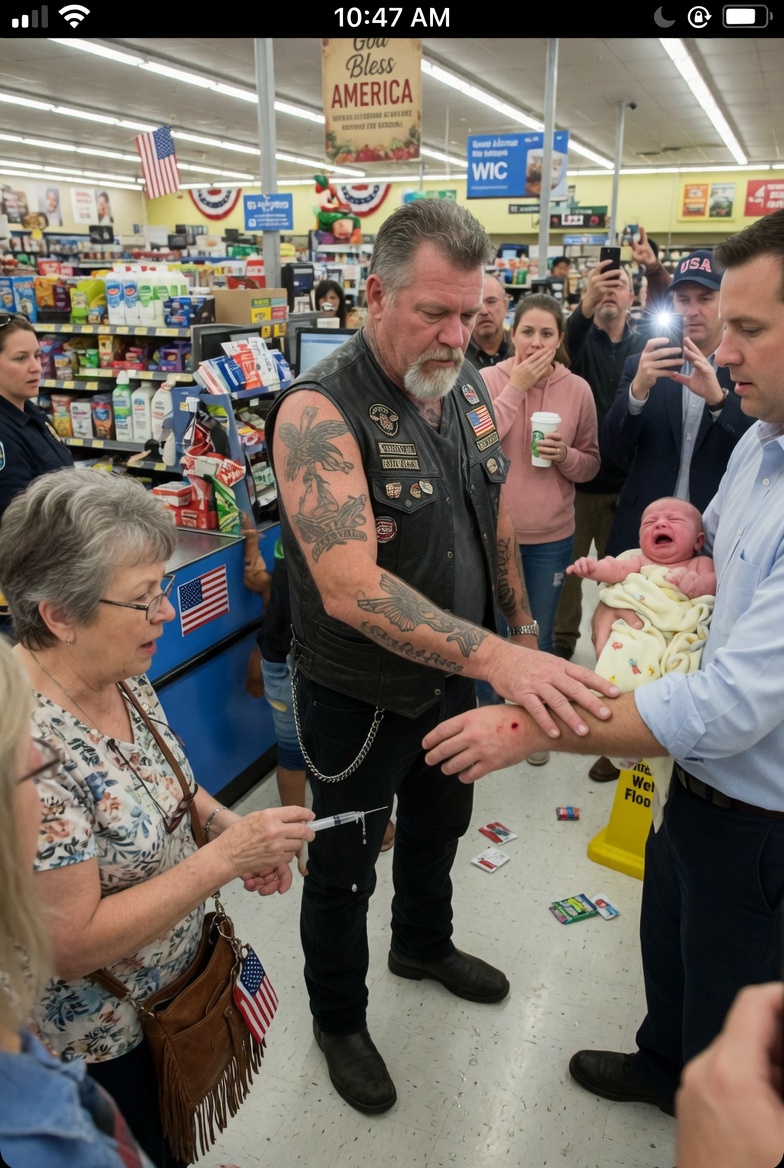
Part 2: The fluorescent lights still hummed. The checkout conveyor belt had stopped mid-motion, a carton of eggs abandoned beside a gossip magazine. The world had narrowed to the space between the biker, the old woman, and the man whose clean shirt was now rumpled in a security guard’s grip.
The baby’s cries had softened to whimpers, tiny lungs exhausted, but the sound cut deeper than any scream. The guard who’d taken the child cradled her awkwardly, a young guy with a name tag that read “Travis.” He looked terrified, like the weight of that small body might break him. The baby’s arm dangled, the needle mark still visible, a pinprick haloed by a faint bruise.
I stayed where I was, boots planted on the scuffed linoleum. The adrenaline that had sharpened my vision began to drain, leaving behind a bone-deep weariness. I’d been here before—not this exact store, not this exact moment—but the aftermath. The part where the world tries to stitch its comfortable story back together. The part where people look at you differently, but they still don’t know what to say.
Helen Carter hadn’t moved either. The syringe was still in her palm, held out like an offering. Her eyes were dry now, but the lines around them had deepened, carving a map of everything she’d just witnessed. She looked at me, then at the man being restrained, then back at the needle. I could see her trying to reconcile the pieces, to make the nightmare fit into a frame she could understand.
The third security guard, an older man with a gray mustache and a voice like gravel, stepped between me and the growing crowd.
“Sir, I need you to stay right here. Police are on their way,” he said, his hand raised but not touching me.
“I’m not going anywhere,” I replied. My voice came out rougher than I intended.
He nodded, eyes flicking to my tattoos, the leather, the size of me. But there was no challenge in his gaze, just a cautious respect that hadn’t been there two minutes ago.
The man in the business suit who’d been filming lowered his phone. His face had gone pale, the righteous fury replaced by a slack-jawed confusion. The woman who’d shouted for security was backing away, her cart abandoned. Shame is a quiet thing. It doesn’t announce itself. It just seeps into the edges of a room, filling the spaces where noise used to be.
The man—the kidnapper—had stopped struggling. That was worse than the fighting. When a cornered animal goes still, it’s either surrender or calculation. His breathing was shallow, eyes darting from the syringe to the baby to the exit. I’d seen that look in a dozen different faces over the years. He wasn’t done. He was just waiting.
“What’s your name?” I asked him.
He flinched, surprised that I’d spoken directly to him. The guard holding his arm tightened his grip.
“None of your business,” he muttered.
“You made it my business the second you stuck a needle in a child.”
His jaw clenched. For a moment, something ugly flashed across his face—a flicker of contempt, cold and calculating. Then it smoothed over, replaced by a mask of injured innocence.
“I don’t know what you’re talking about. That’s my kid. You attacked me.”
Travis, the young guard holding the baby, looked down at the tiny girl in his arms. She was maybe six months old, with wispy blonde hair and cheeks still flushed from crying. Her onesie had little yellow ducks on it. One sock was missing.
“If she’s yours,” Travis said slowly, his voice trembling, “what’s her name?”
The man’s mouth opened. Closed. The silence stretched like a wire pulled taut.
“It’s… I don’t have to answer that. This is harassment. I want a lawyer.”
The mustached guard—his name tag said “Frank”—shook his head. “Son, you’re gonna need one. But right now, you’re gonna stay put until the cops get here.”
Helen took a step forward then, her sensible shoes clicking on the floor. She held the syringe up higher, the needle catching the fluorescent light like a sliver of ice.
“I found this on the floor,” she said, her voice steady but carrying an edge that silenced the remaining murmurs. “It came from him. From his hand. I saw it fall when this man”—she gestured toward me—“stopped him.”
The crowd had grown. Shoppers from other aisles had drifted over, drawn by the commotion. A teenager with earbuds dangling around his neck was staring wide-eyed. A mother had pulled her own child closer, one hand covering the little boy’s eyes. The store manager, a thin man in a red vest, was speaking rapidly into a walkie-talkie.
And then the automatic doors at the front of the store hissed open, and two police officers walked in.
They were a study in contrast. The first was a woman, tall and broad-shouldered, with close-cropped dark hair and eyes that swept the scene in a quick, assessing arc. Her nameplate read “Officer M. Reyes.” The second was a younger man, lean and nervous, his hand resting on his belt near his taser. “Officer D. Chen.”
Reyes took the lead. She moved through the crowd with the practiced ease of someone who’d seen a hundred domestic disturbances and a handful of true nightmares. Her gaze landed on me first—the tattoos, the vest—and I saw the instinctive assessment. Then she saw the baby in Travis’s arms, the syringe in Helen’s hand, the man in the security guard’s grip, and the calculation shifted.
“Someone want to tell me what happened here?” she asked, her voice calm but leaving no room for nonsense.
The man in custody spoke first. “This maniac assaulted me! He just came out of nowhere and attacked me while I was holding my daughter. I want him arrested.”
Officer Reyes looked at me. “That true? You hit him?”
“I slapped his wrist,” I said. “He was holding a syringe. He’d just injected the baby with something to keep her quiet.”
Reyes’s eyes narrowed. She turned to Helen. “Ma’am, is that the syringe?”
Helen nodded, holding it out carefully. “Yes. I saw it fall. The baby has a mark on her arm. A fresh puncture wound.”
Reyes took a pair of gloves from her belt, snapped them on, and gently took the syringe from Helen. She held it up to the light, examining the cloudy liquid still clinging to the barrel. Her expression didn’t change, but something in her posture stiffened.
“Officer Chen,” she said quietly, “secure this as evidence. Bag it.”
Chen stepped forward, pulling an evidence bag from his belt. He took the syringe with careful hands, sealing it away.
Reyes turned back to the man in custody. “Sir, I need you to identify yourself. Do you have ID?”
“I don’t have to show you anything. I know my rights.”
“You’re being detained for questioning regarding the possible abduction and endangerment of a child. You can cooperate now, or we can sort it out at the station. Your call.”
The man’s face went through a series of expressions—anger, defiance, calculation—before settling on a flat, unnerving calm.
“My name is Kevin Lassiter,” he said finally. “And that is my daughter, Emily.”
Travis looked down at the baby again. “Emily,” he whispered, testing the name. The baby didn’t respond, still too groggy from whatever had been in the syringe.
“Do you have a photo of her on your phone?” Reyes asked. “Something to confirm she’s yours?”
Lassiter’s eyes flickered. “My phone’s dead.”
“Convenient.” Reyes pulled a small notebook from her pocket. “We’ll verify soon enough. Where’s the mother?”
“She’s at work. I was just picking up some groceries.”
“With a sedated infant?”
Lassiter’s mask slipped again, just for a moment. His lips pressed into a thin line. “I don’t know what you’re talking about. She was fussy. I gave her some medicine.”
“What kind of medicine requires a syringe with no cap in a grocery store checkout line?” Reyes’s voice was flat, unimpressed.
Silence.
Helen spoke up again, her voice softer now but no less certain. “Officer, I saw him adjusting his grip repeatedly. The baby was too still. Not sleeping—unnaturally still. And when this man”—she gestured toward me again—“intervened, the syringe flew from his hand. He didn’t drop a pacifier or a toy. He dropped a needle.”
Reyes studied Helen for a long moment. “And who are you, ma’am?”
“Helen Carter. I was in line. I saw the whole thing.”
“And you?” Reyes turned to me.
“Mick Dawson.”
“You know the victim? The child?”
“Never seen her before in my life. I just saw something wrong and acted.”
Reyes’s eyes lingered on my face, reading the lines there, the years, the scars on my knuckles. She didn’t ask the question I could see forming behind her eyes: Why you? Why did you notice? But she didn’t need to. Some people are trained to see the details. Others are just born with it.
“We’re going to need statements from all of you,” Reyes said. “But first, I need to call an ambulance for the baby and run this man’s information.”
Lassiter shifted his weight. “This is ridiculous. I’m the victim here. That man attacked me. Look at him—he’s a thug. A criminal. You’re going to take his word over mine?”
Reyes turned to face him fully, her posture unwavering. “Sir, you were found in possession of a syringe that, according to multiple witnesses, you were attempting to inject into an infant. The infant has a visible puncture wound. You’ve provided no proof of relationship. So right now, I’m not taking anyone’s word. I’m following the evidence.”
The word “evidence” landed like a stone in still water. Lassiter’s face drained of color, and for the first time, I saw genuine fear beneath the bluster.
Frank, the mustached guard, spoke up. “Officer, we’ve got security footage. The whole checkout area’s covered. I can pull it up for you.”
“Do that,” Reyes said. “Now.”
Frank nodded and hurried toward the back office, his radio crackling. The manager followed, leaving the rest of us in a tense, suspended silence.
The baby whimpered again, and Travis shifted her awkwardly in his arms. Officer Chen, who’d been standing stiffly nearby, stepped forward. “Do you want me to hold her?” he asked, his voice gentler than I’d expected.
Travis looked relieved. “I—yeah. I don’t really know how to…” He carefully transferred the baby to Chen, who cradled her with surprising ease. The little girl’s eyes fluttered open for a moment—blue, unfocused—before closing again.
“She’s cold,” Chen said quietly. “Do we have a blanket?”
Helen was already moving. She pulled a soft knitted shawl from her purse, the kind of thing you’d never expect to need in a grocery store. She handed it to Chen, who wrapped the baby gently.
“There you go, sweetheart,” Helen murmured, her fingers brushing the baby’s cheek. “You’re safe now.”
Lassiter watched this with an expression I couldn’t quite read. Not guilt. Not remorse. Something hungrier, like a man watching his meal being taken away.
I stepped closer to him, close enough that the guard tightened his grip. “You’re not the father,” I said. “You’ve never been a father. I can see it in the way you’re looking at her. Like she’s a thing. A possession.”
His eyes met mine, and for just a second, the mask dropped entirely. There was nothing behind it but calculation. Cold, reptilian calculation.
“You don’t know anything,” he said.
“I know enough.”
The ambulance arrived seven minutes later. Two paramedics, a man and a woman in dark blue uniforms, pushed a stretcher through the automatic doors and into the awkward stillness of the checkout lane. The woman, a stocky redhead with a name tag that read “K. Donovan,” knelt beside Officer Chen and immediately began assessing the baby.
“What do we know?” she asked, her hands gentle but efficient as she checked the baby’s pulse, her pupils, the angry red dot on her arm.
“Possible sedation,” Reyes said. “Syringe recovered. Unknown substance. The child’s been mostly unresponsive but crying intermittently.”
Donovan nodded, pulling a pediatric oxygen mask from her kit. “Heart rate’s slow but steady. We need to get her to St. Joseph’s. The tox screen will tell us what we’re dealing with.”
Her partner, a tall Black man named “M. Okonkwo” according to his badge, unfolded the stretcher with practiced speed. “Any known allergies? Medical history?”
No one answered. Of course.
“We don’t know who she is yet,” Reyes said. “The man claiming to be her father is in custody, but we haven’t verified.”
Donovan’s eyes flicked up to meet Reyes’s, a silent conversation passing between them. She’d seen this before. The world is full of terrible stories, and paramedics read them in the spaces between the words.
“We’ll take good care of her,” Donovan said, lifting the baby carefully from Chen’s arms. The little girl, Emily—if that was even her name—didn’t stir. Donovan placed her on the stretcher, tucking the knitted shawl around her tiny body. “You’re gonna be okay, sweet pea,” she murmured.
As they wheeled the stretcher out, the automatic doors swallowing them into the morning light, a strange hush fell over the store. The kind of quiet that only comes after something irreparable has been narrowly avoided.
Or so we thought.
The manager returned with Frank, a tablet in his hand. “I’ve got the footage pulled up,” he said, his voice shaking slightly. “You’re gonna want to see this.”
Reyes took the tablet and watched. Chen leaned over her shoulder. Their faces, already grim, grew stonier by the second.
“He came in with the baby already in his arms,” Reyes murmured. “Entered through the east entrance at 9:42 a.m. No stroller. Just the baby. Headed straight for the checkout line. Didn’t shop. Didn’t stop.” She looked up at Lassiter. “Want to explain that?”
Lassiter said nothing.
“There’s more,” Frank said. “I checked the exterior cameras. The parking lot. There’s footage from about fifteen minutes before he walked in.”
Reyes swiped the screen. Her expression didn’t change, but her knuckles whitened around the edge of the tablet.
“What is it?” Helen asked, her voice hesitant.
Reyes looked up, her gaze sweeping across all of us—me, Helen, the remaining shoppers, the guards. “We need to lock down the parking lot. There’s a woman out there. She’s been searching the lot for the past twenty minutes. Looks like she’s screaming for someone.”
My gut tightened. “The mother.”
“We don’t know yet,” Reyes said. “But I need to talk to her. Chen, stay with the suspect. Frank, keep those doors closed until we figure this out. No one leaves.”
She handed the tablet back and strode toward the entrance, her hand resting on her belt. I followed without thinking, my boots heavy on the tile.
“Dawson,” she said without turning around. “You need to stay back.”
“I need to see.”
She paused, glancing over her shoulder at me. Something in my expression must have told her arguing was pointless, because she just shook her head and kept walking.
The parking lot was a sprawl of pale concrete and white lines, heat shimmering off the asphalt despite the early hour. Cars glinted in the sun like scattered coins. Near the far end, by a row of shopping carts, a woman was moving between vehicles.
She was young—mid-twenties maybe—with tangled brown hair and a sweater that hung loose on her frame. Her movements were frantic, jerky, like a marionette with half its strings cut. Every few seconds, she’d stop, look under a car, and then straighten up with a cry that carried across the lot.
“Emily! Emily, please!”
The name hit like a punch to the chest. So it was her name. The baby was Emily. And this woman, whoever she was, had been searching for her while we’d all been standing inside, dealing with the man who stole her.
Reyes approached her with careful, open hands. “Ma’am? Ma’am, I’m Officer Reyes with the Oakdale Police. Are you looking for a child?”
The woman spun around, her eyes wild and rimmed with red. “Yes! My daughter—my baby girl—she’s gone. I just turned around for a second, just one second, and the stroller was empty. Please, you have to help me. Please.”
Her voice cracked on the last word, splintering into something raw and desperate. I’ve heard a lot of sounds in my life. Engines backfiring in the night. Bones breaking. The wet gasp of a man who’s taken his last breath. But the sound of a mother who doesn’t know if her child is alive or dead is its own category of terrible.
“What’s your name?” Reyes asked gently.
“Jessica. Jessica Linwood. My baby is Emily. She’s six months old. She was wearing a yellow onesie with little ducks. One sock is missing. She always kicks it off. Please, have you seen her?”
Reyes reached out and placed a steady hand on Jessica’s shoulder. “We found a baby girl matching that description. She’s alive. She’s on her way to St. Joseph’s right now.”
Jessica’s knees buckled. Reyes caught her before she hit the ground, lowering her to the curb with practiced care. The sobs that followed weren’t just relief. They were a lifetime of terror released in a single, shuddering exhale.
“Oh God. Oh thank God. Is she okay? What happened? Where was she?”
Reyes glanced at me, then back at Jessica. “A man had her. He’s in custody. Your daughter is safe, but she may have been sedated. The doctors are going to run tests.”
Jessica’s face went through a dozen emotions in the space of a breath. Relief, horror, rage, confusion. “A man? What man? I don’t understand. I was just getting a coffee. The stroller was right next to me. I turned around to pay and when I looked back… she was gone. How did he—how could he—”
“We’ll figure all of that out,” Reyes said. “But right now, you need to get to the hospital. Is there someone I can call for you? A partner? A family member?”
Jessica shook her head, tears still streaming. “It’s just me. My husband’s deployed. He’s in Germany. I can’t—I can’t reach him right now. Oh God, what do I tell him?”
“We’ll help you contact him,” Reyes said. “But first, let’s get you to your daughter.”
Reyes helped Jessica to her feet. As they turned back toward the store, Jessica’s eyes found me. I was standing a few yards away, a hulking silhouette against the sun. I saw her take in the leather, the tattoos, the hard lines of my face. I saw the instinctive flinch, the quick assessment that I might be another threat.
But then something else flickered in her expression. Maybe it was the way I was standing—still, patient, unthreatening. Maybe it was the look in my eyes, the weight of too many years spent seeing things I couldn’t unsee.
“Who’s that?” she asked quietly.
Reyes paused. “That’s the man who stopped him.”
Jessica stopped walking. She turned fully toward me, her red-rimmed eyes searching my face. “You… you found her? You saved her?”
I shook my head. “I just saw something wrong and didn’t look away.”
For a long moment, she just stared at me. Then she did something I didn’t expect. She stepped forward, closed the distance between us, and wrapped her arms around me.
It wasn’t a polite hug. It was the desperate, clinging embrace of someone who’d been drowning and just found solid ground. I stood there, arms at my sides for a moment, unsure what to do. Then, slowly, I lifted one hand and patted her back.
“She’s a strong kid,” I said. “She’s gonna be okay.”
Jessica pulled back, wiping her eyes with the sleeve of her sweater. “Thank you. Thank you. I don’t even know your name.”
“Mick.”
“Mick.” She said it like she was memorizing it. “I’ll never forget you.”
Before I could respond, Reyes guided her toward a patrol car that had just pulled into the lot. “We’ll take you to the hospital, Ms. Linwood. You can ride with me.”
As they drove away, I stood in the parking lot, the sun beating down on my shoulders. The adrenaline was gone now, replaced by a hollow ache that settled deep in my bones. I’d been thanked before. I’d been called a hero a few times, though the word never fit right. But this felt different.
I looked back toward the store. Through the glass doors, I could see Lassiter still standing in the grip of the security guards, his face a mask of cold indifference. The man had stolen a child from her stroller, injected her with a sedative, and walked her through a grocery store like a bag of flour. He’d been calm. Confident. Like he’d done it before.
And that thought chilled me more than anything else.
I walked back inside. Helen was sitting on a bench near the customer service desk, a cup of water in her hands. She looked up as I approached.
“You went out there,” she said. “The mother?”
“Yeah. She’s on her way to the hospital.”
Helen nodded slowly. “I keep thinking about what would have happened if you hadn’t been here. If I hadn’t looked down at the right moment. If any one of a hundred tiny things had gone differently.”
“Don’t do that,” I said. “The ‘what ifs’ will eat you alive.”
She smiled faintly. “You sound like my husband. He used to say the same thing.”
“Used to?”
“He passed three years ago. Heart attack.” Her fingers tightened around the cup. “I come to this store every Tuesday morning at the same time. Same aisle order. Milk, bread, eggs. It’s my routine. It keeps me… grounded. But today, I almost didn’t come. I almost stayed home because I was feeling a little tired.” She looked up at me, her eyes glistening. “If I’d stayed home, I wouldn’t have been here to see the syringe. To speak up. To help.”
“But you were here,” I said. “That’s what matters.”
She was quiet for a moment. Then she reached over and placed her hand on my arm. Her fingers were thin and cool, but the gesture was steady. “You’re a good man, Mick. Whatever people might think when they look at you… you’re a good man.”
I didn’t know what to say to that. So I just nodded, my throat tight.
The interrogation room at the Oakdale Police Department was a small, windowless box with gray walls and a single fluorescent light that flickered at irregular intervals. There was a metal table bolted to the floor, two chairs, and a camera mounted in the corner with a red light that never stopped blinking.
Kevin Lassiter sat in one of the chairs, his hands cuffed in front of him. His lawyer hadn’t arrived yet, but he’d waived his right to wait. Arrogance or stupidity, I couldn’t tell. Maybe both.
Officer Reyes sat across from him, a folder open on the table. I watched from behind a one-way mirror in the adjacent room, Helen beside me. We’d given our statements, signed the forms, and been told we could leave. But neither of us had moved. We needed to see this through.
“So, Kevin,” Reyes began, her tone conversational. “We’ve been digging into your background. Quite a file you’ve got here.”
Lassiter shrugged, his expression bored. “Everyone makes mistakes.”
“A DUI in 2019. Shoplifting in 2020. A domestic disturbance call last year. Your ex-girlfriend filed a restraining order. She said you were watching her. Following her. She said you had a fixation.”
“She’s a liar.”
“And then there’s the charge from three years ago. Attempted kidnapping. It was pled down to unlawful restraint. You served eighteen months.”
Lassiter’s jaw tightened. “That was a misunderstanding.”
“A misunderstanding that involved a two-year-old boy and a park bench. The mother tackled you before you could get ten feet. Sound familiar?”
He didn’t answer.
Reyes leaned back in her chair. “Here’s what I think happened, Kevin. I think you’ve been watching. Planning. You probably saw Jessica Linwood at that coffee shop last week, or maybe you followed her from the park. You saw a young mother, alone, her husband deployed. An easy target. You waited for the right moment, and this morning, you took it.”
“You can’t prove any of that.”
“We’re pulling traffic camera footage from the last week. We’re reviewing your phone records, your search history, your GPS data. We’re talking to your parole officer. We’re going to find the pieces, Kevin. We always do.” She leaned forward, her voice dropping. “But here’s what I don’t understand. Why the syringe? Why sedate her? You could have just taken her and run.”
Lassiter stared at the table for a long moment. When he looked up, his eyes were different. Colder. Hungrier.
“A crying baby draws attention,” he said flatly. “A quiet one doesn’t.”
Helen flinched beside me, her breath catching. I felt a cold fury settle into my chest, heavy and familiar. He’d planned it. Calculated. The syringe wasn’t a desperate measure—it was a tool. A way to make the abduction cleaner.
“Where did you get the sedative?” Reyes asked.
“I have a friend who works at a veterinary clinic. Ketamine. It’s easy enough to get if you know the right people.”
“You injected a six-month-old baby with veterinary sedative.”
“She was fine. I used a low dose. I’m not a monster.”
Reyes stared at him for a long, hard moment. Then she closed the folder and stood up. “We’ll continue this when your lawyer arrives. But I want you to know something, Kevin. That little girl is at the hospital right now. She’s going to be okay. And you’re going to spend a very long time in a very small cell.”
Lassiter smiled then, a thin, humorless curve of his lips. “We’ll see.”
Reyes walked out of the room, and the door clicked shut behind her. Through the mirror, I watched Lassiter sit alone in the silence, his expression never changing.
Helen touched my arm. “What kind of person does something like that?”
“Someone who sees people as things,” I said. “Once you understand that, it all makes sense.”
She shivered. “I don’t want to understand that.”
“Neither do I.”
We left the station together, stepping out into the late afternoon sun. The sky had turned a hazy gold, the kind of light that makes everything look softer, gentler. It didn’t match the day.
“I should go home,” Helen said, but she didn’t move toward her car. She just stood on the sidewalk, her purse clutched in front of her. “I don’t know what to do with the rest of today. How do you just… go back to normal after something like this?”
“You don’t,” I said. “You just keep going.”
She looked up at me, her eyes tired but curious. “Is that what you do? Just keep going?”
I didn’t answer right away. I thought about the years behind me—the things I’d seen, the things I’d done. The people I’d lost. The nights I’d spent staring at a ceiling, wondering if any of it mattered.
“Something like that,” I finally said.
She nodded, as if that made sense. “Will you… would you maybe want to get a cup of coffee sometime? I know a little place not far from here. It’s not much, but the coffee’s decent, and I think we could both use someone to talk to.”
I looked at her—this small, gray-haired woman who’d gone from a routine grocery run to the center of a nightmare. She’d held it together. She’d spoken up. She’d been braver than half the men I’d served with, and she was asking me for coffee like she was afraid I’d say no.
“I’d like that,” I said.
She smiled then, a real smile that crinkled the corners of her eyes. “Good. Next Tuesday? Same time as my grocery run?”
“It’s a date.”
She laughed, a soft, surprised sound. “Not a date. Just coffee.”
“Just coffee,” I agreed.
We exchanged numbers—Helen writing mine down in a little address book she pulled from her purse, because she didn’t own a cell phone. I watched her walk to her car, a sensible sedan the color of cream, and drive away.
I stood on the sidewalk for a long time after she was gone, watching the traffic pass. The world was still turning. People were still going about their lives, unaware of how close they’d all been to a tragedy.
Then I got on my bike and headed to St. Joseph’s.
The pediatric ward smelled like antiseptic and crayons. The walls were painted with cartoon animals—smiling giraffes, cheerful elephants—but the cheerfulness felt strained, a thin veneer over the reality of sick children and worried parents.
I found Jessica Linwood in a small room on the third floor. She was sitting in a plastic chair beside a crib, her hand reaching through the bars to touch Emily’s tiny fingers. The baby was awake now, her blue eyes alert and tracking her mother’s face. A small bandage covered the spot on her arm where the needle had gone in.
Jessica looked up when I appeared in the doorway. Her face was still pale, her eyes still shadowed, but something had relaxed in her posture. The frantic energy was gone, replaced by a bone-deep exhaustion.
“Mick,” she said, surprised. “You came.”
“Wanted to see how she’s doing.”
Jessica’s smile was watery but genuine. “The doctors said she’s going to be fine. They gave her something to counteract the sedative. She woke up about an hour ago. She’s been a little fussy, but she’s okay. She’s really okay.”
I stepped closer, looking down at the baby in the crib. Emily was tiny, her wispy hair catching the light, her small fists opening and closing as if she was trying to grasp something invisible. She was alive. Safe. The mark on her arm would fade. The other marks, the ones you can’t see—those would take longer.
“She’s beautiful,” I said.
“She looks like her dad,” Jessica said, her voice catching. “I finally got ahold of him. He’s being sent home on emergency leave. He should be here in two days.” She paused, her fingers tightening around the crib rail. “I don’t know how to tell him what happened. How do you tell someone that their child was taken? That some monster just reached into her stroller and… and…”
“You tell him the truth,” I said. “You tell him she’s safe. You tell him someone was there who saw something wrong and acted. That’s what matters.”
Jessica looked up at me, her eyes searching my face. “The police told me what you did. How you saw the syringe. How you stopped him before he could finish whatever he was planning. They said if you’d been a second later, she might have gotten a full dose. She might not have woken up.”
I didn’t say anything. There was nothing to say.
“I keep thinking about how close it was,” Jessica continued, her voice trembling. “How close I came to losing her. And I keep thinking about you—a complete stranger—just stepping in. No hesitation. No thought for your own safety. Why? Why did you do it?”
I looked down at Emily, at the steady rise and fall of her tiny chest. “Because someone has to,” I said. “Because when you see something wrong and you look away, you carry that forever. I’ve already got enough to carry.”
Jessica was quiet for a moment. Then she stood up and walked over to me. This time, when she hugged me, it wasn’t desperate. It was grateful. Solid. The kind of hug that says more than words ever could.
“I’m going to make sure she knows about you,” Jessica whispered. “When she’s older. I’m going to tell her about the man who saved her. The man who didn’t look away.”
I cleared my throat, uncomfortable with the weight of her words. “She doesn’t need to know about me. She just needs to grow up safe and loved.”
“She will. I promise.”
I nodded, stepping back. “I should go. Let you rest.”
“Wait.” Jessica turned to a small table beside the crib, where a few personal items were scattered—a phone, a wallet, a crumpled tissue. She picked up a small, silver bracelet, the kind with a charm dangling from it. A tiny duck.
“This was hers,” Jessica said, holding it out to me. “It fell off when… when he took her. I found it in the stroller.” She pressed it into my palm. “I want you to have it. I know it’s silly, but… I want you to have something to remember her by. To remember what you did.”
I looked down at the bracelet in my hand. The little duck charm glinted in the fluorescent light. My throat tightened.
“I don’t need a reminder,” I said. “But I’ll keep it. Thank you.”
Jessica smiled, tears spilling down her cheeks. “Thank you, Mick. For everything.”
I left the hospital as the sun was setting, the sky painted in shades of orange and pink. The bracelet was in my pocket, a small weight against my leg. I got on my bike and rode without a destination, letting the road unwind beneath me.
The wind whipped past my face, drowning out everything but the roar of the engine. The city blurred around me—neon signs, traffic lights, the endless stream of people living their lives. None of them knew what had happened that morning. None of them knew how close one of them had come to never seeing their child again.
I thought about Helen, and her Tuesday routine. Milk, bread, eggs. I thought about Jessica, and the sound of her voice when she’d screamed her daughter’s name across the parking lot. I thought about Kevin Lassiter, sitting in his cell, his cold eyes staring at nothing.
And I thought about myself. About the road that had brought me here. The choices I’d made. The people I’d been. The man I was now.
People see the tattoos and the leather and they write their stories. They don’t see the years before the ink, the scars beneath the vest, the things I’ve carried since I was young and stupid and thought I knew everything. They don’t see the nights I’ve spent awake, haunted by faces I couldn’t save and moments I couldn’t undo.
But sometimes—just sometimes—someone sees past all of that. Someone like Helen, who looked at me and saw a good man. Someone like Jessica, who trusted me with her daughter’s bracelet. Someone like Officer Reyes, who didn’t judge me by my cover.
Those moments don’t erase the past. They don’t undo the things I regret. But they remind me that the story isn’t over yet. That every day is a chance to be the person I want to be, not just the person I used to be.
I pulled into a gas station on the edge of town, the kind of place where the pumps are old and the fluorescent lights buzz like angry insects. A kid with acne and a bored expression filled my tank while I leaned against the bike and watched the stars come out.
“Nice bike,” the kid said.
“Thanks.”
“You, like, in a gang or something?”
I looked at him—really looked at him. He was maybe seventeen, with a wispy mustache and eyes that hadn’t yet learned to see the world for what it was.
“No,” I said. “I’m just a man trying to do the right thing.”
The kid shrugged, clearly disappointed. “Cool, I guess.”
I laughed—a real laugh, the first one in longer than I could remember. “Yeah. Cool.”
I paid for the gas and got back on the bike. The road stretched ahead of me, dark and endless. I didn’t know where I was going. I didn’t know what tomorrow would bring. But I knew one thing for certain.
I’d be there. Whatever happened. Watching. Not looking away.
Because that’s what I did. That’s who I was.
And maybe, just maybe, that was enough.
The weeks that followed were strange. The story made the local news—a small segment sandwiched between the weather and a piece about a cat rescued from a storm drain. They didn’t mention my name, which was fine by me. The headlines focused on Lassiter and his arrest, on Jessica and her reunion with her husband. There was a photo of the three of them at the hospital, the husband in his fatigues, holding Emily like she was made of glass.
I cut the article out of the paper and tucked it inside my vest. I don’t know why. Some things you just keep.
Helen and I had coffee that Tuesday, and the Tuesday after that. It became a routine—coffee at the little shop near her grocery store, then I’d walk with her through the aisles while she picked up her milk, bread, and eggs. She’d talk about her husband, a man named George who’d been a carpenter and told terrible jokes. I’d talk about my years on the road, the places I’d seen, the people I’d met. We never ran out of things to say.
One afternoon, about a month after the incident, we were sitting at our usual table when Helen set down her cup and gave me a look.
“I’ve been thinking,” she said.
“Dangerous habit.”
“Hush. I’ve been thinking about what you said that day. About how you’ve already got enough to carry.”
I shifted in my seat, suddenly uncomfortable. “I said a lot of things that day.”
“You said you’ve seen things. Done things. That you have regrets.” She leaned forward, her eyes sharp and kind at the same time. “I’m not asking you to tell me about them. But I want you to know that whatever it is you’re carrying… you don’t have to carry it alone.”
I stared at my coffee, the dark liquid swirling in the cup. Outside, the afternoon sun filtered through the window, casting long shadows across the table.
“There was a fire,” I said finally, my voice low. “Years ago. A house fire. I was passing through a small town in Nevada. Saw the flames from the road. Pulled over, tried to help. There was a family inside. Parents and two kids.”
Helen didn’t interrupt. She just waited.
“I got one of the kids out. A little boy. His name was Tyler.” I paused, the memory sharp and raw even after all this time. “The others… I couldn’t reach them. The fire was too fast. The roof collapsed before I could go back in.”
“Oh, Mick.”
“I carried that for a long time. Still do, some days. The faces of the ones I couldn’t save. The sound of Tyler crying for his mom and dad. The way the fire felt on my skin.” I looked up at her. “That’s why I didn’t hesitate in the store. That’s why I saw the syringe. Because I’ve spent years replaying moments where I was a second too late. I wasn’t going to be too late again.”
Helen reached across the table and took my hand. Her fingers were warm and steady. “You saved that little boy. You saved Emily. That’s not failure, Mick. That’s courage.”
I swallowed hard, my throat tight. “It doesn’t always feel like courage.”
“That’s because you’re a good man, and good men feel the weight of what they do. Bad men don’t feel a thing.” She squeezed my hand. “You’re not a bad man. You never were.”
We sat there in silence for a while, the coffee growing cold, the world moving on outside the window. And for the first time in a long while, the weight on my chest felt just a little bit lighter.
Three months later, I got a letter.
It came in a small envelope with a handwritten address and no return name. Inside was a photograph—Jessica, her husband, and Emily, now nine months old, sitting on a picnic blanket in a park. Emily was laughing, her little hands reaching for the camera. The duck bracelet was around her wrist, a perfect match for the charm I still carried in my pocket.
There was a note, written in careful, looping handwriting:
Dear Mick,
I hope this letter finds you well. We think about you often, especially when we watch Emily grow and explore the world. She’s walking now—well, wobbling—and she has her father’s laugh. I wanted you to have this photo so you can see what you helped protect. You gave us back our future. There are no words big enough for that. But I hope this picture says some of what my heart can’t put into language.
Thank you for not looking away.
With love and endless gratitude,
Jessica, Mark, and Emily Linwood
I read the letter three times. Then I folded it carefully and tucked it inside my vest, next to the newspaper clipping.
Some days, the world feels dark. Some days, the weight of everything wrong with it presses down so hard you can barely breathe. But then there are days like this—days when a photograph and a few handwritten words remind you why you keep going.
I got on my bike and rode to the coffee shop. Helen was already there, waiting at our usual table. She smiled when she saw me, her eyes crinkling at the corners.
“You look happy,” she said.
I sat down and placed the photograph on the table between us. “Got a letter from Jessica. Emily’s doing great.”
Helen picked up the photo, her face softening. “Look at her. She’s beautiful.” She traced a finger over Emily’s laughing face. “You know, I was thinking about something the other day. About that morning in the store.”
“What about it?”
“I was thinking about how everyone jumped to conclusions. How they saw you and assumed the worst. And I was thinking about how you didn’t fight back. You didn’t argue. You just stood there and let the truth speak for itself.” She set the photo down and looked at me. “That takes a special kind of strength. The kind most people don’t have.”
“Or maybe I just don’t care what people think anymore.”
She shook her head. “I don’t believe that. I think you care a great deal. I think you’ve spent your whole life caring. That’s why it hurts when people get it wrong.”
I didn’t answer. Because she was right. She was always right.
“You’re a good friend, Helen,” I said instead.
She smiled, her eyes bright. “So are you, Mick. So are you.”
The years passed. Helen and I kept our Tuesday tradition for as long as we could. I got older. My knees ached in the cold, and the ink on my arms faded to a softer shade. Helen moved slower, her steps more careful, but her eyes never lost their sharpness. She still noticed everything. She still saw the details no one else did.
We didn’t talk about the grocery store much anymore. We didn’t need to. That day had become part of us, woven into the fabric of who we were. It didn’t define us, but it had shaped us.
Then one Tuesday, Helen wasn’t at the coffee shop. I waited for an hour, then drove to her house—a small bungalow with a garden full of roses. Her neighbor, a kind-faced woman with a soft voice, met me at the door and told me Helen had passed in her sleep the night before. Peaceful. Quiet. Just like her.
I stood on the porch for a long time after the neighbor went back inside. The roses were in full bloom, their scent thick and sweet in the morning air. Helen had planted those roses years ago, she’d told me. George had loved them.
I didn’t cry. I’d learned a long time ago that grief doesn’t always show up the way you expect. Sometimes it just settles in your chest like a stone, heavy and still. But I knew I’d miss her. More than I could put into words.
I went to her funeral. It was small, just a handful of neighbors and a distant niece who’d flown in from Oregon. The niece gave a eulogy that was nice enough, but it didn’t capture Helen. Not really. It didn’t talk about the way she’d stood up in that grocery store, steady as a rock, holding a syringe in her hand like it was the most natural thing in the world. It didn’t talk about the coffee and the conversations and the way she’d never judged me, not once.
So after the service, I stood up and I talked. I told them about the grocery store. About the baby and the syringe and the man who tried to steal her. About Helen, kneeling on the floor, picking up the truth with her own two hands. About how she’d spoken up when everyone else was shouting at the wrong person.
When I finished, the room was silent. Then the niece came up to me, tears in her eyes, and thanked me. She said she hadn’t known that side of her aunt. She said it was a story she’d carry with her forever.
I told her Helen was the kind of person who noticed things. The kind of person who didn’t look away.
And that was the best kind of person to be.
As I rode away from the funeral, the wind cold against my face, I thought about all the Tuesdays we’d shared. The coffee. The conversations. The quiet moments when we didn’t need to talk at all. Helen had been a friend when I didn’t know I needed one. She’d reminded me that the world still had good people in it.
She’d also reminded me of something I’d almost forgotten: that sometimes, the most important thing you can do is just show up. Be present. Pay attention. Don’t look away.
I still carry the duck bracelet in my pocket. I still have the newspaper clipping, now yellowed and creased at the edges. The photograph of Emily, the one Jessica sent, is still tucked inside my vest, close to my heart.
Emily would be ten years old now. I don’t know where she is or what she’s doing. I don’t know if Jessica ever told her the full story. Part of me hopes she did. Part of me hopes she didn’t. Some things are better left as they are—quiet, private, meaningful only to the people who lived them.
But I think about her sometimes. About the baby with the wispy hair and the yellow duck onesie, the one who was so still in the checkout line. I think about the cry she let out when I slapped Lassiter’s wrist, the sound that proved she was alive. I think about how close it was—how close we all were to a very different ending.
And I think about Helen. About milk, bread, and eggs. About the order of things. About the routines that hold us together when the world threatens to fall apart.
I’m an old man now. The bike is still running, but the rides are shorter. The road doesn’t call to me the way it used to. I spend more time sitting on porches and less time chasing horizons. But I still notice things. I still watch. I still pay attention.
Because you never know when a single moment will matter. When a split-second decision will change everything. When a small, dark object will skid across the floor and land at your feet, and you’ll have to choose: speak up or stay silent, step forward or step back, look away or keep watching.
I chose to keep watching.
And that choice made all the difference.
So here’s what I know, after all these years: People will judge you by your cover. They’ll see the tattoos and the leather and write their stories in their heads. You can’t stop them. You can’t control what they think. But you can control what you do. You can control whether you act when action is needed. You can control whether you stand up for what’s right, even when the whole world is shouting at you to sit down.
You don’t do it for the recognition. You don’t do it for the thanks. You do it because it’s the right thing. Because if you don’t, who will? Because if you look away, you’ll carry that moment forever.
I’ve carried a lot of moments in my life. Some of them heavy. Some of them light. The moment in the grocery store—the slap, the syringe, the cry of the baby—that one is light. That one doesn’t weigh me down. It lifts me up.
Because that morning, I made a difference. So did Helen. So did Jessica, in her own way, with her love and her resilience and her determination to raise her daughter in a world that tried to take her.
We all made a difference. And that’s the only thing that matters.
The road goes on. The sun rises and sets. People go about their lives, shopping for groceries, drinking coffee, tending their gardens. The world keeps spinning, indifferent to the small dramas that unfold in checkout lines and parking lots.
But I know the truth. I know that the smallest moments can hold the biggest stakes. I know that a quiet grocery store can become a battleground. I know that a man with tattoos and a woman with a worn leather purse can become heroes, just by paying attention.
So pay attention. Watch. Notice the details. Don’t look away.
You never know whose life you might save.
You never know whose story you might change.
And one day, when you’re old and gray, sitting on a porch somewhere, you’ll look back and realize that the moments you chose to act—really act—are the ones that defined you.
They’re the ones that made you who you are.
For me, it was a Tuesday morning. A grocery store. A man holding a baby. A syringe hitting the floor.
And a choice.
Just one choice.
To act.
To not look away.
That’s the story I carry. That’s the story I’ll tell until the day I die. Not because I’m a hero. Not because I’m special. But because I was there. I saw. And I did what needed to be done.
Anyone can do it. Anyone can make that choice.
The question is: will you?
I hope you will.
Because the world needs more people who don’t look away.