| PART 2: THE RUMBLE
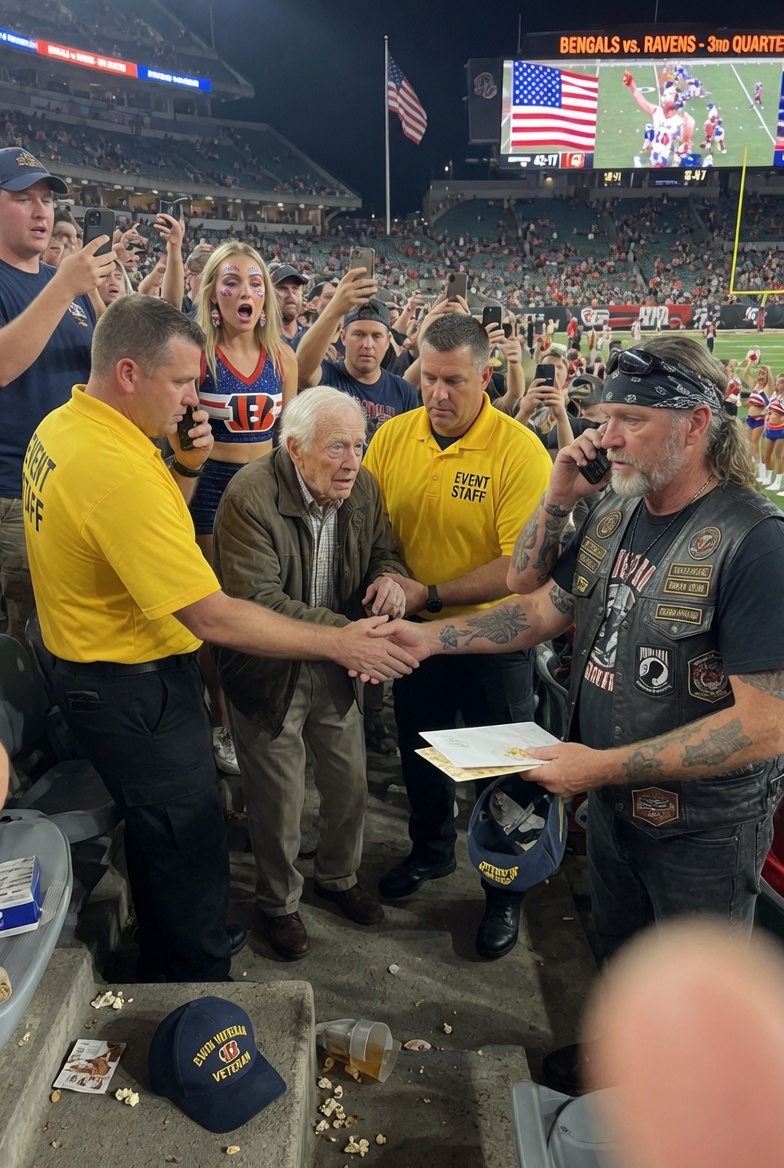
The sound didn’t roar like a threat. It rolled in steady. Controlled. Rhythmic. Not chaos. Not rebellion. Presence. The vibration traveled up through the concrete beneath everyone’s feet first—a low, guttural hum that settled in the chest before the brain could name it. Then the echo bounced off the stadium’s steel rafters, mixing with the distant crowd noise from the field, where no one had yet noticed. But in Section 214, everyone noticed. Frank’s trembling hand tightened on the armrest. His faded blue eyes, clouded by age but not by weakness, darted toward the tunnel entrance below. He knew that sound. He had heard it first in 1953, when he was twenty-two years old, riding shotgun in a jeep through the frozen mud of Korea, listening to supply convoys rumble through mountain passes under cover of darkness. That sound had meant safety then. Now, it meant something else entirely. The security guards exchanged glances. The first one—a stocky man named Officer Briggs, who had been with stadium security for eleven years and had never once questioned a digital scanner—reached for his radio with a sweaty palm. “Control, this is Briggs in 214. We have… unidentified noise approaching from the south concourse. Multiple engines. Possibly motorcycles.” The radio crackled back. “Copy, 214. We’re seeing them on cameras. Stand by.” But standing by wasn’t an option. Because the sound was already growing louder, closer, more distinct. It wasn’t just two or three bikes. It was dozens. The crowd around them began to shift uncomfortably. People who had been glued to the game on the field now turned their heads toward the tunnels. A man in a Bengals jersey two rows up stood on his seat to see better. A teenager pulled out his phone and started live-streaming. “Yo, something’s going down,” the kid said into his camera. “Bikers. Like, a lot of bikers. They’re coming into the stadium.” The biker—Holloway—didn’t turn around. He kept his eyes fixed on the security guards, his body a quiet wall between them and Frank. But his shoulders relaxed almost imperceptibly. Just a fraction. Just enough for someone watching closely to notice. He had expected this. The first bike emerged from the tunnel. It was a Harley-Davidson Road Glide, deep cherry red, chrome gleaming under the stadium lights. The rider was a woman—maybe fifty-five, gray ponytail hanging down her back, leather vest covered in patches. She didn’t rev the engine. She didn’t raise a fist. She simply rolled to a stop at the edge of the field-level concourse, killed the engine, and dismounted with the ease of someone who had spent thirty years in the saddle. Behind her came another bike. Then another. Then five more. Then ten. They parked in formation—neat, disciplined, almost military. Side by side, handlebars aligned, kickstands down in unison. The riders dismounted in silence. No shouting. No posturing. Just boots hitting pavement in a steady, rhythmic thump-thump-thump. There were men and women both. Some gray-haired, some younger. Some with tattoos covering every inch of visible skin. Others dressed plainly, wearing nothing more than jeans and worn-out boots. But every single one of them wore the same patch on the back of their vests: a black shield with a flame in the center, encircled by the words FREEDOM RIDERS VETERANS SUPPORT. And beneath that, smaller but unmistakable: EST. 1987. Officer Briggs’s radio crackled again. “Briggs, this is Command. Do not engage. Repeat, do not engage. Those riders are authorized personnel. I say again, authorized. Stand down.” Briggs’s jaw tightened. He looked at his partner, Officer Miller, a younger man with a crew cut and a lot to prove. Miller looked back, confused and defensive. “Authorized?” Miller muttered. “Since when do we authorize biker gangs?” “They’re not a gang,” the stadium director’s voice cut in from behind them. Everyone turned. The director—a man named Edward Croft, who had run this stadium for nineteen years and rarely left his skybox—stood at the top of the aisle. He was breathing hard, as if he had run from somewhere. His tie was loosened. His face was pale. “They’re not a gang,” he repeated, walking down the steps toward them. “They’re the Freedom Riders. And they’re the reason this stadium still has a veterans memorial wing.” The crowd murmured. Croft stopped in front of Briggs and Miller. His voice was low, meant only for them, but the silence of Section 214 carried every word. “That man you were about to drag out? Frank Donovan? He donated the land for the east wing expansion after the fire in ’91. Without him, half this structure wouldn’t exist. And those seats—” Croft pointed to Row C, Seats 7 and 8. “—are lifetime honorary seats. They’re not in the digital system because they were never supposed to be in the digital system. They belong to him. Permanently.” Briggs’s face went red. “Sir, we didn’t know—” “You didn’t ask,” Croft said. “You just assumed.” He turned to face the crowd, raising his voice slightly. “Ladies and gentlemen, we have a misunderstanding here. Nothing more. This gentleman is a valued member of our stadium family. And these riders—” He gestured toward the concourse, where more motorcycles were still arriving, filling the space with a gleaming row of chrome and steel. “—are here to honor him. Not to intimidate anyone.” But the riders themselves weren’t moving toward the stands. They weren’t marching up the steps. They were simply standing by their bikes, hands at their sides, faces unreadable. Some of them held American flags on small poles. Others carried nothing at all. They weren’t there to fight. They were there to witness. Holloway finally moved. He stepped aside just enough to let Frank see the concourse below. The old man’s eyes widened. His weathered face, lined with eighty years of living, crumpled for a moment—not in sadness, but in something closer to recognition. “Those are my boys,” Frank whispered. Holloway nodded. “Some of them. And some are theirs. And some are just people who never forgot what you did.” Frank shook his head slowly. “I didn’t do anything special.” Holloway’s voice hardened—not with anger, but with insistence. “You carried three men out of a burning supply depot while taking shrapnel in your leg. You gave up your Purple Heart so your buddy’s family would get the death benefit. You spent forty years coaching youth football for free. You donated land you could have sold for millions. Don’t tell me you didn’t do anything special, Frank. I was there. I saw you.” The silence that followed was absolute. Forty thousand people in that stadium, and somehow Section 214 had become its own world. A bubble of stillness in the middle of chaos. Then someone started clapping. Not loudly. Just one person, a few rows behind Frank. An old woman in a floral dress, tears streaming down her cheeks, her hands coming together in slow, deliberate applause. Others joined. First a trickle, then a stream, then a flood. Hands clapping. Whistles blowing. Voices shouting, “Thank you!” and “Way to go, Frank!” and “Respect!” The security guards stepped back, confused and embarrassed. Officer Miller looked like he wanted to disappear into the concrete. Officer Briggs simply stared at the ground, his radio hanging limp in his hand. Frank raised a shaky hand to his cap—the one Holloway had picked up and dusted off—and touched the brim. He wasn’t crying. But he wasn’t not crying, either. PART 3: THE STORY BEHIND THE STORY Twenty minutes later, the game had resumed, but no one in Section 214 was watching it. Word had spread through the stadium like wildfire. People from other sections had wandered over, drawn by the cluster of motorcycles still parked on the concourse and the buzz of something unusual happening. Security had formed a loose perimeter, not to keep people out, but to keep the aisles clear. Frank was back in his seat, Seat 7, Row C. He sat with his hands folded over his cane, his cap straightened, his coat buttoned against the October chill. Beside him, Holloway had finally sat down—not in Seat 8, but on the step next to it, one knee bent, his leather vest creaking softly. The riders below had not left. They had spread out along the concourse, some leaning against their bikes, others sitting cross-legged on the concrete. They were talking quietly among themselves, sharing bottles of water, checking phones. But every few minutes, one of them would look up toward Section 214, toward Frank, and nod. A reporter had appeared—a young woman with a press credential and a notepad, flanked by a cameraman. She was speaking to the stadium director, Croft, who was doing his best to manage the situation without making it worse. “Who is that man?” the reporter asked, pointing toward Frank. “And why are there forty motorcycles in the stadium?” Croft sighed. “That’s Frank Donovan. He’s a Korean War veteran. He’s also the reason this stadium is still standing. And those motorcycles are here because—” He paused, searching for the right words. “—because some people have long memories.” The reporter pressed. “Can I talk to him?” “You can ask. But he’s ninety years old, and he’s been through enough today.” The reporter nodded and approached the aisle cautiously. Holloway saw her coming and stood up, blocking the way. “She’s press,” Croft called out. “She just wants to talk.” Holloway looked at the reporter. His eyes, still bare without the sunglasses, were calm but assessing. “You got a name?” “Sarah Chen, Columbus Dispatch.” Holloway considered her for a moment, then stepped aside. “Five minutes. And don’t ask him about the war. Ask him about football.” Sarah nodded and knelt beside Frank’s seat. The old man turned to look at her, his eyes watery but sharp. “Ma’am,” he said politely. “Mr. Donovan,” Sarah said softly. “I’m so sorry for what happened today. Can you tell me how you’re feeling?” Frank was quiet for a long moment. When he spoke, his voice was thin but steady. “I feel old,” he said. “I didn’t used to feel old. But today I feel old.” Sarah’s pen hovered over her notepad. “Can you tell me about these seats? How long have you been coming here?” Frank’s face softened. “Thirty-two years. Brought my wife, God rest her, to the first game. She loved the marching band. Didn’t care much for the football, but she loved the band.” He smiled faintly. “After she passed, I kept coming. Felt like she was still here, you know? In the noise. In the crowd.” Sarah nodded. “And the bikers? Do you know them?” Frank looked down at Holloway, who had moved a few steps away to give them space. “That one there? That’s Tommy Holloway. He was my radioman in Korea. Kid was nineteen years old, skinny as a rail, couldn’t grow a beard to save his life. But he had hands that never shook. Not once. Not even when the rounds were coming in.” He paused, lost in memory. “He saved my life. 1952. Chosin Reservoir. I took a piece of shrapnel in my calf—still have the scar, looks like a damn worm. I couldn’t walk. Tommy carried me two miles through frozen mountains, under fire the whole way, with a broken rib he didn’t tell me about until three days later.” Sarah’s eyes glistened. “And he’s been coming to games with you?” Frank shook his head. “No. I didn’t even know he was here today. I haven’t seen Tommy in… Lord, twenty years? He moved out west. Rode motorcycles. Started that foundation. I saw his picture in the paper once, but I figured he’d forgotten about me.” Sarah glanced toward Holloway. “He didn’t forget.” Frank’s voice cracked. “No. No, he didn’t.” PART 4: THE CONFRONTATION THAT WASN’T Down on the concourse, a different kind of scene was unfolding. A group of fans—mostly young men, mostly drunk—had approached the row of motorcycles, emboldened by beer and curiosity. One of them, a broad-shouldered guy in a Browns jersey, reached out to touch the cherry-red Harley that the gray-haired woman had ridden in on. She didn’t shout. She didn’t grab his hand. She simply said, “I wouldn’t do that if I were you.” The young man laughed. “What are you gonna do, old lady? Rev your engine at me?” The woman smiled. It wasn’t a friendly smile. “No. But my husband might.” She nodded toward a man standing ten feet away—six-foot-four, bald, with a beard that looked like it had been carved from granite. He wasn’t looking at the young man. He was looking at a point just over his shoulder, the way someone does when they’re counting to ten. The young man’s friends pulled him back. “Dude, let’s go.” “Whatever,” the young man muttered, stumbling away. “Stupid bikers.” The woman watched him go, then turned back to her bike. She pulled a rag from her saddlebag and wiped an invisible smudge off the gas tank. “Kids,” she said to no one in particular. A few feet away, another rider—a younger man, maybe thirty, with a shaved head and a sleeve of tattoos—was talking to a stadium employee. The employee was apologizing, explaining that the security guards had acted without authorization, that the stadium was deeply sorry, that they would be reviewing protocols. The rider listened without interrupting. When the employee finished, he said, “Tell me something. How many other veterans have you kicked out of their seats because your ‘digital system’ didn’t have their names?” The employee stammered. “I—I don’t know. None? I mean, hopefully none—” “Hopefully,” the rider repeated. “That’s a hell of a word.” He walked away without waiting for an answer. PART 5: THE HALFTIME SHOW By halftime, the story had exploded. Not on the field—where the home team was trailing by ten and the marching band was doing its best to distract the crowd—but on social media. Videos of the confrontation were already circulating. The headline on a local news site read: VETERAN, 90, DRAGGED FROM SEATS—UNTIL A BIKER STEPPED IN. But the comments were split. Some praised Holloway and the Freedom Riders as heroes. Others accused them of intimidation, of “bringing a gang into a family stadium,” of making a scene where none was needed. One comment in particular caught Holloway’s eye. He was sitting on the step again, scrolling through his phone with one thumb, when Frank leaned over. “What’s that?” Frank asked. Holloway showed him the screen. The comment read: Typical bikers. Think they own everything. Should have called the cops on all of them. Frank read it twice, then handed the phone back. “People say stupid things when they’re scared.” Holloway pocketed the phone. “They’re not scared. They’re just… comfortable. They’ve never had to fight for anything. So when they see someone who looks like they have, it confuses them.” Frank nodded slowly. “You always were good at reading people, Tommy.” Holloway shrugged. “Had a good teacher.” They sat in silence for a moment, watching the halftime show below. The band was playing a medley of patriotic songs—”America the Beautiful,” “The Stars and Stripes Forever,” “God Bless the USA.” A few riders on the concourse had stood up, hands over their hearts. Frank suddenly spoke. “I almost didn’t come today.” Holloway turned to look at him. “Arthritis was bad this morning,” Frank continued. “Could barely get out of bed. My daughter said, ‘Dad, just stay home. Watch it on TV.’ But I told her no. I told her…” He paused, his voice faltering. “I told her I had a feeling. Something told me I needed to be here.” Holloway was quiet. “And then those guards grabbed me,” Frank went on. “And for a second—just a second—I thought, This is it. This is how it ends. Not with a bang, but with some kid in a uniform telling me I don’t belong.” He looked at Holloway. “And then you stood up.” Holloway’s jaw tightened. “I wasn’t going to let them—” “I know,” Frank interrupted. “I know you weren’t. That’s the thing about you, Tommy. You never let anyone finish what they started. You always had to get in the middle.” Holloway almost smiled. “Someone had to.” Frank reached out and placed a gnarled hand on Holloway’s arm. His grip was weak, but it was there. “Thank you,” Frank said. “For today. For Korea. For… all of it.” Holloway covered Frank’s hand with his own. He didn’t say anything. He didn’t need to. PART 6: THE DIRECTOR’S APOLOGY Edward Croft, the stadium director, found them at the start of the third quarter. He approached slowly, his hands in his pockets, his expression a mixture of embarrassment and determination. Behind him walked a woman in a navy blazer—the stadium’s head of guest services, a woman named Diane who had been crying in her office ten minutes earlier. “Mr. Donovan,” Croft said, stopping at the end of the row. “May I have a word?” Frank looked up. “You’re the man in charge?” Croft nodded. “Yes, sir. And I want to apologize. Personally. What happened today should never have happened. We failed you. And I am deeply, truly sorry.” Frank studied him for a long moment. Then he said, “Do you know what my job was in Korea?” Croft blinked. “I… no, sir. I don’t.” “I was a supply sergeant,” Frank said. “Me and Tommy here, we made sure the boys at the front had food, ammo, boots, blankets. You know what the most important lesson I learned was?” “What’s that, sir?” Frank leaned forward. “Check your goddamn inventory. Because if you send a man into battle without the right gear, he dies. And that’s on you. Not the enemy. You.” Croft swallowed. “Your inventory today was your digital system,” Frank continued. “And it was wrong. It didn’t have my name. So you almost sent me out of here like a piece of trash. That’s on you.” Croft nodded, his face red. “Yes, sir. It is. And I will make sure it doesn’t happen again.” Frank sat back. “Good.” Diane, the guest services head, stepped forward. “Mr. Donovan, we’d like to offer you a permanent VIP pass. Not a digital one. A physical one. With your name on it. And we’d like to invite you and Mr. Holloway to the owner’s suite for the rest of the game.” Frank looked at Holloway. Holloway shrugged. “Tommy?” Frank asked. Holloway shook his head. “I’m fine here.” Frank turned back to Diane. “We’ll stay. But I appreciate the offer.” Diane nodded, wiping her eyes. “Thank you. And again, I’m so sorry.” She and Croft walked away, leaving Frank and Holloway alone again. Frank picked up his cane and tapped it on the concrete step. “You know what I want, Tommy?” “What’s that?” “Hot dog. With mustard. And one of those big soft pretzels.” Holloway stood up. “I’ll be right back.” He walked down the aisle, past the staring fans, past the security guards who wouldn’t meet his eyes, and disappeared into the concourse. PART 7: THE CONCESSION STAND The concession stand on the lower level was chaos. Not because of the crowd—halftime had ended, and most fans were back in their seats—but because of the riders. A dozen of them had lined up at the stand, ordering food and drinks, paying with credit cards and cash, chatting among themselves like they were at a county fair. The young woman working the register—her name tag said MEGAN—was flustered. She had never served so many leather-clad customers at once, and she wasn’t sure if she was supposed to be scared or impressed. Holloway joined the line, standing behind a rider he recognized: a lanky man in his forties named Rick, who had lost his left arm below the elbow in Afghanistan and now rode a custom trike. “Hey, boss,” Rick said, turning around. “Frank doing okay?” Holloway nodded. “He’s good. Wants a hot dog and a pretzel.” Rick grinned. “Man after my own heart.” He stepped aside. “Go ahead. I’ll wait.” Holloway moved to the front of the line. Megan looked up at him, her eyes wide. “Two hot dogs,” Holloway said. “Mustard on both. And a pretzel. Large.” Megan nodded and started punching buttons on the register. Her hands were shaking slightly. Holloway noticed. “You okay?” Megan looked up. “I—yeah. Sorry. I just… I saw what happened. On my phone. With the old man. And you.” She swallowed. “That was really cool. What you did.” Holloway’s expression didn’t change. “I didn’t do anything special.” Megan handed him the hot dogs and pretzel. “That’s not what people are saying.” Holloway paid, took the food, and turned to leave. Then he stopped. He looked back at Megan. “What are they saying?” Megan pulled out her phone and showed him. The video of the confrontation already had two million views. The comments were scrolling too fast to read. But the caption above the video read: ONE BIKER. ONE OLD MAN. ONE SENTENCE THAT STOPPED A STADIUM. Holloway stared at the screen for a long moment. Then he handed the phone back. “They got the wrong guy,” he said quietly. “Frank’s the hero. Not me.” He walked away, carrying the food back toward Section 214. PART 8: THE EIGHTH INNING—I MEAN, FOURTH QUARTER Back in the seats, the game was winding down. The home team had mounted a comeback, trailing by only three points with two minutes left. The crowd was on its feet, roaring, stomping, waving towels. But Frank wasn’t watching. He was looking at the concourse below, where the riders had formed a loose semicircle around their bikes. They weren’t watching the game either. They were watching him. “Tommy,” Frank said as Holloway returned with the food. “Why did they come?” Holloway handed Frank the hot dog. “Because you’re family.” Frank unwrapped the hot dog with trembling fingers. “I don’t have any family left. My wife’s gone. My daughter lives in Florida. My son—” He stopped. “My son doesn’t talk to me.” Holloway sat down on the step. “I know.” Frank took a bite of the hot dog, chewed slowly, swallowed. “Then how am I family?” Holloway was quiet for a moment. When he spoke, his voice was rough. “Because family isn’t about blood, Frank. It’s about who shows up. And those people down there? Every single one of them has a story. Every single one of them served, or lost someone who served, or was saved by someone who served. And they all know your story. I told them. Years ago. At a rally in Sturgis. I stood on a stage in front of five thousand people and I told them about the night you carried me through the snow.” Frank’s hand stopped mid-bite. “I told them how you didn’t have to come back for me,” Holloway continued. “How you could have stayed in the jeep and driven away. But you didn’t. You got out, in the middle of a firefight, and you dragged my skinny nineteen-year-old *ss a mile and a half to the medevac. And when you got there, you collapsed. And the medics said you had lost so much blood, they didn’t think you’d make it.” Frank’s eyes were wet again. “But you did make it,” Holloway said. “And every year since, I’ve told that story. To anyone who would listen. And every year, someone says, ‘Where is he now?’ And I say, ‘He’s in Ohio. Watching football.’” He paused. “So when I heard—through a buddy who works at the stadium—that they were changing the seating system and that some veterans might get flagged as ‘invalid’—I made some calls. I asked the Freedom Riders to be here today. Just in case.” Frank set down the hot dog. “You knew this was going to happen?” Holloway shook his head. “I hoped it wouldn’t. But I feared it would. And I wasn’t going to let you sit here alone if it did.” Frank stared at him. Then he started to laugh. It was a weak, wheezy laugh, the kind that comes from deep in the chest and sounds almost like crying. “You crazy son of a b***h,” Frank said. “You planned this whole thing.” Holloway allowed himself a small smile. “Not the whole thing. I didn’t plan on the guards being such idiots. That part was all them.” Frank laughed harder, and then he was crying, and then he was laughing and crying at the same time, and Holloway put a hand on his shoulder and held on. Around them, the crowd roared as the home team scored the winning touchdown with twelve seconds left. But in Row C, Seat 7, a different kind of victory was unfolding. PART 9: THE FINAL WHISTLE The game ended. Fireworks shot into the night sky above the stadium. The home team’s fight song blared from the speakers. Fans hugged and high-fived and spilled out of the stands toward the exits. But the riders didn’t move. They stood by their bikes, waiting. Watching. Their engines were cold now, their headlights dark. They looked like a row of sleeping animals, patient and still. Frank stood up slowly, using his cane and Holloway’s arm for support. His legs were stiff. His back ached. But he stood. “You don’t have to do this,” Holloway said. Frank shook his head. “Yes, I do.” He began to walk down the steps, one at a time, each one a small victory over gravity and age. Holloway walked beside him, ready to catch him if he fell. Behind them, a handful of fans from Section 214 followed—the old woman in the floral dress, the teenager who had shouted to kick them out, the woman who had muttered “probably snuck in.” They followed because they didn’t know what else to do. Because they had been part of something ugly, and they wanted to be part of something better. Frank reached the concourse. The riders parted, creating a path. The gray-haired woman with the cherry-red Harley stepped forward and saluted—not a crisp, military salute, but something softer, something that said I see you. Frank stopped in front of her. “You’re Tommy’s wife,” he said. The woman nodded. “Anna. He’s told me everything about you. Every single thing.” Frank looked at her for a long moment. Then he said, “You’re too good for him.” Anna laughed—a loud, genuine laugh that echoed off the concrete walls. “I know.” Behind her, the other riders began to move. They formed a loose circle around Frank, not trapping him, but holding him. Containing him in a ring of leather and denim and worn-out boots. One of them—a young man with a patch that said IRAQ ’08—stepped forward and handed Frank something. A small wooden box, carved with an eagle on the lid. Frank opened it. Inside was a Purple Heart. Not his. He had given his away decades ago. This was different. This one had a name engraved on the back: SGT. THOMAS HOLLOWAY. Frank looked up, confused. “It’s mine,” Holloway said from behind him. “I got it after I came home. For the broken rib. For the frostbite. For all of it.” Frank’s hands shook. “Tommy, I can’t take this—” “You’re not taking it,” Holloway said. “You’re holding it. For me. Until I need it back.” Frank closed the box. His fingers traced the eagle on the lid. “Why?” he whispered. Holloway stepped closer. “Because you taught me that medals don’t mean anything if you don’t have someone to share them with. And you’re the only one who was there. The only one who knows.” The stadium was emptying now. The fireworks had stopped. The loudspeakers were silent. Only the dim glow of the exit signs illuminated the concourse. Frank looked around at the riders—at their tired faces, their steady eyes, their silent patience. “Thank you,” he said. Not to Holloway. To all of them. A few of them nodded. A few of them smiled. One of them—the young man with the shaved head—wiped his eyes with the back of his hand. Anna stepped forward and took Frank’s arm. “Let’s get you to your car, Mr. Donovan.” Frank nodded. He was exhausted. His bones felt like they were made of lead. But he wasn’t sad. He wasn’t sad at all. PART 10: THE PARKING LOT The parking lot was nearly empty when they emerged from the stadium. A cold wind had picked up, carrying the smell of exhaust and popcorn and rain. The riders had fired up their engines, and the low rumble filled the night like a heartbeat. Frank’s car—a faded blue sedan, twenty years old, held together by rust and determination—was parked in the disabled section near the north gate. Holloway helped him into the passenger seat, then stood back. “You need anything else?” Holloway asked. Frank shook his head. “My daughter’s coming to get me. She’s on her way.” Holloway nodded. He started to turn away. “Tommy.” Holloway stopped. Frank looked up at him through the open car door. “Next Sunday. Same time. You’ll be here?” Holloway was quiet for a moment. Then he said, “I’ll be here.” Frank smiled. It was the first real smile he had given anyone in years. The riders began to leave, one by one. Engines revved, lights flashed, and leather-clad figures disappeared into the night. Anna gave Frank a wave as she passed. The young man with the shaved head saluted. Rick, the one-armed veteran, honked his horn twice. And then it was just Holloway. He stood alone in the parking lot, his Harley idling beside him, his breath fogging in the cold air. He looked up at the stadium—at the dark windows, the empty stands, the scoreboard that had gone black. Then he looked down at his hands. They weren’t shaking. They never had. He swung his leg over the bike, kicked up the stand, and rode away. Behind him, the stadium lights flickered once and went out. PART 11: THE AFTERMATH Three days later, a letter arrived at Frank Donovan’s apartment. It was typed on stadium letterhead, signed by Edward Croft. It apologized again, formally, and included a lifetime VIP pass made of heavy plastic with Frank’s name embossed in gold letters. It also included two tickets to every home game for the rest of the season—and a note that said: A seat will be reserved for Mr. Holloway as well, should he choose to join you. Frank put the pass in his wallet, next to a faded photograph of his wife. Then he called Tommy Holloway. “Tommy,” he said when the phone picked up. “You busy next Sunday?” A pause. Then: “I’ll be there.” And he was. Every Sunday, for the rest of the season, Frank Donovan sat in Seat 7, Row C, Section 214. And beside him, in Seat 8, sat a biker in a leather vest who didn’t say much but didn’t need to. They didn’t talk about Korea. They didn’t talk about the war or the medals or the night in the snow. They talked about football. About the quarterback’s arm, the coach’s bad calls, the cheerleader who tripped during the halftime show. They talked about nothing. And somehow, that was everything. The security guards who had tried to remove Frank were reassigned—not fired, because Croft believed in second chances, but reassigned to less visible posts. Officer Briggs left the stadium altogether a month later, unable to shake the feeling that people were looking at him differently. Officer Miller stayed. He was the one who, every Sunday, greeted Frank at the gate with a salute and a whispered, “Welcome back, sir.” The Freedom Riders became a regular presence at the stadium. Not every game, but often enough. They parked their bikes in a designated area near the veterans memorial, and they sat in the cheap seats, because they didn’t want special treatment. They just wanted to be there. And somewhere, on a highway in Ohio, a lone biker rode under an open sky— Uncelebrated. Unapplauded. But exactly where he needed to be. PART 12: WHAT HAPPENED NEXT (EPILOGUE) Six months later, Frank Donovan passed away. He died in his sleep, in the same apartment he had lived in for forty years, with a photograph of his wife on the nightstand and a faded baseball cap on the bedpost. The funeral was small. His daughter flew in from Florida. A few neighbors came. The pastor from the local church said a few words. And then, just as they were about to lower the casket, the sound of engines filled the air. Not thunder. Memory. Forty-seven motorcycles rolled into the cemetery, parking in neat rows along the gravel path. Their riders dismounted in silence and walked to the gravesite, forming a semicircle around the open earth. At the front stood Tommy Holloway. He wasn’t wearing his leather vest. He was wearing his dress uniform—the one he hadn’t put on in fifty years. It didn’t fit quite right. The buttons strained at his chest. The sleeves were too short. But he wore it anyway. He stepped forward and placed a small wooden box on top of the casket. The Purple Heart. The one with his name on it. “Keep it for me,” he said quietly. “Until I need it back.” Then he saluted. And every rider behind him saluted. And Frank’s daughter, who had never understood why her father loved the stadium so much, finally understood. Because honor isn’t about the size of the crowd or the volume of the applause. It’s about who shows up. And who keeps showing up. Long after everyone else has forgotten. THE END |