
A MOTHER CLUTCHED HER BABY CLOSER. THEN THIS GIANT MAN IN LEATHER AND BOOTS WALKED STRAIGHT INTO MY SON’S ROOM LIKE HE BELONGED THERE. MY BOY—WHO HADN’T SMILED IN DAYS—SAT UP IN BED FOR HIM. I WAS ALREADY REACHING FOR THE CALL BUTTON WHEN THE BIKER PULLED SOMETHING FROM HIS VEST, SET IT ON THE BLANKET, AND CHANGED EVERYTHING I THOUGHT I KNEW ABOUT MONSTERS…
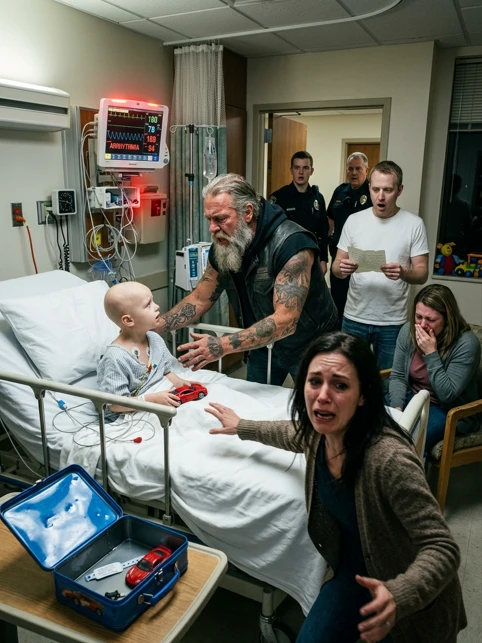
The toy car rolled across Eli’s blanket and stopped near his tiny hand. Bright red. Shiny enough to reflect the fluorescent hospital lights. My son stared at it like someone had handed him treasure.
Wade stood there waiting, shoulders wide enough to block half the doorway, beard streaked gray, arms covered in faded tattoos. He looked like trouble in human form. The kind of man parents warn children about.
My voice came out sharper than I meant it to. “Who sent you?”
He barely glanced at me. “Volunteer desk.”
Then he nodded toward Eli. “He the one who likes fast cars?”
Eli whispered yes before I could answer.
That should have been the moment I asked him to leave. Instead, I watched my child touch that toy Camaro with fingers bruised from IV needles, and I stayed silent.
The next morning, Wade came back.
Same boots. Same leather vest. Different car.
The day after that, he returned again. Then again. Then again.
Soon, the routine became stranger than the man himself. At exactly two-thirty every afternoon, the rumble of his Harley would echo outside the building. Nurses started checking their watches when they heard it. Eli started waiting for it an hour early.
Some days Wade sat cross-legged on the hospital floor, folding that giant body into impossible angles while he built race tracks from tape, paper cups, and cardboard trays. He made engine sounds so dramatic that children in nearby rooms laughed through their own pain.
Some days Eli was too weak to play.
On those days, Wade talked.
About old roads. About engines rebuilt from scrap. About getting lost and finding your way back. He spoke softly then, like he didn’t want to wake something painful inside himself.
And every single time Eli smiled, Wade looked relieved.
I noticed that before I noticed anything else.
I also noticed he never stayed for attention. Never asked for praise. Never told anyone what a good deed he was doing. He would arrive, spend hours with my son, then disappear before dinner.
One evening, I caught him in the hallway and said what any reasonable person would say.
“You don’t have to keep doing this.”
He was holding a tiny blue Corvette in one hand. He lined it up on the windowsill before answering.
“Yeah,” he said quietly. “I do.”
Something in the way he said it made my chest tighten.
Because it didn’t sound like kindness.
It sounded like punishment.
By then, Eli had been fighting leukemia for eight months. He was four years old and weighed less than some toddlers. I was surviving on coffee, fear, and whatever strength I could fake in front of him.
Family promised help and vanished.
Friends texted prayers and disappeared.
People always mean well until suffering becomes inconvenient.
But the biker kept showing up.
Rain hammered the windows one afternoon. He still came soaked to the bone.
A cold snap shut down half the city. He still came.
One day I arrived late from dealing with insurance paperwork and found him reading to Eli with different voices for every character while my son laughed so hard he coughed.
I stood outside the room and cried where neither of them could see me.
Then came the conversation that changed everything.
Two nurses were speaking near the supply closet. I wasn’t trying to listen. I only froze because I heard Wade’s name.
“Three years today,” one of them said softly.
The other sighed. “Since the Thompson accident. His grandson was the same age as the boy in 412.”
My stomach dropped.
“They were both in the car when the drunk driver—”
She stopped mid-sentence when she saw me.
No one says half a tragedy unless the other half is worse.
I walked back to Eli’s room like the floor was moving under me.
Inside, Wade was kneeling beside the bed, racing two toy cars across the blanket. Eli was giggling. Wade looked up.
Our eyes met.
And in that instant, he knew I knew there was a grave behind his kindness.
That night, after Eli finally fell asleep, I found Wade alone in the corridor near the vending machines. No toy cars. No jokes. No armor except the leather on his back.
“I’m sorry,” I said, though I wasn’t sure for what.
He swallowed hard. “His name was Owen.”
The words nearly broke in his throat.
“He loved red cars.”
I leaned against the wall beside him. We stood there in the cold hospital silence, listening to distant monitors beep.
He stared through the glass at Eli’s room. “After it happened, people kept telling me it wasn’t my fault.”
He laughed once, bitter and empty.
“That’s what they say when they don’t know where to put your pain.”
I didn’t interrupt.
His hands—those massive hands that could build entire cardboard cities for my son—were trembling.
“I was supposed to pick him up that day,” he said. “I got delayed.”
He didn’t look at me when he said the next part.
“Fifteen minutes.”
Such a small amount of time. Such a cruel number.
He rubbed a hand over his beard. “I was polishing my bike. Worried about chrome. Worried about shine. Thought fifteen minutes didn’t matter.”
The hallway suddenly felt too narrow to breathe in.
“If I had been on time,” he continued, “we would’ve taken another road. Another light. Another minute. Another life.”
He closed his eyes.
I had seen parents collapse from diagnoses. I had seen children scream through procedures. But there was something uniquely terrible about watching a grown man carry years of blame he could never set down.
“Why come here every day?” I asked.
The question came out barely above a whisper.
He finally turned to me. His eyes were red, but steady.
“Because I made a promise that if I ever got another chance to protect a child, I’d never be late again.”
The vending machine hummed behind us.
Somewhere down the hall, a baby cried.
And then Wade said the part I still wasn’t ready to hear.
“But that’s not the whole truth.”
He looked back through the glass. Eli had rolled in his sleep, one hand still resting on the red Ferrari Wade brought him weeks ago.
“To everyone else,” Wade said slowly, “I’m the man who failed his family.”
His jaw tightened.
“But when your boy sees me…” He stopped, trying again. “He looks at me like I’m somebody worth waiting for.”
I felt tears rise before I could stop them.
“He thinks I’m a hero,” Wade whispered. “And some days that’s the only thing keeping me alive.”
Everything I believed about saving people cracked open in that hallway.
I thought he had been rescuing my son from fear.
I realized my son had been rescuing him from the dark.
The next afternoon, Wade arrived earlier than usual.
He carried a small box wrapped in brown paper.
His face looked different—calmer, but like he’d made some private decision.
Eli clapped when he saw him.
Wade smiled, then glanced at me with an expression I couldn’t read.
He set the box on my son’s bed, reached into his vest, and pulled out something gold that caught the light.
Then footsteps thundered down the corridor, voices rose outside the door, and Wade said, “Before anyone stops me, there’s something both of you need to know…”
PART 2: The voices outside the room got louder, then the door swung open so hard it hit the stopper. Two security guards stepped in first, followed by a woman in an expensive coat and a man whose face looked carved from stone. Wade didn’t move. He only kept one hand on the brown paper box sitting beside Eli.
The woman saw him and instantly burst into tears. “There you are.”
Eli looked between all of us, confused. “Do you know them?”
Wade’s shoulders stiffened. For the first time since I met him, he looked scared.
The older man stepped forward, jaw clenched so tightly I thought his teeth might crack. He wasn’t angry in the loud way. He was angry in the kind of way that has lived inside someone for years.
He pointed at Wade. “You vanish for months, ignore every call, and this is where we find you?”
No one answered. Even the machines in the room sounded too loud.
I moved closer to Eli’s bed on instinct. My son’s eyes were wide, his little hand gripping the blanket. Wade noticed and lowered his voice immediately.
“It’s alright, kid.”
But it clearly wasn’t.
The woman wiped her face and looked at me. “I’m Owen’s mother.”
The room tilted for a second.
She turned back to Wade. “We searched everywhere. We thought you were dead.”
Wade stared at the floor. “Some days I was.”
There are moments when strangers suddenly become family through pain alone. Standing there, I realized this wasn’t just a reunion. It was a collision between grief, guilt, and years no one had survived.
The older man glanced at Eli, then at the toy cars lined across the windowsill. His expression changed in a way I can’t fully explain. Not softer exactly—just broken in a different place.
“He used to line Owen’s cars up like that,” he said quietly.
Eli reached for the gold key still in Wade’s hand. “Is that for me?”
Wade nodded, but his eyes never left the couple in the doorway. “Yeah, buddy. It is.”
Then the woman noticed the brown paper box.
Her breathing changed immediately.
“No,” she whispered.
She took one step back like the box itself had struck her.
I looked at Wade. “What’s in there?”
He swallowed hard. “Something I should’ve given them three years ago.”
The older man’s face went pale. “You kept that?”
Wade finally looked at me, and there was no hiding left in him now. “The police never found the last thing Owen was holding after the crash.”
Every hair on my arms lifted.
The woman covered her mouth and began to sob. Eli looked at me, not understanding why adults suddenly seemed made of glass.
Wade placed his shaking hand on the package.
“I couldn’t open it then,” he said. “I can barely open it now.”
He started peeling back the paper.
And that’s when my phone buzzed with a call from the hospital front desk saying officers were on their way upstairs…
I remember that moment with a clarity that still hurts.
The fluorescent lights. The sterile smell. The toy cars on Eli’s tray table. The way every adult in that room looked like one wrong word could split them open. And underneath all of it, the sound of my son’s shallow breathing, small and steady, as if his little body had no idea it was sitting in the middle of a reckoning that had been building for years.
I answered the call without taking my eyes off Wade.
“There are police officers asking for Mr. Wade Thompson,” the woman at the desk said. Her voice was careful, professionally calm in the way hospital staff learn to be when chaos arrives wearing ordinary clothes. “They were told he might be on this floor.”
I looked at Wade. He already knew. Of course he knew.
“Do you want security to hold them downstairs?” she asked.
My mouth went dry. “No.”
The word came out before I could think.
I hung up, and Wade gave me a look I will never forget—not gratitude exactly, but the expression of a man who had expected a door to slam shut and instead found it still open.
“They’re coming up,” I said.
The older man in the doorway drew in a long breath through his nose. Owen’s father. I still didn’t know his name then. He stood so rigid he looked as if he were bracing against impact.
His wife shook her head, tears running freely now. “Wade, what did you do?”
Wade’s hand tightened on the paper. “I didn’t do anything new.”
That sentence settled over the room like smoke.
Not new.
Which meant old.
Which meant unfinished.
Eli tugged weakly at my sleeve. “Mommy?”
I leaned down immediately. “I’m right here, baby.”
He pointed to the box. “Is there another car in there?”
The innocence of that question nearly destroyed me. Around us, grief had entered the room like a storm, and my four-year-old still believed every mystery ended with a toy.
Wade’s face changed when he looked at Eli. Some of the fear left it. Some of the shame too. “Not a car, buddy.”
“Then what?”
Wade glanced at Owen’s mother and father. “Something that belongs to family.”
The woman let out a broken sound and pressed a fist to her mouth.
For a second, nobody moved. Then Wade slowly peeled the paper away.
Inside was a dented metal lunchbox, blue with faded race cars across the top. One hinge was bent. The front latch had snapped off years ago. There was a dark scrape down one side, ugly and deep, the kind of mark metal keeps when violence touches it.
Owen’s mother made a sound I had only heard in the pediatric oncology ward after doctors used words like refractory and terminal. It was not crying. It was what happens when pain recognizes something before the mind can bear it.
“Oh God,” she whispered. “That’s his.”
Eli looked from the lunchbox to Wade to me. “Why is everybody sad?”
I pulled him gently against me, pressing his small head to my side. “Because it was very important.”
Wade didn’t open the lunchbox right away. He just stood there with it in both hands, like the weight of it was far greater than metal and rust and old paper could ever explain.
“I found it under the seat after the wreck,” he said.
The father finally spoke again. “The police searched that vehicle twice.”
“They searched what they could reach,” Wade said. “This was jammed under the frame. I saw the corner of it when they let me go back weeks later.”
“You should have told us,” the mother said, voice cracking on every word. “You should have brought it to us.”
“I know.”
But he did not sound like a man defending himself. He sounded like a man confessing at the edge of a cliff.
The father stepped farther into the room. “Why didn’t you?”
That was the question beneath everything. Not where he had been. Not why he disappeared. Not why the police wanted him. Just that one brutal thing: why keep the last piece of a dead child hidden from the people who loved him most?
Wade stared at the lunchbox for so long I thought he might not answer.
Then he did.
“Because it was the last thing in this world that proved he was still here.”
Nobody breathed.
His voice went rougher. “Everybody took everything else. The crash took him. The funeral took his face from memory and turned it into a photograph. The cemetery took his body. The grief took my daughter. The bottle took a year of my life. And this…” He looked down at the box. “This was the last thing he touched.”
Owen’s mother started sobbing again, not because she approved, not because she understood, but because grief does ugly things to good people and sometimes the truth is too broken to hate cleanly.
Wade swallowed. “Every time I tried to bring it back, I pictured your faces. I pictured the look in your eyes. I pictured you asking why I wasn’t there on time, and I knew you’d have every right to ask. So I kept delaying it. One week turned into a month. A month turned into a year. Then I became the kind of man who didn’t know how to walk into daylight.”
The father’s nostrils flared. “So you hid.”
“Yes.”
“You let us think the police lost it.”
“Yes.”
“You let my wife spend three years believing there was nothing left in his hands when he died.”
Wade’s eyes filled, but he did not look away. “Yes.”
There is a kind of honesty so raw it doesn’t soften anything. It just lays the knife on the table and steps back.
Eli shifted against me and whispered, “Mommy, is he in trouble?”
I kissed the top of his head. “Not from you, baby.”
The father heard that. He looked at Eli again, really looked at him. At the bald little head. At the hollow cheeks. At the toy cars arranged in a careful line. At the red Ferrari on the blanket.
Then something I didn’t expect happened.
His anger faltered.
Not vanished. Not forgiven. Just cracked.
Because whatever history had exploded into that room, it had exploded inside a hospital where another little boy was fighting for his life. Rage looks different when it has to stand beside innocence.
The mother took a shaky step forward. “Open it.”
Wade hesitated.
She said it again, stronger this time. “Open it.”
His fingers trembled against the metal lid. He lifted it slowly.
Inside were three things.
A folded sheet of paper, stained and wrinkled from age.
A little red plastic race car with one wheel missing.
And a hospital bracelet so tiny it looked unreal.
Owen’s mother collapsed into the nearest chair before her knees gave out completely. The father caught the back of it with one hand, his face drained of all color.
I couldn’t stop staring at the bracelet.
Because I knew exactly what it meant to keep one.
Parents in hospitals become archivists of survival. We keep wristbands, appointment cards, dried-up crayons from chemo waiting rooms, anything that proves our child was here on a day we were terrified to lose them.
Wade touched the folded paper but didn’t lift it.
“The police gave me his things in a clear bag after they inventoried the scene,” he said. “This note wasn’t in there. It was tucked under the lining in the lunchbox.”
The father’s eyes narrowed. “What note?”
Wade looked at him. Then at the mother. Then at me. Then finally at Eli, who had gone very still in that eerie way sick children do when they sense adults are standing at the edge of something enormous.
“I never read it all the way through,” Wade said.
That surprised all of us.
The father’s voice turned hard again. “You expect me to believe that?”
Wade nodded once. “I opened it that first night. Saw the first line. Recognized the handwriting. Couldn’t breathe after that.”
The mother’s face changed. “My daughter’s handwriting?”
Wade lowered his eyes.
That was when I understood the real center of the wound. Owen had not simply died in an accident. His death had blown apart every person attached to him. His parents. His mother. Wade’s daughter. Whoever she had been before that day no longer existed intact.
Wade reached into the box and lifted the note with both hands, like it might disintegrate. The paper was creased so many times it looked soft.
A knock sounded sharply at the open door.
Two police officers stood there.
Everything in the room tightened at once.
One officer was young, maybe early thirties, with the stiff posture of someone trying to appear more authoritative than he felt. The other was older, eyes tired, expression careful. Both took in the scene in one sweep: sick child, crying woman, furious man, tattooed biker, open lunchbox.
The younger officer fixed on Wade. “Mr. Thompson?”
Wade didn’t even turn fully. “Yeah.”
“We need to speak with you.”
The father stepped between them instinctively, though I couldn’t tell whether he was protecting Wade or blocking him from leaving. Maybe neither. Maybe he just needed to be standing somewhere other than inside his own memories.
“This is a hospital,” I said before anyone else could speak. “There’s a very sick child in this room.”
The older officer gave me a small nod. “Ma’am, we’re aware. We’re not here to make a scene.”
Too late, I thought.
The younger one glanced at the open lunchbox and frowned. “Sir, we received notice there may be evidence connected to the Thompson collision that was never turned over.”
The word evidence landed like ice water.
Wade closed his eyes once.
So that was it.
Not some fresh crime. Not violence. Not a warrant for something new. Just the law finally catching up with what grief had hidden.
Owen’s mother turned toward the officers, appalled. “He brought it back.”
“With respect, ma’am,” the younger officer said, “that doesn’t erase three years.”
“No,” Wade said quietly. “It doesn’t.”
Eli tugged at the blanket again. “What’s evidence?”
No one answered him.
The older officer looked uncomfortable, which made me trust him slightly more. “Mr. Thompson, we can discuss this outside.”
Wade shook his head. “No.”
The younger officer stiffened. “Sir—”
“No,” Wade repeated, louder now, then checked himself when Eli flinched. He lowered his voice immediately. “Not until they have this.”
He held out the folded note toward Owen’s mother, but she didn’t take it. Her hands were shaking too hard.
The father took one step closer. “Give it to me.”
Wade didn’t release it right away.
For a terrible second, I thought he was going to cling to it again, choose guilt again, choose fear again, and destroy whatever fragile bridge had been built in that room.
Then his fingers opened.
The father took the note.
The room became utterly silent.
Even the officers said nothing.
The mother stared at the paper in her husband’s hand as if it were explosive.
“What does it say?” I whispered, not because I thought anyone should answer me, but because silence had become unbearable.
The father carefully unfolded the top crease.
His eyes moved across the first line.
Then his entire face changed.
Not grief. Not anger. Something sharper. More stunned.
The mother saw it and grabbed his wrist. “What?”
He didn’t answer.
“What does it say?” she demanded again.
He looked at Wade with an expression so complicated I can still see it when I close my eyes. Accusation, yes. But also disbelief. And beneath that, something that looked horrifyingly like understanding.
Wade’s voice was barely audible. “Read it.”
The father swallowed and looked back down.
His lips parted, but before he could speak, a monitor behind me began shrieking.
Every adult in the room snapped toward Eli.
He had gone pale. Too pale. His little body tensed against the pillows, one hand pressed weakly to his chest, the other still reaching toward the red Ferrari on the blanket like he was trying not to let go of something small and certain while the world spun apart around him.
I dropped to the bedside instantly. “Eli?”
A nurse came running from the hall before I could hit the call button. Then another. Then a doctor. The room that had just been full of old grief was suddenly consumed by immediate terror, and that is one of the cruelest truths I know: the present does not pause just because the past has arrived bleeding.
“Mommy,” Eli whispered.
“I’m here.” My voice was shaking so hard it barely sounded like mine. “I’m right here.”
The doctor checked the monitor, then Eli’s line, then barked orders I no longer fully remember. Everything turned into motion and noise. Machines. Gloves. A crash cart dragged into the doorway. Someone guiding me back. Someone saying they needed space.
I refused to leave my son.
Wade was already there before anyone asked him to help. He moved to the other side of the bed, not interfering, just grounding. His hand hovered near Eli’s foot as if he knew better than to touch without permission.
“It’s okay, buddy,” he said, voice raw but steady. “Eyes on me. You hear that engine?”
And then, impossibly, he made that ridiculous low rumbling sound he used when racing toy cars on the floor.
Eli’s eyes flickered toward him.
The father still held the unfolded note.
The mother still had tears on her cheeks.
The officers had stepped back.
And in the middle of all that chaos, Wade—this scarred, haunted, broken man—was doing the only thing he had promised himself he would ever do again.
He was not being late.
After a minute that felt longer than entire months, Eli’s numbers steadied. The doctor’s shoulders lowered first. Then the nurses’. The room exhaled.
I nearly collapsed.
Someone eased me into a chair. I couldn’t tell who. My whole body was trembling so hard my teeth hurt.
The doctor looked at me with that careful expression hospital people wear when they know you are hanging over an abyss. “He’s stable. We need to monitor him closely, but he’s stable.”
Stable.
A word that means nothing and everything.
I started crying then, not politely, not quietly. The kind of crying that comes from too many days of fear stacked on top of each other until one extra ounce breaks the whole structure.
Wade stepped back, giving space the instant he knew Eli was safe. He never tried to claim the moment. Never tried to make himself central. He just stood there breathing hard, his own eyes wet.
The older officer cleared his throat awkwardly. “Mr. Thompson…”
But Owen’s father lifted a hand without even looking at him.
“Not now.”
It was not a request.
The officers exchanged a glance. Neither argued.
Owen’s mother rose slowly from her chair and crossed to Eli’s bed. She touched the rail lightly, like she was afraid of intruding on a miracle or a tragedy. Her face softened as she looked at him.
“He’s brave,” she whispered.
I nodded because I couldn’t trust my voice.
She looked at Wade next. “And he loves you.”
Wade flinched harder at that than he had at the police.
The father folded the note once. Then again. His hands were still unsteady, but his anger no longer looked simple. It had turned into something heavier, more dangerous to carry because it came with questions.
He faced Wade. “You should have given us this the day you found it.”
“Yes.”
“You had no right to keep it.”
“I know.”
“But if this note says what I think it says…” He stopped and glanced at his wife, then at me, then at the officers. “Then the story we all lived with for three years wasn’t the whole story.”
No one moved.
No one spoke.
The older officer frowned. “Sir?”
The father turned the paper over in his hands, then looked at Wade with a grief so old it seemed carved into his bones.
“My daughter wrote this the morning of the crash,” he said.
Wade’s throat worked. “I know.”
“She didn’t write it to Owen.”
“No.”
The mother’s eyes widened slowly, as if terror was dawning in layers. “Then who?”
The father closed his eyes.
When he opened them again, he looked straight at Wade.
And the answer was sitting there between them before a single word was spoken.
The room seemed to contract around that truth.
I felt it before I understood it.
The officers felt it too. I could tell by the way the younger one straightened and the older one went still.
Wade looked wrecked. Not because he was being accused. Because whatever was in that note had been burning through him alone for three years, and he had finally run out of places to hide from the fire.
Owen’s mother took a step back, one hand on her chest. “No.”
The father’s voice dropped to almost nothing. “Read the first line.”
Wade didn’t move.
The father unfolded the paper again.
My heart was pounding so hard I could hear it in my ears.
Outside the room, the hospital continued on—carts rolling, phones ringing, footsteps passing, other families living inside their own private disasters. But inside room 412, every life had narrowed to one folded sheet of paper and the man who had carried it like a wound.
The father drew in a breath to read.
And just before the words left his mouth, Wade looked at Eli, then at me, and whispered, “Whatever happens after this, the gold key is his.”
Then the father began to speak…