PART 3
I paused.
“It was a home when I had nowhere to go.”
Ruth lowered her eyes. Walt rubbed his thumb against the brim of his hat.
I continued.
“Eleven days after I buried my husband, I arrived at my mother’s house with two one-year-old babies, a truck full of our belongings, and $412 to my name. I wasn’t asking her to buy me a house. I wasn’t asking her to pay my bills. I was asking for somewhere safe for my children to sleep.”
My mother stopped smiling.
“She stood in her doorway and told me she couldn’t deal with my situation. Then she went inside and turned off the porch light.”
A murmur traveled through the audience.
I could hear the faint click of a camera.
“I sat in a gas station parking lot that night, holding my daughter while my son slept in his car seat. I wondered how I was going to feed them, how I would keep the ranch running, and how I could possibly survive a future I had never imagined living without Daniel.”
I looked at Ruth.
“Then I called the woman who had just lost her son.”
Ruth’s lips trembled.
“She didn’t ask how much money I had. She didn’t ask how long I intended to stay. She didn’t ask whether I could repay her. She simply told me to stay where I was, and forty-one minutes later, she and Walt arrived.”
I smiled through the tears gathering in my eyes.
“They gave my children blankets. They brought me food. They took us into their home, and from that night forward, they never made us feel like a burden.”
Walt looked away, wiping his cheek with the back of his hand.
I waited until the room became quiet again.
“Some people are family because they’re related to you. Others become family because, when the world leaves you standing in the dark, they turn on the light.”
Then I turned toward the front row.
My mother had gone pale.
My father sat completely still, his hands clasped tightly between his knees. Travis had stopped whispering to the reporter beside him.
I picked up the final document from the podium.
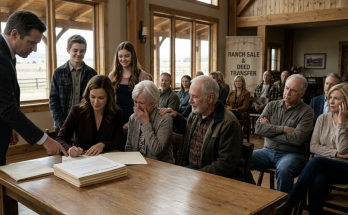
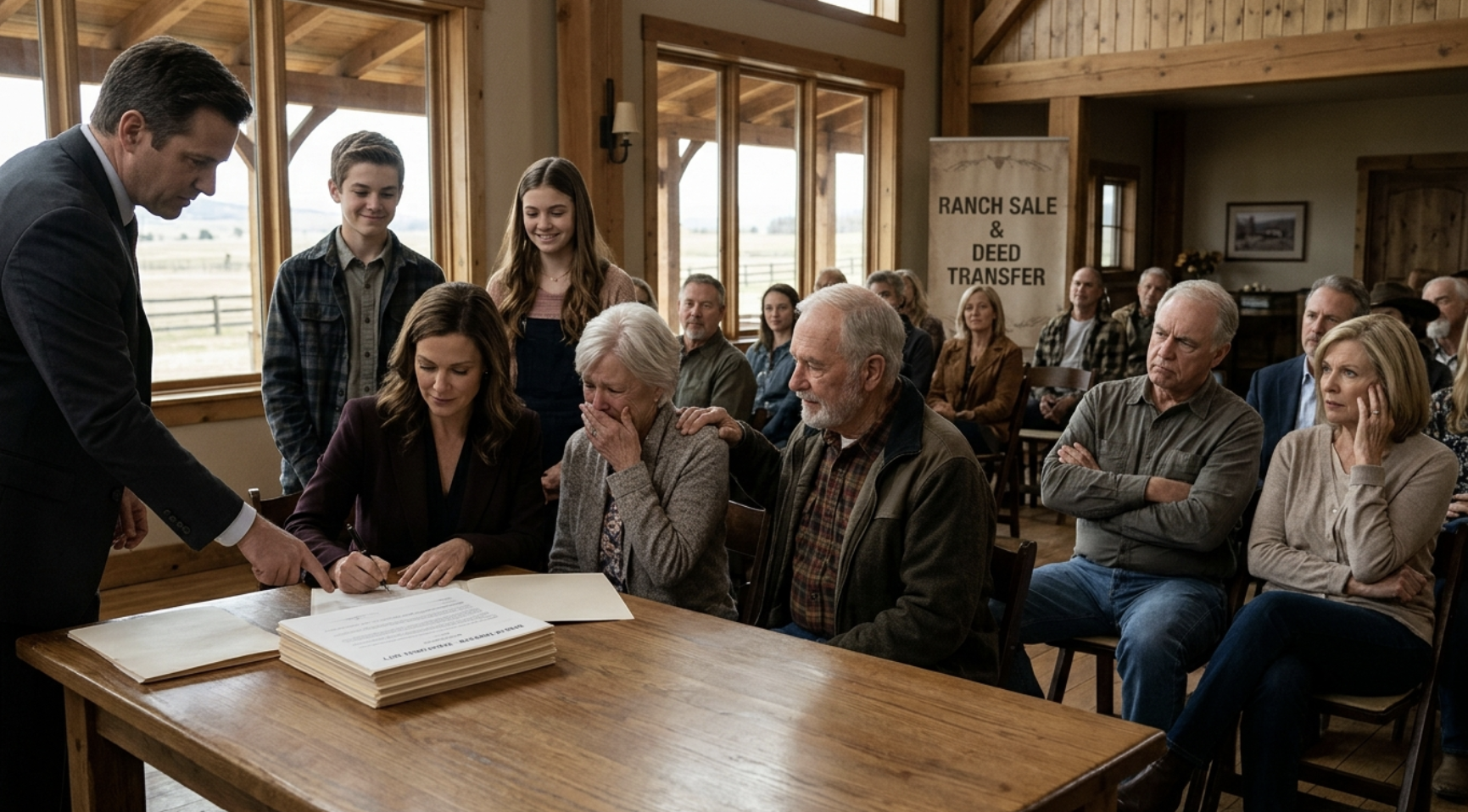
“The company purchasing this ranch has agreed to a sale price of one hundred million dollars. The legal arrangements have been reviewed, and the transfer documents are ready.”
My mother’s expression changed.
She leaned forward, apparently convinced that the next sentence would finally give her the recognition she had traveled there to receive.
I looked directly at Ruth and Walt.
“And today, I am making an announcement that means more to me than the sale itself.”
I held up the document.
“Ruth and Walt Callaway will receive the entire net proceeds of this sale, as provided for in the transfer agreement we’ve prepared. They will have the financial freedom to live the rest of their lives without worrying about money, and they will have the resources to support the causes they care about.”
The room erupted in applause.
Ruth covered her mouth.
Walt stood up so suddenly that his chair scraped against the floor.
“Beth,” he whispered, shaking his head. “Honey, you don’t have to do this.”
I smiled at him.
“I know. That’s why I want to.”
But I wasn’t finished.
“The ranch itself will be sold to the development company under the agreement we’ve signed. My children and I will retain the investments and savings we’ve built outside this transaction. And the people who helped us build this business will receive the bonuses and benefits we’ve promised them.”
I glanced toward my parents.
“Because this isn’t about punishing anybody. It’s about honoring the people who showed up when it mattered.”
My mother rose halfway out of her chair.
“Beth,” she said, her voice suddenly sweet, “we need to talk about this.”
I heard her clearly through the microphone.
I turned toward her.
“We can talk later, Mom. Today isn’t about us.”
She slowly sat back down.
For the first time since I had known her, she seemed unable to find the right words.
And then the reporter sitting beside Travis asked the question that changed everything.
“Mrs. Callaway, is it true that your parents refused to take you in after your husband’s death?”
My mother looked at the reporter as though he had insulted her.
“That is a private family matter,” she replied sharply.
I placed the microphone back near my mouth.
“It was a private family matter until my family arrived today and began telling people a different story.”
The room fell silent again.
I reached into the folder beside me and removed a second set of papers.
“Six years ago, my brother accidentally forwarded me an email conversation between my parents. I saved it because I couldn’t understand why they had been so willing to let me struggle, yet so interested in staying connected to my life.”
Travis’s face changed.
He knew exactly what I was talking about.
I didn’t read every message aloud. I didn’t need to.
I simply explained that the correspondence showed my parents discussing the possibility that the ranch might become valuable and suggesting they maintain contact in case my financial circumstances improved.
“I spent years wondering whether they regretted what happened that night,” I said. “Those emails made me realize that, while I was trying to rebuild my life, they were already thinking about what my future success might mean for them.”
My father finally stood.
“Beth, those messages were taken out of context.”
I looked at him.
“Then tell me what context makes turning off the porch light while your widowed daughter sits outside with two babies the right thing to do.”
He opened his mouth.
Nothing came out.
My mother began crying, but I could not tell whether it was regret, embarrassment, or the realization that the money she had expected to celebrate would never be hers.
Perhaps it was all three.
I returned my attention to the audience.
“I’m not asking anyone here to hate my parents. I’m not asking anyone to take sides. I’m simply telling you why I chose to give this ranch’s proceeds to the people who helped me save it.”
I looked at my twins.
Clare was holding Ruth’s hand. James sat beside his grandfather, swinging his legs beneath his chair.
They were eight years old now.
They had grown up knowing that their father had loved them, that their grandparents had helped raise them, and that kindness mattered more than appearances.
I wanted them to remember this day for the right reasons.
“Money can purchase land, buildings, horses, and beautiful homes,” I said. “But it cannot purchase the years someone spends helping you through grief. It cannot repay the nights someone stays awake with a sick child. And it cannot replace the people who choose to love you when loving you costs them something.”
Then I stepped away from the podium.
Ruth reached me first.
She wrapped her arms around me and began sobbing.
Walt joined us, holding both of us tightly.
For a moment, the cameras, reporters, investors, and three hundred guests disappeared.
We were simply a family that had survived something terrible together.
And in the front row, my parents watched the family they had once turned away embrace the woman they had expected to become rich.
But I had no idea that, before the evening ended, my mother would approach me with a confession that would force me to reconsider everything I thought I knew about the night Daniel died.
Part 3: The Secret My Mother Had Kept for Eight Years
The celebration continued for nearly two hours.
People congratulated Ruth and Walt. Employees hugged one another. Several longtime ranch hands cried when I announced their bonuses, and the development company’s representatives confirmed that the closing would proceed according to the signed agreement.
I tried to enjoy the evening.
I really did.
But every time I looked across the room, I saw my mother standing alone near the entrance.
She wasn’t speaking to the guests anymore.
She was watching me.
Finally, just as the sun began to disappear behind the western pasture, she approached me.
“Beth, please. I need five minutes.”
I looked toward Ruth, who was helping Clare arrange flowers on a table.
Then I nodded.
We walked away from the crowd and stopped beside the old wooden fence Daniel and I had repaired during our first year of marriage.
My mother looked older than I remembered.
There were deep lines around her mouth, and her hands trembled as she tried to straighten the sleeves of her jacket.
“I know you hate me,” she said.
“I don’t hate you.”
“Then why would you do this to me in front of everyone?”
I stared at her.
“Mom, I told the truth about what happened. You were the one who came here and told strangers you had always supported me.”
She lowered her eyes.
“I was ashamed.”
“So was I. I was ashamed that my own mother wouldn’t let me and my babies sleep in her house. But I never lied about you afterward.”
She flinched.
For several seconds, neither of us spoke.
Then she whispered, “There is something you don’t know about that night.”
I felt my stomach tighten.
“What?”
She glanced toward the crowd, making sure nobody was close enough to hear.
“Your father wanted to take you in.”
I stared at her.
“What are you talking about?”
“He wanted you to stay. He told me we could put the twins in the spare bedroom. He even went upstairs to change the sheets.”
My mother’s eyes filled with tears.
“But I refused.”
I waited for her to explain.
She looked toward the ranch house.
“I was afraid you’d stay longer than a few days. I was afraid we’d have to help you financially. Your father and I had retirement plans, and I convinced myself that taking you in would mean sacrificing everything we’d worked for.”
My hands began to shake.
“You let me drive away because you didn’t want to spend money on your grandchildren?”
She nodded, crying.
“Yes.”
I had imagined many explanations over the years.
I had wondered whether my mother was angry with me, whether she blamed me for Daniel’s death, or whether she simply didn’t care.
But the truth was painfully ordinary.
She had chosen her comfort over my desperation.
“And the emails?” I asked.
She wiped her cheeks.
“I thought that if you became successful, perhaps you’d forgive us. I thought we could become close again. I told myself we could repair things once the hardest years were behind you.”
“You wanted to wait until I didn’t need anything from you.”
She didn’t answer.
Because we both knew I was right.
I turned away.
“Why are you telling me this now?”
Her next words stopped me.
“Because your father has been sick.”
I looked back at her.
“What?”
“He was diagnosed with a serious heart condition last year. He’s receiving treatment, but it’s been difficult. He hasn’t wanted you to know.”
I felt a sudden rush of conflicting emotions.
Part of me wanted to ask why she hadn’t called sooner.
Another part remembered the countless nights I’d spent worrying about my children, the bills, the horses, and the future.
When Daniel died, I had needed my parents.
They had chosen not to be there.
Now my father was ill, and my mother was standing before me asking for something I couldn’t quite identify.
Forgiveness, perhaps.
Or simply the chance to stop feeling guilty.
“Does Dad know you came to talk to me?” I asked.
She nodded.
“He told me I should apologize.”
“Did he tell you to tell me about his condition?”
She hesitated.
“No.”
I took a deep breath.
“Mom, I’m sorry Dad is sick. I truly am. But his illness doesn’t erase what happened, and it doesn’t mean I can pretend we have a relationship we never built.”
She began to cry harder.
“I know.”
“I hope he gets better. If he wants to speak to me honestly, I’ll listen. But I’m not going to hand over money because we’re related, and I’m not going to pretend that giving Ruth and Walt this money was a mistake.”
“I never said it was.”
“You didn’t have to.”
She looked down at her hands.
For the first time that evening, she didn’t try to defend herself.
She simply nodded and walked away.
I stood beside the fence for several minutes, listening to the wind move through the grass.
Then I heard a familiar voice behind me.
“Beth?”
It was Walt.
He had come looking for me.
“Everything all right, sweetheart?”
I told him what my mother had said.
He listened without interrupting, then placed a gentle hand on my shoulder.
“You don’t have to forgive someone before you’re ready,” he said. “And you don’t have to hate them forever, either. Just don’t let their choices decide who you become.”
I leaned against him and cried.
Because that was the difference between the family I had been born into and the family that had chosen me.
Ruth and Walt never told me what I owed them.
They never treated their kindness like a loan.
They never made me earn my place at their table.
And somehow, without even realizing it, they had taught me how to become the kind of person I wanted my children to remember.
That night, after the guests had left, Clare and James sat with me on the porch.
“Mom,” Clare asked, “why did Grandma look so sad?”
I thought carefully before answering.
“Sometimes grown-ups make choices that hurt people they love. And sometimes they don’t know how to fix those choices afterward.”
“Are we going to see her again?” James asked.
“If we can find a healthy way to be part of each other’s lives, yes. But we don’t have to pretend something didn’t happen just because someone says they’re sorry.”
James nodded slowly.
Then Clare slipped her hand into mine.
“I’m glad Grandma Ruth came to get us.”
I kissed the top of her head.
“So am I, sweetheart.”
Neither child knew how close we had come to losing everything that first year.
They didn’t know how many nights I’d cried over the bills, how often I’d considered selling the horses, or how frightened I’d been when I realized I had to become both parents overnight.
But they knew who had been there.
And that was enough.
Over the following weeks, the sale moved toward completion. The ranch’s employees received their promised benefits, the development company prepared to take ownership, and Ruth and Walt worked with financial advisers to decide how they wanted to use their new resources.
They set aside money for their retirement, established education funds for Clare and James, and created a charitable program to help families facing sudden financial hardship after the death of a spouse.
Ruth named it the Daniel Callaway Family Relief Fund.
When I asked her why, she smiled.
“Because your husband would have wanted another family to have a little help before they reached the point where they had nowhere left to turn.”
I cried when she told me.
Not because of the money.
Because Daniel’s kindness was still alive in the people he had left behind.
And for the first time in years, I felt that the life we had built together would continue to mean something beyond the boundaries of our ranch.
But there was still one conversation I hadn’t had.
My father had called twice.
I hadn’t answered.
Then, one quiet Sunday morning, I found a handwritten letter in my mailbox.
It was from him.
The first line read:
Beth, I have spent eight years telling myself that your mother made the decision that night. The truth is that I let her make it, and I have regretted my silence ever since.
I sat down at the kitchen table and began to read.
My Parents Turned Me Away With My Twins After My Husband’s Funeral—Years Later, I Gave My $100 Million Ranch to the In-Laws Who Saved Us
Part 1 of 2