My father’s letter was four pages long.
He didn’t ask me for money.
He didn’t mention the ranch sale.
He didn’t tell me I owed him forgiveness because he was ill.
Instead, he wrote about the night I had arrived at my mother’s house.
He remembered seeing me through the front window, standing on the porch with a diaper bag hanging from my shoulder.
He remembered my daughter crying in the truck.
He remembered telling my mother that we should let me stay.
And he remembered doing nothing when she refused.
I have spent years telling myself that I was powerless, he wrote. But I wasn’t powerless. I was afraid of arguing with your mother, and I chose the easier path. I allowed you to leave because I didn’t want conflict in my own home.
I read that paragraph several times.
My father had always been a quiet man.
Growing up, I had mistaken his silence for patience. I had assumed that because he rarely raised his voice, he was also the person who would stand beside me when something truly mattered.
Now I understood that silence could hurt just as much as cruelty.
He continued.
I heard later that Daniel’s parents had taken you in. I wanted to call you, but your mother said we should give you space. Then months passed, and calling became harder. Every year, I told myself I’d find the right words. Every year, I waited too long.
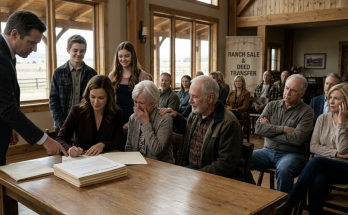
He admitted that he had read the emails about the ranch’s possible value.
He admitted that he had said nothing when my mother suggested keeping in touch in case I became wealthy.
And he admitted that, when Travis began experiencing financial problems, he had encouraged my brother to contact me.
I told myself that helping your brother might give us an opportunity to reconnect. But I understand now that I was thinking about what we wanted from you instead of what you needed from us.
At the bottom of the final page, he wrote one sentence that broke my heart.
I cannot ask you to remember me as a good father. I can only ask whether you might allow me the chance to do one honest thing before I run out of time.
I folded the letter and sat quietly for a long time.
Then I called him.
He answered on the second ring.
“Beth?”
His voice sounded smaller than I remembered.
“Hi, Dad.”
For several seconds, neither of us spoke.
Then he began to cry.
“I didn’t think you’d call.”
“I read your letter.”
“I meant every word.”
I looked out the kitchen window toward the pasture.
“I can’t change what happened,” I told him. “And I can’t promise that everything will be the way it was before.”
“I understand.”
“But if you want to know your grandchildren, you can start by being honest with them. No stories about how you helped build the ranch. No pretending you were there when you weren’t. Just be their grandfather.”
He agreed immediately.
We arranged to meet at a small café the following weekend.
I didn’t tell Ruth or Walt until after the call. When I did, Ruth simply squeezed my hand.
“Whatever happens, sweetheart, you don’t have to go through it alone.”
The meeting with my father was awkward.
He arrived early and sat near the window, turning a coffee cup between his hands. When Clare and James walked in, he stood so quickly that his chair nearly tipped over.
“Hello, you two,” he said.
The twins greeted him politely.
He had brought them small gifts, but he didn’t use them to demand affection. He asked about school, listened to James describe a science project, and laughed when Clare explained why she wanted to become a veterinarian.
For the first time, I watched my father simply be present.
When we were leaving, he approached me beside the car.
“Thank you for letting me see them.”
“Don’t thank me yet,” I said gently. “Trust takes time.”
“I know.”
He didn’t ask about the money.
He didn’t mention the ranch.
And he didn’t ask me to forgive him.
That was the beginning.
Over the next year, he kept his promises. He called when he said he would. He showed up for the twins’ school events. He listened when they spoke, and he never tried to rewrite the past.
My mother took longer.
She sent messages that were often filled with explanations before apologies. Sometimes I replied. Sometimes I didn’t.
Eventually, she wrote a letter of her own.
It was shorter than my father’s.
She admitted that she had been selfish, that she had prioritized her comfort over her daughter’s safety, and that she had been ashamed of the truth when I finally spoke about it publicly.
She didn’t ask me to send her money.
She didn’t ask me to change the ranch agreement.
She simply wrote:
I cannot undo the night I turned off that light. I wish I could. I am sorry I made you learn what family should mean from someone other than me.
I read it twice.
Then I placed it in the same drawer where I kept Daniel’s old letters.
I wasn’t ready to call her.
But I no longer felt the need to rehearse arguments with her in my head.
For years, I had carried the memory of that porch light as though I had to keep it burning inside me to prove what happened.
Now I could remember it without allowing it to control every day that followed.
I began to understand that moving forward didn’t mean declaring the past harmless.
It meant refusing to let the worst night of my life become the only story I ever told myself.
And the best part was that my children were learning something different from what I had learned.
They were learning that love meant showing up.
They were learning that apologies mattered most when followed by changed behavior.
And they were learning that generosity was a choice, not a debt.
Three years after the sale, Ruth and Walt invited the entire family to the opening of the Daniel Callaway Family Relief Fund’s first permanent center.
The center would provide temporary housing assistance, emergency childcare support, and practical financial guidance for widowed parents and families facing sudden hardship.
I stood beside Ruth at the entrance while my father helped the twins arrange flowers near the doorway.
My mother arrived quietly.
She didn’t approach the reporters.
She didn’t tell anyone she had always believed in me.
She simply walked up to Ruth and Walt.
“I don’t know if I deserve to be here,” she said.
Ruth considered her for a moment.
“This isn’t about what any of us deserve,” she replied. “It’s about helping people who need help.”
My mother nodded.
Then she turned to me.
“I know I can’t ask you to forget.”
“No,” I said. “You can’t.”
She swallowed.
“But I hope one day you can look at me without remembering only that night.”
I looked at her for a long moment.
“I already remember more than one thing about you, Mom. But that night will always be part of our story. What happens next is up to us.”
She began to cry.
I didn’t hug her immediately.
I didn’t promise that everything was forgiven.
But I reached for her hand.
It was a small gesture, and it didn’t erase eight years of hurt.
Still, it was honest.
And sometimes an honest beginning is more valuable than a perfect apology.
That afternoon, Clare and James helped Ruth cut the ribbon at the center.
My father stood nearby, smiling through tears.
Walt gave a short speech about Daniel, about the ranch, and about the night he and Ruth had driven to the gas station to bring us home.
He didn’t mention the money.
He spoke about the two babies sleeping beneath borrowed blankets and the young mother who had been terrified but refused to give up.
Then he looked at me.
“People sometimes think wealth is what makes a person successful,” he said. “But I think success is what you do when you finally have enough to help someone else.”
The crowd applauded.
I stood beside the man who had become a father to me in every way that mattered.
And I knew that the ranch sale had never been the real ending.
It had simply given us the means to begin something bigger.
Something that would continue helping families long after the fences had been removed and the barns belonged to someone else.
That night, after the celebration, I returned home with my children.
They were tired, happy, and full of questions about the families who would receive help from the center.
As I tucked them into bed, Clare looked up at me.
“Mom, do you think Dad would be proud of us?”
I kissed her forehead.
“I think he would be proud of what we’ve done with the love he left us.”
James reached for my hand.
“And Grandpa Walt?”
I smiled.
“Especially Grandpa Walt.”
They laughed softly, and soon both were asleep.
I walked downstairs and opened the drawer where I kept Daniel’s wedding photograph.
For years, I had believed that losing him meant losing the future we had planned together.
But our children had grown up surrounded by people who loved them. The business we had built had become a source of help for other families. And the people who had once been strangers to me had become the foundation of a life I never could have imagined.
I looked at Daniel’s photograph.
“I think we’re going to be all right,” I whispered.
Then I turned off the kitchen light and walked upstairs.
This time, the darkness outside didn’t frighten me.
Because I had finally learned something I wished I’d understood long before that terrible night in Texas.
Family isn’t measured by who shares your blood, who sits in the front row, or who celebrates when you succeed. It’s measured by who opens the door when you have nothing left to offer them.
And the people who opened their door to me and my babies never once asked what they would get in return.
That was why, when I had the chance to change their lives, I didn’t hesitate.
Not because they expected it.
Not because I owed them.
But because they had loved us when love was the only thing they had to give.
And that was worth more than one hundred million dollars.
PART 4
Ten years after Daniel’s death, I returned to the old gas station where Ruth and Walt had found me that terrible night.
The building had been renovated, but the parking lot remained almost unchanged. I stood beside my truck, remembering the frightened young mother who had sat there with two babies, wondering how she would survive another day.
I wasn’t that woman anymore.
Clare and James were eleven now. They were healthy, confident, and surrounded by people who loved them. The Daniel Callaway Family Relief Fund had helped hundreds of struggling families, including widowed parents who needed somewhere safe to stay.
And Ruth and Walt were still the heart of our family.
One evening, I invited everyone to dinner at their house.
My father came. My mother came, too, arriving quietly with a homemade pie. Things between us weren’t perfect, but we had begun rebuilding our relationship slowly, one honest conversation at a time.
After dinner, my father pulled me aside.
“I need you to know something,” he said. “Giving that money to Ruth and Walt was the right decision. I finally understand that you weren’t trying to punish us. You were honoring the people who helped you survive.”
I looked at him and nodded.
“I needed you to understand that family isn’t something we can claim only when it benefits us.”
“I know,” he whispered.
Then he hugged me.
It wasn’t a magical moment that erased everything. It was simply a father acknowledging the daughter he had failed and trying, at last, to do better.
Later that evening, Ruth handed me Daniel’s old childhood quilt. The same quilt she’d wrapped around Clare at the gas station.
“I thought you should keep this,” she said.
I held it against my chest.
“Thank you for everything you’ve done for us.”
She smiled.
“Beth, you don’t owe us anything.”
“I know,” I replied. “That’s what makes it mean so much.”
A few weeks later, Walt took me to visit the ranch one last time before the new owners completed their plans for the property.
We walked past the old barns and the fence Daniel and I had repaired together. The pastures looked beautiful beneath the Texas sunset.
“I sometimes wish Daniel could have seen what you accomplished,” Walt said.
I swallowed the lump in my throat.
“So do I.”
“He would have been proud.”
I looked across the land where we’d once struggled to keep our dreams alive.
“Then I hope he would also be proud of what we’re doing with it now.”
Walt placed his hand on my shoulder.
“He would be.”
Before we left, I turned toward the house one final time.
I remembered the woman I’d been when I arrived there with $412, two babies, and a broken heart.
I remembered how Ruth had opened her arms without asking questions.
I remembered how Walt had carried my children’s car seats as carefully as though they were the most precious things in the world.
And I remembered the promise I’d made to myself that night: if I ever became strong enough to help another person, I would never turn them away simply because their troubles were inconvenient.
That promise became my inheritance from Daniel, Ruth, and Walt.
Not the money.
Not the land.
The love.
Years later, Clare became a veterinarian, while James studied business and helped expand the family relief fund. They grew up understanding that wealth was useful, but kindness was what gave wealth its purpose.
My parents remained part of our lives, though our relationship was never exactly what it had been before. Some wounds healed. Others left scars. I learned that forgiveness didn’t require pretending the past had never happened.
And whenever someone asked me why I’d given the ranch proceeds to my in-laws instead of my own parents, I answered honestly.
“Because when I had nothing, they gave me everything that mattered. When I finally had something valuable to give, I knew exactly who deserved it.”
I never regretted that decision.
Not once.
Because my mother had turned off her porch light when I needed her most.
But Ruth and Walt had driven forty-one minutes into the night to find me.
They didn’t see a burden.
They saw a daughter, two grandchildren, and a family that needed help.
And that is why the greatest gift I ever received wasn’t the ranch, the business, or even the hundred million dollars.
It was discovering that even after the worst night of my life, there were still people willing to leave the light on.
The end.
My Parents Turned Me Away With My Twins After My Husband’s Funeral—Years Later, I Gave My $100 Million Ranch to the In-Laws Who Saved Us
Part 2 of 2