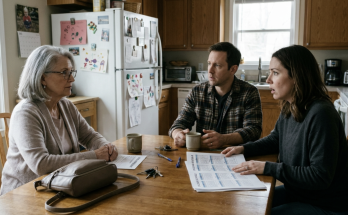
A month later, Kristen called me on a Wednesday morning.
I was preparing to leave for the community garden when my phone rang.
“Marilyn, do you have a minute?”
“Of course.”
She sounded hesitant.
“I wanted to talk to you about something. I’ve been thinking about the way things happened before you moved.”
I sat down at the kitchen table.
“All right.”
“I know we made you feel as though we were deciding your life for you.”
I remained quiet.
She continued.
“When I told Nathan you should move out, I was thinking about the space in the house, the children’s routines, and how difficult everything had become. I didn’t really think about what it would feel like for you to hear that.”
I looked out the window.
“Thank you for acknowledging that.”
“And the schedule we made…”
She exhaled.
“It was unfair. We should have asked what you wanted instead of assuming you’d keep doing everything.”
I could hear the discomfort in her voice.
Apologizing wasn’t easy for her.
It hadn’t always been easy for me, either.
“I appreciate you telling me,” I said.
“I don’t expect everything to be fine just because I said I’m sorry.”
“That is true.”
“But I’d like us to have a better relationship. I don’t want you to feel as though you have to help us to be welcome in our family.”
Those words stayed with me.
For two and a half years, I had quietly wondered whether my place in the family depended on how useful I could be.
Hearing Kristen say that I didn’t have to earn my place was something I hadn’t realized I needed.
“I would like that, too,” I replied.
There was a pause.
Then she asked, “Would you like to come over for coffee sometime? Just the two of us?”
I smiled.
“I’d like that.”
We agreed on the following Thursday.
When the call ended, I remained at the table for a moment.
Forgiveness, I had learned, wasn’t always a dramatic declaration.
Sometimes it was simply the decision to leave a door open while still keeping the key to your own home.
I didn’t need Kristen to become my closest friend.
I didn’t need her to understand every choice I made.
I only needed us to treat each other with honesty and respect.
That was enough to begin again.
By early summer, my new life had developed a rhythm.
On Tuesdays, I attended pottery class.
On Thursdays, I joined the book club.
Saturday mornings often found me tending my garden plot, where I had successfully grown lettuce, tomatoes, and enough basil to make more pesto than one woman could reasonably eat.
Eleanor visited twice.
We walked beside the river, explored the little bookstore, and spent an entire afternoon painting flowers at my kitchen table.
One afternoon, she watched me arrange my brushes and smiled.
“You look different.”
“Different how?”
“Lighter.”
I considered that.
“I think I am.”
“You were always smiling when I saw you before, but it was as if you were waiting for someone to call your name.”
I looked down at my paints.
“That sounds about right.”
Eleanor reached across the table.
“I’m glad you finally chose yourself, Marilyn.”
I felt tears gather in my eyes.
“So am I.”
My grandchildren visited regularly.
Sometimes Nathan and Kristen brought them on Saturdays. Other times, I drove to their house when I had planned a visit and felt comfortable making the trip.
The difference was simple.
We arranged our time together.
Nobody assumed it.
And because our visits were no longer built around an endless list of obligations, they began to feel more precious.
Chloe would show me her schoolwork.
Owen would demonstrate whatever new skill he had learned.
We baked cookies, walked by the river, and sat on the balcony watching the boats pass.
One Saturday, Chloe looked around my apartment and announced, “Grandma, your house feels happy.”
I laughed.
“What makes you say that?”
She shrugged.
“You smile more here.”
I looked at her little face.
Children often notice things adults spend years trying to hide.
“Perhaps I do,” I said.
She leaned against me.
“I like happy Grandma.”
I kissed the top of her head.
“So do I, sweetheart.”
Then came the afternoon that changed the way I understood everything that had happened.
It was late July.
I had just returned from the garden when Nathan called.
“Mom, do you have time to talk?”
“I’m home. What’s wrong?”
“Nothing’s wrong. Actually, I wanted to ask you something.”
I sat down beside the window.
“Go ahead.”
He took a breath.
“Kristen and I have been discussing our plans for next year. Her work may require her to travel more often, and my department is changing schedules.”
I waited.
“We’re going to need to make some adjustments with the children.”
I smiled slightly.
“Have you considered after-school care?”
“Yes. We’ve looked into a few options.”
“And?”
“We found one that seems good. It’s not cheap, but it would cover most of the afternoons.”
“That sounds promising.”
“It does.”
He paused.
“There’s something else, though.”
“What is it?”
“We wanted to ask whether you’d like to have the kids stay with you for one Saturday each month. If you’re available, of course.”
I looked at the calendar on the table.
One Saturday each month.
Not every weekend.
Not every holiday.
Not an open-ended promise to be available whenever their plans changed.
They were asking.
And they were giving me room to say no.
“I’d love to have them stay sometimes,” I answered. “Let’s look at the calendar together.”
“Great. And if you have other plans, just tell us. We’ll work around them.”
I felt a lump rise in my throat.
“Thank you, Nathan.”
“Why are you thanking me?”
“Because you asked.”
He went quiet.
Then he said, “I should have done that a long time ago.”
“Yes,” I replied gently. “You should have.”
Neither of us tried to fill the silence.
We didn’t need to.
When we ended the call, I looked at Paul’s photograph.
For years, I had thought that if I stopped doing everything, I might stop being needed.
But the truth was more complicated.
I was still needed.
I was still loved.
And now, perhaps, I was beginning to be seen.
In August, Nathan and Kristen invited me to a family barbecue.
When I arrived, Kristen was arranging plates on the patio while Nathan grilled chicken.
The children were running through the garden.
I brought a bowl of salad and a small cake from the bakery near my apartment.
Kristen thanked me and placed them on the table.
Nobody asked me to help with anything else.
After dinner, Nathan raised his glass.
“I want to say something.”
Everyone looked at him.
“Before Mom moved, we made a lot of assumptions about what she would continue doing for us. We were so used to her help that we forgot she had her own life.”
He looked at me.
“I don’t think we ever properly thanked you for everything you did. Not just the big things, but all the little things that made our lives easier.”
My eyes began to sting.
Nathan continued.
“I’m sorry we made you feel like your place in our family depended on how much you could do for us. It shouldn’t have been that way.”
Kristen put down her glass.
“I owe you an apology, too,” she said. “I was so focused on what our family needed that I didn’t consider what you needed. I treated your time as if it were already ours to plan.”
She looked directly at me.
“You deserved better than that.”
For a moment, I couldn’t speak.
I had imagined receiving an apology many times during those first lonely weeks in my apartment.
In some versions, I had imagined myself explaining every hurt in detail.
In others, I had imagined walking away and never looking back.
But now that the apology was happening, I discovered that I didn’t want to punish them.
I wanted them to understand.
And I wanted to move forward without carrying the same pain into every new day.
“Thank you,” I said finally. “I know raising children and building careers is difficult. I never wanted to make your lives harder.”
Nathan shook his head.
“You didn’t.”
“I wanted to help because I love you. But I needed you to remember that I am a person with needs and dreams, too.”
“We understand that now,” Kristen said.
I looked around the patio.
The children were chasing bubbles near the fence. Eleanor had come as my guest, and she was talking with Kristen’s mother about the community garden.
The evening sunlight fell across the table.
I thought about the woman I had been when I first moved into this house.
She had believed that keeping everyone happy was the best way to keep a family together.
She had confused being needed with being valued.
She had waited for someone else to notice that she was tired.
I wished I could reach back through time and tell that woman something.
You are allowed to want more.
You are allowed to rest.
You are allowed to have a life that belongs to you.
And you do not have to wait for permission.
I lifted my glass.
“To family,” I said.
Nathan smiled.
“To family.”
Kristen raised her glass, too.
This time, the word meant something different.
It didn’t mean that one person would carry everyone else.
It meant that everyone would learn to carry their share.
A year after I signed the lease, I invited Nathan, Kristen, Chloe, and Owen to my apartment for dinner.
I prepared roast chicken, potatoes, and a chocolate cake.
Nathan arrived with flowers.
Kristen brought a bottle of sparkling cider.
The children came running through the door as if they hadn’t visited a dozen times before.
“Grandma! We brought you something!”
Chloe held up a large sheet of paper.
Owen carried a smaller one covered in green and blue scribbles.
I spread both drawings across the table.
The first showed my apartment beside the river, with flowers around the windows and a little garden in front.
The second showed a family standing together beneath a bright yellow sun.
There were five people in the picture.
Me.
Nathan.
Kristen.
Chloe.
Owen.
Above them, Chloe had written:
FAMILY MEANS WE LOVE EACH OTHER AND GIVE EACH OTHER ROOM TO GROW.
I stared at the words.
Then I hugged her.
“That’s a beautiful lesson, sweetheart.”
She grinned.
“Daddy helped me spell it.”
Nathan looked embarrassed.
“I thought it was important.”
“It is,” I told him.
After dinner, we sat together by the window.
The children watched boats move along the river while Nathan and Kristen asked about my garden and pottery classes.
I showed them a small bowl I had recently finished.
It was rounder than the first one, although one side still leaned slightly.
Owen examined it.
“Grandma, why isn’t it perfect?”
I laughed.
“Because I’m still learning.”
He nodded thoughtfully.
“That’s okay. I’m still learning how to tie my shoes.”
Everyone laughed.
And I thought that perhaps we were all still learning.
Nathan was learning how to be a son to a mother who had her own life.
Kristen was learning that accepting help didn’t mean owning the person who offered it.
The children were learning that love could survive distance.
And I was learning that the years ahead of me could hold more than memories of the years behind me.
Later that evening, after everyone had left, I washed the dishes and put the leftover cake in the refrigerator.
Then I walked to the balcony.
The river was dark beneath the evening sky, its surface catching the lights from the buildings across the water.
I thought about Paul.
I wished he could have seen the apartment, the garden, the pottery bowls, and the woman I was becoming.
I imagined him sitting in his old armchair, smiling at me.
And what has Marilyn done for Marilyn today?
I finally had an answer.
I had planted flowers.
I had made a terrible bowl and a better one.
I had made new friends.
I had laughed.
I had read books without interruption, walked beside the river, and learned to say no without feeling that I had betrayed someone.
Most importantly, I had discovered that loving my family didn’t require me to abandon myself.
I could be a mother without being constantly available.
I could be a grandmother without being the family’s permanent childcare plan.
I could be generous without giving away every hour of my day.
And I could love people deeply while still choosing the life I wanted to live.
I went inside, turned off the lights, and placed Chloe’s drawing beside Paul’s photograph.
Then I stood back and looked at them together.
One belonged to the life I had shared with the man I loved.
The other belonged to the family that was learning to love me differently.
Both mattered.
Both belonged in my home.
And so did I.
The End.
My Son and Daughter-in-Law Told Me to Move Out—But They Still Expected Me to Raise Their Children. Then I Made One Decision That Changed Everything
Part 2 of 2