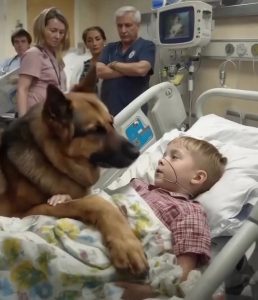
Five-year-old Tommy Chen lay quietly in a hospital bed, staring at the pale ceiling tiles above him as machines softly beeped around the room. The world outside the glass doors felt distant, almost unreal, as if life had narrowed down to this single moment—waiting for a surgery that could decide everything.
Tommy didn’t fully understand all the medical details, but he understood enough. His heart was sick, and the doctors were going to fix it. Or try to. For a child his age, that uncertainty was heavier than words could carry.
His parents stood close by, speaking in low, careful voices to the medical team, trying to stay strong in a way that only parents in crisis can. But Tommy wasn’t watching them. His small hands clutched a worn stuffed animal, and his thoughts were somewhere else entirely.
“Can Archie come to me?” he asked suddenly, his voice soft but steady.
The nurse paused, surprised by the request. Archie wasn’t just a pet—he was a golden retriever, Tommy’s constant companion through hospital visits, tests, and long nights filled with unfamiliar sounds and anxious waiting. In a place defined by sterile routines and clinical efficiency, Archie had become something rare: comfort that didn’t need explanation.
Within a short time, approval was granted. And then, as if the entire room had been holding its breath, Archie was brought in.
The moment the dog stepped inside, everything changed. Tommy’s face lit up with recognition and relief, and for the first time that day, the tension in his small body seemed to loosen. He reached out instinctively, and Archie moved forward without hesitation, pressing close as Tommy wrapped both arms around him.
For a few quiet moments, nothing else mattered. Not the machines. Not the fear. Not even the surgery waiting just beyond the door. It was just a boy and his dog, holding on to each other like anchors in a storm.
Doctors and nurses paused what they were doing, watching the scene unfold with a kind of quiet respect. In a place where precision and urgency ruled every second, this moment felt still—almost sacred in its simplicity.
But then, something shifted.
Archie, usually calm and gentle, suddenly stiffened. His posture changed in an instant, muscles tightening as his attention snapped toward the doorway. A low growl rose from his chest, sharp and unmistakable.
The room went silent.
All eyes followed the dog’s gaze as he stepped protectively in front of Tommy, his focus locked on Dr. Hawthorne, the surgeon preparing for the operation.
It wasn’t just alertness. It was warning.
The growl deepened, and Archie moved forward again, forcing the medical team to react quickly as confusion filled the room. The atmosphere shifted from emotional warmth to sudden, uneasy tension in seconds.
No one understood what was happening. Archie had never behaved like this before.
A nurse tried to calm him, but the dog refused to back down. His stance remained firm, his attention unbroken. Something about the surgeon had triggered an instinct so strong it overrode everything else.
The situation escalated just enough to demand immediate attention. Dr. Hawthorne stepped back, visibly unsettled, while staff exchanged uncertain glances.
And then, quietly, someone noticed it.
A faint smell—alcohol.
At first, it was dismissed as impossible. Hospitals had strict protocols, especially before surgery. But as questions were raised and procedures were reviewed, the concern deepened. What began as suspicion turned into urgency.
Within minutes, the decision was made to halt the procedure. The surgeon was removed from the case pending investigation, and a replacement was assigned.
The atmosphere in the room changed again—this time from confusion to shock. What had started as a child’s emotional farewell to his dog had unexpectedly become the moment that stopped a potentially dangerous situation from unfolding.
No one spoke for a while after Archie settled back beside Tommy, as if nothing had happened at all.
The surgery was postponed, carefully reassigned, and eventually carried out under a different surgical team. This time, everything proceeded as it should. The procedure was long, delicate, and filled with the usual tension of pediatric heart surgery—but it was successful.
Tommy survived.
Recovery was slow at first, then steady. Each day brought small improvements, and each improvement brought relief that deepened over time. His parents, who had once feared the worst, now watched their son regain strength with gratitude that was impossible to fully put into words.
Through it all, Archie remained a constant presence. Calm again. Gentle again. As if his earlier outburst had been nothing more than a fleeting instinct no one could fully explain—but everyone now understood in their own way.
In the months that followed, Tommy’s story quietly spread beyond the hospital walls. It became less about a dramatic moment and more about connection—between a child and his dog, between intuition and awareness, between fear and comfort in a place where all three often coexist.
Inspired by their experience, Tommy’s family later supported initiatives focused on therapy animals in medical environments. For them, Archie had become more than a companion—he had become a reminder of how deeply comfort and healing can be intertwined.
As for Tommy, he grew stronger with time. The hospital visits eventually became memories instead of routines, and fear gave way to normal childhood life again. But Archie never stopped being part of his world.
Years later, people would still ask about the story. About the dog who barked at a surgeon. About the moment that changed everything in a quiet hospital room.
And Tommy, now older, would simply say that sometimes the smallest instincts notice what people overlook—and sometimes love shows up not just in comfort, but in protection.
Because in the end, what he remembered most wasn’t the fear.
It was the hug before everything changed.