
on Homeowner Discovers Horrifying Hornet Colony in Attic and Is Shocked by Its Gigantic Size
What began as a typical weekend chore for Les Stagg quickly escalated into a situation that no homeowner ever hopes to face. Like many people trying to keep up with household maintenance, Les spent his Saturday washing his car and enjoying a bit of outdoor work. It was a routine task, the kind that usually brings a sense of accomplishment and calm. But as he wiped down the hood, he noticed several large hornets buzzing aggressively near the roofline.
At first, Les dismissed it as a minor inconvenience. Perhaps there was a small nest tucked away in an obscure corner of the eaves, he thought. After all, he had seen hornets near the house before, and most years, they were easily ignored. But this time, the sheer number of insects made him uneasy. Their movements were purposeful, almost territorial, and he began to worry that the problem was more serious than a minor nest.
Concerned for his safety and the safety of his family, Les decided to call in a pest control professional. He knew the risks of attempting to handle aggressive hornets on his own; stings from certain species can be dangerous, even life-threatening. When the specialist arrived, she took the time to thoroughly inspect the exterior and then requested access to the attic for a closer look.
Minutes passed, and Les waited anxiously below, watching the expert disappear into the confined space above his head. What seemed like a short inspection took longer than expected. When she finally emerged, the look on her face told him everything he needed to know: this was not a typical hornet problem.
“I need you to see this for yourself,” she said, gesturing toward the attic entrance. With a mix of curiosity and trepidation, Les climbed the ladder and entered the space he thought he knew so well. What he encountered left him utterly stunned.
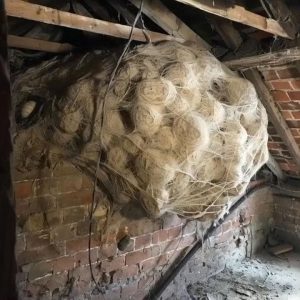
Dangling from the rafters was a massive hornet nest, unlike anything he had ever imagined. The structure was enormous, layered intricately, and teeming with activity. Thousands of hornets moved in a constant rhythm, their bodies glinting as they shifted in unison. The nest’s scale alone was terrifying; it stretched across a significant portion of the attic, a testament to the colony’s unchecked growth over several months.
The pest control specialist explained that the colony was highly aggressive. The hornets were territorial and defensive, meaning any disturbance could provoke attacks. Removing the nest would require full protective gear, specialized equipment, and precise handling. There was no room for error—one wrong move could result in painful stings or worse.
As the professional prepared for the removal, she noted that certain weather patterns and mild winters in the region had contributed to an increase in large nests. Hornets, like many insects, are highly sensitive to climate conditions. In recent years, warmer temperatures had allowed colonies to grow larger than previously seen, often undetected until they reached alarming sizes.
The actual removal process was a careful ballet of safety and technique. The specialist methodically worked to detach the nest, using smoke to calm the hornets and protective barriers to prevent stings. Les watched in disbelief as what had begun as a seemingly small problem became a highly technical operation requiring patience, precision, and expertise.
Once the nest was safely removed, Les took a moment to reflect on the experience. What had appeared as a minor annoyance—a few hornets buzzing near the roof—was actually a serious safety threat. He realized that small signs, such as faint buzzing or a few insects, should never be ignored. These early indicators are often the only warnings homeowners receive before a problem escalates into a potentially hazardous situation.
The incident left a lasting impression on Les. Beyond the immediate relief of having the nest removed, he gained a valuable lesson in home maintenance and vigilance. Homeowners often overlook subtle signs of infestation, assuming that minor insect activity is harmless. However, as Les’s experience demonstrates, even a few insects can indicate a much larger, hidden threat.
In addition to serving as a cautionary tale, this story highlights the importance of professional intervention. Hornet nests, particularly large colonies, are not a DIY project. The risk of severe stings, allergic reactions, and structural damage requires trained professionals who understand insect behavior and safety protocols. Attempting to remove such nests without experience can lead to serious injury.
Finally, Les’s encounter serves as a reminder that nature often operates on a scale we fail to notice. Hornets, bees, and other insects are remarkably resilient, capable of building intricate structures in spaces humans rarely examine closely. Attics, wall voids, and eaves provide the perfect environment for colonies to grow undisturbed. Regular inspections and attention to subtle warning signs can prevent such discoveries from turning into emergencies.
In the end, Les Stagg’s ordinary Saturday chore turned into an extraordinary lesson in vigilance and respect for nature. The enormous hornet nest in his attic was a startling example of what can happen when small signs are ignored and served as a powerful reminder of the importance of proactive home care. Thanks to swift action and professional expertise, Les and his family were safe, and the lesson they learned would not be forgotten: in matters of home safety, no warning is too small to take seriously.