
PART 3 (Ending)
I let him stand in my living room.
In my house.
On my floor.
Then I came down the stairs.
Lorraine’s eyes locked on me instantly.
“You did this,” she said, not a question.
I smiled politely. “Good morning.”
Ryan frowned. “Audrey, what is going on? The door—”
“Doesn’t open for people who don’t live here anymore,” I said calmly.
A pause.
Then a laugh from Lorraine—sharp, offended.
“This is my son’s house,” she snapped. “Don’t play games.”
I tilted my head slightly. “Is it?”
Ryan shifted uncomfortably. “Audrey, stop. Just fix it.”
That word—fix it—landed like a habit he had used too many times before.
Not what happened?
Not are you okay?
Just fix it.
I walked past them into the kitchen and placed a folder on the counter.
“I think we should go through something,” I said.
Lorraine rolled her eyes. “I don’t have time for your little—”
I opened it.
And she stopped talking.
Inside were printed documents. Ownership records. Transaction histories. Legal filings.
Ryan leaned in first.
I watched the exact moment his expression changed.
Confusion.
Then disbelief.
Then something much worse.
Understanding.
“This…” he started, then stopped. He read again. Slower. “This can’t be right.”
I met his eyes. “It’s right.”
Lorraine snatched a page from his hand.
“What is this nonsense?”
I answered calmly.
“The house is in my name. The mortgage has been paid from my accounts for years. The company shares you brag about at dinner parties, Ryan—they were placed in a trust before our marriage. You were never the owner. You were just… living around it.”
Silence fell so hard it felt like pressure in the room.
Lorraine’s voice dropped. “You’re lying.”
I shook my head gently. “No. You just never asked.”
Ryan stared at me like he was seeing a stranger wearing my face.
“That’s impossible,” he said. “I paid—”
“You contributed,” I corrected. “Sometimes. But you never owned anything. You just assumed you did.”
His jaw tightened. “So what, you’re punishing us?”
That word again.
Punishing.
As if boundaries were revenge.
As if consequences were cruelty.
I stepped closer to the counter.
“I’m not punishing anyone,” I said. “I’m correcting reality.”
Lorraine slammed the folder shut.
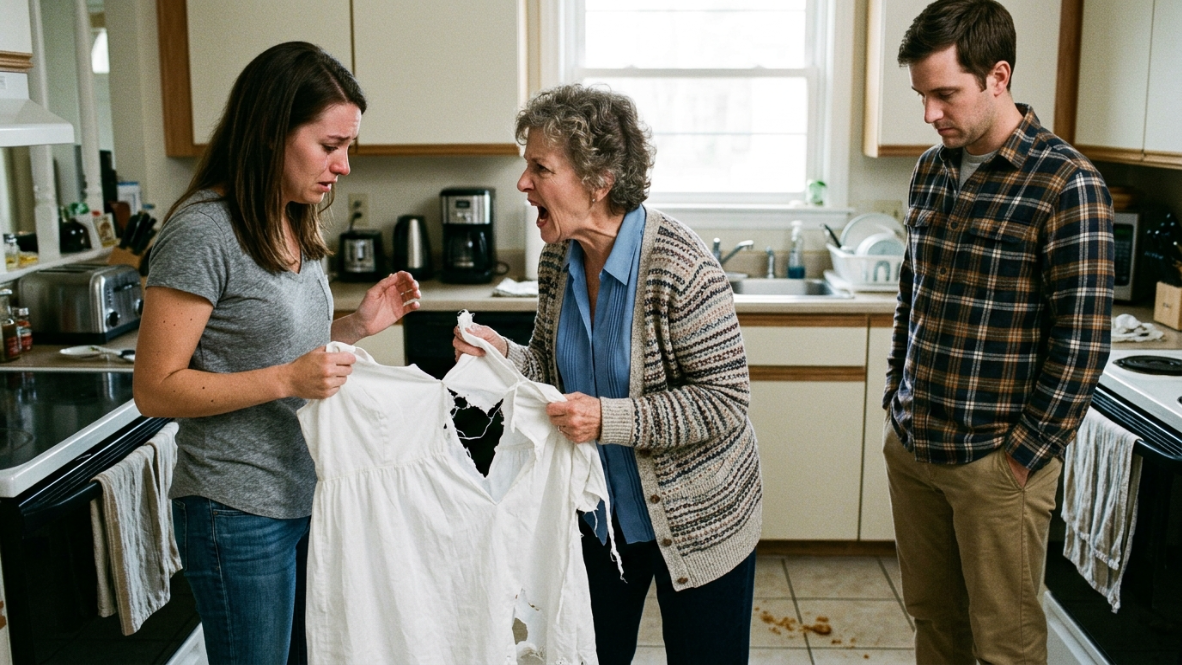
“This is because of yesterday,” she said sharply. “Because I tore your little dress? You’re destroying a family over fabric?”
I almost smiled.
“No,” I said softly. “I’m doing this because yesterday was the first time you showed me exactly what you think I am.”
Her eyes narrowed.
“And what is that?”
I didn’t hesitate.
“Disposable.”
The word landed heavier than anything she had said to me.
Ryan looked between us. “Audrey, we can talk about this. You don’t need to escalate—”
“Escalate?” I repeated quietly.
I turned toward him fully now.
“You stood in my kitchen yesterday and said nothing while your mother humiliated me in my own home. You didn’t ask what happened. You didn’t stop her. You didn’t even look at me.”
His silence came again.
The same silence.
Different day.
Lorraine crossed her arms. “Men don’t get involved in women’s drama.”
That made something inside me go still again.
Not anger.
Decision.
I nodded slowly. “You’re right.”
Ryan blinked. “What?”
I reached into the drawer beside the counter and placed another document on top of the folder.
“This isn’t drama,” I said. “It’s legal notice.”
Ryan stared at it.
Eviction.
His name was on it.
So was his mother’s.
Lorraine’s face drained of color. “You can’t do this.”
I looked at her evenly. “I already did.”
Ryan stepped forward. “Audrey, stop this. We’re married.”
I held his gaze.
“Yes,” I said. “We were.”
That silence after it wasn’t loud like before.
It was empty.
Lorraine’s voice cracked. “You’re throwing us out over a disagreement?”
I shook my head slightly.
“No,” I said. “I’m removing people who only respected me when they thought I had no power.”
For the first time, Lorraine didn’t have a response.
She looked at Ryan, expecting him to fix it.
To speak.
To take control.
To do what he had always done: stay silent until she told him what to think.
But Ryan didn’t move.
Because now there was nothing left for him to hide behind.
By afternoon, the locksmith had come and gone.
By evening, the security company had updated every access point.
And by nightfall, the house was quiet in a way I had never experienced before.
Not empty.
Clean.
I stood in the kitchen, the same place the dress had been torn, and watched the light reflect off the marble.
No shouting.
No footsteps pretending they belonged here.
Just silence that finally belonged to me.
My phone buzzed once.
Ryan.
Then again.
I didn’t answer.
Instead, I opened the last message I had saved in my drafts but never sent.
I looked at it for a long moment.
Then I deleted it.
Because there was nothing left to explain.
Some people think power is loud.
That it looks like shouting.
Like tearing dresses.
Like standing behind someone who refuses to defend you.
But real power is quieter than that.
It’s the moment you stop waiting for permission to protect yourself.
I turned off the kitchen light.
And for the first time in years—
I didn’t feel like I was living in someone else’s house.
I felt like I had finally come home.
The next morning, I woke up to silence so deep it almost felt unfamiliar.
No footsteps upstairs. No drawers opening too hard. No distant argument disguised as “family discussion.” Just the soft hum of a house that finally belonged to one voice instead of three competing ones.
For a few seconds, I just lay there, staring at the ceiling, waiting for the old life to interrupt the new one.
It didn’t.
My phone lit up on the nightstand.
Unknown number.
Then another.
And another.
I didn’t need to open them to know what they were.
Lorraine didn’t accept loss. She rebranded it as injustice.
Ryan, however, was different.
His messages weren’t angry at first.
They were confused.
Then pleading.
“We can fix this.”
“You’re overreacting.”
“I didn’t mean to stay out of it, I just didn’t know what to do.”
That last one stayed on the screen longer than the others.
“I didn’t know what to do.”
That was the truth he had been living in for years.
And the excuse I had been living under.
I set the phone down without replying.
By noon, a car pulled up outside the gate.
I didn’t need the camera to know who it was.
I still checked anyway.
Ryan sat in the driver’s seat alone. No Lorraine this time.
That was new.
He didn’t come in immediately. He just sat there, engine off, staring at the house like it had changed shape overnight.
Like it wasn’t supposed to look this final.
Ten minutes passed.
Then twenty.
Finally, he stepped out.
I met him at the front door—but didn’t open it fully.
Just enough.
A boundary made visible.
He looked tired in a way I hadn’t seen before. Not physically tired.
Structurally tired.
Like something inside him had finally started collapsing under its own weight.
“I just want to talk,” he said quietly.
I nodded once. “Talk.”
He swallowed. “I didn’t realize how bad it looked.”
I waited.
He kept going, faster now, like he was afraid silence would interrupt him.
“I grew up with my mom handling everything. She speaks, I follow. I didn’t think— I didn’t understand that you— that this house— I thought we were part of it.”
“You didn’t think I mattered,” I said calmly.
He shook his head quickly. “No, that’s not—”
“It is,” I interrupted gently.
Not angry.
Just certain.
That made him stop.
For the first time, he didn’t have a rebuttal ready.
Behind him, a taxi pulled up slowly and parked.
Lorraine stepped out.
Of course she did.
She always arrived when control was slipping.
She saw us at the door and marched forward immediately.
“I told you this was a mistake,” she snapped before she even reached us. “You’re humiliating him. You’re destroying your marriage over pride.”
I looked at her quietly.
“No,” I said. “I’m ending a pattern.”
Her lips curled. “Pattern?”
I stepped out onto the porch fully now.
Ryan instinctively shifted back slightly.
That tiny movement said more than any apology ever could.
“You taught him silence,” I said to Lorraine. “And he taught me patience I never should have needed.”
She scoffed. “You’re being dramatic.”
I shook my head.
“No. I’m being done.”
That word landed differently.
Done.
Not angry.
Not hurt.
Not negotiating.
Finished.
Ryan exhaled shakily. “So what happens now?”
I looked at him for a long moment.
And for the first time, I didn’t see the man I had married.
I saw the man who had never stepped out of his mother’s shadow long enough to become one.
“You leave,” I said simply.
Lorraine snapped, “This is still his home—”
“It isn’t,” I cut in.
Then I added, quieter:
“It never was.”
Silence again.
But this time, no one tried to fill it.
Ryan’s shoulders dropped slightly.
Not in defeat.
In recognition.
Because deep down, he had known this moment was coming.
He just never believed I would actually arrive at it.
By evening, the locks were changed again.
Not out of fear this time.
Out of finality.
The house didn’t feel heavy anymore.
It felt… settled.
I walked through each room slowly, not to remember the past—but to reclaim the space from it.
The kitchen where the dress was torn.
The living room where silence was chosen over truth.
The hallway where I once learned how small I was willing to become just to keep peace.
And then I stopped.
Because I realized something simple but important:
None of those moments owned this house.
They only passed through it.
A week later, the legal process moved forward exactly as it should.
There were no dramatic courtroom scenes.
No last-minute apologies that changed anything.
Just signatures.
Paperwork.
Closure in its most unromantic form.
Ryan didn’t fight it after a while.
Not because he agreed.
But because he finally understood there was nothing left to argue with.
Lorraine tried once more—through messages, through calls, through mutual relatives.
But entitlement doesn’t survive documentation.
Eventually, even she stopped.
One quiet Sunday morning, I stood in the kitchen with coffee in hand.
Sunlight spilled across the marble floor—the same floor she once called proof of my dependency.
I smiled slightly at that memory.
My phone buzzed one last time.
Ryan.
This time, the message was short.
“I’m sorry. For everything.”
I read it twice.
Then set the phone down.
Not because it didn’t matter.
But because it no longer changed anything.
Forgiveness, I realized, is not always about reopening doors.
Sometimes it’s about not needing to.
I looked around the house one more time.
No tension in the air.
No footsteps that didn’t belong.
No voices speaking over mine.
Just stillness.
And for the first time in a long time—
stillness didn’t feel like waiting for something bad to happen.
It felt like peace.
I took a slow breath, finished my coffee, and whispered to the empty room:
“This house is mine.”
And this time—
the silence agreed.