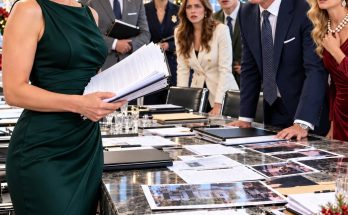

My husband’s mistress tried to sit beside him at my father’s will reading.
She wore black lace, red lipstick, and the confidence of a woman who thought grief made me weak. Her perfume reached me before she did—white roses and something expensive, the kind of scent that clung to marble hallways and guilty men.
My husband, Graham Ashford, didn’t even flinch when she placed one manicured hand on the back of the chair next to him.
I looked at the chair.
Then at her.
Then at him.
That chair had been mine for nine years.
At charity galas, courthouse dinners, boardroom celebrations, and Sunday brunches at my father’s house in Newport, that seat had always been mine. I had sat beside Graham when he was still a charming nobody with a rented tuxedo and a last name that opened fewer doors than he pretended. I had sat beside him when my father gave him his first chance, his first office, his first introduction to people who measured wealth not in dollars, but in generations.
Now my father was dead.
And Graham had brought Celeste Monroe to the reading of his will.
The room went so quiet that the antique clock above the fireplace sounded vulgar.
Graham adjusted the cuff of his Tom Ford suit and said, with the soft cruelty of a man who thought he had already won, “Celeste is my support now.”
A few people gasped.
I did not.
My father’s attorney, Margaret Ellis, lifted her eyes from the leather folder on her lap. She was seventy-one, silver-haired, razor-backed, and had spent four decades making billionaires afraid of punctuation.
She opened the will.
Then she read the amendment aloud.
“Any man who publicly dishonored my daughter shall be removed from every business trust, voting agreement, real estate holding, and financial instrument connected to this estate, effective immediately upon verification.”
Graham’s face drained of color.
Celeste’s red smile froze.
And for the first time since my father’s funeral, I almost laughed.
Chapter 1 — The Woman in the Wrong Chair
My father used to say that true wealth was quiet because it didn’t need to beg.
That morning, everything was quiet.
The Whitlock brownstone on Commonwealth Avenue had always felt less like a home and more like a private museum built for secrets. The floors were black walnut polished to a mirror. The windows were tall, arched, and framed by velvet curtains the color of old wine. Every portrait on the walls looked like it was judging you for being temporary.
My father, Everett Whitlock, had lived there during the Boston winters and ruled from it like a monarch in a cashmere overcoat.
Now his closest friends, attorneys, trustees, executives, and distant relatives sat in his study while the snow pressed against the windows like a ghost asking to be let in.
I wore a simple black silk dress. No diamonds. No dramatic veil. No trembling widow performance.
I was not my father’s widow.
But some griefs make you feel married to death.
Graham sat across the room, not beside me. That alone should have been humiliation enough. But men like Graham never stop at enough. Enough is for people with shame.
He had chosen a chair beneath my father’s portrait, where Everett Whitlock looked down with pale blue eyes and one hand resting on a mahogany desk. Graham had always wanted to look like he belonged under that portrait.
Celeste arrived ten minutes late.
Of course she did.
Women like her were never late by accident. She wanted the room to turn. She wanted every whisper to become a necklace around her throat.
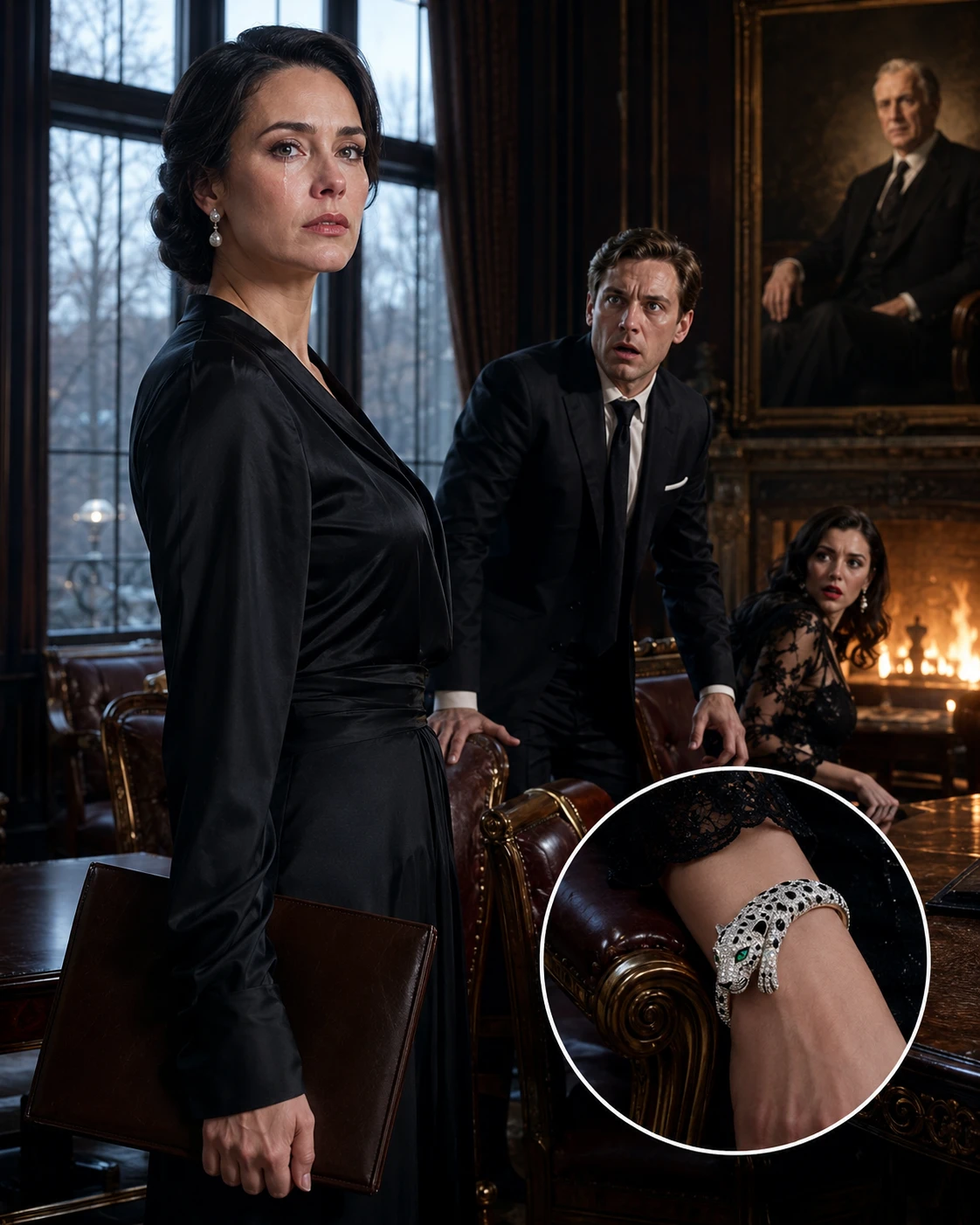
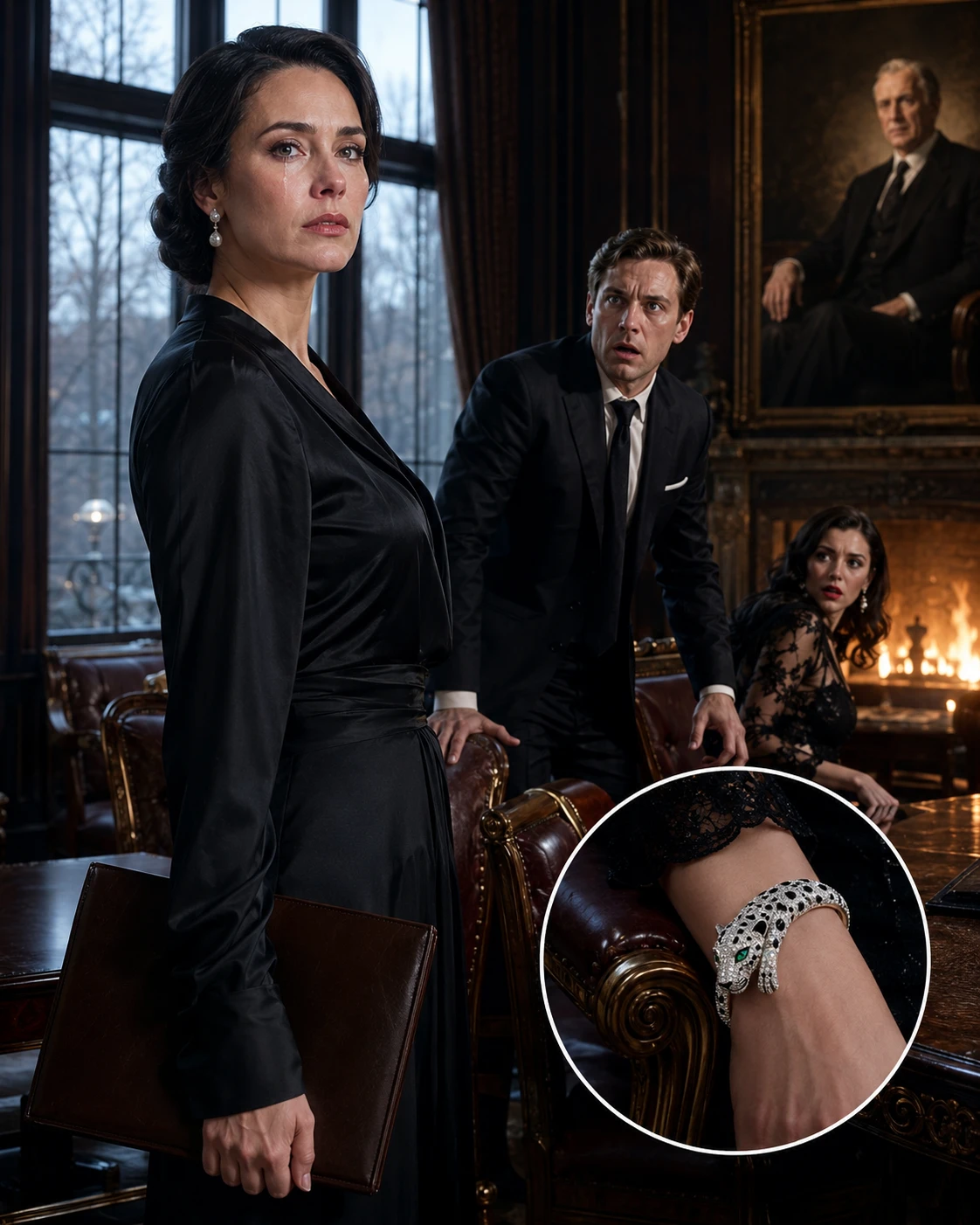
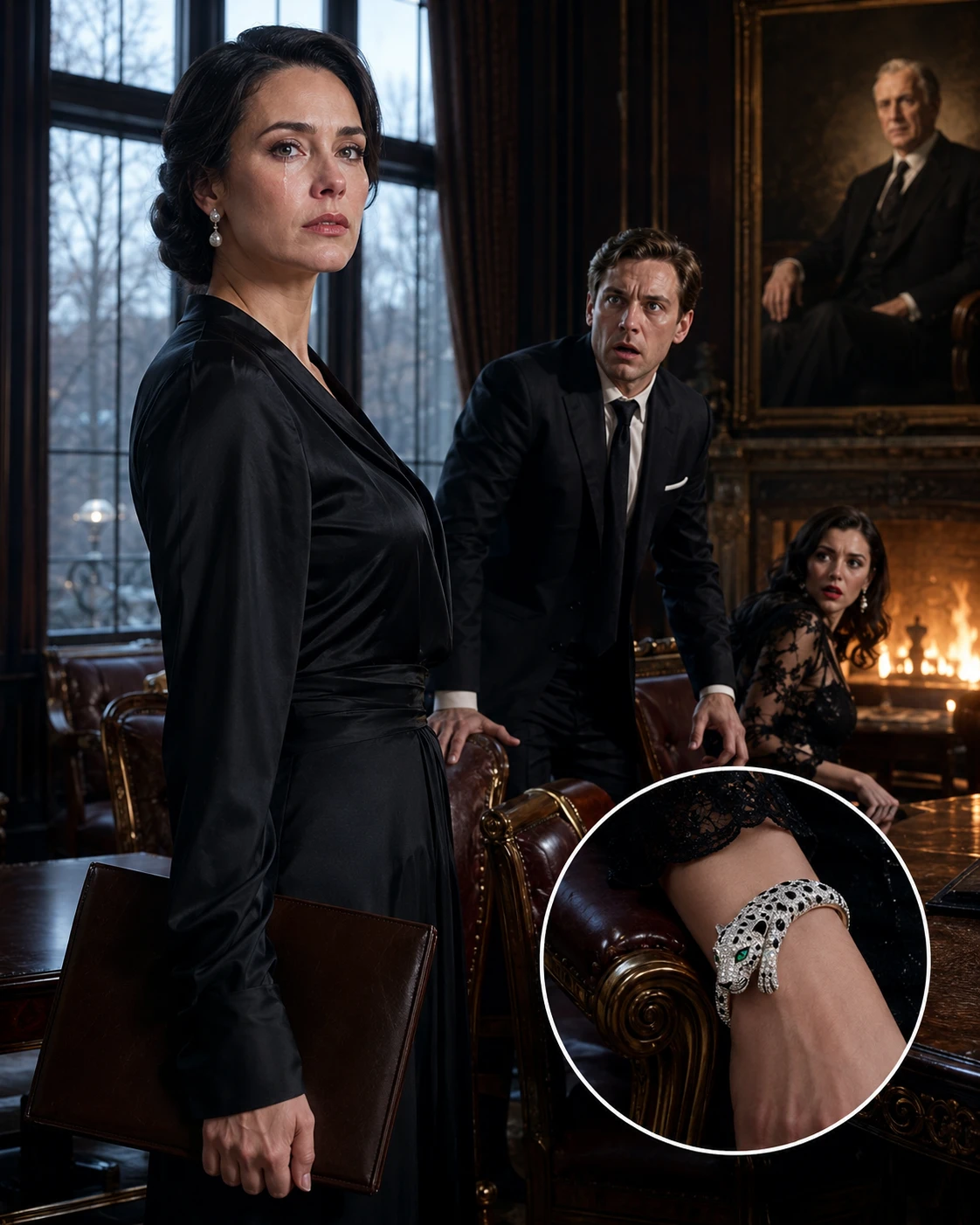
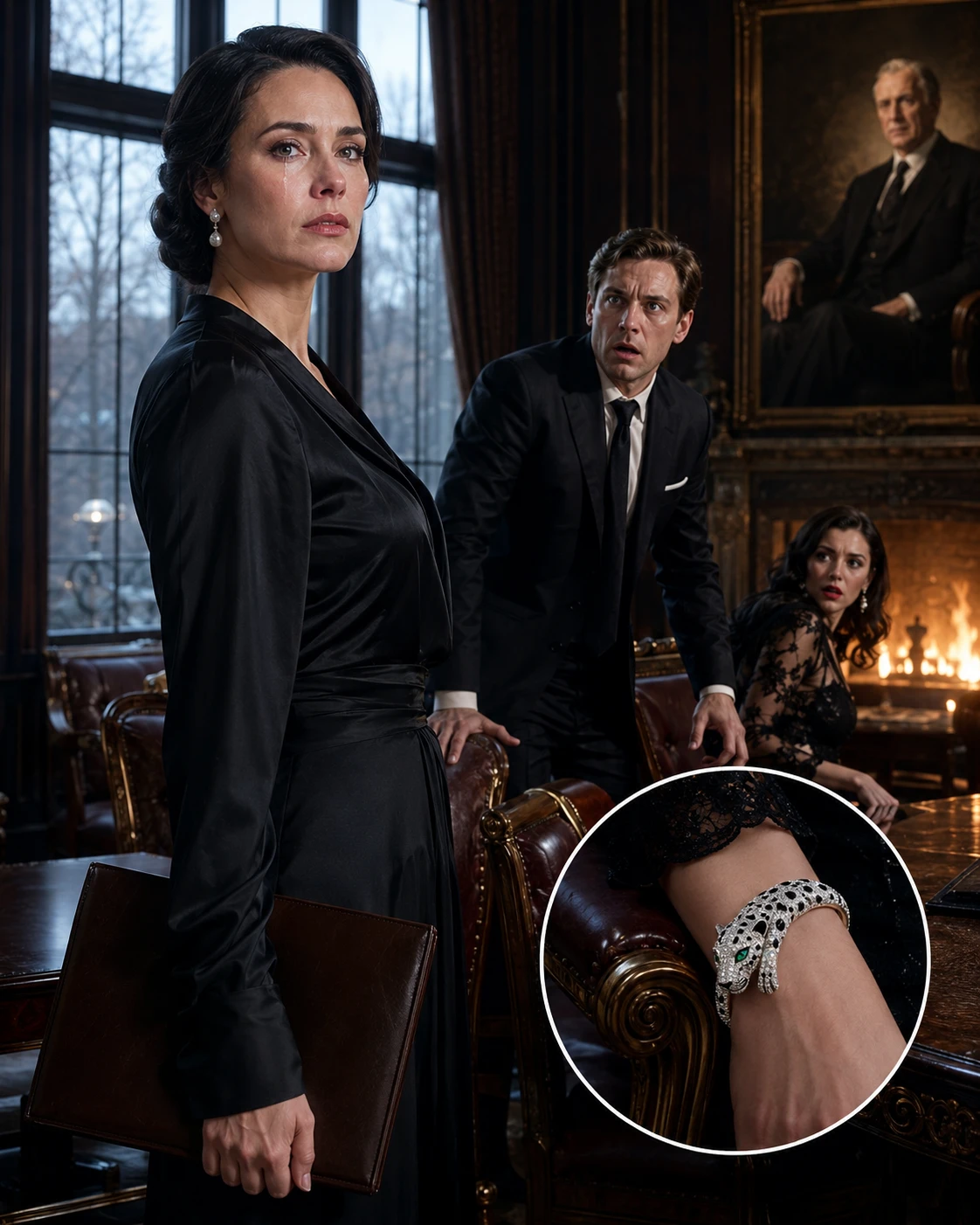
She was thirty-two, almost a decade younger than me, with honey-blonde hair pinned under a black fascinator, a lace dress that had never known mourning, and a diamond bracelet I recognized immediately.
It had been mine.
A Cartier panther bracelet, emerald eyes, platinum body. Graham had given it to me for our seventh anniversary after missing dinner, then claimed it had been stuck in customs.
I had found the receipt two years later in his assistant’s deleted emails.
It had been purchased in Celeste’s size.
She walked to Graham like the room had been arranged for her entrance. He reached for her hand.
I watched their fingers touch.
The old Vivian would have shattered.
The old Vivian—the woman who used to cry in marble bathrooms, who used to refresh his location on her phone at 2:00 a.m., who used to believe that dignity meant staying silent because the world punished women for making scenes—would have broken right there.
But that Vivian had died before my father did.
She had died slowly.
Once at a Christmas gala at the Boston Harbor Hotel, when Graham introduced Celeste as “a family friend” and let her correct the waiter by saying, “Actually, I prefer his usual wine.”
Once in Palm Beach, when I found two champagne flutes on the balcony of our suite and one lipstick mark that was not mine.
Once at my father’s seventieth birthday dinner, when Graham leaned close and whispered, “Don’t embarrass yourself, Vivian. Men like me always have options.”
That night, my father saw my face from across the room.
He said nothing.
But the next morning, his private investigator called me.
“Mrs. Ashford,” the woman said. “Your father would like you to know that evidence is not revenge. Evidence is inheritance.”
I did not understand then.
I understood now.
Celeste lowered herself into the chair beside Graham.
My chair.
Margaret Ellis closed the leather folder with one finger still marking the page.
“Ms. Monroe,” she said politely. “This is a private proceeding.”
Celeste tilted her head. “I’m here with Graham.”
Graham smiled without warmth. “She stays.”
No one moved.
My cousin Beatrice stared into her tea like it might absolve her. My father’s CFO, Daniel Voss, studied the Persian rug. Two trustees avoided my eyes entirely, which told me everything I needed to know about how long they had known.
I turned to Graham.
“Really?” I asked.
It was the first word I had spoken since Celeste entered.
He sighed, as if my grief bored him. “Vivian, not today.”
Not today.
As if I had scheduled his betrayal poorly.
As if my father’s death had inconvenienced his affair.
As if there was a correct day to bring your mistress into the room where your wife was about to hear her father’s last wishes.
Celeste placed her hand over his. Her bracelet flashed.
My bracelet.
“She’s my support now,” Graham said.
Margaret Ellis looked down at the will.
And my father reached out from the grave.
Chapter 2 — My Father’s Favorite Sin Was Preparation
The amendment had been dated eight months before his death.
Eight months ago, I had still been pretending.
That is what people misunderstand about wives like me. They call us blind because we remain quiet. They call us weak because we don’t throw wine, slash tires, scream in restaurants, or upload evidence to Instagram at midnight.
But silence is not always surrender.
Sometimes silence is surveillance.
Eight months ago, my father invited me to Newport for the weekend.
The Whitlock estate stood on the cliffs above the Atlantic, a white stone mansion with slate roofs, iron balconies, and gardens that had been photographed for magazines that used words like timeless and heritage. My mother had loved that house before cancer took her when I was nineteen. My father had never remarried. He claimed he was too old to be trained by another woman.
That weekend, the sea was gray and furious.
My father and I sat in the conservatory while rain battered the glass roof. He poured black coffee into porcelain cups and slid a folder toward me.
“Do you want to be comforted,” he asked, “or do you want to be free?”
I stared at the folder.
Inside were photographs.
Graham and Celeste outside The Carlyle in New York.
Graham and Celeste boarding a private jet in Teterboro.
Graham and Celeste at a villa in Aspen that I recognized because I had paid the deposit.
Then bank statements.
Transfers.
Shell companies.
A Delaware LLC called C.M. Holdings.
Invoices marked consulting.
My signature forged on two authorizations.
A line of credit opened against property my mother had left me.
I could not breathe.
My father did not touch my hand. That was not his way. He loved like architecture—solid, cold, designed to withstand storms.
“I am sorry,” he said.
That nearly broke me more than the evidence.
Because Everett Whitlock did not apologize unless something had already been proven beyond appeal.
“How long have you known?” I asked.
“Long enough to be angry. Not long enough to act without you.”
I looked at the photographs until Graham’s face blurred.
The man in those pictures was not the man I had married at Trinity Church under white orchids and candlelight. That man had cried during his vows. This one looked relaxed, entitled, hungry.
My father tapped the folder.
“He is not only unfaithful. He is planning.”
“Planning what?”
“To make you look unstable, push you out of the family voting trust, and take control of Ashford-Whitlock Capital through your marital shares.”
I laughed once. It sounded nothing like laughter.
“He can’t. The shares are protected.”
“Most of them,” my father said. “But not all. Your grandfather believed marriage was sacred and prenups were vulgar. I have spent years repairing that sentiment.”
I closed the folder.
The rain kept falling.
“What do I do?”
My father leaned back. “Nothing dramatic.”
“I want dramatic.”
“I know. That is why you will do nothing dramatic.”
He told me then what he had already started building.
A revised estate structure.
A new irrevocable trust.
Private ownership layers behind names Graham would not recognize.
Wisteria Holdings.
North Lantern Foundation.
Blue Harbor Charitable Endowment.
Each one legal. Each one clean. Each one designed to move assets out of Graham’s reach without triggering a single alarm.
“And the amendment?” I asked.
My father’s eyes sharpened.
“That is for public dishonor.”
I thought of all the dinners, all the whispers, all the women who had looked at me with pity because they knew what I had refused to say.
“He has already dishonored me,” I said.
“Privately,” my father replied. “Socially. Cowardly. But for the clause to survive challenge, he must do it plainly. In front of witnesses. In a way no judge can soften.”
I stared at him.
“You want me to wait until he humiliates me.”
“No,” my father said. “I want you to stop saving him from himself.”
That was the last lesson Everett Whitlock ever gave me.
Do not push a man into ruin.
Open the door.
Let him walk in wearing his best suit.
Chapter 3 — The Art of Looking Breakable
For eight months, I became exquisite glass.
At least, that was what Graham thought.
I attended galas with bare shoulders and quiet eyes. I smiled when he arrived late. I did not ask questions when his phone turned face down. I let Celeste appear in the background of foundation events, charity auctions, and winter benefits like an unpaid actress desperate for a speaking role.
She wanted me to confront her.
I never did.
She wanted me to cry.
I saved my tears for rooms without cameras.
She wanted me to look old.
I looked expensive.
The trick to revenge is not anger. Anger is loud. Anger burns evidence. Anger gives men like Graham exactly what they need: proof that you are emotional, unstable, vindictive, impossible.
So I became calm.
I signed nothing without my lawyer.
I smiled for photographs.
I wore cream satin to a board dinner where Celeste arrived in red.
When Graham called me frigid, I asked whether he preferred the Dover sole or the lamb.
When he accused me of making him feel lonely, I said, “That must be difficult for you,” and passed him the salt.
When he stayed out all night, I slept eight hours.
And every morning, I forwarded receipts, recordings, timestamps, and bank alerts to Margaret Ellis.
Margaret did not comfort me either.
She simply replied with sentences like:
Received.
Useful.
Do not respond.
Excellent.
The first truly public humiliation happened at the Whitlock Winter Fund gala in Manhattan.
It was held at the Plaza, in the Grand Ballroom, beneath chandeliers that looked like frozen explosions. Three hundred guests attended. Senators, CEOs, museum trustees, old-money widows wearing emeralds the size of lies.
My father was already sick by then, though he had not announced it. He sat at the head table in a black tuxedo, thinner than usual, his silver hair combed back, his expression unreadable.
I wore midnight blue velvet.
Graham arrived with Celeste.
Not behind him.
Not beside the event staff.
On his arm.
The room noticed.
Of course it did.
Graham kissed my cheek in front of the photographers and whispered, “Don’t make a scene.”
I smiled toward the cameras.
“I wasn’t planning to.”
Celeste laughed lightly, as if we were all old friends. “Vivian, you look beautiful. So brave.”
Brave.
There are words women use when they mean defeated.
Dinner was served. Speeches began. My father spoke about legacy, obligation, and the kind of philanthropy that outlives applause. His voice was weaker than it once had been, but the ballroom listened like church.
Then Graham stood for his toast.
I had not known he was giving one.
That was his first mistake.
He thanked my father for believing in him. He thanked the trustees. He thanked “the women who stand beside ambitious men when ambition becomes lonely.”
Then he looked at Celeste.
Not at me.
At Celeste.
“To the person who has been my peace this year,” he said, raising his glass. “You know who you are.”
The ballroom inhaled.
Celeste lowered her lashes.
My father’s hand tightened around his water glass.
I lifted my champagne and drank.
By morning, society pages called it “an awkward moment.” Blind items called it “a billionaire son-in-law’s soft launch.” Group chats called it what it was.
I called Margaret.
“Does that count?” I asked.
“Almost,” she said. “But not enough. He did not name her.”
That was the thing about men like Graham.
They liked the cruelty of ambiguity.
They wanted everyone to know and no one to prove it.
So we waited.
My father died six weeks later.
Renal failure, though the doctors wrapped the phrase in gentler silk. He passed at Newport before sunrise with the windows open to the sea and his wedding ring still on his hand.
I was there.
Graham was not.
He sent flowers.
Celeste posted a black-and-white photo of a candle on Instagram with the caption, “Grief reveals who truly belongs.”
I did not comment.
I planned the funeral.
I chose the hymns.
I stood in St. Bartholomew’s in Boston while six hundred people watched me bury the last person who had loved me without wanting anything first.
At the reception, Graham kissed my forehead for the cameras.
His mouth was cold.
“We should talk soon,” he said. “About restructuring.”
There it was.
The body was barely in the ground, and he was already counting.
I looked at him and saw not my husband, not my mistake, not even my enemy.
I saw an unsigned document.
“Of course,” I said.
He smiled, satisfied.
That night, I sat alone in my father’s study and opened the final letter he had left for me.
Vivian,
When they think you are grieving, they will come for what they believe grief has loosened.
Let them.
Do not argue over chairs.
The right chair owns the room.
Love,
Dad
Under the letter was a small cream envelope.
Inside was one card.
It contained Celeste Monroe’s private email address.
And a note in Margaret’s handwriting:
Invitation sent.
I stared at it for a long time.
Then I understood the final move.
Celeste had not been invited by Graham.
Not directly.
She had been invited by us.
Chapter 4 — The Will Reading
The morning of the will reading, I woke before dawn.
Boston was blue with winter.
I stood in front of the mirror in my Beacon Hill townhouse and studied my face the way one studies a painting before auction. Pale. Still. Controlled. My eyes were swollen, but not ruined. My hair was pulled into a low knot. My black dress had belonged to my mother.
I fastened pearl earrings at my ears.
No diamonds.
Diamonds are for celebration.
Pearls are for women who know how to survive pressure.
Margaret arrived at nine with two associates, a court reporter, and a sealed digital recorder in her briefcase.
“The room will be documented,” she said.
“Is that legal?”
“With disclosure. There will be a notice on the table. Anyone who remains consents.”
“Will he notice?”
Margaret looked at me over her glasses.
“Men who bring mistresses to estate proceedings rarely read notices.”
At ten, the family arrived.
At ten-thirty, the trustees.
At ten-forty-five, Graham.
He looked almost handsome enough to forgive.
Almost.
That had always been the danger of him. Graham Ashford had a face made for candlelight and apologies. Dark hair. Green eyes. A smile that suggested intimacy even when he was lying to a waiter. He wore grief beautifully, like everything else he had borrowed from my life.
He kissed my cheek.
“Vivian.”
“Graham.”
His eyes searched mine for cracks.
He found none.
“You look tired,” he said.
“You look prepared.”
A flicker crossed his face.
Then he took his seat across the room.
Not beside me.
Good.
At eleven-oh-two, Celeste entered.
Late.
Perfect.
Her heels clicked across the floor with obscene confidence. She looked around the room, registering the trustees, the lawyers, the relatives, the oil painting, the money.
Especially the money.
She did not look at the small brass sign on the center table.
Proceeding Recorded.
She walked straight to Graham.
I watched his expression.
Surprise first.
Then pleasure.
Then calculation.
He had not expected her, but he liked the theater of it. He liked what her presence announced: that my father was dead, that I was alone, that the old rules no longer applied.
Celeste touched the chair beside him.
My chair.
Margaret warned her once.
Celeste ignored it.
Graham said the words.
“She’s my support now.”
The room gave them to us like an offering.
Margaret waited three full seconds.
Then she opened the will.
She began with the formalities. Everett James Whitlock, sound mind, disposing of his estate, revoking prior instruments except where incorporated by reference. The language moved like a procession of black cars.
Then came the amendment.
“Any man who publicly dishonored my daughter shall be removed from every business trust connected to the estate…”
Graham leaned forward.
“Excuse me?”
Margaret continued.
“…including but not limited to the Whitlock Family Voting Trust, the Harborline Development Partnership, the Ashford-Whitlock Capital Advisory Pool, Wisteria Holdings, North Lantern Foundation, and all subsidiary management agreements…”
His skin went gray.
“Wisteria?” he said.
That was when I knew.
He had found some of the structures.
Not all.
Never all.
Margaret turned the page.
“Upon verification, such removal shall be automatic, irrevocable, and not subject to spousal claim, marital challenge, advisory appeal, or equitable reinstatement.”
Graham stood.
“This is absurd.”
Margaret looked at him calmly. “Sit down, Mr. Ashford.”
“I will not sit down while you threaten my rights.”
“You have no rights under these instruments.”
“I am her husband.”
I finally spoke.
“Are you?”
The room turned to me.
Graham’s jaw tightened.
Celeste’s hand slipped from his.
I rose slowly. Not because I needed drama, but because my father had once told me never to deliver important news from a chair.
“You came to my father’s will reading with your mistress,” I said. “You sat across from me. You let her take the seat you abandoned. And then, in front of witnesses, attorneys, trustees, relatives, and a court reporter, you said she was your support now.”
Graham laughed harshly. “You set this up.”
I smiled.
There it was.
The moment men always reached when they realized consequences were not coincidences.
“You did that yourself.”
Celeste stood too. Her confidence was fraying at the edges.
“Graham,” she whispered. “What is happening?”
He ignored her.
“Vivian, this will never hold.”
Margaret removed a second folder from her briefcase.
“It will. The amendment was drafted with independent counsel, witnessed properly, and supported by documented prior conduct. Mr. Whitlock anticipated a challenge.”
“Prior conduct?” Graham snapped.
Margaret slid copies across the table.
Photographs.
Bank transfers.
Invoices.
The forged authorizations.
The line of credit.
The gala transcript.
The toast.
Celeste’s emails discussing “post-Everett restructuring.”
Graham’s messages to Daniel Voss about having me declared “emotionally compromised” after my father’s death.
Daniel Voss made a sound like a dying animal.
I looked at him.
“You should have chosen silence,” I said softly.
He lowered his head.
Graham grabbed the documents. His eyes moved faster and faster until panic made him ugly.
Celeste snatched one page.
Her mouth opened.
“What is C.M. Holdings?” Margaret asked.
Celeste blinked.
“I don’t know.”
Margaret nodded to one of her associates.
The young woman opened a laptop and turned the screen toward the room.
A corporate filing appeared.
C.M. Holdings LLC.
Managing member: Celeste Monroe.
Registered address: a mailbox in Wilmington, Delaware.
Linked payments: Ashford-Whitlock Capital.
Linked invoices: strategic lifestyle consulting.
Celeste turned on Graham.
“You said those were gifts.”
Graham hissed, “Not now.”
But betrayal is never loyal.
Not even to itself.
“She didn’t know?” I asked.
Margaret glanced at me, and for the first time that morning, I saw the ghost of a smile.
“She knew enough.”
Then came the hidden assets.
My father’s voice seemed to fill the room through Margaret’s mouth.
The Newport estate had transferred to North Lantern Foundation, with lifetime residential rights granted solely to me.
The Boston brownstone was held by Wisteria Holdings, of which I was the controlling beneficiary.
My mother’s jewelry, art, and private investment accounts had been placed into a women’s legal defense endowment bearing her name.
My voting shares had been consolidated into a protected trust that Graham could neither access nor influence.
Ashford-Whitlock Capital, the firm Graham believed he had married into, had a morality and fiduciary clause tied to the estate. His removal triggered a mandatory review.
His office, his title, his board seat, his distributions, his access to capital—every golden ladder my father had built beneath his feet—began disappearing with each paragraph.
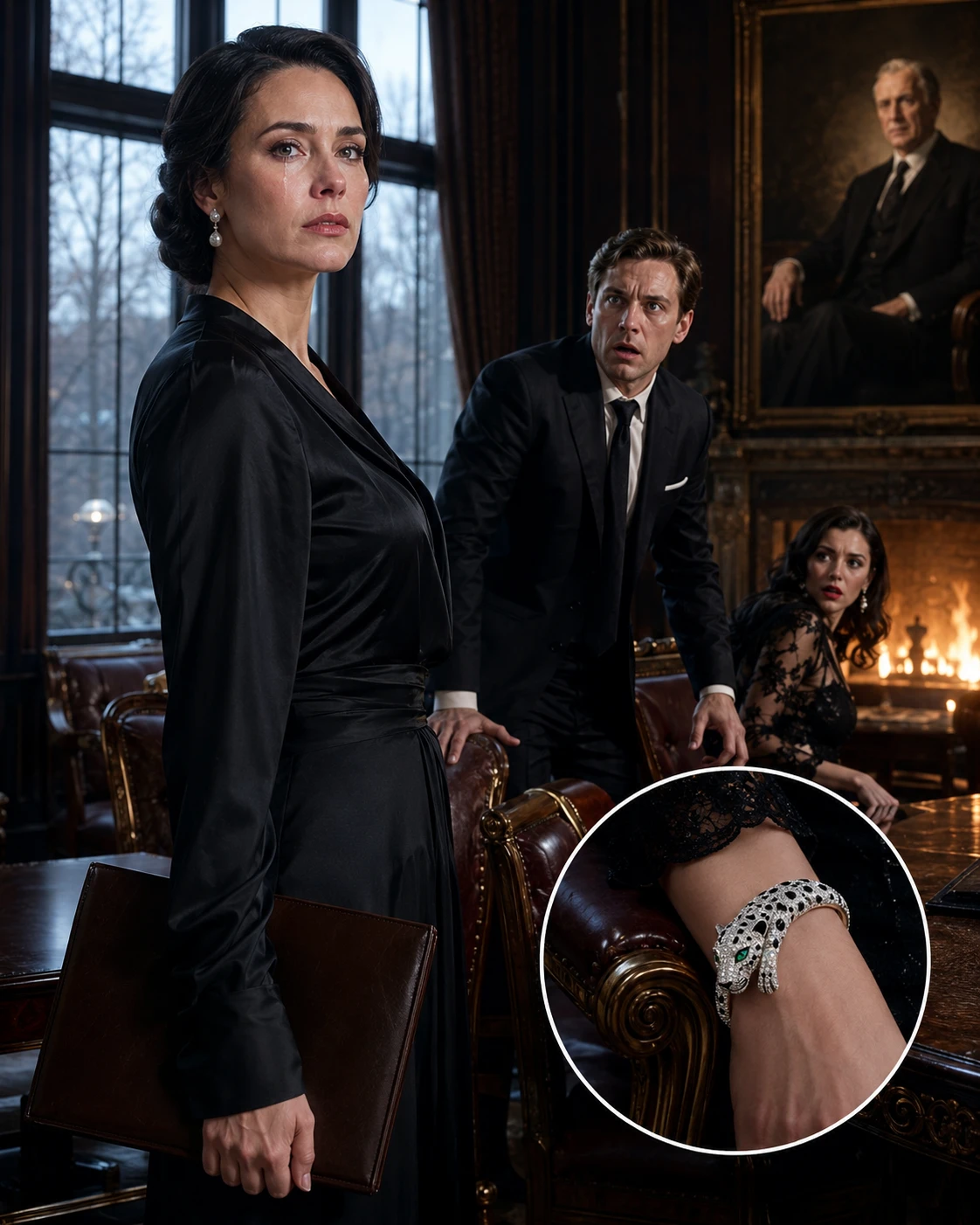
By the time Margaret finished, Graham was gripping the back of his chair.
Celeste sat down slowly, no longer beside him but near him, as if proximity had become contagious.
Then Margaret closed the folder.
“There is one final codicil.”
Graham looked at me with pure hatred.
Good.
Hatred meant he finally understood I was not broken.
Margaret read:
“To my daughter, Vivian Claire Whitlock Ashford, I leave not only the assets described herein, but the authority to decide whether Graham Ashford’s conduct should be referred for criminal investigation regarding fraud, forgery, and misappropriation. I advise mercy only where it protects the innocent. I advise severity where mercy would become vanity.”
My father had always known how to make love sound like law.
Margaret lowered the page.
“Vivian?”
The room waited.
Graham looked at me then, really looked at me, for the first time in years.
Not as his wife.
Not as furniture.
Not as the quiet woman beside him in photographs.
As the door.
“Vivian,” he said, voice low. “Don’t do this.”
I remembered our wedding.
I remembered believing him.
I remembered the first time he lied and I forgave him because forgiveness felt cheaper than rebuilding my life.
I remembered my father’s hand shaking as he signed the documents that would save me.
Then I looked at Celeste.
Her lipstick was still perfect.
Her eyes were not.
“I won’t decide today,” I said.
Graham exhaled.
“Thank God.”
I picked up my father’s letter from the table.
“I decided yesterday.”
Margaret nodded.
The study doors opened.
Two federal agents walked in.
Chapter 5 — The Kingdom Changes Hands
No one screamed.
That was the luxury of the room.
In cheaper rooms, people screamed when ruin arrived. In rooms like my father’s study, ruin entered politely, wearing wool coats and carrying warrants.
The agents asked Graham to step aside.
He refused at first, because men like him confuse volume with power. Then one of the agents said something too quiet for the room to hear, and Graham’s face changed.
He looked at Daniel Voss.
Daniel looked away.
That was when Graham knew there was no loyalty left to buy.
Celeste stood so fast her chair scraped the floor.
“I’m not part of this.”
Margaret’s associate handed her a document.
“You may want counsel before making further statements.”
Celeste stared at the paper as if it were written in another language. Perhaps it was. Consequence often feels foreign to people who have only spoken entitlement.
Graham turned to me while the agents waited.
“You destroyed me.”
I walked closer.
“No,” I said. “I stopped funding you.”
His mouth twisted.
“You think you’re better than me because of your father’s money?”
I considered that.
The old Vivian would have defended herself. She would have said she worked hard, served on boards, managed foundations, studied markets, learned the language of power in rooms where men assumed she was decorative.
The new Vivian did not audition for respect.
“No,” I said. “I think I’m better than you because when I had the chance to become cruel, I became precise.”
That landed.
Not loudly.
Deeply.
Graham’s eyes went wet, and for one wild second I saw the boy he had once been—the ambitious scholarship kid at Harvard Business School who wanted so badly to enter rooms he had not been born into. I had loved that hunger once. I had mistaken it for courage.
But hunger without honor does not become greatness.
It becomes theft.
The agents led him out past my father’s portrait.
Celeste did not follow him.
That was the last betrayal he received in that room.
She stayed seated, hands folded around a bracelet that had never belonged to her.
My bracelet.
I walked over and held out my palm.
She looked up.
“What?”
“The bracelet.”
Her laugh cracked. “Are you serious?”
“Always.”
For a moment, I thought she might refuse. Then Margaret quietly said, “It is listed among disputed marital assets purchased through misappropriated funds.”
Celeste unclasped it with trembling fingers.
The panther dropped into my palm, cold and heavy.
I did not put it on.
Some things return to you too stained to wear.
I placed it on the table beside my father’s will.
After everyone left, the study felt impossibly large.
Snow kept falling outside. The fireplace had burned low. My father’s chair sat empty behind his desk, angled toward the room as if he might return from lunch and ask why everyone looked so dramatic.
Margaret stood beside me.
“You handled it well,” she said.
“I feel nothing.”
“That will change.”
“Is that good?”
“It will be human.”
I looked at the portrait.
“Did he suffer?”
Margaret did not pretend not to understand.
“At the end? No.”
I nodded.
The answer mattered less than her giving it cleanly.
She gathered the papers, then paused at the door.
“There is one more thing. Not legal. Personal.”
She handed me a small velvet box.
Inside was my mother’s wedding band.
Not the diamond engagement ring. Not the famous Whitlock sapphires. Just a thin gold band, worn smooth by years of touch.
A note sat beneath it.
Vivian,
Your mother used to say gold remembers warmth.
When the cold part is over, wear this.
Not as a wife.
As a woman who came home to herself.
Dad
That was when I cried.
Not prettily.
Not like a heroine in a black dress with good lighting.
I cried like a daughter.
I cried until the room blurred, until the snow became white fire, until every version of me—wife, orphan, fool, strategist, survivor—sat together in the wreckage and breathed.
Margaret did not hug me.
She stood guard at the door.
Some women comfort by holding you.
Others comfort by making sure no one interrupts your collapse.
Three months later, Graham Ashford pleaded not guilty to charges his attorneys described as “a misunderstanding of complex financial arrangements.” The press enjoyed that phrase for exactly six hours before the evidence leaked through the proper channels.
Not gossip.
Not revenge porn.
Not drunken screenshots.
Evidence.
Emails with headers.
Wire transfers.
Forged documents.
Board memos.
Security footage.
A timeline so clean it looked surgical.
Daniel Voss cooperated.
Celeste negotiated.
Graham lost his office first, then his advisory licenses, then the townhouse he had assumed I would surrender because women are always expected to trade property for peace.
I gave him neither.
The divorce finalized in July.
I wore white to court.
Not bridal white. Not innocent white.
A sharp white suit, wide-legged trousers, pearl buttons, my mother’s gold band on my right hand. Outside the courthouse, reporters shouted questions.
“Mrs. Ashford, do you feel vindicated?”
“Ms. Whitlock, did your father plan all of this?”
“Vivian, what do you say to people calling this revenge?”
I stopped at the courthouse steps.
For the first time in months, cameras pointed at me without Graham standing nearby to translate my silence into weakness.
I looked into the nearest lens.
“Revenge is when you become like the person who hurt you,” I said. “Justice is when you become impossible for them to hurt again.”
The clip went viral before dinner.
By morning, women I had never met were quoting it under videos of packed suitcases, signed divorce papers, empty apartments, new haircuts, restraining orders, business launches, and babies sleeping safely in new homes.
I watched them from Newport, wrapped in one of my father’s old cardigans.
The ocean was blue that day.
Not gray.
Blue.
Warm Conclusion — The House That Finally Belonged to Me
A year after my father’s death, I reopened the Newport estate for the first Whitlock Women’s Legal Fund gala.
No husbands gave speeches.
No men were thanked for allowing women to survive them.
The ballroom was filled with lawyers, nurses, teachers, founders, mothers, daughters, widows, students, and women who had arrived in borrowed dresses with fear still tucked behind their smiles.
We raised more money in one night than my father’s foundation had raised in its first five years.
At midnight, after the guests had gone and the caterers were packing silver into padded boxes, I walked alone through the garden.
The roses were blooming.
My mother’s roses.
I stopped at the cliff where the Atlantic broke against the rocks below. The air smelled of salt, rain, and summer grass. For the first time in a long time, the quiet did not feel like punishment.
It felt like ownership.
My phone buzzed.
A message from Margaret.
Your father would have been insufferably proud.
I smiled.
Then another message appeared.
A video someone had posted from the gala. In it, I stood beneath the chandeliers in a black velvet gown, laughing with a young woman whose emergency custody case the fund had helped win. The caption read:
The mistress attended the will reading. The dead father had the final twist.
I watched it twice.
Not because of Celeste.
Not because of Graham.
Because in the video, I looked alive.
Not healed in the perfect way people demand from women after betrayal. Not untouched. Not sweetly forgiving. Not softened into something easier to digest.
Alive.
Elegant.
Unowned.
Behind me, through the ballroom windows, my father’s portrait had been moved from Boston and hung above the fireplace. He looked exactly as he always had—severe, brilliant, impossible to impress.
But I knew better.
Somewhere, somehow, Everett Whitlock was smiling.
Because Celeste had come in black lace, red lipstick, and the confidence of a woman who thought grief made me weak.
Graham had called her his support.
The lawyers had opened the will.
The trusts had shifted.
The doors had closed.
The kingdom had changed hands.
And my father, who had loved me too quietly in life, had roared for me in death.
She came to hold his hand. My father came to cut it off.