“Don’t touch that glass, kid,” the man at the counter snapped.
Lily Carter pulled her hand back from the diner window like the sandwich had burned her.
Ethan Walker looked up from the register.
The lunch rush had ended badly.
Only one sandwich remained inside the display case.
Turkey, tomato, lettuce, mustard, and the last fresh roll from that morning.
Outside, Chicago shimmered under a brutal July sun.
Inside, Ethan saw a nine-year-old girl staring like the sandwich was a miracle.
The man at the counter muttered, “She’s been standing there ten minutes.”
Ethan ignored him.
He wiped his hands on his brown apron and moved toward the door.
“Are you hungry?” Ethan asked.
Lily froze.
Her yellow summer dress looked too bright for her tired face.
She nodded once.
Ethan opened the door wider.
“Come inside where it’s cooler.”
Lily shook her head.
“I’m okay.”
Her voice barely crossed the sidewalk.
Ethan glanced at her white sneakers.
The left one had a loose sole.
The right one had a grass stain.
“Where are your parents?” he asked.
Lily looked down.
“Busy.”
That one word carried too much weight.
Ethan knew that kind of answer.
He had heard it from runaways, lonely kids, and adults pretending not to break.
He stepped back inside.
The man at the counter scoffed.
“You feeding every stray now?”
Ethan said, “Finish your coffee, Ray.”
Ray raised both hands.
“Just saying. People notice things.”
Ethan opened the display case.
Cold air rolled over his fingers.
He lifted the sandwich carefully.
For a second, he hesitated.
It was his dinner.
The register had barely made rent that week.
Still, he wrapped the sandwich in white paper.
He placed it into a brown bag.
Then he walked back outside.
Lily stared at the bag like it might disappear.
Ethan held it out.
“It’s yours.”
Lily did not take it.
Her small hands curled against her dress.
“I don’t have any money.”
Ethan smiled.
“That’s okay.”
Her eyes lifted.
“No, really. I can’t pay.”
“I heard you.”
“My mom says we don’t take things.”
“Your mom sounds smart.”
Lily swallowed.
“Then I shouldn’t.”
Ethan crouched slowly.
His knees cracked.
He kept the bag between them.
“Then let’s make a deal.”
Lily leaned back.
“What deal?”
“Someday, help someone else.”
She blinked.
“That’s all?”
“That’s all.”
Ray’s voice came from behind them.
“That’s not a business model, Ethan.”
Ethan did not turn.
“It’s a diner, Ray.”
Ray laughed without humor.
“Not for long.”
The words hit harder than Ethan expected.
Lily noticed.
Kids always noticed what adults tried hiding.
She looked from Ethan to the peeling diner sign.
The sign read Walker’s Corner Diner.
The W flickered sometimes, even in daylight.
“Is this your place?” Lily asked.
“It is.”
“It smells good.”
“That may be the nicest review I get today.”
A tiny smile appeared on her face.
Ethan placed the bag into her hands.
She held it with both palms.
The paper crinkled softly.
“You sure?” she whispered.
“I’m sure.”
Lily looked at the sandwich bag.
Then she looked through the window at Ray.
“He’s mad.”
“Ray is always mad.”
“Why?”
“He likes things easy.”
“Do you?”
Ethan paused.
“No.”
“Why not?”
“Because easy things don’t always matter.”
Lily seemed to think about that.
The city moved around them.
A bus hissed at the corner.
A cyclist rang his bell.
Somewhere, a woman argued into a phone.
Ethan reached into his apron pocket.
He pulled out a clean napkin.
Then he took a black pen from behind his ear.
Lily watched him write one tiny letter.
E.
He folded the napkin once.
Then again.
He tucked it beside the sandwich.
“What’s that?” Lily asked.
“A receipt.”
“But it only has one letter.”
“That’s all this deal needs.”
“E?”
“For Ethan.”
She studied him like she was memorizing his face.
“You own the diner, so you write your name?”
“Something like that.”
Lily gripped the bag tighter.
“What if I forget?”
“You won’t.”
“How do you know?”
Ethan looked at the tired courage in her face.
“Because hungry people remember kindness.”
That made her eyes shine.
She turned away quickly.
“I should go.”
“Eat somewhere cool.”
She nodded.
Then she took three steps down the sidewalk.
She stopped.
She looked back once.
Ethan lifted his hand.
Lily lifted the sandwich bag back.
Then she disappeared into the summer crowd.
Ray appeared in the doorway.
“You gave away your last sandwich.”
Ethan looked at the empty display case.
“I did.”
“You’re a fool.”
Ethan folded his arms.
“Maybe.”
Ray pointed toward the register.
“Fools don’t survive Chicago rent.”
Ethan watched the sidewalk.
The girl was gone.
But the small emptiness she left behind felt louder than Ray.
Inside, the diner hummed quietly.
A ceiling fan clicked.
The soda machine buzzed.
Ethan returned behind the counter.
Ray slapped five dollars onto the surface.
“Coffee was cold.”
“You drank three cups.”
“And complained about all of them.”
Ethan took the money.
Ray leaned closer.
“You keep giving things away, that bank letter becomes real.”
Ethan’s jaw tightened.
“What bank letter?”
“The one under your register.”
Ethan looked at him.
Ray smirked.
“Small towns gossip. So do city blocks.”
“This block has too much time.”
“It has eyes.”
Ethan slid the money into the register.
Ray tapped the glass case.
“Last sandwich, Ethan.”
“I know.”
“Last chances look exactly like that.”
Ethan said nothing.
Ray walked out into the heat.
The bell above the door jingled.
Then silence settled again.
Ethan stood alone.
He took the bank letter from under the register.
Final notice.
Ninety days.
He folded it before the words could fully sink in.
That afternoon, he washed the empty display tray himself.
He cleaned the counter twice.
He fixed the wobbling stool near the window.
But every small repair looked temporary.
The diner had been his wife’s dream first.
Maggie had picked the red booths.
She had chosen the chrome napkin holders.
She had insisted on the old jukebox.
“People eat better when they remember dancing,” she used to say.
After she died, Ethan kept the place alive.
Some weeks, barely.
Some months, impossibly.
He had fed cab drivers, nurses, lonely veterans, and construction crews.
He had let people pay later.
Some did.
Some never returned.
But that little girl’s face stayed with him.
He did not know why.
Maybe because she never begged.
Maybe because she tried to refuse.
Maybe because she looked like someone already learning shame.
Near closing, his cook, Marvin, came out.
“Boss, you ate today?”
Ethan wiped down the counter.
“Coffee counts.”
“No, it doesn’t.”
“It counts when you’re the owner.”
Marvin crossed his arms.
“You gave away dinner again?”
Ethan glanced at him.
“Ray tell you?”
“Ray tells everybody everything.”
Ethan tossed the rag into the sink.
“She was a kid.”
“She looked bad?”
“She looked hungry.”
Marvin nodded.
“That’s enough.”
Ethan smiled faintly.
“That’s what I thought.”
Marvin looked around the diner.
“We going to make it?”
Ethan wanted to lie.
He wanted to say yes with confidence.
Instead, he looked at the old booths.
“We’ll open tomorrow.”
Marvin heard the truth inside that answer.
“That bad?”
“Bad enough.”
Marvin removed his cap.
“My cousin can cover Friday shifts cheaper.”
“I’m not cutting you.”
“Ethan.”
“No.”
Marvin sighed.
“You can’t save everyone.”
Ethan looked toward the door.
“No. But sometimes one sandwich is within reach.”
Marvin studied him.
Then he gave a tired laugh.
“You’re impossible.”
“So Maggie said.”
That night, Ethan locked the diner after sunset.
The summer sky had turned purple over Chicago.
He stood beneath the old sign.
Walker’s Corner Diner buzzed weakly above him.
The W flickered.
Then it went dark.
Ethan stared at it.
For the first time, he felt the place exhale like an old man.
He touched the doorframe.
“Not yet,” he whispered.
Twenty years passed slowly, then all at once.
The diner survived bad winters, rising rent, broken fryers, and three neighborhood remodels.
It survived Maggie’s absence.
It survived Ray’s predictions.
It survived by inches.
But survival was not victory.
By the summer Ethan turned sixty-eight, the street had changed.
The laundromat became a boutique gym.
The hardware store became a glass office.
The old bakery became a coffee bar selling twelve-dollar toast.
Walker’s Corner Diner remained between them like a stubborn memory.
Its red booths were cracked.
Its floor tiles were faded.
Its jukebox still refused every third quarter.
Ethan’s beard had turned light gray.
His shoulders bent more now.
His smile still arrived before his words.
But the bills no longer waited politely.
The bank sold the loan.
The new property group wanted him gone.
They called it redevelopment.
Ethan called it erasure.
On a bright August morning, the final notice became a person.
Then it became three people.
Two debt collectors stood outside the diner with folders.
A third man wore a navy suit and sunglasses.
He had the patient cruelty of someone paid by the hour.
Ethan stood in the doorway.
Marvin stood behind him, older now, thinner, still wearing the same white cook’s cap.
The diner staff watched from inside.
A few regulars sat frozen over coffee.
The man in the navy suit unfolded a document.
“Mr. Walker, today is your final deadline.”
Ethan looked at the papers.
“I asked for thirty more days.”
“You asked for many things.”
“I’ve been here forty years.”
“That is not a payment method.”
Marvin stepped forward.
“Don’t talk to him like that.”
The man smiled without warmth.
“And you are?”
“The cook.”
“Then cook while you still have a kitchen.”
Marvin’s fists tightened.
Ethan touched his arm.
“Leave it.”
The second collector pointed at the windows.
“We have authorization to begin inventory review.”
“You’re not entering yet,” Ethan said.
The man in the navy suit lowered his sunglasses.
“You are not in a position to set terms.”
Ethan looked behind him.
The diner was full of people pretending not to listen.
Old Mrs. Alvarez held her mug with both hands.
Tommy, the mailman, stared down at his plate.
A college kid near the window stopped typing.
Everyone knew.
Everyone had known for weeks.
Still, seeing it happen made shame physical.
It pressed against Ethan’s chest.
He stepped outside and closed the door behind him.
The bell jingled like a tiny apology.
“Let’s not do this in front of customers,” Ethan said.
The man glanced at the diner.
“They should know where not to eat tomorrow.”
Ethan’s face changed.
Marvin reached for the door.
Ethan held up one hand.
The sidewalk seemed too bright.
Heat rose from the pavement.
The diner sign shook in the summer wind.
The W had been repaired six times.
Now it trembled like it was tired of fighting.
The man opened another folder.
“Outstanding debt, accumulated penalties, legal fees, property taxes, and transfer processing.”
Ethan nodded slowly.
“I know what I owe.”
“Then you understand the matter.”
“I understand numbers.”
“Good.”
“I also understand people.”
The man laughed.
“That may be why you are in this situation.”
One collector smirked.
The other avoided Ethan’s eyes.
Ethan heard movement behind the glass.
Marvin had come closer.
So had half the diner.
The man held out the document.
“Sign acknowledgment of voluntary surrender.”
Ethan stared at the pen.
“I’m not surrendering anything voluntarily.”
“Then we proceed involuntarily.”
Ethan’s throat tightened.
The sidewalk blurred for a second.
He saw Maggie painting booth trim.
He saw Marvin flipping pancakes at dawn.
He saw a little girl in a yellow dress holding a sandwich bag.
The memory struck him unexpectedly.
It had no reason to appear.
But there she was.
Thin hands.
Loose sneaker.
Confused eyes.
Someday, help someone else.
The man snapped his fingers.
“Mr. Walker.”
Ethan returned to the street.
“I heard you.”
“Sign.”
“No.”
The word was quiet.
But it landed.
The man’s smile disappeared.
“Excuse me?”
“No.”
“You cannot afford pride.”
Ethan looked at the diner behind him.
“This is not pride.”
“What is it?”
“A door people still need.”
The collector rolled his eyes.
“Sentimental statements do not stop enforcement.”
A black SUV turned the corner.
No one noticed at first.
Then another followed.
Then a third.
The vehicles moved with slow certainty.
Their windows were dark.
Their engines were low and expensive.
They stopped along the curb behind the collectors.
The man in the navy suit turned.
“What is this?”
A fourth SUV pulled in.
Then a fifth.
The diner fell silent behind the glass.
Even the traffic seemed to dim.
Doors opened almost together.
Men and women in dark suits stepped out.
They did not rush.
They looked practiced, calm, and serious.
The collector straightened.
“Can I help you?”
No one answered him.
The last SUV door opened.
A woman stepped onto the sidewalk in beige heels.
She wore an elegant beige business suit.
Her long dark hair moved softly in the wind.
Luxury sunglasses covered her eyes.
She stood still for one second.
Everyone looked at her.
Not because she demanded attention.
Because the air changed around her.
The collector forced a professional smile.
“Ma’am, this is a private legal matter.”
She removed her sunglasses.
Her gaze passed over him like he was furniture.
Then she looked at Ethan.
Something unreadable moved across her face.
Ethan did not recognize her.
But something in his chest tightened.
The woman walked toward him.
Her heels tapped against the sidewalk.
Each step sounded louder than the last.
Marvin whispered from inside, “Who is that?”
No one answered.
The woman stopped beside Ethan.
She looked at the papers in the collector’s hand.
“Calculate everything,” she said.
The collector blinked.
“Pardon?”
“Principal, penalties, fees, taxes, attorney charges, transfer expenses.”
Her voice stayed calm.
“I’ll pay all of it.”
The sidewalk went still.
Ethan turned toward her.
“Ma’am, I don’t know who you are.”
She did not look away from the collector.
“You will.”
The collector recovered quickly.
“This is not a charity transaction.”
“No,” she said.
“It’s a debt settlement.”
He studied her suit, her watch, her security team.
His tone changed.
“May I ask your name?”
“Lily Carter.”
One of the suited assistants stepped forward.
“Founder and CEO of Carter Horizon Group.”
The collector’s mouth tightened.
He knew the name.
Most people did.
Carter Horizon had appeared on magazine covers, business channels, and downtown buildings.
Ethan had seen the name on a billboard near the Kennedy Expressway.
He had never connected it to a person.
Certainly not this person.
Lily held out her hand.
“Your documents.”
The collector hesitated.
She waited.
He handed them over.
She gave them to her assistant.
“Verify the amount.”
The assistant opened a tablet.
Another team member began making calls.
The second collector whispered, “Is this real?”
Lily heard him.
She turned.
“It will feel real when the wire clears.”
Inside the diner, someone gasped.
Mrs. Alvarez crossed herself.
Tommy lowered his phone without realizing he had raised it.
Marvin opened the door.
“Ethan?”
Ethan could not speak.
He looked at Lily’s face.
Something pulled at memory.
Not the suit.
Not the confidence.
Something smaller.
The way she held still when people stared.
The way her chin lifted before fear could show.
The collector cleared his throat.
“Ms. Carter, even if payment occurs, transfer proceedings have advanced.”
Lily looked back at him.
“Then reverse them.”
“That may not be possible today.”
“It is possible.”
“With respect, you do not understand the timing.”
Lily’s expression sharpened.
“With respect, you do not understand my attorneys.”
One of her lawyers stepped forward.
“We contacted your office before arrival.”
The collector stiffened.
“I received no such confirmation.”
“You will.”
His phone rang.
Everyone watched him answer.
He turned away, but his face gave him away.
The call was not going well.
Lily looked at the diner sign.
Walker’s Corner Diner swayed in the wind.
Her eyes softened for the first time.
Ethan saw it.
It frightened him more than her power.
Because grief lived there.
Gratitude too.
The collector ended the call.
His confidence had thinned.
“There may be a temporary hold.”
Lily said, “There will be a permanent resolution.”
“We need time to process.”
“You had twenty years to process what this place means.”
The words hit Ethan strangely.
Twenty years.
He stared at her.
Lily turned to him at last.
Up close, she was younger than her authority suggested.
Twenty-nine, maybe.
Her face carried polish, discipline, and old hunger.
Ethan whispered, “Have we met?”
She reached into her leather handbag.
Her fingers paused inside.
For the first time, her calm cracked.
Not much.
Enough.
She withdrew a small laminated square.
The plastic was old.
Its edges were cloudy.
Inside lay a folded white napkin.
A tiny black letter sat at the center.
E.
Ethan’s breath left him.
The city vanished.
The collectors blurred.
The SUVs became shadows.
Only that letter remained.
His own handwriting.
Small.
Crooked.
Written with a dying pen behind his ear.
His hands began to tremble.
Lily held the napkin carefully.
Like it was not paper.
Like it was bone.
Ethan stepped closer.
“Where did you get that?”
Lily smiled through tears she refused to release.
“You gave it to me.”
Ethan’s voice broke.
“Who are you?”
She looked at the diner.
Then back at him.
“I was the girl who couldn’t pay.”
No one moved.
Even the collector lowered his papers.
Ethan stared at her.
The yellow dress returned.
The white sneakers.
The shy voice.
I don’t have any money.
His hand covered his mouth.
“Lily?”
She nodded.
“Lily Carter.”
He shook his head slowly.
“You were so small.”
“I was hungry.”
“I remember.”
“So do I.”
The words trembled between them.
Ethan reached toward the laminated napkin, then stopped.
“May I?”
Lily placed it into his hands.
His fingers closed around it.
The plastic clicked softly against his wedding ring.
He looked at the tiny E.
“I thought you forgot.”
“I tried to forget a lot from that summer.”
Her smile faded.
“But not this.”
Ethan swallowed hard.
“You kept it?”
“I kept it through shelters, foster homes, college dorms, and my first office.”
The regulars inside listened without breathing.
Marvin stood in the doorway with wet eyes.
Lily continued.
“I kept it when people laughed at my clothes.”
She looked at the collectors.
“I kept it when banks said no.”
She looked back at Ethan.
“I kept it because one man told me hunger did not make me worthless.”
Ethan closed his eyes.
He saw the sandwich.
He saw the bag.
He saw himself giving away dinner.
He had thought it was a small thing.
Maybe too small to matter.
Now the small thing stood before him in a beige suit.
And she had brought an army.
The collector shifted uncomfortably.
“Ms. Carter, this is moving, but we still need signatures.”
Lily turned.
The warmth vanished from her face.
“You’ll get signatures.”
Her attorney stepped forward with a folder.
“Debt payoff authorization, property lien release demand, emergency injunctive notice, and acquisition offer.”
The collector stared.
“Acquisition?”
Lily said, “Yes.”
Ethan looked at her.
“No.”
She turned gently.
“Ethan.”
“No, you don’t need to buy anything.”
“I’m not buying your diner from you.”
“Then what are you doing?”
“Buying the threat away from it.”
He shook his head.
“That sounds expensive.”
“It is.”
“I can’t accept that.”
“You already did.”
“When?”
“When you let me accept the sandwich.”
Ethan looked down.
“That was different.”
“No.”
Lily’s voice softened.
“That was everything.”
Ethan tried to respond.
Nothing came out.
Marvin stepped onto the sidewalk.
“Boss, maybe let the billionaire talk.”
A few people laughed through tears.
Even Ethan gave a broken smile.
Lily looked at Marvin.
“You’re Marvin.”
He blinked.
“You remember me?”
“You came out with lemonade.”
Marvin covered his face.
“I thought you looked familiar.”
“You told Ethan he was impossible.”
Marvin laughed.
“I still do.”
Lily looked at the diner windows.
“Can I go inside?”
Ethan nodded.
“It’s your diner today, apparently.”
“No,” she said.
“It’s yours.”
She walked through the doorway.
The bell jingled above her.
She stopped under it.
Her face changed again.
The smell hit her first.
Coffee.
Griddle grease.
Pickles.
Toast.
Lemon cleaner.
Old wood warmed by sunlight.
She stood there like she had entered a church.
The customers parted without being asked.
Mrs. Alvarez whispered, “God bless you, honey.”
Lily turned to her.
“He already did, ma’am.”
Ethan followed slowly.
The laminated napkin remained in his hand.
Lily walked to the display case.
It was almost empty again.
Two slices of pie.
A bowl of coleslaw.
One tuna melt waiting for pickup.
She touched the glass lightly.
“This was where it was.”
Ethan stood beside her.
“The sandwich?”
She nodded.
“I stared so long my stomach hurt.”
“I almost didn’t come outside.”
She looked at him.
“Why did you?”
He thought about lying beautifully.
Instead, he told the truth.
“You looked like someone was waiting for the world to say no.”
Lily nodded slowly.
“It had.”
Ethan’s face tightened.
“I’m sorry.”
“You weren’t the one who owed me an apology.”
“What happened after?”
She looked at the laminated napkin in his hand.
“That day?”
“Yes.”
“I ate behind a library.”
Ethan closed his eyes.
“I’m sorry.”
“Don’t be.”
Her voice became steadier.
“I ate half the sandwich.”
“Half?”
“I saved the rest for my little brother.”
Ethan opened his eyes.
“You had a brother?”
“Caleb.”
“Is he…”
“He’s alive.”
Relief crossed Ethan’s face.
“He runs my foundation.”
Lily smiled.
“He remembers that sandwich too.”
Ethan let out a shaky breath.
“So I fed two kids.”
“You did more than that.”
Outside, the collector’s voice rose.
Her attorney answered firmly.
The legal machinery continued.
But inside, time had slowed.
Lily walked to the last booth by the window.
The vinyl was cracked.
Sunlight fell across it.
She touched the seat.
“I sat outside there once.”
“You came back?”
“Three times.”
Ethan stared.
“You never came in.”
“I was afraid.”
“Of me?”
“Of needing kindness twice.”
That sentence pierced him.
Marvin looked away.
Ethan sat across from her.
His knees hurt, but he barely felt them.
“Lily, why didn’t you come in?”
She sat carefully.
“Because I thought deals had limits.”
He placed the napkin on the table.
“Not that one.”
She smiled sadly.
“I know that now.”
A young server named Chloe approached with a trembling notepad.
“Can I get you anything?”
Lily looked up.
“What’s still good here?”
Chloe laughed nervously.
“Everything, honestly.”
Ethan said, “She’s being loyal.”
Chloe whispered, “The turkey club is best.”
Lily’s eyes flickered.
“Then I’ll have that.”
Ethan smiled.
“On the house.”
Lily pointed at him.
“Absolutely not.”
“Too late.”
“Ethan.”
He lifted both hands.
“One sandwich started this. Let me keep my brand consistent.”
For the first time, Lily laughed fully.
The sound changed the room.
People breathed again.
Chloe wiped her eye.
“One turkey club.”
“And lemonade,” Lily said.
Marvin turned sharply.
“You remember lemonade?”
“You made it too sweet.”
Marvin pressed a hand to his chest.
“That was artistic.”
“It was syrup with ambition.”
The diner laughed.
Outside, another black car arrived.
A local news van slowed near the curb.
Lily noticed through the window.
Her expression tightened.
Ethan noticed.
“You don’t like cameras.”
“I learned cameras take more than pictures.”
“I can tell them to leave.”
She looked amused.
“You?”
“I have a broom.”
“I believe you.”
Then her face grew serious.
“I don’t want this to become a spectacle.”
“It already has.”
“I know.”
She looked at the customers.
“I just don’t want your kindness turned into my branding.”
Ethan studied her.
“You’re not here for publicity.”
“No.”
“Then why the convoy?”
“Because people with folders listen faster when engines are expensive.”
Ethan laughed softly.
“That sounds true.”
“It is unfortunately true.”
Her assistant entered quietly.
“Lily, the payoff amount is confirmed.”
The diner went silent again.
Lily did not ask the number aloud.
“Send it.”
The assistant nodded.
“Full amount?”
“Full amount.”
“Plus property acquisition hold?”
“Yes.”
“Foundation structure?”
Lily looked at Ethan.
“Not yet.”
The assistant nodded and stepped away.
Ethan leaned forward.
“What foundation structure?”
Lily folded her hands.
“I want to place the building into a community trust.”
“No.”
“You haven’t heard it.”
“I heard enough to know it sounds like charity wearing a suit.”
“It is protection wearing paperwork.”
Ethan paused.
Lily continued carefully.
“The trust would own the building.”
“Then I wouldn’t.”
“You would operate the diner.”
“For how long?”
“As long as you want.”
“And after?”
“You choose who carries it.”
Ethan looked toward Marvin.
Marvin looked shocked.
Lily spoke gently.
“No landlord could force it out.”
Ethan’s eyes lowered.
“No redevelopment?”
“No.”
“No rent hike?”
“No.”
“No man in sunglasses at my door?”
“Not unless he wants pie.”
Marvin whispered, “We can charge him double.”
Ethan tried to smile.
But tears gathered too quickly.
He looked away.
Lily let him.
The power had shifted, but she did not use it cruelly.
That made it harder for Ethan.
Humiliation he could resist.
Kindness undid him.
Chloe returned with lemonade.
Her hand shook.
Lily thanked her by name.
Chloe blinked.
“How did you know?”
“Your name tag.”
“Oh.”
Lily smiled.
“Still counts.”
The lemonade glass landed beside the laminated napkin.
For a second, the present and past touched.
Ethan saw little Lily holding a bag.
Adult Lily saw Ethan crouching on a sidewalk.
Neither spoke.
The bell jingled again.
The collector entered.
His confidence had been replaced by paperwork panic.
“Ms. Carter.”
Lily did not stand.
“Yes?”
“The wire has been received pending final confirmation.”
A murmur swept the diner.
He continued.
“Our office will suspend enforcement actions immediately.”
“Remove your people from his door.”
“Yes.”
“Apologize to Mr. Walker.”
The collector stiffened.
Ethan shook his head.
“That’s not necessary.”
Lily looked at him.
“It is.”
The collector faced Ethan.
His jaw worked.
“Mr. Walker, I apologize for the manner in which this was handled.”
Ethan nodded once.
“Accepted.”
Lily added, “And to his staff.”
The collector turned toward Marvin and Chloe.
“I apologize.”
Marvin crossed his arms.
“Try saying it like you mean people are people.”
The collector took a breath.
“I apologize.”
Marvin nodded.
“Better.”
Lily looked back at the collector.
“You may leave.”
He did.
No one applauded.
It felt too heavy for applause.
Instead, the diner sat in stunned quiet.
Then Mrs. Alvarez lifted her coffee mug.
“To the last sandwich.”
Tommy raised his glass.
“To Ethan.”
Marvin raised a spatula from nowhere.
“To Lily.”
The room repeated her name softly.
Lily looked overwhelmed.
For a moment, she seemed nine again.
Ethan saw it.
He reached across the table and pushed the laminated napkin toward her.
“You should keep this.”
She shook her head.
“No.”
“It’s yours.”
“It was always yours too.”
“I only wrote one letter.”
“You wrote proof.”
“Proof of what?”
“That someone saw me.”
Ethan’s eyes filled again.
He pushed it back gently.
“Then we’ll frame it here.”
Lily blinked.
“Here?”
“Near the register.”
She looked toward the front counter.
“That’s where you kept the bank letters.”
Ethan froze.
“How would you know that?”
She smiled faintly.
“I came back years later.”
“When?”
“College.”
Ethan stared.
“You came here?”
“I stood outside.”
“Why didn’t you come in?”
“You were laughing with customers.”
“And?”
“I didn’t want to walk in as a sad memory.”
“You were never that.”
“I know now.”
He leaned back.
“How many times did you come back?”
“More than I planned.”
“Lily.”
“I watched the diner when I felt lost.”
Her voice lowered.
“When my first company failed, I came here.”
Ethan listened.
“When investors called me naive, I came here.”
She touched the table.
“When Caleb relapsed, I came here.”
Ethan’s face tightened.
“He’s okay now?”
“Yes.”
“Good.”
“I never came inside.”
“Why?”
“Because I wanted to become someone who could return properly.”
Ethan shook his head.
“You returned properly the first day.”
She looked down.
“I didn’t know that.”
The turkey club arrived.
Chloe placed it before Lily.
It had been cut diagonally.
A pickle spear leaned against the plate.
Lily stared at it.
Her breath trembled.
Ethan pretended not to notice.
“Still hungry?” he asked.
She laughed through tears.
“Apparently.”
“Then eat.”
She picked up half the sandwich.
The whole diner watched.
She took one bite.
Her eyes closed.
The room waited.
Marvin whispered, “Well?”
Lily opened her eyes.
“It’s better than I remembered.”
Marvin threw both hands up.
“Of course it is.”
Laughter returned, warmer this time.
Ethan leaned back and watched her eat.
The city outside kept moving.
Buses hissed.
Phones rang.
Traffic argued with traffic.
But inside Walker’s Corner Diner, something broken had been braced.
Not healed.
Not erased.
Braced.
Lily finished half the sandwich.
Then she wrapped the other half in a napkin.
Ethan noticed.
“For Caleb?”
She smiled.
“He’s flying in tonight.”
Ethan nodded slowly.
“Then tell him I said hello.”
“No.”
Ethan frowned.
“No?”
“You’ll tell him yourself.”
His face changed.
“He’s coming here?”
“If that’s okay.”
Ethan looked around his diner.
The cracked booths.
The faded floor.
The stubborn jukebox.
The people who had stayed.
“It’s more than okay.”
Lily’s assistant returned.
“All enforcement agents are leaving.”
Through the window, the collectors packed their folders.
Their cars pulled away one by one.
The black SUVs remained.
The diner exhaled.
Chloe started crying openly now.
Marvin patted her shoulder.
“Don’t drip into the coffee.”
She laughed and cried harder.
Ethan stood.
His body felt unsteady.
Lily stood too.
For a second, they faced each other awkwardly.
Too much had happened for a handshake.
Too much time had passed for simple thanks.
Ethan opened his arms slightly.
Lily stepped into them.
The hug was careful at first.
Then it became real.
Ethan held her like a daughter returned from a storm.
Lily held him like a door had finally opened.
No one spoke.
Even Marvin stayed quiet.
When they separated, Ethan wiped his face with his sleeve.
“Sorry.”
Lily shook her head.
“Don’t be.”
“I’m not used to being rescued.”
“Neither was I.”
That made him smile.
She looked toward the old register.
“Can I ask one thing?”
“After today, probably anything.”
“Don’t close early.”
Ethan blinked.
“What?”
“Stay open tonight.”
“We may be out of food.”
“Then make coffee.”
“Why?”
Lily looked at the people inside.
“Because places like this should not end on paperwork.”
Ethan absorbed that.
Then he turned toward Marvin.
“You heard the woman.”
Marvin wiped his eyes.
“I’ll check the freezer.”
Chloe grabbed menus.
Mrs. Alvarez called her daughter.
Tommy texted half the block.
The college kid posted nothing.
He simply ordered pie.
Within an hour, the diner filled.
Not because of cameras.
Because regulars called regulars.
Because Chicago blocks remember places that remembered them.
A nurse came in still wearing scrubs.
A bus driver arrived between routes.
A retired teacher brought flowers from her porch.
Ray appeared near sunset.
Older, heavier, still frowning.
He looked at the crowd.
“What happened?”
Marvin pointed at Ethan.
“He gave away dinner twenty years ago.”
Ray stared at Lily.
Then at the framed napkin now sitting near the register.
It had not been mounted yet.
It leaned inside a clean pie stand.
Ray leaned closer.
“That’s the famous sandwich girl?”
Lily raised an eyebrow.
“Depends who’s asking.”
Ray looked at Ethan.
“You’re still a fool.”
Ethan smiled.
“Maybe.”
Ray placed twenty dollars on the counter.
“For coffee.”
Ethan poured him a cup.
“Coffee is two dollars.”
Ray shrugged.
“Inflation.”
Ethan slid eighteen dollars back.
Ray refused it.
Ethan pushed it again.
Ray scowled.
“You are impossible.”
Lily and Marvin said together, “We know.”
Night settled slowly over Chicago.
The diner sign glowed above the door.
The W flickered once.
Then held steady.
Inside, Lily sat in the window booth with Ethan.
Her security waited outside.
Her lawyers handled calls quietly.
But she ignored the machinery of wealth.
She listened while Ethan told stories about Maggie.
He described how she chose the booths.
How she danced after closing.
How she believed hungry people could become neighbors.
Lily listened like every detail mattered.
“She would’ve liked you,” Ethan said.
Lily looked down.
“I wish I had met her.”
“Me too.”
“Did she know about me?”
Ethan smiled.
“She knew about every kid I fed.”
Lily’s eyes widened.
“You told her?”
“Every night.”
“What did she say?”
“She said I was ruining our margins.”
Lily laughed softly.
“Then she kissed me and packed extra bread.”
Lily covered her mouth.
The grief was gentle now.
Still sharp.
But no longer alone.
Caleb arrived after nine.
He was thirty-one, tall, and nervous.
He entered with Lily’s same careful stillness.
He carried the other half of the sandwich wrapped in a napkin.
Ethan stood behind the counter.
Caleb looked at him for a long second.
Then his face crumpled.
“You fed us.”
Ethan came around the counter.
“I fed your sister.”
“She fed me.”
“Then she kept the deal.”
Caleb nodded hard.
“She always did.”
They hugged too.
This one was rougher.
Caleb gripped Ethan like a man thanking someone for a life he almost lost.
When they separated, Caleb wiped his face.
“I don’t know what to say.”
Ethan pointed at a stool.
“Say your order.”
Caleb laughed.
“That’s it?”
“That’s where we start.”
Caleb sat.
“Turkey club.”
Marvin shouted from the kitchen.
“Everybody wants the emotional sandwich tonight.”
Ethan called back.
“Make it two.”
Lily looked at Ethan.
“Two?”
He smiled.
“I missed dinner.”
She laughed.
For a while, the night became almost ordinary.
Coffee poured.
Plates clinked.
The jukebox finally accepted a quarter.
An old soul song filled the room.
Lily looked around, and her face softened.
“This place feels smaller now.”
Ethan nodded.
“You got taller.”
“It felt huge when I was nine.”
“Hunger makes windows look like walls.”
She looked at him.
“You always talk like that?”
“Only when I’m tired.”
“You must be exhausted.”
“I am.”
The crowd thinned near midnight.
One by one, people left with hugs, bills paid, and promises to return.
The news vans eventually gave up.
The lawyers packed their folders.
The SUVs waited beneath streetlights.
Finally, only Ethan, Lily, Caleb, Marvin, and Chloe remained.
The diner looked wrecked.
Good wrecked.
Plates stacked high.
Coffee rings on tables.
Napkins everywhere.
Ethan picked up a rag.
Lily took it from him.
“No.”
“This is my place.”
“Tonight it’s ours.”
She wiped the table.
Caleb gathered cups.
Chloe protested.
“You don’t have to do that.”
Caleb smiled.
“I’ve worked worse shifts.”
Marvin leaned in the kitchen doorway.
“This is weird.”
Ethan nodded.
“Very.”
Lily looked at the laminated napkin near the register.
“We need a frame.”
Ethan reached beneath the counter.
He pulled out an old wooden frame.
Maggie’s handwriting was on the back.
For small miracles.
Lily read it.
Her face went still.
Ethan whispered, “She bought it years ago.”
“For what?”
“I never knew.”
Lily touched the words.
“Maybe she did.”
Ethan placed the napkin inside.
His hands still trembled.
Lily helped him close the frame.
Together, they hung it beside the register.
The tiny E looked almost absurd inside the wood.
So small.
So plain.
So powerful.
Caleb stared at it.
“That letter fed us.”
Ethan said, “Your sister did.”
Lily shook her head.
“You started it.”
Marvin turned off the kitchen lights.
Chloe locked the back door.
The diner settled into a soft quiet.
Ethan stood beneath the framed napkin.
He looked older now.
But lighter.
Lily stood beside him.
“The trust paperwork can wait until morning,” she said.
“Good.”
“You should sleep.”
“So should billionaires.”
“We don’t sleep. We schedule unconsciousness.”
Ethan chuckled.
“That sounds unhealthy.”
“It is.”
He looked at her.
“You’ll come back?”
She smiled.
“Ethan.”
“I had to ask.”
“I’m not standing outside anymore.”
His eyes filled again.
He nodded.
“Good.”
Lily glanced toward the last booth.
“Can I sit there one more minute?”
“Take all the minutes you want.”
She walked to the booth and sat alone.
The city glowed beyond the glass.
Her reflection hovered over the street.
For years, she had seen this diner as a promise.
Now she was inside it.
Ethan turned off the main lights.
Only the counter lamps remained.
Warm gold spilled across chrome and cracked red vinyl.
He joined her with two glasses of lemonade.
She smiled.
“Marvin’s?”
“Mine.”
“That’s risky.”
He sat across from her.
They drank.
It was too sweet.
Both pretended otherwise.
For a long moment, neither spoke.
Then Lily removed her sunglasses from the table.
She placed them beside the glass.
Without them, she looked tired.
Successful.
Powerful.
Still human.
Ethan looked at the framed napkin.
“You know, I gave you that sandwich because I thought it was all I had.”
Lily watched him.
He continued.
“Turns out it was enough.”
She looked toward the window.
“No.”
Her voice was quiet.
“It was more than enough.”
Outside, the diner sign hummed.
The repaired W held steady in the summer night.
Inside, Ethan and Lily sat across from each other.
Between them rested two untouched halves of a new sandwich.
Neither hurried to eat.
For once, no one was hungry alone.
The Daughter Who Asked Questions
“You deserved that,” my father said, and the room waited for me to break.
Instead, I went completely still.
I didn’t cry when my mother slapped me.
I didn’t flinch when my brother applauded.
I didn’t react when my father smirked and said, “You had that coming.”
I simply stood there, my cheek stinging, my heart eerily silent.
In that moment, I realized they had no idea what I was about to do.
By midnight, I had made three phone calls.
By sunrise, my family’s empire was already beginning to crumble.
And their darkest secret was still buried.
Six months after I cut ties with my family, my mother sent me a text as though nothing had ever happened.
Thanksgiving. Everyone will be here. It’s time to come home and stop acting ridiculous.
I stared at the message for a long while.
My family had always been masters at rewriting history.
In their version, I was the bitter, ungrateful daughter.
In reality, I was the one who spent years cleaning up their disasters.
I protected their reputation and swallowed every insult to keep the family intact.
My name is Victoria Harrington.
In my family, peace had always meant my silence.
I nearly ignored the invitation.
But something inside me wanted closure.
Maybe I needed one last chance to see if they had changed.
Maybe I needed proof that walking away had been the right choice.
So on Thanksgiving evening, I drove back to my parents’ estate in Connecticut.
A knot twisted in my stomach.
A backup plan waited inside my glove compartment.
The mansion glowed beneath warm golden lights.
Luxury cars filled the driveway.
More than fifty guests crowded the rooms.
My father, Edward Harrington, wore the same flawless smile he displayed at charity galas.
My older brother, Nathan, moved through the crowd as though he owned every inch of it.
My younger sister, Sophia, shimmered in a cream-colored dress.
She was already behaving as though her wedding would be the event of the year.
The moment I stepped inside, conversations softened.
For a brief second, the room noticed me.
Then everyone returned to their performance.
My mother, Margaret, greeted me with a stiff embrace.
“Please don’t embarrass us tonight,” she whispered.
I should have turned around and left.
Dinner dragged on beneath crystal chandeliers and polished smiles.
Guests praised the decorations.
They complimented the catered meal.
They admired Sophia’s engagement ring.
Then my mother rose from her chair and lifted her glass.
She asked for everyone’s attention.
Her smile was flawless.
Her words were venom.
She spoke about loyalty, sacrifice, and family duty.
She talked about the pain of raising a daughter who confused arrogance with independence.
She spoke of people who forget who paid their bills.
People who forget who created their opportunities.
People who take generosity for granted.
The guests shifted uncomfortably in their seats.
Everyone pretended not to realize she was talking about me.
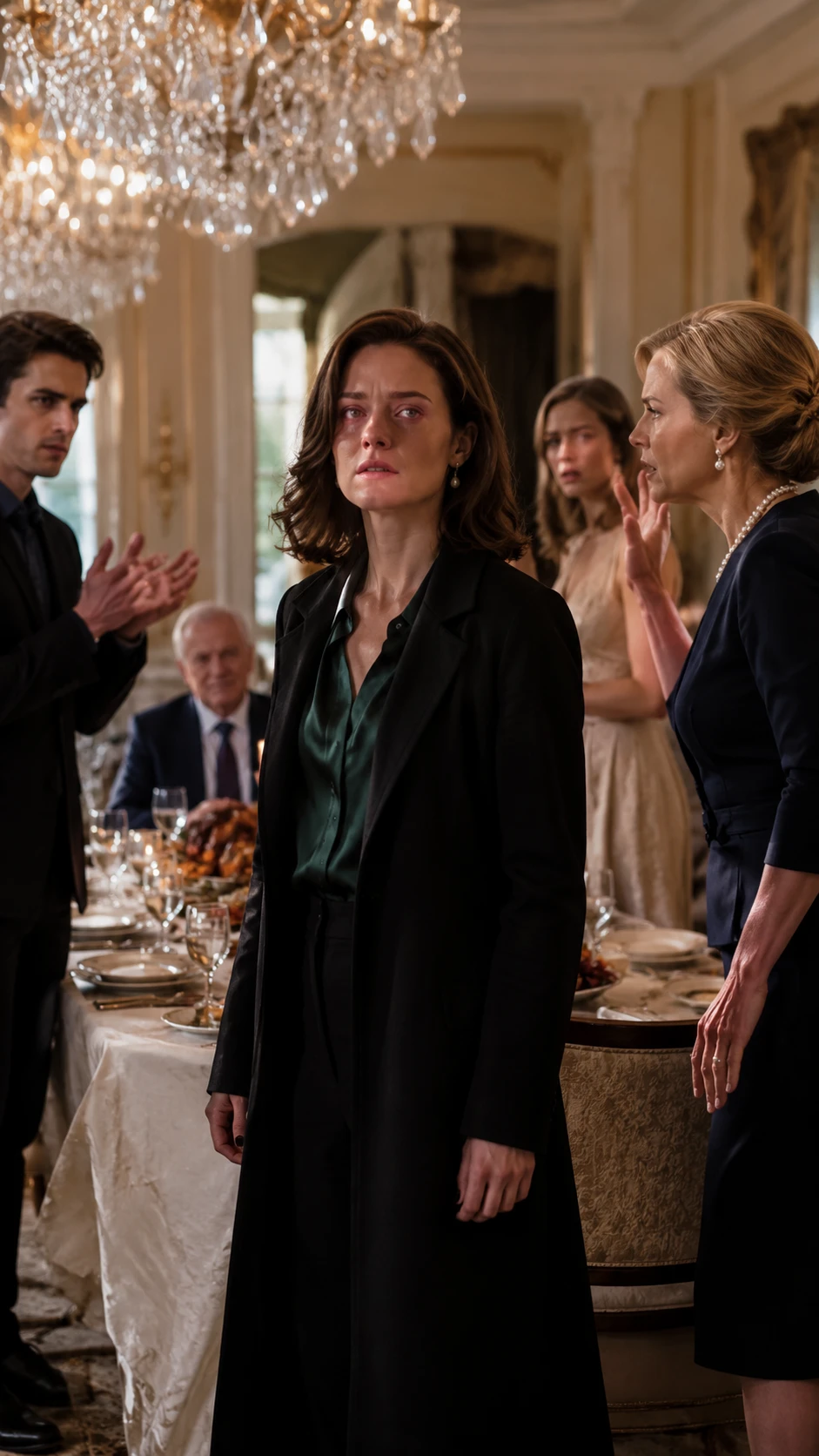
Without a word, I stood and reached for my coat.
That was when my mother crossed the room.
Her hand struck my face so hard my head snapped sideways.
The room fell silent.
Then Nathan started clapping.
My father smirked.
“You deserved that,” he said.
And in that exact moment, something inside me became completely still.
For a few seconds, no one breathed.
Not really.
There was only the low hum of the chandelier, the faint clink of ice inside someone’s glass, and the heat spreading across my cheek.
My mother’s hand still hovered in the air.
Her fingers trembled, but not from remorse.
From satisfaction.
She had finally done in public what she had been doing in private for years.
Only this time, there were witnesses.
I slowly turned my head back toward her.
Margaret Harrington stood inches from me, her pearls shining against her throat, her lips parted in triumph.
Behind her, Sophia had one hand pressed over her mouth.
Not in horror.
In performance.
Nathan’s applause died slowly, one clap at a time, until even he seemed to realize the room had become too silent.
My father remained seated at the head of the table.
Edward Harrington looked almost pleased.
That was the part that should have broken me.
Instead, it steadied me.
I finally understood that they had mistaken my silence for weakness.
I lifted my hand to my cheek.
My skin burned beneath my fingertips.
Then I looked at the guests.
Every face turned away.
Old family friends.
Board members.
Charity patrons.
My sister’s future in-laws.
People who had eaten at our table for years and praised our family name.
Not one of them moved.
Not one of them said a word.
I laughed once.
It was small, sharp, and completely humorless.
My mother narrowed her eyes.
“What is funny?”
I looked at her.
“You still think this is your room.”
Her smile faltered.
Nathan stepped closer, his jaw tight.
“Watch your tone.”
I turned to him.
“No.”
The word was quiet.
But it landed harder than shouting.
My father’s chair scraped back.
“Victoria.”
There it was.
The warning voice.
The voice that had ended every argument when I was a child.
The voice that had taught me to apologize for crying, for asking questions, for noticing things I was not supposed to notice.
He adjusted his cufflinks, calm and controlled.
“You are embarrassing yourself.”
I nodded slowly.
“I know that line.”
His eyes sharpened.
“You should leave before you make this worse.”
“I was leaving.”
I looked at my mother.
“Then she hit me.”
Margaret’s face hardened.
“You provoked me.”
“No,” I said. “I survived you.”
A ripple moved through the room.
Sophia whispered, “Victoria, please.”
I looked at my sister.
For one strange second, I saw something behind her polished expression.
Fear.
Not of me.
Of what might happen next.
Then it vanished beneath her social smile.
“Don’t ruin Thanksgiving,” she said softly.
I almost felt sorry for her.
Almost.
Then my phone vibrated in my coat pocket.
Once.
Twice.
Three times.
The first call had gone through.
My backup plan had started without me.
I slid my phone out and glanced at the screen.
A message waited there from a number I had saved under one name.
MARA.
We’re outside.
I closed my eyes for half a second.
Then I opened them and looked at my father.
“You told me once that every family has a foundation,” I said. “Do you remember that?”
His expression froze.
“You said ours was loyalty.”
I placed my phone on the table.
“But it wasn’t loyalty.”
No one moved.
“It was fear.”
My father stepped closer.
“Enough.”
I looked at him, and for the first time in my life, I did not lower my eyes.
“No.”
The front doorbell rang.
The sound cut through the mansion like a blade.
Margaret turned toward the foyer, startled.
One of the catering staff moved to answer it, but my father lifted a hand.
“No one opens that door.”
The bell rang again.
Longer this time.
Nathan walked toward me.
“What did you do?”
I smiled faintly.
“Three calls.”
His face changed.
Just a little.
Enough.
My mother looked between us.
“What does that mean?”
Before anyone could answer, the front door opened.
Not by the staff.
By Mrs. Vale, the housekeeper who had worked for my family since I was thirteen.
She stood in the foyer in her black dress and white apron, one hand still on the handle.
Behind her were two people I recognized instantly.
A woman in a navy coat with silver hair and tired eyes.
And a man carrying a leather folder against his chest.
Mara Ellison stepped into the house first.
She had been my father’s corporate counsel for nearly twenty years.
She had resigned six months after I left.
At least, that was what everyone believed.
The man beside her was Daniel Frost, a forensic accountant.
The same Daniel my father had once called “a dangerous little termite” after he questioned a foundation transfer.
My father’s face lost all color.
For the first time that night, Edward Harrington looked afraid.
Margaret whispered, “Edward?”
He did not answer her.
His eyes stayed fixed on Mara.
“You have no right to be here,” he said.
Mara removed her gloves slowly.
“I was invited.”
Nathan turned toward me.
His face twisted.
“By her?”
Mara looked at him.
“No.”
Then her gaze moved to Sophia.
“By your sister.”
The room went cold.
Sophia staggered back as if the words had struck her.
“What?”
Mara’s expression softened with something like pity.
“I’m sorry, Sophia.”
My sister shook her head.
“No. I didn’t invite anyone.”
Mara opened the leather folder Daniel handed her.
“You did,” she said quietly. “Three weeks ago.”
Sophia’s fiancé, Grant, stood from his chair.
“Sophia?”
Sophia looked at him, panicked.
“I don’t know what she’s talking about.”
Mara held up a cream envelope.
It matched the wedding stationery stacked on the entry table.
Inside was a folded note.
Mara read aloud.
“If something happens at Thanksgiving, come before dessert. Victoria will need proof, and I won’t be brave enough to say it first.”
The room erupted in whispers.
Sophia’s face crumpled.
“No,” she breathed.
I stared at her.
My entire body felt suddenly hollow.
“Sophia?”
She would not look at me.
Her hands began trembling.
My mother snapped, “This is absurd. Sophia, tell them you wrote no such thing.”
Sophia swallowed.
Tears gathered in her eyes.
Then Grant stepped away from her.
Just one step.
But she felt it.
I saw it break something inside her.
She looked at me then.
Not with hatred.
Not with superiority.
With shame.
“I didn’t think you would come,” she whispered.
Every memory of her sharp smile, her cruel little comments, her perfect obedience to our parents shifted slightly.
Not excused.
But changed.
My father slammed his palm on the table.
“Stop this immediately.”
Mara turned to him.
“No, Edward. It is already over.”
Daniel opened the folder.
“Copies of the foundation transfers were sent tonight to the Attorney General’s office, the trustees, and the major donors.”
A woman near the fireplace gasped.
My father’s jaw tightened.
“You have nothing.”
Daniel looked at him calmly.
“We have eleven years of misdirected charitable funds, shell invoices, forged board approvals, and personal expenses charged to relief accounts.”
My mother gripped the back of a chair.
“That is a lie.”
Mara looked at her.
“No, Margaret. You signed several of them.”
The room shifted again.
Guests began standing.
Some looked horrified.
Others looked guilty.
I recognized several board members suddenly staring at their shoes.
My father looked around the room, calculating.
Always calculating.
Then he smiled.
It was small and icy.
“You think you can destroy me with paperwork?”
Daniel did not blink.
“No.”
Mara looked toward the dining room entrance.
“Victoria can.”
Every eye turned to me.
My stomach tightened.
I had prepared for this.
I had rehearsed it in my apartment.
In the mirror.
In the shower.
In the car outside the house.
But standing there, with my cheek burning and my family watching, I suddenly felt twelve years old again.
Small.
Cornered.
Desperate to be loved by people who only loved obedience.
Then Mrs. Vale stepped forward.
She carried a silver serving tray.
On it sat my old blue notebook.
The one I thought had been lost years ago.
The one I had kept hidden beneath a loose floorboard when I was sixteen.
My breath caught.
Mrs. Vale’s eyes met mine.
“I saved it,” she said softly.
I could barely speak.
“You had it?”
She nodded.
“Your mother ordered me to burn it.”
Margaret spun toward her.
“You ungrateful woman.”
Mrs. Vale straightened.
“I raised your daughter more than you did.”
The words landed like a slap.
For one instant, Margaret had no reply.
Mrs. Vale looked back at me.
“You wrote everything down, Miss Victoria. Dates. Names. Checks. Conversations. You were always trying to understand why everyone acted afraid.”
My throat tightened.
I remembered that notebook.
I remembered the childish handwriting becoming sharper as I got older.
I remembered recording overheard arguments, suspicious accounts, my father’s locked study, my mother’s threats.
Not because I wanted revenge.
Because I wanted proof that I was not crazy.
That notebook was not a weapon when I wrote it. It was a lifeline.
Mara lifted another document.
“Combined with Victoria’s records, Sophia’s emails, and the recovered files from Edward’s old assistant, we have enough.”
My father’s eyes moved to Sophia.
“You sent emails?”
Sophia flinched.
“I didn’t know what else to do.”
His voice dropped.
“You stupid girl.”
Grant stepped between them.
“Do not speak to her like that.”
Nathan laughed bitterly.
“Oh, now you care?”
Grant turned on him.
“I cared the moment I realized this family was hiding something.”
Sophia began crying openly.
“I thought I could fix it before the wedding,” she said. “I thought if I gave Mara the files, she could force Dad to return the money quietly.”
She looked at me.
“I didn’t know Mom would invite you.”
My mother’s eyes sharpened.
“Enough.”
But Sophia kept going.
“I didn’t know she wanted to humiliate you in front of everyone.”
I stared at her, unable to understand.
“Then why did you act like that when I walked in?”
Sophia wiped her face with shaking fingers.
“Because I was terrified.”
Her voice broke.
“Because if Dad knew I had contacted Mara, he would destroy Grant’s family business. He told me so.”
Grant went still.
My father’s expression gave nothing away.
But silence answered for him.
Sophia whispered, “He said if I did not smile, if I did not play the perfect bride, he would make sure Grant’s father lost every loan extension.”
Grant looked at my father with disgust.
“You threatened my family to control her?”
Edward smiled faintly.
“I protected my investment.”
Sophia covered her mouth.
Grant turned back to her.
“Why didn’t you tell me?”
She shook her head.
“Because I thought you would leave.”
His face softened.
“Sophia.”
“I lied,” she whispered. “I smiled. I laughed. I let Victoria think I was just like them.”
Her eyes found mine again.
“I’m sorry.”
I wanted to forgive her immediately.
I wanted the apology to erase years of cruelty.
But pain is not a door that opens just because someone knocks.
I said nothing.
Sophia looked down, accepting it.
Nathan stepped forward, clapping once again.
Slow.
Mocking.
“Well, this is touching.”
He looked at Mara.
“But none of this changes anything. Dad has survived worse.”
Mara’s eyes shifted to him.
“That depends.”
Nathan’s smile froze.
Daniel removed a smaller envelope from the folder.
“Nathan Harrington, we also reviewed the acquisition contracts from Veyron Capital.”
Nathan’s face changed too quickly.
My father turned toward him.
“What contracts?”
Nathan swallowed.
For the first time all night, he looked young.
Not powerful.
Not arrogant.
Young and cornered.
Daniel continued.
“Your son has been selling private company information to a competitor for eighteen months.”
A murmur rolled through the guests.
My mother whispered, “Nathan?”
Nathan exploded.
“I did what I had to do!”
My father stared at him.
“What you had to do?”
Nathan pointed at me.
“She left. Sophia was getting married. You were going to give everything to the foundation trust.”
My father’s voice became deadly soft.
“You betrayed my company?”
Nathan laughed, but there was panic beneath it.
“Your company? You mean the machine that eats everyone who gets near it?”
He looked around the room.
“You all worship him. You think Edward Harrington built an empire. He built a cage.”
My father’s hand curled into a fist.
Nathan turned back to him.
“You told me I was your heir. Then you made me beg for every signature, every title, every inch of control.”
His voice cracked.
“You never wanted a son. You wanted a guard dog.”
For the first time, I saw Nathan clearly.
Not innocent.
Not absolved.
But shaped by the same house that had shaped me.
He had learned cruelty as survival.
He had mistaken dominance for safety.
My mother stepped toward him.
“Nathan, stop.”
He rounded on her.
“You knew.”
Margaret recoiled.
“You knew what he did to all of us, and you dressed it up as family loyalty.”
His eyes flicked to me.
Then away.
“I clapped because if I didn’t, he would know I was scared too.”
The admission sucked the air from the room.
I felt no instant sympathy.
Only a strange, aching recognition.
We had all become different versions of fear.
My father looked at his children as if seeing defective assets.
“You are pathetic.”
That was when the final door opened.
The study door.
A man stepped out slowly.
He was older than I remembered, with white hair and a cane in his right hand.
The room fell into a stunned silence.
My mother made a sound like she had been cut.
“No.”
My father took one step back.
I knew that face from one photograph hidden in my grandmother’s Bible.
Julian Devereux.
My father’s older brother.
The man I had been told died before I was born.
Except he was standing in our dining room.
Alive.
Breathing.
Watching us with eyes full of grief.
My knees nearly buckled.
“What is this?” I whispered.
Julian looked at me.
“You look like your grandmother.”
My father’s voice was barely human.
“Get out.”
Julian did not move.
“I stayed away for thirty years because you promised the children would be safe.”
The children.
Not the company.
Not the money.
The children.
My mother’s face collapsed.
Edward’s mask finally cracked.
“You have no right to speak.”
Julian leaned on his cane.
“I have every right. I founded the Devereux Trust before you stole it.”
The room erupted.
Mara stepped beside him.
“The original trust documents were recovered two months ago.”
My head spun.
“What trust?”
Julian’s eyes softened.
“The family trust your grandmother created. It was never meant to belong to Edward.”
He looked at me, Sophia, then Nathan.
“It was meant to protect all three of you.”
I could not breathe.
My father said nothing.
That silence was an answer.
Mara opened another file.
“Edward had Julian declared mentally unfit after a business dispute. He used that ruling to take control of the trust.”
Julian’s jaw tightened.
“He put me in a private facility and told everyone I had died.”
Sophia sobbed.
Nathan whispered, “What?”
My mother turned away.
I stared at her.
“You knew?”
Her lips trembled.
For the first time all night, my mother looked old.
“I knew later.”
“When?”
She closed her eyes.
“When you were fifteen.”
Fifteen.
The year I started the blue notebook.
The year my father’s office door was always locked.
The year my mother began watching me like I was a threat.
I felt the floor tilt beneath me.
“That was why you wanted the notebook burned.”
She did not deny it.
My voice shook.
“You knew he locked away his own brother.”
Margaret’s eyes filled with tears.
“I thought I could protect you.”
I laughed.
It came out broken.
“By letting him destroy us?”
Her tears spilled over.
“You don’t understand what he was.”
Julian’s voice was quiet.
“She does.”
My mother looked at him.
“She understands better than anyone.”
I turned toward Julian.
He held my gaze.
“Your grandmother suspected Edward before she died. She changed the trust protections secretly.”
Mara nodded.
“The controlling rights did not pass to Edward permanently.”
My father’s face hardened.
“Careful.”
Mara ignored him.
“They passed to the first descendant who could prove coercion, fraud, or abuse within the direct family line.”
My pulse thundered.
Julian looked at me.
“That descendant is you.”
The room disappeared.
All sound thinned into a distant ringing.
Me.
Not Nathan.
Not Sophia.
Not my father.
Me.
The unwanted daughter.
The embarrassment.
The difficult one.
The one they slapped in public and called dramatic.
The empire they used to silence me had legally been waiting for me to speak.
My father lunged toward the table.
Daniel moved first, gathering the files.
Grant stepped in front of Sophia.
Nathan blocked my father without seeming to think.
Edward stopped.
He looked at Nathan with pure disgust.
“You would stand against me?”
Nathan swallowed hard.
Then, for the first time in my life, my brother did not perform.
“Yes.”
The word broke something.
Not in me.
In him.
My father stared at us.
His children.
The assets that had failed to obey.
The guards who had stepped away from the gate.
Outside, blue and red lights flashed faintly through the curtains.
My mother turned toward the windows.
“No,” she whispered.
Mara’s face remained calm.
“The investigators are here.”
My father looked at me.
There was no love in his eyes.
No sorrow.
Only disbelief.
“You did this.”
My voice was steady, though everything inside me trembled.
“No. You did.”
The front doors opened again.
This time, the room did not pretend.
Two state investigators entered with a uniformed officer behind them.
They were polite.
Professional.
Almost quiet.
That made it worse.
One investigator approached my father and asked him to step into the study.
My father looked at the guests, expecting someone to intervene.
No one did.
The same people who had watched my mother slap me now watched my father fall.
But this time, their silence belonged to him.
Margaret reached for his arm.
“Edward.”
He pulled away from her.
“Do not touch me.”
She recoiled as if struck.
He walked out without looking back.
Nathan exhaled shakily and sat down hard in a chair.
Sophia collapsed against Grant, sobbing into his jacket.
Guests began leaving in clusters, whispering into phones, avoiding eye contact.
The perfect Thanksgiving dissolved into panic, shame, and shattered glass.
Somewhere in the kitchen, a plate fell.
No one moved to clean it.
I stood beside the table, surrounded by wreckage, and realized I did not feel victorious.
I felt exhausted.
Mrs. Vale approached me.
“Miss Victoria.”
I turned to her.
She held out the blue notebook.
My fingers closed around it carefully.
The cover was worn soft at the edges.
A child’s sticker still clung to one corner.
A silver star.
I remembered putting it there after my grandmother told me stars were proof that light survived distance.
My throat closed.
“Why did you keep it?”
Mrs. Vale’s eyes shone.
“Because one day, I hoped someone would believe you.”
That was the first time I almost cried.
Not when my mother slapped me.
Not when my father smirked.
Not when my family’s empire began to collapse.
But when someone said they had believed me all along.
I hugged the notebook to my chest.
“Thank you.”
She touched my shoulder.
“You were never the problem.”
Those five words reached places inside me no apology ever had.
Mara stepped closer.
“We need your statement tonight.”
I nodded.
“I know.”
Julian watched me gently.
“You don’t have to decide everything now.”
I looked at him.
“How long were you in that facility?”
His eyes dropped.
“Fourteen years.”
The answer hurt.
“Why didn’t you come back sooner?”
He smiled sadly.
“Because by the time I got out, Edward had built walls around all of you.”
His gaze moved toward my mother.
“And because someone sent me money every month under a false name.”
My mother froze.
I turned toward her.
“What?”
Julian nodded.
“She kept me alive.”
The room seemed to shift again.
Margaret gripped the chair beside her.
“I didn’t deserve to tell that part.”
I stared at her.
My anger did not disappear.
But it changed shape.
“You knew he was alive.”
“Yes.”
“And you let us believe he was dead.”
Her voice broke.
“Yes.”
“Why?”
She looked at the floor.
“Because your father said if I told anyone, he would have Julian moved somewhere worse.”
Julian’s face tightened.
“She believed him.”
Margaret wiped at her tears, ruining her makeup.
“I was a coward.”
No one corrected her.
She looked at me.
“I became cruel because cruelty was rewarded here. That is not an excuse.”
Her voice shook harder.
“It is only the truth.”
I wanted to hate her cleanly.
I wanted a simple villain.
But families rarely give you clean wounds.
They give you knots.
Margaret reached into her clutch with trembling hands.
Nathan tensed.
But she only removed a small flash drive.
“I copied Edward’s private ledger three years ago.”
Mara stepped forward slowly.
Margaret held it out.
“I was going to give it to Victoria after she left.”
I looked at her.
“But you didn’t.”
“No.”
Her face crumpled.
“Because if I gave it to you, I had to admit I had let you suffer while I gathered courage.”
Sophia cried harder.
Nathan looked away.
Margaret extended the drive toward me.
“I am giving it now.”
I did not take it.
Not immediately.
My mother’s hand trembled in the space between us.
The same hand that had slapped me.
The same hand that had signed documents.
The same hand that had fed me soup when I had the flu at nine.
The same hand that had pushed me away whenever I became inconvenient.
I finally took the drive.
Not as forgiveness.
As evidence.
Forgiveness could wait. Truth could not.
Mara placed the drive into an evidence sleeve.
“That may accelerate everything.”
My mother nodded.
“I know.”
“You may face charges too.”
Margaret closed her eyes.
“I know.”
That was the first honest thing I had heard from her in years.
The investigators took statements in separate rooms.
Thanksgiving dinner sat untouched beneath the chandeliers.
Candles burned lower.
Flowers drooped.
Wine warmed in abandoned glasses.
I sat in the library with Daniel while he recorded my statement.
At first, my voice was steady.
Then he asked when I first suspected something was wrong.
I opened the blue notebook.
The first page was written in round, childish handwriting.
Dad yelled at Uncle room again. Mom cried after dinner. Nathan said don’t ask.
My breath caught.
I did not remember writing that.
Daniel waited.
He did not rush me.
So I kept reading.
Page after page.
The past returned in fragments.
My father’s locked drawers.
My mother’s sudden silence.
Nathan standing outside my room after arguments.
Sophia slipping notes under my door that said, Don’t come downstairs.
I had forgotten those notes.
Or maybe I had buried them because remembering would make everything harder.
Sophia had not always been cruel.
Nathan had not always clapped.
There had been a time when we had all been children listening to footsteps in the hall.
When Daniel finally turned off the recorder, my hands were shaking.
“You did well,” he said.
I looked down at the notebook.
“I don’t feel well.”
“That is different.”
I almost smiled.
Outside the library, I heard Sophia’s voice rising.
“No, I will not leave with you.”
I stepped into the hall.
Grant stood near the staircase, pale and stunned.
Sophia faced him with red eyes.
“I lied to you,” she said. “I understand if you need distance.”
Grant took her hands.
“I need truth.”
She nodded.
“I can do that.”
He swallowed.
“Can you?”
She looked toward me.
Then back at him.
“I don’t know. But I want to learn.”
That was not a perfect answer.
It was the first real one.
Nathan stood alone near the window.
For once, he looked smaller without his arrogance.
He glanced at me as I approached.
“I’m not asking you to forgive me.”
“Good.”
He nodded, accepting the hit.
“I clapped because I hated myself.”
I said nothing.
He rubbed both hands over his face.
“I know that doesn’t fix anything.”
“No,” I said. “It doesn’t.”
He looked toward the study door, where our father was still speaking with investigators.
“I thought if I became like him, he couldn’t hurt me.”
His voice cracked.
“But then I became someone who hurt you.”
I looked at my brother.
The boy who once taught me how to ride a bike.
The man who applauded when our mother slapped me.
Both were real.
That was the terrible part.
“What happens now?” he asked.
“For you?”
He nodded.
“You tell the truth.”
He laughed weakly.
“That simple?”
“No.”
I looked toward the dining room.
“But it is where we start.”
He wiped his eyes quickly, ashamed of them.
“I can give Mara the competitor contracts. All of them.”
“Then do that.”
He nodded.
“And after?”
I looked at him for a long moment.
“After, you live with what you did.”
He flinched.
But he did not argue.
Near midnight, the house was nearly empty.
The investigators had taken my father away for further questioning.
Not in handcuffs.
Not dramatically.
That would have been too easy.
He left with his coat over his arm, still trying to look dignified.
But everyone had seen him.
Everyone had heard enough.
The Harrington name did not shatter with a scream.
It cracked under the weight of documents, witnesses, and children who finally stopped lying for him.
Margaret remained in the sitting room.
Alone.
When I entered, she stood immediately.
Her cheek was pale.
Her lipstick gone.
Without the pearls and performance, she looked like a woman who had spent decades holding up a burning house.
She looked at the mark on my face and began crying again.
“I am sorry.”
The words were small.
Too small for what they needed to carry.
I stood by the doorway.
“You humiliated me.”
“I know.”
“You hit me.”
“I know.”
“You let him make me believe I was the selfish one.”
Her voice broke.
“I know.”
I waited for an excuse.
There was none.
She folded her hands together.
“I cannot ask you to forgive me.”
“You shouldn’t.”
She nodded.
“I won’t.”
That mattered more than any dramatic apology.
She looked toward the fireplace.
“When you were little, you used to hide under this table during parties.”
I remembered.
Vaguely.
“You said it was quieter under there.”
I swallowed.
“It was.”
“I should have noticed that a child needing quiet in her own home meant something was wrong.”
I said nothing.
She looked back at me.
“I noticed. I just did nothing.”
The honesty hurt worse than denial.
I sat across from her, keeping distance between us.
“What happens to the trust?”
“Mara will explain it better.”
“I’m asking you.”
Margaret drew a shaky breath.
“Your grandmother knew Edward was dangerous. She tried to protect Julian first. Then the children.”
Her hands tightened.
“She named you as the contingency because you were the only one who questioned things.”
A bitter smile touched her mouth.
“We punished you for the very trait that could save everyone.”
I looked away.
The fire cracked softly.
“Why invite me tonight?”
She closed her eyes.
“I wanted to scare you back into silence.”
The answer was ugly.
At least it was true.
“Then why text me like nothing happened?”
“Because I could not bear the idea that you might be free.”
I looked at her sharply.
She opened her eyes.
“I told myself I wanted my daughter home. But some part of me wanted proof that leaving had not saved you.”
Her tears fell again.
“Because if you were free, then I had no excuse for staying.”
The room became very still.
There it was.
The smallest, cruelest truth.
My freedom had offended her captivity.
I stood.
“I don’t know what we are after tonight.”
She nodded.
“I don’t either.”
“I’m not coming back to this family the way it was.”
“No.”
“I may never come back to you.”
Her face folded with pain.
But she nodded again.
“I understand.”
I reached the door.
Then stopped.
“But if you tell the truth, all of it, to the investigators, to the board, to Sophia, to Nathan, and to yourself…”
I turned back.
“Then someday, maybe we can speak again.”
Her lips trembled.
“I will tell the truth.”
I believed her.
Not completely.
Not safely.
But enough to leave the door unlocked.
In the foyer, Julian waited with his cane.
Mara stood beside him.
The mansion behind them looked different now.
Not grand.
Just enormous.
Cold.
A place built to impress strangers and frighten children.
Julian smiled gently.
“There is a guesthouse on the old property. It belongs to the trust. I am staying there tonight.”
I blinked.
“The old property?”
“Your grandmother’s house.”
I had not been there since I was eight.
My father told me it had been sold.
Of course he had.
Julian held out a small brass key.
“She wanted you to have it.”
I stared at the key.
It looked ordinary.
Tiny.
Impossible.
“She left me a house?”
“She left you a place to be safe.”
My fingers closed around the key.
For the second time that night, tears threatened.
Mara touched my arm.
“There will be legal battles. Public ones.”
“I know.”
“The foundation can be repaired, but not quietly.”
“Good.”
Julian nodded once, approving.
“The money must go where it was promised.”
“It will.”
He studied my face.
“You understand what this means?”
I looked back at the dining room, where the candles had nearly burned out.
“It means the empire doesn’t belong to him anymore.”
Julian’s eyes softened.
“No, Victoria.”
He leaned closer.
“It means it never did.”
That was the twist that settled deepest.
Not that my father had fallen.
Not that my sister had helped.
Not that my mother had hidden evidence.
But that the power they had used against us had always been stolen.
Their kingdom had been built on a locked door, a forged signature, and children taught not to ask why.
By morning, the story had reached every donor, board member, and executive in my father’s world.
The headlines were restrained at first.
Questions Raised Over Harrington Charitable Foundation.
Then stronger.
Devereux Trust Review Reveals Decade of Misused Funds.
Then unavoidable.
Edward Harrington Under Investigation.
I stayed at my grandmother’s house while the world discovered what we had lived inside.
It was smaller than I remembered.
Warmer.
The windows faced a line of bare winter trees.
The floors creaked.
The kitchen smelled faintly of cedar and dust.
In the upstairs bedroom, I found a quilt folded at the foot of the bed.
A note sat on top of it, yellowed with age.
For the child who asks questions.
I sat on the floor and cried until my chest hurt.
Not because everything was fixed.
It wasn’t.
My father would fight.
The board would panic.
Reporters would circle.
Nathan would face charges for the contracts.
Sophia postponed her wedding.
My mother entered a formal cooperation agreement and moved out of the mansion.
Nothing became simple.
But something became honest.
Weeks passed.
Then months.
The foundation was placed under independent management.
Millions were traced and redirected.
Scholarship recipients whose funds had been delayed received calls.
Medical programs my father had used for publicity finally received the money promised to them.
The Harrington name was stripped from buildings.
The Devereux Trust was restored.
I did not take the empire.
I dismantled the parts that had been built to control people.
Mara became interim trustee.
Daniel stayed on as oversight counsel.
Julian began restoring the family records, slowly and carefully, as if putting bones back into a body.
Nathan testified.
It cost him his position, his reputation, and most of his pride.
But one afternoon, he came to the old house and left an envelope on the porch.
Inside was a list of every person he had helped my father intimidate.
At the bottom, he had written one line.
I am done being his guard dog.
I kept the list.
Not the apology.
The work mattered more.
Sophia came by in early spring.
She wore jeans, no makeup, and no engagement ring.
Grant waited in the car, giving us space.
She stood on the porch, nervous and pale.
“I postponed the wedding indefinitely,” she said.
“I heard.”
She nodded.
“I’m in therapy.”
I almost laughed, not cruelly.
“That sounds healthy.”
A faint smile broke through her fear.
“I hate it.”
“That also sounds healthy.”
For a moment, we were almost sisters again.
Then silence returned.
She looked down.
“I found the notes.”
“What notes?”
“The ones I used to slide under your door.”
Her eyes filled.
“I remembered some of them. Not all.”
I gripped the porch railing.
“I forgot them too.”
“I think we had to.”
The wind moved through the trees.
She wiped her cheek.
“I don’t expect you to trust me.”
“I don’t.”
“I know.”
She took a small envelope from her coat pocket.
“I wrote everything I remember. About Dad. Mom. Nathan. Me.”
She held it out.
“Not for court. For you.”
I took it.
Our fingers brushed.
She flinched like she expected me to pull away.
I didn’t.
That was all I could give.
It was enough for that day.
My mother wrote letters.
I did not answer most of them.
But I read them.
The first ones were apologies.
The later ones were truth.
She wrote about Julian.
About fear.
About the first time my father threatened to have her declared unstable too.
About how she chose comfort over courage until comfort became another prison.
One letter ended with:
I do not ask you to carry my guilt. I am learning to carry it myself.
I folded that one carefully and placed it in the blue notebook.
Not because it healed everything.
Because it belonged with the record.
In May, Julian planted a dogwood tree in the yard.
He said my grandmother loved them.
I stood beside him with a mug of coffee as he pressed soil around the roots.
His hands shook from age, but he refused help.
“You are stubborn,” I said.
He smiled.
“Family trait.”
I looked at him.
“Dangerous thing to say.”
He chuckled softly.
Then he grew quiet.
“I wish I had found you sooner.”
I watched the young tree tremble in the wind.
“I wish a lot of things.”
“So do I.”
We stood there in silence.
No performance.
No polished speeches.
Just two survivors beside something newly planted.
That summer, the old mansion was sold.
Not to another family desperate for status.
To a nonprofit consortium that turned it into a recovery residence for women rebuilding their lives after financial and domestic abuse.
I thought I would feel strange walking through it before the transfer.
Instead, I felt calm.
The dining room was empty.
No chandeliers lit.
No guests whispered.
No mother stood with a raised hand.
I walked to the place where she had slapped me.
The floorboards did not remember.
But I did.
Sophia came with me.
Nathan too.
Margaret waited outside, unsure whether she was welcome.
After a long moment, I opened the door.
She entered slowly.
None of us spoke.
We stood together in the ruined center of our old mythology.
Four people who had hurt each other.
Four people who had been hurt.
No easy absolution.
No magical reunion.
But no more pretending.
Nathan looked at the empty dining room.
“I hate this room.”
Sophia whispered, “Me too.”
My mother said, “So do I.”
I touched my cheek.
The mark was long gone.
The memory was not.
“Then let it become something better.”
The transfer happened one week later.
There were no cameras at my request.
No speeches from politicians.
No family portrait.
Just signatures.
Keys.
A quiet turning of ownership.
As I signed the final document, Mara looked at me.
“Are you sure?”
I thought of my father.
His empire.
His name carved into stone.
His belief that power meant keeping everything.
Then I thought of my grandmother’s note.
For the child who asks questions.
“Yes,” I said.
“I’m sure.”
The first residents moved in that autumn.
A woman with two children.
An older nurse rebuilding her finances.
A young mother escaping a marriage that looked perfect from the outside.
I did not meet them as a benefactor.
I met them as someone who knew the shape of a beautiful cage.
On Thanksgiving one year after the slap, I did not return to a mansion.
I stayed at my grandmother’s house.
Julian cooked badly.
Sophia brought pies from a bakery because none of us trusted her oven.
Nathan arrived with coffee and a nervous joke no one laughed at until he laughed at himself.
Margaret came last.
She stood on the porch holding a covered dish.
Her hair was shorter now.
Her pearls were gone.
“I can leave this and go,” she said.
I looked at her for a long time.
Then I opened the door wider.
“You can come in.”
Her eyes filled immediately.
“I don’t want to ruin anything.”
“Then don’t.”
It was not warm.
Not exactly.
But it was real.
We ate at a small wooden table that barely fit five people.
No crystal chandeliers.
No catered food.
No speeches about loyalty.
When silence came, it was not threatening.
It was just silence.
Halfway through dinner, Nathan cleared his throat.
“I have something to say.”
Everyone tensed.
He noticed and winced.
“Not like that.”
Sophia snorted.
The sound surprised us all.
Then we laughed.
Not loudly.
Not freely.
But honestly.
Nathan looked at me.
“I’m working with the oversight board to identify everyone Dad harmed through the company.”
I nodded.
“Mara told me.”
“I’m not saying that for praise.”
“Good.”
He smiled faintly.
“I deserved that.”
Then Sophia lifted her glass of water.
“To no speeches.”
Julian raised his.
“To no lies.”
Margaret’s hand trembled around her glass.
She looked at me.
“To the daughter who asked questions.”
Everyone turned to me.
I felt the old instinct rise.
Deflect.
Smile.
Make the moment easier for everyone.
But I did not.
I let the words exist.
I let myself receive them.
Then I raised my glass.
“To the people who finally answered.”
After dinner, I stepped outside alone.
The air was cold.
The dogwood tree stood bare in the yard, thin branches reaching into the dark.
Behind me, through the kitchen window, I could see them.
Julian washing dishes badly.
Sophia drying them.
Nathan arguing with the faucet.
Margaret standing nearby, uncertain where to place herself, but staying.
It was not the family I had wanted as a child.
It was not repaired.
It might never be.
But it was no longer a stage built around one man’s power.
No one was performing.
No one was clapping.
No one was telling me what I deserved.
I pulled the blue notebook from my coat pocket.
The cover was more fragile now, the silver star fading at the corner.
I opened to a blank page near the end.
For a long time, I did not know what to write.
Then I took out a pen.
My hand moved slowly.
Thanksgiving.
No one yelled.
No one lied.
No one left afraid.
I stopped there.
The page blurred.
A tear slipped down my face, but this time, I did not wipe it away.
Inside the house, someone laughed softly.
The sound was imperfect.
Uncertain.
Alive.
I closed the notebook and looked up at the winter sky.
Above the bare trees, one star burned steady through the dark.
And for the first time in my life, silence did not feel like surrender.
It felt like peace.