I used to believe that if I worked hard enough, my mother would eventually find one reason to be proud of me.
That belief ended at my sister’s wedding.
Not when my mother raised her voice.
Not when the guests started laughing.
It ended when my six-year-old son looked up at me and asked whether I had done something wrong.
I still remembered the way he held my sleeve.
Two small fingers.
A worried face.
And a question no child should have needed to ask.
My name was Corrine Whitmore.
I was thirty-three years old, a neonatal nurse, and the mother of a little boy named Beckett.
I had spent years learning how to survive without much help.
I knew how to stretch one paycheck until the next one arrived.
I knew which grocery items could wait another week.
I knew how to work twelve hours on my feet, come home exhausted, and still make my son feel as though he had my full attention.
I wasn’t wealthy.
I wasn’t married.
And according to my mother, those two facts told people everything they needed to know about me.
Lorraine Whitmore had never been subtle about which daughter she preferred.
My younger sister, Fallon, had always been her favorite.
Fallon wore the right clothes.
She knew the right people.
She understood how to make our parents look successful.
I had never been particularly good at any of those things.
I had chosen nursing because I wanted to help people.
My mother thought I should have chosen something that brought more money and admiration.
When I became a single mother, she treated it as proof that she had been right about me all along.
I tried not to let her opinions matter.
That was what I told people, anyway.
The truth was less impressive.
Some part of me still wanted her approval.
Even at thirty-three.
Even after everything.
That evening, Fallon was marrying Gideon, a man who managed a charitable foundation that supported hospitals, shelters, and families in difficult circumstances.
He was polite, successful, and respected.
My mother considered him exactly the sort of husband a daughter should find.
She had spent months preparing for the wedding.
The final cost was close to $150,000.
I knew because she had mentioned the amount repeatedly.
Sometimes she sounded proud.
Sometimes she sounded as though the expense itself proved that Fallon mattered more than ordinary people.
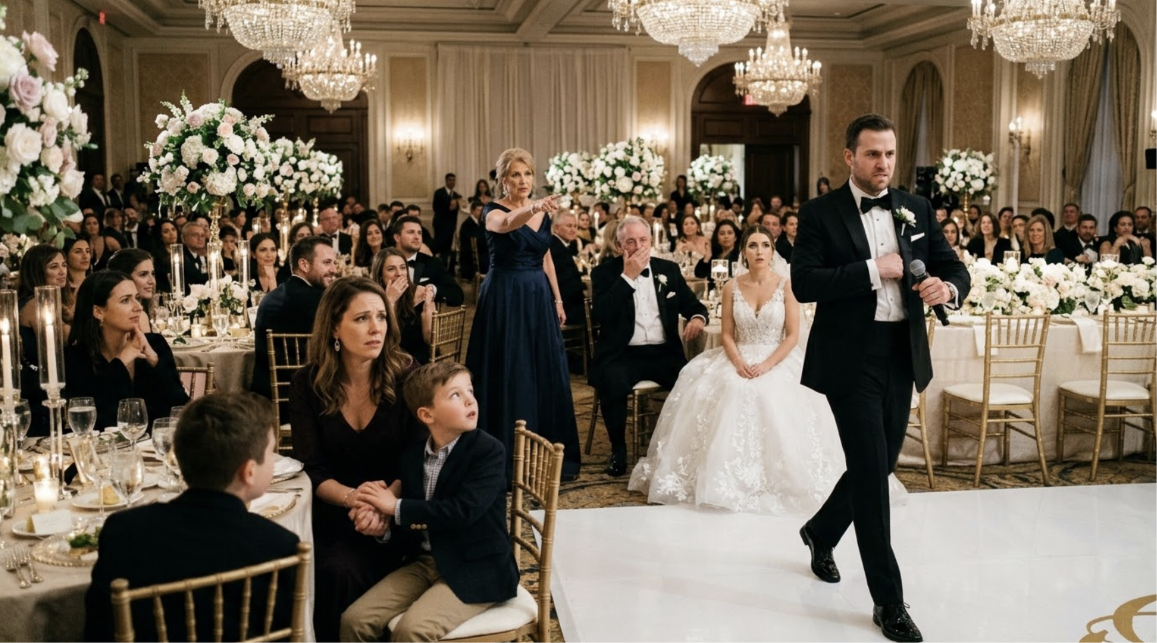
The reception was held in an enormous ballroom in Newport.
When Beckett and I arrived, I stopped just inside the entrance.
The room was beautiful.
Tall flower arrangements rose above the tables.
Crystal decorations caught the light.
Servers moved between guests carrying trays of drinks.
The chairs were dressed in pale fabric, and every table seemed arranged with almost unreasonable care.
I remember looking at the decorations and thinking about how many months of my salary they represented.
Then I felt ashamed of myself.
It was my sister’s wedding.
I wanted to be happy for her.
I wanted to be the older sister who smiled in the photographs and meant it.
Beckett tugged at my hand.
“Mom, is this where we’re eating?”
I nodded.
“That’s right.”
He looked around.
“It’s really big.”
“It is.”
He was wearing a little jacket that I had carefully straightened before we left the apartment.
He had been excited all afternoon.
He rarely attended events where adults dressed so formally.
He thought the whole thing was rather wonderful.
I wanted him to enjoy it.
A member of the reception staff checked our names and directed us toward the back of the ballroom.
We walked past the decorated tables.
Past people laughing together.
Past relatives I recognized but hadn’t seen in months.
I smiled at a few familiar faces.
Some smiled back.
Others barely looked at us.
Our table was number twenty-eight.
It stood near the swinging doors leading to the kitchen.
The contrast was hard to miss.
At the front of the room, my parents sat close to the wedding party.
Their table was surrounded by flowers and candles.
At the back, Beckett and I could hear dishes being stacked whenever the kitchen doors opened.
I stood beside our chairs for a moment.
I checked the table number again.
Twenty-eight.
I had the foolish hope that someone had made a mistake.
No one had.
Beckett climbed onto his chair and looked toward the front.
“Why are we so far away?”
I put my bag down.
“There’s plenty of room here.”
That wasn’t an answer.
I knew it.
He looked behind us as a server pushed through the doors.
“It’s noisy.”
“I know, honey.”
He turned toward the head table.
“I can see Grandma.”
I followed his gaze.
My mother stood among several guests, smiling and touching the necklace at her throat.
She looked perfectly comfortable.
There was no sign that she had even noticed our arrival.
“Can we go over there?” Beckett asked.
“Maybe after dinner.”
He nodded and started examining the folded napkin on his plate.
I watched him for a moment.
Then I looked down at my own place setting.
My name was printed neatly on a little card.
Corrine Whitmore.
At least that part was correct.
I wondered whether my mother had personally chosen our seats.
I suspected she had.
Still, I told myself not to make a problem out of it.
That had become my habit.
Find an explanation.
Accept the inconvenience.
Keep the peace.
I had been doing it since childhood.
When Fallon received expensive birthday presents and I received something practical, I was told to appreciate what I had.
When she needed help with money, my parents found a way.
When I needed help, I was given a lecture.
My father, Richard, rarely argued with my mother.
He preferred silence.
He could watch her say something hurtful and somehow behave as though the real problem was my reaction.
I had learned not to expect him to intervene.
Even so, I had hoped this wedding might be different.
There were too many guests for my mother to start an argument.
Too much money had been spent.
Too many photographs would be taken.
I thought she would want everything to look perfect.
Looking back, that was my mistake.
I assumed her idea of a perfect family occasion included allowing everyone to feel welcome.
It didn’t.
It included reminding people where they belonged.
Fallon appeared near the front of the ballroom.
She looked beautiful.
Her wedding gown fitted her perfectly.
Her hair had been arranged with care, and her jewelry flashed whenever she moved.
For a moment, I forgot my uncomfortable seat.
I remembered the little girl who had followed me around our grandfather’s summer home.
I remembered helping her learn to ride her bicycle.
I remembered the way she used to reach for my hand during thunderstorms.
That little girl was getting married.
I wanted something good for her.
Whatever our relationship had become, I still loved her.
Gideon stood beside her.
He looked calm, although I noticed he wasn’t smiling quite as much as Fallon.
I barely knew him.
We had spoken at family dinners and a handful of gatherings.
He had always treated me politely.
That alone made him different from some of the people my mother admired.
But we weren’t close.
I certainly hadn’t expected him to become involved in anything between my parents and me.
Dinner began.
Beckett was delighted by the food.
He asked whether he could have another roll.
I told him he could.
He tried to sit properly because he knew it was a special occasion.
Every so often, the kitchen doors opened behind us.
Warm air and the clatter of dishes drifted into the ballroom.
Beckett started making a game of guessing when the doors would open next.
I smiled despite myself.
He could find something interesting almost anywhere.
That was one of the things I loved most about him.
Then the speeches began.
Several people spoke about Fallon and Gideon.
There were jokes.
Stories about their relationship.
Warm wishes for their future.
I clapped with everyone else.
I was beginning to relax when my mother stood.
She took the microphone and walked toward the front of the room.
I knew that expression.
She was enjoying herself.
She began with a speech about Fallon.
She described her as beautiful, capable, and accomplished.
She spoke about how much pride her younger daughter had brought into the family.
The guests smiled.
Some applauded.
I smiled too.
Fallon deserved to hear kind words on her wedding day.
Then my mother turned her head toward the back of the ballroom.
I felt my stomach tighten.
She had that little smile she always wore before making a remark she expected other people to find amusing.
She began talking about the difference between her daughters.
At first, she kept it light.
She suggested that some children understood the importance of making good decisions.
Others, she implied, preferred learning things the difficult way.
Several guests chuckled.
I lowered my eyes.
There it was.
The comparison.
I had heard it at birthdays and family dinners.
I had heard it over the telephone.
Now she was doing it in front of two hundred people.
She described Fallon as the daughter who had fulfilled every parent’s hopes.
Then she gestured toward my table.
“And Corrine is still figuring out how to make something of herself.”
A few people laughed.
My face burned.
I stared at my plate.
I wanted to believe she would stop there.
She didn’t.
My mother continued.
She mentioned my failed marriage.
She mentioned how hard I worked without having much to show for it.
She made my small apartment sound like a personal disgrace.
Then she called me a failure.
Worthless.
Those were the words she chose.
Not privately.
Not during an argument.
Into a microphone.
In front of a ballroom filled with people.
I looked toward my father.
He was laughing.
Not loudly.
Just enough to show that he approved.
I turned toward Fallon.
She was smiling.
Maybe she was uncomfortable.
Maybe she didn’t know what to do.
I couldn’t tell.
What I could tell was that neither of them made any effort to stop her.
Beckett pulled at my sleeve.
“Mom?”
I turned toward him.
His eyes were moving between my face and the front of the ballroom.
“Why is everybody laughing?”
I felt my throat close.
“Don’t worry about them.”
He frowned.
“Did you do something bad?”
I reached for his hand.
“No, sweetheart.”
He studied me.
“Then why is Grandma saying those things?”
I had no good answer.
I had spent most of my life trying to explain my mother’s behavior to myself.
I couldn’t explain it to a six-year-old.
I pressed his hand between mine.
“You haven’t done anything wrong. Neither have I.”
He looked relieved for a moment.
Then he glanced back at the head table.
I noticed that he wasn’t interested in his food anymore.
That hurt more than my mother’s words.
I had brought him here expecting a happy evening.
Instead, he was learning what humiliation looked like.
I thought about leaving.
I could pick up our jackets and walk out.
We could go home.
I could make him something warm to drink and let him watch a little television before bed.
Nobody could stop us.
I put my napkin beside my plate.
Then a chair moved at the head table.
Gideon was standing.
He reached for the microphone.
My mother smiled and handed it to him.
I think she expected another speech about Fallon.
Instead, Gideon looked toward our table.
He didn’t smile.
He held several sheets of paper in one hand.
For a few seconds, he said nothing.
Then he began talking about me.
Not about my marriage.
Not about my apartment.
About my work.
He described the long shifts I spent caring for premature infants.
He spoke about frightened parents waiting beside incubators.
He spoke about the weight of having another person’s newborn child depending on you.
I sat frozen.
He knew things I hadn’t told him.
Things about the hospital.
About the families.
About how difficult the work could become.
Then he looked at Beckett.
He told the guests that I went home after those shifts and cared for a child of my own.
I heard someone near the front stop whispering.
Gideon glanced toward the kitchen doors behind us.
He mentioned where we had been seated.
He pointed out that my mother had chosen to insult us in front of everyone.
The laughter disappeared.
I could hear a server moving dishes behind the swinging doors.
My mother approached him.
She placed her hand on his arm.
“Gideon, we don’t need to discuss family disagreements here.”
He stepped away gently.
“Then Corrine shouldn’t have been made part of your speech.”
My father stood.
“Let’s leave it there. This is your wedding, after all.”
Gideon looked at him.
“I know what today was supposed to be.”
He paused.
“I didn’t expect to see a little boy treated this way.”
Beckett leaned against me.
I wrapped my arm around him.
I wanted Gideon to continue.
I also wanted the whole evening to end.
Then he lowered his eyes to the papers.
He said he had been reviewing financial records connected to his charitable foundation.
Some figures had bothered him.
At first, he had assumed they were ordinary accounting errors.
But certain documents hadn’t matched the transactions they were supposed to explain.
He looked toward my mother.
Her smile had disappeared.
Gideon said the questionable entries were connected to the Whitmore family.
My mother took a step closer.
“That isn’t something you should be discussing tonight.”
Gideon didn’t move.
He looked at the papers again.
Then he looked at her.
For the first time that evening, my mother seemed unsure what to say.
And I realized the man holding the microphone wasn’t merely defending me.
He had found something.
Something my parents didn’t want anyone to see.
Click here to continue reading: PART 2: The Groom Questioned My Mother About Missing Donations, and I Learned Someone Had Been Using My Name Behind My Back
My Mother Made Me the Joke of My Sister’s Wedding, but One Man at the Head Table Refused to Laugh
Part 1 of 16