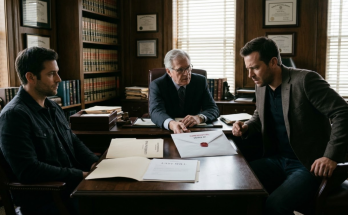
The first few weeks of the investigation were quieter than I expected.
No dramatic telephone calls.
No sudden apologies.
No envelope arriving with all the answers.
Mostly, there were documents.
Requests for records.
Questions I couldn't answer.
And long conversations with Evelyn Marsh about transactions that had taken place years before.
I had imagined that once someone found the trust agreement, the truth would become obvious.
It didn't work that way.
The original valuation was approximately $1.8 million.
That much was established.
But a trust wasn't simply a pile of money sitting untouched in a bank.
Grandpa had funded it through several kinds of assets.
Investments.
Commercial property interests.
Securities.
Their values had changed over time.
Some had produced income.
Some had been sold.
Others had been transferred into accounts that were difficult to follow.
Evelyn explained each step as patiently as she could.
I tried to keep up.
I had never taken a finance course.
My experience with money had mostly involved earning it and spending as little as possible.
Now I was learning terms I hadn't expected to need.
Trust administration.
Account ownership.
Beneficiary rights.
Supporting documentation.
I began keeping a notebook.
Every time Evelyn called, I wrote down the date.
Every time she requested information, I noted what she needed.
I made a separate page for questions.
At first, the questions filled the notebook faster than the answers.
I wanted to know where the assets had gone.
I wanted to know why my father hadn't informed me.
I wanted to know what my mother had known.
And I wanted to understand whether Grandpa's intentions could still be honored.
Some evenings, I sat at the kitchen table after Beckett fell asleep and studied the papers.
The apartment was quiet.
I could hear the refrigerator running.
Sometimes a car passed outside.
I would look at the numbers until they stopped making sense.
Then I would close the folder and go to bed.
I still had to work.
The hospital hadn't become less demanding because my family was under investigation.
Premature babies still needed care.
Parents still needed explanations.
My shifts were still long.
One night, I cared for a tiny newborn whose parents were frightened by every change on the monitor.
I stayed beside them while they asked questions.
I explained what I could.
When my shift ended, I felt the familiar exhaustion in my legs.
I washed my hands.
Collected my belongings.
And went home to Beckett.
Nothing about that part of my life had changed.
In a strange way, I was grateful.
The hospital reminded me that I was still Corrine.
Not an inheritance dispute.
Not the woman people were discussing after a ruined wedding.
A nurse.
A mother.
Someone who had responsibilities that didn't disappear when the rest of life became confusing.
I needed that.
I also needed the ordinary moments at home.
Beckett would show me something he'd drawn.
He would tell me about school.
He would ask whether we could make pancakes on the weekend.
Sometimes I caught myself smiling while he talked.
Then I would remember the trust.
The money.
My parents.
And the smile would fade.
I didn't want him to see that happen too often.
He had already witnessed enough.
So I tried to keep the legal discussions away from him.
When Evelyn called, I stepped into another room when possible.
When documents arrived, I put them in the folder.
I didn't want his childhood to become an endless conversation about what his grandparents had done.
I wanted him to know that adults could solve problems without making children responsible for them.
That wasn't always easy.
Some nights, I lay awake thinking about the wedding.
I remembered my mother's face when Gideon mentioned the bank account.
I remembered Dad closing his eyes.
I remembered Aunt Nadine standing with the envelope.
And I wondered how many people had known something I didn't.
Evelyn kept reminding me to focus on evidence.
She didn't want me building assumptions around memories.
That was good advice.
I had spent years letting my mother's explanations shape what I believed.
I didn't want anger to replace one set of assumptions with another.
So I waited for records.
And I kept working.
The first important findings concerned transfers from the original trust.
Some money had been moved into accounts connected to my parents.
Other funds had been used to purchase property.
There were records involving renovations and personal expenses.
Evelyn explained that we would have to determine which transactions were authorized.
A transfer wasn't automatically proof of wrongdoing.
But the trustee needed to account for how the assets had been managed.
I understood that much.
My father had been responsible for protecting something that belonged to me.
He needed to explain what had happened to it.
The next set of records raised more questions.
There were financial notices addressed to my parents.
Documents involving institutions that had held trust assets.
Information that had apparently never been shared with me.
I recognized none of it.
I had never received those statements.
I had never been asked to review them.
I had never been told that accounts continued to exist.
Evelyn asked whether my parents had ever discussed investments with me after Grandpa died.
I told her no.
She asked whether I remembered receiving any payments from the trust.
I couldn't recall any.
Everything I had earned as an adult had come through my own work.
There had been no regular trust distributions.
No financial adviser calling to discuss my future.
No letter explaining that I was entitled to anything.
Just my mother's statement that Grandpa had left nothing meaningful.
I felt foolish admitting how completely I had believed her.
Evelyn didn't criticize me.
She reminded me that beneficiaries often depended on trustees and family representatives to provide accurate information.
The obligation to maintain proper records didn't disappear because the beneficiary was young or inexperienced.
I wrote that down.
It mattered to me.
For so long, my mother had treated my lack of financial knowledge as a personal failure.
Now I was learning that not knowing about concealed records wasn't the same as being incapable.
I had never been given the information.
That was different.
One afternoon, Evelyn called while I was between shifts.
She had obtained additional records concerning an investment property.
Part of the original trust's assets appeared to have been transferred into a property registered jointly to my parents.
I sat down.
"Both of them?"
"That's what the records indicate."
I stared at the wall.
I thought about the improvements my parents had made to their home over the years.
I thought about how often my mother talked about investments.
I couldn't say those expenses had come from my trust.
The evidence wasn't complete.
But the possibility made me feel sick.
Evelyn explained that the property records would need closer examination.
The question was whether the trust funds had been used properly and whether any resulting interest could be recovered.
I asked whether my parents could simply keep the property.
She said the answer depended on the transactions, the governing documents, and what the court ultimately determined.
I nodded even though she couldn't see me.
It wasn't satisfying.
But I was learning to accept careful answers.
The investigation wasn't a story where every wrong was corrected as soon as it was exposed.
It was slow.
Sometimes frustrating.
And often confusing.
Meanwhile, the questions surrounding Gideon's foundation were being examined separately.
The disputed charitable authorizations were still part of that review.
I knew my name had appeared on forms I hadn't signed.
But I didn't know who had prepared them.
Evelyn made sure I understood that distinction.
My own case concerned the trust and the assets intended for me.
The foundation's records raised different legal and accounting questions.
There might be connections.
But they had to be established through evidence.
I appreciated that she didn't turn every suspicious detail into a conclusion.
I wanted to know what happened.
Not what would make the most dramatic explanation.
Weeks passed.
I continued working.
I continued raising Beckett.
And I continued answering Evelyn's questions whenever she needed information.
Then one Thursday afternoon, my phone rang.
I was at home.
Beckett was occupied nearby.
I saw Evelyn's name on the screen and answered immediately.
Her voice sounded different.
Not excited.
But more certain than usual.
She told me her team had located an investment account connected to the original trust.
The account hadn't appeared in the financial summaries my parents had provided.
I sat down at the kitchen table.
I asked whether it still existed.
She said it did.
The bank had confirmed the account.
For several seconds, I couldn't speak.
Until then, so much of the investigation had involved money that had moved years earlier.
Assets that had been sold.
Transactions that needed explanations.
Now she was talking about an account that still existed.
I asked how much it held.
Evelyn checked the information in front of her.
She told me the latest statement showed approximately $740,000.
I covered my mouth.
Seven hundred forty thousand dollars.
I couldn't make the number feel real.
I looked around my kitchen.
The little table.
The chairs.
The counter where I prepared Beckett's meals.
I thought about all the nights I'd worried over a bill that was due.
I thought about the winter shoes I'd postponed buying until my next paycheck.
The dental work I'd delayed.
The old car I'd kept running because replacing it seemed impossible.
And somewhere, an investment account connected to Grandpa's trust still held hundreds of thousands of dollars.
I closed my eyes.
I wasn't happy.
Not immediately.
I felt angry.
Then sad.
Then frightened that the information might somehow disappear again.
I asked Evelyn whether the money was definitely mine.
She answered carefully.
The account existed.
The balance had been confirmed.
But the ownership structure and the history of the transactions still needed to be verified.
She didn't want me assuming the full amount could be released immediately.
I understood.
At least, I tried to.
For a moment, I had imagined paying off every bill.
Buying a reliable car.
Taking Beckett somewhere nice.
Never again wondering whether I could afford an unexpected expense.
Then I reminded myself that a bank balance wasn't the same as money I could use.
Not yet.
I asked what would happen next.
Evelyn explained that they would continue reviewing the account's ownership and the records connecting it to the original trust.
They would also examine the investment property associated with my parents.
The goal was to determine what assets could properly be recovered.
She warned me that the process could still take a long time.
My parents might dispute the findings.
There could be additional records.
More legal proceedings.
I listened.
I was getting used to hearing that justice required patience.
After we ended the call, I remained at the table.
Beckett came over.
He looked at my face.
"Mommy, are you upset?"
I looked at him.
I wasn't sure how to answer.
"Just thinking."
He climbed into the chair opposite me.
"About work?"
"Something like that."
He considered my answer.
Then he asked whether I wanted to see what he had been making.
I smiled.
"Of course."
He went to get his drawing.
I watched him cross the room.
He was healthy.
He was safe.
He was growing into a kind little boy.
Those were things no amount of money could replace.
Still, I couldn't ignore what the account meant.
Grandpa had intended to provide security for us.
The trust might not be gone.
Some of it still existed.
And the people who had told me there was nothing would have to explain why I'd never been informed.
That evening, I opened Grandpa's letter again.
I read it slowly.
I stopped at the part where he explained why he wanted me to have choices.
I thought about the $740,000 account.
I thought about the property records.
I thought about the twelve years I'd spent believing there was no inheritance.
Then I looked at Beckett, who had fallen asleep on the couch with his drawing beside him.
I covered him with a blanket.
For a moment, I just watched him breathe.
I wanted to tell Grandpa I was trying.
Trying to understand the truth.
Trying not to let anger decide everything.
Trying to build the kind of life he'd wanted for me.
I still didn't know how much of the trust would be recovered.
I didn't know what the investigation would reveal about my parents.
And I didn't know whether Fallon and I would ever have a real relationship again.
But I knew I wasn't going to stop asking questions.
Three months after the wedding, my phone rang again.
This time, it wasn't Evelyn.
It was Fallon.
I stared at her name for several seconds.
I hadn't spoken to my sister since the reception.
I had no idea what she wanted.
For a moment, I considered letting the call go unanswered.
Then I picked up.
"Hello?"
There was a long pause.
I could hear her breathing.
Finally, she spoke.
"Corrine?"
I closed my eyes.
"Yes, Fallon."
Her voice was quiet.
Nothing like the confident sister I remembered from the wedding.
She asked whether we could meet.
I looked toward the folder on my kitchen table.
The trust investigation was still moving forward.
My attorney was still tracing the money.
And I wasn't prepared to pretend that nothing had happened.
I asked what she wanted to discuss.
She took a moment before answering.
"All of it."
I didn't agree immediately.
I thought about the woman who had smiled while our mother insulted me.
The sister who had received so much while I struggled.
The bride who had lost her marriage in front of two hundred people.
Then I remembered the little girl who used to hold my hand when thunderstorms frightened her.
I couldn't erase either version of Fallon.
Finally, I told her we could meet.
But I wanted one thing understood.
I wasn't going to discuss dropping the legal case.
She agreed.
We arranged to meet at a small coffee shop away from Newport.
After the call ended, I sat quietly for a while.
I didn't know whether Fallon was calling to apologize.
I didn't know whether my parents had sent her.
And I didn't know if she was finally prepared to tell me the truth.
But I had learned something during the months since the wedding.
I could listen without surrendering my boundaries.
I could care about someone without accepting the way they treated me.
And I could allow another person to speak without promising to forgive them.
That was enough.
I put down my phone.
Then I returned to the ordinary work of being Beckett's mother.
The investigation would continue.
My sister would have her chance to speak.
And I would decide what to do based on what she actually said.
Not what my family expected me to do.
Click here to continue reading: PART 9: Three Months After the Wedding, My Sister Sat Across From Me Without Her Ring and Finally Admitted Why She Had Laughed
My Mother Made Me the Joke of My Sister’s Wedding, but One Man at the Head Table Refused to Laugh
Part 8 of 16