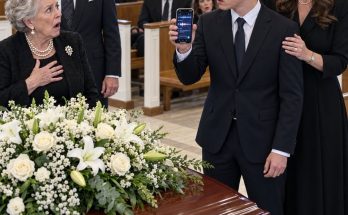

Chapter 1: The Illusion of the Tragic Accident
I watched my husband weep over our daughter’s grave. I didn’t know his tears were just relief that his two-million-dollar payday had finally cleared.
The rain that morning had been unrelenting, a cold, gray deluge that soaked through the black wool of my mourning coat, chilling me to the very marrow of my bones. I stood before the small, agonizingly tiny mahogany casket, my body held upright entirely by the strong, trembling arm of my husband, Mark. He held an umbrella over my head, completely neglecting himself, allowing the freezing rain to plaster his dark hair to his forehead. To the dozens of friends, family members, and coworkers gathered around the open earth, we were the tragic portrait of unimaginable loss. We were the parents who had survived the unsurvivable.
My four-year-old daughter, Ava, was gone.
For five days, the world had been reduced to the muffled, agonizing silence of a house missing its heartbeat. The vibrant, chaotic noise of cartoons, the padding of small, socked feet on the hardwood floors, the endless, beautiful chatter of a child discovering the world—it had all been violently vacuumed out of my existence. The smell of her strawberry detangling shampoo still lingered heavily on her pillow, a cruel, invisible phantom that triggered waves of physical agony every time I walked past her bedroom door. It was a constant, vicious reminder of the morning I had rushed out the door to an urgent, early-morning office meeting, kissing her forehead hurriedly instead of driving her to daycare myself.
Mark, my husband of six years, had been the absolute pillar of our tragedy. From the moment the hospital called, he had taken control. He handled the police interviews, shielding me from the harsh questions. He managed the coroner. He sat with the funeral director, picking out the floral arrangements because I was physically incapable of speaking without hyperventilating. He held me on the bathroom floor at three in the morning while I screamed until my vocal cords bled, my fingernails digging into the grout.
“It was an accident, Sarah,” he whispered into my hair during those endless, dark hours, his own face a mask of pale, hollow devastation. “We couldn’t have known. She must have found something on the playground. Someone must have brought something from home. It’s not your fault. It’s not my fault. It was an accident.”
I believed him. I clung to his words like a drowning woman clinging to driftwood.
Ava had a severe, Stage 5 peanut allergy. It was a condition we had managed with militant, terrifying precision since she was diagnosed at eighteen months old. Our house was a fortress. Her daycare, the elite, highly-rated Sunshine Academy, was a strictly nut-free zone. The staff was trained. The emergency protocols were drilled into everyone. Her sudden, catastrophic anaphylactic shock at a “safe” facility seemed impossible, a statistical nightmare, a fluke of the universe. Yet, it was tragically, horrifyingly plausible. A dropped cookie, a careless parent, a contaminated playground surface. The doctors said her throat had closed in minutes.
I believed the narrative of the tragic, inescapable allergy.
Until the fifth day, when the phone rang.
It was a Tuesday afternoon. Mark had finally left the house for an hour to “finalize some paperwork” with the funeral home. I was sitting at the kitchen island, staring blankly at a cold cup of coffee. When my cell phone vibrated against the granite, I almost ignored it. But the caller ID flashed the name of the daycare.
I answered, expecting a call from the administration regarding a memorial they wanted to set up.
“Hello?” my voice was a dry, broken rasp.
It was Miss Greenwood, Ava’s primary teacher. Her voice was thin, vibrating with a high-pitched, frantic terror that cut entirely through the heavy layer of sedatives clouding my brain.
“Sarah… Mrs. Carter?” Miss Greenwood choked out. She sounded like she was crying, but it wasn’t just grief; it was panic. “Sarah, you need to listen to me. I haven’t gone to the police yet. I was too scared. The administration told us not to look at the servers, but I couldn’t sleep. I couldn’t understand how it happened.”
“Miss Greenwood, what are you talking about?” I asked, my heart giving a strange, irregular thud.
“I reviewed the security footage from the main hallway,” she whispered, her breath shuddering over the receiver. “Your husband lied to you. He lied to the police. I downloaded it to a secure drive. I sent you the video to your personal email. Sarah… I am so, so sorry.”
The line went dead.
I sat at my kitchen table, the house deathly quiet around me. The grandfather clock in the hallway ticked with deafening volume.
My laptop, resting on the counter, chimed with an incoming email notification.
My hands shook so violently I knocked my coffee mug over. The dark liquid spilled across the granite, dripping onto the floor, but I didn’t care. I pulled the laptop toward me. I could barely move the mouse to click on the video file attached to the email from an encrypted address.
The video loaded. The screen went black for a second. And then, the world as I knew it ended.
Chapter 2: The Anatomy of an Assassination
I stared at the screen, my breath trapped like a jagged stone in my throat.
The video began to play. It was the grainy, high-definition, black-and-white feed from the daycare’s hallway camera, time-stamped 8:14 AM on the Tuesday Ava died. The hallway was empty, lined with small, colorful cubbies and finger-painted artwork taped to the walls.
I watched my husband walk into the frame.
He was holding my daughter’s tiny hand. Ava was wearing her favorite yellow raincoat and carrying her pink Disney princess backpack. She was skipping slightly, looking up at him. At first, everything seemed terrifyingly, beautifully normal. It looked exactly like the hundreds of other drop-offs we had done over the years.
But then, Mark stopped walking. He was directly beneath the camera, but angled slightly so his actions were perfectly captured.
He knelt down to Ava’s eye level. And what he pulled out of his coat pocket made the blood in my veins turn entirely to ice.
On the video, Mark smiled at her. It was that warm, crinkling, fatherly smile I had loved so much, the smile that had convinced me to marry him. He reached into the inner breast pocket of his expensive wool peacoat and handed her a large, dark, circular cookie.
Even through the monochrome security footage, I recognized the texture. It was a peanut butter blossom. A lethal, concentrated dose of the exact allergen that turned her immune system into a weapon of self-destruction.
Ava hesitated. I saw her little mouth move. She was likely reminding him of the rules. Daddy, I can’t have that.
But Mark leaned forward, kissed her forehead with sickening, performative tenderness, and nodded encouragingly. He patted her shoulder. He told her it was okay. He was her father, her ultimate protector, the man she trusted more than anyone else in the universe. If Daddy said it was safe, it was safe.
She took a bite. She chewed happily.
My stomach violently rebelled. I clamped a hand over my mouth, suppressing a scream that threatened to tear my vocal cords apart.
But that wasn’t the worst part. The true, absolute horror of his sociopathy was yet to be revealed.
As Ava chewed, happily unaware that she was swallowing a lethal, suffocating dose of peanut flour, Mark unzipped her pink Disney backpack. He reached into the front, clear mesh pocket—the designated, strictly monitored pocket where we kept her emergency medical supplies.
He pulled out the bright yellow plastic casing of her twin EpiPens.
They were the only things on earth that could stop the anaphylaxis. The only things that could save her life when her throat began to close in five minutes.
Mark looked down the hallway to ensure no teachers were coming. Then, with the casual, smooth motion of a man pocketing a wallet, he slipped the yellow casing into his own jacket pocket. He zipped her bag back up, adjusted it on her little shoulders, and gently pushed her toward the classroom door.
He watched her walk away. He stood there for exactly fifteen seconds, watching his own flesh and blood skip happily toward her own agonizing, suffocating death.
Then, Mark turned back toward the glass entrance doors.
The camera caught his face perfectly as he pivoted.
He wasn’t sad. He wasn’t concerned. He wasn’t panicked.
He smirked. A slow, chilling, victorious smirk spread across his face.
He walked out the double glass doors of the academy and got into the passenger seat of a sleek, bright red sports car waiting at the curb. The driver’s side window was rolled down. The driver was a beautiful, blonde woman wearing oversized sunglasses. Mark leaned over the center console, pulled her toward him by the back of the neck, and kissed her passionately before the car sped away from the curb.
The video ended. The screen went black, reflecting my own pale, horrified face back at me.
I didn’t vomit. I didn’t scream. The woman who had wept on the bathroom floor, the fragile, grieving mother who had relied on her husband for strength, died right there in the kitchen. She evaporated into the ether, completely annihilated by the sheer, grotesque magnitude of the betrayal.
I closed the laptop. The lid clicked shut with a soft, final sound.
The silence in the house didn’t feel heavy anymore; it felt electric. It hummed with a cold, vibrating, radioactive energy.
I walked into the downstairs bathroom. I turned on the faucet and stared at myself in the mirror. My eyes were bloodshot, surrounded by dark, bruised circles of grief. My skin was sallow. I looked like a victim.
I cupped the freezing, icy water in my hands and splashed it over my face. I washed the grief away. I washed the weakness away. I stared into my own eyes, watching the pupils dilate, watching the warm, loving light of a mother extinguish, replaced by the terrifying, cold-blooded void of an executioner.
When I walked back into the living room, drying my face with a towel, I heard the familiar crunch of tires on the gravel driveway.
Mark was home from “making funeral arrangements.”
I took a deep, steadying breath. I pushed the agonizing image of Ava taking that bite into a steel vault in my mind and locked it. I put on my best, most broken, most pathetic smile, unlocked the front door, and opened it to welcome the monster inside.
Chapter 3: The Forensic Mother
“Hey, baby,” Mark said softly as he stepped into the foyer, shaking the rain from his umbrella. He looked at my pale face and immediately dropped his keys, rushing forward to wrap his arms around me. “I’m so sorry I was gone so long. The paperwork took forever. How are you holding up?”
“I’m just so tired, Mark,” I whispered, resting my head against his chest. I could smell his cologne. Beneath it, I could smell the faint, lingering scent of a woman’s floral perfume. It took every ounce of physical restraint I possessed not to drive a kitchen knife through his throat right then and there.
“I know, sweetheart. I know,” he murmured, kissing the top of my head—the exact same way he had kissed Ava before he murdered her. “Why don’t you go lie down? I’ll make you some chamomile tea. I brought your pills.”
For three days, I lived with a murderer.
I let him hold my hand while we watched meaningless television. I let him cook me dinner. I played the role of a woman entirely destroyed by grief, heavily, pathetically reliant on the “sleeping pills” he kept handing me every night with a sympathetic smile.
He wanted me sedated. He wanted me docile. He wanted me unconscious so he could finalize his plans.
But I wasn’t swallowing them. Every night, I palmed the heavy sedatives, pretending to wash them down with water, before secretly flushing them down the master bathroom toilet. Because when Mark fell asleep, when his deep, even breathing signaled that his sociopathic mind was at rest, I went to work.
Mark thought of me as a quiet, domestic wife. He conveniently forgot that before we were married, I was a senior forensic data analyst for a major corporate financial firm. My entire career was built on finding anomalies, tracing hidden assets, and uncovering the digital footprints that corrupt men tried to erase.
Bypassing his laptop password took me exactly twelve minutes.
Sitting in the dark of his home office, illuminated only by the sterile glow of the monitor, I dissected the digital anatomy of his betrayal.
The digital trail was a masterclass in sociopathic greed. Mark was sloppy. Arrogance breeds carelessness, and Mark believed he was the smartest man in any room.
I started with his banking apps, moving quickly through his deleted emails, recovering files from the trash bin. I found a hidden, encrypted folder labeled ‘Project Delta.’ I broke the weak encryption in under an hour.
Inside, I found the emails to his bookie. Mark had a severe, hidden gambling addiction. He had been leveraging our home, taking out secret lines of credit, and placing massive, catastrophic bets on offshore sports syndicates. He was exactly $400,000 in debt to an illegal, highly violent betting syndicate operating out of Chicago. There were threatening emails. Pictures of our house taken from the street by anonymous numbers.
I found the leasing documents for the sleek, red sports car I had seen in the video. It was leased under the name ‘Chloe Vance’—a junior associate at his real estate firm. I found the text threads between them.
“Just hold on a little longer, baby,” he had texted her three weeks ago. “The payout is almost secure. Then we’re gone. Fiji, just like we promised.”
But the crown jewel, the absolute, undeniable motive for the execution of my four-year-old daughter, was hidden in a buried PDF file synced to his cloud storage.
It was a life insurance policy document.
A massive, staggering, comprehensive $2 million life insurance policy.
The insured: Ava Carter.
The sole, uncontested beneficiary: Mark Carter.
The policy had been initiated and finalized exactly one month before she died. He had specifically opted for an exorbitant rider that paid out double in the event of an “accidental, sudden death on school premises.”
He had calculated her worth. He had weighed the life of his child against his gambling debts and his lust for his mistress, and he had made his choice. He sold our daughter’s life to pay off the men who were going to break his legs, and to buy a new life in the sun with a blonde woman who drove a red car.
I didn’t cry as I read the policy. I felt an icy, terrifying calm settle deep into my marrow.
I meticulously copied every single email, every IP address, the video file from Miss Greenwood, the insurance documents, and the lease agreements onto a heavily encrypted, military-grade flash drive. I wiped the search history on his computer, returning it to the exact state I found it in, and crept back into bed beside the man who killed my child.
The next morning, while Mark was “at the lawyer’s office,” I drove straight to the downtown police precinct.
I didn’t go to the front desk. I asked specifically for Detective Robert Miller in the Homicide Division. Miller was a grizzled, no-nonsense veteran cop who had coached my older brother’s little league team twenty years ago. He was a man who understood duty, and more importantly, he knew my family.
I sat in his cluttered, windowless office. I didn’t cry. I didn’t shake. I slid the encrypted flash drive across his scratched metal desk.
“My daughter wasn’t a tragic accident, Bobby,” I said, my voice dead and flat. “She was a highly orchestrated financial transaction. And the man who executed it is sleeping in my bed.”
Detective Miller plugged the drive into his secured terminal. He watched the video from the daycare first.
I watched the color completely, violently drain from the veteran cop’s face. He had seen decades of gang violence, murders, and horrors, but watching a father hand a poisoned cookie to a smiling four-year-old broke something inside him. He paused the video just as Mark smirked at the camera. Miller looked at me, his jaw clenched so hard a muscle feathered and twitched rapidly in his cheek. His eyes burned with a lethal, barely contained fury.
“I have the financial records on that drive, Detective,” I told him, pointing to the screen. “The offshore debts. The mistress. And the two-million-dollar insurance policy he took out thirty days ago. He’s filing the final insurance claim tomorrow morning. He thinks he got away with it. He thinks he’s brilliant.”
Miller slowly exhaled, his hands gripping the edge of his desk. “Sarah… I am so, so sorry. We can go arrest him right now. We have enough for premeditated, first-degree murder. We can send the SWAT team to his office.”
“No,” I said instantly, my voice ringing with absolute, uncompromising authority.
Miller frowned, confused.
“I don’t want him arrested at the office,” I stated, leaning forward, looking the detective dead in the eyes. “I want him to feel it. I want him to believe, with every fiber of his being, that he has crossed the finish line. I want him to taste the money. I want him to feel the handcuffs click around his wrists the exact moment he thinks he’s won the world. I want to break his mind before you break his body.”
Miller studied my face. He saw the cold, dead wasteland where a mother’s heart used to be, and he understood. He nodded slowly, pulling a notepad toward him.
“We’ll need to set a trap, Sarah. A wire. A confession to solidify the premeditation,” Miller said, his voice dropping to a tactical whisper. “Are you strong enough to go back into that house tonight, look the man who murdered your baby in the eye, and bait him?”
I stood up from the chair.
“Detective,” I said, my voice echoing off the concrete walls. “I’m going to serve his head on a silver platter.”
Chapter 4: The Celebration of Death
Friday night.
A heavy, torrential thunderstorm was battering the roof of our house, the lightning casting long, jagged shadows across the hardwood floors of our kitchen.
Mark was in a spectacular, almost euphoric mood. He had ordered expensive, high-end takeout from our favorite Italian restaurant across town. He had set the kitchen island with our good china, lighting a few candles to cast a soft, warm glow. He opened a bottle of vintage Amarone—a $200 bottle of red wine he usually saved for anniversaries.
He was celebrating. He thought I was too sedated to notice the subtle spring in his step, the way he hummed while plating the pasta.
I sat on the barstool, wearing an oversized, comfortable sweater, playing the role of the fragile, exhausted widow. Beneath the thick wool of my sweater, taped securely to my ribcage, a high-fidelity police wire was actively transmitting audio to a tactical surveillance van parked three houses down the street.
Mark poured two large glasses of the dark red wine, sliding one toward me.
Then, he reached into his briefcase resting on the counter and pulled out a thick, heavily tabbed stack of legal papers. He placed them gently on the kitchen island, right next to my wine glass.
“Sarah, babe,” he said gently. He knelt beside my stool, taking my cold hand in his warm one, using his best, most tragic, empathetic voice. “I know this is incredibly hard. I know it feels wrong to even think about logistics right now. But my lawyer called today. The insurance company needs your signature as the secondary guardian to release the policy funds. They’ve expedited the payout because of the clear-cut nature of the… the accident.”
He squeezed my hand, looking up at me with those practiced, puppy-dog eyes.
“I know it feels like blood money, sweetheart,” he whispered, executing his manipulation flawlessly. “But this money… it’s what Ava would have wanted for us. She wouldn’t want us to suffer and lose the house. It will help us start over. We can pay off the mortgage. We can travel. We can finally heal. Together.”
I looked at him. I looked at the handsome face, the strong jawline, the man who had kissed my daughter’s forehead before executing her.
I reached out and picked up the heavy, silver Montblanc pen resting on top of the documents.
I looked at the signature line.
“Start over,” I repeated softly, my voice barely above a whisper. I let the words hang in the air, swirling my wine glass.
“Yes, baby,” Mark encouraged, nodding slowly, pushing the paper an inch closer to my hand. “A fresh start. Just you and me.”
I didn’t sign the paper. I set the silver pen down with a loud, definitive click against the granite.
“Start over,” I said again, my voice losing the frail, trembling edge, dropping into a cold, flat resonance. “With Chloe?”
Mark froze.
The wine glass he was lifting to his lips stopped dead in mid-air. The muscles in his neck tightened. The performance of the grieving father cracked, just for a microscopic fraction of a second, before he tried to piece it back together.
“What?” he let out a nervous, high-pitched chuckle. “Sarah, what are you talking about? Who is Chloe? Is it the medication? Are you feeling confused?”
“I said, start over with Chloe,” I repeated, turning my head to look him dead in the eyes. The facade was completely gone from my face. I stared at him with the terrifying, unblinking intensity of an apex predator. “In the sleek, red sports car. The one parked outside the daycare on Tuesday morning.”
Mark’s face drained of all color. He slowly stood up from his kneeling position, backing away from me, his eyes darting frantically around the kitchen.
I reached under the kitchen island, pulled out my laptop, flipped the screen up, and turned it around to face him.
I hit play.
The volume was turned all the way up. The silence of the kitchen was broken by the background noise of the daycare hallway.
Mark watched himself on the screen. He watched himself kneel down. He watched himself hand our four-year-old daughter a peanut butter cookie. He watched himself meticulously, deliberately unzip the pink backpack and steal her yellow EpiPens.
The silence in the kitchen was absolute, save for the rhythmic drumming of the rain against the windows.
I waited for him to panic. I waited for him to launch into a desperate, weeping denial. I expected him to claim the video was doctored, or that he didn’t know what was in the cookie.
Instead, Mark exhaled a long, heavy, exasperated breath.
The grieving father vanished entirely, melting away like wax over a flame. His posture straightened. The faux-sadness in his eyes evaporated, replaced by a cold, reptilian, sociopathic emptiness.
He set his wine glass down on the counter. He leaned back against the refrigerator, crossed his arms over his chest, and actually, genuinely smirked.
“So, you know,” Mark said, his voice entirely devoid of remorse. It was casual. Transactional.
“I know everything, Mark,” I stated, keeping my voice steady for the wire. “I know about the four hundred thousand dollars you owe the Chicago syndicate. I know about Chloe. I know you insured my daughter’s life to pay for your mistress.”
Mark chuckled, shaking his head, a dark, sinister amusement dancing in his eyes.
“You were always too smart for your own good, Sarah,” Mark sighed, taking a step slowly around the kitchen island, moving closer to where I sat. “I told Chloe you were a liability. I knew I should have secured the payout before the funeral.”
He didn’t sound guilty. He sounded annoyed that his math had been slightly off.
“But you’re also practical,” Mark continued, his voice dropping into a dangerous, persuasive cadence as he closed the distance between us. “You’re a numbers girl, Sarah. Let’s look at the numbers. I owed the wrong people a lot of money. They were going to kill me. They threatened to burn this house down with both of us in it.”
He stopped a few feet away, leaning his hands on the counter.
“Ava was an accident waiting to happen anyway with that severe allergy,” he rationalized, dismissing his daughter’s life with breathtaking, monstrous cruelty. “Living with her was a nightmare. Constantly checking labels, wiping down tables. It was exhausting. We were hostages to a peanut, Sarah. Now? Now we have two million dollars in clean, untraceable cash.”
He reached out, his hand hovering over the knife block resting on the counter.
“If you keep your mouth shut,” Mark whispered, his eyes locking onto mine, dark and lethal, “I’ll split it with you. You take a million, I take a million. We walk away. You can start a new life. You can have another kid.”
I stared at him, letting the horrific, premeditated confession echo into the microphone taped to my chest.
“And if I don’t?” I asked softly.
Mark’s smirk faded into a grim, homicidal line. His hand wrapped around the heavy, black handle of an eight-inch, stainless steel carving knife. He slowly slid it out of the wooden block. The metal scraped menacingly.
“If you don’t,” Mark said, taking a definitive step toward me, raising the blade slightly, “you might just succumb to the overwhelming, unbearable grief of losing your daughter tonight. It happens all the time to grieving mothers. They just can’t take the pain. A tragic, messy suicide in the kitchen.”
He took another step, raising the knife.
“I don’t think so, Mark,” I whispered, not moving an inch, looking past his shoulder toward the heavy oak door of the pantry.
Chapter 5: The Arrest and the Excision
“FBI! DROP THE KNIFE! GET ON THE GROUND! NOW!”
The scream ripped through the kitchen with deafening, concussive force.
Simultaneously, the heavy pantry door and the back patio door burst open, shattering the doorframes. The storm outside howled into the house, accompanied by the blinding, strobing beams of tactical flashlights.
Detective Miller, flanked by three heavily armed, body-armored SWAT officers, flooded the kitchen in a fraction of a second. Four red laser sights danced frantically across Mark’s chest and forehead. Assault rifles were trained directly on his heart.
Mark shrieked. It was a high, pathetic, profoundly cowardly sound.
The arrogant, terrifying murderer vanished instantly in the face of overwhelming, superior force. He dropped the carving knife as if the handle had suddenly turned to molten lava. It clattered loudly against the granite tiles.
He threw both of his hands high into the air, instantly dropping to his knees, his expensive trousers soaking up the spilled wine on the floor.
“Don’t shoot! Don’t shoot!” Mark sobbed hysterically, cowering, covering his head with his hands.
An officer violently tackled him, driving a heavy knee into Mark’s back, slamming his face brutally against the hard tiles. The cold, heavy steel handcuffs clicked shut around his wrists with a loud, incredibly satisfying, permanent snap.
“Mark Carter,” Detective Miller barked, standing over the groveling man, his voice vibrating with a righteous, furious disgust. He hauled Mark up by the collar of his expensive shirt, forcing him to his knees. “You are under arrest for first-degree premeditated murder, insurance fraud, conspiracy to commit murder, and attempted homicide.”
Mark was hyperventilating. His chest heaved, his face slick with a mixture of sweat and tears of pure, unadulterated panic. The reality of his absolute, inescapable ruin was crashing down on him.
“It was a mistake!” Mark babbled, looking wildly at the officers, snot running down his face. “I didn’t mean to! She made me do it!”
“Save it,” Miller sneered, yanking him upward. “We also picked up your girlfriend, Chloe Vance, at the international airport terminal twenty minutes ago. She had a one-way ticket to Fiji. She sang like a canary the second my agents mentioned the death penalty. She gave us the texts, the emails, the entire timeline. She threw you under the bus before we even got her to the precinct.”
Mark’s eyes widened in sheer horror. The master plan, the brilliant sociopathic scheme, had disintegrated into dust. He looked at me, struggling pointlessly against the grip of the massive SWAT officers.
“Sarah!” Mark screamed, thrashing wildly. The facade of his dominance was completely gone. He was begging the woman he had just threatened to murder. “Sarah, please! You know me! I’m your husband! Tell them I was drunk! They’re going to put me on death row! You have to help me!”
I slowly stood up from the barstool.
I didn’t rush toward him. I didn’t scream obscenities. I moved with the slow, deliberate grace of a queen surveying a conquered battlefield.
I walked over to the kitchen island. I picked up his half-full crystal glass of vintage Amarone wine. I walked to the stainless-steel sink, made eye contact with him, and poured the expensive red liquid slowly down the drain.
I set the empty glass on the counter and walked over to where he was being held by the officers.
I leaned down until my face was inches from his weeping, pathetic, terrified eyes.
“You shouldn’t have taken her EpiPen, Mark,” I whispered. My voice was entirely dead, flat, and devoid of any human mercy.
“Why?” he choked out, sobbing.
“Because now,” I replied, staring into the dark, empty void of his soul, “nobody is coming to save you when you can’t breathe.”
I stood up, nodded to Detective Miller, and stepped back.
I watched them drag him out the front door, his shoes dragging across the hardwood, his pathetic screams fading into the wail of the numerous police sirens waiting outside in the pouring rain.
The heavy front door closed, and the house was suddenly quiet again.
But it wasn’t the agonizing, heavy, suffocating silence of grief that had plagued the house for the last week. It was the clear, sharp, ringing silence of a battlefield after the war has been decisively, brutally won. The air felt clean.
I walked slowly up the stairs. I walked down the hallway and pushed open the door to Ava’s nursery.
I walked over to her pristine, perfectly made bed. I picked up her favorite stuffed animal, a worn, floppy brown bear she had slept with every night since she was an infant. I pressed the soft fabric to my face, breathing in the fading scent of her strawberry shampoo.
I sat down in the rocking chair, clutching the bear to my chest, and finally, for the first time since she died, I allowed myself to cry.
But as the tears fell hot and fast in the dark nursery, I realized something profound. These were no longer the terrified, helpless tears of a victim. They were the heavy, cleansing tears of a warrior who had avenged her fallen, an executioner who had successfully slaughtered the monster in the dark.
Chapter 6: The Legacy of Ava
A year later.
The trial was a media spectacle that made international headlines. The prosecution’s case was an impenetrable fortress of undeniable truth. Faced with the high-definition security footage of the cookie and the EpiPen theft, the meticulous offshore financial records I had extracted, the audio recording of his confession in my kitchen, and Chloe’s desperate, damning testimony, the defense had absolutely nothing.
The jury deliberated for less than two hours.
When the guilty verdict was read, Mark Carter collapsed at the defense table, weeping uncontrollably. The judge, a man who stared at Mark with unfiltered, profound disgust, showed absolutely zero mercy.
Mark was sentenced to life in a maximum-security federal penitentiary without the possibility of parole. He was relegated to a concrete, six-by-eight-foot cage, surrounded by violent men, stripped of his name, his tailored suits, and his freedom. He would die in the dark, suffocating under the weight of his own monstrous greed. Chloe received a twenty-year sentence for her role as an accessory and co-conspirator.
I didn’t just attend the criminal trial. I unleashed hell in the civil courts.
Through aggressive, unrelenting civil litigation, I seized every single asset Mark had ever owned. I liquidated his remaining bank accounts, sold his properties, and legally secured the two-million-dollar life insurance payout that the company was forced to release to my sole custody upon his conviction.
I didn’t keep a single dime of his blood money for myself.
I used the entirety of his seized wealth to establish the Ava Carter Foundation.
It was a massive, fiercely funded, multi-million-dollar charity dedicated to a single, uncompromising mission: providing free, life-saving EpiPens and comprehensive allergy emergency training to underfunded public schools, daycares, and community centers across the entire country.
I hired lawyers to lobby for stricter state laws regarding emergency medical access in childcare facilities. I spent my days traveling, speaking at national conferences, and ensuring that no child would ever be left defenseless in a classroom again. I took the horrific, agonizing tragedy of my daughter’s death and weaponized it into a shield that would protect millions of other children.
It was a brilliant, cloudless spring afternoon.
I stood in the warm sunshine at a massive, bustling local park in the heart of the city. We were hosting a foundation event. Dozens of children were running across the green grass, their laughter echoing through the air, their faces painted with bright colors. Parents stood nearby, chatting and smiling, holding the emergency medical kits our foundation had just provided them, free of charge.
I stood near the edge of the playground, wearing a bright yellow dress—Ava’s favorite color.
I watched a little girl, roughly four years old, with pigtails bouncing as she chased a butterfly across the grass.
Mark had looked at our beautiful, vibrant daughter and seen nothing but a disposable asset. He saw a convenient tool to erase his gambling debts and fund his lust. He thought my unconditional love for her would make me weak. He believed I would be too blinded by my own suffocating grief to see the truth right in front of my eyes. He thought he could outsmart a mother’s intuition.
He didn’t understand the fundamental, terrifying laws of nature.
He didn’t understand that when you violently steal a child from a mother, you don’t just break her heart. You don’t leave her weak.
You take her shattered, bleeding heart, and you forge it into a titanium engine of absolute, undeniable, apocalyptic ruin. You strip away her mercy, and you birth an executioner.
I smiled, the warm sun hitting my face, watching the children run freely across the park. I felt a profound, heavy, beautiful peace settle deep into my soul. I knew with complete, unwavering certainty that Ava’s short, beautiful life had successfully saved thousands of others, and the monster who took her away would spend the rest of his miserable, pathetic existence drowning in the dark, forever choking on the consequences of his own greed.
If you want more stories like this, or if you’d like to share your thoughts about what you would have done in my situation, I’d love to hear from you. Your perspective helps these stories reach more people, so don’t be shy about commenting or sharing.Three days after my 4-year-old daughter’s funeral, her daycare teacher called and whispered, “Your husband hasn’t told you the truth.” Then she sent me a video. I realized my daughter’s de/ath was not what I’d been told…