PART 2:
My name is Ray Carver. I’m sixty-one years old, and for the last eighteen of those years I’ve worn the same sleeveless leather vest, the one with the faded patch on the back that reads Desert Guardians MC. I know what people see when they look at me—gray beard, tattoos wrapping both arms, boots that have walked through more trouble than most men could stomach. I’m used to the flinch, the quick step back, the way a room can tighten its throat when I walk in. I don’t blame them. Fear is a reflex, and I’ve learned to live inside that reflex without letting it turn me into the monster they expect.
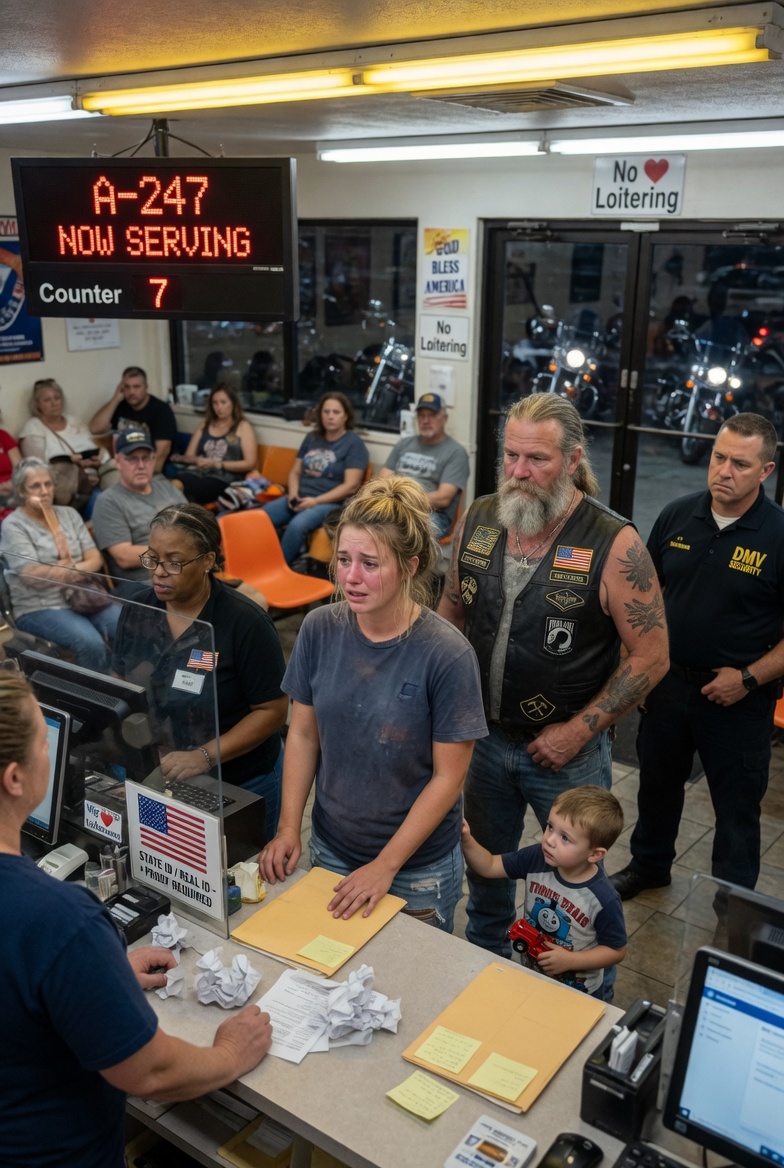
What I did that Tuesday morning at the DMV wasn’t planned. Not in the way you’d think. I didn’t wake up looking to make a statement or rescue anybody. I woke up with the same ache in my lower back I’ve had since a warehouse accident in ’03, the same silence in a house that used to hold my wife’s laugh, and a single errand on my mind: renew my motorcycle endorsement before the deadline. I pulled on my vest, grabbed my helmet, and pointed the bike toward the state office on Cactus Lane. Just another line to stand in. Just another fluorescent-lit wait.
But life has a way of bending the road when you least expect it, and that morning the bend was a woman’s voice cracking at Counter 7.
The rumble outside the DMV didn’t start as a threat. It started as an answer. I’d pressed “call” and spoken four words—It’s her turn now—to Linda Hayes, the closest thing to a dispatcher our riding group has. Linda is fifty-eight, a retired court clerk, and she carries a notary stamp in her saddlebag the way other people carry pepper spray. She’s also the fastest organizer I’ve ever met. I didn’t need to explain the address; she’d gotten the landlord’s location from me ten minutes earlier in a quick text. She knew the missing affidavit, knew the urgency, and she knew the woman at the counter had about sixty seconds before the security guard’s patience ran out.
I felt the engines before I saw them. That’s how it always is with a group of V-twins rolling in tight formation—the vibration climbs up through the concrete floor, rattles the metal window frames, and makes the fluorescent lights hum at a slightly different frequency. People in the waiting area stopped pretending to read their phones. The man who’d muttered “Should’ve brought the right stuff” sat up straighter. The business-attired woman who’d predicted it would get loud clutched her purse like it might save her. The security guard, a young guy with a name tag that read Officer Mendez, shifted his weight and let his hand rest openly on the radio clipped to his belt.
Through the tinted glass doors I could see the bikes pulling into the lot in an orderly single-file line. Linda’s maroon Road King was in the lead, followed by Tommy Yazzie’s black Softail, then a dozen more. They parked along the curb without a single engine revving unnecessarily. No showboating. No intimidation. Just the quiet, deliberate shutting down of fourteen motors, one after another, like candles being snuffed out in sequence.
I stayed where I was, hands folded in front of me, my body still angled slightly toward the woman who had become the unwitting center of a storm. She’d gone pale. The little boy—I’d learn later his name was Jacob—pressed his face into her jeans and held his toy truck like a talisman.
— Sir, I need you to step away from the counter now.
Officer Mendez’s voice had lost its earlier attempt at diplomacy. He was scared. I could smell it on him—the sharp, metallic tang of adrenaline poorly disguised as authority. He was maybe twenty-five, and he was standing in a room where every civilian suddenly looked to him for protection against an invasion that existed mostly in their imaginations.
I didn’t move.
— I’m not armed, I said quietly. I’m not blocking anyone. I’m not raising my voice. I’m just waiting for a notary who’s about to walk through that door with a document this woman needs to keep her job.
The clerk behind the counter—her nameplate read Patricia—looked from me to Mendez to the approaching figures outside, her face cycling through confusion, irritation, and something that might have been the beginning of shame. She’d been ready to dismiss a crying mother. Now she was witnessing a biker gang descend on her workspace, and none of the protocols covered this.
The glass doors opened.
Linda entered first, her white ponytail swinging, the black folder held against her chest like a shield. Behind her came Tommy, a Navajo veteran who’d served two tours in Iraq and now spent his weekends building wheelchair ramps for disabled riders. Then Delores, a retired emergency room nurse with reading glasses tucked into the collar of her denim jacket. Then Marcus, then Angie, then half a dozen others I’d ridden with through canyons and chaos and countless quiet mornings when the desert was the only church we needed.
They didn’t spread out to intimidate. They formed a loose line along the wall, hands visible, expressions neutral. Linda walked directly to the supervisor, a thin-lipped woman in a gray blazer who’d emerged from her glass office with the expression of someone who’d just discovered a plumbing disaster.
— My name is Linda Hayes, she said. I’m a licensed notary public in the state of Arizona. I was called to notarize a residency affidavit for the woman at Counter 7. I have the completed document here, time-stamped and sealed.
The supervisor, whose name I’d later see on a plaque as Barbara Kowalski, Branch Manager, opened her mouth, closed it, then opened it again. She looked at the folder, at the line of leather-clad riders, at the scared waiting room, and finally at me. I could see her trying to calculate the path of least liability.
— You can’t just… summon a notary to a DMV, she said, but her voice lacked conviction.
— With respect, ma’am, Linda replied, the state notary handbook doesn’t specify a location restriction. I’m within my jurisdiction, I’ve verified the signer’s identity through her state ID application, and the landlord confirmed residency this morning. I have his signed statement and a copy of the lease.
She opened the folder and laid it on the counter.
Inside, perfectly organized, were the notarized affidavit, a photocopy of a lease agreement with the woman’s name—Elena Vasquez—on the tenant line, and a signed statement from the landlord’s office on 7th and Pierce.
I hadn’t known her last name until that moment. Elena. It fit her, somehow. Soft, strong, carrying more weight than it should have to.
Elena stared at the documents like she’d just watched someone perform a magic trick with her own life as the prop. Her hand moved instinctively to Jacob’s head, her fingers threading through his dark curls. She was still trembling, but something in her posture had shifted. Not relief—not yet—but the tentative, fragile awareness that maybe the floor wasn’t going to collapse beneath her after all.
— How? she whispered.
She was looking at me.
I met her eyes for the second time that morning. Brown eyes. Tired eyes. The kind of eyes that had learned to expect disappointment and were terrified of hope.
— You were at the gas station on Bell Road yesterday, I said. You were on the phone, standing by the air pump. You were crying, and you said his name—the landlord’s name—and you said he’d promised to send the paperwork for school registration and never did. I was filling up my bike. I heard you.
She blinked. The memory surfaced slowly, like a shape rising through murky water.
— I remember, she said. I… I saw you. I thought you were…
— You thought I was going to cause trouble.
She didn’t deny it. She didn’t have to.
— I wrote down the address, I continued. 7th and Pierce. It’s three blocks from my mechanic’s shop. This morning I stopped by the landlord’s office before I came here. I told him a notary would be calling to confirm residency. He was cooperative.
I didn’t tell her the rest. I didn’t tell her that the landlord, a doughy man named Gerald Pembleton, had initially refused to speak to me until Tommy Yazzie stepped into his doorway and simply stood there, arms crossed, saying nothing. Some conversations don’t require words. The signed statement had appeared within five minutes.
Barbara Kowalski, the branch manager, took the affidavit from Linda’s folder and examined it with the grudging thoroughness of someone who wanted to find a flaw. She held it up to the light. She checked the notary seal. She compared the signature against the lease copy. The waiting room watched her with collective breath held.
— The notary commission is valid, she admitted finally, the words dragged out of her like a confession. The affidavit meets state requirements.
She turned to Patricia, the clerk.
— Process the ID.
Patricia’s fingers moved across the keyboard. The printer behind the counter hummed. I watched Elena’s face as the sound filled the silence—watched the slow, disbelieving softening around her mouth, the way her shoulders finally dropped a fraction of an inch. Jacob sensed the change and looked up at her, his small brow furrowed.
— Mama? You okay?
— Yeah, baby. She crouched to his level, her voice steadier now. I’m okay. We’re okay.
The new state ID slid across the counter, glossy and official, her unsmiling face captured in bad DMV lighting but valid. Valid. That was the word that mattered. Valid meant she could clock in tomorrow at seven. Valid meant the job at the warehouse, the paycheck that would keep the apartment, the fragile architecture of a life trying to rebuild itself from rubble.
She signed the receipt with a hand that barely shook.
Then she turned to me.
— Why? she asked again. Why do this for someone you don’t know?
I could have told her the truth then—the full truth, the long truth, the truth that lived in the scar tissue of my own history. But there were too many people watching, too many ears still primed for drama. So I gave her the short version, the one that wasn’t a lie but wasn’t the whole story either.
— You were next in line.
She searched my face for something more, and I let her look. After a moment, she nodded once—a small, solemn acknowledgment that went beyond words. Then she gathered her documents, took Jacob’s hand, and stepped away from the counter.
I turned toward the exit without waiting for thanks. That’s not why I did it. Thanks is a currency I stopped collecting a long time ago.
Outside, the Arizona sun was climbing toward its mid-morning brutality. The parking lot asphalt shimmered with heat already, and my bike—a 2008 Dyna I’d rebuilt from the frame up after Sarah died—sat waiting like an old friend who never asked questions. I fastened my helmet, threw a leg over the seat, and let the engine’s rumble settle the noise in my head.
Linda pulled up beside me on her Road King.
— You’re going to tell her eventually, she said. Not a question.
— Maybe.
— She’ll want to know. People always want to know why a stranger steps in.
— She’s got a job to start and a kid to raise. She doesn’t need my baggage.
Linda shook her head, the corners of her mouth tugging into something that wasn’t quite a smile. She’d known me for twelve years, ever since the night I walked into a VA support group smelling of cheap whiskey and looking for a reason not to eat my gun. She knew the shape of my baggage better than anyone.
— You’ve got a lot of miles on that bike, Ray, she said. Enough to know that some roads circle back whether you want them to or not.
She wasn’t wrong.
Three days later, I was sitting in a booth at Manny’s Diner, a greasy spoon off the I-10 that served coffee strong enough to strip paint and pancakes the size of hubcaps. It was my regular Thursday spot—have the same breakfast, read the same newspaper, tip the same waitress who’d stopped asking about my life years ago. Routine is a railing for men who’ve fallen down too many stairs.
I was halfway through my second cup when the bell above the door jingled and Elena Vasquez walked in, Jacob at her side.
She spotted me immediately. I saw the hesitation—the brief internal calculation of whether approaching me was an intrusion or an obligation. Gratitude can be a heavy thing to carry, and I didn’t want to add weight to her load. I gave a small nod, just enough to say I see you, no pressure, and went back to my newspaper.
But she walked over anyway.
— Mr. Carver? The DMV clerk gave me your name from the paperwork Linda filed. I hope that’s okay.
— It’s just Ray, I said. And it’s fine. Have a seat if you want.
She slid into the booth across from me. Jacob climbed in next to her and immediately began driving his toy truck across the Formica tabletop, making quiet vroom sounds. The kid had the same brown eyes as his mother, the same wary curiosity.
— I started the job, she said. The warehouse on Thomas Road. Packaging and shipping. It’s not glamorous, but it pays fourteen an hour, and they have health insurance after ninety days.
— That’s good. That’s real good.
— I wouldn’t have gotten it without you. She said it plainly, without dramatic emphasis, which made it land harder. Another day without an ID and they would have given the position to someone else. I’d be back to square one. Square one for me is… She paused, glanced at Jacob, and seemed to edit herself. Square one isn’t a good place.
I understood editing yourself around a child. I’d done it plenty, back when there was a child in my life to edit for.
— Can I buy you breakfast? she asked. It’s not much, but it’s what I’ve got.
— You don’t owe me breakfast.
— I know. I’m offering anyway.
Manny’s waitress, Doreen, appeared with a coffee pot and an expectant look. Elena ordered scrambled eggs and toast for herself, a short stack of pancakes for Jacob. I let her pay, because refusing would have been a different kind of unkindness.
While we waited, Jacob looked up from his truck and fixed me with the unblinking stare only a five-year-old can deploy.
— You have a motorcycle.
— I do.
— Is it loud?
— When I want it to be.
He considered this for a moment, then nodded as if I’d passed some invisible test.
— My dad had a motorcycle. But he’s not here anymore.
Elena’s face tightened. Not anger, exactly—something more complicated. The kind of expression that comes from living through a story you wouldn’t tell a stranger over pancakes.
— He’s not coming back, she said quietly, more to Jacob than to me. And that’s okay.
The way she said it told me everything I needed to know about why he wasn’t coming back, and why that was okay. I’d seen that look before—on my own mother’s face, decades ago, in a different kitchen, in a different state. Some patterns are universal.
Breakfast arrived. Jacob attacked his pancakes with the single-minded focus of a demolition crew. Elena ate slowly, like someone who’d learned not to take food for granted. I nursed my coffee and waited. I’ve learned that when someone tracks you down three days after a DMV incident, they usually have more to say than thank you.
— I want to understand, she said finally. The gas station. You heard a stranger crying and you just… decided to get involved? Most people don’t do that.
— No, I agreed. Most people don’t.
— So why you?
I set my coffee cup down and looked out the diner window at the traffic crawling along the interstate. The sun was high now, bleaching the sky to a pale, merciless blue. A semi-truck downshifted with a roar that vibrated through the glass. I could feel the question settling between us, heavy and patient, waiting for an answer I’d spent years learning how to give.
— I ever tell you why I started the Desert Guardians? I asked.
— You haven’t told me anything, she said. That’s why I’m asking.
Fair point.
The story starts in 2008, but its roots go deeper—back to 1982, when I was seventeen and thought I knew everything. I enlisted in the Marine Corps two days after my birthday, partly out of patriotism and partly because my old man had made it clear there was no room for me in his house after graduation. The Corps gave me structure, purpose, and a set of brothers I still talk to in my head when the nights get long. It also gave me a piece of shrapnel in my left hip during the Gulf War that still aches when it rains, and a set of memories I don’t visit without bracing myself first.
I came home in ’91, honorably discharged, with a limp and a drinking problem I didn’t acknowledge. Met Sarah at a VFW dance in Tempe. She was a teacher, third grade, with a laugh that sounded like wind chimes and a stubbornness that rivaled my own. We married in ’94. Our son, Michael, was born in ’96. For twelve years, I had something I’d never thought possible: a family that loved me, a life that made sense, a future that didn’t look like a dead-end road.
Then Sarah got sick.
Pancreatic cancer. The kind that doesn’t announce itself until it’s already moved in and unpacked its bags. She was diagnosed in March of 2008 and gone by September. Fifty-three days. I spent every one of them in a hospital chair, holding her hand, watching the light drain out of her eyes while Michael—twelve years old and trying to be brave—sat in the corner doing homework he couldn’t focus on.
After she died, I fell apart. I don’t mean I was sad. I mean I disintegrated. I stopped showing up for work. I stopped showing up for Michael. I stopped showing up for anything except the bottom of a bottle. By Christmas, I’d lost my job at the construction company. By New Year’s, I’d lost the house. By Valentine’s Day, my sister in Ohio had custody of Michael and I was sleeping in a shelter on Van Buren Street, sharing a room with eleven other men who all smelled like failure and regret.
That’s where I was when I realized my wallet was gone. Stolen, maybe, or just dropped in a drunken stupor somewhere between the liquor store and the shelter. Either way, it was gone, and with it my driver’s license, my social security card, my veteran’s ID—everything that proved I existed.
You don’t realize how fragile identity is until you can’t prove yours. You can’t get a job without an ID. You can’t get an ID without a birth certificate. You can’t get a birth certificate without an address. You can’t get an address without a job. It’s a loop designed by people who’ve never been trapped inside it, and it tightens every day you stay homeless.
I spent six months in that loop. Six months of walking into offices and walking out with nothing. Six months of watching clerks look at me—at my worn clothes, my unshaven face, my desperate eyes—and decide I wasn’t worth the paperwork.
And then a man named Frank Delgado stepped into my line.
Frank was a social worker at the shelter—overworked, underpaid, and carrying a coffee mug that said World’s Okayest Employee. He’d seen me come back from the DMV three times, each time more defeated than the last. On the fourth attempt, he showed up at the office with me, armed with a file folder and a notary he’d convinced to volunteer her lunch hour.
— This man is a veteran, Frank told the clerk. He served his country. He lost his wife. He’s trying to put his life back together. And all he needs is a piece of plastic with his face on it. So I’m going to stand right here until you issue it.
The clerk hesitated. The line behind us grumbled. Someone muttered about “handouts” and “personal responsibility.” But Frank didn’t move. The notary stamped the affidavit. The clerk processed the application. And forty-five minutes later, I walked out of that DMV with a state ID in my hand and something I hadn’t felt in years: hope.
— Frank died in 2012, I told Elena. Heart attack. But before he went, he made me promise something. He said, “You got back in the line because someone stood beside you. Now you stand beside someone else.”
I paused, letting the memory settle. Jacob had finished his pancakes and was now driving his truck along the edge of the table, oblivious to the weight of the conversation happening above his head.
— I started the Desert Guardians about a year after Frank died. Me, Linda, Tommy, a few other veterans who’d been through similar messes. We’re not a gang. We’re not a club in the usual sense. We’re just people who know what it’s like to be invisible, and we decided to make ourselves visible for folks who can’t.
Elena was quiet for a long moment. When she spoke, her voice was thick.
— I was invisible too, she said. For a long time.
— Do you want to talk about it?
She looked at Jacob. He was humming now, some tuneless song, perfectly content.
— Not all of it, she said. But some of it. You earned that much.
Elena’s ex-husband was named Damian. She told me about him in fragments, the way people tell stories that still have thorns. He was charming when they met—a welder, good with his hands, good with words. The trouble started after Jacob was born. Small things at first. A raised voice. A slammed door. Then bigger things. A grabbed wrist that left bruises. A phone thrown against the wall. A night when she had to lock herself and the baby in the bathroom while he pounded on the door and screamed things she still couldn’t repeat out loud.
She left when Jacob was two. Packed a single suitcase, waited until Damian was at work, and took a Greyhound bus to Phoenix with four hundred dollars and a cousin who said she could sleep on her couch. The cousin’s generosity lasted six weeks. After that, she was in a shelter, then another shelter, then a transitional housing program that helped her get the apartment and the landlord who kept promising paperwork and never delivering.
— He does it on purpose, she said. Gerald—the landlord. He knows I’m in a vulnerable position. He knows I don’t have family here, don’t have backup. So he drags his feet. Makes me beg. I think he likes it.
A cold, quiet anger settled into my chest. I knew Gerald Pembleton’s type. I’d met a dozen of them over the years—petty tyrants who wielded their tiny authority like a weapon because it was the only power they had. I also knew that Tommy’s silent visit to his office had probably been more effective than any official complaint. Sometimes the most powerful thing you can do is simply stand there and be impossible to ignore.
— The landlord won’t be a problem anymore, I said.
She looked at me sharply.
— What did you do?
— Nothing illegal. Nothing threatening. A friend of mine just made it clear that the Desert Guardians take an interest in tenants who get treated unfairly. That’s all.
She absorbed this, a flicker of something—relief, wariness, maybe a little of both—crossing her face.
— You didn’t have to do that.
— I know.
— Why do you keep saying that? “You were next in line,” “I know,” “That’s all.” You keep deflecting.
I almost smiled. She was sharp. Sarah had been sharp too.
— Because if I make it about me, I said, then I’m doing it for the wrong reasons. Frank didn’t help me because he wanted a story to tell. He helped me because he saw a human being who needed a hand, and he had a hand to offer. That’s the whole philosophy. No ego. No debt. Just… stand in the line.
— Stand in the line, she repeated softly.
— Sometimes the line you’re standing in isn’t just about paperwork. It’s about who’s willing to stand beside you when everything feels impossible. You were alone at that counter. Nobody in that room was going to step up. So I did. It’s not complicated.
But of course, it was more complicated than that. I just wasn’t ready to tell her the rest yet. The part about how helping her had helped me. The part about how, for the first time since Sarah died, I’d woken up the morning after the DMV with something that felt almost like purpose.
Two weeks passed. I went back to my routines—morning rides through the desert before the heat became unbearable, afternoons at the garage working on an old Triumph I’d been restoring for three years, evenings at the VFW hall playing cards with Tommy and the others. The world spun on as it always does, indifferent to the small dramas of individual lives.
But Elena and Jacob stayed on my mind. I found myself wondering how the job was going, whether the warehouse supervisor was treating her fairly, whether Jacob was settling into the new daycare she’d mentioned. I told myself it was just the natural follow-through of someone who’d gotten involved. I told myself I wasn’t getting attached.
Linda saw through it immediately.
— You’re checking your phone every five minutes, she said one afternoon at the garage, wiping grease off her hands with a rag. Expecting a call?
— Not expecting anything.
— Uh-huh. She tossed the rag onto the workbench and fixed me with a look that had probably made court defendants confess on the spot. You’ve got that expression. The one you used to get when Michael had a school play and you were trying to act like you weren’t nervous.
— I’m not her father.
— No. But you’re something. And whatever it is, it’s got you caring again. That’s not a bad thing, Ray.
Caring again. The phrase landed somewhere between my ribs and my spine, a place that had been hollow for a long time. After Michael went to live with my sister, I’d convinced myself it was better that way. He needed stability, structure, a home that wasn’t haunted by grief and empty bottles. I told myself I was doing the noble thing by stepping back. But the truth, the ugly truth I only admitted at three in the morning when sleep was a foreign country, was that I was terrified. Terrified of failing him again. Terrified of being the kind of father my own old man had been. So I retreated into leather and chrome and the brotherhood of other damaged men, and I told myself that was enough.
It wasn’t enough. It had never been enough.
— I don’t know how to do this, I admitted.
— Do what?
— Care. Without messing it up.
Linda sat down on a crate next to me, her joints popping in the way of someone who’d spent too many years on a motorcycle and not enough on a yoga mat.
— You didn’t mess it up at the DMV. You didn’t mess it up at the diner. You’re not going to mess it up now unless you let fear make your decisions for you. The woman needs allies, Ray. That ex of hers—Damian—he’s still out there. She told me when I notarized some follow-up documents for her. He’s been calling. Leaving messages. She’s scared.
I straightened up.
— She didn’t mention that at breakfast.
— She probably didn’t want to burden you. She’s got that same stubborn streak you do. But I’m telling you because you need to know. The DMV was one battle. There might be more.
The thought of Elena and Jacob looking over their shoulders, waiting for a man who’d already hurt them, lit a fire in my gut that I hadn’t felt since my active duty days. Not the reckless, destructive anger of my drinking years. Something cleaner. Something more useful.
— I’ll talk to her, I said.
— Good. And Ray?
— Yeah?
— Let her in. You’ve been alone long enough.
I showed up at Elena’s apartment that evening without calling first. Maybe I should have called. But some conversations need to happen face-to-face, and I wanted to see her expression when I asked the hard questions.
The apartment complex was one of those aging stucco buildings that populate the outer edges of Phoenix—pale pink walls, iron-railed walkways, a swimming pool that had been drained for repairs since the Bush administration. Elena’s unit was on the second floor, number 214. The stairs creaked under my boots. A neighbor’s TV murmured through thin walls. Somewhere a dog barked twice and then fell silent.
I knocked.
After a long pause, the door opened a few inches. Elena’s face appeared in the gap, her eyes wary, then softening with recognition.
— Ray. What are you doing here?
— I heard about Damian. The calls.
She flinched, glanced over her shoulder toward the interior of the apartment, then stepped outside and pulled the door almost closed behind her. She was wearing a faded Phoenix Suns T-shirt and jeans, her hair pulled back in a hasty ponytail. She looked exhausted.
— Linda told you.
— She was worried. I’m worried too.
— You don’t need to be. I’m handling it.
— How?
She crossed her arms over her chest—defensive, but not hostile. More like someone bracing against a wind that wouldn’t stop blowing.
— I changed my number. I told the daycare not to release Jacob to anyone but me. I talked to my supervisor about the security protocol at the warehouse. I’m doing everything I’m supposed to do.
— That’s a lot to carry alone.
— I’ve been carrying it alone for two years. I’m used to it.
The words hit me harder than they should have, because I recognized them. I’d said the same thing to Linda a dozen times, in a dozen different ways. I’m used to it. I don’t need help. I’ve got this. It was a lie every time, and I knew it.
— Being used to something doesn’t make it okay, I said. You’ve got people now, whether you want them or not. The Desert Guardians—we’re not just for DMV paperwork. We do escorts. We do check-ins. If Damian shows up, you don’t face him alone. Do you understand what I’m telling you?
She stared at me, her jaw tight. Then her eyes welled up—not the full, sobbing breakdown of the DMV, but a quieter kind of grief, the kind that leaks out around the edges when you’ve been holding it in too long.
— I don’t know how to accept help, she whispered. Every time I’ve tried, it’s come with strings attached. People want something. They always want something.
— I don’t want anything, I said. I’m sixty-one years old, I’ve got a fixed income from my disability pension, I’ve got a bike that runs and a garage full of projects. I’ve got more than I need. If I can use what I’ve got to make sure you and Jacob stay safe, that’s not charity. That’s just… standing in the line.
She let out a shaky breath. Behind her, through the door, I heard Jacob’s voice calling, “Mama? Who’s there?”
— It’s the motorcycle man, she called back, and her voice almost broke on the last word.
A pause. Then small footsteps. The door opened wider, and Jacob appeared, his toy truck in one hand and a smear of what looked like peanut butter on his chin. He looked up at me with the same unblinking assessment he’d given me at the diner.
— Is your motorcycle here?
— It’s in the parking lot.
— Can I see it?
— Jacob— Elena started.
— It’s fine, I said. If your mom’s okay with it.
She hesitated. Then something in her face shifted—the same shift I’d seen at the DMV, that tentative, frightened opening toward trust. She nodded.
— Okay. But just for a minute. And you stay right next to me.
Jacob bolted past us and clattered down the stairs with the boundless energy of a five-year-old who’d been cooped up indoors. Elena and I followed at a slower pace.
— He’s been asking about you, she said quietly. Ever since the DMV. He calls you the motorcycle man. I think you made an impression.
— Kids like motorcycles. It’s universal.
— It’s not just the motorcycle.
We reached the parking lot. Jacob was already circling my Dyna like a small, curious shark, his toy truck temporarily abandoned on the asphalt. The bike gleamed dully under the parking lot lights—black, chrome, and worn leather saddlebags. It wasn’t pretty. But it was reliable.
— Can I sit on it? Jacob asked.
I looked at Elena. She sighed, the ghost of a smile flickering at the corner of her mouth.
— Five seconds, she said. And you don’t touch anything.
I lifted Jacob onto the seat. His feet didn’t come anywhere near the foot pegs, and his hands were too small to reach the handlebars, but the grin that spread across his face was the kind of unguarded joy that adults spend years trying to find again.
— Vroom, he said.
— Vroom, I agreed.
After I lifted him back down, he retrieved his truck and clutched it to his chest.
— When I’m big, I’m gonna have a motorcycle. And a truck.
— Sounds like a solid plan.
Elena was watching us, her expression unreadable.
— I should get him to bed, she said. Early shift tomorrow.
— I’ll have Tommy do a drive-by tonight, I said. And tomorrow morning, someone will be outside when you leave for work. Just to make sure everything’s quiet. You won’t even notice we’re there.
— I’ll notice, she said. But… thank you.
She said it like it cost her something. Maybe it did. I nodded and climbed onto the Dyna.
— Goodnight, Elena. Goodnight, Jacob.
— Night, motorcycle man! Jacob called.
I rode out of the parking lot and into the warm desert night, the engine’s rumble steady beneath me. The stars were out—more of them than you ever see in the city, scattered across the blackness like spilled salt. I thought about Sarah, as I often did on nights like this. I thought about Michael, grown now, living in Cincinnati with a wife and a daughter I’d only met through photographs. I thought about Frank Delgado, who’d stood beside a broken veteran and refused to let him fall.
And I thought about the line.
The line you stand in at the DMV. The line between strangers and community. The line between a past that nearly destroyed you and a future you’re still trying to earn.
Some lines are drawn in ink on a state ID. Some are drawn in the choices we make, every day, about who we’re going to be.
The next month brought a rhythm I hadn’t expected.
Elena and Jacob became part of the Desert Guardians’ orbit—not officially, not in any formal sense, but in the way that happens when people decide to care about each other. Tommy did the overnight drive-bys for the first week, then passed the duty to Delores, then to Marcus, then to Angie. There was always someone on a motorcycle somewhere near Elena’s apartment or the warehouse, just a presence, just a reminder that she wasn’t invisible anymore.
Damian called a few more times from different numbers. Each time, Elena documented it. Each time, she called me, and I called Tommy, and Tommy called a contact he had in the Phoenix PD—a detective named Ramirez who specialized in stalking cases and owed Tommy a favor from their shared time in Fallujah. The wheels of the system turned slowly, but they turned.
Gerald Pembleton, the landlord, experienced a sudden and dramatic improvement in his administrative efficiency. Elena’s lease was renewed without a single missing signature. Her maintenance requests were answered within twenty-four hours. The stairwell light that had been broken for six months was fixed overnight. I didn’t ask Tommy what he’d said to Gerald during that follow-up visit. Some things are better left to the imagination.
And Jacob—Jacob started calling me “Uncle Ray.” I didn’t correct him. I didn’t encourage it either. But every time he said it, something old and buried shifted in my chest.
One Saturday in late June, the Guardians organized a community barbecue at a public park near the warehouse district. We did this a few times a year—grilling hot dogs, handing out information about veterans’ services, connecting people with notaries and social workers and anyone else who could help untangle the bureaucratic nightmares that trapped so many folks on the margins. Linda called it our “outreach program.” Tommy called it “feeding people and minding our own business.” Both were accurate.
Elena brought Jacob. She was off work that weekend, and she’d volunteered to help set up tables. Watching her move through the crowd—laughing at something Delores said, handing Jacob a hot dog, finally looking like someone who wasn’t bracing for disaster—I felt a quiet sense of satisfaction that wasn’t about ego. It was about witnessing a life starting to heal.
Late in the afternoon, when the food was mostly gone and the kids were running through the sprinklers the parks department had turned on, Elena found me sitting on a bench near the parking lot, watching the sun sink toward the mountains.
— Mind if I sit?
— Free country.
She sat. For a while, neither of us spoke. The sounds of the barbecue drifted over—laughter, music from someone’s portable speaker, the shrieks of children playing. It was a good noise. A living noise.
— I’ve been thinking about what you said, she said finally. At the diner. About the line.
— What about it?
— I used to think standing in line meant waiting. Passively. Just surviving until someone else decided I deserved a chance. But that’s not what you meant, is it?
— No.
— You meant showing up. Being present. Refusing to let someone stand alone.
— Something like that.
She turned to look at me. The setting sun caught her face, softening the lines of exhaustion that had been there the first time I saw her.
— You’ve done a lot for us, Ray. More than I can ever repay. And I know you’ll say you don’t want repayment. But I need to know—why us? Specifically. Out of all the people you could have helped, why did you pick me?
I’d been expecting this question for weeks. I’d rehearsed answers in my head—deflections, half-truths, the same old lines about coincidence and being in the right place at the right time. But sitting there in the fading heat of a June evening, with the noise of the barbecue behind us and the mountains turning purple in the distance, I found I didn’t want to deflect anymore.
— Because you reminded me of my son, I said.
She blinked. — Michael?
— Yeah. Not physically. Not in any obvious way. But when I lost him—when I lost custody, when I had to send him to Ohio because I couldn’t take care of myself, let alone a twelve-year-old boy—I watched him go through something. He had to learn how to survive without me. He had to figure out how to be strong when the person who was supposed to protect him had fallen apart. And I wasn’t there to help him. I wasn’t in the line.
My voice roughened. I let it.
— Jacob’s about the same age Michael was when everything fell apart. And when I saw you at that counter, crying, trying to hold it together for your son while everyone around you just watched… I saw what I’d done to Michael. Or what I hadn’t done. And I thought, maybe this time I can be the person who steps up. Maybe I can’t go back and fix what I broke. But I can do this.
Elena was quiet for a long moment. Then she reached over and placed her hand on mine—just for a second, just a brief, warm pressure before pulling away.
— You’re not the same man who lost custody, she said. You know that, right?
— I’m trying not to be.
— You’re not. The man at the DMV, the man who organized notaries and escorts and barbecues—that man shows up. That man stands in the line.
I looked at her. This woman who had been through her own version of hell and was still standing. Still fighting. Still showing up for her son every single day, even when showing up felt impossible.
— You’re pretty good at standing in the line yourself, I said.
— I learned from someone who knew what he was doing.
The sun dipped below the mountains. The sky turned orange, then pink, then the deep, bruised purple of desert twilight. Jacob ran over, soaking wet from the sprinklers, and threw himself onto the bench between us.
— Uncle Ray! Did you see me? I went through the sprinklers seven times!
— I saw you, buddy.
— Can we do this again? The barbecue?
I looked at Elena. She smiled—a real smile, not the cautious, edited version I’d seen before.
— Yeah, she said. I think we can do this again.
The summer stretched on. The Desert Guardians continued their work—escorting abuse survivors to court dates, helping veterans navigate the VA system, standing with anyone who needed someone to stand beside them in the lines that life draws.
I started calling Michael more often. The conversations were awkward at first, full of gaps and things unsaid. But gradually, haltingly, we began to rebuild something. He sent me a picture of my granddaughter—Maya, age four, dark curls and a gap-toothed grin. I framed it and put it on the workbench in the garage.
Elena got promoted to shift supervisor at the warehouse. She texted me a photo of the announcement letter, followed by a string of exclamation points. Jacob started kindergarten in August. I went to his first-day-of-school ceremony, standing in the back with the other parents and grandparents, a leather vest among pastel sundresses, feeling more proud than I had any right to feel.
Life isn’t a story with tidy endings. There’s no final chapter where all the threads resolve and everyone rides off into the sunset. What there is, instead, is the daily choice to keep showing up. To keep standing in the line. To be the person who doesn’t look away when someone is crying at a counter.
I still ride my Dyna through the desert most mornings. I still drink coffee at Manny’s Diner. I still carry Frank Delgado’s memory like a talisman against the darkness that sometimes creeps in at the edges. But I’m not alone anymore—not in the way I was for all those years after Sarah died.
I’ve got a family now. An unconventional one, stitched together from DMV encounters and motorcycle clubs and shared meals in a park. But a family nonetheless.
And if you ever find yourself standing in a line somewhere—at a government office, a hospital, a courtroom, wherever—and you feel the weight of the world pressing down and nobody seems to see you, remember this: you’re not invisible. Someone sees you. Someone might just step forward when you least expect it.
When they do, let them stand beside you.
That’s the whole secret. That’s the whole philosophy.
Just stand in the line.