— Please… just open your eyes.
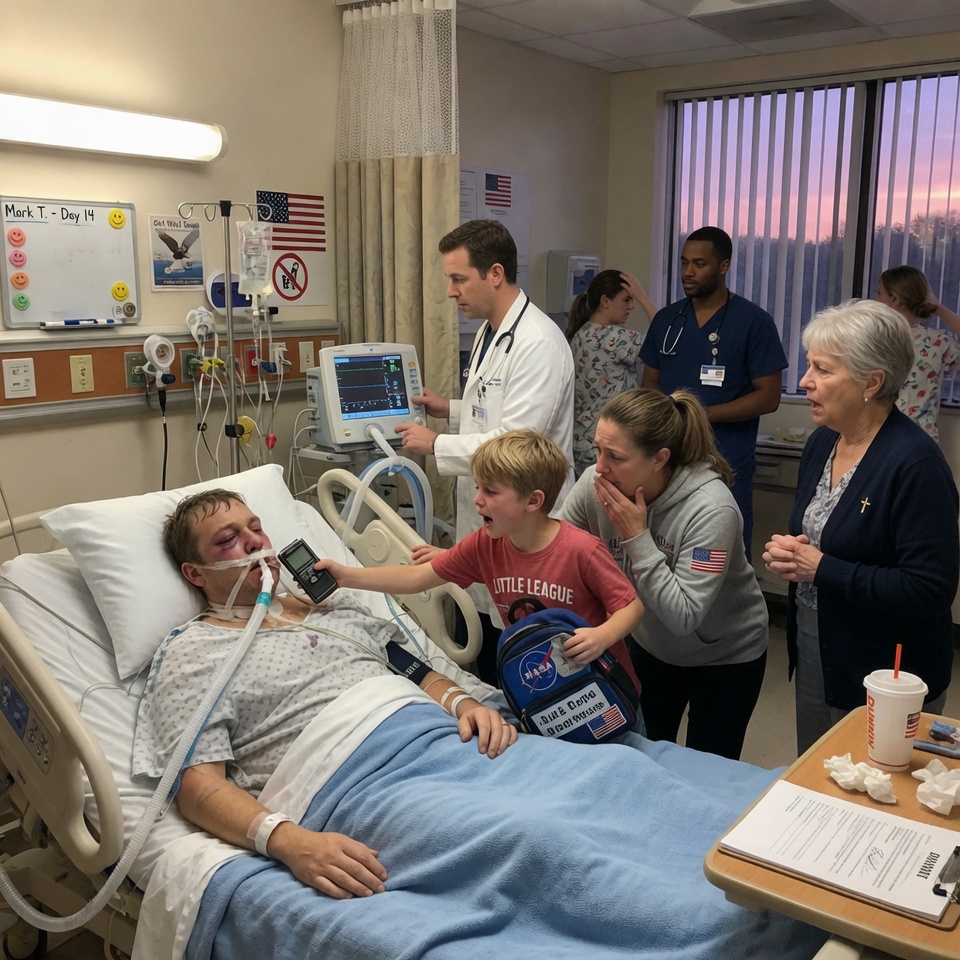
My whisper tangled with the ventilator’s hiss. For fourteen days, that mechanical breath had been the only sign Mark was still with us. His hand lay limp in mine, swollen and unresponsive. In the corner, our eight‑year‑old son Leo crushed his little blue backpack against his chest like it held the last warm piece of his father.
The neurologist had pulled me into a windowless room that morning. His voice was a scalpel.
— The swelling hasn’t gone down. We’re not seeing meaningful brain activity. It’s time to let him go.
I nodded, but I wasn’t really there. Diane, Mark’s mother, gripped my arm outside the door.
— Think of Leo, Annie. Mark wouldn’t want his son remembering him like this.
The guilt was a second wound, deeper than the doctor’s words. I let them talk about timing and preparation. That evening, I signed the DNR. The pen shook so badly I could barely hold it.
We gathered around Mark’s bed—a silent jury of grief. A nurse turned away. Diane’s prayers tangled with the beeping monitors. I knelt beside Leo and forced the words out.
— It’s time to say goodbye to Daddy.
Leo’s lower lip trembled, but his eyes stayed locked on that backpack. The doctor stepped toward the ventilator switch.
Then Leo shot forward.
— No!
He grabbed the doctor’s wrist. The whole room froze.
— Leo, sweetheart…
I reached for him, but he ducked away.
— I know what to do.
A nurse moved to stop him, but Leo was already unzipping the backpack. He pulled out something black and rectangular—a voice recorder I’d never seen. My stomach dropped.
— Leo… where did you get that?
He looked up, tears sliding down his cheeks.
— Dad and I made it. Mom, one man told me this would wake Dad up.
He pointed toward the door. Nurse Caleb stood there in his jacket, calm and certain.
— I overheard him talking to Mark last night. Mark’s heart rate changed the moment Leo mentioned a secret. Twice. Before you disconnect him, you need to see what I saw.
Diane’s face went white.
— You told a child to play games with this?
Caleb didn’t look at her. His voice stayed low, for me alone.
— Hope doesn’t always look like a miracle. Sometimes it looks like a scared boy refusing to let go.
Leo placed the recorder right beside Mark’s ear, his small fingers steady. Then he pressed play.
Part 2: Static crackled from the tiny speaker, and then my husband’s voice filled the hospital room.
“Okay, buddy, is it on?”
The sound of him—alive, whole, warm—hit me in the chest so hard I forgot to breathe. Mark’s voice, recorded before the crash, before the coma, before two weeks of ventilator hiss and whispered goodbyes. It was his Saturday-morning voice, the one he used when making pancakes and pretending to burn them just to make Leo laugh. I grabbed the bed rail to keep from falling.
Leo’s smaller voice answered from the recorder, bright and proud. “It’s on, Dad. Say the thing.”
And Mark laughed.
I had not heard that laugh in fourteen days. I had not dared to imagine I would ever hear it again. A sob lodged in my throat, thick and hot. Diane made a strangled noise behind me. One of the nurses covered her mouth. The doctor, who had been reaching for the ventilator switch seconds earlier, stood frozen, his hand still suspended in the air like a man who had forgotten how to move.
“Hi, Annie,” the recording said, and my name in his mouth was a knife and a lifeline at the same time. “If Leo did his job and didn’t spoil the surprise, then happy anniversary.”
My hand flew to my mouth. I couldn’t breathe. Leo had started crying without sound, tears sliding down his cheeks while he held the recorder steady beside his father’s ear. His little shoulders shook, but his hands did not waver. My eight-year-old son, who still asked me to check for monsters under his bed, was holding a miracle in his grip.
The message kept going.
“I know I’ve been working too much. I know I keep saying it’s just until things settle down. But you never complain, even when you should. You make this family feel safe, and I don’t tell you enough that I see it.”
A sob broke out of me so hard it hurt. I heard Diane turn away sharply, her heels clicking on the linoleum. Caleb, the night nurse, stood near the foot of the bed, his arms folded, watching the heart monitor with an intensity that made the air feel charged.
Mark’s voice softened, that private tenderness he only used when we were alone in the dark, our legs tangled under the covers, the world shut out. “So this year, I’m making two promises. First, I’m taking you to that little place by the lake, the one with the terrible pie you pretend to like.”
A few people in the room let out wet, broken laughs. One of the younger nurses turned her face away, her shoulders trembling. The pie. God, that pie. It was a joke between us, a tiny cabin resort we’d found on our honeymoon where the owner’s mother made apple pie that tasted like cinnamon and regret. I always ate every crumb and told her it was wonderful, because her hands shook when she served it and her eyes begged for approval. Mark knew I hated it, but he also knew why I ate it. He knew everything about me.
“And second,” the recording continued, “I’m taking Leo fishing. No phone. No work calls. Just worms, bad sandwiches, and my brave boy telling me I’m doing it wrong.”
Leo giggled on the recording, the same giggle that used to fill our living room before the world collapsed into beige hospital walls and antiseptic silence. “You always do it wrong.”
Mark laughed again, and the sound was sunshine. It was everything. It was a future I had been told, less than an hour ago, I would never have.
Then his voice changed. Gentler now. More private. The way he spoke when he thought no one else was listening.
“And Annie… if I ever forget to say it, remember our code.”
I closed my eyes.
Three squeezes.
A dumb, sweet habit from our early years when money was tight, life was loud, and we had no language for reassurance except what we made ourselves. A hand squeeze. Three beats. I’m here. I’m yours. We’re okay. It had started on a freezing night in our first apartment, when the heat had gone out and we were huddled under every blanket we owned, too proud to ask for help. He squeezed my hand three times. I squeezed back. No words necessary. We had used it at funerals, in labor and delivery when Leo came screaming into the world, during fights when neither of us could find the words to apologize. Three squeezes. A Morse code of the heart.
Mark said into the recorder, “Three squeezes means I’m here.”
Recorded Leo echoed proudly, “Three squeezes means Dad’s here.”
In the hospital room, my living son leaned over my husband’s face. His voice was a whisper, cracked and wet. “Daddy… three squeezes means you’re here.”
For a long moment, nothing happened. The ventilator hissed. The monitors beeped their steady, indifferent rhythm. Diane stood rigid by the wall, her hands clasped so tightly her knuckles were white. The doctor’s brows furrowed, a skeptic still fighting his own hope.
Then a nurse at the monitor station drew a sharp breath. “Wait… what is that?”
The doctor stepped closer. “Hold on.”
I looked at the screen, at the jagged lines that had measured fourteen days of emptiness. Something was changing. A spike. Small, but unmistakable. Brain activity, stirring like a creature waking from hibernation. Then I felt it—weak pressure against my palm. Mark’s fingers twitched. Barely anything. A shadow of movement. But I felt it.
My breath left me in a sound that wasn’t quite a word. “Mark? Oh my God, Mark!”
His thumb moved. One press against my hand. Then a second. I held my breath, counting, praying, begging the universe that I hadn’t imagined it. The third press was so faint I almost missed it. But it was there. Three squeezes. I’m here.
Caleb moved to the monitor, his voice calm but urgent. “There. That’s what I saw last night. During Leo’s visit, when the boy whispered to him. His heart rate changed the same way. I documented it in my notes.”
The doctor’s face shifted. Not into hope exactly. Into sharpness. The cold focus of a man who had just watched the impossible happen and needed to understand it. “Stop the withdrawal process,” he said to the nurse. “Page neurology again. I want a repeat assessment. Full cognitive panel. And get an EEG running now.”
Diane started crying, but it wasn’t relief. It was confusion, anger, fear all tangled together. “But you said there was no brain activity. You said he was gone. How can a recording change anything? This is cruel. What if it means nothing?”
I stared at Caleb. “You knew?”
He shook his head slowly. “I suspected. I’ve been a nurse for eighteen years. I’ve seen things I can’t explain. When I heard Leo talking to Mark last night, I watched the vitals. Then again this morning, just before your meeting. I didn’t know about the recording until Leo told me. But I knew something was happening. I couldn’t stand by and let you pull the plug without seeing it for yourself.”
“You should have told me sooner,” I whispered, but there was no anger in it. Just exhaustion. Just gratitude too heavy to carry.
“I was trying to protect Leo,” Caleb said. “He was terrified of breaking his promise. If I’d pushed too hard, he might have shut down. Kids carry secrets like glass. Squeeze too tight and they shatter.”
I dropped to my knees in front of my son. The floor was cold and hard, but I didn’t feel it. I cupped his face in my hands, his cheeks wet and warm.
“And you kept this all this time because Daddy told you not to tell me?”
Leo nodded, his chin trembling violently. “He said it had to be a surprise for your anniversary. He made me promise. We practiced it in the garage. I thought if I told you, I would ruin everything.”
“Oh, baby.” I pulled him close, his little body folding into mine. He smelled like hospital soap and the strawberry lotion my sister had brought him three days ago, the scent of childhood clinging to him despite everything. “You didn’t ruin anything. You saved him. You hear me? You saved Daddy.”
He sobbed into my shoulder, the sound muffled and raw, and I held him the way I’d been holding Mark’s hand—like he was the anchor and the ship and the entire ocean, all at once.
Behind us, Diane spoke again, her voice sharp. “This is still cruel. False hope is the worst thing you can give a child. You need to prepare him for the reality that Mark might never wake up. That recording could be a fluke. A reflex.”
Something in me finally snapped.
For two weeks, I had let everyone speak over my grief. Around my grief. Into my grief. Doctors with statistics. Family with advice. People telling me what Mark would want, what Leo needed, what acceptance looked like. I had nodded and cried quietly and let them carve pieces off me because I didn’t have the strength to fight. But that moment, on my knees on the hospital floor, with my son’s tears soaking my shirt and my husband’s three squeezes still burning in my palm, I found that strength again.
I stood and faced Diane.
“Hope is often cruel,” I said, and my voice didn’t shake. “But I’d rather know that I tried, that I did everything I could, than sit with the regret of wondering if this one chance was all Mark needed to find his way back to us.”
She stared at me like I had slapped her.
Then I reached down and picked up the doctor’s clipboard, which had fallen to the floor during the chaos. I removed the DNR form I’d signed earlier—my signature still fresh, the ink barely dry—and I tore it in half. Then in half again. The sound of ripping paper cut through the room like a gunshot.
“No one discusses removing support again,” I said, looking at the doctor, at Diane, at every nurse who would listen. “Not until every test is repeated with Leo’s voice and that recording included. If there’s a chance—any chance—we’re taking it. I am his wife. I am his medical proxy. And I am done letting other people decide what hope is allowed to look like.”
The doctor nodded slowly, his expression unreadable but his posture shifting. He’d seen families break in rooms like this. He’d probably seen some put themselves back together too. “We’ll run the tests. All of them. And we’ll do it with the recording present. It’s unorthodox, but I’ve seen stories where familiar voices help stimulate neural activity. There’s research. Not much, but enough.”
“Then use it,” I said.
The next hour was a blur of activity. The neurology team arrived, a swarm of white coats and clipboards and machines I didn’t understand. They attached electrodes to Mark’s scalp, wires sprouting from his head like strange silver roots. The EEG monitor flickered with squiggly lines that looked to me like nonsense, but the doctors stared at them with furrowed brows and low murmurs. Caleb stayed past his shift, refusing to leave, standing in the corner with his arms crossed and his eyes never leaving the monitors.
They played the recording again. Leo held my hand this time, squeezing it with all the strength his small fingers could muster.
“Okay, buddy, is it on?”
Mark’s voice again. The room went silent except for the machines.
The neurologist, a woman with sharp eyes and silver-streaked hair, watched the EEG. “There,” she said softly, pointing at a spike. “See that? It’s not just random. The waveform shifts when the patient’s name is mentioned. And there—when the child’s voice appears. It’s subtle, but it’s consistent.”
“Does that mean he can hear us?” I asked, afraid to hope.
“It means something is processing auditory stimuli. Whether it’s conscious awareness or not, I can’t say yet. But it’s not nothing. It’s absolutely not nothing.”
I closed my eyes and let that wash over me. Not nothing. After fourteen days of nothing, not nothing felt like everything.
Diane stood by the window, her back to us, her reflection ghostly in the darkened glass. I didn’t have the energy to comfort her. I barely had the energy to stay upright. But Leo squeezed my hand again—three squeezes—and I looked down at him.
“Daddy did it,” he whispered. “He kept his promise.”
“He did, baby. He did.”
The doctors ordered a new round of imaging: functional MRI, more EEG monitoring, a full cognitive assessment protocol that would take days. They adjusted Mark’s medications, tweaked the ventilator settings, and posted a new sign on his door: STIMULATION THERAPY IN PROGRESS. DO NOT DISTURB WITHOUT COORDINATION. It felt like a declaration of war against the certainty that had filled this room hours earlier.
That night, after Diane finally left—muttering something about needing rest and not being able to watch this circus—Caleb brought me a cup of terrible hospital coffee and sat down in the chair opposite mine.
“I should tell you something,” he said, his voice low. Leo had fallen asleep on the cot by the window, his backpack clutched to his chest even in sleep. “About why I got involved.”
I wrapped my hands around the coffee cup, letting its warmth seep into my fingers. “I’m listening.”
“My younger brother was in a coma when I was sixteen. Car accident. Hit by a drunk driver. The doctors said there was no hope. My parents signed the papers.” He paused, staring at the floor. “The morning they were going to disconnect him, my mother sang to him. Some old lullaby from our childhood. And his eyes opened. Just for a few seconds. But it was enough to stop everything. He woke up fully three days later. He’s an engineer now, married, two kids.”
My throat tightened. “Why didn’t you tell me this before?”
“Because it’s not my story to push onto grieving families. I’ve learned that over the years. People need to find their own hope, not have it handed to them like a prescription.” He looked at me, his kind eyes serious. “But when I saw Leo talking to Mark, and I saw the vitals change, I couldn’t stay quiet. That boy… he’s got a gift. Not the recording. The faith. He believed his dad would hear him. And belief like that… it can move mountains. Or at least move a few brain waves.”
I reached over and put my hand on his arm. “Thank you. For staying. For seeing what the rest of us missed.”
He nodded, then stood. “I’m off shift in an hour. But I’ll be back tomorrow. And the day after. We’re going to see this through.”
After he left, the room settled into its nighttime hush. The ventilator kept its rhythm. The monitors beeped. But something had changed. The air itself felt different, charged with possibility instead of the stale weight of grief. I pulled my chair closer to Mark’s bed and picked up his hand again. It was still swollen, still marked with IV bruises and the pale pallor of illness. But it was warm. And it had moved.
“Hey, you,” I whispered, pressing my lips to his knuckles. “I don’t know if you can hear me. But I heard you. On that recording. And Leo… Leo’s been so brave. You should see him. He’s holding the whole world together, and he’s only eight. You’d be so proud of him, Mark. I’m so proud of him.”
I talked to him for hours that night. I told him about the two weeks I hadn’t told him about, the days I’d sat here in silence, the nights I’d cried in the hospital chapel even though I wasn’t sure I believed in God. I told him about the phone calls to insurance companies, the well-meaning casseroles piling up in our freezer from neighbors who didn’t know what else to do. I told him about the moment I’d signed the DNR form, how I’d felt my soul leave my body, how I’d imagined a future without him and it had looked like a black hole, an emptiness with no bottom.
“And then Leo said no,” I said, laughing through fresh tears. “Our tiny, stubborn, miraculous boy looked at a room full of adults who had given up on you and said no. You made a secret recording with him. You planned an anniversary surprise. You were thinking about us, about keeping our family together, even when you didn’t know you’d need to.”
I squeezed his hand three times. “I’m here. I’m yours. We’re okay.”
He didn’t squeeze back. Not this time. But the EEG showed a ripple of activity that hadn’t been there before, and I let that be enough.
The next morning, Leo woke up before sunrise. He climbed out of the cot, his hair sticking up in seventeen directions, and padded over to me.
“Mommy, did you sleep?”
“A little,” I lied. “Did you?”
He shook his head. “I had a dream about Daddy. He was in a boat. On the lake. He said he was trying to get back to us but the water was too cold.”
My heart clenched. “That was just a dream, sweetheart. Daddy’s right here. And the doctors are helping him get back to us.”
He looked at Mark, his small brow furrowed with concentration. “Can I talk to him again? Like I did last night?”
“Of course you can.”
I lifted Leo onto the bed—carefully, so he didn’t tangle any of the wires—and he settled beside Mark’s shoulder. He put his hand on his father’s chest, rising and falling with the ventilator’s rhythm, and he started talking.
“Hi, Daddy. It’s me. Leo. I didn’t tell Mommy the secret. I kept it just like you said. And it worked. The nurse man said it worked. He said you heard me.” His voice wobbled but didn’t break. “I miss you. I miss playing catch. I miss when you make pancakes and you flip them too high and they stick to the ceiling. Remember that time? Mom was so mad but then she laughed so hard she couldn’t breathe.”
I laughed now, remembering. One pancake had stuck to the ceiling for three days before it finally fell. Mark had named it Pancake the Explorer. We’d been so happy then. So ordinary. I hadn’t known to appreciate ordinary.
“I want you to wake up,” Leo continued. “But I know you’re trying. So I’ll wait. I’m good at waiting. I waited for Christmas. I waited for my birthday. This is like that, right? You’ll wake up and it’ll be like a present.”
He leaned down and pressed his lips to Mark’s cheek. “Three squeezes, Daddy. And then we can go fishing. I’ll even let you do it wrong.”
Nothing happened for a long moment. Then Mark’s eyelid fluttered. It was barely a movement—so slight I might have missed it if I hadn’t been staring directly at his face. But it was real.
“Mark?” I shot upright. “Mark, can you hear us?”
Another flutter. Then his thumb twitched again. Not three squeezes this time—just one, a weak press against Leo’s small hand. But it was deliberate. It was something.
“He did it!” Leo shouted, nearly bouncing on the bed. “Mom, he did it! He heard me!”
The nurse on duty—not Caleb, but a woman named Patricia with kind eyes and a thick Southern accent—rushed in. “What happened?”
“He moved his eyelid,” I said. “And his thumb. Twice now. Twice in twelve hours. That’s not a reflex, is it? That’s him.”
Patricia checked the monitors, her expression shifting from professional to wondering. “I’m going to call Dr. Reyes. You keep talking to him. Whatever you’re doing, it’s working.”
For the next three days, we turned that hospital room into a stage for Mark’s return. Leo brought school worksheets and read them aloud, his voice filling the space. I played his favorite music—Bruce Springsteen, Van Morrison, the playlist from our wedding—and told him stories about our life together. Diane came back, subdued and quiet, and sat in the corner without saying much. She brought flowers but didn’t offer any more opinions about hope or letting go. I think she was too shaken to speak. There’s something humbling about watching a child do what all your adult wisdom couldn’t.
Caleb continued to visit even on his days off. He brought comic books for Leo and sat with me during the long afternoons when the waiting threatened to crush me. He told me more about his brother, about the months of rehabilitation, about the slow, frustrating, beautiful process of relearning how to live.
“It won’t be a miracle movie moment,” he warned me gently. “If Mark wakes up fully, it’ll be slow. He might not be the same. Brain injuries are unpredictable.”
“I know,” I said. “I don’t need him to be the same. I just need him to be here.”
On the fourth day, Dr. Reyes called me into the hallway. She was the neurologist with the silver-streaked hair, and she’d been cautiously optimistic since the first EEG results.
“We’re seeing consistent improvement,” she said. “His Glasgow Coma Scale score has increased from a stable six to a fluctuating nine. That’s significant. The auditory stimulation—your voices, the recording—seems to be accelerating neural repair pathways we don’t fully understand. I’m not going to pretend it’s common. But it’s real.”
“What happens next?” I asked.
“We’re reducing sedation to see if he can tolerate spontaneous breathing trials. If he passes those, we’ll remove the ventilator. After that… it’s up to him. But I’ll be honest—I didn’t think we’d get this far. Your son’s recording changed something. Not just medically. It changed the energy in that room. And in my experience, energy matters.”
That night, I told Leo that they might take the breathing tube out soon. He looked at me with those big, serious eyes that had seen too much in the past two weeks.
“Will Daddy be able to talk then?”
“Maybe. It might take time. But eventually, yes.”
“Good,” he said, “because I want to tell him I’m not mad about the pancakes on the ceiling.”
I laughed, and it felt like the first real laugh in weeks. “I think he’ll be very relieved to hear that.”
Two days later, they removed the ventilator. I held my breath for the entire procedure, my hand gripping Mark’s, my eyes locked on his chest. The tube slid out, and for one terrifying moment, nothing happened. Then his chest rose on its own—a shallow, ragged breath, but his own breath. No machine. Just Mark.
The room erupted in quiet celebration. Patricia wiped her eyes. Dr. Reyes smiled, a genuine, unguarded smile that transformed her whole face. Leo jumped up and down, then remembered to be quiet and put his hand over his mouth.
I leaned down and pressed my forehead to Mark’s. “Welcome back,” I whispered. “We’ve been waiting.”
He didn’t open his eyes. Not yet. But his hand—his beautiful, stubborn hand—squeezed mine once. Twice. Three times.
Three squeezes.
I’m here. I’m yours. We’re okay.
The days that followed were a strange, suspended time. Mark drifted in and out of consciousness, never fully awake but no longer fully absent either. He would move his fingers in response to questions. Once, when Leo sang “Twinkle Twinkle Little Star”—badly, adorably off-key—Mark’s lips curved into something that might have been a smile. It was enough to reduce half the nursing staff to tears.
His mother Diane finally broke her silence one afternoon. She came into the room while I was reading aloud from a novel Mark had been halfway through before the accident, and she sat down heavily in the visitor’s chair.
“I owe you an apology,” she said, her voice rough. “And I owe Leo one too.”
I put the book down. “Diane…”
“No, let me say this. I was so afraid. I’ve always been afraid. Of losing him. When his father died, Mark was the one who held me together. I don’t… I don’t know how to live without him. And when the doctors said there was no hope, I thought it would be easier to let go than to watch him linger.” She wiped her eyes with a tissue. “I was wrong. If you hadn’t torn up that DNR… if Leo hadn’t had that recording… I would have let my own son die because I was scared.”
I didn’t know what to say. Part of me wanted to stay angry at her. She had made the worst moments of my life even harder. But I looked at her—gray-haired and trembling, a mother terrified of losing her child—and I saw a reflection of my own fear.
“I was scared too,” I said. “I almost let them do it. If Leo hadn’t stopped the doctor… I was holding the pen. I signed the form.” My voice broke. “We both almost lost him. But we didn’t. He’s still here.”
She reached out and took my hand. Her grip was bony and cold, but it was also an olive branch. “Thank you for fighting. Even when I didn’t.”
I squeezed her hand three times. An offering. A beginning.
Two weeks after they removed the ventilator, Mark opened his eyes.
It happened at 3:47 in the afternoon, a Tuesday, with weak winter sunlight slanting through the window and a half-eaten Jell-O cup on the bedside table. Leo was drawing a picture of a fish—a wobbly, enthusiastic scribble of scales and fins—and I was answering emails on my phone, trying to keep the rest of our life from falling apart.
Mark made a sound. Not a word. A grunt, low and guttural, like someone trying to lift something too heavy. I looked up, and his eyes were open.
Not the half-lidded, vacant gaze I’d seen during his semi-conscious episodes. Open. Tracking. Aware.
“Mark?” I dropped my phone and leaned over him. “Can you hear me? Do you know where you are?”
His eyes moved to my face. They were cloudy, unfocused, but they were searching. They were trying.
“Annie.” His voice was a ragged whisper, barely audible, scraped raw from weeks of intubation. But it was my name. He said my name.
I broke. Just shattered. All the composure I’d held together for Leo, for the doctors, for the world, dissolved into sobs that shook my whole body. I pressed my forehead to his chest and wept, feeling his heart beating under my cheek—his heart, still faithful, still fighting.
Leo scrambled up onto the bed, his drawing forgotten. “Daddy? Daddy, are you awake? Are you real awake?”
Mark’s hand lifted—slowly, trembling with effort—and touched Leo’s face. His fingers traced the curve of his son’s cheek, his nose, his hair. “Leo… my boy…”
“I kept the secret,” Leo said, crying and laughing at the same time. “I didn’t tell Mommy. And it worked. You woke up. I knew you would.”
Mark’s eyes filled with tears that spilled over and ran into the hollows of his ears. “So brave… my brave boy…”
The next few weeks were a roller coaster. Mark was transferred to a rehabilitation facility, a place that smelled like physical therapy and hope. He had to relearn everything: how to sit up without help, how to stand, how to walk. The accident had fractured his left leg in multiple places, and the weeks of immobility had atrophied his muscles. Speech therapy, occupational therapy, physical therapy—our lives became a calendar of appointments and small victories.
He remembered the recording, vaguely. He had made it the weekend before the accident, sneaking Leo out to the garage while I was at the grocery store. It was supposed to be an anniversary gift, something to play for me over dinner at the little cabin by the lake. The pie place. I had forgotten we’d booked it for late May, the same weekend as our anniversary.
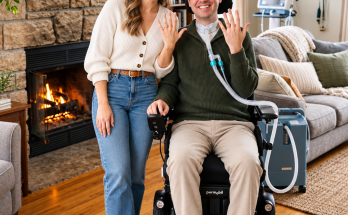
“I wanted to surprise you,” Mark said one evening, sitting in his wheelchair by the window of his rehab room. His speech was still halting, but clearer every day. “You’d been so tired. Working extra shifts. Taking care of Leo. I felt like… like I never told you enough how much I saw it. How much I loved it. Loved you.”
I sat on the arm of his chair, my hand resting on his shoulder. “You told me every day. Maybe not with words. But with three squeezes. With pancake disasters. With staying. You always stayed.”
“I almost didn’t make it back,” he said, his voice breaking. “I remember… darkness. And cold. And then… Leo’s voice. His little voice, saying my name. And your voice too. Pulling me out of it. I couldn’t let go. I kept thinking, I have to get back to them. I made a promise.”
I closed my eyes and let the tears come. Healing, it turns out, is not a linear thing. It’s circles and spirals and sudden relapses into grief you thought you’d processed. But it’s also this: a quiet room, a recovering man, a love that survived.
Caleb came to visit once, a month after Mark woke up. He brought Leo a model airplane kit and me a card signed by all the ICU nurses. He and Mark shook hands, and Mark looked at him with a gratitude I knew he didn’t have the words for yet.
“You saved my life,” Mark said anyway, because he was always stubborn about trying.
Caleb shook his head. “Your son saved your life. I just watched.”
“You believed him,” I said. “That’s not nothing.”
He shrugged, uncomfortable with praise, but I saw the emotion in his eyes. “Take care of each other. That’s all that matters now.”
The day finally came when Mark walked out of the rehab facility—slowly, with a cane, but on his own two feet. Leo ran ahead to open the car door, his face shining with pride. Diane waited in the parking lot, holding a “Welcome Home” sign she’d made herself, her hands still trembling but her smile steady.
We drove home through streets that felt unfamiliar, like the world had shifted while we were living in that suspended animation of hospitals and recovery. Our house looked the same—the same blue shutters, the same overgrown rose bushes I hadn’t had time to trim—but everything felt different. Precious. Fragile.
That summer, we took the trip to the cabin by the lake. The pie was still terrible, and I still ate every bite with a smile, and Mark squeezed my hand under the table. Three squeezes. I squeezed back.
Leo caught a fish on the second day, a tiny sunfish that he insisted on naming “Pancake the Explorer II.” Mark’s casting technique was still, as Leo put it, “completely wrong.” But they sat on the dock together for hours, their lines in the water, their silhouettes dark against the sunset, and I watched from the porch and felt something I hadn’t felt in months: peace.
One night, after Leo had fallen asleep, Mark and I sat on that same porch, wrapped in a blanket against the evening chill. The lake was still, a mirror for the stars.
“I was thinking,” he said, his voice stronger now, almost back to normal. “About what you told me. That you almost signed the DNR. That you were holding the pen.”
I stiffened. “Mark…”
“I’m not angry,” he said, turning to look at me. “I’m grateful. Because you didn’t. Because you listened to our son. Because you believed in something when everyone else was telling you not to.” He took my hand. “I know you. I know how hard that must have been. How much courage it took to tear up that paper.”
I swallowed. “I was so scared. I thought I was losing you. I thought… I thought I was going to have to raise Leo alone. And I was so tired. So tired I almost let you go.”
“But you didn’t.” He kissed my forehead. “You held on. And I’m here because of it. Because of you. Because of Leo. Because of… I don’t know. Something bigger than us. A recording I forgot I made. A nurse who noticed a change in a heartbeat. A little boy who kept a secret.”
“A code,” I said. “Three squeezes.”
“Three squeezes,” he echoed.
We sat there until the stars brightened and the moon rose over the lake, and I thought about all the people who had been in that hospital room: Diane, Dr. Reyes, Caleb, Patricia, the other nurses whose names I’d never learned. I thought about the two weeks I’d spent measuring time by a ventilator’s hiss, and the one moment that had changed everything. I thought about hope—cruel, stubborn, beautiful hope—and how it had looked like an eight-year-old boy clutching a blue backpack and saying no.
I squeezed Mark’s hand three times. He squeezed back.
And I knew, with a certainty that settled into my bones, that we were going to be okay. Not the same as before. Scarred and changed and carrying the weight of what we’d almost lost. But okay. Together. A family, still unbroken.
The following spring, on a Saturday morning, Mark made pancakes. Leo stood on his step stool beside him, wearing an apron that hung down to his ankles, and they flipped batter into the air with more enthusiasm than skill. One pancake hit the ceiling.
Leo shrieked with laughter. Mark looked at me, grinning, his cane propped against the counter, his wife covered in flour, his son pointing at the ceiling and shouting “Pancake the Explorer III!”
I laughed so hard I couldn’t breathe.
Three squeezes later, I was still laughing.
And somewhere in the ceiling of our kitchen, a pancake began its slow, triumphant descent.