PART 2:
The morning light had turned harsh by the time my son’s apology hung in the air like smoke. No one moved to clear it away. The word “sorry” sat between us—me, the boy I’d raised, and the mother who’d buried her daughter four days ago—and it wasn’t enough. It would never be enough. I knew that the way a man knows the weight of his own fists before he learns to open them.
Emily’s mother, Diane Carter, still clutched the white frame against her chest. I could see the edge of a school photo, a gap-toothed smile frozen behind glass. She didn’t look at my son, Ethan. She looked at me. Her eyes were dry, but that wasn’t peace. That was depletion. The kind of empty that comes after you’ve cried until your body has nothing left to give.
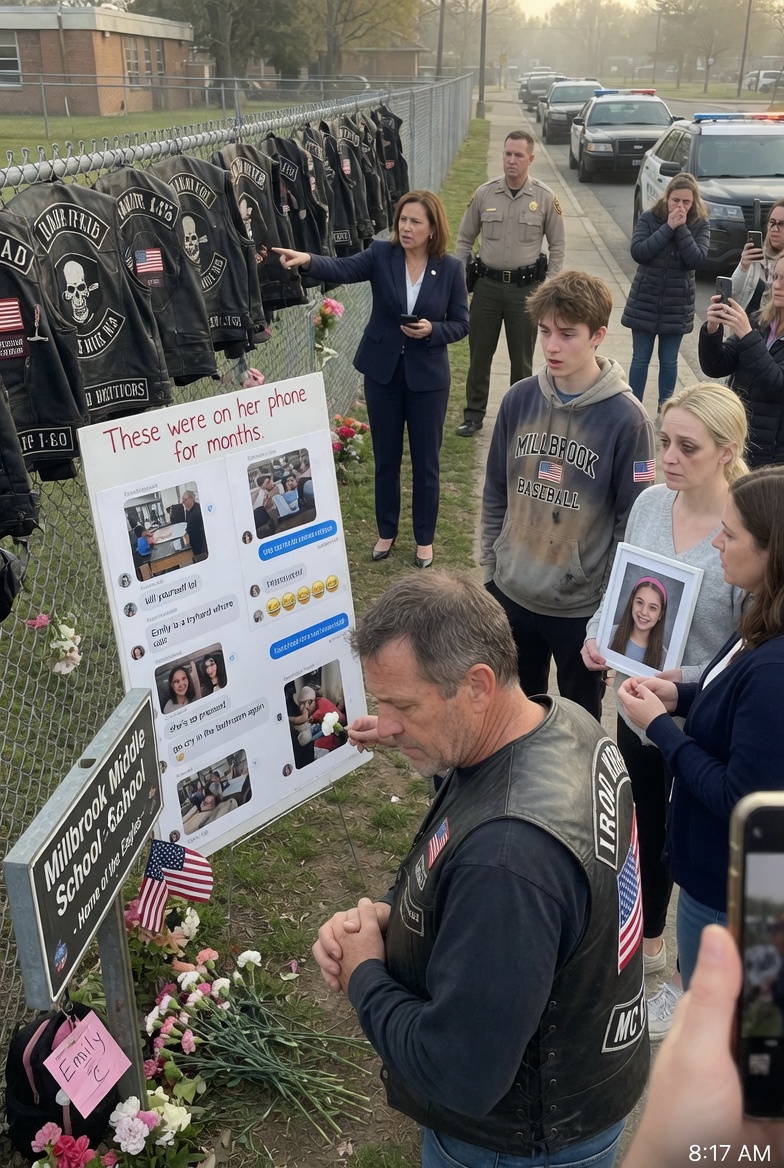
Principal Harris stepped back, her heels scraping the sidewalk. She’d threatened trespassing charges minutes ago. Now she just stood there with her arms crossed, a woman whose procedural armor had cracked. Officer Randall holstered his radio. The other parents—some still filming, some lowering their phones—seemed to forget why they’d been afraid. The bikers hadn’t come to burn anything down. They’d come to burn something out.
I turned to Ethan. Sixteen years old, shoulders curved inward like a question mark. His jaw trembled. I’d seen him cry exactly twice in his life: once when he was seven and broke his arm falling off a trampoline, and once now. His Red Sox cap was pulled low, but I could still see the red rims around his eyes.
“Louder,” I said. My voice wasn’t harsh. It was hollow. “They need to hear you.”
Ethan swallowed. I watched his Adam’s apple bob like a fishing float. He lifted his chin just enough to face Diane Carter, but his gaze landed somewhere around her collarbone. He couldn’t look at her eyes. I understood. I’d spent forty-eight years avoiding the eyes of people I’d wronged.
“I’m sorry,” he said again, and this time the words cracked in the middle. “I… I said things. Online. At school. I thought it was…” He stopped. His breath hitched. “I thought it was funny.”
The word funny landed like a slap.
Someone in the crowd made a noise—a choked-off sob or a grunt of disgust, I couldn’t tell. I didn’t turn to see. My focus was on Diane Carter’s face, because I owed her that much. Her expression didn’t change. She didn’t nod. She didn’t forgive. She just stood there, a statue carved from grief, and let my son’s words fall into the silence.
“I didn’t know she would…” Ethan’s voice trailed off. He couldn’t finish the sentence. Good. Some sentences shouldn’t be finished.
“You didn’t know,” Diane repeated. Her voice was flat, sanded down to nothing. “That’s what they all say.”
Ethan flinched. I flinched too, because the they included me. I’d spent years telling myself I didn’t know. Didn’t know my son was spending hours on group chats where kids tore each other apart. Didn’t know the boy who still hugged me goodnight could craft cruelty with his thumbs. Didn’t know because I didn’t look.
Diane shifted her weight. The white frame pressed tighter to her chest. “Emily kept a journal. She wrote about the lunch table. About the messages. She wrote your son’s name, Mark. Right there in blue ink. Ethan Delaney told me I should disappear.”
My stomach dropped so fast I felt dizzy. I’d known the broad strokes—the bullying, the screenshots, the suicide—but hearing those words spoken aloud, pinned to my own blood, gutted me. I’d been a Marine. I’d been in bar fights. I’d rebuilt engines in a freezing garage with bleeding knuckles. None of it prepared me for the pain of realizing my child had told another child to vanish.
Ethan made a sound like a wounded animal. “I didn’t mean—”
“You didn’t mean for her to do it,” Diane cut in, and now a flicker of something sharp entered her voice. “You just meant for her to hurt. That’s what you meant. And it worked.”
I reached out and put my hand on the back of Ethan’s neck. Not to comfort him. To anchor him. To keep him standing in the truth he’d created. He was shaking so hard I could feel the vibration through my palm. I wanted to pull him into my chest and shield him from everything—from the crowd, from the cameras, from the weight of what he’d done. But that instinct was exactly what had brought us here. Shielding. Excusing. Pretending.
“I’m not going to let you run from this,” I whispered to him, low enough that only he could hear. “You’re going to stand here. You’re going to listen. And then you’re going to start making it right, even though it’ll never be fully right. Do you understand me?”
He nodded, a jerky motion like a puppet with tangled strings.
Behind us, the other bikers had not moved. Thirty men and women who’d ridden here before dawn, who’d hung their vests on a school fence not to intimidate but to signal surrender—they stood like a wall of witnesses. Maria, the gray-haired woman who’d adjusted the vests earlier, had tears tracking down her cheeks. She was a grandmother of five. She ran a daycare. She’d told me on the ride over that her own granddaughter had been bullied so badly she’d switched schools. “Nobody did anything,” she’d said, gripping her handlebars. “Nobody ever does anything.”
Today, somebody was doing something. It just happened to be the people nobody expected.
Diane Carter’s husband, Rob, stepped forward. He was a big man, broad through the shoulders, the kind of guy who’d spent his life working construction and keeping his emotions locked behind a tight jaw. I’d seen him at Little League games years ago, cheering for Emily when she played softball. He looked like he hadn’t slept since Thursday.
“You brought your whole club here,” Rob said to me, his voice gravelly and low. “For what? A show?”
“No,” I said. “For accountability.”
“Accountability.” He tasted the word like it was sour. “My daughter is dead. Accountability doesn’t bring her back.”
“I know it doesn’t.”
“Then what good is it?”
It was a fair question. Maybe the fairest question anyone had asked all morning. I didn’t have a clean answer. I’d spent the last three days since learning about Ethan’s involvement doing nothing but asking myself the same thing. I’d sat in my garage at two in the morning, staring at my motorcycle, wondering if I should just get on and ride until the road ran out. But running wasn’t accountability. Running was what cowards did. And I’d been a coward in small ways for years.
“It’s not good,” I admitted. “Not the way you need it to be. But it’s what I have. It’s my son standing here instead of hiding. It’s me telling you the truth instead of making excuses. It’s every person behind me deciding that silence was part of the problem.”
Rob’s jaw worked side to side. He looked at Ethan, then at the poster board still leaning against the fence. The screenshots were visible from where he stood—cruel words, laughing emojis, a cascade of digital poison. I saw his fists clench and unclench.
“Your son wrote that?” he asked me, pointing at one particularly vicious message: Nobody would care if you just weren’t here anymore.
“Yes,” I said. The word tasted like ash.
“And you didn’t know.”
“I didn’t look.”
Rob nodded slowly. The nod wasn’t acceptance. It was processing. A man trying to figure out whether to throw a punch or walk away. I would have taken the punch. I almost wanted him to throw it. Physical pain I understood. Physical pain had a beginning and an end.
But Rob didn’t hit me. He turned to Ethan.
“Look at me,” he said.
Ethan’s head lifted an inch. His eyes were swollen, terrified. He looked like a child who’d just realized the monster under the bed was real—and it was him.
“She was my only daughter,” Rob said, and his voice broke on the word only. “She played the clarinet. She made these awful burnt cookies every Christmas and we pretended they were good because she was so proud. She was afraid of thunderstorms. She still slept with a stuffed dog she’d had since she was three.”
Ethan’s face crumpled. Tears spilled over his cheeks. He didn’t wipe them away.
“She was real,” Rob continued, stepping closer. “She wasn’t a character in one of your video games. She wasn’t a punchline. She was real, and she’s gone, and you helped make her want to be gone.”
“I know,” Ethan choked out. “I know, and I’m sorry, I’m so sorry—”
“I don’t want your sorry right now,” Rob said. “I want you to remember this. Every day. For the rest of your life. I want you to remember what your words did.”
Ethan nodded, a frantic, desperate motion. “I will. I swear I will.”
Diane touched her husband’s arm. A small gesture, but it spoke volumes. She was pulling him back, not because she forgave, but because she was too exhausted for confrontation. I recognized that exhaustion. After a certain point, anger takes more energy than you have left.
“We’re going home,” Diane said quietly. “There’s nothing else here.”
She was right. There was no justice at this fence. No resolution. Just the beginning of a long, brutal reckoning.
Rob let himself be guided away. As they turned, Diane paused beside me. She didn’t look at me. She looked at the vests on the fence, dark leather draped like mourning cloth.
“Emily’s funeral is Friday,” she said. “Don’t come.”
“We won’t,” I said immediately.
“No.” She finally met my eyes. “You won’t come. But if he wants to—your son—he can stand in the back. And he can watch. And he can see what his words cost.”
It was the cruelest kindness I’d ever witnessed. An invitation not to grieve, but to witness. To sit with the consequences in a wooden pew and feel the full weight of a casket closing.
“He’ll be there,” I said.
Diane nodded once and walked away. Rob followed, his shoulders hunched. The crowd parted for them like water around a stone.
I watched them go, then turned back to the fence. The vests were still there. Thirty pieces of leather that used to mean rebellion and brotherhood and the open road. Now they just meant regret.
“Start taking them down,” I said to the others. “It’s time.”
Maria moved first, unhooking her vest with gentle hands. The others followed. One by one, the leather came off the chain-link, and the fence returned to being just a fence—silver wire and metal posts, unremarkable. But the ground underneath felt different. Charged. Like after a lightning strike.
Ethan stood frozen beside me. He hadn’t moved since Rob and Diane left. His chest was heaving like he’d run a marathon, but his feet were planted. I didn’t rush him. The worst was still ahead.
Principal Harris cleared her throat. “I’ll need to file a report with the district. And the police may have questions for your son.”
“I know,” I said.
“The school has a zero-tolerance policy for bullying, but…” She paused, and for the first time, her professional mask slipped. “But we missed this one. We missed a lot of them.”
I didn’t have the energy to assign blame to her. She was part of a system that had failed, but so was I. So were the other parents. So was a culture that told kids to toughen up and then acted surprised when they broke.
“We all missed it,” I said. “The question is what we do now.”
She didn’t have an answer. Neither did I.
By the time the last motorcycle pulled away, it was nearly ten in the morning. The school day had started—late, disrupted, but started. Kids were inside, whispering about what they’d seen from the bus windows. Teachers were trying to regain control of classrooms that had spun off their axis. And I was driving home with my son in the passenger seat of my truck, the bed filled with folded leather vests that smelled like road and regret.
We didn’t speak for the first ten minutes. The radio was off. The only sound was the hum of the tires on asphalt and Ethan’s uneven breathing. He was staring out the window, his forehead pressed against the glass.
“Dad,” he finally said.
“Yeah.”
“What happens now?”
I gripped the steering wheel tighter. Outside, the Ohio landscape rolled by—flat fields, bare trees just starting to bud, a sky that couldn’t decide between blue and gray. It looked like the inside of my chest felt.
“Now we go home,” I said. “And you tell your mother everything. Every detail. Every message. Every time you laughed when you should have stopped.”
He flinched. His mother, Lauren, didn’t know yet. She knew Emily had died. She knew there were rumors about bullying. But she didn’t know our son’s name was on the list. I’d found out three days ago when one of the other bikers, a man whose daughter was in Ethan’s grade, had pulled me aside after a club meeting. “You need to look at your boy’s phone,” he’d said, his face grim. “There’s screenshots going around.”
I’d looked. I’d found the group chats, the DMs, the threads of mocking comments that stretched back months. I’d found the message where Ethan told Emily she should “do everyone a favor.” I’d thrown up in the kitchen sink.
That night, I’d confronted him. He’d broken down immediately—no denial, no deflection. Just tears and babbling about how it had “just escalated” and he “didn’t think she’d take it seriously.” I’d spent two days deciding what to do. Call the police myself? Confront the school? Show up at the Carters’ door and beg forgiveness? In the end, I’d called the club. Told them the truth. Asked for help.
The ride to the school had been their idea. A show of force, but not the kind the town expected. A show of contrition.
“Mom’s going to hate me,” Ethan whispered.
I didn’t sugarcoat it. “She’s going to be devastated. There’s a difference.”
He started crying again. I let him. Tears were the least of what he owed.
Our house was a split-level on Oak Street, two blocks from the elementary school where Emily had learned to read. The driveway was empty—Lauren’s car was gone. She was at work, or maybe running errands, unaware that her entire world was about to fracture. I pulled into the garage and killed the engine. The silence rushed in.
“Inside,” I said. “Wash your face. Then wait in the living room.”
Ethan shuffled out of the truck like a condemned man walking to the gallows. I grabbed the pile of vests from the truck bed and carried them into the garage. Maria had offered to take them, but I’d said no. They needed to come home with me. They were a reminder.
I found Ethan on the couch, hunched over his knees. He’d washed his face, but his eyes were still red. He looked smaller than he had at the school. Younger. Sixteen is a strange age—old enough to inflict real damage, young enough to still look like a child when the armor falls off.
I sat down across from him in the worn armchair that had belonged to my father. The chair still smelled faintly of pipe tobacco, even though my dad had been dead for six years. I wished he were here. He’d have known what to say. Or maybe he wouldn’t have. Maybe nobody knew what to say in moments like this.
“Tell me,” I said. “From the beginning. Not the version you want to tell. The truth.”
Ethan’s hands twisted together in his lap. “It started in October. There was this group chat—some guys from the soccer team started it. At first it was just jokes. Memes. Stuff like that. Then someone posted a picture of Emily with her clarinet, and people started making fun of her. I didn’t start it, but I…”
“You joined in.”
“Yeah.” His voice was barely audible. “I wanted to fit in. The guys thought it was funny, and I just… I wanted them to like me.”
“So you made her life hell so you could be popular.”
He flinched. “When you say it like that…”
“How else should I say it?”
He didn’t have an answer. The silence stretched, thick and suffocating. Outside, a neighbor’s dog barked. A lawnmower hummed in the distance. Ordinary sounds for an ordinary Tuesday, except nothing was ordinary anymore.
“It got worse,” Ethan continued, his voice cracking. “In November, someone made a fake account. They pretended to be a guy from another school who liked her. They… we… we made her think someone cared about her, and then we posted all the messages she sent. Private stuff. She was so embarrassed she didn’t come to school for a week.”
I felt sick. Genuinely, physically sick. The kind of nausea that starts deep in your gut and radiates outward. My son—my son who used to cry when he accidentally stepped on ants—had participated in catfishing a vulnerable girl for entertainment.
“Who else was involved?” I asked.
“A bunch of kids. Like, maybe ten or fifteen. Some did worse stuff than others.” He paused. “Colton Bowers was the worst. He’s the one who made the fake account. He’s the one who kept pushing even when some of us wanted to stop.”
“Why didn’t you stop?”
“I don’t know.” His voice broke. “I was scared. Scared of being next. Scared of being the weird kid again. I just… I went along. And after a while, it didn’t even feel real. It was just a screen. Just words. I didn’t…”
“You didn’t think about her as a person.”
“No.” The admission hung between us. “I didn’t.”
I leaned back in the armchair. The weight of his confession pressed down on my chest. I wanted to scream at him. I wanted to grab him by the shoulders and shake him until he understood the magnitude of what he’d done. But screaming wouldn’t bring Emily back. And shaking him wouldn’t undo months of cruelty.
“What happened in February?” I asked. I knew about the bullying reports, the meeting request. Lauren and I hadn’t been told. The school had kept it quiet, “protecting student privacy.”
Ethan’s face went pale. “Emily’s parents came to the school. They had printouts of the messages. Some of them. The principal called a bunch of us into her office separately. She said there would be consequences, but… nothing really happened. They talked to our parents, but Colton’s dad is a lawyer, and he threatened to sue. The school backed off. We all just… pretended it didn’t happen.”
“And you kept going.”
“Not as bad. But yeah. The group chat moved to a different app. Colton said the school couldn’t track it there. I stayed in the chat. I didn’t say as much, but I didn’t leave either. And then…” His voice trailed off.
“And then last Thursday.”
He nodded, tears streaming down his face. “Colton sent her a message. He said… he said the world would be better off without her. He said nobody would care. He said she should just do it already. And a bunch of people—they didn’t say anything. They just… let it happen. And then that night, she…”
He couldn’t finish. He didn’t need to.
I sat in silence, processing. Colton Bowers. The name was familiar—his father, Richard Bowers, was a corporate attorney in Columbus. I’d seen him at school fundraisers, always with a glass of scotch and a condescending smile. His son had been the ringleader, and he’d used his influence to shield him from consequences. And now a thirteen-year-old girl was dead.
“I want to see the messages,” I said. “All of them. Everything you sent. Everything you received.”
Ethan pulled out his phone with trembling hands. He unlocked it and handed it to me without argument. The screen was cracked—he’d dropped it months ago, and I’d never gotten around to fixing it. Such a small thing. Such a stupid, small thing to have ignored.
I scrolled through the group chat. It was worse than I’d imagined. The casual cruelty. The escalating dares. The laughing emojis that followed every cutting remark. And in the middle of it all, Ethan’s messages—not the worst, but bad enough. Bad enough to haunt him forever.
Maybe she should just log off permanently
No one would even notice tbh
Colton’s right she’s so cringe
I set the phone down on the coffee table. My hands were shaking again. I’d faced enemy fire with steadier hands than this.
“I’m going to ask you something,” I said. “And I need you to be honest with me. Do you feel sorry because you got caught, or do you feel sorry because she’s dead?”
Ethan looked at me, and for the first time, there was something behind his eyes that wasn’t just fear. “Both,” he said quietly. “At first, when the news came out, I was terrified someone would find out. I just wanted to hide. But then… then I saw her parents on the news. Her mom was crying so hard she couldn’t talk. And I realized… I realized I did that. Me. My words. I can’t undo it. I can’t take it back. And I don’t know how to live with that.”
“Good,” I said. “Because you shouldn’t know how to live with that. Not yet. Maybe not ever.”
He didn’t argue. He just sat there, shoulders heaving, as the weight of his actions settled over him like a shroud.
The front door opened. Lauren walked in carrying grocery bags. She was wearing her scrubs—she’d come from work, her shift at the hospital probably swapped to accommodate some emergency in a life that had no idea it was about to be shattered.
“Hey,” she said, setting the bags on the kitchen counter. “I got stuff for dinner. What’s going on? Why are you both…” She stopped when she saw Ethan’s face. Then she saw mine. “Mark. What happened?”
I stood up. “Sit down, Lauren. We need to talk.”
She didn’t sit. She crossed her arms over her chest, her nurse’s instincts already scanning for the wound. “Just tell me.”
So I told her. I told her about the group chat. About the months of harassment. About the message that had pushed Emily over the edge. About the school’s failure to act. About the ride to the school this morning and the thirty vests on the fence. And I told her about our son’s role in all of it.
Lauren listened without interrupting. Her face went through stages—confusion, disbelief, horror, and then a terrible, gutted stillness. When I finished, she turned to Ethan.
“Is that true?” Her voice was so quiet I barely recognized it.
Ethan couldn’t meet her eyes. “Yes.”
She walked over to him. For a moment, I thought she was going to slap him. I almost wished she would—something physical to break the unbearable tension. But instead, she sank onto the couch beside him and put her face in her hands.
“I carried you,” she whispered. “I carried you for nine months. I stayed up all night when you had croup. I taught you to read. I told you to be kind. I told you every single day to be kind.”
“Mom, I’m sorry—”
“Sorry doesn’t fix this.” She looked up, and her eyes were blazing with a grief I’d never seen before. “Sorry doesn’t bring that little girl back. Sorry doesn’t undo months of torture. You tortured her, Ethan. Do you understand that? You and your friends made her life so unbearable that she chose to end it. She was thirteen. She still believed in the tooth fairy when you were already tormenting her.”
The room went silent. Even the lawnmower outside had stopped. The universe seemed to be holding its breath.
Lauren stood up abruptly. “I need to think. I need to… I can’t be in this room right now.”
She walked out of the living room and down the hall. The bedroom door closed with a soft click—not a slam, but somehow worse. A slam would have been angry. The click was just… defeated.
Ethan stared at the floor. “She hates me.”
“She loves you,” I said. “That’s why it hurts so much.”
“Is there a difference?”
I didn’t answer. Because honestly, I wasn’t sure.
The next few days passed in a fog. Ethan didn’t go back to school—the district had “suggested” he stay home pending an investigation, which was bureaucratic language for we don’t know what to do with this. Lauren moved through the house like a ghost, speaking in monosyllables and spending long hours in the backyard garden that had always been her sanctuary. I fielded calls from reporters who’d gotten wind of the story, from parents demanding answers, from other club members checking in.
On Wednesday, Officer Randall showed up at our door. He wasn’t in uniform, just jeans and a polo shirt, looking as tired as I felt.
“The department’s opening an official investigation,” he said, sitting at my kitchen table with a cup of coffee he hadn’t touched. “Cyberbullying, harassment, possibly criminal negligence if we can prove the messages directly led to… what happened. The county prosecutor’s involved.”
“What does that mean for Ethan?”
“Depends. He’s a minor, so juvenile court. Given the circumstances—the severity, the outcome—he could face charges. So could the other kids. The Bowers kid especially.”
“What about the school? They knew. They had reports.”
Randall sighed. “That’s a different conversation. One the school board’s going to have to have. But right now, the focus is on the kids who did this. And on making sure it doesn’t happen again.”
“It’s already happened,” I said. “A girl is dead. You can’t un-happen it.”
“No,” he agreed. “But you can make sure the next girl doesn’t end up the same way.”
I spent that afternoon on the phone with a lawyer. Not Richard Bowers—God, no—but a defense attorney who specialized in juvenile cases. Her name was Patricia Okonkwo, and she was blunt from the first minute.
“Your son needs to cooperate fully,” she said. “No hiding. No minimizing. If the prosecutor sees genuine remorse and proactive steps toward accountability, it’ll matter. But if he tries to dodge responsibility, or if you try to shield him, it’ll go much worse.”
“I’m not shielding him,” I said.
“Good. Because a lot of parents would. A lot of parents already are.” She paused. “The Bowers family has lawyered up. Hard. They’re claiming Colton was ‘hacked’ and didn’t send those messages. The school’s dragging their feet on releasing records. This is going to get ugly.”
“It’s already ugly.”
“It’s going to get uglier,” she said. “Prepare yourself.”
Friday arrived gray and cold. Emily Carter’s funeral was scheduled for eleven o’clock at St. Michael’s Catholic Church, a modest stone building on the edge of town. I’d told Ethan what Diane had said—he could come, but only to stand in the back and witness.
He wore a black suit we’d bought for his grandfather’s funeral two years ago. It still fit, but barely. He looked older in it. Or maybe he just looked older because he’d aged a decade in five days.
“I’m scared,” he admitted as we pulled into the church parking lot.
“Good,” I said. “Fear means you understand what’s at stake.”
“I don’t mean scared of getting in trouble. I mean… scared to see them. Her family. Knowing what I did.”
I turned off the engine and faced him. “You should be scared. That’s appropriate. But you’re going to walk in there, and you’re going to stand in the back, and you’re going to listen. You’re not going to try to talk to the family. You’re not going to make this about you. You’re going to be a witness. Do you understand?”
He nodded.
The church was packed. Every pew was full, and people were standing along the walls and in the vestibule. I recognized faces from around town—teachers, neighbors, kids from the middle school, parents clutching tissues. The altar was covered in white flowers. A large photo of Emily rested on an easel near the casket, the same gap-toothed smile Diane had held against her chest at the school fence.
Ethan and I slipped into the back, as promised. A few people noticed us. I saw whispers, sideways glances. One woman glared at Ethan with undisguised hatred, and I couldn’t blame her. He’d earned every ounce of that glare.
The service was brutal. Emily’s aunt read a poem Emily had written for a school assignment—a poem about wanting to fly away, about feeling invisible, about hoping someone would notice. The words were heartbreakingly beautiful and devastatingly prophetic. Her clarinet teacher played a piece Emily had been learning, something slow and mournful that filled the stone church with a grief so thick you could taste it.
Rob Carter got up to speak. His voice broke on the first sentence. “Emily loved sunflowers,” he said. “She planted them every spring. She said they reminded her that even when things felt dark, something bright could grow.” He paused, gripping the podium. “But the darkness grew faster than the sunflowers. And I didn’t notice. I didn’t notice until it was too late.”
My throat constricted. I’d been that father. The one who didn’t notice. Maybe I still was.
Diane didn’t speak. She sat in the front pew, surrounded by family, her face blank with exhaustion. But when the casket was wheeled down the aisle at the end of the service, she looked up and saw Ethan standing in the back. Her gaze locked onto him for a long, terrible moment. She didn’t nod. She didn’t soften. But she didn’t look away either. It was, I realized, a kind of acknowledgment. You’re here. You’re watching. That’s the minimum.
Ethan held her gaze. His face was wet with tears, but he didn’t hide. He didn’t look down. He bore witness, just as she’d asked.
As the procession passed, someone near the front pew stood up. A teenage girl, maybe fifteen, with a tear-streaked face and a defiant set to her jaw. She walked straight toward Ethan, and for a moment I tensed, ready to intervene.
“You,” she said, her voice shaking. “You were one of them.”
Ethan nodded. “Yes.”
“I was Emily’s friend. Her only real friend, by the end. She told me everything. She told me about the messages. She told me about the fake account. She told me she wanted to die.” The girl’s voice cracked. “And you just kept going.”
“I know,” Ethan whispered. “I’m sorry.”
“I don’t care if you’re sorry. I want you to know what you took from us. She was going to be a musician. She was going to travel. She had dreams. And you and your friends stomped on them until there was nothing left.”
I stepped forward, but the girl held up her hand. “No. I’m not going to hit him. I’m not like them. I just want him to hear me. Really hear me.”
“I hear you,” Ethan said.
She stared at him for a long moment. Then she turned and walked back to her seat.
The funeral ended. The burial was private, family only. Ethan and I drove home in silence. That night, he sat in his room with the door open—a new rule, no closed doors, no privacy until we could trust him again—and wrote in a journal Lauren had given him. She’d said it might help him process. He’d looked at her like she’d handed him a lifeline.
The investigation unfolded over the next several weeks. Detectives interviewed students, collected phones, subpoenaed chat records. The group chat was recovered in its entirety—months of cruelty documented in black and white. Colton Bowers’ claim of being “hacked” crumbled when forensic analysis showed the messages came from his device, his IP address, his typing patterns. His father’s legal threats grew louder, but they were empty. The evidence was overwhelming.
Other parents circled the wagons. Some blamed Emily—she was too sensitive, kids will be kids, it wasn’t that bad. Some blamed the school. Some blamed social media. Very few blamed their own children.
I made a choice. I didn’t protect Ethan from the consequences. When the school board held a disciplinary hearing, I didn’t hire a lawyer to argue for leniency. I sat beside my son while the board read the charges, and when they asked if he had anything to say, he stood up and spoke without notes.
“I can’t undo what I did,” he said, his voice shaking but clear. “I can’t bring Emily back. But I can make sure no one else goes through what she went through. If you let me stay in school, I want to start an anti-bullying program. I want to talk to other kids about what happened. I want them to see me—the person who did this—and understand that the things they say online have real consequences. And if you don’t let me stay, I’ll do it somewhere else. Because this is my responsibility now. For the rest of my life.”
The board was silent. Some members looked skeptical. Others looked moved. In the end, they gave him a long-term suspension—the rest of the school year—and mandated community service and counseling. It wasn’t enough. It would never be enough. But it was a start.
Colton Bowers was expelled. His father filed an appeal, then withdrew it when the prosecutor hinted at criminal charges. Colton ended up facing juvenile court for cyberbullying and harassment. The other kids involved received various consequences—suspensions, mandatory counseling, probation.
The town was fractured. Some people thought the punishment was too harsh. Some thought it was too lenient. Some just wanted to move on and pretend nothing had happened. But the vests on the fence had changed something. They’d forced a conversation that Millbrook had been avoiding for years.
One evening in late May, I got a call from Rob Carter. I almost didn’t answer—what could he possibly want? But I picked up.
“Mark,” he said. “Can we meet?”
We met at a diner on the edge of town, a neutral place with sticky vinyl booths and coffee that tasted like it had been brewed during the Reagan administration. Rob was already there when I arrived, sitting in a corner booth with two cups on the table. He looked older than he had at the funeral. Grief had hollowed him out.
“Thanks for coming,” he said.
“I wasn’t sure you’d want to see me.”
“I wasn’t sure either.” He stirred his coffee absently. “I’ve been thinking. About what your son said at the hearing. About the anti-bullying thing.”
I nodded, waiting.
“I think Emily would have wanted that,” he said, and his voice cracked. “She always stuck up for the underdog. Even when she was the one getting picked on. She’d come home crying, but she’d still tell me about defending some other kid who was getting bullied. She was so damn brave.”
“She sounds like she was an amazing person,” I said.
“She was. And I failed her.” He looked at me with red-rimmed eyes. “We both failed our kids, didn’t we? Just in different ways.”
I didn’t argue. He was right.
“Diane’s not ready to talk to you,” Rob continued. “She might never be. But I’ve been talking to the school board about starting a foundation in Emily’s name. Something that addresses bullying, mental health, all of it. And I was wondering if you and your son would be willing to help.”
I stared at him. “You want us to help with Emily’s foundation?”
“I want your son to be a voice. A real voice. Not some polished anti-bullying campaign with stock photos. I want him to stand up in front of kids and say, ‘I did this. I was the bully. And it haunts me every single day.’ Do you think he could do that?”
I thought about Ethan. About the journal he’d been filling with page after page of regret. About the nightmares he still had, the ones where Emily was alive and forgiving him, and then waking up to the reality that she wasn’t. About the way he’d started spending his suspension reading books about cyberbullying and restorative justice, trying to understand the machinery of cruelty he’d been part of.
“He could do that,” I said. “He’d want to.”
Rob nodded slowly. “Good. Because I think it’s the only way any of this means anything. If her death just becomes a news story that people forget, then the bullies win. But if something changes—really changes—then maybe…” He didn’t finish the sentence. He didn’t need to.
We sat in the diner for another hour, talking about logistics and ideas and the impossible weight of parenting. When I finally stood up to leave, Rob grabbed my arm.
“One more thing,” he said. “I want your son to visit Emily’s grave. Alone. I want him to sit there and really think about what his words did. I’m not doing it to punish him. I’m doing it because I think he needs to see it. To make it real.”
“I’ll tell him,” I said.
That Sunday, I drove Ethan to the cemetery. It was a small plot on a hill outside town, overlooking a field of wildflowers that had just started to bloom. Emily’s grave was marked with a temporary stone—the permanent one was still being carved. Someone had left sunflowers. Dozens of them, bright yellow against the green grass.
Ethan walked to the grave alone. I stayed by the car, watching from a distance. He stood there for a long time, head bowed, shoulders shaking. At one point, I saw him kneel. He was there for almost an hour.
When he came back, his face was blotchy and swollen. But there was something different in his eyes. Something harder. Something resolved.
“I’m going to do it,” he said. “The foundation. The speaking. All of it. I’m going to spend the rest of my life trying to make this right.”
I put my hand on his shoulder. “That’s all anyone can ask.”
“Is it enough?”
I looked back at the grave, at the sunflowers trembling in the breeze. “It has to be. Because it’s all we have.”
The months that followed were not a redemption story. Redemption implies a clean arc, a satisfying resolution, a return to innocence. There was none of that. Ethan’s counseling sessions were hard, brutal excavations of insecurities and cowardice and the dark thrill of belonging that had driven him to cruelty. He faced backlash from kids who thought he was a snitch, from parents who thought he’d gotten off too easy, from his own reflection in the mirror every morning.
The Emily Carter Foundation launched in September, on what would have been her fourteenth birthday. Diane and Rob stood at the podium in the school auditorium, flanked by sunflowers and a photo of their daughter. They spoke about kindness, about vigilance, about the difference between being a bystander and being an accomplice. And then they introduced Ethan.
He walked onto the stage looking like he might throw up. His voice wobbled at first. But he told the truth—the full, unvarnished truth about what he’d done and why. He talked about the group chat, the fake account, the escalating cruelty. He talked about the moment he’d learned Emily was dead, and the terrible, selfish fear that had consumed him before the grief. And he talked about the vests on the fence.
“My dad and his friends,” he said, “they didn’t come to the school to intimidate anyone. They came to show me what accountability looked like. They hung their vests on that fence as a symbol—not of power, but of surrender. Surrender to the truth. Surrender to the consequences. They showed me that being a man isn’t about never making mistakes. It’s about owning them. Fully. Publicly. Even when it’s the hardest thing you’ve ever done.”
I sat in the back of the auditorium, trying not to cry. I failed.
After the assembly, Diane Carter approached me. It was the first time she’d spoken to me directly since that morning at the school fence.
“I still hate what your son did,” she said quietly. “I probably always will.”
“I understand.”
“But I don’t hate him. And I don’t hate you.” She paused, and her eyes glistened. “Emily would have wanted something good to come out of this. So let’s make sure something good comes out of this.”
“We will,” I promised. “Every day. For the rest of our lives.”
She nodded and walked away. It wasn’t forgiveness. It was something harder and more complicated—an alliance born of shared grief and mutual determination. It was, I realized, as much grace as any of us could hope for.
The foundation grew. Ethan spoke at schools across the state, then across the country. He told his story so many times that the words became worn, but never meaningless. Every time he stepped onto a stage, he carried Emily’s photo with him. Every time he looked at a crowd of students, he saw the potential for both cruelty and redemption reflected back at him.
I went back to my life—the garage, the club, the quiet rhythms of a small Ohio town. But I was different. I paid attention now. To my son’s moods, his phone, the subtle shifts in his behavior. To the other kids in the neighborhood, the ones who seemed withdrawn or anxious. To the parents who, like me, had been too busy or too trusting or too scared to look closely at their children’s lives.
The bikers’ vests hung in my garage now, cleaned and folded, a permanent reminder of the day we’d laid our pride on a chain-link fence and refused to pick it back up. Sometimes, late at night, I’d go out there and touch the leather, remembering the weight of it. Remembering the weight of everything.
One evening, about a year after the funeral, Ethan found me in the garage.
“Dad,” he said, “I’ve been thinking.”
“About what?”
“About the foundation. About everything.” He sat down on the stool beside my workbench. “I’ve been talking to Diane. She’s thinking of expanding the program to include mandatory parent workshops. Because she says—and I agree—that the problem isn’t just kids. It’s parents who don’t know what their kids are doing. Parents who don’t pay attention.”
I nodded slowly. “She’s right.”
“She wants you to help run the workshops. Share your story. Talk about what you missed. How you fixed it.”
I considered it. Public speaking wasn’t my gift. I was a mechanic, not an orator. But the foundation wasn’t about comfort. It was about accountability.
“I’ll do it,” I said.
Ethan smiled—a real smile, the first I’d seen in months. “Thanks, Dad.”
“Don’t thank me yet. I’m probably terrible at it.”
“You’ll be fine,” he said. “You’ve already done the hard part.”
I thought about that. The hard part. What was the hard part? Hanging the vest on the fence? Admitting my failure to the Carters? Watching my son shatter and helping him rebuild? All of it was hard. All of it was necessary.
“The hard part never really ends,” I said. “It just changes shape.”
Ethan nodded. He understood now. Maybe better than most adults.
Outside, the Ohio sky was shifting toward dusk, streaks of orange and pink bleeding across the horizon. The garage door was open, and I could see the silhouette of my motorcycle against the fading light. I thought about the open road, the freedom of riding, the illusion that you could outrun your mistakes if you just went fast enough.
But you can’t outrun them. You have to turn around and face them. You have to hang your pride on a fence and let the whole town see it. You have to stand still while the consequences catch up.
And then, slowly, painfully, you have to start moving forward again—not away from the past, but with it. Carrying it. Letting it reshape you into something closer to the person you should have been all along.
That’s what the vests meant to me now. Not surrender. Not defeat. But the beginning of a longer, harder journey. One I was finally ready to take.
And somewhere, I hoped, Emily Carter was watching. And maybe—just maybe—she knew that her death had not been in vain. That the sunflowers were still growing. That the darkness had not won.
Not today. Not ever again.