PART 2
I want to tell you who Gunner Wallace was before he was the man at the end of our cul-de-sac.
His full name is Garrett Wallace. He has been Gunner since he was nineteen, when he picked up the nickname in a stretch of his life that started in 1992 and ended in 1996, in a state correctional facility called the Polk Correctional Institution in Polk City, Florida. He did four years for a charge that involved another man, a bar parking lot in Tampa, and a baseball bat that he should not have been holding. He came out at twenty-three. He has been clean since the day he walked out of the gate.
He is fifty years old now. He is six foot one. He weighs two hundred and twenty pounds. He has a completely shaved head and a full thick gray beard down to the third button of his cut. Both arms sleeved in old prison-style tattoos that have gone soft and blue with age — the kind of ink that does not come from a tattoo parlor, the kind that comes from a sewing needle and pen ink and a man with three years of nothing else to do.
He has been a master Harley-Davidson custom builder for sixteen years.
He started building custom bikes in 2008 in a single-car garage off Crystal Lake Drive in Lakeland with a credit card and one mig welder. By 2010 he had moved into the small white concrete-block building on our cul-de-sac and welded the GUNNER CUSTOMS sign over the bay door himself. He has, by the small handwritten ledger I have seen on the wall of his shop, built one hundred and forty-three custom Harleys in those sixteen years.
His customers are, by my own observation from across the cul-de-sac, mostly orthopedic surgeons from Tampa, dentists from Sarasota, a hedge-fund manager from Coral Gables who flies into Lakeland Linder once a quarter to pick up a project bike, and the kind of well-off middle-aged Florida men who buy a hundred-and-eighty-thousand-dollar Harley and ride it twice a year on the way back from their lake house.
Gunner has been married to his wife Cheryl for twenty-two years. Cheryl is forty-eight. She is a dental hygienist. They had a daughter named Hazel who passed in 2014 of a congenital heart defect at the age of seven. Hazel had been, by all accounts in the small handful of conversations I have had with Cheryl over the back fence over the years, obsessed with motorcycles since she was three. Hazel had been begging Gunner to teach her to ride a Harley when she was big enough.
She was never big enough.
Gunner has not, in the eleven years since 2014, built a Harley for a single child of any of his wealthy customers. He has, by his own statement to Cheryl across their kitchen table in May of 2014 — Cheryl told me this, with permission, in the spring of this year — Gunner had said: Cheryl. I am not building bikes for rich men’s kids who do not want them. I am building bikes for the rest of my life for the men who can pay for the things their kids will get for free.
He did not, in those eleven years, ride past a child on a bicycle who looked like Hazel had looked at nine.
He had not seen one.
He saw one on the first Saturday of June.
PART 3
I want to tell you about the second Saturday of June.
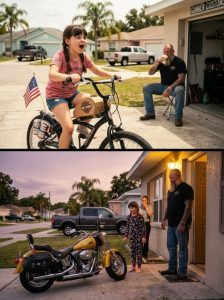
Goldie rode her cardboard Harley around the cul-de-sac for three hours that morning. She had upgraded the cardboard between Saturdays. The gas tank now had a small painted skull on the rear-fender side that she had copied off a photograph of a real Harley fender she had pulled out of a magazine. She had added a second American flag. She had refined the vroom sound with what I can only describe as a thirty-six-hour personal practice regimen of listening to V-twin engines on YouTube and adjusting her mouth-shape to match.
She came past Gunner’s garage at eleven twenty-two.
She waved.
Gunner was standing in the open bay door with his coffee cup in his right hand.
He waved back.
Then he did something he had not done in the eight days of cardboard-Harley rides.
He walked out to the edge of his driveway.
He waited until Goldie circled back around. He held up his right hand. She braked, on the pedal-back brakes of her 2002 Schwinn, and she stopped at the curb.
She looked up at him.
He looked down at her.
I was watching from the front porch. I was watching because I am a single mother and I watch where my nine-year-old daughter is at all times when she is on the street. I had also been watching, for three years, every interaction my daughter had ever had with Gunner Wallace, because my own mother had told me to not let her wave at him, and I had been waiting — in some quiet part of myself that I am only now able to name — to see what kind of man Gunner Wallace actually was.
I was about to find out.
Gunner crouched down on the curb on his haunches in front of Goldie’s bike. He was eye level with her now. He set his coffee cup down on the asphalt beside him.
He pointed at the cardboard gas tank.
He said: “That’s a nice piece of work, kid.”
Goldie said: “Thanks. I made it myself.”
Gunner said: “I see that. What year is this Harley supposed to be?”
Goldie did not hesitate.
She said: “1998 Heritage Softail. Sequoia Yellow Pearl with black trim. Two-tone leather seat. The one in Cycle World July issue 2003.”
Gunner looked at her.
He looked at the bicycle.
He looked back at her.
He said: “Kid. What’s your name?”
She said: “Marigold. People call me Goldie. I’m nine.”
He said: “Goldie. You ever sat on a real Harley?”
She shook her head.
He said: “You wanna?”
She nodded. She did not say anything. She just nodded.
He said: “Wait here.”
He stood up. He walked back into his garage. Sixty seconds later he rolled a custom 2018 Heritage Softail — Sequoia Yellow Pearl, two-tone leather seat, the bike a customer had picked up the previous Friday and that Gunner was, by his own report later, just about to deliver across town that afternoon — Gunner rolled it out of the bay and parked it on the curb in front of my daughter.
He said: “Goldie. Hop on. I’m not gonna start it. Just sit.”
She got off the cardboard Harley. She laid it down very carefully on the grass strip between the curb and the sidewalk. She walked over to the Heritage Softail. She put one foot on the left peg. She swung her leg over the seat the way she had been watching people do it on YouTube for five years.
She sat down on the leather seat of a sixty-thousand-dollar custom Heritage Softail in Sequoia Yellow Pearl.
She put both her small hands on the ape-hanger handlebars.
She closed her eyes.
She made the vroom sound with her mouth.
For exactly four seconds.
She opened her eyes.
She said: “Mister Gunner. Thank you. That was the best thing that ever happened in my whole life.”
She got off the bike. Very carefully. She did not scratch a single inch of the paint.
She picked up her cardboard Harley off the grass.
She got back on it.
She started pedaling again.
She made the vroom sound the way you make the vroom sound when you have just heard, in your head, what a 2018 Heritage Softail actually sounds like.
Gunner watched her ride back up the cul-de-sac.
He picked up his coffee cup off the asphalt.
He went back into his garage.
He did not come out for three hours.
PART 4
I am going to tell you, because Cheryl told me, what Gunner did in his garage between Saturday afternoon, June 8th, and Saturday afternoon, June 22nd, 2024.
He did not deliver the Heritage Softail to the customer that afternoon. He texted the customer — a heart surgeon in Tampa named Dr. Petrosian — and told him there was a fabrication issue and the bike would be ready Monday. Dr. Petrosian, who is sixty-one years old and a very patient man, said okay.
Gunner spent the rest of Saturday afternoon at a Goodwill on Memorial Boulevard, where he bought a used twenty-four-inch BMX-style bicycle frame for eleven dollars.
He spent Sunday morning at the Lakeland Harley-Davidson dealership where he has had a working relationship since 2009. He bought, at parts cost, two used items from their backroom inventory: one fuel-tank emblem off a 1998 Heritage Softail that had been parted out for insurance reasons in 2019, and one small section of chrome exhaust pipe from the same parts bike.
He bought, full price, one quart of Sequoia Yellow Pearl factory Harley paint.
He spent Sunday afternoon back in his garage on the twenty-four-inch BMX frame.
He stripped it to bare metal. He welded a custom crossbar plate to it that would hold a hand-cut steel gas-tank cover the same shape and dimensions as a 1998 Heritage Softail tank, scaled down to roughly forty percent. He cut the tank cover out of sheet steel in his garage on the Saturday night with a plasma cutter. He hand-welded the seams. He ground them smooth on Sunday.
He primered it on Sunday night.
He laid down the Sequoia Yellow Pearl in three thin coats over the next four nights — Monday, Tuesday, Wednesday, Thursday — letting each coat cure for twelve hours. He hand-applied the black pinstriping with a small brush at the kitchen table on Friday night under a desk lamp, with Cheryl reading a book on the couch behind him.
He laid the genuine Harley fuel-tank emblem he had bought on Sunday at the dealership into the tank cover on Saturday morning.
He cut and welded the small section of chrome Harley exhaust pipe into two short pieces that he mounted to the frame as functional “exhaust cosmetics” on the back wheel.
He hand-stitched a small leather seat from a sheet of real Harley-brand seat leather he had in his shop, with a two-tone insert that matched the colors of the 2018 Heritage Softail Goldie had sat on. He stitched it himself with a leather needle and waxed thread at his workbench. He had not, by Cheryl’s report, hand-stitched a seat for a customer in four years because the shop pays a specialist in Tampa to do it now. He did this one himself.
He built two small leather saddlebags from the same leather. Real Harley leather. Hand-stitched. Sized to fit a nine-year-old’s school backpack.
He cut down a set of mini ape-hanger handlebars from a parts bin in his shop — handlebars that had originally been on a Sportster — to twenty-four-inch BMX scale. He chromed them himself with a small powder-coater he keeps in the back of the shop. He installed real Harley grips.
The bicycle, when he was finished on the night of Friday, June 21st, weighed thirty-one pounds.
It was a working twenty-four-inch BMX bicycle.
It looked like a forty-percent-scale 1998 Harley-Davidson Heritage Softail.
It had cost Gunner Wallace, by Cheryl’s count of the receipts in their kitchen drawer, four hundred and twelve dollars in parts.
It had cost him sixty-two hours of his time.
He did not, by Cheryl’s report, sleep more than four hours a night for the fourteen days he was building it.
On Saturday morning, June 22nd, he put it in the bed of his truck under a tarp.
He drove the four houses up the cul-de-sac.
He pulled into our driveway at six-fifteen p.m.
He knocked on our front door at six-eighteen.
PART 5
Goldie answered the door.
She was wearing pajamas. She had been in pajamas since five p.m. because we had eaten dinner early. She had been watching a YouTube video on my phone about motorcycle vintage restoration. She had her hair in two short crooked pigtails that she had tied herself.
She opened the door.
Gunner Wallace was standing on our porch in a clean black t-shirt and dark jeans and heavy black engineer boots, with his cut on, and his enormous calloused tattooed hands held one finger up in a just wait gesture.
He said: “Goldie. Step out on the porch.”
She stepped out.
He turned and walked down the porch steps and over to the bed of his truck. He pulled back the tarp.
He lifted the small custom forty-percent-scale 1998 Heritage Softail bicycle out of the bed of the truck.
He set it down on the concrete of our driveway under the porch light.
The Sequoia Yellow Pearl paint caught the warm white light of the porch lamp. The chrome exhaust catches glowed. The two-tone leather seat sat in the dusk. The small genuine Harley-Davidson fuel-tank emblem on the side of the tank — a real one, lifted off a parted bike, mounted on a hand-fabricated steel cover that Gunner had welded in his garage at midnight on the previous Sunday — caught the light.
Goldie stood on the porch.
She did not say anything.
For ten full seconds.
I want to be honest about what I saw. My nine-year-old daughter, in pajamas, with her hair in two crooked pigtails, stood absolutely still on our concrete porch and looked at the bicycle in our driveway with her small mouth slightly open and her hazel eyes wide and completely silent.
I had never seen her be silent for ten seconds in her entire life.
At the eleven-second mark, she opened her small mouth all the way.
She screamed, at the top of her lungs:
“THAT’S MY HARLEY!”
She ran down the porch steps in her bare feet on the concrete.
She did not get on the bike.
She walked all the way around it three times. Slowly. Like a man at a car show. She crouched down and looked at the welds on the bottom of the gas tank cover. She put one small finger on the chrome exhaust. She traced the Harley-Davidson emblem on the gas tank with her fingertip. She gently — very gently — squeezed the real Harley grip on the right handlebar.
Then she stood up.
She walked over to Gunner.
She looked up at him.
She said: “Mister Gunner. Did you make this for me?”
Gunner said, in a voice I did not recognize as the voice of the man across the cul-de-sac: “Goldie. I made it for you.”
She said: “How did you know what year?”
He said: “Kid. You told me.”
She said: “Can I ride it?”
He said: “Goldie. It’s yours. You can ride it anywhere you want.”
She put her arms around his right leg. He is six foot one. She was four foot two. Her arms reached around his thigh.
She did not let go.
For about thirty seconds.
He put his enormous calloused tattooed right hand on the top of her head.
He looked at me on the porch.
I am thirty-four years old. I am her mother. I had not, in the three years we had lived on this cul-de-sac, exchanged more than fifteen words with Gunner Wallace.
I walked down the porch steps.
I stopped in front of him.
I said: “Gunner. I cannot afford that bike.”
I said: “Even a piece of it. I cannot afford a piece of it. Tell me what it cost.”
Gunner Wallace looked at me.
He looked down at my daughter, with her arms still around his leg.
He said: “Ma’am. I’m not charging you. I have been building custom Harleys for sixteen years. Every one of them goes to a grown man with money who is gonna ride it three times a year. This is the first bike I’ve built for a person who actually wants to ride one. The bike was free, ma’am. The work was the gift.”
I started to cry.
I did not mean to.
I am not a person who cries in front of strangers.
I had not cried in front of a man on my driveway since 2018.
Gunner did not say anything about it.
He looked at the porch.
He said: “Ma’am. I’m sorry. I’m gonna leave the helmet by the door tomorrow. It’s a real one. DOT certified. I sized it off photos I had Cheryl take when Goldie waved at me last week.”
He patted Goldie on the head one more time.
He walked back to his truck.
He drove the four houses back down the cul-de-sac.
PART 6
I want to tell you about Hazel.
I want to tell you because Cheryl came over the next morning, on Sunday, with a small Tupperware of banana bread and the kind of careful red-eyed face that women have when they have been crying the night before. She sat at my kitchen table. She drank a cup of coffee. She told me about Gunner’s daughter.
Hazel Wallace had been born in 2007. She had been diagnosed with hypoplastic left heart syndrome at three days old. She had had three open-heart surgeries — the Norwood, the Glenn, the Fontan — by the time she was four. She had, by Cheryl’s account, been a small fierce dark-haired child with hazel eyes who had stood in Gunner’s garage every Saturday morning from the time she was two and a half until she was seven and who had been able to identify, by the age of six, the difference between a Twin Cam and an Evo engine by listening to the idle from across the parking lot.
Hazel had been obsessed with motorcycles since she could form sentences.
She had told Gunner, on her sixth birthday in May of 2013: Daddy. When I am big enough I am going to learn to ride a Harley. I am going to ride a 1998 Heritage Softail in Sequoia Yellow Pearl. I want the one with the two-tone seat.
She had picked the year and the color out of one of Gunner’s old Cycle World magazines.
She passed fourteen months later, in August of 2014, of complications following her Fontan revision surgery at Lakeland Regional Health.
She was seven years old.
In the eleven years between August of 2014 and June of 2024, Gunner Wallace had not built a Harley for a child of any of his customers. He had not let himself imagine building one for a child at all. He had ridden past two hundred and seventy children waving from front porches in his truck for eleven years without — by his own quiet statement to Cheryl the night of June 22nd — feeling the thing he had felt on the first Saturday of June when a nine-year-old on a cardboard Harley waved at him from the cul-de-sac.
Cheryl told me, sitting at my kitchen table, that Hazel had had hazel eyes too. That Hazel had had dark brown hair. That Hazel had cut her own bangs the year before she passed because she had wanted to look like a “Harley girl” and not, in her words, “a princess.”
Cheryl told me that on the second Saturday of June, when Gunner had crouched down at the curb and asked Goldie what year the Harley was supposed to be, and my daughter had said 1998 Heritage Softail. Sequoia Yellow Pearl with black trim. Two-tone leather seat — Gunner had walked back into his garage and Cheryl had been there bringing him a sandwich for his lunch — Cheryl had been there, and Gunner had stood in the middle of his shop floor with his back to her and he had not said anything for about two minutes.
Then he had turned around.
He had said: Cheryl. I need to build a bike. I’m gonna take a couple weeks off the Petrosian job. Can you cover the front office.
Cheryl had said: Garrett. Yes.
She had not had to ask him what the bike was, or for whom.
She had known.
PART 7
Goldie rides the bike past Gunner’s garage every afternoon at four-thirty after she gets off the school bus.
She is wearing her helmet. It is a small black DOT-certified open-face helmet that Gunner left by the door on Sunday afternoon, with a small custom flame decal he hand-painted on the left side that says GOLDIE in red script.
She has the small leather saddlebags packed with her school books.
She makes the vroom sound with her mouth as she passes his garage. She has, in fourteen months, refined the vroom sound to a fidelity that approximates, with reasonable accuracy, the idle of a 1998 Heritage Softail with stock pipes.
Gunner sits on his small folding stool in the front of his bay every afternoon at four-thirty.
He has his coffee cup in his right hand.
When Goldie passes the front of his garage, he raises his right hand off the cup. Slowly. Deliberately. Two fingers extended, three fingers tucked. The low two-finger wave that one biker gives to another biker on a Florida highway when both of them are doing seventy-five and there is no time for anything more than that small acknowledgment.
He has done that wave for fourteen months.
Goldie returns it.
Two fingers extended. Three fingers tucked. Her small left hand off the chrome ape-hanger grip. At four-thirty on a Florida afternoon, on a cul-de-sac in Lakeland, in a school helmet with a hand-painted flame.
He nods at her.
She nods back.
She rides on.
Follow the page for more stories about the bikers America thinks it knows — and the forty-percent-scale Heritage Softails they build in their garages for the kids who actually want to ride.
I slipped a laxative into my husband’s coffee before he left to meet his mistress… and I watched him drink it like he wasn’t swallowing his own shame.
Part 2 of 2