I want to tell you who Leah was.
Her full name was Leah Anne Whitfield, born Leah Anne Pruitt in 1986 in Jonesborough, Tennessee, twenty miles east of Greeneville. Her father had been a long-haul trucker for Western Express for thirty-two years. Her mother had taught third grade at South Side Elementary in Jonesborough for twenty-eight. Leah had one older brother named Dean who lives in Asheville, North Carolina, and runs a small landscaping company.
She had been a pediatric oncology nurse at the Niswonger Children’s Hospital in Johnson City for fourteen years.
She had taken care, by the small handwritten count she kept in a leather journal on her bedside table, of approximately four hundred and ten children with pediatric cancers in those fourteen years. She had lost approximately forty-nine of them. She had kept their names in the back of the journal in a separate column, in her own neat blue ballpoint handwriting, with a small star next to each one.
She had been on the back of my Road King for sixteen years.
She had been my old lady for fourteen years before we got married in 2006 at a small Baptist church off Highway 11E. Her father walked her down the aisle in a blue suit. My charter — twenty-three of us patched at the time — stood on the back wall of the sanctuary in our cuts. Reverend, our charter chaplain, performed the ceremony in addition to the regular Baptist minister, who had agreed to share the duties after Leah had asked him on a Tuesday afternoon at his office.
We bought a small two-bedroom house on West Vann Road in 2014 with the down payment from her hospital signing bonus and three years of overtime from the quarry.
Aspen was born in March of 2014.
Leah rode the back of my Road King with Aspen in a Snugli carrier on her chest for the first time when Aspen was nine months old, on a Sunday afternoon in December at twenty-eight miles an hour around our neighborhood — she insisted on the Snugli, the helmet, the goggles, and her own arms wrapped around me for ten straight minutes — and she had told me, when we pulled back into our driveway and she was unstrapping the helmet from Aspen’s small head, that the small daughter she had been carrying for nine months had giggled into her chest the entire time.
Aspen has been on the back of my Road King with me since she was six months old in a side-car attachment my charter brother Hutch made by hand in his garage as a baby gift.
She has not, since her mother passed in October of 2022, been on the back of any motorcycle.
She had stopped asking me to ride after the accident.
I had not pushed her.
The Road King I had been riding since 2009 had been the same Road King that had pulled up to our small house on West Vann Road every weekday evening between five-thirty and six p.m. for sixteen years. I had pulled into the driveway. I had cut the engine. The screen door at the front of our house had opened approximately seven seconds after the engine cut, by Leah’s own count over fourteen years of marriage, and Leah had come out onto the front porch in whatever she was wearing — sometimes scrubs from the hospital, sometimes a sundress on weekends, sometimes pajamas if she had pulled an overnight shift the night before — and she had stood on the porch with her arms crossed and her hip cocked, and she had said, every single time, the same six words.
She had said: “There he is. My old man.”
She had been saying it since 2006.
She had said it sixteen years.
The first night I came home in November of 2022 after Leah had been gone for thirty-four days, I cut the engine in the driveway and I sat on the bike for forty-one minutes before I could make myself walk to the front door.
The screen door did not open.
It had not opened since.
That was the thing my daughter had remembered.
That was the thing she had asked about three years later.
PART 3
I want to tell you what I did between the Tuesday night in early April when Aspen asked me the question and the morning of Leah’s birthday three weeks later.
I sat on the back porch that first night until two a.m. with my coffee.
I did not sleep.
I went to work the next morning at the quarry. I broke a hydraulic line on a Caterpillar 980 front-end loader at ten-fifteen a.m. by accident because my hands were not where my hands usually are. My shift supervisor — a fifty-eight-year-old man named Bobby Trent who has been at the quarry for thirty-six years — Bobby pulled me into his small trailer office at eleven, sat me down across from his desk, looked at me, and said:
“Reece. What’s going on with you, brother.”
I told him about Aspen’s question.
I did not mean to. I had not, in thirty-four months, talked about Leah at the quarry except to nod when somebody offered condolences. Bobby is not a biker. Bobby is a Southern Baptist deacon who has been married to his wife Carolyn for thirty-four years. Bobby and Carolyn have four grown children and eleven grandchildren.
Bobby listened to me for about three minutes.
He did not say anything for about ten seconds after I finished.
Then Bobby said, in his slow east Tennessee voice: “Reece. I’m not gonna tell you what to believe. I have my opinions about heaven. You have yours. What I will tell you is this. Your daughter is asking you a question. You owe her an answer. Even if the answer is I don’t know. Don’t leave her sitting with that question in the dark.”
I went home that night.
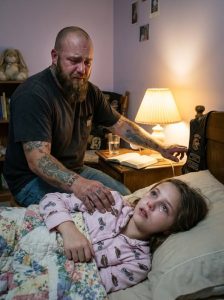
I read to Aspen at bedtime.
I sat back down on the edge of her bed when I was done.
I said: “Honey. I been thinking about your question. About mama and the Harleys. I want to tell you what I’m gonna do.”
She said: “Okay, daddy.”
I said: “Honey. Mama’s birthday is in three weeks. I want to take you out to Mountain View. I want to take you on the bike. I want to start it up next to mama’s headstone. And I want us to stand there for five minutes and listen to it run. Because if mama can hear it — if there is any way at all that she can — that is the loudest way I know how to talk to her.”
Aspen looked at me.
She said: “Daddy. Will I be scared?”
I said: “Honey. I don’t know. Maybe a little. But I’ll be there.”
She said: “Okay.”
She said: “Daddy. Can I wear mama’s helmet?”
I did not answer for ten seconds.
I had Leah’s helmet in our bedroom closet, on the top shelf, in the same canvas helmet bag she had bought it in in 2008. It was a black half-shell with a small white painted daisy on the left side that Leah’s mother had painted on as a Christmas gift in 2010. I had not taken the helmet out of the bag in three years.
I said: “Honey. We will see if it fits.”
I went into our bedroom after Aspen went to sleep. I took the helmet out of the canvas bag for the first time in three years. I sat on the edge of our bed with it in my lap for about an hour.
I tried it on Aspen the next morning at the kitchen table.
It was, by my measurement, half a size too big.
Aspen looked at herself in the small mirror by the door. She turned her head left. She turned her head right. The helmet wobbled slightly.
She said: “Daddy. It fits.”
I did not correct her.
I bought a small foam liner kit at the Harley-Davidson dealership in Bristol on the Saturday afterward. I installed it that night at our kitchen table. The helmet fit her after that. Not perfectly. Close enough.
She wore it for three weeks at the kitchen table while she did homework.
She was getting used to it.
PART 4
Leah’s birthday was April 17th.
It fell on a Tuesday this year. I took the day off from the quarry. Aspen had spring break that week, so she was already off school.
We got up at six a.m. I made pancakes — Leah’s recipe, the one with sour cream in the batter, that I had been making every Saturday morning since 2007 and that I have not, in three years, stopped making on Saturdays. I made them on a Tuesday morning this time. Aspen put strawberries on hers. We did not talk much at the table.
We left the house at seven forty-five.
I rolled the Road King out of the garage. I had cleaned it the night before — wiped down the chrome with a microfiber, polished the tank, checked the tire pressure, topped off the oil. It was a 2009 Road King in Vivid Black, the same bike I had bought new from Bristol Harley-Davidson in October of 2009 when Leah had been three months pregnant with our first child, who we lost in the second trimester in January of 2010 and who would have been Aspen’s older brother.
We named him Wyatt. He has a small headstone next to his mother’s in section C, row eleven, plot three.
Aspen does not know about Wyatt.
I have not figured out how to tell her.
I helped Aspen into Leah’s helmet. I buckled it under her chin. I helped her into the small leather jacket I had bought her on her tenth birthday last year that she had not, until that morning, worn. I helped her up onto the back of the Road King. She put her small arms around my waist. She was eleven years old and seventy-three pounds and her arms barely reached around me.
I started the engine.
The Road King caught on the first push. It always does.
The exhaust came up from the dual pipes the way the exhaust on a 2009 Road King with a hundred and forty-thousand miles on it and a Stage One kit and clean filters comes up — low, throaty, settled, the way the engine of a bike that has been ridden by the same man for sixteen years sounds when it has been told, again, that it is time to go.
Aspen’s small arms tightened around my waist.
I did not say anything.
I pulled out of our driveway at seven fifty-three.
We rode the four and a half miles from West Vann Road to Mountain View Cemetery on Old Knoxville Highway at thirty-five miles an hour. I rode slow. I rode every gear shift smooth. I rode the curve at Tusculum Boulevard at twenty-eight when I would normally have taken it at forty. I rode like a man carrying his eleven-year-old daughter to her mother’s grave on a Tuesday morning in April.
We turned in at the wrought-iron arch at the gate of Mountain View at eight-oh-six a.m.
I rode the access road through the center of the cemetery to section C.
I parked the Road King on the grass strip eighteen yards from the cedar trees, three yards from Leah’s headstone.
I cut the engine.
I helped Aspen down off the back.
I helped her take off the helmet. Her dark blonde hair came down around her shoulders, slightly mussed.
We walked to the graveside together.
She held my left hand.
She had not held my left hand walking to her mother’s grave since the funeral in October of 2022.
We stood in front of the polished gray granite stone for about a minute without saying anything. The cedar trees moved in the soft April wind. A bird I could not identify called somewhere in the back of the cemetery. The smell of fresh-cut grass was in the air from the cemetery groundskeeper having mowed the day before.
Aspen looked up at me.
She said, very quietly: “Daddy. Are you ready?”
I said: “Honey. I think so.”
I walked back to the Road King.
I straddled it.
I looked at my eleven-year-old daughter standing in front of her mother’s headstone in a leather jacket that was slightly too big for her and a helmet that was now resting in her hands and her dark blonde hair coming down around her shoulders in the morning sun.
I started the engine.
The Road King caught on the first push.
I twisted the throttle once to clear it. Then I let it settle into idle.
A 2009 Road King with a Stage One kit idles at approximately nine hundred and fifty revolutions per minute. The exhaust note at idle is the lowest, deepest, most settled sound that engine ever makes. It is the sound of a V-twin sitting in second gear of its own breathing, waiting to be asked for something.
It is the sound Leah had heard pull into our driveway every weekday evening for sixteen years.
I let it idle.
I did not throttle it. I did not rev it. I did not move.
I sat on the bike for five minutes and let the Road King idle three yards from my wife’s headstone.
The bird in the back of the cemetery stopped calling.
The cedar trees kept moving.
Aspen stood absolutely still in front of the granite stone with her mother’s helmet in her hands and her dark blonde hair in the April wind.
At minute three, I saw her shoulders start to shake.
She was crying.
She did not turn around.
She kept her face toward her mother’s headstone.
At minute four-thirty, I saw her bend at the waist. She set the helmet down on the grass at the foot of the headstone, very carefully. She straightened back up.
She put both of her small hands flat on the top of the polished gray granite.
Her lips were moving.
I could not hear her over the idle of the bike.
At minute five, I cut the engine.
The cemetery went quiet.
Aspen turned around.
She walked back to me.
She was crying with the kind of full body shake that an eleven-year-old does when something she has been holding for three years has come up out of her chest at exactly the moment her body decided it was safe to let it.
She came up to the side of the Road King.
I got down off the bike.
I went down on one knee in the grass in front of her so my face was level with hers.
She said, in a voice that was barely there: “Daddy. She heard it. She heard it. I felt her.”
I said: “Honey. I felt her too.”
She put both her small arms around my neck.
She held on for about a minute.
I held my eleven-year-old daughter on my knee in the grass of Mountain View Cemetery in Greeneville, Tennessee, three yards from her mother’s headstone, on a Tuesday morning in April, and I cried for the first time since Leah’s funeral in front of my daughter.
I cried because I had spent three years not believing that my wife could hear me when I came home.
And my eleven-year-old daughter had just heard her.
PART 5
I want to back up to the screen door.
I told you, in the second part, that the screen door at the front of our house had opened approximately seven seconds after I cut the engine of my Road King in the driveway every weekday evening for sixteen years, and that Leah had said, every single time, the same six words.
There he is. My old man.
I told you the screen door had not opened since November of 2022.
That is what I had believed for three years.
It is not, by Aspen’s account in our small kitchen on the night of Leah’s birthday, fully true.
Aspen told me, sitting at the kitchen table eating a grilled cheese I had made her at seven-thirty p.m., that she had been hearing the screen door for three years.
She told me she had heard the screen door in her bedroom every weekday evening between five thirty-eight and six-oh-five p.m. since the funeral. Not loud. Not the way it had sounded when her mother had pushed it open. Quiet. A small soft creak. The sound the screen door made when the wind hit it the right way through the small gap in the porch where the door frame had warped in 2019.
She told me she had not, in three years, told me about it because she had not been sure I would believe her.
She told me the only reason she had asked me, three weeks before Leah’s birthday, whether her mother could hear Harleys in heaven was because she had been wondering whether the sound she heard every evening at five thirty-eight was her mother going back inside the house after listening to me cut the engine.
She told me she had been wondering, for three years, whether her mother was still doing the routine on her end.
I sat at the kitchen table across from my eleven-year-old daughter.
I did not say anything for about thirty seconds.
Then I said: “Honey. I am gonna tell you something. I have been hearing the screen door too. I thought I was making it up. I never told you about it because I didn’t want you to think I was crazy.”
Aspen said: “Daddy. I never thought you were crazy.”
I said: “Honey. I think your mama hears the engine.”
She said: “Daddy. I know she does.”
She took a bite of her grilled cheese.
She said, in the tone an eleven-year-old uses when she has decided a thing and the adult has finally caught up: “Daddy. I think she has been hearing it the whole time. I think we just hadn’t given her the loud version yet.”
That is what my daughter said.
That is the whole arc.
PART 6
We have gone back to Mountain View Cemetery every April 17th since.
Aspen is fourteen now. We will go back next April when she is fifteen.
The ritual is the same. We get up at six. I make Leah’s pancake recipe. Aspen puts strawberries on hers. We leave the house at seven forty-five. I ride the Road King to the cemetery at thirty-five miles an hour. We turn in at the wrought-iron arch at eight-oh-six. I park three yards from the headstone. I help Aspen down. She takes off the helmet. She stands in front of the polished gray granite stone with her hands on the top of it for about a minute. She nods at me.
I straddle the bike. I start the engine. I let the Road King idle for five minutes.
Aspen stands at the headstone.
Her lips move.
I cannot hear her over the engine.
At minute five I cut it.
We stand together at the grave for about another minute.
Then we ride home.
This past April was the fourth time we did it.
It will not be the last.
PART 7
Aspen got her motorcycle endorsement at the Tennessee DMV in March of this year, two weeks before she turned eighteen.
She bought a 2017 Harley-Davidson Sportster Iron 883 with money she had saved from her summer jobs at the dental clinic where her mother’s best friend works as the receptionist.
She will turn eighteen in March.
Her mother would have been fifty in April.
On April 17th of this year, for the first time in Aspen’s adult life, we are going to ride two Harleys to Mountain View Cemetery. Aspen on her Sportster. Me on the Road King. We are going to turn in at the wrought-iron arch together. We are going to park side by side in section C, three yards from her mother’s headstone.
We are going to start both engines.
We are going to let them idle for five minutes side by side.
Aspen has told me, at our kitchen table last week, what she is going to say to her mother’s headstone with her hands on the top of the granite.
She has told me her exact words.
She is going to say:
“Mama. Now I come visit you too. Can you hear me better?”
That is what my daughter is going to say.
I am going to sit on the Road King two bikes over and let the engine idle and try not to throttle it, the way I have tried not to throttle it every April for four years, and I am going to listen for the screen door.
I have not heard the screen door open in our house in three weeks.
I think Leah has been waiting to hear the second bike.
Follow the page for more stories about the bikers America thinks it knows — and the screen doors they listen for at five thirty-eight in the evening.