PART 3
The message remained on my screen.
Before you decide what Lila is to you, ask your mother whose son you really are.
Behind the closed hospital door, voices moved quickly. A cart rolled across the floor. The monitor’s alarm stopped, then began again at a slower rhythm.
I read Daniel’s message a second time.
Then I turned off the screen.
For most of my life, uncertainty had felt like an opponent. I responded to it with information, pressure, and speed. I summoned people. I demanded documents. I entered rooms before I had been invited and remained until someone gave me an answer.
That instinct was still there.
But Claire was on the other side of the door because our conversation had pushed her too far. Lila was waiting in an apartment across the city, wondering whether her mother was dying and whether the father she had met only hours ago would return.
Whatever Daniel wanted, it could wait.
Dr. Lee appeared several minutes later.
Her expression was composed, but the lines around her eyes had deepened.
“Ms. Walsh is stable,” she said.
The breath I had been holding left me.
“What happened?”
“Her heart rhythm became irregular. We corrected it, but this confirms that waiting is no longer the best option.”
“How soon do you need to operate?”
“Tomorrow morning, provided her test results remain acceptable.”
I glanced at the closed door.
“Will she survive the surgery?”
Dr. Lee did not offer the easy reassurance most people expected from doctors.
“She is young, and that helps. But this is a serious procedure. There are risks.”
“What do you need?”
“From you?”
“From anyone.”
“She needs rest tonight. She needs a calm environment. And she needs to believe that the people she loves will be able to care for one another while she recovers.”
The answer unsettled me because none of those things could be purchased or negotiated.
“I can arrange anything the hospital requires.”
“I’m sure you can.” Dr. Lee’s voice softened. “But not everything she requires will come from the hospital.”
I looked at her.
She nodded toward the elevators.
“Go see the child.”
For once, I followed an instruction without argument.
Outside, the rain had stopped.
The city shone beneath a thin layer of water, every streetlight doubled in the pavement. Matteo waited beside the car, holding an umbrella he no longer needed.
He opened the rear door.
“Mr. Moretti, Daniel Voss has called six times.”
“Do not return the calls.”
Matteo paused.
That was unusual enough for him to question it.
“Would you like me to block the number?”
“No. Preserve every message. Make copies of the letter Nora gave me and have the original returned to Claire.”
“Yes, sir.”
“And quietly determine when Daniel last entered California.”
Matteo nodded.
As I moved to get into the car, he said, “Is Ms. Walsh all right?”
“She is having heart surgery in the morning.”
His expression changed.
“I’m sorry.”
I had heard the phrase thousands of times. It was what people said when there was nothing useful left to offer.
Yet from Matteo, it sounded sincere.
“Thank you.”
He closed the door.
The apartment above the bookstore was dark except for a lamp in the living room.
Nora sat on the sofa with a blanket around her shoulders. She stood as soon as I entered.
“What happened?”
“Claire is stable. Dr. Lee plans to operate tomorrow morning.”
Nora gripped the edge of the blanket.
“Tomorrow?”
“They believe waiting would be more dangerous.”
She sat down again.
The apartment became very quiet.
“Does Lila know?” I asked.
“No. She tried to stay awake for you.”
The words caught me unexpectedly.
“For me?”
“She said you promised to come back.”
I looked toward the narrow hallway.
“Where is she?”
“In Claire’s room. She refused to sleep in her own bed.”
I found Lila curled on top of the blanket, still wearing the clothes she had worn on the plane. One arm was wrapped around her mother’s pillow. Her notebook lay open beside her.
I stood in the doorway.
The room was unmistakably Claire’s. A wool coat hung from the back of a chair. Two museum catalogs were stacked beside the bed. On the dresser sat a ceramic cup filled with pens and a small bottle of the same lavender perfume Claire had worn years ago.
Lila opened her eyes.
“You came back.”
Her voice was rough with sleep.
“I promised.”
She pushed herself upright.
“Did you see Mom?”
“Yes.”
“Did you tell her everything?”
“Most of it.”
“Even the juice box?”
“I didn’t have time to deliver the complete report.”
She did not smile.
“Is she worse?”
I sat on the edge of the chair beside the bed rather than beside her.
“The doctors need to repair her heart tomorrow morning.”
“Repair it how?”
“With surgery.”
Her fingers tightened around the pillow.
“Will it hurt?”
“She’ll be asleep during the operation.”
“That doesn’t mean it won’t hurt after.”
“No,” I said. “It may hurt afterward. But the doctors will help her.”
“Could she die?”
I heard Nora stop in the hallway outside.
I wanted to tell Lila no.
The word was there, ready to protect her for one night.
But she had already lived too long among answers designed to make adults more comfortable.
“There is a risk,” I said. “Dr. Lee believes the surgery gives your mother the best chance to become strong again.”
Lila lowered her face.
A few seconds passed.
Then she asked, “Are you scared?”
“Yes.”
The answer made her look up.
“Grown-ups aren’t supposed to say that.”
“Grown-ups are often scared. We’re simply better at pretending not to be.”
“Mom isn’t.”
“Your mother has never been especially interested in pretending.”
A faint smile appeared and disappeared.
Lila lifted the edge of the blanket.
“You can sit here.”
It was not an embrace. It was not forgiveness for six absent years.
It was an invitation.
I sat beside her.
After a moment, she rested her head against my arm.
“Are you staying until tomorrow?” she asked.
“Yes.”
“And after tomorrow?”
“As long as your mother and you need me.”
She was silent.
“That sounds like an answer with a door in it.”
I turned toward her.
“What does that mean?”
“You can leave when we stop needing you.”
She had found the weakness in my sentence immediately.
I looked down at my hands.
For years, I had measured commitment through obligation. Contracts had terms. Partnerships had conditions. People stayed while staying served a purpose.
A child understood love differently.
“I’ll say it again,” I told her. “I’m not staying only because your mother is sick. I’m staying because I want to know you.”
“For how long?”
“I don’t know how to be your father yet.”
Her face fell.
“But I want to learn for the rest of my life.”
She searched my expression.
“The whole rest?”
“The whole rest.”
Lila’s hand slid into mine.
It was the first promise I had ever made without considering the cost.
By six in the morning, no one had slept much.
Nora made coffee strong enough to make my eyes ache. I attempted pancakes because Lila had asked on the plane whether I knew how to make them.
It became clear within minutes that I did not.
The first pancake folded over itself. The second burned along one edge while remaining liquid in the center. The third landed partly on the stove when I turned it too quickly.
Lila sat at the kitchen table watching the disaster unfold.
“You said you could learn things,” she observed.
“I am learning.”
“What did you learn?”
“That your stove is uneven.”
Nora took the spatula from me.
“The stove is fine.”
She poured a perfect circle of batter into the pan.
I frowned.
“You’ve done this before.”
“Yes, Luca. Some of us acquired survival skills before owning multiple buildings.”
Lila giggled.
The sound loosened the heaviness in the room.
I placed the least damaged pancake on her plate.
She examined it.
“It looks like Florida.”
“I was aiming for a circle.”
“Florida is almost better.”
She covered it with strawberries.
While she ate, my phone vibrated again.
Daniel.
I ignored it.
Nora noticed.
“Is that him?”
I nodded.
“What does he want?”
I looked toward Lila.
She was arranging strawberry slices along the edge of the pancake, but I no longer assumed that distraction meant she was not listening.
“He sent me a message at the hospital,” I said.
Nora waited.
“He told me to ask my mother whose son I am.”
The spatula stopped in her hand.
Lila looked up.
“Aren’t you your mom’s son?”
“I believe I am.”
“That’s a strange thing to believe. You should know.”
“Yes,” I said. “I should.”
Nora lowered her voice.
“What are you going to do?”
“Call my mother.”
“And Daniel?”
“Not until I understand what he wants me to misunderstand.”
Nora studied me.
“You’re calmer than you were on the plane.”
“I’m not calm.”
“No,” she said. “But you’re thinking before you act.”
Lila cut a small piece from her Florida-shaped pancake.
“Mom says thinking before you act is how you avoid apologizing later.”
“Your mother has accumulated an alarming number of useful statements.”
“She writes them down.”
“Where?”
“In the blue book.”
Nora turned toward her.
“What blue book?”
“The one she keeps at the museum.”
Lila pointed toward the shelf by the window.
“She said if something happened, Aunt Nora should find it.”
Nora set down the spatula.
“Claire never told me that.”
“She told me.”
“When?”
“Before I went to Boston. She said adults forget important things when they’re scared, so children have to remember.”
Nora and I exchanged a look.
“What does the book look like?” I asked.
“Dark blue. It has a gold bird on the front.”
“Where at the museum?”
“In the room with the broken paintings.”
The call from the hospital came before we could ask more.
Claire was awake. She had signed the consent forms. Dr. Lee would begin the procedure in two hours.
Lila stopped eating.
“Can I see her first?”
Nora looked uncertain.
I called the hospital and asked.
Dr. Lee approved a short visit.
Claire looked smaller in the hospital bed than she had the night before.
Her hair had been gathered beneath a pale cap. The machines around her seemed louder in the morning light.
Lila stopped at the doorway.
For the first time since I had met her, she had no question ready.
Claire opened her arms.
Lila crossed the room and pressed herself carefully against her mother.
“I’m mad at you,” she whispered.
“I know.”
“You should have told me how sick you were.”
“I should have.”
“And about Luca.”
Claire looked past her toward me.
“I should have told you that too.”
Lila lifted her head.
“He says he’s going to learn how to be my dad for the whole rest of his life.”
Claire’s eyes filled.
“Does he?”
“Yes,” I said.
The answer passed between Claire and me.
It carried no claim of ownership and no demand that the past be forgiven. It was simply a statement about what I intended to do next.
Claire touched Lila’s cheek.
“You don’t have to decide everything today.”
“I already decided he can stay.”
Her mother smiled through tears.
“That’s a good beginning.”
Lila opened her notebook.
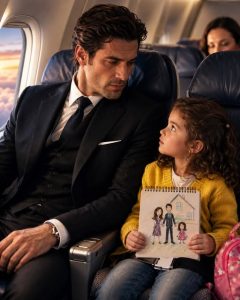
She had added a fourth figure to the drawing I had made on the plane. Claire stood beside the three uneven people with arms emerging at approximately the correct height.
“I fixed the proportions,” Lila said.
Claire laughed, though it made her wince.
Then Lila handed her the page.
“This is for when you wake up.”
“When I wake up,” Claire repeated.
Not if.
When.
A nurse entered and said it was time.
Lila’s face changed, but she did not cry.
She kissed Claire’s cheek, then moved aside.
Nora embraced her sister next.
They whispered something neither Lila nor I could hear.
Then it was my turn.
I stood beside the bed.
Claire looked up at me.
“If anything happens—”
“No.”
“Luca.”
“You are allowed to be afraid,” I said. “You are not allowed to turn fear into a farewell.”
Her mouth trembled.
“You always were controlling.”
“I’m working on it.”
“I noticed.”
I took her hand.
It felt fragile, but her fingers closed around mine.
“I am not taking Lila away from you,” I said. “And I am not disappearing from her life. We will decide what comes next together.”
“We?”
“You, me, Nora, and Lila. No more decisions made by one frightened person in a room.”
Claire’s eyes held mine.
“Do you think we can do that?”
“I think we can begin.”
She nodded.
It was not forgiveness.
It was more valuable.
It was trust offered cautiously, with full knowledge of what it had cost before.
The orderly arrived to take her to surgery.
Lila slipped her hand into mine as the bed moved down the corridor.
We watched until the doors closed.
The waiting room had wide windows overlooking the city.
Morning fog drifted between the buildings, slowly thinning as sunlight reached the rooftops.
Nora sat with a paper cup of coffee she never drank. Lila colored at a low table. I stood near the windows until she looked up.
“You’re doing the walking thing,” she said.
“What walking thing?”
“The thing people do when they want the floor to give them an answer.”
I sat down.
She selected a green crayon and handed it to me.
“What am I drawing?”
“A house.”
“I’m not good at houses.”
“You’re not good at people either, but you tried.”
I drew a square with a roof.
Lila added windows.
“Where is it?” I asked.
“I don’t know yet.”
“Who lives there?”
“Mom and me.”
She drew two figures beside the door.
Then she added a third.
“Is that Nora?”
“No. Aunt Nora lives in Boston because she likes arguing in court.”
“Then who is it?”
Lila gave me a patient look.
“You.”
Something tightened behind my ribs.
“Do I live there?”
“You can have a room.”
“That’s generous.”
“It’s a small room.”
“Less generous.”
“You have a big house already.”
“I have an apartment.”
“Does it have a bedroom for me?”
“No.”
She stopped coloring.
“Not yet,” I added.
Her crayon began moving again.
An hour later, a hospital technician approached with a sealed kit.
Claire had authorized the paternity test before surgery.
Nora looked at me.
“We can wait.”
“No,” I said. “Claire and I agreed that Lila deserves certainty.”
The technician explained the procedure. A simple swab from inside my cheek. Another from Lila.
Lila stared at the packet.
“Can the test say he isn’t my dad?”
“It can tell us whether you are biologically related,” the technician replied carefully.
Lila looked at me.
“And if it says no?”
I crouched beside her chair.
“Then we will discover that the adults misunderstood something.”
“Would you leave?”
“No.”
“But you said the truth matters.”
“It does. The truth can change what we call something. It does not have to erase what we choose.”
Her eyes narrowed.
“You’ve only known me one day.”
“That is true.”
“So how do you know?”
I thought of the plane, the hospital, the ruined pancakes, and the small room she had drawn for me in an imaginary house.
“Because leaving is no longer one of the choices I’m considering.”
She allowed the technician to take the sample.
Just before noon, Dr. Lee entered the waiting room.
We all stood.
“The repair went well,” she said.
Nora covered her face.
Lila did not move.
“Is she alive?” she asked.
“Yes,” Dr. Lee said immediately. “Your mother is alive. Her heart is beating steadily, and we are taking her to recovery.”
Lila ran toward me.
I caught her as she collided with my chest.
Her arms wrapped around my neck.
I held her tightly, closing my eyes against the relief that moved through me.
Nora put one hand on Lila’s back and the other over her own mouth.
The three of us stood together beneath the bright hospital lights, connected not by history but by the fact that Claire had survived and would wake to find none of us alone.
That afternoon, while Claire slept, Nora and I went to the museum.
Lila remained at the hospital with a child-life specialist, working on a welcome-back sign for her mother. She made me promise twice that I would return.
The museum’s conservation wing occupied a quiet building behind the main galleries.
A supervisor named Dr. Amara Singh met us at the security desk. Claire had listed Nora as her emergency contact, and Lila’s description of the blue book had been enough for Dr. Singh to recognize it.
“Claire was working on a private restoration project,” she explained as she led us through a corridor smelling faintly of wood, paper, and varnish. “She became unusually protective of it.”
“What kind of project?” I asked.
“A family photograph.”
She unlocked a temperature-controlled room.
At the center stood a long worktable beneath white lamps. Brushes rested in neat rows. Magnifying lenses were folded beside small bottles of solvent.
On one end of the table lay a dark blue notebook embossed with a gold bird.
Nora reached for it, then stopped.
“What if this is private?”
“It is,” I said.
She looked at me.
“Claire told Lila where to find it if something happened. She wanted us to read it.”
Nora opened the cover.
The first pages contained notes about paintings, pigments, and damaged frames. Farther in, Claire’s handwriting changed. The lines became hurried.
Daniel came again today.
He insists the photograph is genuine, but the ink on the date is newer than the paper. He wants Luca to believe his entire life was built on a substitution. I don’t understand why.
Nora turned the page.
There was another entry.
I asked Daniel why he forged Luca’s letter. He said he did not separate us because he hated Luca. He said he did it because he knew what the Moretti name could make of a child.
The next sentence had been underlined twice.
Then he said: I had already lost one son to that family. I would not lose my granddaughter too.
Nora read it again.
“One son,” she whispered.
I stared at the words.
“Daniel has no children.”
“That you know of.”
Dr. Singh opened a flat archival box.
Inside lay the photograph.
Antonio Moretti stood in the main sitting room of my childhood home. He was younger than I remembered him, though the hardness in his expression was already there.
He held a sleeping infant wrapped in a white blanket.
The image was faded along the edges. A handwritten date appeared on the back.
My birthday.
But Claire had made notes in pencil beneath it.
Ink added later. Original writing removed.
Dr. Singh adjusted the lamp.
“There was another inscription beneath the date,” she said. “Claire was trying to recover it.”
“Did she succeed?”
“Partly.”
She placed a filtered light over the back of the photograph.
Slowly, pale marks emerged beneath the false date.
Nora leaned closer.
I could make out only three words.
Antonio with his son.
Below them was a name, but most of it had been scratched away.
Only the final letters remained.
—I—L.
“Daniel?” Nora whispered.
“No.”
The name was too short.
Or perhaps what remained was not the end of the name at all.
My phone rang.
Matteo.
I answered.
“I located your mother,” he said. “She left Lake Como this morning.”
“For New York?”
“No, sir. She is in San Francisco.”
I looked at the photograph.
“Where?”
“At St. Catherine’s Hospital.”
We returned immediately.
Elena Moretti was standing outside Claire’s recovery room when we arrived.
My mother had always possessed the ability to make any place appear as though it had been arranged for her entrance. Even at seventy, after an international flight, she stood straight in a cream-colored coat with her silver hair pinned neatly at the back of her head.
But when she saw me, the composure left her face.
“Luca.”
Lila stood beside her.
She was holding my mother’s hand.
The sight stopped me.
“How did you meet?” I asked.
“Your mother was lost,” Lila said.
Elena lifted one eyebrow.
“I was not lost.”
“You asked where the heart floor was.”
“I was confirming directions.”
“That means lost.”
For the first time in years, I saw my mother almost smile.
Then her gaze moved to the photograph in my hand.
The color left her face.
“Where did you get that?”
“Claire was restoring it.”
“You should not have brought it here.”
“Why?”
She glanced toward Lila.
Nora understood.
“Lila, let’s check whether your mother is awake.”
Lila looked between us.
“Are you going to talk about secrets?”
“Yes,” I said.
“Will you tell me later?”
“The part that belongs to you.”
She considered this, then nodded.
Before following Nora, she squeezed my hand.
My mother watched her walk away.
“She has your eyes,” she said.
“So everyone keeps telling me.”
“And Claire’s courage.”
“She needed both.”
Elena looked toward the recovery-room door.
“I did not know about her.”
“Neither did I.”
“Daniel did.”
“Yes.”
My mother closed her eyes.
For one brief moment, she no longer looked elegant or formidable. She looked tired.
“What has he told you?”
“That the baby in this photograph was not me. He also suggested I should ask you whose son I am.”
Her eyes opened.
“Did you speak to him?”
“No.”
“Good.”
“Is the photograph genuine?”
“Yes.”
“Is the date?”
“No.”
“Who is the baby?”
She looked down the corridor.
“That story belongs to more than one person.”
“I have spent one day learning what secrets do to children. Do not ask me to accept another one.”
“I am trying to protect you.”
“That sentence has caused enough damage in this family.”
The words struck her.
She sat slowly on a bench beside the window.
I remained standing for a moment, then sat beside her.
Below us, the city stretched toward the bay. The fog had cleared, leaving the water bright beneath the afternoon sun.
“I remember the house in that photograph,” I said. “I remember Father standing in that room. I remember you at the piano. I remember Daniel arriving every Sunday with documents no one else was permitted to see.”
My mother folded her gloves in her lap.
“Antonio trusted him.”
“Did you?”
“Once.”
“What changed?”
“You were born.”
I waited.
She looked at my face as if searching for the child she had known inside the man sitting beside her.
“Antonio and I had been married for twelve years,” she said. “He wanted an heir more than he wanted a son. There is a difference.”
“Was the baby in the photograph his heir?”
“Yes.”
“What happened to him?”
Her fingers tightened around the gloves.
“He disappeared from our lives.”
“That is not an answer.”
“It is the only one I can give without telling another person’s story for him.”
“Him?”
My mother looked toward the elevator.
Footsteps approached.
Matteo came around the corner carrying a small overnight bag.
He stopped when he saw the photograph.
For the first time since I had known him, he looked not merely surprised but frightened.
My mother rose.
“You should not be here,” she told him.
Matteo’s voice was barely audible.
“You said you would never tell him.”
I looked from one to the other.
“Tell me what?”
Neither answered.
Then Matteo’s eyes moved to the infant in Antonio Moretti’s arms.
His face changed with a recognition that could not be mistaken.
My mother reached for my hand.
“Luca,” she said, “Daniel’s message was cruel, but the question was real.”
The corridor seemed to narrow around us.
“Whose son am I?”
Her fingers trembled inside mine.
“You are my son,” she said. “You always have been.”
“That is not what I asked.”
Tears filled her eyes.
Across from us, Matteo lowered the overnight bag to the floor.
My mother drew one unsteady breath.
“Antonio Moretti was not your biological father.”
I felt the world shift without moving.
“Then who was?”
She looked past me toward the recovery room where Claire slept and Lila waited.
When she answered, her voice was almost a whisper.
“Daniel Voss.”
👉 Follow the page and turn on notifications so you won’t miss the next chapter. The story continues in the next post.