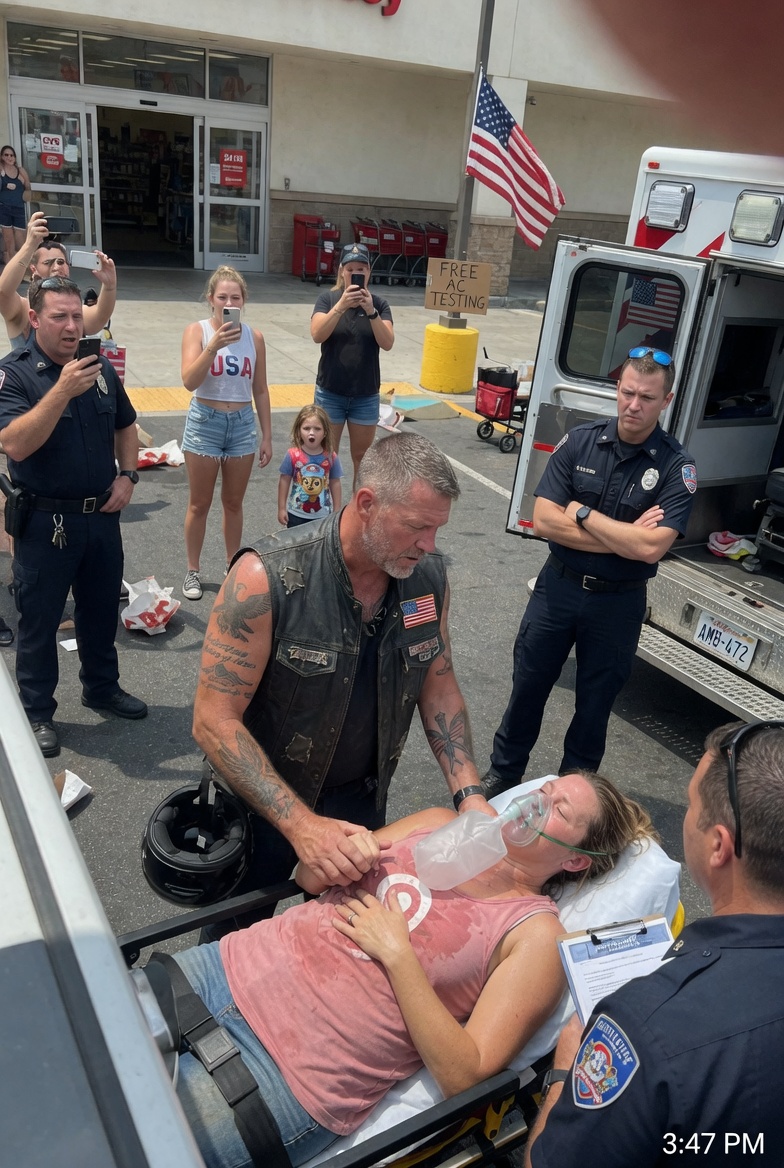
The low thrum I’d been waiting for started as a vibration in the asphalt before it became sound. It crept up through the soles of my boots, a frequency you feel in your molars, in the fine bones of your inner ear. The crowd didn’t recognize it at first. A few people glanced toward the highway, frowning at the heat shimmer that turned every distant shape into a mirage. Then the vibration sharpened into the distinct rumble of multiple engines, downshifted and steady, not the angry blat of street racers but something more measured—a rolling bass note that made shopping carts tremble faintly in their corrals.
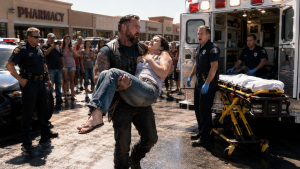
The officer’s hand drifted an inch closer to his belt. He was a compact man in his early forties, built like a wrestler who’d switched to distance running, and his eyes had that cop’s habit of tracking everything without seeming to move. He looked at the strip mall entrance, then back at me, then at the paramedic who was still standing rigid beside the stretcher like a soldier guarding a disputed border.
— You said “you’ll see,” the officer repeated, and now his voice carried an edge that hadn’t been there before. — I’m asking you again. Who did you contact?
I didn’t answer right away, not out of defiance but because the first motorcycle had just turned into the lot and I wanted him to see it for himself. A matte-black Indian Scout, ridden by a woman in a black leather vest, silver-streaked hair pulled into a tight ponytail that whipped once in the wind before she slowed. She didn’t rev. She didn’t even look at the crowd. She simply rolled to a stop ten feet behind the ambulance, killed the engine, and removed her helmet with the unhurried economy of someone who’s done it ten thousand times. Behind her, four more bikes turned in—a gray-bearded man on a vintage Triumph, two women on identical Honda Shadows, and a lean guy in his sixties on a battered BMW that looked older than me. They parked in a staggered line that left the ambulance unobstructed but also sent a message I didn’t need to translate: we’re not here to block you, but we’re not leaving either.
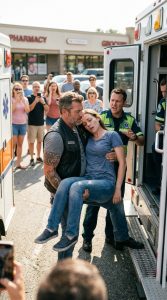
The officer’s jaw tightened. The crowd, which had been muttering and filming and casting me as the afternoon’s designated villain, went very still.
— Is this some kind of intimidation? the officer asked, and I could hear him trying to decide whether to call for backup.
The woman with the ponytail didn’t wait for me to answer. She walked straight toward the ambulance with the stride of someone who’s navigated a thousand emergencies and learned that hesitation costs lives. Her vest had a small embroidered patch over the left chest: Veterans Outreach Medical Support, stitched in faded blue thread that had seen years of sun and sweat. Around her neck, a laminated ID bounced against her sternum.
— Patient’s name? she asked. Her voice was calm, not loud, but it cut through the parking-lot noise like a scalpel.
The paramedic blinked. — Maria Torres.
She nodded, unhurried. — Retired ER nurse. Volunteer liaison with St. Luke’s Medical Board. She held up the ID just long enough to be seen, then let it drop. — You were given a direct call for community medical support.
The paramedic’s face cycled through surprise, irritation, and something that looked a lot like embarrassment. — This is an active scene. We were verifying protocol.
The retired nurse glanced at me once—a flicker of recognition, nothing more—then looked back at him. — How long was open oxygen delayed pending that verification?
The question hung in the air like smoke. The paramedic’s partner, a younger woman who’d been hovering near the stretcher with an expression of barely concealed discomfort, suddenly found the ambulance floor intensely interesting. The lead paramedic opened his mouth, closed it, and the retired nurse didn’t wait for an answer.
— You transport first. Paperwork second. She said it like she was reciting something so fundamental it shouldn’t need to be spoken aloud.
The officer had been watching this exchange with the focused stillness of a man recalculating every assumption he’d made in the last three minutes. He keyed his radio and spoke in a low voice, turning away from the crowd. I caught fragments: — Possible misunderstanding… medical outreach team on scene… requesting verification.
Static. Then a dispatcher’s voice, tinny and distorted: — St. Luke’s confirms. VOMS unit is authorized community support. No flags.
The officer holstered the radio and turned back to me. For a long moment, he just looked. I’ve been looked at by cops before, and I know the difference between suspicion and reassessment. This was the latter. His eyes moved from my face to the patch on the retired nurse’s vest to the line of silent motorcycles gleaming in the sun, and I could see him fitting pieces together in real time.
— You ride with them, he said. Not a question.
— I ride with them.
He let out a breath that wasn’t quite a sigh. — You could’ve told me.
— Would you have believed me?
He didn’t answer, and that was answer enough. A leather-vested biker with ink crawling up his arms, standing over a woman he’d just lifted without permission—I could have recited my entire résumé and he still would’ve seen what he was trained to see. I didn’t blame him. The world teaches you to sort people into categories fast, because sometimes your life depends on it. But categories have edges, and Maria Torres was bleeding out air on those edges while the system debated whether she was worth the ride.
The retired nurse had already turned her attention to Maria. She knelt beside the stretcher, her voice dropping to a register I couldn’t hear, and I watched Maria’s hand reach up and grip her arm with the desperate strength of someone who’s been drowning and finally feels solid ground. The oxygen mask was fogging with each shallow exhale. The retired nurse checked the flow meter, adjusted something I couldn’t see, and then looked at the lead paramedic with an expression that wasn’t angry but was absolutely final.
— She’s in respiratory distress with probable bronchospasm. You have an open airway, oxygen running, and a hospital eight minutes away. What exactly are we still discussing?
The paramedic’s shoulders dropped half an inch. It was the smallest surrender, but I saw it. The younger paramedic was already moving, securing the stretcher, checking the straps. The crowd began to stir, a collective exhale. Someone lowered their phone. Someone else wiped their eyes and pretended it was sweat.
The officer stepped forward and said, firmly, — Transport her.
This time, no one argued. The ambulance doors closed with a solid thud that echoed off the storefront glass. Through the small back window, I saw Maria’s face turn toward me—pale, still frightened, but no longer alone. Her lips moved, and even without hearing the words, I knew what she said. Thank you. Or maybe just please don’t leave. In the end, they’re the same thing.
The siren spooled up, a rising wail that scattered a flock of grackles from the power lines overhead. The ambulance pulled out of the lot and turned left onto the arterial road, accelerating toward St. Luke’s with the kind of urgency that should have been there from the start. I watched until the red lights disappeared behind the heat shimmer, and then I let my hands drop to my sides.
The parking lot felt suddenly enormous and very quiet. The remaining motorcycles sat silent, their engines cooling with small ticking sounds. The crowd was already dissolving, people drifting back toward their cars and their errands, the momentary crisis already curdling into an anecdote they’d tell at dinner: You won’t believe what I saw at the pharmacy today. Some biker grabbed a woman and the cops showed up. The phones would have their footage. The comments sections would have their verdicts. I’d probably be a hero in some of them and a lunatic in others, and neither would be the truth.
The officer walked over to me. His hand had moved away from his belt, and his posture had shifted from confrontation to something closer to weariness. Up close, I could see the lines around his eyes, the faint sun damage on his forehead. He’d been standing in parking lots like this one for a long time.
— That was a hell of a gamble, he said.
— It wasn’t a gamble.
— Felt like one from where I was standing.
I nodded. — I get that.
He studied me for a moment, and I let him. I’ve learned that silence makes some people uncomfortable, but cops usually appreciate it. It gives them room to make their own assessments. He glanced at the retired nurse, who was now speaking quietly with the gray-bearded Triumph rider, then back at me.
— You knew she’d come. The nurse.
— I knew she was close.
— And if she hadn’t been? If she’d been across town, or stuck in traffic, or just didn’t pick up?
I didn’t answer immediately. The truth was complicated, and I’d spent most of my life avoiding complicated truths. But this man had just watched me carry a stranger past a paramedic and then stand there while a crowd filmed me and called me dangerous, and he’d still chosen to listen instead of escalating. He’d earned something.
— Then I would’ve called someone else, I said. — And if that didn’t work, I would’ve driven her to the hospital myself.
— That’s not legal.
— I know.
— You could’ve been arrested. You still could be, depending on how the department wants to handle this.
— I know that too.
He shook his head slowly, not in disbelief but in the way people do when they’ve encountered something that doesn’t fit their mental filing system. — You always this reckless?
The question landed harder than he could have known. I felt it in my chest, a dull ache that never really went away, just faded into the background until something brought it roaring back. I thought about a different parking lot, fifteen years ago, in a different state. I thought about my sister.
— Not always, I said. — I used to be careful. It didn’t work out.
He waited, but I didn’t elaborate. Some doors don’t open on command. He seemed to understand that, or maybe he was just tired. He pulled a small notepad from his pocket and jotted something down—my license plate, probably, or a note to follow up with the hospital. Then he looked at the other riders, who were mounting their bikes without ceremony.
— These folks do this often? he asked.
— Whenever they’re needed.
— That’s not really an answer.
— It’s the only one I’ve got.
He almost smiled. Almost. — You got a name?
— Jack.
— Jack what?
— Just Jack, for now.
He closed the notepad and tucked it away. — Officer Mendez. If the hospital calls, I might need to reach you.
— You know how to find me.
I didn’t mean it as a challenge, but it came out that way. He took it in stride, nodding once before walking back to his cruiser. The crowd had thinned to a handful of stragglers, one of whom—a young guy in a polo shirt, still holding his phone—took a hesitant step toward me.
— Hey, man, I just want to say… I thought you were going to, like, attack the paramedic. I was filming it, and I was sure something bad was about to happen. But you didn’t. You just… helped her.
I looked at him. Early twenties, maybe. The kind of kid who’d grown up with a camera in his pocket and a world that taught him to expect the worst from people who looked like me. I couldn’t blame him either.
— It’s okay, I said.
— No, it’s not. I posted the video before I knew the whole story. I’ll take it down.
— Keep it up.
He blinked. — What?
— Take it down if you want. But if you keep it up, maybe post an update too. People need to see the whole thing, not just the part where a guy in leather looks scary.
He nodded slowly, his thumb already moving across the screen. — Yeah. Yeah, okay. I can do that.
He walked away, and I stood alone in the heat, feeling the sun press against the back of my neck. The retired nurse—her name was Evelyn, I should say that now—finished her conversation with the Triumph rider and walked toward me. Her boots crunched on the asphalt, a sound so familiar it was almost comforting.
— She’ll be admitted, Evelyn said. Her voice had dropped the professional crispness and softened into something more human. — Severe asthma complication, possibly stress-induced bronchospasm. But she’s stable now, and she’ll get the treatment she needs.
— She’ll be okay?
— Yes.
The word hit me harder than I expected. I felt something loosen in my shoulders, a tension I’d been carrying since the moment I saw Maria’s hand pressed against her chest. I didn’t cry. I haven’t cried in years. But something in my throat tightened and then released.
— You still move too fast sometimes, Evelyn said, and there was affection buried in the scolding.
— You still talk too much.
She smiled, a small, tired smile that deepened the lines around her eyes. She’d been a combat nurse in Desert Storm, then an ER charge nurse in Phoenix for twenty years, and then a volunteer with VOMS for the last eight. She’d seen more broken bodies and bureaucratic cruelty than most people could imagine, and she’d responded by getting quieter and more effective. I respected her more than almost anyone I knew.
— You did good today, Jack, she said.
— I almost made it worse.
— You almost made it worse. But you didn’t. That’s the part that matters.
She put a hand on my arm, briefly, and then walked back to her Indian Scout. The other riders fell into formation behind her, engines starting in a staggered sequence that sounded almost musical. They pulled out of the lot the same way they’d arrived: no revving, no showboating, just a line of motorcycles disappearing into the afternoon haze. I watched them go, and then I was alone with the heat and the faint oil smell and the echo of everything that had just happened.
I climbed onto my bike—a 2014 Harley Softail, nothing flashy, just reliable—and sat there for a minute with my hands resting on the tank. The engine was off. The lot was quiet. A shopping cart rattled somewhere in the distance. And for the first time in hours, I let myself think about Sarah.
My sister was four years younger than me. She had our mother’s laugh—a bright, unguarded sound that made strangers smile—and our father’s stubbornness, which was less charming but probably saved her life more than once. She also had severe asthma, the kind that turned a simple cold into a week-long hospitalization, the kind that made her carry an inhaler everywhere and still wake up gasping in the middle of the night. When we were kids, I used to sit beside her bed during the bad nights, timing her breaths with the second hand of my watch, telling her stupid jokes to keep her calm while we waited for the medication to kick in. I was her brother. Keeping her breathing was my first real job.
Fifteen years ago, she was thirty-two and living in Phoenix. She’d gone to a grocery store on a Tuesday evening—just a quick trip for milk and eggs—and had an asthma attack in the parking lot. A severe one, the kind that doesn’t respond to an inhaler. Someone called 911. An ambulance arrived. And according to the witness statements I pieced together later, the paramedics spent seven minutes arguing with her about whether she had adequate insurance before they loaded her onto the stretcher. Seven minutes. I did the math, afterward, in the sleepless weeks that followed. The hospital was nine minutes away. If they’d transported immediately, she would have been in the ER when her heart stopped. Instead, she was still in the parking lot.
I was three states away, working a construction job, when the call came. By the time I got to Phoenix, she was already gone. The hospital had done everything they could, they said. The paramedics had followed protocol, they said. There was an investigation, briefly, and then there wasn’t. The system closed over the wound like water over a stone, and I was left holding nothing but anger and a guilt so heavy I thought it might crush me.
I started riding after that. Not for freedom, not for rebellion—just because it was the only thing that made the noise in my head quiet down. The road demanded focus. The engine vibrated at a frequency that matched my grief. And somewhere along the way, I found Evelyn and her outreach group, a loose network of veterans and medical professionals and people who’d fallen through the cracks and decided to hold the cracks open for others. They didn’t ask for my story. They just handed me a vest and said, We ride where we’re needed.
Today, I was needed in a Tulsa strip mall. And for the first time in fifteen years, I was fast enough.
The hospital was a low, sprawling building on the east side of town, a campus of beige brick and tinted windows that looked like every other hospital I’d ever seen. I parked the Harley in the visitor lot and sat there for a while, letting the engine cool, trying to decide if I was doing the right thing. I didn’t know Maria Torres. I didn’t know if she’d want to see me, or if my presence would just remind her of the worst moments of her afternoon. But I’d carried her in my arms. I’d felt her weight, her trembling, her fear. That kind of thing creates a thread between two people, thin but real, and I couldn’t just ride away without checking on her.
The automatic doors of the ER entrance opened with a pneumatic hiss. Inside, the air was cold and antiseptic, heavy with the smell of rubbing alcohol and industrial cleaner. A receptionist glanced up from her computer, took in my leather vest and tattoos, and managed a professional smile that didn’t quite reach her eyes.
— Can I help you?
— Maria Torres. She was brought in about an hour ago. Respiratory distress.
The receptionist typed something, her acrylic nails clicking against the keyboard. — Are you family?
— No.
— I’m sorry, I can’t release information to non-family members.
I’d expected this. I nodded and stepped back from the desk, but I didn’t leave. I found a plastic chair in the corner of the waiting room and sat down. The chair was uncomfortable by design, meant to discourage loitering, but I’ve sat in worse places for longer stretches. I folded my arms and waited.
The waiting room was a museum of quiet desperation. A young couple huddled in the far corner, the woman’s face swollen from crying, the man’s hand wrapped around hers like he was trying to anchor her to the earth. An elderly man sat alone near the windows, staring at a muted television that was playing a daytime talk show. A mother rocked a feverish toddler in her arms, humming a lullaby that sounded like it was fraying at the edges. Every few minutes, the automatic doors would open and admit another wave of heat and another person carrying the invisible weight of a medical crisis. The chairs filled and emptied in slow cycles. The fluorescent lights buzzed overhead. Time moved like cold honey.
I don’t know how long I sat there. Long enough for the afternoon light to shift from white to gold. Long enough for my back to ache and my stomach to remind me I hadn’t eaten since breakfast. Long enough to replay every moment of the parking lot in my head, searching for the mistakes, cataloging the things I could have done differently. I should have identified myself sooner. I should have called Evelyn the moment I heard the paramedic ask about insurance. I should have found a way to de-escalate before the officer arrived. But should-haves are a poison I’ve been drinking for fifteen years, and I’ve learned that the only antidote is action. Today I acted. That had to be enough.
Eventually, a nurse in blue scrubs walked into the waiting room and looked around, her gaze landing on me with the particular intensity of someone who’s been given a description.
— Are you the man who brought in Maria Torres?
— I didn’t bring her in. I helped her into the ambulance.
She nodded, her expression unreadable. — She’s been asking about you. Would you like to see her?
The question caught me off guard. I’d been preparing for rejection, for bureaucracy, for the long ride home with nothing but unanswered questions. I hadn’t prepared for yes.
— Yeah, I said. — Yeah, I would.
The nurse led me through a maze of corridors, past curtained bays where machines beeped and patients murmured and the air thickened with the complicated smell of illness and antiseptic. We stopped outside a private room on the third floor, the kind with a window and a door that closed. The nurse knocked once and pushed it open.
Maria was sitting up in bed, propped against a mountain of pillows. She looked smaller than I remembered, diminished by the hospital gown and the tubes and the pale light, but her color had improved. Her lips were no longer gray. Her eyes, when they found mine, were clear and alert. An IV line snaked into her left arm. A pulse oximeter clipped to her finger glowed red. Beside the bed, a monitor displayed a steady heartbeat, the green line spiking in a rhythm that felt like music.
— You, she said. Her voice was hoarse but stronger than I expected. — You’re the one who carried me.
— I’m Jack.
— Maria. But you already knew that.
I nodded and stepped into the room, suddenly aware of how out of place I looked among the sterile white surfaces and the delicate medical equipment. My boots seemed too loud on the linoleum. My vest seemed too dark against the pale walls. But Maria didn’t flinch. She watched me with an expression I couldn’t quite read—gratitude, maybe, or curiosity, or something else entirely.
— Please, sit, she said, gesturing toward a plastic chair near the window.
I sat. The chair creaked under my weight. For a moment, neither of us spoke. The monitor beeped softly. Outside the window, the sun was beginning its slow descent toward the horizon, painting the sky in shades of orange and pink that seemed almost too beautiful for a hospital room.
— The doctor said I almost died, Maria said finally. — Severe bronchospasm. My airway was closing up. If I’d been out there much longer…
She didn’t finish the sentence. She didn’t need to.
— You’re okay now, I said.
— Because of you.
— Because of a lot of people. I just got the ball rolling.
She shook her head, a small, stubborn gesture that made the IV tube sway. — I was on the ground, and I couldn’t breathe, and everyone was just… standing there. The paramedics were arguing. The crowd was filming. I thought I was going to die in that parking lot, and no one was going to do anything. And then you picked me up.
Her voice cracked on the last word, and she looked away, blinking hard. I stayed quiet. I’ve learned that people need space to feel what they’re feeling, and that filling silence with words is sometimes the cruelest thing you can do.
After a moment, she took a shaky breath—a full, deep breath, the kind she hadn’t been able to take for hours—and looked back at me.
— Why? she asked. — Why did you do it? You didn’t know me. You could have gotten in serious trouble. I heard the paramedic yelling at you. I heard the cop. You risked everything for a stranger.
It was the same question the officer had asked, in different words. Why did you insert yourself? And I’d given him the short answer, the one that was true but incomplete. Maria deserved more. She’d nearly died waiting for someone to see her as a person instead of a liability. The least I could do was give her the full truth.
— I had a sister, I said.
The words came out heavier than I intended. Maria’s expression shifted, the curiosity sharpening into something more attentive.
— Her name was Sarah. She had asthma, like you. Bad asthma. When we were kids, I used to sit up with her during the attacks. Count her breaths. Make sure she didn’t stop.
I paused, and the monitor filled the silence with its steady rhythm. Outside, a distant siren wailed and faded.
— Fifteen years ago, she had an attack in a grocery store parking lot in Phoenix. An ambulance came. The paramedics spent seven minutes arguing about insurance. By the time they got her to the hospital, it was too late.
Maria’s hand moved to her mouth. Her eyes welled up, and she didn’t try to hide it. — Oh, God. I’m so sorry.
— I wasn’t there, I said, and my voice stayed steady even though my chest felt like it was caving in. — I was three states away. By the time I got the call, she was gone. I didn’t get to say goodbye. I didn’t get to do anything.
The words hung in the air, raw and unpolished. I’d told this story before, a few times, always in fragments, always to people who’d earned it. But it never got easier. The grief had changed shape over the years—it was less sharp now, less likely to cut—but it was still there, a permanent resident in the back of my mind, waiting for moments like this to step forward and make itself known.
— So when I saw you on the ground, I said, and when I heard that paramedic asking about insurance, I just… I couldn’t let it happen again. Not in front of me. Not if I could do something about it.
Maria didn’t speak for a long moment. Then she reached out, IV tube trailing, and took my hand. Her fingers were cool and thin, but her grip was surprisingly strong.
— Thank you, she said. — For not letting it happen again.
I nodded. I didn’t trust my voice.
We sat like that for a while, the monitor beeping, the sunset deepening outside the window. Eventually, Maria’s hand slipped away, and she settled back against the pillows. She looked exhausted but peaceful, the way people look when a storm has passed and they’re still standing.
— Do you have kids? I asked, mostly to shift the conversation onto safer ground.
— Two. A boy and a girl. They’re with my mom right now. I haven’t told them what happened yet. I don’t know how.
— You’ll figure it out. You’re still here. That’s what matters.
She smiled faintly. — You sound like you know something about that.
— I know a little.
The door opened, and a doctor walked in—a tall woman with silver-rimmed glasses and a clipboard. She glanced at me with professional neutrality and then addressed Maria.
— Ms. Torres, your latest bloodwork looks good. We’re going to keep you overnight for observation, but if everything stays stable, you should be able to go home tomorrow.
Maria nodded, relief softening her features. — Thank you, Doctor.
The doctor made a note on her clipboard and left, her footsteps fading down the corridor. I stood up, sensing that my time here was drawing to a natural close.
— I should go, I said. — You need rest.
— Will you come back?
The question surprised me. I hesitated, and she must have seen the conflict on my face, because she added quickly:
— Only if you want to. I just… I’d like to thank you properly, when I’m not hooked up to a million machines.
— You don’t have to thank me.
— I know. But I want to. She paused, then smiled, a real smile this time, small but genuine. — Besides, my kids are going to want to meet the mysterious biker who saved their mom’s life.
I almost laughed. Almost. — They might be disappointed. I’m not that mysterious.
— I’ll be the judge of that.
I nodded and walked toward the door. At the threshold, I turned back.
— Maria?
— Yeah?
— I’m glad you’re still here.
She didn’t say anything. She didn’t need to. The look in her eyes was enough.
I left the hospital and stood in the parking lot for a long time, watching the last light drain from the sky. The heat of the day was finally relenting, replaced by a warm breeze that smelled faintly of cut grass and distant rain. My bike was where I’d left it, gleaming under the parking lot lights that had just flickered on. I swung a leg over the seat and sat there, hands on the tank, engine still off.
I thought about Sarah. I thought about the way she used to laugh, the way she’d call me at random hours just to tell me about something funny her cat did, the way she never let her asthma define her even when it tried to. I thought about the seven minutes that had cost her her life, and the fifteen years I’d spent carrying the weight of that. And I thought about Maria, who’d gotten the seven minutes Sarah never did, and who was now lying in a hospital bed with a future still intact.
The guilt wasn’t gone. It would never be gone. But it felt different tonight—less like a weight and more like a compass, pointing me toward the people who needed someone to step in when the system failed them. I couldn’t save Sarah. But I could save Maria. And maybe, in some way I didn’t fully understand, that was enough.
I started the engine. The Harley rumbled to life, a deep, familiar vibration that settled into my bones. I pulled out of the hospital lot and headed toward the highway, the wind rushing past me, the city lights blurring into streaks of gold and red. The road stretched ahead, dark and open and full of possibility.
I didn’t know where I was going. I never really did. But I knew I’d be ready when the next call came.
Three days later, I got a text from an unknown number. It was a photo of Maria, sitting on a couch in a living room I didn’t recognize, with a little boy on one side and a little girl on the other. All three of them were smiling. Below the photo, a message:
This is Maria. I got your number from Evelyn. Hope that’s okay. The kids wanted to see a picture of you, but I realized I don’t have one. Can we fix that?
I stared at the screen for a long moment. Then I handed my phone to Evelyn, who happened to be standing next to me in the VOMS garage, and said, — Take a picture.
She raised an eyebrow but didn’t ask questions. She framed the shot—me, leaning against my bike in my vest, the garage door open behind me, late-afternoon light spilling in. I wasn’t smiling, exactly, but I wasn’t frowning either. I looked like what I was: a man who’d seen too much and was still here.
I sent the photo. A minute later, Maria replied:
The kids say you look like a superhero. I told them you’re better than that. You’re real.
I didn’t reply. I didn’t know how. But I saved the photo, and I saved the message, and when I rode out of the garage that evening, the weight on my shoulders felt a little bit lighter than it had in fifteen years.
The story of Maria Torres didn’t make the news. A few local blogs picked it up, and there was a short segment on a Tulsa public access channel, but for the most part, it faded into the background noise of a world that produces a hundred crises a minute. But in the circles where it mattered—the VOMS network, the hospital staff who’d heard what happened, the friends and family of a single mother who almost didn’t come home—it became something else. A reminder. A lesson. A seed.
I started getting calls after that. Not just from Evelyn, though she remained my primary point of contact, but from other outreach groups, other riders, other people who’d heard about the biker who’d lifted a stranger into an ambulance and wanted to know how they could help. I told them the same thing I told Maria: I didn’t do anything special. I just refused to stand still. But they kept calling, and I kept answering, and slowly, without meaning to, I became part of something larger than myself.
VOMS had always been a small organization—a few dozen riders spread across Oklahoma, Texas, and Arkansas—but in the months following the strip mall incident, we started to grow. New volunteers showed up at our monthly meetings. Donations trickled in from people who’d seen the cell phone videos and wanted to support our work. We used the money to buy medical supplies, portable oxygen kits, defibrillators. We trained our riders in basic emergency response. We built relationships with hospitals and clinics, securing the kind of official recognition that made interventions like mine less necessary. The goal, Evelyn always said, was to make ourselves obsolete. We weren’t there yet, but we were getting closer.
Maria, for her part, became an unlikely advocate. She started a blog about her experience—part medical diary, part call to action—and it gained a modest following. She wrote about the terror of not being able to breathe while the system debated her worth. She wrote about the stranger who’d carried her past the bureaucracy. She wrote about the changes she wanted to see in emergency medical protocols, the legislation she wanted to support, the conversations she wanted to start. She was a natural writer, raw and honest and unafraid to show her scars. People responded.
We stayed in touch. Not constantly—I’m not good at constant—but regularly enough that I learned the names of her kids (Mateo and Lucia), the details of her job (she was a paralegal at a small firm downtown), the shape of her life before and after that July afternoon. She invited me to dinner once, a few months after the hospitalization, and I went. Her apartment was small and cluttered with toys and smelled like garlic and cumin. Mateo, who was seven, spent the entire meal staring at my tattoos with wide-eyed fascination. Lucia, who was five, climbed into my lap halfway through dessert and fell asleep with her head against my leather vest. Maria watched this with an expression I couldn’t decipher, and later, when the kids were in bed, she said:
— They’ve never done that with anyone before. Fallen asleep like that.
— I’m not scary once you get to know me.
— No, she said. — You’re not.
We sat on her balcony, drinking lukewarm beer and watching the city lights flicker in the distance. The conversation wandered from her ex-husband (absent, unreliable, a wound that was slowly healing) to my past (I told her more about Sarah, and she listened without interrupting, which I appreciated) to the strange, unexpected friendship that had grown between us.
— I still don’t understand why you did it, she said at one point. — I mean, I understand intellectually. Your sister. The guilt. The need to make things right. But I don’t understand how you had the courage to actually do it. To pick me up and carry me while everyone was yelling at you.
I thought about it for a long moment. The night was quiet, the traffic a distant murmur, the stars faint but present overhead.
— It wasn’t courage, I said finally. — Courage is doing something even though you’re afraid. I wasn’t afraid. I was angry. Angry at the paramedic for following a rule that didn’t make sense. Angry at the system for valuing paperwork over people. Angry at myself for all the years I spent doing nothing because I thought one person couldn’t make a difference. And anger, if you channel it right, can look a lot like bravery.
Maria nodded slowly. — So what do you call it, then? What you did?
— I don’t know. Necessity. The only option. The thing that had to be done.
— That’s a pretty good definition of heroism, Jack.
— I’m not a hero.
— Maybe that’s exactly what a hero would say.
I didn’t have an answer for that. I finished my beer and said goodnight, and when I rode home through the dark Tulsa streets, I thought about what she’d said. I didn’t feel like a hero. I felt like a man who’d been given a second chance—not to save his sister, but to save someone else’s. And maybe that was all heroism ever was: ordinary people who refused to let the bad thing happen twice.
The next time I saw Maria, it was at a VOMS fundraiser in the spring. The organization had grown enough to warrant an actual event—a barbecue and silent auction in a rented pavilion at a city park, with picnic tables and bouncy castles and a surprising number of motorcycles parked in neat rows along the grass. Maria came with Mateo and Lucia, both of whom were wearing tiny leather vests that Evelyn had custom-made for them. They ran around the park shrieking with joy, and for a few hours, I forgot about the work, the emergencies, the calls that came at all hours. I just watched a family be happy.
Toward the end of the afternoon, as the sun began to dip and the crowd started to thin, Maria found me leaning against my bike, watching the kids chase each other around the bouncy castle.
— You’re brooding again, she said.
— I’m not brooding. I’m observing.
— Same thing, with you.
I smiled faintly. — Maybe.
She leaned against the bike next to me, her shoulder almost brushing mine. We stood like that for a while, comfortable in the silence.
— I’m writing a book, she said eventually.
I turned to look at her. — A book?
— About what happened. About the parking lot, and the hospital, and everything that came after. About you, and Sarah, and the broken system that almost killed me. I’ve been working on it for months, and I think it’s almost done.
— That’s… impressive.
— You’re in it, obviously. I’ll change your name if you want.
I considered that. — No. Keep it. People should know.
— You’re sure?
— I’m sure.
She smiled, and for a moment she looked exactly like the woman I’d carried into the ambulance—vulnerable, grateful, fiercely alive.
— Good, she said. — Because I wasn’t going to change it anyway.
I laughed, a real laugh, the kind that surprised me with its volume. Maria joined in, and we stood there in the fading light, two people who’d been brought together by the worst day of her life and had somehow built something meaningful from the wreckage.
The book came out a year later. It was called Carried: One Woman’s Fight to Breathe, and it got picked up by a small but respected publisher. Maria went on a book tour—modest, mostly local libraries and community centers—and I went to a few of her readings. I sat in the back, trying to be invisible, but she always pointed me out to the audience. This is Jack, she’d say. The one who carried me. And people would turn and look at me with expressions I still didn’t know how to process. Gratitude. Curiosity. Sometimes tears. I’d nod and try not to look uncomfortable, and afterward, strangers would come up to me and shake my hand and tell me their own stories. About the time they almost lost someone. About the paramedic who didn’t help. About the stranger who did. The stories were endless and heartbreaking and beautiful, and every one of them reminded me why I’d gotten on my bike in the first place.
One evening, about two years after the strip mall incident, I found myself standing in a cemetery in Phoenix. I’d ridden out alone, a long trip through desert highways and small towns, carrying nothing but a change of clothes and a small bouquet of flowers I’d bought at a roadside stand. The cemetery was quiet, the headstones casting long shadows in the late-afternoon light. I walked until I found the one I was looking for.
Sarah Elizabeth Callahan
Beloved daughter and sister
*1983 – 2015*
I knelt in the grass and laid the flowers against the stone. For a long time, I didn’t say anything. I’d never been good at talking to the dead. But today, I had something I needed to say.
— I didn’t get there in time for you, I said. My voice was low, barely more than a whisper. — I’ve spent fifteen years wishing I had. Fifteen years replaying that day, trying to figure out what I could have done differently. And I finally realized… I couldn’t have saved you. I was too far away. I didn’t even know it was happening. But I can save other people. I did save someone. Her name is Maria, and she has two kids, and she’s alive because I was in the right place at the right time. And I think… I think that’s because of you. Because you taught me what it looks like when the system fails. Because you showed me what happens when nobody steps in. So thank you, Sarah. For everything. I miss you. I’ll always miss you. But I’m not angry anymore. Not at myself, not at the world. I’m just… doing the work. And I hope that’s enough.
I stayed there until the sun disappeared behind the mountains and the first stars appeared in the deepening blue. Then I stood, brushed the grass from my knees, and walked back to my bike. The cemetery gates creaked as I pushed through them. The road stretched out ahead, dark and open, and I pointed my front wheel toward home.
The years passed, as years do. VOMS continued to grow, expanding into neighboring states, partnering with larger organizations, influencing policy at local and state levels. Evelyn retired from active leadership and passed the reins to a younger rider—a former Army medic named Delia who had more energy than any three people I’d ever met. I stayed on as a volunteer, taking calls when I could, mentoring new riders, sharing the lessons I’d learned the hard way. My body was older now, my joints stiffer, my reflexes a shade slower, but I could still ride. I could still show up. I could still refuse to stand still.
Maria’s book led to speaking engagements, which led to advocacy work, which led to a meeting with state legislators about reforming emergency transport protocols. The bill she helped draft—the Sarah Callahan Act, she’d insisted on the name—passed in Oklahoma three years after its introduction, and similar legislation was slowly making its way through neighboring states. It wasn’t a perfect solution. The system was still broken in a thousand ways. But it was a step, and steps add up.
Mateo and Lucia grew up. Mateo became a teenager who played soccer and asked me endless questions about motorcycles. Lucia developed her mother’s asthma and her mother’s fierce independence, and I taught her the breathing exercises I’d once taught Sarah, sitting beside her bed during the bad nights, timing her breaths with the second hand of my watch. The world was different now. She had better medication, better monitoring, better support. But some things don’t change—the fear in a child’s eyes when their lungs won’t cooperate, the steadying power of a calm voice in the dark. I was grateful I could give her that.
Maria and I never became anything more than friends, though there were moments—long looks, lingering touches, conversations that felt like they were leading somewhere—when I wondered if we might. In the end, I think we both understood that what we had was something rarer than romance. We had saved each other, in different ways, and that bond was sacred in its own right. I was the godfather to her children. She was the keeper of my story. It was enough.
I still think about that July afternoon sometimes. The heat shimmering above the asphalt. The paramedic’s voice asking about insurance. Maria’s hand pressed against her chest, her lips turning gray. The weight of her in my arms, lighter than I expected. The crowd’s judgment, the officer’s suspicion, the rumble of motorcycles arriving just in time. And I think about what would have happened if I’d stayed on my bike. If I’d told myself it wasn’t my problem. If I’d let the system run its course. Maria would be gone. Mateo and Lucia would be motherless. The Sarah Callahan Act would not exist. All of that, hanging on a single decision, a single moment of refusing to stand still.
People ask me, sometimes, what they should do if they find themselves in a similar situation. If they see someone in need and the system is failing them. I tell them the same thing I’ve been telling myself for years: Don’t wait for permission. Don’t assume someone else will handle it. Don’t let protocol override compassion. Step in. Speak up. Lift them if you have to. You might get in trouble. You might be misunderstood. You might be filmed and judged and criticized. But you might also save a life. And at the end of the day, that’s the only thing that matters.
I’m an old biker now, gray-haired and weathered, with more miles behind me than ahead. But I still ride. I still carry my vest in my saddlebag, the patch faded but intact. I still answer the phone when it rings, no matter the hour. And somewhere, in a modest apartment in Tulsa, a woman named Maria Torres still draws full, deep breaths, every single one of them a gift that almost wasn’t given. Her children still laugh. Her story still inspires. Her life still unfolds, one beautiful, ordinary day at a time.
The parking lot is still there. The pharmacy is still there. The heat still shimmers above the asphalt every July. And if you pass through on the right afternoon, you might see a ghost of the moment that happened there—a biker lifting a stranger, a crowd holding its breath, a system bending toward grace. You might not recognize it for what it is. But I do. And that’s enough.
I turn the key. The engine rumbles to life. The road is waiting, as it always is, and somewhere out there, someone needs me. I pull on my helmet and I ride.