PART 2
Harris did not answer immediately.
He stood beside my hospital bed with one hand wrapped around mine and the other resting against the polished wooden rail. Beyond the window, snow moved across the city in soft white sheets, almost beautiful from a distance.
Nothing about snow felt beautiful to me anymore.
“First, let them bury me,” I repeated.
My voice was barely more than breath.
Harris’s expression tightened. “Eloise, I understand why you’re angry.”
“I’m not asking for revenge.”
“Then what are you asking for?”
“Time.”
He studied me carefully, as though I were a contract written in a language he had once known but forgotten.
I tried to sit up. Pain moved through my left side, and the room tilted.
Harris immediately reached for the nurse call button.
“No.” I caught his wrist. “Please.”
“You have three cracked ribs, a fractured ankle, and stitches along your shoulder. The doctors said even a small amount of stress could—”
“I know what the doctors said.”
My hand moved to my stomach.
The baby shifted beneath my palm.
Strong.
Present.
Still with me.
That movement steadied me more than any medication could.
“Damien thinks I’m dead,” I said. “Wendy thinks I’m dead. If they learn I survived before anyone knows what they did, they’ll change their story. They’ll erase whatever they can. They’ll blame the mountain, the storm, my state of mind—anything except themselves.”
Harris looked toward the door.
Two security officers waited outside the private hospital suite. They were not there to intimidate anyone. They were there because Harris had insisted that no one reach me without authorization.
Only four people knew my real identity.
Harris.
My doctor.
The lead investigator.
And Mara Vance, Harris’s attorney.
The rescue team had admitted me as an unidentified patient because I had no visible identification when they found me. My wedding ring was gone. My wallet had disappeared with the torn outer pocket of my coat. The locator beacon had been registered through a private safety company under a confidential number.
For the moment, Damien had no reason to know I was alive.
Harris pulled the chair closer and sat.
“You want them to believe the search failed.”
“I want them to keep talking.”
“You almost died.”
“I know.”
“You could still lose the baby.”
His voice cracked on the final word.
It was the first time I saw past the billionaire, the founder, the man whose photograph appeared in financial magazines and whose signature moved markets.
He was afraid.
Not of losing control.
Of losing me.
A daughter he had known for less than six months.
A daughter he had already lost once without ever holding her.
I softened my grip on his wrist.
“I won’t do anything the doctors say is unsafe,” I told him. “But if Damien believes he succeeded, he’ll act like a man who believes the danger is over.”
“And you think that will expose him?”
“I think it already has.”
Harris’s eyes narrowed.
“What do you mean?”
Before I could answer, the door opened.
Mara Vance entered carrying a leather folder and a tablet. She was in her early forties, with calm gray eyes and the kind of stillness that made everyone else in a room seem hurried.
Behind her came Detective Lena Ortiz, the officer assigned to the case.
Ortiz removed her coat and placed it over the back of a chair.
“We have confirmation,” she said.
Harris stood.
“Of what?”
“The emergency locator recorded audio.”
My heart began to beat faster.
The device Harris had given me was designed for people at risk of abduction or domestic danger. Once activated, it transmitted location data and opened a secure audio channel.
I had remembered the tracking signal.
I had not known about the recording.
“How much?” I asked.
“Thirty-eight seconds before the signal was obstructed by the fall.”
Ortiz glanced at Harris.
“It captured a male voice mentioning an insurance policy. A female voice told him to make it look like an accident. Then there was a scream and impact noise.”
Harris looked down at the floor.
His hand closed slowly at his side.
“Is that enough to arrest them?”
“Not yet.”
His head snapped up. “You have their voices.”
“We have voices that still need formal identification. The recording is strong evidence, but defense counsel would challenge context, authenticity, and chain of custody. We also need to establish whether either suspect remained at the overlook long enough to conceal evidence or whether anyone else was involved.”
“I can identify them,” I said.
Ortiz nodded. “Your identification matters. But the strongest case is built from evidence that stands even when a witness is attacked in court.”
I understood what she meant.
Damien had spent years making me question my own judgment. If he could not erase me, he would try to erase my credibility.
Mara placed the folder on the table.
“There’s something else,” she said. “Mr. Finch reported you missing at 4:12 yesterday afternoon.”
I stared at her.
“He pushed me shortly after two.”
“He waited nearly two hours.”
“What did he tell the police?”
“That you became upset during an argument and walked away from the marked trail.”
“What argument?”
“He claimed you were distressed because you suspected him of having an affair.”
A bitter laugh escaped me.
Even in the story he created to explain my death, I was the unstable one.
Mara continued. “He said he searched for you before contacting the ranger station. According to his statement, Ms. Wendy Sloan was not with him.”
“She was there.”
“We believe you,” Ortiz said. “But Damien says she was at a spa in Silver Peak Village.”
“Was she?”
“She checked in that morning. There’s a payment receipt and a staff member remembers seeing her.”
“Then she left.”
“Possibly. The spa has a rear exit and no cameras in the treatment corridor. She could have been gone for more than two hours without being noticed.”
Harris turned toward the window.
“They planned this.”
The certainty in his voice made the room colder.
Mara opened the folder.
“Damien also contacted the insurance carrier this morning.”
My eyes moved to her.
“How did he even know which department to call?”
“He has the policy documents.”
“But I never gave them to him.”
The fifty-million-dollar policy had been arranged through an independent estate planner six months earlier, shortly after I learned about Harris.
I had not wanted the money.
I had barely wanted the relationship.
But Harris had insisted on building financial protection for me and the baby while we slowly worked out what being family might mean.
The policy was meant to benefit my child.
Not Damien.
At least, that was what I had believed.
Mara turned the tablet toward me.
“The original beneficiary designation names a trust for your daughter.”
Relief came too quickly.
“Then Damien gets nothing.”
“The original designation does.”
The word original changed everything.
Mara swiped to the next page.
“A revised beneficiary form was submitted seven weeks ago. It names Damien Finch as primary beneficiary.”
A copy of my signature appeared at the bottom.
It looked almost perfect.
The long curve of the E.
The slight downward angle in my surname.
The small break between the o and the i.
But I had not signed it.
“No,” I said.
Harris came to my side.
“You’re certain?”
“I would remember giving my husband fifty million dollars if I died.”
Mara nodded. “The form was notarized and submitted through a licensed financial adviser.”
“Who?”
She looked at Ortiz before answering.
“Wendy Sloan.”
I stared at her.
“Wendy is an event planner.”
“That is how she presents herself socially,” Mara said. “But she maintained an active insurance producer’s license until last year.”
The room became very quiet.
I thought of every time Wendy had smiled at me across a dinner table.
Every time she had complimented the nursery.
Every time she had told me Damien was lucky to have a wife who trusted him.
She had not entered our lives by accident.
“How long has she known him?” I asked.
Ortiz sat across from me.
“That’s one of the questions we’re trying to answer.”
“I met Wendy eighteen months ago. Damien said she was organizing a charity dinner.”
“Her phone records suggest they were in contact at least a year before that.”
The truth hurt differently from the fall.
The mountain had broken bone and skin.
This broke memories.
Our first anniversary trip.
The night Damien brought home flowers because he said he had been thinking about how hard pregnancy might be for me.
The way he encouraged me to rest while he handled the finances.
His concern had never been tenderness.
It had been preparation.
Harris touched my shoulder gently.
“You don’t have to hear the rest today.”
“Yes, I do.”
“Eloise—”
“I spent three years being told I was too fragile to know what was happening in my own life. I need to hear it.”
The words came out stronger than I felt.
Harris sat again.
Mara closed the folder but kept one hand on it.
“Then we proceed carefully,” she said.
Ortiz explained that search teams were still working the mountain. They had found a torn section of my coat and one glove in a ravine below the trail.
They had not publicly announced any sign that I might have survived.
The weather and terrain made immediate recovery difficult. Damien had been informed that authorities feared I had fallen into a deeper channel beneath the ice.
He had begun planning a memorial service.
“So quickly?” I asked.
“It’s scheduled for Saturday,” Mara said.
Three days away.
My husband had tried to kill me on Tuesday and planned to mourn me by Saturday.
“Is that normal?”
“Families sometimes hold memorials before remains are recovered,” Ortiz said. “Especially when conditions make recovery uncertain.”
“But Damien isn’t doing this because he needs closure.”
“No.”
“He wants a death certificate.”
Mara’s eyes met mine.
“He wants the legal process moving.”
I pressed both hands over my stomach as the baby shifted again.
My daughter had no idea that people were discussing policies, beneficiaries, and death certificates around her.
She knew only warmth, heartbeat, and movement.
I had spent months fearing I would not know how to be a mother because I had never known my own.
Now one thing felt clear.
I would never allow my daughter to grow up believing love required her to become smaller.
“I want to attend the memorial,” I said.
Harris stood so abruptly that his chair moved backward.
“No.”
Mara said nothing.
Ortiz watched me closely.
“I don’t mean from the front row,” I continued. “I want to hear what he says when he thinks I cannot answer.”
“Absolutely not,” Harris said. “The police can record the service.”
“He’ll perform for strangers. I need to see him.”
“Why?”
The question carried more than disagreement.
Harris wanted to know what part of me still belonged to Damien.
I wanted to know that too.
“Because I loved him,” I said.
Harris’s face softened, though the anger did not leave it.
“After what he did?”
“I’m not saying I love him now. I’m saying I did. I built a life around believing him. If I’m going to stand in court and tell the truth, I need to understand how much of that life was real.”
Ortiz leaned forward.
“Attending could compromise your safety.”
“Would appearing alive compromise the investigation?”
“Potentially.”
“Would it also stop the insurance claim?”
“Yes.”
Mara lifted a hand.
“It would stop the claim temporarily, but stopping the payout is not the same as proving fraud or attempted murder. If you appear too soon, Damien may claim you fell accidentally and that shock caused you to invent the rest.”
“He’ll say I’m confused.”
“He may.”
“Then what do you recommend?”
Ortiz looked toward the door, as though measuring how many walls stood between us and the outside world.
“We allow the memorial to proceed. We monitor Damien and Wendy. We preserve every statement they make. If you attend, you do so only with medical approval, security, and a clear understanding that you may be asked not to reveal yourself until we determine it will not damage the case.”
Harris shook his head.
“She belongs in a hospital.”
“I belong in my own life,” I said.
His eyes met mine.
The words hurt him, and I regretted the sharpness immediately.
But I did not take them back.
For years, other people had decided what I could survive.
Damien decided I was too emotional to manage money.
Doctors decided my childhood questions about adoption were signs of anxiety.
Even kind people had often mistaken protecting me for choosing for me.
Harris was not Damien.
But fear could make control look like care.
I reached for his hand.
“I know you’re trying to protect me.”
“I failed once already.”
“You didn’t know I existed.”
“I should have.”
“How?”
He looked away.
The answer was not simple.
My adoption records named my birth mother as Celeste Rowan, a twenty-two-year-old graduate student who died when I was four. Harris had known her briefly, before either of them understood she was pregnant.
By the time he learned about me, I was an adult.
His regret had nowhere reasonable to go, so he carried all of it.
“You found me when I pressed the beacon,” I said. “You did not fail.”
His eyes returned to mine.
“But you cannot protect me by taking away every choice.”
The room remained silent.
Then Harris sat and covered my hand with both of his.
“What does your doctor say?”
It was not agreement.
It was movement.
“I’ll ask her.”
“And if she says no?”
“Then I won’t go.”
He nodded once.
Mara reopened the folder.
“There is another reason your presence may matter.”
She removed a photograph.
It showed the cathedral where Damien planned to hold the memorial. The building was old stone and colored glass, large enough for several hundred people.
“He invited the press,” she said.
“Why?”
“Your disappearance has attracted attention. A pregnant woman lost in the mountains, a grieving husband, a substantial charitable donation announced in your memory—it’s a story news organizations will cover.”
“What donation?”
“Damien has pledged five million dollars to a winter rescue foundation.”
Harris gave a humorless exhale.
“With money he expects from her policy.”
“Likely.”
I looked at the image of the cathedral.
Damien was not merely preparing to collect the money.
He was preparing to control the meaning of my life.
He would turn me into a tragic wife whose death revealed his generosity.
The same way he had turned my fear into instability and my isolation into proof that I needed him.
“I’m going,” I said.
This time, Harris did not argue.
He only squeezed my hand.
“We’ll do it safely.”
The next three days moved slowly and too quickly.
My room became a quiet command center.
Detective Ortiz came and went with updates. Mara reviewed documents at the small table near the window. Harris took business calls in the hall and returned before I could wonder whether he had left.
My doctors monitored the baby constantly.
Each time the heartbeat filled the room, strong and rhythmic, every adult conversation stopped.
Harris always looked toward the monitor first.
On Thursday morning, I woke to find him sitting beside the window with a tiny knitted hat in his hands.
It was pale yellow, uneven around the edge, and much too large for a newborn.
“Did you make that?” I asked.
He looked embarrassed.
“A nurse on the maternity floor tried to teach me.”
“You run an international insurance company.”
“That has not prepared me for yarn.”
I laughed.
The sound pulled at my ribs, but it was worth the pain.
He placed the hat on the table.
“I missed everything with you,” he said. “Your first steps. Your first day of school. Every birthday.”
“You didn’t choose to miss them.”
“That doesn’t make the absence smaller.”
“No.”
He looked at the yellow hat.
“I don’t know how to be your father.”
“I don’t know how to be your daughter.”
“That seems inconvenient.”
“It does.”
A smile passed between us.
For the first time since I had learned who he was, I did not feel pressure to decide whether he belonged in my life.
He was already there.
Not because of blood alone.
Because when I had called for help, he came.
“I was afraid to contact you,” I admitted.
“Why?”
“You were Harris Campbell.”
“I still am.”
“You know what I mean. I had spent my life wondering why no one came looking for me. Then I discovered my father had enough resources to find almost anyone.”
His expression fell.
“I did not know your mother had a child.”
“I understand that now.”
“But part of you still wondered.”
“Yes.”
He nodded.
“I would have wondered too.”
I looked down at my hands.
“Damien said you would be ashamed of me.”
Harris became very still.
“He knew?”
“He found the adoption file.”
“When?”
“I don’t know. I thought I hid it.”
“What exactly did he say?”
“That men like you don’t welcome inconvenient daughters. That if I contacted you, your lawyers would call me a liar.”
Harris’s jaw tightened, but his voice remained controlled.
“He wanted you isolated.”
“I let him isolate me.”
“No. He worked to convince you isolation was safety.”
I looked at him.
There was no pity in his face.
Only understanding.
That mattered more than I could explain.
A knock sounded.
Ortiz entered with an evidence bag.
Inside was my wedding ring.
“We recovered it near the upper trail,” she said.
I stared at the thin band.
Damien had chosen it during the first year of our marriage. He said the simplicity suited me.
At the time, I thought he meant I did not need ornament.
Later, I understood that he preferred anything that made me appear modest, quiet, and grateful.
“Was it found where I fell?”
“No. It was found beside the parking area.”
My breathing changed.
“That’s impossible.”
“You were wearing it on the mountain?”
“Yes.”
“I was still wearing my gloves when he pushed me.”
Ortiz placed a photograph beside the bag.
The ring lay in a patch of disturbed snow near Damien’s vehicle.
“He removed it,” I whispered.
“Possibly before reporting you missing.”
“Why?”
“To suggest you left it behind intentionally. Or because he believed it contained identifying evidence.”
“There’s nothing unusual about it.”
Ortiz turned the ring slightly within the bag.
A dark speck marked the inside of the band.
“We found a trace of dried blood.”
“Mine?”
“The lab is testing it.”
Harris came closer.
“Could it belong to Damien?”
Ortiz met his eyes.
“That is one possibility.”
I remembered grabbing Damien’s coat after the first step backward. My nails had scraped his wrist. He pulled away before pushing again.
Perhaps the ring cut him.
Perhaps the smallest detail he tried to control had preserved the truth.
On Friday evening, Dr. Priya Shah entered my room carrying a portable monitor and an expression that told me she had already argued with three people before reaching me.
She examined my ankle, checked my stitches, listened to the baby, and reviewed the plan Mara had prepared.
“You may attend for no more than forty-five minutes,” she said. “You will use a wheelchair until you reach the entrance. You will not stand for extended periods. You will not speak to the press. At the first sign of pain, dizziness, contractions, or distress, you leave.”
“I understand.”
“I don’t think you do.”
“I do.”
Dr. Shah folded her arms.
“Your body survived a major trauma less than a week ago. Survival is not the same as recovery.”
The words stayed with me.
Perhaps they applied to more than my injuries.
“I’ll follow every instruction,” I promised.
She looked at Harris.
“And you will not turn this into a dramatic spectacle.”
“I have spent three days trying to stop her from going.”
“That was not my question.”
He almost smiled.
“No spectacle.”
The plan was simple.
I would arrive after the service began through a side entrance. Police would record Damien’s remarks. If investigators believed enough evidence had been preserved, Ortiz would give Mara a signal.
Then I would decide whether to reveal myself.
Not Harris.
Not the police.
Me.
That condition mattered.
Saturday morning came under a sky the color of pearl.
A nurse helped me dress in a loose cream-colored gown that allowed room for the medical support around my ribs. Over it, I wore a dark blue coat.
The bandage along my temple remained visible.
So did the bruising near my jaw.
I considered covering both.
Then I stopped.
I had spent enough time concealing what Damien had done.
Harris entered wearing a black suit.
For a moment, neither of us spoke.
His gaze moved over the scars, the coat, the curve of my stomach.
“You look like your mother,” he said.
It was the first time he had said that.
“What was she like?”
“Brilliant. Restless. She could become angry at injustice and forget to eat dinner.”
“Did you love her?”
His eyes shifted toward the window.
“Yes.”
“Then why weren’t you together?”
“We were young. Proud. Both convinced there would always be another chance to say what mattered.”
There was more to the story.
I could hear it in the pause.
But this was not the time.
Harris held out his arm.
“Ready?”
“No.”
“Neither am I.”
I took his arm anyway.
The cathedral was already full when we arrived.
From the side corridor, I could hear the low murmur of hundreds of people. Camera crews waited outside the main doors. Security personnel moved discreetly along the walls.
Mara stood near the entrance with an earpiece.
Ortiz watched the service from a small monitor in an adjoining room.
Damien’s voice came through the speakers.
“Eloise saw goodness in everyone,” he said. “Even when the world gave her reasons not to.”
My hand tightened around Harris’s arm.
On the screen, Damien stood beside a large photograph of me taken during the second month of my pregnancy.
He wore black.
His face looked pale and solemn.
Beside him sat Wendy in the front pew, wearing the scarf I had knitted.
She kept her head lowered, the picture of quiet grief.
Damien continued.
“My wife lived with great sensitivity. Sometimes the world overwhelmed her. I wish I had understood how deeply she was struggling.”
There it was.
The foundation of his defense.
Not an accident on the trail.
A troubled woman wandering into danger.
Harris shifted beside me.
“Stay,” I whispered.
“I’m not moving.”
Damien’s voice broke at exactly the right moment.
“I will spend the rest of my life wondering whether I could have saved her.”
The audience was silent.
I watched his face on the monitor.
I had seen that expression before.
He used it when apologizing after saying something cruel.
The lowered eyes.
The careful pause.
The tremor that arrived only when someone else was watching.
For years, I mistook performance for remorse.
Now I could see the distance between them.
Ortiz touched her earpiece.
A message came through Mara’s phone.
She read it and looked at me.
“The audio is preserved. His statement contradicts portions of his police interview. We also confirmed Wendy’s vehicle traveled toward the trail before the incident.”
“Can they arrest them?”
“Ortiz wants more before making that decision.”
I looked back at the screen.
Damien stepped away from the lectern.
The minister invited everyone to stand for a final prayer.
Wendy rose beside him.
Damien reached for her hand.
It was subtle.
A grieving man seeking comfort.
But his thumb moved across her fingers with familiar tenderness.
Then he smiled at her.
Not broadly.
Not enough for most people to notice.
But I knew that smile.
It was the one he wore when a plan had worked.
Something inside me became still.
The part that needed to understand whether any of our marriage had been real finally accepted that I might never know.
I did not need to know.
Whatever had once been true between us could not excuse what he had chosen.
“I’m ready,” I said.
Mara opened the side door.
The prayer ended.
A singer began the first quiet notes of a hymn.
Harris and I moved down the corridor toward the main entrance.
My ankle throbbed beneath the medical brace. Every step required concentration, but I refused the wheelchair for the final distance.
The cathedral doors stood ahead of us.
On the other side, Damien was accepting condolences for my death.
A security officer reached for the handle.
“Mrs. Finch,” he said softly, “once these doors open, there is no returning to secrecy.”
I looked at Harris.
He did not tell me what to do.
He only offered his arm more firmly.
“Open them,” I said.
The cathedral doors swung inward.
Cold daylight spilled across the stone floor.
The singer stopped.
One by one, people turned.
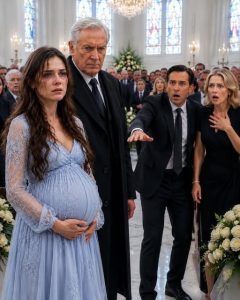
A murmur moved through the pews, growing until it seemed the entire building had inhaled at once.
Damien stood near the altar.
When he saw me, his face emptied.
Not grief.
Not joy.
Recognition.
Wendy’s hand flew to her throat.
The scarf slipped from her shoulders and fell to the floor.
I walked forward slowly, one hand resting on my stomach and the other holding Harris’s arm.
Cameras flashed from the back of the cathedral before security blocked them.
Someone whispered my name.
Then someone else.
Soon it moved through the room like a prayer no one had expected to be answered.
“Eloise.”
Damien took one step toward me.
His lips parted, but no words came.
I stopped halfway down the aisle.
My body shook.
For one frightening moment, the mountain returned—the wind, the ice, his smile above me.
Then my baby kicked.
I placed my hand over the movement.
I was not on the mountain.
I was standing.
I was alive.
Damien finally found his voice.
“My God,” he whispered. “Eloise.”
He began moving toward me.
Detective Ortiz stepped into the aisle between us.
“Mr. Finch, remain where you are.”
The congregation erupted into confused whispers.
Damien looked around as though he had forgotten there were witnesses.
Then he did what he had always done best.
He changed.
Shock softened into relief. Tears filled his eyes.
“You’re alive,” he said. “I knew—I prayed—”
“Stop.”
My voice was quiet, but the cathedral carried it.
Damien froze.
I had imagined this moment in the hospital.
In some versions, I exposed him before everyone.
In others, I demanded answers.
But standing there, I understood that the truth did not need performance.
It needed patience.
“I am alive,” I said. “The rest will be discussed with the authorities.”
Wendy backed away from the altar.
Ortiz glanced toward another officer, who moved discreetly toward her.
Damien’s eyes shifted to Harris.
“Who is he?”
Harris did not answer.
I did.
“This is Harris Campbell.”
A new murmur moved through the room.
Damien knew the name.
Of course he did.
His gaze dropped to Harris’s hand supporting mine, then returned to my face.
Understanding arrived slowly.
“You contacted him?”
“Six months ago.”
Damien’s expression betrayed him.
Not surprise that Harris was my father.
Fear that I had known more than he believed.
Harris’s voice remained calm.
“I am Eloise’s father.”
For the first time, Wendy looked directly at him.
The color drained from her face.
Her reaction was different from Damien’s.
He looked trapped.
She looked as though an old ghost had entered the room.
Then she whispered something I could not hear.
Harris heard it.
His hand tightened beneath mine.
“What did you say?” he asked.
Wendy shook her head.
“Nothing.”
“You said Celeste.”
My birth mother’s name.
Damien turned toward her.
“Who is Celeste?”
Wendy looked from Harris to me.
Her composure disappeared.
“I didn’t know,” she said.
“Didn’t know what?” I asked.
She stepped backward.
“I didn’t know you were her daughter.”
The cathedral seemed to fall silent again, though people were still whispering all around us.
Harris moved forward half a step.
“How did you know Celeste Rowan?”
Wendy’s eyes filled with tears.
Not the controlled tears she had displayed during the memorial.
These came with fear.
With memory.
“I knew her before Eloise was born.”
Damien stared at her.
“You told me you found the adoption file through my computer.”
Wendy closed her eyes.
That single sentence exposed more than he seemed to realize.
Ortiz immediately signaled to the officers.
“Mr. Finch, do not say anything further.”
But I barely heard her.
I was looking at Wendy.
“You knew my mother?”
She nodded once.
“How?”
Wendy’s gaze moved to Harris.
“She was my sister.”
The world shifted beneath me.
Harris caught my weight before I fell.
My aunt.
The woman who helped my husband arrange my death was claiming to be my mother’s sister.
But Celeste Rowan’s adoption records listed no siblings.
Wendy’s voice trembled as she continued.
“You were never supposed to find Harris. None of us were.”
“None of whom?” I asked.
Before she could answer, Detective Ortiz’s phone rang.
She listened for only a few seconds before turning toward Harris.
Her face had changed.
“What is it?” he asked.
“The laboratory finished testing the blood recovered from Eloise’s wedding ring.”
My eyes moved to her.
“Is it Damien’s?”
Ortiz looked at Wendy.
“No.”
“Then whose is it?”
She hesitated.
“It belongs to a woman.”
Wendy’s face went completely still.
Ortiz continued.
“The DNA is a close maternal-family match to Eloise.”
I stared at Wendy, unable to breathe.
She had claimed to be my aunt.
But the blood on my ring suggested something even closer.
Something the adoption records, Harris, and perhaps my entire life had hidden from me.
Wendy whispered, “Eloise, I can explain.”
Before I could ask the question forming inside me, Harris spoke it aloud.
“If Celeste Rowan was really your sister,” he said, “why does the DNA indicate that you may be Eloise’s mother?”
END OF PART 2 – LIKE, SHARE AND COMMENT “THE ENTIRE STORY” IF YOU WANT TO READ THE FULL STORY