
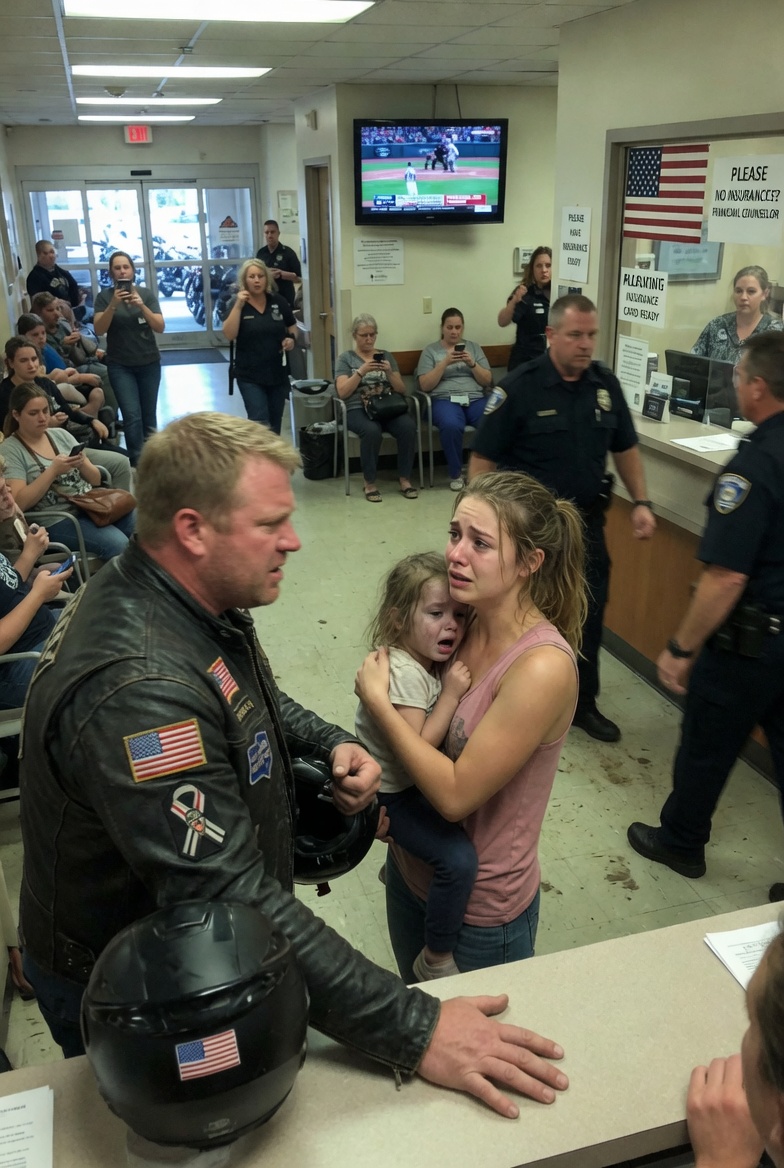
The seconds after I pocketed the phone felt like standing inside a bell after it’s been struck—every nerve ringing, vision narrowing to a pinpoint. The mother’s grip on my sleeve hadn’t loosened. I could feel each tremor running through her fingers, a Morse code of pure terror. The little girl in her arms gave another wet, shuddering breath, and the sound crawled under my skin and nested there.
—Sir, I’m not gonna ask again. Step away from the counter.
The security guard’s voice had that rehearsed calm, the one they teach in de-escalation training. I knew the cadence. I’d been on the other side of it once, in a different uniform, a different life. I turned my head just enough to meet his eyes. Mid-forties, tired, a wedding ring that had seen better days. He wasn’t a bad man. None of them were. They were just gears in a machine that had been grinding up the poor and the uninsured for decades.
—I’m not moving, I said. My voice came out gravel, low, almost a whisper. Not a challenge. Just a fact.
The second guard shifted his weight, fingers curling around the radio on his belt. —We’ve got a situation at the intake desk. Possible hostile.
Hostile. The word tasted like rust. I’d delivered a baby on the side of a highway once, both hands slick with blood and hope, no insurance card in sight. I’d held a man’s chest together after a construction accident while his buddy screamed that they didn’t have coverage. And I’d watched my own son die in a room just like this because a computer said we weren’t covered anymore. Hostile. Yeah, maybe I was hostile. But not at the people in this lobby. At the lie that care was a privilege and not a right.
The mother’s voice cracked beside me. —Please, just let them help her. I’ll pay anything. I’ll sign anything. I’ll work it off. Just please—
The receptionist’s face flickered. For half a heartbeat, I saw the human being behind the exhaustion and the protocols. But then the mask slammed back down. She’d been trained to be a wall. Walls don’t bend.
I caught the girl’s face—really caught it—for the first time. Maybe four years old. Hair matted with sweat, dark curls plastered to a forehead the color of candle wax. Her lips were no longer gray. They were edging toward blue. My son’s lips had turned that color in the final minutes. A color that doesn’t exist in nature, only in nightmares.
I bit the inside of my cheek until I tasted blood. The pain was an anchor. Without it, I might have floated away into the past completely.
Behind me, the lobby churned with whispered outrage. I caught fragments.
—What is he doing?
—Someone needs to call the cops.
—Look at that poor woman, he’s scaring her.
—Why doesn’t he just leave?
I wanted to turn around and scream at them. I wanted to shake them until they understood that their fear was aimed at the wrong target. But I’d learned a long time ago that screaming doesn’t open ears. It only hardens them.
The older security guard took a step closer. I heard the soft creak of his belt, the jingle of keys. —Last chance, buddy.
I didn’t answer. I was listening for something else.
There. Beneath the hum of the vending machines and the drone of the television and the shuffle of shoes, I caught it. A low rumble. Not thunder. Throatier. The sound of engines. Not one or two. Many. Growing from a distant vibration into a presence that pressed against the glass doors like a rising tide.
The guard heard it too. His eyes flicked toward the entrance. —What the hell?
The mother’s breathing hitched. —What’s happening?
I finally looked at her. Really looked. Her eyes were the color of strong coffee, and they held that same desperate question I’d asked the universe three years ago when I was the one clutching a dying child. Why is no one helping? Why is the world built like this?
—Help is here, I said. Quiet. Certain.
She didn’t believe me. I didn’t blame her. Belief was a luxury neither of us could afford anymore.
The automatic doors slid open.
The first thing that entered was the sound. Engines idling outside, a deep, synchronized purr that spoke of machines maintained by people who respected power. Then the footsteps. Boots on linoleum. Steady. Unhurried. Not the chaotic stomp of a gang looking for trouble, but the deliberate cadence of people who had rehearsed this moment a hundred times.
Harold led them.
Dr. Harold Webb was seventy-two years old, with a spine straight as a judge’s gavel and eyes that had seen too many people die for lack of a piece of paper. He’d been chief administrator at this very hospital fifteen years ago, before the corporate buyout, before the algorithms and the profit margins. He’d walked away with his pension and his conscience, but he’d never stopped fighting. Instead of boardrooms, he now held meetings in parking lots and diners. Instead of suits, he wore a plain gray jacket with no patches, no insignia. The only badge he needed was the quiet authority he carried in the set of his shoulders.
Behind him, nine other riders filed into the lobby. They removed their helmets as they crossed the threshold—a gesture of respect, a refusal to intimidate. I recognized them all. Maria, a former pediatric nurse who’d lost her license after blowing the whistle on a for-profit dialysis chain. Big Ray, a mechanic who’d buried his wife because their insurance denied her cancer treatment as “experimental.” Leon, a veteran who’d seen battlefield triage run more humanely than a civilian ER. The others had their own stories, their own scars. We never talked about them much. We didn’t need to. The wounds were visible in the way we rode, the way we showed up, the way we refused to let anyone else suffer the same losses in silence.
The lobby fell completely still. Even the television seemed to mute itself. The receptionist’s hand hovered over the phone, frozen. The security guards exchanged a look I’d seen before—the dawning realization that the situation had shifted beyond their training.
Harold walked directly to the counter. He didn’t look at me. He didn’t need to. We had a rhythm, refined over years of moments like this. He placed a small cream-colored card on the counter between the receptionist and the phone. The card had no name. No number. Just a simple gold emblem—a bed with an open door beneath it.
The receptionist stared at it. Her face went through a journey in the span of three seconds. Confusion. Recognition. And then something that looked almost like shame.
—The Last Bed Foundation, she whispered.
Harold nodded once. —We’ll take responsibility. All of it. The admission, the treatment, any follow-up care. No questions. No bills. No insurance games.
The silence that followed was deeper than anything I’d heard in years. It was the silence of a system that had just been bypassed by people who had learned its weaknesses.
A nurse appeared in the hallway behind the reception desk. Young, probably fresh out of school, still carrying the idealism the job hadn’t beaten out of her yet. She saw the girl. Her eyes went wide.
—Why is this child still in the waiting room?
Her voice cut through the paralysis. Within thirty seconds, a gurney appeared. Hands reached for the little girl—gentle, professional, urgent. An oxygen mask settled over her blue-tinged lips. The mother let out a sound I can’t describe, something between a wail and a laugh, a release of pressure so profound her knees buckled. Maria caught her before she hit the floor.
—It’s okay, Maria said, her voice the soft balm of a woman who’d calmed a thousand panicking parents. —She’s in the right hands now. Let them work.
The mother grabbed Maria’s arm with both hands, eyes wild. —Will she be okay? Please, tell me she’ll be okay.
Maria didn’t lie. She never did. —They’re going to do everything possible. And we’re going to be right here.
The gurney disappeared through the double doors, the mother stumbling after it with Maria at her side. The doors swung shut with a soft pneumatic hiss. And just like that, the crisis was over. Except it wasn’t. The air still crackled with all the things that had been revealed.
The other riders formed a loose line behind Harold, a wall of quiet presence. None of them spoke. None of them had to. The message was clear: we were here to ensure nothing blocked that child’s care, and we would not leave until we were certain.
The older security guard’s hand fell away from his radio. He looked at me, and for the first time, I saw something other than suspicion in his eyes. It might have been respect. It might have been guilt. It was hard to tell the difference some days.
—Who are you people? he asked.
Harold answered before I could. —We’re the ones who show up when the system fails. We’ve been doing it for eight years. Quietly. No press. No fundraising galas. Just people who’ve lost too much to let it happen to someone else.
The receptionist’s composure finally cracked. Her chin trembled. —I was just following policy. I didn’t want to turn her away. You have to understand, if I break protocol, I lose my job. I have kids too.
Harold’s expression didn’t change. It wasn’t unkind. It was simply… tired. —I know. I used to write those protocols. I thought they’d create fairness. Instead, they created a machine that values paperwork over breathing. That’s not on you. It’s on all of us.
He turned away from the counter and faced the lobby. The waiting patients, the ones who’d watched, the ones who’d judged me, the ones who’d looked away. They were still there, frozen in their chairs like a tableau of guilt.
—You all saw a child struggling to breathe, Harold said, his voice carrying without a microphone. —You saw a mother begging. And you saw a man in a leather jacket who refused to accept no for an answer. Many of you decided he was the danger. I want you to sit with that for a moment. I want you to ask yourselves why you were more afraid of him than of the system that was letting that little girl die.
Nobody answered. A man in a business suit stared at the floor. A woman with a designer handbag wiped at her eyes. The silence was an answer all its own.
I looked at the scuff mark on the counter where my hand had landed. A small, pale crescent on the laminate. It would be wiped away by morning, invisible to everyone who hadn’t been here. But I would remember it. I would remember the jolt that went up my arm, the way the sound had cut through the bureaucracy like a blade. I wasn’t proud of it. But I wasn’t ashamed either. Some walls only move when you hit them.
Big Ray ambled over to me, his massive frame casting a shadow across the counter. He clapped a hand on my shoulder, and the weight of it was grounding.
—You did good, brother, he rumbled. —Little rough on the delivery, but the message got through.
—I almost lost it, I admitted, my voice barely audible. —When I saw her lips turning blue, I was back in that room with Danny. I was right back there.
Ray’s grip tightened. He knew about Danny. Everyone in the group knew. It was the reason I rode with them. The reason I couldn’t walk away even when the memories clawed at me.
—That’s why you’re the best one for this, he said. —You remember what it costs. Every single time.
I nodded, not trusting myself to speak. The lump in my throat was the size of a fist.
Harold approached me, his worn boots stopping just inches from mine. He studied my face for a moment, then nodded once. No words. Just that nod, which said everything I needed to hear. You did what had to be done. You held the line.
We waited.
The hospital didn’t kick us out. I think they were too stunned. The receptionist made a few quiet phone calls, and after about twenty minutes, a man in a blazer appeared—some kind of administrator. He spoke with Harold in hushed tones near the vending machines. I caught snippets: “foundation,” “existing agreement,” “cannot be liable.” Harold’s responses were calm, unwavering. The administrator’s shoulders gradually relaxed. An arrangement was reached. The child would be treated. The foundation would cover everything. No media. No lawsuits. Just quiet, efficient care.
Leon appeared at my elbow with a cup of terrible lobby coffee. I took it, wrapped my hands around the warmth, and let it seep into my bones.
—She’s in good hands, Leon said. —I talked to one of the nurses. Severe asthma attack. They’ve got her on a nebulizer and steroids. Vitals are stabilizing.
—The mother?
—Sedated, lightly. She was hyperventilating. Maria’s sitting with her.
I breathed out. The air left my lungs in a shuddering rush, and with it went some of the tension that had been coiling in my chest since I’d walked through those doors. Not all of it. Never all of it. But enough to keep moving.
The lobby slowly returned to life. Patients were called. Forms were filled out. The TV resumed its murmur of weather and sports. But something had changed. The people who’d witnessed the scene no longer looked at me with fear. They looked at me with curiosity, with questions they weren’t brave enough to ask. A few offered small, hesitant nods. One elderly woman made the sign of the cross. I didn’t know what to do with any of it. I wasn’t built for gratitude. I was built for the fight.
Two hours passed. The fluorescent lights hummed overhead. The coffee grew cold. The riders took turns stepping outside to check on the bikes, to make calls, to breathe air that didn’t smell of antiseptic. I stayed by the counter, my back against the wall, watching the double doors.
And then they opened.
The mother walked through first, supported by Maria. Her eyes were red-rimmed but clear, and when she saw me, she broke away and crossed the lobby at a half-run. She stopped inches from me, her hands hovering in the air like she didn’t know whether to embrace me or fall at my feet.
—She’s okay, the mother choked out. —The doctor said she’s going to be fine. She’s sleeping. They’re keeping her overnight, but she’s going to be fine.
I nodded. My throat was too tight for words.
—I don’t know how to thank you, she said, her voice splintering. —I don’t have anything to give you. I don’t even know your name.
—Jake, I managed. —My name’s Jake.
—Jake. She repeated it like a prayer. —I’m Elena. Her name is Sofia. She’s four. She loves butterflies and pancakes and she’s the only good thing I’ve ever done in my life.
Her voice broke on the last word, and the tears came then, not the panicked tears from before but a release, a flood of everything she’d been holding back since her daughter first started gasping for air in their cramped apartment across town.
I didn’t know what to do with my hands. I’d rebuilt engines from scrap. I’d hauled injured riders off rain-slick highways. But I’d forgotten how to comfort a crying woman without feeling like I was intruding. So I just stood there, arms at my sides, and let her cry.
Maria stepped forward and wrapped Elena in a hug, murmuring something in Spanish I couldn’t quite catch. Elena buried her face in Maria’s shoulder and sobbed. The sound echoed off the lobby walls, raw and unguarded.
After a while, Elena pulled back, wiping her nose on her sleeve. She looked at the scuff mark on the counter. Then back at me.
—The way you hit that counter, she said. —Everyone thought you were a threat. But I knew. The second you walked in, I knew you were someone who’d been where I was. How did you know?
The question hung between us, delicate as a soap bubble. I could feel the other riders watching me, giving me space, trusting me to tell as much or as little as I could bear.
I reached into my jacket and pulled out my wallet. From behind my driver’s license, I slid out a worn photograph, creased and faded from years of handling. A small boy with bright eyes and a gap-toothed grin, sitting on a motorcycle that was far too big for him. My Danny. Three years old. The last photo taken before everything fell apart.
—My son, I said. —His name was Danny. He died three years ago in an ER just like this one. Insurance lapse. They turned us away. By the time a doctor agreed to see him, he was already gone.
Elena’s hand flew to her mouth. The horror in her eyes was immediate and deep, the horror of a mother imagining the unthinkable.
—I’m so sorry, she whispered.
—I’m not telling you for sympathy, I said. —I’m telling you so you understand. Today, when I saw Sofia turning blue, I wasn’t just seeing her. I was seeing Danny. And I made a promise to myself after he died that I would never, ever stand by again. Not while a child was dying. Not while a mother was begging. Never again.
The words cost me. Every one. I felt scraped raw, exposed in a way I hadn’t been in years. But I also felt something else. A lightness, almost. Like speaking Danny’s name aloud in this place, for this reason, had shifted a weight I’d been carrying so long I’d forgotten it was there.
Elena reached out and took my hand. Her fingers were cold, but her grip was steady.
—Sofia will know your name, she said. —When she’s old enough to understand, I’ll tell her about the man who refused to let them turn her away. I’ll tell her about Danny, too. I’ll tell her that because he lived, she lived.
The lump in my throat returned, fiercer than before. I nodded, unable to speak. Elena squeezed my hand, then let go. Maria guided her back toward the double doors, toward her daughter’s room, toward a future that had nearly been stolen.
I stood there for a long moment, the photograph still in my hand. Danny’s smile, frozen in time, reminding me why I kept riding.
Harold appeared beside me, quiet as ever. He didn’t say anything. He just stood there, sharing the silence, until I was ready.
—Same time next week? he finally asked.
It was a ritual, a dark joke we shared. Because there was always a next time. Always another family, another child, another bureaucratic wall. The work never ended. But neither did we.
—Same time, I said.
I tucked the photograph back into my wallet, next to my heart.
The riders filed out of the lobby one by one, mounting their bikes in the fading afternoon light. Engines rumbled to life, a low, resonant chorus. I swung my leg over my own bike—a battered black cruiser that had carried me through three years of grief and purpose—and settled into the familiar weight of the seat.
Before I pulled on my helmet, I looked back at the hospital. The glass doors reflected the orange glow of the setting sun. Inside, a little girl was breathing easily for the first time in hours. Inside, a mother was no longer alone.
I thought about Danny. I thought about the last time I’d held him, his small body gone still, the monitor’s flatline screaming into the sterile silence. I’d made a promise to him then, kneeling on that cold floor, my chest caving in. I’d promised that his death would mean something. That I would make sure no other parent had to feel what I felt. Not if I could help it.
Today, I’d kept that promise.
I pulled on my helmet. The visor clicked into place. The engine growled as I twisted the throttle. And then I was moving, the road opening up before me, the wind scouring my skin, carrying away the ghosts just long enough to breathe.
Tomorrow, there would be another hospital. Another counter. Another family. And I would be ready.
But tonight, I would ride until the stars came out, and I would talk to Danny the way I always did. I would tell him about Sofia. About Elena. About the sound of a hand hitting a counter and the silence that followed when a child finally got the care she deserved.
And I would tell him that his daddy was still here. Still fighting. Still remembering.
The highway stretched into the dark, and I followed it, a single headlight cutting through the night, a lone rider carrying the weight of one small life and the hope of all the others.
The ride home took longer than usual.
Not because of traffic—the freeway was nearly empty, the late hour thinning the rush of headlights to an occasional stream. But I wasn’t ready to park the bike and walk into the silence of my apartment. The silence had teeth. It always did. So I took the long way, looping through the industrial district, past the shuttered factories and the all-night diners with their flickering neon signs.
The diner on Clover Street was still open. It always was. A relic from a different era, the kind of place where the coffee was strong enough to strip paint and the waitresses called you “hon” regardless of your age. I pulled into the empty lot and killed the engine. The sudden quiet felt heavy. I sat there for a moment, helmet still on, listening to the tick of the cooling metal.
I wasn’t hungry. I just didn’t want to be alone.
Inside, the diner smelled of old grease and fresh pie. A radio played soft country from a speaker above the cash register. The only other customer was a trucker in the corner booth, hunched over a plate of eggs, eyes glazed with road weariness. I took a seat at the counter, and a waitress in her sixties—Marge, I knew her name from a dozen late nights—poured me a cup of coffee without asking.
—Rough one? she said, eyeing the lines on my face.
—You could say that.
—You want to talk about it?
I wrapped my hands around the mug, letting the heat seep into my palms. —Not really.
Marge nodded, wise enough not to push. She wiped down the counter with a rag and left me to my thoughts. The coffee was bitter and perfect. I drank it slowly, letting the warmth settle in my chest.
Danny would have been six years old this year. I tried to imagine him sitting on the stool next to me, legs swinging, ordering a hot chocolate with extra whipped cream. He’d never made it to a diner like this. He’d barely made it out of diapers. The thought sat in my stomach like a stone.
I pulled out the photograph again, studying his face under the diner’s yellow light. That gap-toothed grin. The way his eyes crinkled at the corners, just like his mother’s. Linda. I hadn’t spoken to her in two years. The grief had torn us apart, as it did so many couples. We’d tried therapy, support groups, long walks where we held hands and said nothing. But every time I looked at her, I saw Danny. And every time she looked at me, she saw the man who hadn’t been able to save him. It wasn’t fair. None of it was fair. But fairness had stopped being a factor a long time ago.
I tucked the photograph away and signaled Marge for the check.
—On the house, honey, she said. —You look like you could use a break.
I left a twenty on the counter anyway. Some debts you don’t let others pay.
The apartment was a one-bedroom walk-up on the south side of town. It had thin walls, a radiator that clanked like a dying engine, and a view of a brick wall six feet from the window. It was the kind of place you lived in when you’d stopped caring about comfort. I kept it clean, though. Danny’s picture on the nightstand. A single shelf of books I’d never read. A closet with more leather jackets than shirts.
I hung my keys on the hook by the door and stood in the dark for a full minute before flicking on the light. The stillness wrapped around me, cold and familiar. I’d learned to live with it. I wasn’t sure that was a good thing.
My phone buzzed. A text from Harold.
“Sofia’s breathing on her own. Doctor says full recovery. Mom’s resting. Good work.”
I stared at the screen for a long time. “Good work.” Two words that held the weight of everything we did. They weren’t praise. They weren’t a reward. They were a confirmation that the mission had succeeded, that another child would get to grow up, that another mother wouldn’t have to plan a funeral. That was enough. It had to be.
I typed back: “Thanks. See you at the next one.” Then I turned off the phone and lay down on the bed without undressing.
Sleep didn’t come easy. It rarely did. But when it finally pulled me under, I dreamed of Danny. Not the hospital room, not the blue lips and the screaming monitor. I dreamed of him laughing, running through a field of tall grass, chasing butterflies. Sofia was there too, a little girl with dark curls, her hand in Danny’s, both of them running toward a horizon I couldn’t quite see.
I woke at dawn with wet cheeks and a strange, fragile peace.
Three days later, I was in the garage behind Ray’s shop, helping him rebuild a transmission, when my phone rang. Unknown number. I almost let it go to voicemail, but something made me answer.
—Is this Jake? The voice was soft, female, hesitant.
—Yeah.
—This is Elena. Sofia’s mom. I got your number from the foundation. I hope that’s okay.
I straightened up, wiping grease from my hands onto a rag. —Is everything all right? Is Sofia okay?
—She’s wonderful. She’s home. She’s playing with her dolls right now. Elena’s voice caught. —I just… I needed to hear your voice. To say thank you properly. What you did… I don’t have words.
—You don’t need words, I said. —Just take care of her.
—I will. I promise. There was a pause, and then she added, —I looked up your son. Danny. I found the old news article. I’m so sorry, Jake. I lit a candle for him at church. I hope that’s okay.
The rag in my hand stilled. I hadn’t expected that. I hadn’t expected anyone to carry Danny’s name forward except me.
—It’s more than okay, I said, my voice rougher than I intended. —Thank you.
—He’s not forgotten, she said. —Neither are you.
The call ended shortly after, with a promise to send pictures of Sofia once she was fully recovered. I leaned against the workbench, staring at the phone in my hand. Ray watched me from across the garage, saying nothing, just nodding once in that way of his. He understood.
That evening, I rode out to the cemetery.
Danny’s grave was on a small hill beneath an oak tree. The headstone was simple—his name, the dates, and a small engraved butterfly. I knelt in the grass and brushed a few fallen leaves from the stone. The sunset painted the sky in shades of orange and pink, and for a while, I just sat there, letting the quiet settle over me.
—Hey, buddy, I said. My voice sounded strange in the open air, too loud and too small at the same time. —I met someone the other day. A little girl named Sofia. She’s about your age. Well, the age you would be. She loves butterflies too. I think you would have liked her.
The wind stirred the oak leaves, a soft rustle that could have been an answer.
—She almost didn’t make it. The system tried to turn her away, just like they turned us away. But this time, I was there. I didn’t let them. I hit a counter so hard I probably cracked a bone in my hand. It was stupid and reckless and it worked.
I paused, swallowing the thickness in my throat.
—I miss you, Danny. Every day. Every hour. I’m not going to stop missing you. But I think… I think I’m starting to figure out how to carry it. Does that make sense?
The wind blew again, stronger this time, and a single oak leaf drifted down to land on the headstone, right over the engraved butterfly. I picked it up, twirled it between my fingers, and tucked it into my jacket pocket.
—I’ll keep fighting, I said. —For you. For Sofia. For all the ones who don’t have anyone else. That’s my promise.
I stood up, my knees aching from the cold ground, and walked back to the bike. The road home was quiet, but for the first time in a long time, the silence didn’t feel like an enemy. It felt like a companion.
The weeks that followed were a blur of highways and hospitals, of phone calls in the middle of the night and quiet interventions in fluorescent-lit lobbies. The foundation never advertised, but word spread through the cracks—nurses who slipped our card to desperate parents, social workers who knew the system was broken, former patients who became advocates. There was always another call. Another family. Another wall to break down.
I didn’t mind. The work gave me purpose, a reason to get out of bed on the mornings when the grief sat heavy on my chest. The other riders became my family in ways I hadn’t expected. Maria taught me how to cook something other than microwave meals. Big Ray dragged me to the gym when I started losing weight. Harold shared his books, his wisdom, his quiet, unshakeable faith that what we were doing mattered.
One night, after a particularly grueling case—a premature baby whose parents had been denied coverage because of a clerical error—we gathered at Harold’s house, a modest ranch on the outskirts of town. He had a fire pit in the backyard, and we sat around it, passing a bottle of whiskey, watching the flames dance.
—I ever tell you how I started the foundation? Harold asked, his voice reflective.
—You mentioned it once, Maria said. —But not the details.
Harold took a sip of whiskey, his eyes fixed on the fire. —Fifteen years ago, I was the chief administrator at St. Jude’s. You know the one. I thought I was doing good work. I’d streamlined intake, cut costs, improved efficiency. Then a young couple came in with their son. He had a heart defect. Treatable, but expensive. Their insurance had a loophole—a waiting period for pre-existing conditions. The boy didn’t have two months to wait.
The fire crackled. No one spoke.
—I followed protocol, Harold continued, his voice barely above a whisper. —I told them there was nothing I could do. They begged. The mother fell to her knees. I still remember the sound. I turned them away. The boy died three days later at another hospital, one that agreed to treat him but got to him too late.
Harold’s hand trembled around the whiskey glass. —I resigned the next week. Spent the next seven years trying to drink myself to death. Then one night, I found myself in a diner, and a young man sat down next to me. He’d just lost his son. Same story. Insurance loophole. I listened to him talk, and I realized that the system I’d helped build had killed his boy just as surely as it had killed that other little boy years before.
I set my own glass down, my heart pounding. —That was me.
Harold turned to look at me, his eyes wet. —Yes, Jake. That was you. You told me about Danny that night. You didn’t know who I was. You just needed to talk to someone. And I realized that I couldn’t keep drowning. I had to do something. The next morning, I started making calls. I used my contacts, my reputation, every favor I’d ever been owed. Within a year, the Last Bed Foundation was operational. And I tracked you down. I asked you to ride with us. Because I knew you understood what was at stake.
The fire popped, sending sparks spiraling into the night sky. I stared at Harold, this man who had been a stranger in a diner and had become something closer than family. He’d saved me. Not just by giving me a mission, but by showing me that my pain could be fuel instead of poison.
—I didn’t know, I said. —I didn’t know you were there that night because of your own ghosts.
—We all have ghosts, Jake, Harold said. —The trick is learning to ride with them.
Leon raised his glass. —To the ghosts.
We all raised our glasses. —To the ghosts.
The whiskey burned going down, but the warmth that spread through my chest had nothing to do with alcohol.
Spring arrived slowly that year, melting the frost and coaxing green shoots from the hard ground. I received a letter in the mail, hand-addressed, no return label. Inside was a crayon drawing of a butterfly with the words “Thank you for my breath” scrawled beneath it in a child’s uneven hand. Signed at the bottom: Sofia.
I pinned the drawing to the wall above Danny’s photograph.
And then I went back to work.
There was always another call. Always another family waiting. Always another chance to be the person I’d needed when Danny was dying. The road stretched on, endless and open, and I followed it wherever it led, knowing that as long as I could still ride, I could still fight. As long as I could still fight, Danny’s death meant something. And as long as his death meant something, I could keep breathing.
The story doesn’t end here. It never does. But this chapter, at least, closed with a child alive, a mother healed, and a biker who remembered that the loudest protests don’t always come from voices. Sometimes, they come from the sound of a hand on a counter, a rumble of engines in a hospital parking lot, and the quiet refusal to let another name be added to the list of those who fell through the cracks.
The sun rose on another Tuesday. I pulled on my jacket, grabbed my helmet, and headed for the door. The road was waiting. So was the next fight.
I was ready.
—End of Part 2—
Part 3 continues with Jake’s deepening involvement in the foundation, a new crisis that forces him to confront the limits of what they can do, and an unexpected encounter with someone from his past that shakes the fragile peace he’s built. But that’s a story for another ride.
For now, the bike hummed beneath me, the wind was clean and cold, and somewhere in the city, a little girl named Sofia was laughing, chasing butterflies, breathing easy. That was enough. That was everything.