
The air smelled like barbecue smoke and birthday cake frosting—that heavy-sweet vanilla they pump into every grocery-store sheet cake. Music thumped from a tinny Bluetooth speaker someone had set on the fence. I killed the engine on my Softail and just sat there for a second, helmet still on, watching the pink balloons quiver against the chain-link gate.
I hadn’t been invited. That was fine. I never get invited to those things. My sister’s little girl, Emily, had begged her mom to let me pick her up after the party. My sister works double shifts at the diner on Saturdays; she said yes because the alternative was Emily walking six blocks alone. I was the backup plan. The guy you call when the schedule falls apart. The uncle with the ink and the leather vest who doesn’t fit in the PTA photos.
So I got there ten minutes early, figured I’d wait on the curb. Then I saw her.
Emily stood just outside the gate, clutching a paper gift bag with both hands. Her shoulders were trembling like a sparrow’s wings. She wore that yellow dress—the one my mother bought her at the church thrift sale, the only “party” thing she owned. The hem was coming loose on one side. She hadn’t noticed. She was staring at the gap in the gate like it had been slammed in her face.
I pulled off my helmet and her name jumped out of my mouth before I could smooth it.
— Emily. Hey. Em, look at me.
She turned. Her cheeks were wet. Eight years old, and she was trying not to make a sound because some adult had already told her she was making a scene.
I crouched right there on the sidewalk, boots scraping the concrete.
— What happened? Why are you out here?
She shook her head, lips pressed tight. Then a woman’s voice cut across the yard.
— Excuse me! Sir?
Lily’s mother. I recognized her from the school drop-off line—the kind who drives an SUV that’s never been dirty, who remembers your kid’s name only when it benefits her. She walked toward me like I was a loose dog.
— This is a private party. I don’t know who you are, but you can’t be here.
I stayed low, eyes on Emily.
— She’s my niece. She was invited.
The woman’s smile was a blade wrapped in a napkin.
— I think there’s been a misunderstanding. We have limited seating, and… well, Lily needs her closest friends today. I asked her to wait outside until her ride came.
A lie. I could see the gift bag shaking in Emily’s hands—still wrapped, unopened. They’d made her carry it out like evidence she didn’t belong.
Something hot coiled in my chest. I’ve been that kid. The one picked last. The one whose clothes hung wrong. I’ve stood outside school gates while other fathers pushed past me, and I swore I’d never let it happen to her.
I stood slowly, making sure both hands stayed visible. I’m six-two, two hundred and forty pounds. A sleeve of tattoos down my right arm. I know what I look like to people like her. I whispered anyway.
— Ma’am, she’s crying. She’s eight. Please, just let her sit at the table. She doesn’t even need cake.
— I said no.
The music kept playing behind her. Kids were still laughing somewhere near the swing set. I could hear a father telling someone to “cut the cake already” like my niece’s entire heart wasn’t breaking at the edge of their lawn.
Emily tugged the back of my cut.
— Uncle Jake, it’s okay. I’ll just wait in the truck.
The little hitch in her voice split me in half.
I pulled out my phone. Not to threaten—never that. I typed two words to a group chat I hadn’t opened in months: “I need you.”
Then I knelt again and put my palms on my thighs so I looked smaller.
— No, baby. You don’t hide. Not today.
Lily’s mother stepped back and raised her voice, playing to the audience now.
— I’m going to ask you one more time to leave. This is inappropriate. Someone call the police.
A man in a polo shirt pushed through the small crowd near the grill, his phone already in his hand. He didn’t look at Emily. He looked at me, at my vest, at the motorcycle—and saw a problem, not a person.
I didn’t move. I didn’t argue. I stayed right there, cross-legged on the ground, while Emily pressed her forehead into my shoulder and the whole party held its breath.
And then, from the next block over, the sound began. Deep. Measured. A vibration you feel in your ribs before your ears catch up.
Engines. Not one. Not two. Five of them.
They turned the corner like a slow procession of old friends who’d been waiting to be called home. I didn’t wave. I just looked up, feeling Emily’s tiny fingers grip my sleeve, and I thought about all the times people like her mother had told me I was nothing. Today, I’d let them see what “nothing” could bring.
The candles on the birthday cake flickered in the sudden wind.
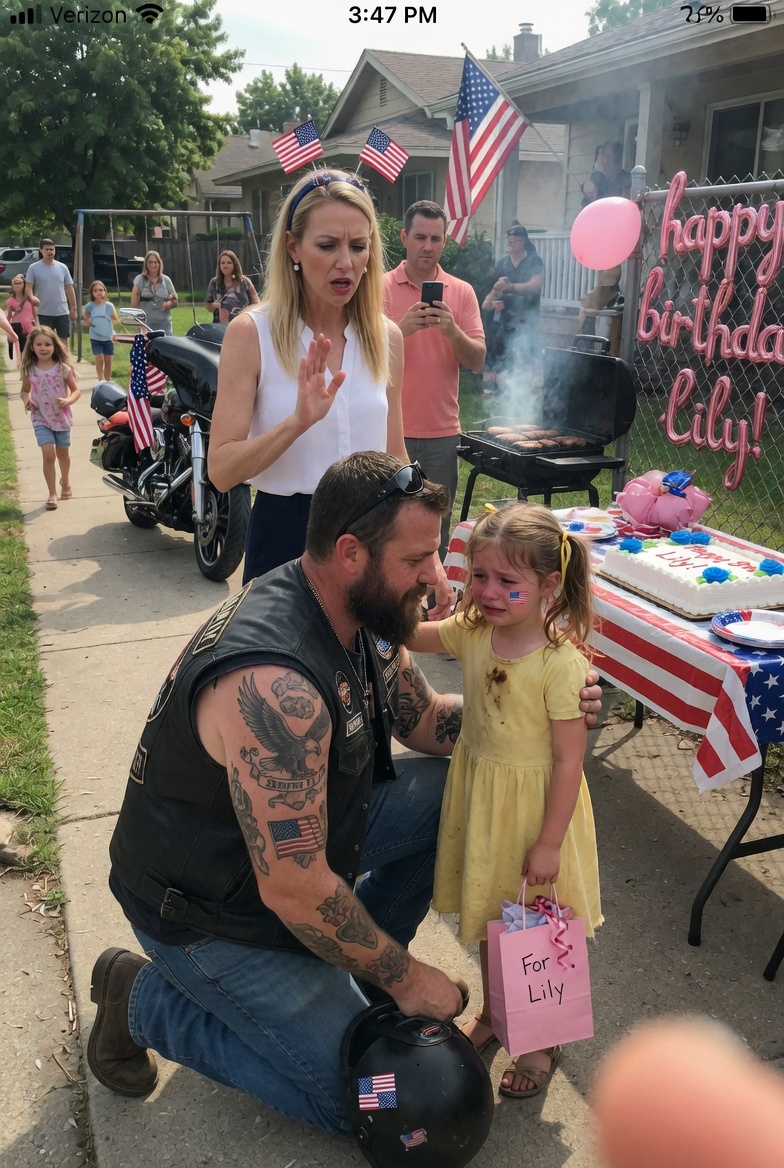
The rumble filled the street like a slow-rising tide, a deep-throated vibration that rattled the windows of the minivans parked along the curb. I stayed where I was, cross-legged on the sun-warmed concrete, Emily’s forehead still pressed into the hollow of my shoulder. I could feel her pulse through her temple, quick and scared, like a bird trapped in a closed room.
The first bike rounded the corner at a crawl. A matte-black Road King, ridden by a woman with silver-streaked braids falling over a denim cut. Behind her, a burgundy Softail with ape hangers, a bearded giant of a man who looked like he’d been carved out of a mountain. Then a trio of Dynas and a vintage Panhead, rolling two-by-two, their riders upright and silent, no revving, no showing off. Five motorcycles total, parking in a neat line along the opposite curb. Engines cut one by one, and the sudden quiet was louder than the noise had been.
Lily’s mother, whose name I’d later learn was Diane Calloway, took two steps backward onto her own lawn. Her face had gone the color of the paper plates on the dessert table. The man with the polo shirt—Diane’s husband, I assumed—lowered his phone but didn’t put it away. His eyes darted between me and the line of bikes like he was calculating escape routes.
“What is this?” he asked, voice pitched higher than he probably intended. “Who are you people?”
I didn’t answer him. I kept my focus on Emily, whose breathing had gone shallow. I rubbed slow circles on her back, the way I used to do when she was colicky as an infant and my sister was too exhausted to stand.
“Hey, Em,” I whispered. “You remember Aunt Sarah?”
She nodded against my shirt. Sarah was the woman with the braids. She wasn’t blood-related—none of them were, not technically—but Emily had known her since she was in diapers. Sarah had taught her how to braid dandelion stems at a Fourth of July cookout three summers ago. She was the kind of aunt you earn, not the kind you’re born to.
Sarah dismounted first. She removed her helmet, hung it on the handlebar, and walked toward us with the unhurried pace of someone who has nothing to prove and nowhere to be except right here. Her boots crunched on the gravel at the edge of the lawn, and I saw Diane flinch.
“Jake,” Sarah said, her voice low and warm. “She okay?”
“She will be,” I said.
Sarah nodded once, then turned her gaze toward Diane. She didn’t glare. She didn’t posture. She just looked, the way you look at a stain on a tablecloth before deciding whether to blot it or throw the whole thing out.
“Ma’am,” Sarah said, “I understand there’s been a misunderstanding.”
Diane found her voice somewhere deep in her throat. “There’s no misunderstanding. This is private property. You’re all trespassing.”
“We’re on the sidewalk,” Sarah said. “Public right-of-way. I checked.”
A small detail, but it landed. Diane’s mouth opened and closed soundlessly. I hadn’t known Sarah checked. She probably hadn’t. But she said it with such calm conviction that nobody questioned it.
The other riders had dismounted by now. The big man—everyone called him Tiny, for reasons that required a sense of irony—stood with his arms crossed, mirrored sunglasses hiding his eyes. Next to him, a lean guy named Marcus, who’d done two tours in Afghanistan and never talked about it, leaned against his Dyna and lit a cigarette. He didn’t smoke it, just held it, watching the ember glow. Two others, a couple named Rosa and Dave, stayed by their bikes, hands in pockets. None of them moved toward the gate. None of them raised their voices.
This was something I’d learned over twenty years in the life: the quiet ones are the ones you should pay attention to. The loud ones are usually bluffing. My crew wasn’t loud.
Diane’s husband, whose name I’d later learn was Tom, stepped forward and positioned himself slightly in front of his wife. He was a fit guy, probably did CrossFit or whatever suburban dads do to feel capable. He held up a palm like he was directing traffic.
“Okay, let’s everybody calm down,” Tom said. “I’m going to ask you all to leave. If you don’t, I will call the police. I’m not bluffing.”
Sarah tilted her head. “Who’s not calm? I’m asking a simple question.” She shifted her attention to Diane. “Why is this little girl standing outside your gate, crying, holding a gift she clearly brought for your daughter’s birthday?”
A ripple went through the small crowd of parents still lingering by the snack table. I saw a woman in yoga pants glance at her husband, then at Emily, as if seeing her for the first time. A younger dad with a toddler on his hip frowned and stepped a little closer to the fence.
Diane’s smile was back, but it was strained now, a rictus of forced politeness. “I already explained. We had limited seating. Lily wanted a small party with her closest friends. Emily’s mother and I discussed it. There’s no issue.”
I felt Emily tense against me. She whispered into my shirt, “Mommy didn’t know. She told me I could go.”
That was all I needed.
I looked up at Diane, and for the first time since I’d arrived, I let my voice carry.
“My sister works double shifts at the diner on Saturdays. She left for work at five this morning. She wasn’t home when Emily got ready. She trusted that her daughter had been invited to a birthday party by a classmate who handed her an invitation at school. So tell me again how there was a discussion.”
Diane’s face flushed crimson. A few parents shifted uncomfortably. The woman in yoga pants looked at her shoes.
“It was a mistake,” Diane said, voice tighter now. “The invitation was for the whole class. But I sent a follow-up message clarifying that we could only accommodate a small group. Maybe Emily’s mother didn’t see it.”
“Maybe you didn’t send it,” Sarah said flatly.
Tom bristled. “Now wait just a minute—”
“No,” Sarah cut in, still calm. “I’m not going to wait. Because a child is standing on a sidewalk holding a present she wrapped herself—look at the paper, it’s got teddy bears on it, she’s eight—and you’re talking about follow-up messages? What kind of adult watches a kid get escorted out of a party and then blames the kid’s working mother for not checking her email?”
The silence that followed was thick enough to choke on.
Emily pulled back just enough to look at my face. Her eyes were red-rimmed, but she wasn’t crying anymore. She was watching, the way kids do when they’re trying to figure out whether the world is as cruel as it just proved to be or whether someone might still fix it.
I brushed a strand of hair out of her eyes. Her forehead was damp with sweat and tears.
“You’re not in trouble,” I said quietly, for her ears only. “You didn’t do anything wrong. Do you understand that?”
She nodded, but I wasn’t sure she believed it yet.
From the yard, a small voice piped up. “Mommy?”
Lily. The birthday girl. She’d abandoned the swing set and was standing near the cake table, her pink party dress smudged with frosting, a paper crown tilted on her head. She was looking at Emily with the uncomplicated confusion of a child who hasn’t yet learned to edit her heart.
“Why is Emily outside? She’s my friend. I gave her an invitation. I told her to come.”
Diane’s composure cracked. Not much, just a flicker around the eyes. “Honey, we talked about this. Mommy had to make some adjustments.”
“But you said she could come,” Lily insisted, louder now. “You promised.”
I watched Diane swallow. Her throat moved like she was trying to force something bitter down. Tom put a hand on her shoulder, but she shook it off.
“Lily, sweetie, why don’t you go inside and get ready for cake,” Diane said, her voice syrupy and desperate.
“I don’t want cake if Emily can’t have any,” Lily said, and folded her arms.
I almost smiled. Kids have a way of cutting through * that adults spend decades perfecting.
Tiny, the big man, cleared his throat. It sounded like rocks tumbling in a barrel. Everyone turned. He hadn’t moved from his spot by the curb, but his voice carried like a preacher’s.
“Ma’am,” he said to Diane, “I don’t know you. I don’t know your family. But I know that little girl over there.” He pointed a thick finger toward Emily. “She’s the one who made a get-well card for my dog when he got sick last year. My dog. She didn’t even know his name. She just heard he was sick and made a card with a drawing of a puppy on it. You know what that tells me?”
Diane said nothing.
“It tells me she’s got more kindness in her left pinky than most folks have in their whole bodies. And you put her out on the street like she was nothing.” Tiny shook his head slowly. “That ain’t right. That ain’t right at all.”
Another long silence. The kind that rearranges things.
I stood up, lifting Emily with me. She weighed almost nothing. I set her gently on her feet and kept one hand on her shoulder.
“Here’s what’s going to happen,” I said, and I made sure my voice was quiet enough that people had to lean in to hear. “I’m not here to ruin a child’s birthday. That little girl in the crown—Lily—she didn’t do anything wrong. And as much as I want to be angry right now, this isn’t about anger. It’s about my niece.”
I looked at Diane. Then at Tom. Then at the cluster of parents who’d been pretending not to watch.
“Emily is going to walk back through that gate. She’s going to give Lily the gift she brought—a bracelet-making kit she saved her allowance for, by the way, because Lily told her she wanted to learn how to make friendship bracelets. And then she’s going to decide whether she wants to stay for cake or whether she’d rather go get ice cream with her uncle and his friends. That’s her choice. Nobody else’s. Understood?”
Diane’s mouth tightened into a thin line. I could see her calculating: the other parents watching, the phones that might or might not still be recording, her own daughter staring at her with that unblinking child-gaze that demands truth. She was losing the room. She knew it.
“Fine,” she said, the word clipped and brittle. “If it means that much to everyone, she can join us for cake.”
It was a surrender wrapped in condescension, but I’d take it.
I knelt down again and turned Emily so she faced the gate. Sarah had already pulled it open and was holding it with one hand, her expression unreadable.
“What do you say, Em?” I asked. “You want to go give Lily her present?”
Emily looked at me, then at Sarah, then at the open gate. Her chin trembled, but she lifted it anyway.
“Okay,” she whispered.
She stepped through the gate, the paper bag crinkling in her grip. The parents parted like water around a stone. I watched her walk toward the cake table where Lily was already bouncing on her heels, crown askew, grinning.
When Emily handed her the gift, Lily threw her arms around her in a hug so fierce that Emily stumbled backward. Somebody’s phone camera clicked. Somebody else let out a breath they’d been holding.
I didn’t follow her in. I stayed right there on the sidewalk, one shoulder leaning against the fence post, arms crossed. My crew stayed behind me, a silent wall of leather and denim. Rosa caught my eye and gave me a small nod. That was all.
Sarah moved to stand beside me. “You good?”
“I will be,” I said.
She didn’t push. She just stood there, shoulder to shoulder, watching the party resume in slow, uncertain fits and starts.
The cake was relit—eight pink candles flickering in the late-afternoon breeze. Somebody cued up the birthday song on the Bluetooth speaker. Lily grabbed Emily’s hand and pulled her right next to the cake, front and center. I saw Diane’s jaw tighten, but she didn’t intervene. Tom busied himself slicing additional pieces, making a show of welcoming everyone.
I watched Emily’s face as the song began. She wasn’t smiling yet. But she was standing straight, her yellow dress catching the golden light, her hand intertwined with Lily’s. She looked over her shoulder once, searching for me through the crowd. I lifted two fingers in a small wave. She nodded, just barely, and turned back to the candles.
They blew them out together, cheeks puffed, eyes squeezed shut. A cheer went up from the children. The adults clapped, though a few of them still glanced nervously toward the curb where we stood.
It was, I thought, the strangest birthday party I’d ever witnessed. And I’d been to some strange ones.
An hour passed. The sun sank lower, painting the sky in streaks of orange and lavender. The children migrated to the lawn for some game involving a parachute and plastic balls. Parents clustered in small groups, sipping lemonade and pretending not to discuss what had happened. I could feel their eyes on me like gnats—persistent, but easy to ignore.
Tiny had produced a deck of cards from somewhere and was teaching Marcus a game on the hood of a parked car. Rosa and Dave had walked to the corner store and come back with bottles of water, one of which they handed to me without a word. Sarah sat on the curb, braiding a piece of long grass, humming something I didn’t recognize.
Emily stayed at the party. She ate her cake slowly, sitting next to Lily at the plastic table. At one point, a boy I didn’t know asked her about the bracelet kit, and I saw her explain it with the kind of serious enthusiasm only an eight-year-old can muster. She was okay. She was more than okay.
But I wasn’t.
I kept replaying the moment in my head—the moment I’d pulled up and seen her standing there, alone, clutching that gift bag like a life raft. I’d seen a lot in my forty-two years. Bar fights and broken bones and funerals for men who died too young. I’d held my mother’s hand while she took her last breath. I’d watched my sister cry herself to sleep on a sofa that smelled like cigarette smoke and regret. But nothing had ever gutted me quite like the sight of Emily, eight years old, learning that the world could reject her for no reason at all.
I’d been that kid once. Different reasons, same feeling. My old man walked out when I was seven. My mother worked two jobs to keep the lights on. I went to school in shoes that had holes in the soles and ate free lunch while other kids brought Lunchables and Capri Suns. I knew what it was to be the one they whispered about. The one they didn’t invite. The one they looked past.
When I joined the MC at twenty-two, it was the first time I’d ever felt like I belonged somewhere. The club gave me a patch and a family and a code to live by. It also gave me a reputation that followed me like a shadow. I’d never been arrested, never hurt anyone who didn’t have it coming, but people saw the ink and the leather and the motorcycle and they made assumptions. I learned to live with it. I learned to use it.
But I never, ever wanted Emily to feel like an outsider. Not the way I had.
I’d made a promise to myself the day she was born. I was in the hospital waiting room, still wearing my work boots, grease under my fingernails, and the nurse had looked at me like I might steal something. When my sister handed me that tiny, red-faced bundle wrapped in a hospital blanket, I swore I would be the person Emily could count on. No matter what. No matter when.
Today, I’d almost been too late.
That thought sat in my chest like a stone.
Around six o’clock, the party began to wind down. Parents collected their children, folding chairs were stacked, leftover cake was wrapped in tinfoil. Diane had retreated to the house at some point, and Tom was the one handling goodbyes. He didn’t look at me, but he didn’t look away either. That felt like progress.
Emily appeared at the gate, Lily trailing behind her. Both girls had matching friendship bracelets on their wrists—uneven knots, clashing colors, clearly made in a hurry. Emily’s face was flushed with the particular joy of a child who has played hard and eaten too much sugar.
“Uncle Jake,” she said, “Lily wants to know if I can come over again next weekend.”
I glanced at Tom, who had drifted within earshot. He hesitated, then nodded once.
“We’ll talk to your mom,” I said to Emily. “But if she says it’s okay, then yeah.”
Lily beamed. Emily beamed back. They hugged again, the kind of full-body hug that only children and long-lost relatives can pull off authentically.
As we turned to leave, Tom cleared his throat.
“Hey,” he said.
I stopped.
He walked over, hands in his pockets, shoulders slightly hunched. Up close, he looked less like a CrossFit dad and more like a guy who’d been carrying something heavy for a long time.
“I want to apologize,” he said, voice low. “For my wife. For myself. What happened earlier… it wasn’t right.”
I didn’t answer immediately. I let the silence stretch until I saw him start to squirm.
“Your daughter’s a good kid,” I said finally. “She stood up for my niece when nobody else would. That counts for something.”
Tom nodded. “Lily’s always been that way. She gets it from her mother, believe it or not. Diane’s just… she gets caught up in appearances. She’s not a bad person.”
“I’m sure she’s not,” I said. “But today, she hurt a little girl. And that little girl is going to remember this for the rest of her life.”
Tom flinched. “I know.”
“Good,” I said. “Then you know what to do next.”
I didn’t wait for a response. I took Emily’s hand and we walked to the bikes.
The ride home was quiet. Emily sat behind me on the Softail, her arms wrapped around my waist, her helmet bobbing with every bump in the road. She’d been on my bike a dozen times before, always with her mother’s reluctant permission and a lecture about safety that lasted longer than the ride itself. She loved it. She told me once that it felt like flying, and I’d never forgotten that.
Instead of heading straight to her house, I took a detour. We rode out toward the old reservoir, where the road curved along the water and the trees opened up to show the first stars blinking to life. The air smelled like pine and distant rain. The engine hummed beneath us, steady as a heartbeat.
I pulled over at a lookout point, a gravel pull-off with a wooden railing and a view that stretched for miles. Emily climbed off and removed her helmet, her hair sticking up in wild directions.
“Why are we stopping?” she asked.
“Because sometimes you need to look at something big before you go back to something small,” I said.
She considered this, then nodded like it made perfect sense. Kids are like that.
We stood at the railing, side by side, watching the water turn gold in the fading light. A few boats drifted in the distance, their running lights winking on. Somewhere a dog barked.
“Uncle Jake?” Emily said after a long silence.
“Yeah, sweetheart.”
“Why didn’t Lily’s mom want me there?”
The question hit me square in the chest. I’d known it was coming. That didn’t make it easier.
I crouched down so our eyes were level. Her face was serious, her small brow furrowed. She was trying to solve a puzzle that adults spend their whole lives failing to solve.
“Some people,” I said slowly, “they get scared of things that are different. They look at someone and they see what’s on the outside—clothes, or money, or where someone lives—and they make a judgment. They decide that person doesn’t belong before they ever get to know them. And that’s wrong. It’s always wrong. But it happens.”
“Is it because our house is small?” Emily asked. “Or because Mommy works at the diner?”
My heart cracked a little. “Maybe. But that’s not about you. That’s about them. You didn’t do anything wrong, Em. You showed up with a gift and a smile, and you were a good friend. That’s all that should have mattered.”
She thought about this for a moment. “Lily’s mom said it was a family thing.”
“I heard that.”
“But you’re my family. And Sarah and Tiny and Marcus and Rosa and Dave. They came. They’re my family too, aren’t they?”
I felt my throat tighten. “Yeah, kid. They are. Family’s not just blood. Family’s the people who show up when you need them.”
She looked out at the water again. Her little hand found mine on the railing.
“I’m glad you showed up,” she said.
“Me too.”
We stayed there until the stars came out. Then I drove her home.
My sister’s name is Rachel. She’s three years younger than me, but life has aged her in ways that make the gap feel wider. She had Emily at twenty-one, the result of a relationship that fell apart before the baby took her first breath. The father signed away his rights and moved to Florida. We never heard from him again. Rachel raised Emily alone, working jobs that left her feet aching and her spirit frayed, but she never complained. She just kept going, the way our mother did, the way women in our family always had.
She was sitting on the front stoop when we pulled up. The porch light was on, and she had a cup of coffee in her hands despite the hour. She stood when she saw us, her face creased with the particular worry of a mother whose child is late.
Emily ran to her, the day’s exhaustion finally catching up. Rachel scooped her up, kissed her forehead, and shot me a questioning look over her shoulder.
“She okay?” Rachel mouthed.
I nodded. “She’s okay.”
Later, after Emily was bathed and tucked into bed with a story about a dragon who was afraid of the dark, Rachel and I sat at the kitchen table. The house was small—two bedrooms, a galley kitchen, a living room that doubled as a dining room—but Rachel kept it clean. There were crayon drawings on the fridge and a vase of wilting daisies on the windowsill. It smelled like laundry detergent and the faint, sweet trace of Emily’s shampoo.
“Tell me what happened,” Rachel said.
I told her. Everything. From the moment I pulled up to the moment Emily blew out the candles. Rachel listened without interrupting, her hands wrapped around her coffee mug, her knuckles white.
When I finished, she was quiet for a long time. Then she set the mug down with a soft clink.
“I didn’t get any follow-up message,” she said. “I checked my phone when you texted. There’s nothing. No email, no text, no call. That woman lied.”
“Yeah,” I said. “I figured.”
Rachel pressed her palms against her eyes. “I should have been there. I should have taken the day off. If I’d been there, none of this would have—”
“Stop,” I said. “You’re working yourself to the bone to keep a roof over her head. You’re doing everything right. This isn’t on you. It’s on a woman who decided her party photos would look better without a kid in a secondhand dress.”
Rachel’s shoulders shook. She didn’t cry—she’d long since trained herself not to—but I could see the tears pooling anyway.
“I hate this,” she whispered. “I hate that she has to learn this so young. That the world is mean. That people will look at her and decide she’s not good enough.”
“She learned something else today too,” I said. “She learned that when people try to push her out, there’s a whole crew of folks who will push back. She learned she’s not alone.”
Rachel looked at me. “You brought the whole club to a child’s birthday party?”
“Not the whole club. Just the ones who answered the text.”
A laugh escaped her, surprised and wet. “Jake, you’re insane.”
“Maybe. But it worked.”
She shook her head, but the ghost of a smile lingered. “Thank you. For being there. I don’t say it enough.”
“You don’t have to say it. I made a promise the day she was born.”
“I remember.” She reached across the table and squeezed my hand. Her fingers were cold from the coffee mug. “You were so scared to hold her. You said you’d drop her.”
“I didn’t drop her.”
“No,” Rachel said. “You didn’t.”
We sat in the quiet kitchen, the refrigerator humming, the clock ticking. Outside, a motorcycle passed in the distance, and I thought about all the rides I’d taken, all the roads I’d traveled, all the places I’d tried to outrun. None of them had brought me as far as that stretch of sidewalk in front of Diane Calloway’s house.
The next week, something unexpected happened.
I was at the garage, changing the oil on a customer’s Sportster, when my phone buzzed. An unknown number. I almost let it go to voicemail, but something made me answer.
“Hello?”
“Is this Jake? Emily’s uncle?” A woman’s voice, hesitant.
“Yeah. Who’s this?”
“This is—this is Diane. Diane Calloway. Lily’s mom.”
I wiped my hands on a rag and leaned against the workbench. “What can I do for you, Diane?”
A pause. I heard her take a breath, the kind you take before jumping into cold water.
“I owe you an apology. A real one. Not the one my husband gave you at the party. I was horrible to your niece, and I was horrible to you, and I’ve been thinking about it all week. I can’t stop thinking about it.”
I waited. I’ve learned that when people are confessing, filling the silence doesn’t help.
“I grew up poor,” Diane said, her voice thinner now. “Dirt poor. Trailer park, free lunch, the whole thing. I got made fun of all through school. And when I got out, I promised myself I would never be that person again. I married money. I curated my life. I became someone who threw perfect parties and knew the right people.” She laughed bitterly. “And somewhere along the way, I became the exact kind of person who made my childhood a living hell. I looked at your niece, and I saw myself. And I pushed her away because I was ashamed of where I came from. That’s the truth. Ugly as it is.”
I let that settle. “Why are you telling me this?”
“Because I want to make it right. I want to apologize to Emily. And to her mother. And I want to ask if Emily would like to come over for a playdate—a real one, no party, no pretense. Just two little girls making bracelets. I already talked to Lily about it, and she’s been asking every day.”
I thought about it. My instinct was to tell her to go to hell. But I wasn’t the one who’d been hurt. Not really. This was Emily’s call.
“I’ll talk to her mom,” I said. “If Emily wants to, and Rachel’s okay with it, then fine. But if either of them says no, that’s it.”
“That’s fair,” Diane said. “That’s more than fair.”
I hung up and stared at the phone for a long time. People surprise you. Sometimes in terrible ways. Sometimes in the opposite.
Rachel was skeptical when I told her. But she asked Emily, and Emily—who had apparently spent the week exchanging crayon drawings with Lily at school—said yes without hesitation. Kids forgive faster than adults. It’s one of their superpowers.
The playdate happened on a Saturday afternoon. I drove Emily over on my bike, and this time, Diane met us at the gate with a smile that looked almost human. She’d set up a craft table in the backyard with beads and string and a plate of cookies that didn’t look store-bought. Lily ran out and tackled Emily before we even got through the gate.
I stayed for a few minutes, then excused myself. “I’ll be back in two hours.”
Diane walked me to the curb. “Thank you,” she said quietly. “For giving me a chance.”
“Don’t thank me yet,” I said. “Just don’t make me regret it.”
I went to a coffee shop down the street and nursed a black coffee while reading a beat-up paperback I kept in my saddlebag. Two hours later, I returned to find Emily and Lily sitting on the grass, wrists covered in bracelets, laughing at something only they understood. Diane was on the porch, watching them with an expression I couldn’t quite read.
Emily saw me and jumped up. “Uncle Jake! Look! We made twelve bracelets! Twelve!”
“That’s a lot of bracelets,” I said.
“We’re going to sell them at school and give the money to the animal shelter,” Lily announced. “Mom said we could.”
I looked at Diane. She nodded. “The shelter by the highway. They need donations.”
Something in my chest loosened. Just a little.
Time passed. The seasons changed. Emily turned nine, and we threw a party at Rachel’s house—nothing fancy, just hot dogs and a homemade cake and a piñata shaped like a unicorn. The whole crew came: Sarah, Tiny, Marcus, Rosa, Dave. They brought gifts and laughter and stories that were probably inappropriate for children but not in a way anyone could pinpoint. Lily came too, with her mother and father. Diane brought a salad and an apology that she delivered to Rachel in private, and I saw my sister’s shoulders relax for the first time in years.
It wasn’t a fairy tale. Things weren’t magically fixed. Diane still cared too much about appearances, and Rachel still worked too many shifts, and I still got side-eyed in grocery stores by people who didn’t know me. But something had shifted. A small crack in the wall that separates people who are different from each other. And through that crack, a little light was getting in.
Emily started calling me more often. Not for anything specific—just to talk. She’d tell me about school, about her friends, about a book she was reading. I’d listen while I worked on bikes, the phone wedged between my ear and shoulder. Sometimes she’d ask questions that were too big for a nine-year-old. “Why do people judge each other?” “How do you know who your real friends are?” “What if I’m not good enough?”
I didn’t have all the answers. But I told her what I believed: that everyone is scared of something, and most cruelty comes from fear. That real friends show up when it’s inconvenient. That being good enough isn’t something you prove to other people—it’s something you know about yourself, deep in your bones, and nobody can take it away from you.
I don’t know if she understood all of it. But she listened. She always listened.
One evening in late October, I got a call from Rachel. Her voice was tight, the way it got when she was trying not to panic.
“Jake, can you come over? There’s something I need to talk to you about.”
I was there in fifteen minutes. Emily was at a sleepover, so the house was quiet. Rachel sat me down at the kitchen table and handed me a letter.
It was from the school. Emily had been nominated for a kindness award—something the PTA had started, recognizing students who demonstrated exceptional compassion. The nomination had come from Lily, with a supporting statement from Diane Calloway.
The statement read: “Earlier this year, I witnessed an act of exclusion that I was responsible for. Emily showed more grace and forgiveness than I deserved. She taught me that kindness isn’t about being perfect. It’s about showing up, even when it’s hard. She deserves this award not because she was wronged, but because she chose to respond with love.”
I read it three times. My eyes blurred on the third pass.
“She’s going to get an award,” Rachel said, her voice cracking. “At the school assembly. They want us both there.”
“Of course we’ll be there,” I said.
“Jake… I’m so proud of her. And I’m so scared. What if she loses this? This… goodness? What if the world beats it out of her?”
I took my sister’s hand. It was still cold, still calloused from years of hard work.
“The world’s going to try,” I said. “It tries with everyone. But she’s got something a lot of people don’t have. She’s got a mom who loves her and an uncle who’s stubborn as hell and a whole crew of weirdos who will ride across town just to prove a point. She’s going to be okay.”
Rachel laughed through her tears. “You’re ridiculous.”
“I know.”
The assembly was on a Thursday morning in November. The school auditorium smelled like floor wax and cafeteria pancakes. I wore my best shirt—black, with buttons, which was as formal as I got—and sat in the front row with Rachel on one side and Sarah on the other. Tiny, Marcus, Rosa, and Dave had come too, filling a whole row in the back, looking completely out of place among the fold-up chairs and construction-paper decorations. A few teachers glanced at them nervously, but nobody said anything.
When they called Emily’s name, she walked up to the stage with the same quiet dignity she’d shown that day at the birthday party. She wore a new dress—blue, with pockets, which she’d picked out herself. Her hair was braided. Her chin was up.
The principal read the nomination statement, and I watched Diane Calloway wipe her eyes in the third row. Tom had his arm around her. Lily was bouncing in her seat, clapping louder than anyone.
Emily took the certificate with both hands. She stood at the microphone, looking out at the crowd, and for a moment I saw a flicker of the same uncertainty she’d shown at the gate. But then she found my face in the front row. I gave her a small nod—the same one I’d given her that day.
She smiled.
“Thank you,” she said into the microphone. Her voice was small but steady. “I want to thank my friend Lily, and my mom, and my Uncle Jake. He taught me that family is the people who show up. And I want to be that kind of person for other people. The kind who shows up.”
The applause was thunderous. I didn’t cry. I’m not a crier. But my eyes stung, and Sarah handed me a tissue without saying a word.
Afterward, in the parking lot, Emily ran up to me with the certificate flapping in her hands. “Uncle Jake, did you hear? I got to talk into the microphone!”
“I heard, kid. You did good.”
“Can we get ice cream?”
“Absolutely.”
The whole crew descended on the Dairy Queen down the street. Bikers and nine-year-olds and one exhausted mother who finally let herself relax. We took over the corner booth and the sidewalk tables, and Emily held court like a queen, showing off her certificate to anyone who would look.
At one point, Tiny lifted her onto his shoulders so she could see over the crowd. She laughed, her arms outstretched, the certificate still clutched in one hand.
“Look, Uncle Jake! I’m taller than you!”
“For now,” I said.
Sarah leaned over. “She’s going to be taller than you someday. Mark my words.”
“Probably,” I said. “But she’ll always be small enough to fit on the back of my bike.”
The sun was setting, the same golden light as that day months ago. I looked around at the mismatched group of people who had become my family—blood and chosen, broken and whole—and I thought about what Emily had said on the microphone. The kind of person who shows up.
That was it, wasn’t it? The whole secret. You couldn’t fix the world. You couldn’t stop people from being cruel or scared or small-hearted. But you could show up. You could kneel on a sidewalk and hold a crying child. You could send a text that said “I need you” and trust that someone would answer. You could offer forgiveness to someone who didn’t deserve it and grace to someone who did.
Emily had learned that at eight years old. I was still learning it at forty-two.
That night, after I dropped Rachel and Emily off at home and rode back to my own apartment, I sat on the steps outside and looked up at the stars. The same stars I’d stared at as a boy, wondering if I’d ever be enough. The same stars Emily had looked at from the reservoir, holding my hand.
I didn’t have all the answers. But I had a bike that ran, a family that showed up, and a niece who was learning, day by day, that she belonged in this world just as much as anyone else.
And that, I decided, was more than enough.
Spring came. Emily finished fourth grade with straight A’s and a backpack full of friendship bracelets. Rachel got promoted to shift manager at the diner, which meant a small raise and slightly less time on her feet. I kept working at the garage, fixing bikes and trading stories with anyone who walked through the door. The club still met on Friday nights at a bar on the edge of town, a dive with sticky floors and a jukebox that only played country music from the nineties.
One Friday, I brought Emily.
She’d been begging to come for months, and Rachel finally relented on the condition that she be home by nine. The guys loved her. Tiny taught her how to play pool—badly—and Marcus showed her how to choose songs on the jukebox without getting her fingers stuck. Rosa braided her hair, and Sarah bought her a Shirley Temple with extra cherries.
At one point, she climbed onto the stool next to me and watched the room with the same serious, cataloging gaze she’d had at the birthday party.
“Uncle Jake?” she said.
“Yeah?”
“When I grow up, I want a motorcycle.”
I grinned. “You’re going to have to ask your mom about that.”
“She’ll say no.”
“Probably.”
“So I’ll ask you instead.”
“That’s not how it works, kid.”
She sighed, the long-suffering sigh of a ten-year-old who knows the world is unfair. “Fine. But when I’m eighteen, you’re going to teach me, right?”
“When you’re eighteen, I’ll teach you. That’s a promise.”
She held out her pinky. I hooked it with mine.
In the dim light of the bar, surrounded by the people I loved most in the world, I felt something I hadn’t felt in a long time. Hope. Not the fleeting kind that fades with the morning, but the deep, steady kind that settles into your bones and stays there.
June arrived, and with it, the anniversary of that fateful birthday party. Diane Calloway, in a move that surprised everyone, decided to host a block party to mark the occasion—not just for Lily, but for the whole neighborhood. She rented a bouncy castle and a cotton-candy machine and sent invitations to every house on the street. She called me personally to ask if my “family” would like to come.
“We want to do things differently this year,” she said. “No exclusions. No judgments. Just a party.”
I talked it over with the crew. They were in.
The day of the party was bright and hot, the kind of June day that makes you grateful for shade and cold drinks. We rode over as a group—eight bikes this time, because a couple of new prospects had joined the club and wanted to see what the fuss was about. We parked in the same spot we’d parked a year before, but this time, the gate was wide open.
Diane met us at the entrance. She wore a sundress and sandals and a slightly nervous smile. “Welcome,” she said. “Please, come in. All of you.”
Tiny tipped an imaginary hat. “Thank you, ma’am.”
The bouncy castle was already swarming with kids. A DJ was playing Motown hits. The cotton-candy machine was churning out clouds of pink sugar. Emily spotted Lily across the yard and took off running, the two of them colliding in a hug that nearly knocked them both over.
I found a spot in the shade and watched. Sarah sat beside me, and Rosa brought us both lemonades. Marcus challenged Dave to a cornhole game that got competitive fast. Tiny wandered over to the grill and struck up a conversation with Tom about the proper way to season a burger.
At some point, Diane found me. She stood next to my chair, her arms crossed, looking out at the party.
“I never properly thanked you,” she said. “For last year. For not… making it worse.”
“You thanked me plenty,” I said.
“I know. But I wanted to say it again. You could have humiliated me in front of everyone. You could have yelled, or threatened, or made a scene. But you didn’t. You just… stood there. With her. And that was worse, in a way. Because it made me look at myself.”
I didn’t respond. She continued.
“I’ve been doing a lot of work this year. Therapy. Reading. Trying to figure out why I am the way I am. And I realized that I’ve spent so much time running from my past that I forgot how to be a decent human being in the present. Your niece reminded me. So did you.”
She turned to face me. “I know I can’t undo what I did. But I can spend the rest of my life trying to do better. That’s what I’m going to do.”
I studied her for a moment. She meant it. I could see it in the way she held herself—less rigid, less defensive.
“That’s all anyone can do,” I said.
She nodded. “Well. I should go check on the cake. Thank you for coming.”
She walked away, and Sarah nudged me with her elbow. “People change.”
“Some of them,” I said.
“More than you’d think.”
I thought about that for the rest of the afternoon. About all the people I’d written off over the years. About the ones who’d written me off. About the small, stubborn hope that kept me showing up, again and again, even when it seemed pointless.
Emily ran up to me, her face painted like a butterfly, her hands sticky with cotton candy. “Uncle Jake, come jump in the bouncy castle!”
“I don’t think that’s built for someone my size, Em.”
“Please? Just once?”
I looked at Sarah. She shrugged. “You heard the kid.”
I sighed, set down my lemonade, and let Emily drag me toward the inflatable castle. The other parents laughed as I climbed in, boots and all, and proceeded to bounce with all the grace of a buffalo on a trampoline. Emily shrieked with delight. Lily joined in. Soon half the kids in the party were bouncing around me, and I was laughing so hard I could barely breathe.
Tiny captured the whole thing on his phone. “This is going on the club’s social media,” he announced.
“You do and you’re dead,” I called back.
He posted it anyway. It got three hundred likes.
That evening, after the party had wound down and the sun had set and the bikes were all pointed toward home, Emily asked if she could ride with Sarah for a change. Sarah agreed, and I watched them pull away together, Emily’s braids streaming behind her in the wind.
I rode alone for a while, taking the long way home. The roads were empty, the air was cool, and the stars were brighter than they’d been in months. I thought about the year that had passed—about Diane’s apology, Emily’s award, the playdates and parties and quiet moments in between. I thought about the people who had shown up: Tiny, Sarah, Marcus, Rosa, Dave. I thought about my sister, who was stronger than she knew. And I thought about myself, the man I used to be and the man I was trying to become.
When I got home, there was a voicemail on my phone from Emily.
“Hi Uncle Jake, it’s me. I just wanted to say thank you for today. And for last year. And for always showing up. I love you. Goodnight.”
I saved the voicemail. I still listen to it sometimes, on days when the world feels heavy and the road seems long.
Because here’s the thing I’ve learned, after forty-three years of mistakes and motorcycles and moments I’d rather forget: Love isn’t grand gestures. It’s showing up. It’s kneeling on a sidewalk when everyone else is standing. It’s sending a text that says “I need you” and trusting that your people will answer. It’s teaching a nine-year-old that she belongs, even when the world tells her otherwise.
Emily is eleven now. She’s in middle school. She still makes friendship bracelets, still dreams of motorcycles, still calls me when she has questions too big for her age. And every time I see her, I’m reminded of that day in the sun, when a little girl in a yellow dress stood outside a gate and learned that she wasn’t alone.
None of us are. Not really. We just have to be brave enough to ask for help, and humble enough to accept it when it comes.
That’s the story. The one I’ll tell her when she’s older, if she ever asks. The one I’ll tell myself when I forget.
The story of how a biker, a bunch of outcasts, and an eight-year-old girl reminded a neighborhood what family really means.
And they all lived—not happily ever after, because life doesn’t work that way—but together. Which is better.
Epilogue
Three years have passed since that birthday party. Emily is thirteen now, all long limbs and braces and a laugh that still sounds like sunshine. She’s in eighth grade, on the honor roll, and she’s started volunteering at the animal shelter every Saturday. Lily is still her best friend. They’ve weathered middle school together—the cliques, the gossip, the awkward dances—and come out stronger. Diane and Tom are regulars at our cookouts now. Diane runs a community group focused on teaching kids about empathy and inclusion. She speaks at schools sometimes, and she always tells the story of the little girl in the yellow dress.
Rachel met someone last year—a good man, a mechanic at a shop across town, who treats her with the gentleness she’s always deserved. They’re taking it slow, but I’ve seen her smile more in the past twelve months than in the decade before. She still works hard, but she’s learned to rest. That’s a victory all its own.
The club has grown. We’ve got a few new members, and we’ve started doing charity rides for the local children’s hospital. Emily rides with me on those, wearing her own tiny leather vest that Tiny had custom-made for her birthday. She waves at the crowds like royalty, and the crowds wave back, and somewhere in that exchange is the whole point of everything.
As for me, I’m still turning wrenches at the garage. Still riding my Softail. Still showing up. Some things don’t change. But I’ve changed. That day on the sidewalk rewired something in me. It reminded me that the small moments matter—the knelt knee, the quiet word, the text that brings people together. The world is full of noise, but the signal cuts through if you listen.
Yesterday, Emily came to me with a problem. A girl at school was being excluded from a group project, left to do all the work alone. Emily didn’t know what to do.
“What did you want someone to do for you?” I asked.
She thought about it. “Stand next to me.”
“Then go stand next to her.”
She did. She came back with a new friend and a story that made her mother cry happy tears.
This is the legacy of that day. Not anger, not bitterness, but a quiet, unshakable determination to be the person who shows up. It’s spreading, like ripples on a pond. You throw one stone, and the circles keep widening long after the stone is gone.
I think about that often. I think about the Calloways’ gate, the pink balloons, the way the engines sounded coming down the street. I think about Emily’s face, tear-streaked and brave. I think about Tiny’s voice, Diane’s apology, Sarah’s steady presence at my side. I think about all the people who chose, in that moment, to be better than their instincts.
And I think about you. The person reading this. Maybe you’ve been the one outside the gate. Maybe you’ve been the one closing it. Maybe you’ve just been a bystander, pretending not to see. It doesn’t matter where you’ve been. What matters is where you go from here.
So this is my challenge to you: Show up. Kneel down. Send the text. Make the call. Be the person who refuses to let someone stand alone. Because the world is full of gates, but it’s also full of people willing to open them—if only someone asks.
That’s the story I have to tell. That’s the life I’m still living. And if an ex-con biker with a temper and a past can learn it, so can anyone.
All it takes is one moment. One choice. One child in a yellow dress, asking with her eyes, Am I worth fighting for?
The answer is yes. It’s always yes.
Now go show up.