PART 2:
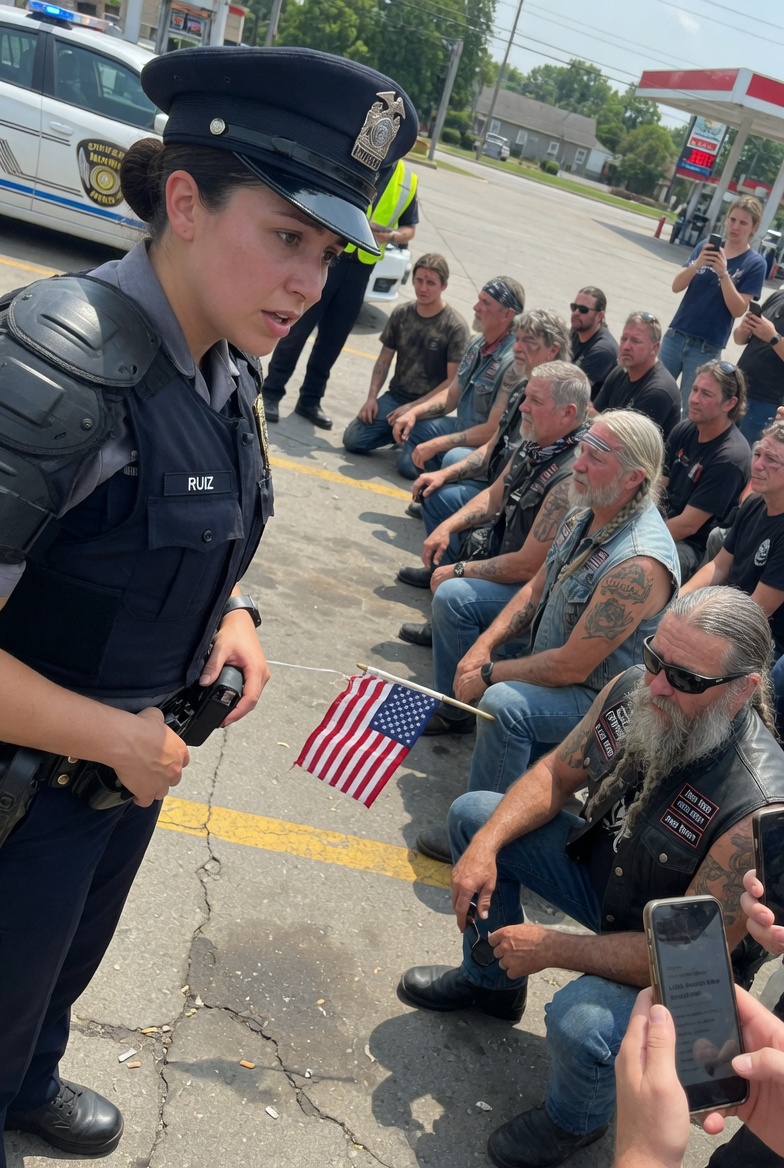
The older biker didn’t lower the flag patch. He held it up between them, the frayed edges catching the wind, the faded threads of red and white and blue still holding their shape after what looked like decades of road dust and sun damage. Officer Ruiz stared at it, then at the faces behind it—faces he’d been trained to read for threat, now arranged into something his training didn’t cover.
“This patch,” the biker said, “belonged to a man who served in a war you’re too young to remember. He came home, made mistakes, lost everything. Died on the street while people walked past him. Same street. Same kind of sun.”
Ruiz’s jaw worked but no words came out.
“We don’t carry flags to make statements. We carry them to remember that every body on the pavement belongs to someone. You didn’t need a patch to remember that. You just remembered.”
The silence that followed wasn’t empty. It was full of re-calibration.
Caleb limped forward until he stood beside the older biker, his hand resting on the man’s shoulder for balance. He looked at Ruiz. “I would have died with the taste of gravel in my mouth and everyone assuming I deserved it. You didn’t assume.” He wiped his eyes with the back of a trembling hand. “I’m an addict. I’ve been an addict for six years. That’s not an excuse. It’s a fact. And facts don’t make people kneel in oil puddles for you. People do.”
Ruiz felt the sting behind his eyes. He blinked hard.
Sergeant Miller, a twenty-year veteran with a graying mustache and a permanent squint, stepped forward and positioned himself beside Ruiz. Not in front of him. Beside him. A subtle shift. “We’re going to clear the lot,” he said quietly. “But these folks aren’t doing anything illegal. So it’s your call how you want to handle this, Officer Ruiz.”
The crowd had grown to maybe eighty people now. Some still filmed. Others had pocketed their phones. A mother pulled her young son closer, not out of fear, but out of reverence. She whispered something in his ear and the boy nodded solemnly.
Ruiz looked at the older biker. “What’s your name?”
“Everyone calls me Preach.”
“Is that your real name?”
The biker allowed a faint, almost imperceptible smile. “It’s the one that stuck. Real enough.”
Ruiz nodded. He glanced at Caleb. “You need to go to the hospital. Get checked out. The Narcan is temporary. You could relapse into respiratory depression.”
Caleb shook his head. “I know the drill. I’ve been Narcanned three times. I’ll go.”
“You promise me?”
The question landed harder than Ruiz expected. Caleb’s face tightened. “Yeah. I promise.”
Preach turned toward the kneeling rows and made a small gesture—two fingers flicked upward. In unison, the bikers rose. Not hurried. Not sloppy. The sound of leather creaking and boots shifting on concrete filled the parking lot like a slow exhale. They didn’t cheer. They didn’t pump fists. They just stood, waiting.
Preach looked at Ruiz one more time. “Not every cop would’ve done what you did. Some would’ve waited for the ambulance. Some would’ve stood by with their hand on their weapon. You didn’t. That matters.”
“I’m just a patrol officer,” Ruiz said. “I’m nobody special.”
“Nobody special is exactly who saves the world,” Preach replied. “One choice at a time.”
He folded the flag patch carefully, tucked it back into his vest, and began walking toward his motorcycle. The others followed without being told. Engines rumbled to life, not roaring, just alive. One by one, they pulled out of the lot, a long ribbon of chrome and black leather threading back onto the highway.
Ruiz stood in the emptying space, his uniform still stained with oil and dust from when he’d knelt on the ground to save a stranger. Sergeant Miller put a hand on his shoulder. “You did good, kid. Now get in your car. I’ll handle the report.”
“I’m fine,” Ruiz said.
“I know you are. That’s what worries me. Get in the car anyway.”
The gas station cleared out slowly. The EMTs loaded Caleb into the ambulance despite his protests that he could ride his bike. Preach had apparently told him in no uncertain terms that his bike would be waiting for him at the clubhouse and that if he so much as argued, he’d be polishing chrome for a month. Caleb had laughed weakly and climbed onto the gurney.
Ruiz sat in his patrol car for twenty minutes after everyone left. The engine was off. The windows were down. The afternoon sun had begun its slow descent toward the tree line, turning the sky the color of a healing bruise. He stared at his hands on the steering wheel. They were steady now. They hadn’t been steady when he’d uncapped the Narcan. They hadn’t been steady when he’d held Caleb’s thrashing body. But they’d done the work anyway. That, he was learning, was the only definition of courage that mattered.
His phone buzzed. A text from his sister in Columbus: “Saw something online. Was that you???” He typed back: “It’s complicated.” Then he put the phone down and closed his eyes.
He thought about his father. A mechanic in Dayton. A man who’d worked sixty-hour weeks and never once complained, whose hands were permanently stained with grease, whose favorite phrase was “showing up is half the job.” His father had died of a heart attack when Ruiz was nineteen. He’d been fixing a transmission in a stranger’s car on a Sunday afternoon because the stranger couldn’t afford a shop. Just showed up. Just did the work.
Maybe that’s where it came from. Maybe that was the thread.
Three days later, Ruiz was back on shift. The world had moved on the way it always does—the gas station incident had flared up online, briefly, then been buried under a dozen newer outrages and heartwarming animal videos. The blogger who had almost posted “Biker Protest Against Police” had instead posted a correction titled “What I Almost Got Wrong” that had, surprisingly, gone modestly viral. She’d interviewed a few bystanders, included a shaky cell-phone video of the kneeling, and written: “I assumed confrontation. I assumed hostility. I was wrong. A young officer knelt first. That’s the part everyone missed.”
Ruiz didn’t read it. He didn’t want to. The attention made his skin itch. He just wanted to do his job, drive his patrol route, and not think about the way fifty people had bowed before him like he was something holy when he knew, with bone-deep certainty, that he was just a twenty-five-year-old who still called his mom every Sunday and sometimes forgot to take his uniform out of the dryer.
But the world doesn’t always cooperate with the simple plans of quiet people.
On a Thursday afternoon, Ruiz pulled into a diner parking lot off Route 42 for his usual coffee stop. The diner was called Mabel’s, a squat brick building with a flickering neon sign and the best black coffee in the county. Mabel herself was seventy-two, sharp-tongued, and had been feeding cops and truckers for four decades. She knew Ruiz’s order by heart: black coffee, no sugar, and a grilled cheese if he hadn’t eaten lunch.
He walked in, the little bell above the door jingling, and immediately felt the shift. The diner wasn’t crowded—just a few regulars at the counter—but the atmosphere was different. People looked up. They held his gaze a moment longer than usual. One old man in a trucker cap nodded slowly, the kind of nod that said I know what you did. Ruiz’s neck went hot.
He slid onto his usual stool at the counter. Mabel poured his coffee without asking, her wrinkled hands steady as a surgeon’s. “Heard you made some friends,” she said, her voice dry as toast.
“News travels,” Ruiz muttered.
“News? Honey, there was a whole pack of ’em in here yesterday. Big fellas. Leather. Very polite. Left a fifty-dollar tip and a note that said ‘thank you for serving the community.’” She slid a folded piece of paper across the counter. “Said to give this to the officer who drinks black coffee. That’s you.”
Ruiz unfolded the note. Handwritten in careful block letters:
Officer Ruiz — We’re having a cookout Saturday. 4PM. The clubhouse is at 1409 Old Mill Road. No cameras. No speeches. Just food. You saved our brother. That makes you family. Come if you want. — Preach
Underneath, in smaller, shakier handwriting: I’ll be there. Hope you come. — Caleb
Ruiz read it three times. Mabel wiped the counter with a rag and pretended not to watch him. “You gonna go?” she asked finally.
“I don’t know,” he said. “It doesn’t feel appropriate.”
“Appropriate,” Mabel repeated, as if tasting the word and finding it bitter. “Boy, you knelt in an oil puddle for a stranger. Appropriate left the conversation about the time you got out of your car. You want my advice? Go. Eat a burger. Let people thank you. The world is short on gratitude and you’re standing there refusing a shipment.”
Ruiz snorted. “You ever think about writing greeting cards?”
“I’d make a killing,” she said. “Now drink your coffee before it gets cold.”
He went.
Saturday arrived humid and thick, the kind of Ohio summer afternoon that made the air feel like warm soup. Ruiz drove his personal vehicle—a ten-year-old Silverado with a dented tailgate—down Old Mill Road, which wound through a tunnel of oak trees before opening into a gravel lot. The clubhouse was a converted barn, weathered gray, with a steel roof and a large wooden deck out front. Motorcycles lined the perimeter like resting animals. A plume of smoke rose from a massive grill near the side, and the smell of charred meat hit Ruiz before he even killed the engine.
He sat in the truck for a full minute. His palms were sweating. He’d come in civilian clothes—jeans, a plain gray t-shirt, no badge, no gun. He felt naked without the uniform, which was probably the point. This wasn’t a police visit. This was something else.
Caleb spotted him first. He was sitting on the deck steps with a can of soda, looking markedly better than he had on the pavement. His color was back. His eyes were clear. He stood up and walked toward the truck with a slight limp, his boots crunching on gravel.
“You came,” Caleb said, a grin breaking through the initial uncertainty.
“I heard there was food,” Ruiz said, stepping out.
“There’s so much food. Preach takes cookouts very seriously. He’s got a brisket that’s been smoking since 4 AM.”
They walked toward the deck together. A few bikers glanced up, nodded, went back to their conversations. No one stared. No one treated him like a curiosity or a threat. He was just… there. A guest.
Preach emerged from the clubhouse carrying a tray of cornbread. He was wearing an apron over his cut, which made Ruiz smile despite himself. “Officer Ruiz,” Preach said. “Glad you came. Grab a plate. Eat. No speeches, like I promised. But there’s someone who wants to meet you.”
He gestured toward a woman sitting in a rocking chair near the grill. She was older—maybe late sixties—with silver hair braided down her back and a face that had seen more than it spoke. Her eyes were sharp and kind. She wore a simple denim shirt and held a glass of sweet tea.
“My mother,” Preach said. “She’s the real president.”
The woman laughed, a rich, throaty sound. “Don’t listen to him. I just keep him from making stupid decisions.” She extended her hand. “They call me Mama V. You must be Daniel.”
Ruiz shook her hand. It was warm and dry, her grip surprisingly firm. “Yes, ma’am. Daniel Ruiz.”
“Ma’am,” she repeated, amused. “Such manners. Sit down, Daniel. Tell me about yourself. Where’d you learn to care about people the way you do?”
He sat on the edge of the deck, feet dangling, plate balanced on his knees. “I don’t know. My dad, maybe. He was a mechanic. He used to fix people’s cars for free if they couldn’t pay. Said a man’s circumstances don’t erase his dignity.”
Mama V nodded slowly. “Your father sounds like a wise man.”
“He was. I miss him every day.”
“The missing doesn’t go away,” she said. “But it changes shape. Turns into something you can carry without stumbling. You’re young. You’ll learn that.”
They ate in companionable silence for a while. The brisket was incredible—smoky, tender, the bark seasoned with something secret and perfect. Ruiz ate two plates and didn’t feel self-conscious about it. The conversations around him were ordinary: someone’s kid graduating high school, a transmission that needed rebuilding, a debate about the best route to Sturgis. None of it fit the image he’d unconsciously absorbed from media and training. These were just people. Complicated, imperfect, loud, generous people.
Later, as the sun began its slow descent and the string lights above the deck flickered on, Caleb sat down beside him. For a long while, neither of them spoke. Then Caleb cleared his throat.
“I owe you more than a thank you,” he said.
“You don’t owe me anything.”
“See, you keep saying that. But I think you’re wrong. I think the world runs on debts of gratitude that nobody ever collects, and that’s why everything’s broken. People don’t let themselves owe. They just take and forget. I don’t want to forget.”
Ruiz turned to look at him. Caleb’s face was raw, earnest, the face of a man who’d seen the bottom and was still climbing out. “How long have you been clean?” Ruiz asked.
“Since that day. Four days. It’s not much.”
“It’s everything,” Ruiz said. “Four days is the beginning of a lifetime.”
Caleb’s eyes glistened. “I’ve tried before. Rehab. Meetings. I always went back. But something about watching fifty people kneel for me… I don’t know. It rewired something. I saw myself through their eyes. I saw a man worth saving. I’d never seen that before.”
“Maybe that’s the real medicine,” Ruiz said quietly. “Not the Narcan. The belonging.”
Caleb wiped his nose with the back of his hand. “You’re too smart to be a cop.”
“Somebody’s gotta do it.”
They both laughed, and the tension broke, and around them the party hummed on—music playing softly from a Bluetooth speaker, children of club members chasing fireflies in the adjoining field, the stars beginning to prick through the darkening sky.
Later that night, Ruiz found himself sitting with Preach on the tailgate of his Silverado, nursing a bottle of water. The older biker was smoking a pipe, the tobacco sweet and earthy. Fireflies blinked in the treeline. The distant sound of a guitar drifted from the deck.
“I lost my brother in 2004,” Preach said abruptly. “Overdose. He was found behind a dumpster in Cincinnati. The officer who responded didn’t even get out of his car. Just called it in and waited. By the time the ambulance arrived, my brother was gone.”
Ruiz absorbed this quietly. “I’m sorry.”
“I hated cops for a long time after that. All of them. Didn’t matter if they were good or bad. The uniform was the same. It took me years to understand that the uniform isn’t the man. And men can choose. You chose.”
“I just did what felt human.”
“That’s exactly my point.” Preach took a slow draw from his pipe. “Most people numb their humanity out of fear. You leaned into yours. That’s not small.”
They sat in silence, the weight of the words settling between them like a stone dropping into still water. Ruiz thought about all the times he’d been afraid on the job—traffic stops where his hands shook, domestic calls where the chaos was so loud he couldn’t hear his own thoughts, moments where the gap between what he was trained to do and what he felt he should do stretched into a chasm. And yet, somehow, he’d chosen. He’d kept choosing.
“Can I ask you something?” Ruiz said.
“Anything.”
“When you knelt—all of you—what were you hoping would happen?”
Preach considered this. “Honestly? Nothing. It wasn’t about outcomes. It was about honor. You honored Caleb with your actions. We honored you with ours. It wasn’t a transaction. It was a mirror. We wanted you to see what you’d done, reflected back at you. So you’d know it mattered.”
“It did.”
“I know.”
The weeks that followed were strange and quiet. The video of the kneeling resurfaced occasionally on social media, usually accompanied by captions like “This cop did something incredible” or “Bikers show respect in unexpected way.” Local news reached out for interviews. Ruiz declined all of them. Sergeant Miller ran interference, telling reporters that Officer Ruiz was “focused on his duties and not available for comment.” Privately, Miller told Ruiz, “You’ve got something rare, kid. Humility in a world that rewards arrogance. Don’t lose it.”
Ruiz didn’t intend to.
He continued his patrols. He wrote tickets when he had to, calmed disputes, helped a lost tourist find their hotel, sat with an elderly woman who’d locked herself out of her house until a locksmith arrived. The ordinary fabric of police work. He thought less about the biker incident, though it never fully left him. It had become a part of his internal geography, a landmark he could navigate by.
One evening, near the end of his shift, he received a call from dispatch about a disturbance at a convenience store on the edge of town. Possible shoplifting. He arrived to find a teenage girl, maybe fifteen, cornered by a store manager who was red-faced and shouting. The girl was trembling, her arms wrapped around herself. A stolen pack of granola bars lay on the counter.
Ruiz approached slowly. “Sir, I’ll handle this. Please step back.”
The manager, still agitated, jabbed a finger at the girl. “She’s a thief. I want her arrested.”
“I understand. Let me talk to her.”
The manager huffed but stepped away. Ruiz crouched down to meet the girl’s eyes. Her name, he would learn, was Mia. Her clothes were clean but worn. Her shoes had holes. She looked hungry in a way that went beyond food.
“What’s going on?” he asked softly.
“I was hungry,” she whispered. “My mom’s working double shifts. We don’t have anything until Friday.”
Ruiz nodded. He looked at the granola bars. Then at the manager. Then back at Mia. “Okay. Here’s what we’re going to do. I’m going to pay for these. And then you and I are going to have a conversation about resources. There are programs. Food banks. You don’t have to steal to eat. But I’m not going to arrest you for being hungry. Do you understand?”
Mia’s eyes filled with tears. She nodded.
The manager protested. “That’s not policy—”
“Policy is a guideline,” Ruiz said, standing. “Humanity is a requirement. I’m the responding officer. I’m exercising discretion. If you want to file a complaint, you know the department number.”
He paid for the granola bars and a bottle of water. He sat outside with Mia for twenty minutes, writing down addresses and phone numbers for local food pantries and a youth outreach program he’d learned about during training. She thanked him, clutching the paper like it was made of gold. When she walked away, back straight despite everything, Ruiz felt a quiet, fierce pride. Not in himself. In her. In the possibility of small salvations.
He thought of his father. Showing up is half the job. The other half, he was realizing, was refusing to let the world harden you into something unrecognizable.
The following Saturday, Ruiz found himself at the Iron Mercy clubhouse again. He hadn’t planned to go. But Caleb had sent a text that morning: “Mama V is making peach cobbler. You’re contractually obligated to appear.” He couldn’t argue with peach cobbler.
When he arrived, the atmosphere was different—quieter, more subdued. A handful of members sat around a fire pit in the backyard, not speaking much, just passing a bottle of something non-alcoholic and watching the flames. Preach was there, his pipe unlit, his expression distant.
“Everything okay?” Ruiz asked, sitting down in an empty chair.
Preach took a long breath. “We lost a member yesterday. Not Caleb. An older guy named Walt. Heart attack. He was 68. Rode until the day before he died.”
“I’m sorry.”
“He was a good man. Made mistakes like the rest of us. But he was good.” Preach stared into the fire. “Death has a way of clarifying things. You realize that all the grudges you’re holding are just noise. All the anger is just fear in disguise.”
Ruiz didn’t respond with platitudes. He just sat. The fire crackled. The night deepened.
After a while, Mama V came out with the cobbler. She served it in mismatched bowls, the warm sweetness cutting through the somber air. She sat beside Ruiz and said, “You fit here, you know. Don’t think we haven’t noticed.”
“I’m just a cop.”
“You keep saying that like it’s a flaw. It’s not. You’re a cop who knows how to be a human being first. That’s rare. That’s worth protecting.” She took a bite of cobbler. “You’re part of this family now, whether you like it or not. The door’s open. Always.”
Ruiz looked around the fire pit at the faces illuminated by flickering orange light. Tattooed men and women who’d been judged their whole lives. A teenager from the convenience store incident. A man who’d died on the pavement and come back. They had nothing in common with him on paper. And yet.
And yet.
Family is not always the one you’re born into. Sometimes it’s the one that kneels for you on a sun-scorched parking lot and refuses to let you forget that you matter.
Winter came. The Ohio cold settled in like a permanent ache. The roads iced over. The motorcycles went into storage. The clubhouse became a place of indoor gatherings—board games, shared meals, long conversations by the wood stove. Ruiz visited when he could. He’d been promoted to Senior Patrol Officer, a small step that came with a modest pay bump and a lot more paperwork. Sergeant Miller retired. Ruiz spoke at his going-away party, his voice cracking when he said, “You taught me that this job is about people, not procedures.”
Miller had hugged him—a rare gesture from a man who’d once told him, “Emotions are for off-duty.” People change. That’s the whole point.
Caleb celebrated six months of sobriety. The club threw a party. There was cake, non-alcoholic cider, and a speech from Caleb that left no one dry-eyed. He talked about the moment he woke up on the pavement, angry and confused, and saw a young cop’s face hovering over him. “I tried to hit him,” Caleb said. “And he just… stayed. He didn’t flinch. He didn’t leave. That’s the first time in years I felt like someone wasn’t going to abandon me. And I realized that if a stranger could stay, I could stay too. I could stay in my own life. I could fight for it.”
Ruiz, standing at the back of the room, felt something unlock inside his chest. Not pride. Not satisfaction. Just a quiet, overwhelming rightness. He had done one thing—one simple, human thing—and it had rippled outward in ways he couldn’t have predicted. The biker kneeling on concrete had been their ripple back to him. And now the ripple continued, passing through Caleb’s sobriety, through Mia’s new part-time job at the diner, through the teenagers who’d seen the video online and messaged Ruiz to say, “I want to be a cop who’s like you.”
The world wasn’t fixed. The world would never be fixed. But it could be nudged. One choice at a time.
Spring arrived with its usual softness—crocuses pushing through thawing soil, the first warm day that made everyone roll their windows down and breathe deep. The Iron Mercy MC planned their first major ride of the season, a charity event to raise money for a local addiction recovery center. They called it “Caleb’s Run.”
Caleb had been clean for nine months. He’d become a sponsor to two other men in the program. He’d gotten a job at a motorcycle repair shop. He was, in every measurable way, a different person. But he insisted he wasn’t. “I’m the same person,” he told Ruiz. “I just finally believe I’m worth the effort.”
The ride assembled in the parking lot of the community center on a Saturday morning. Over a hundred bikes. Riders from different clubs, different towns. A few off-duty officers joined, wearing their cuts over civilian clothes. Ruiz was there in his Silverado, because he’d never learned to ride. Preach had offered to teach him, and he’d accepted for the summer.
Before the ride, Mama V gave a blessing. She stood on a flatbed trailer, her silver hair loose, her voice carrying without a microphone. “We ride today for everyone who’s still fighting. For everyone who didn’t make it. For the families who buried someone too soon. And we ride to remind ourselves that judgment is a cage, but compassion is a highway. Open road. No tolls. Just souls.”
The engines started. The sound was immense, a rolling thunder of pistons and exhaust. Ruiz stood by his truck, watching the parade pull out. Caleb rode near the front, his bike gleaming, his posture straight. He caught Ruiz’s eye and raised two fingers in a peace sign. Ruiz returned the gesture.
He thought about the day it all started. The gas station. The oil puddle. The crowd that had assumed the worst. The silence that had followed the kneeling. He thought about how perception could shift like a weather front, and how one action could rewrite the narrative entirely. Not because the narrative was false—there were real problems, real tensions between law enforcement and communities—but because the narrative was incomplete. It always was. Stories needed people willing to complicate them with truth.
He got into his truck and drove home, the rumble of the bikes fading behind him. He had a shift tomorrow. There would be more calls. More moments where he could either harden or stay soft. He’d keep choosing soft. Not weak. Soft. Open. Human.
The kind of man who kneels in oil and gravel.
The kind of man who stays.
Two months later, on a Tuesday afternoon, Ruiz was dispatched to a residential address for a report of a man in crisis. When he arrived, he recognized the house. The peeling paint. The broken porch step. He’d been here before, a year ago, for a noise complaint. The resident was a veteran named Earl, a man in his seventies who suffered from severe PTSD and had alienated most of his neighbors.
Ruiz approached the door carefully. He could hear shouting inside—not at anyone, just into the void. The sound of a man wrestling with demons no one could see. He knocked softly. “Earl? It’s Officer Ruiz. We met last year. I’m not here to cause trouble. I just want to talk.”
The shouting stopped. Footsteps. The door cracked open. Earl’s face was haggard, unshaven, his eyes wild with a mixture of fear and exhaustion. “You again.”
“Yeah, me again. Can I come in? I brought coffee.”
Earl stared at the cup in Ruiz’s hand. “Is that from Mabel’s?”
“Black, no sugar. Same as mine.”
A long pause. Then Earl stepped back and let him in.
The house was cluttered but not dirty. Framed photographs on the wall—Earl in uniform, Earl with a woman who must have been his wife, Earl holding a baby. A life, once orderly, now fragmented. Ruiz sat on a worn couch and handed Earl the coffee. They sat in silence for several minutes.
“They want to put me away,” Earl finally said. “The neighbors. They called you, didn’t they? They think I’m crazy.”
“I think you’re hurting,” Ruiz said. “There’s a difference.”
“Hurting. Yeah. That’s a word for it.” Earl’s voice cracked. “You ever see things you can’t unsee? Do things you can’t undo?”
Ruiz thought of Caleb’s face, blue-lipped and dying. He thought of the teenage girl, Mia, hungry and ashamed. He thought of his father’s hands, still and cold. “Not the same way,” he said. “But yes.”
Earl looked at him, surprised. “You’re honest.”
“I try to be.”
“Most cops aren’t.”
“Most cops haven’t had fifty bikers kneel for them in a parking lot. It changes your perspective.”
Earl let out a hoarse, unexpected laugh. “I saw that. On the news. That was you?”
“That was me.”
“Well, I’ll be.” Earl sipped his coffee. The tension in his shoulders eased, just a fraction. “You’re not what I expected.”
“Neither are you,” Ruiz said.
They talked for an hour. Ruiz didn’t try to fix anything. He just listened. Earl talked about the war, about his wife who’d died of cancer six years ago, about the son who never called, about the nights when the walls felt like they were closing in. It wasn’t a resolution. It wasn’t a cure. But it was a connection, and sometimes that was enough.
When Ruiz left, he gave Earl his personal number. “If it gets bad,” he said, “call me. Not dispatch. Me.”
Earl held the card like it was a grenade with the pin still in. “Why would you do this?”
“Because someone did it for me. Not directly. But I learned it somewhere. You pay it forward.”
The year turned. Ruiz learned to ride a motorcycle, a beat-up Honda Shadow that Preach helped him restore. He joined the Iron Mercy MC as an honorary member—not patched, but welcomed. He went on rides, attended cookouts, sat through memorials. He arrested people when he had to, but he also let people go when he could. He bought granola bars for hungry kids. He drank coffee with grieving veterans. He stood between conflict and escalation whenever possible, not because he was naive, but because he’d seen what happens when people rushed to judgment without first rushing to understand.
The blogger who’d nearly posted the wrong story eventually wrote a long-form piece about the incident, interviewing Ruiz, Preach, Caleb, and several bystanders. The piece won a local journalism award. The title was “The Kneeling: How One Afternoon Rewrote a Small Town’s Story.” Ruiz didn’t read it until months later, and when he did, he wept. Not from pride. From the overwhelming recognition that his small action had been seen, captured, and reflected back. That it mattered.
Caleb marked one year of sobriety with a tattoo: a single word on his forearm, in Ruiz’s handwriting. Stay. He’d asked Ruiz to write it on a napkin one day, and then taken it to a tattoo artist. The ink was permanent now. So was the choice.
Preach continued to lead the club with quiet authority. He never asked Ruiz to compromise his job, and Ruiz never asked the club to be anything other than what it was. The boundary was clear, respected, and somehow stronger for being acknowledged. They were not allies in any formal sense. They were something rarer: friends who disagreed on many things, yet shared a fundamental belief that humans were worth saving.
On the one-year anniversary of the overdose, the club held a small ceremony at the gas station. The owner, who’d initially complained about the spectacle, had since become an unlikely supporter. He’d installed a bench near the air pump with a small plaque: In honor of second chances. May we all receive one.
Caleb stood beside the bench, clean and healthy, and spoke. “A year ago, I was dying right here. On this concrete. And the world was ready to let me go. But one person wasn’t. One person knelt down and refused to give up. That person taught me that I was worth something. And if I’m worth something, so is everyone else. Every addict. Every outcast. Every person you’ve written off. Worth something. Worth everything.”
Ruiz stood at the back of the small crowd, out of uniform, his badge in his pocket. He wasn’t here as a cop. He was here as a friend. That distinction, he had learned, was the most important one of his life. The badge was a tool. The friendship was the point.
After the ceremony, Preach pulled him aside. “You know this all started because you didn’t hesitate, right?”
“I almost did,” Ruiz admitted. “For a split second, I saw the leather and the tattoos and I thought, ‘This could be dangerous.’ But then I saw his face. His lips were blue. None of the rest mattered.”
“That’s the secret,” Preach said. “When you see the face, you can’t unsee it. Most people never look.”
That night, Ruiz sat alone in his apartment, the window open to let in the spring air. He thought about all the moments that had led him here: his father’s grease-stained hands, the Narcan kit in his patrol bag, the fifty bikers who’d knelt and shattered a crowd’s assumptions. He thought about Mia, who now worked part-time at Mabel’s and was saving for college. He thought about Earl, who’d called him three times over the winter and was now in therapy, slowly healing. He thought about Caleb, whose life was a miracle of ordinary persistence.
He thought about himself. The young cop who’d been so unsure, so stiff, so desperate to do the right thing that he’d almost missed it. He wasn’t that man anymore. He was still unsure sometimes. Still afraid. But he knew now that courage wasn’t the absence of fear. It was the decision to act despite it. To stay. To kneel. To choose compassion when cruelty would have been so much easier.
Outside, a motorcycle rumbled past—probably one of the club members heading home. The sound faded. The night settled into silence. And Ruiz, with a full heart and tired bones, allowed himself a small, quiet smile. He’d done a good thing. Not a perfect thing. Not a world-changing thing. But a good thing. And in a world that often felt starved for goodness, a single good thing could echo forever.
He closed his eyes. Tomorrow he’d put on the uniform again. He’d answer calls. He’d do his job. He’d keep choosing, over and over, to be the kind of man his father would have been proud of. The kind of man who knelt first.
Stay.
That’s what Caleb’s tattoo said.
And that’s exactly what Officer Daniel Ruiz intended to do.