PART 2:
The doctor’s whisper hung in the air like a spent shell casing.
— You.
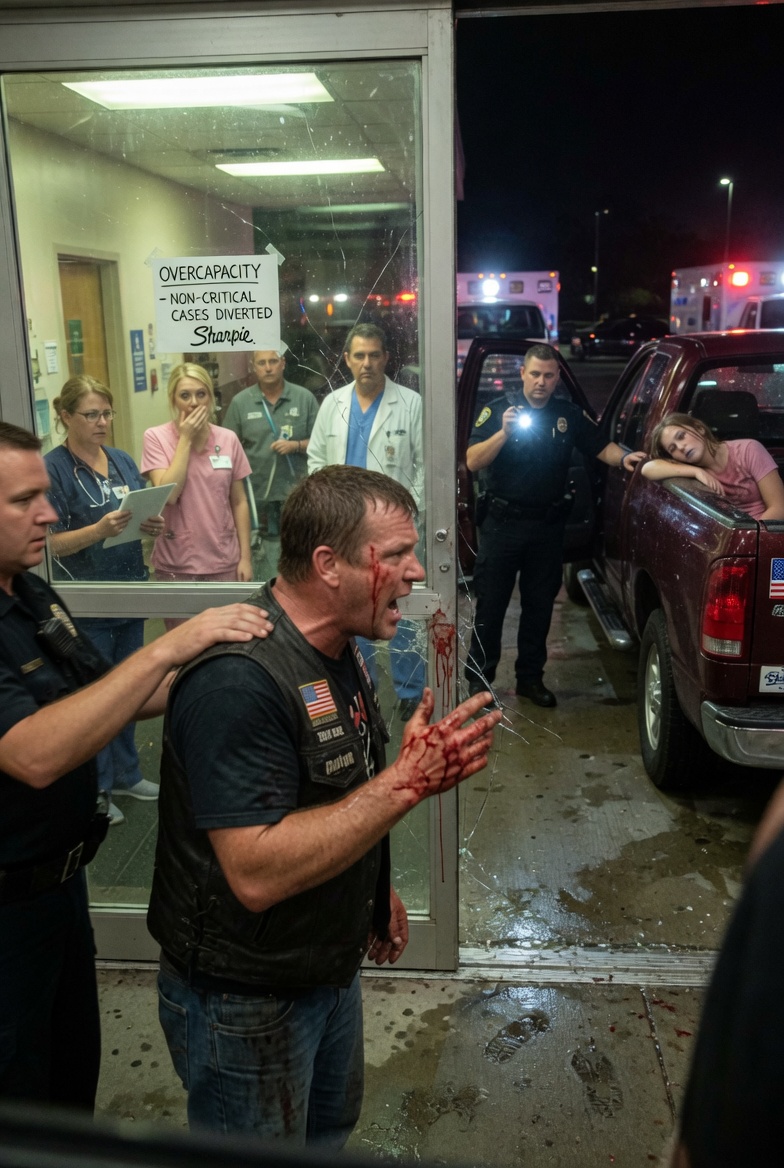
My bloody knuckles throbbed in time with the red-and-blue lights splashing across the parking lot. The two police officers froze mid-step, hands hovering near their belts, glancing between me and the man in the white coat who had suddenly stopped being a bystander and started being the only thing standing between my daughter and a body bag.
I didn’t answer him. Couldn’t. My throat had sealed shut around a name I hadn’t spoken in fifteen years — a name I didn’t even know, not really, because that night on Highway 27 we hadn’t exchanged pleasantries. Just terror. Just rain. Just the sharp smell of gasoline pooling under twisted metal.
He took a step closer, ignoring the fractured glass, ignoring the security guard whose hand was still clamped on my shoulder. His eyes moved from my face to my truck, to the open passenger door where the second officer was now checking Emma’s pulse with two fingers pressed against her neck.
— She’s barely there, — the officer called out, voice tight. — Respiratory rate’s maybe six a minute.
The doctor’s expression hardened into something I recognized — the same look he’d worn fifteen years ago when he realized his leg was pinned and the fuel tank was leaking. Not panic. Calculus.
— Get a gurney. Now, — he said, and the authority in his voice cut through the lobby noise like a scalpel. — I want a crash cart at Bay Three, respiratory on standby, and somebody page Dr. Liu from immunology.
The same charge nurse who’d told me they were diverting non-critical cases stood rooted behind the desk, mouth open.
— Dr. Mercer, we’re at—
— I don’t care what we’re at. — He didn’t shout. Didn’t need to. — That girl has anaphylaxis written all over her and she’s maybe five minutes from a surgical airway. Move.
The word “surgical airway” landed in my gut like a fist. I’d watched enough combat medic videos during my stint as a volunteer firefighter years ago to know what that meant — a scalpel cutting into my daughter’s throat, a tube forced through cartilage, all because a system had decided she wasn’t urgent enough.
The nurse disappeared. Two orderlies burst through the double doors with a gurney clattering across the pavement. The doctor — Dr. Mercer, I now had a name, a name I’d carry into every prayer I didn’t know how to say — was already pulling on gloves as he jogged toward my truck.
The security guard’s grip finally loosened. I think he realized he’d been restraining a father, not a threat. Or maybe he just didn’t want to be the guy who got between a doctor and a dying child. Either way, his hand fell away, and I stumbled forward, knees weak, boots scraping asphalt.
— Stay back, sir, — one officer said, not harsh now, just procedural. — Let them work.
I stopped. Watched them lift Emma onto the gurney — watched her head loll, her hair spilling over the edge like a dark curtain closing. Watched the doctor press a stethoscope to her chest, then shine a penlight into her fixed, dilated pupils. Watched the orderlies wheel her through those same glass doors that had been a barrier ten minutes ago.
Now they were wide open.
The lobby had transformed. The cluster of gawking patients and staff had parted like a sea, and all the efficiency that had been missing earlier was suddenly in overdrive. Monitors beeped. Someone called out vitals I couldn’t process. A respiratory therapist appeared from nowhere with an oxygen mask already flowing, strapping it over Emma’s pale face as the gurney disappeared down the hallway.
And I was still standing outside, hand bleeding, sirens dying down, the cracked glass reflecting a man I barely recognized.
One officer turned to me.
— You’re the father?
— Yeah.
— We need to talk about this, — he gestured at the spiderwebbed glass.
— Can it wait? — My voice cracked, finally cracked, and I didn’t care who heard it. — Can it wait until I know if my daughter is dead or not?
The officer exchanged a look with his partner. Something passed between them — maybe the recognition that arresting a distraught father while his child fought for her life wasn’t good optics, or maybe just the simple human decency that sometimes surfaces in people who’ve been trained to suppress it.
— We’ll be in the waiting area, — the second officer said. — Go.
I didn’t thank them. Didn’t have the space for gratitude yet. I just walked through those sliding doors, past the intake desk where the nurse wouldn’t meet my eyes, past the security guard who was now talking quietly into his radio, past the scattered chairs and the vending machine and the cheap magazines, until I reached the double doors that led to the treatment bays.
A nurse blocked me.
— Sir, you can’t go back there.
— I’m her father.
— I understand. — Her voice was gentler than the others had been. Young, maybe twenty-five, dark circles under her eyes that suggested she’d been on shift too long. — But they’re working on her now. The best thing you can do is wait in the family room. I’ll come get you the second there’s news.
I looked down at my knuckles. The gauze someone had wrapped around them was already soaked through, bright red seeping into white.
— You should get that stitched, — she added.
— It can wait.
She nodded, not arguing, and led me to a small room with a couch, a box of tissues, and a painting of a lighthouse that someone had probably chosen because it was supposed to be calming. It wasn’t. It just reminded me of storms.
She closed the door softly, and I was alone with the hum of the air conditioner and the memory of rain.
Fifteen years earlier, I’d been riding a ’92 Softail down Highway 27 on a night that felt a lot like this one — humid, heavy, the sky threatening violence. I was twenty-eight years old, fresh out of a bad relationship, working construction by day and drinking too much by night. The motorcycle was the only thing I had that made sense.
I remember the storm breaking open like a wound. Rain so thick my headlight barely cut through it. Wind shoving me sideways across the lane lines. I should have pulled over, should have waited it out under an overpass, but I was young and stupid and had something to prove to nobody in particular.
The car ahead of me was a dark sedan, taillights blurry in the downpour. I saw it hydroplane first — saw the rear end fishtail, then snap sideways, then roll. Two, three times. Metal screaming against asphalt. Sparks cutting through the rain like distress flares.
I braked hard, felt my rear tire slide, corrected. By the time I stopped, the sedan was upside down in the ditch, wheels still spinning, and something dark was leaking from the undercarriage that smelled sharp and chemical.
Gasoline.
I killed my engine, dropped the kickstand, ran.
The driver was unconscious. Mid-thirties, maybe, dark hair matted with blood, face slack. His leg was pinned under the crumpled dashboard, and the smell of fuel was getting stronger, pooling around the wreckage like a countdown.
I didn’t think. I grabbed the door frame and pulled until I felt something in my shoulder tear. I pulled again. The metal groaned, gave way maybe four inches. Enough. I reached in, hooked my arms under his, and dragged him out of that car with a strength I didn’t know I had, dragging us both through wet grass and mud and broken glass until we were twenty yards away and the rain was washing gasoline off our skin.
The sedan didn’t explode. That only happens in movies, mostly. But the engine block sparked once, twice, and a small fire kindled near the fuel line, and if he’d still been inside he would have breathed smoke and flame instead of oxygen.
I checked his pulse. Weak, but there. His leg was bent wrong, compound fracture from the look of it. I used my belt as a tourniquet, hands shaking, rain blinding me. Then I heard sirens — someone else must have called it in — and I did something that still feels strange to explain.
I left.
Not because I didn’t care. Because I didn’t want to be a hero. Because I’d had enough of people looking at me like I was either a threat or a charity case, and I didn’t know which one the paramedics would pick. Because my bike was still running and the road was still there and I had never learned how to stay in one place long enough to be thanked.
I rode away with gasoline on my jeans and a stranger’s blood drying under my fingernails.
I never knew his name.
Until tonight.
The family room door opened at 10:42 p.m.
Dr. Mercer stood in the doorway, still in his white coat, a smear of something dark on his sleeve. He looked tired. Not the tired of a long shift — the tired of someone who’d just spent forty minutes wrestling a child back from the edge of something irreversible.
— She’s stable, — he said.
The word hit different this time. Not dismissive. Not distant. A life raft.
— Her airway was swelling shut, — he continued, stepping inside and closing the door behind him. — Anaphylactic reaction. We think it was a bee sting — there’s a puncture mark on her right forearm, swelling at the site. She went into shock, her blood pressure tanked, and by the time we got her on the table she was seconds away from respiratory arrest.
I couldn’t speak.
— We gave her epinephrine, steroids, fluids. She’s on oxygen. She’s conscious now — groggy, but conscious. She’s asking for you.
The sob that escaped me wasn’t loud. Wasn’t dramatic. It was just a single, shaky exhale that carried fifteen years of rain and fear and the ghost of a highway I’d never really left.
— Can I see her?
— In a minute. — He pulled a chair closer and sat down across from me, elbows on his knees, hands clasped. Up close, I could see the faint scar on his forehead, the one that traced a jagged line from his hairline to his brow. A scar I’d watched form while I tightened my belt around his thigh.
— It was you, — he said quietly. — That night. Highway 27.
— Yeah.
— I tried to find you. After I got out of the hospital. The police report said an unidentified motorcyclist pulled me from the vehicle and left before first responders arrived. I searched for years. Posted on forums. Called bike shops in three counties.
— I’m not easy to find.
— Apparently not.
A silence settled between us, heavy but not uncomfortable. Two men who’d shared a moment of absolute crisis and then lived entire lives on opposite sides of it.
— Why’d you leave? — he asked.
— I wasn’t looking for gratitude.
— That’s not an answer.
I looked down at my bandaged hand. The bleeding had stopped.
— I grew up in a town where people like me — people who look like me — were always assumed to be the problem. I learned early that if you stay long enough to be thanked, you also stay long enough to be questioned. ‘What were you doing on that road at that hour? Why were you riding in a storm? What’s your criminal record?’ I didn’t have one, by the way. Not then. But I got tired of proving it.
He nodded slowly.
— I became a doctor because of you, — he said. — I was a sales rep before the accident. Spent my life selling things nobody needed. After that night, I realized I wanted to be someone who could do what you did — show up when it mattered. I enrolled in pre-med the next year. I was thirty-four years old, starting over.
I didn’t know what to say to that. So I said nothing.
— And tonight, — he continued, — you punched through a hospital door to get your daughter help. And I almost didn’t recognize you until I saw the tattoo.
I glanced at my left forearm, exposed where my sleeve had ridden up. The ink was faded now, twenty years old, but still legible: a phoenix rising from flames, wings spread, beak open in a silent scream. I’d gotten it after my brother died. A reminder that some things can burn and still come back.
— That night, — he said, — when you pulled me out, I was going in and out of consciousness. But I remember seeing that tattoo. The fire. The bird. I thought I was hallucinating. Then tonight, when I saw your hand bleeding and your sleeve pushed up, I knew.
The air conditioner cycled off, and the room fell into a deeper quiet.
— You saved my life, — he said.
— You just saved my daughter’s.
— That’s not the same.
— It’s exactly the same.
He held my gaze for a long moment. Then he stood, extended his hand — the same hand I’d seen shaking as he strapped an oxygen mask to Emma’s face an hour ago.
— Ryan Mercer, — he said.
— Michael Cole.
We shook. His grip was firm, warm, a doctor’s grip.
— Come on, — he said. — She’s waiting.
Emma was propped up in a hospital bed with an IV line trailing from her arm and an oxygen cannula under her nose. The swelling in her face had started to recede, but her lips were still a shade too pale, her eyelids heavy. When she saw me, she tried to smile, and the effort of it nearly undid me.
— Dad… you look like crap, — she whispered.
— Learned it from you, — I managed, pulling a chair up to her bedside.
Her hand found mine — the uninjured one — and held on with the weak, fierce grip of a kid who’d already been through more than most adults.
— What happened?
— Bee sting, — I said. — You’re allergic. Apparently.
— I don’t remember a bee.
— It was on your arm. You probably didn’t feel it.
She closed her eyes, breathed in the oxygen.
— I remember being in the truck. You were carrying me. Then… nothing.
— You passed out.
— Did I scare you?
The question, asked with such small, simple sincerity, cracked something open in my chest that I’d been holding together with adrenaline and anger.
— Yeah, Em. You scared me pretty good.
— Sorry.
— Don’t you dare apologize. — I squeezed her hand. — None of this was your fault.
The nurse came in to check her vitals, a different one than before — older, softer, the kind of nurse who’d been doing this long enough to know that families needed reassurance as much as medicine. She adjusted Emma’s IV, asked about pain levels, made notes on a tablet.
— Dr. Mercer said you’ll need to stay overnight for observation, — she told Emma. — Probably go home tomorrow afternoon if everything looks good.
— Can my dad stay?
— There’s a cot in the room. We’ll make it work.
I could have kissed her for that.
Later that night — 2:16 a.m., the same time the original timeline had etched into my memory — Emma was asleep, her breathing steady, the monitor beeping a soft, rhythmic reassurance. I was stretched out on the cot they’d brought in, staring at the ceiling, not sleeping.
The door opened quietly, and Dr. Mercer stepped in. He’d changed out of his scrubs, now wearing a button-down shirt and slacks, a jacket slung over his arm. Off-duty, but still here.
— Thought you might be awake, — he whispered.
— Can’t sleep.
— Me neither. Not after tonight.
He pulled the visitor chair closer, sat down, kept his voice low so he wouldn’t wake Emma.
— The police decided not to press charges, — he said. — I explained the situation. The hospital isn’t pursuing anything either, given the circumstances. The glass is already replaced.
— That was fast.
— Hospitals are good at fixing things quickly when they’re motivated. — A pause. — I also filed an incident report. About the intake protocol. About how a child in anaphylactic shock was classified as non-critical because someone at the desk didn’t look up from their screen long enough to see her.
— Will it change anything?
— It might. I’m not naive about bureaucracy. But I’m also the head of emergency medicine now, so my reports carry weight.
I turned my head on the thin pillow to look at him.
— You did all that in a few hours?
— I owed you fifteen years of debt. Consider this a down payment.
We sat in silence for a while, the only sounds the beep of the monitor and the distant hum of the HVAC.
— Can I ask you something? — he said eventually.
— Go ahead.
— Why’d you punch the glass? Why not just… I don’t know, yell louder? Make a scene inside?
I thought about it.
— Because I’d already made a scene inside. I’d carried my unconscious daughter through those doors and asked for help, and they told me to wait. I was calm. I was polite. I did everything you’re supposed to do. And it didn’t work. So I needed something that couldn’t be ignored.
— The glass.
— The glass.
He nodded, as if that made perfect sense.
— I’ve been on the other side of that desk, — he admitted. — Not tonight, but other nights. You get numb. You see so many people, so much panic, you start filtering. ‘This one’s dramatic. This one’s exaggerating. This one’s just looking for pain meds.’ You build walls because you have to, to survive the shift. But sometimes those walls keep out the people who actually need you.
— Tonight, I was the one who looked dramatic.
— You looked like a threat. — He didn’t soften it. — Tattoos, leather, loud voice. The staff saw what they expected to see. It’s not right, but it’s real.
— I know. I’ve been seen that way my whole life.
He was quiet for a moment.
— My daughter’s fourteen, — he said finally. — Her name’s Olivia. She’s got allergies too — peanuts, shellfish. We carry an EpiPen everywhere. If she ever has a reaction and we end up in an ER, I hope someone like you is in the waiting room. Someone who won’t take no for an answer.
— I hope you never have to find out.
— So do I.
The next morning, sunlight cut through the blinds in pale stripes. Emma woke up hungry — always a good sign — and managed half a tray of hospital scrambled eggs before the fatigue pulled her back under. I sat by the window, watching the parking lot fill with the day shift, the same lot where I’d stood twelve hours earlier with blood on my knuckles and terror in my throat.
The charge nurse from the night before knocked on the doorframe. It was the same woman who’d told me they were diverting non-critical cases. She looked like she hadn’t slept.
— Can I come in?
— It’s a hospital. I don’t think I can stop you.
She winced, but stepped inside, closing the door gently behind her.
— I owe you an apology, — she said. — I was the one who classified your daughter. I looked at her vitals on the screen and didn’t see anything alarming. She was talking, her color was okay, her blood pressure hadn’t dropped yet. By the time you came back, I didn’t reassess. I just defaulted to protocol.
I didn’t respond immediately. Part of me wanted to unload on her — to tell her that her protocol had nearly killed my child, that her screen couldn’t measure fear, that her “non-critical” label had been a lie her own system had told her. But I looked at her face, at the exhaustion and the genuine regret, and I thought about what Dr. Mercer had said about walls.
— I’m not going to pretend it’s okay, — I said. — Because it’s not. My daughter almost died in a parking lot while you were looking at a screen.
— I know.
— But you’re here now. That counts for something. Most people wouldn’t have come.
She nodded, her throat working.
— I’ve been a nurse for eighteen years, — she said. — I’ve never had a patient’s father punch through a door to get my attention. I don’t ever want to be the reason that happens again.
— Then don’t let the screen be the only thing you see.
She left after that, and I didn’t know if the conversation would change anything long-term, but it felt like a door cracking open. Not the kind you have to break — the kind that opens because someone finally decided to reach for the handle.
Emma was discharged at 3:00 p.m. that afternoon. Dr. Mercer signed the paperwork himself, along with a prescription for an EpiPen and a referral to an allergist. He walked us to the entrance — the same entrance where the glass had been replaced so seamlessly you’d never know it had been fractured.
A security guard I didn’t recognize nodded as we passed. The one from the night before was off-duty now, probably at home trying to forget the shift. I hoped he’d forget me. I hoped he’d remember Emma.
— Michael, — Dr. Mercer said as we reached the truck. — I meant what I said last night. If you ever need anything — and I mean anything — you call me.
He handed me a business card. White, simple, embossed with the hospital logo.
— You already paid your debt, — I said.
— A debt like that doesn’t get paid in one night. — He smiled, tired but genuine. — It’s an installment plan.
I put the card in my pocket.
— Thank you, Ryan.
— Thank you, Michael. For fifteen years ago. And for reminding me why I do this.
Emma, bundled in a hospital blanket she’d refused to give up, tugged at my sleeve.
— Dad, who is he?
I looked at Dr. Mercer — at the scar on his forehead, at the hands that had saved my daughter, at the man who had been a stranger in a wrecked sedan and was now something closer to a friend.
— Someone I met on the road a long time ago, — I said. — I’ll tell you the story sometime.
— Is it a good story?
I glanced at the ER doors, at the invisible seam where new glass met old frame.
— It’s a story about what happens when you don’t leave someone behind.
She seemed to accept that, climbing into the passenger seat with the blanket wrapped around her like armor. I closed her door, shook Dr. Mercer’s hand one more time, and climbed behind the wheel.
As I started the engine, Emma reached over and touched my bandaged hand.
— Does it hurt?
— A little.
— Why did you do it? Punch the glass?
I pulled out of the parking lot, the hospital shrinking in the rearview mirror.
— Because sometimes, — I said, — people don’t hear you until something makes noise.
She was quiet for a moment, processing.
— That’s kind of sad.
— Yeah. It is.
— But you made noise.
— I did.
She leaned her head against the window, the afternoon sun catching the color that had finally returned to her cheeks.
— Good, — she said. And closed her eyes.
The drive home took forty minutes. We passed the overpass where I’d once sheltered during a storm, the diner where Emma and I ate pancakes every Sunday, the stretch of Highway 27 that I’d avoided for fifteen years without fully understanding why. Today, I drove it deliberately. The asphalt was dry, the sky clear. No wreckage. No rain. Just the hum of the engine and the soft rhythm of my daughter’s breathing — alive, steady, present.
When we pulled into the driveway of our small house on the edge of town, the neighbor’s dog barked a greeting. The front porch light was still on from the night before, a yellow beacon that I’d forgotten to turn off in the chaos. The sight of it — that small, ordinary detail — undid something in me. I sat in the truck for a full minute, hands on the wheel, while Emma stirred beside me.
— Dad? You okay?
— Yeah. I just… need a minute.
She didn’t push. She just waited, the way she’d learned to wait during all the hard years after her mother left, during the lean months when the construction work dried up, during every moment when I’d been less than the father she deserved but more than the man I thought I was.
— I love you, Em.
— I know, Dad. I love you too.
— I mean it. I don’t say it enough.
— You say it plenty. — She unbuckled her seatbelt, still wrapped in the hospital blanket. — But you can say it again if you want.
— I love you.
— There. Twice in one minute. New record.
I laughed — a cracked, broken laugh that felt like the first rain after a drought. Together, we walked up the porch steps, past the peeling paint and the loose floorboard I kept meaning to fix, and into the house that held our entire world.
That night, after Emma was asleep in her own bed, I sat on the back porch with a beer I didn’t drink and looked up at the stars. The business card Dr. Mercer had given me was still in my pocket. I pulled it out, turned it over in my hands.
On the back, in blue ink, he’d written a note I hadn’t noticed before:
“You told me once that you didn’t stay for thanks. Tonight, I’m not thanking you. I’m telling you that what you did mattered. Both times. — R.M.”
I folded the card carefully and tucked it into my wallet, behind Emma’s school photo and the faded picture of my brother that I’d carried since the funeral.
The night was quiet. No sirens. No shattering glass. Just the crickets and the distant hum of the highway and the knowledge that somewhere, in a hospital on the other side of town, a man with a scar on his forehead was probably looking up at the same stars, thinking about a storm and a motorcycle and a stranger who refused to let him burn.
I didn’t know if I believed in fate. But I believed in the long arc of consequence — the way a single decision, made in the rain with gasoline on your hands, could ripple forward across fifteen years and save the life of the person you loved most.
I finished my beer. Went inside. Checked on Emma one more time — watched the rise and fall of her chest, the peaceful slack of her face, the blanket pulled up to her chin.
Then I went to bed, and for the first time in years, I slept without dreaming of rain.
The weeks that followed were a slow return to normalcy, or something like it. Emma’s allergist confirmed the bee venom allergy and prescribed an EpiPen, which she now carried everywhere in a small pouch decorated with Sharpie doodles of bees wearing tiny skull-and-crossbones hats. Her humor had always been darker than mine.
The hospital never billed me for the broken glass. I called to ask about it, was transferred three times, and finally ended up speaking to a woman in administration who said, and I quote, “There’s no record of any damage to hospital property on that date.” I didn’t argue.
Dr. Mercer — Ryan — and I stayed in touch. Not constantly, but enough. He texted occasionally to check on Emma, sent articles about allergy research, invited us to a barbecue at his house one Saturday. I went, reluctantly, and met his wife Claire and his daughter Olivia, who was fourteen and fierce and immediately bonded with Emma over a shared hatred of middle school math.
Sitting on his back deck with a plate of grilled chicken, watching our daughters laugh about something on a phone screen, I felt something I hadn’t felt in a long time: belonging. Not the belonging of a club or a crew, but the quiet belonging of knowing you’d stumbled into someone’s life and decided to stay.
— You know, — Ryan said, settling into the chair next to me, — I still think about that night. Not the crash — the part after. When you disappeared.
— I’m not great at goodbyes.
— Clearly. — He took a sip of his soda. — But here’s the thing. You disappearing meant I never got to put a face to the person who saved me. For fifteen years, you were just… a ghost. A myth. The guy on the motorcycle. And then you walked back into my ER looking like you’d fight the whole building barehanded.
— I almost did.
— You almost did. — He laughed, but it was a serious laugh, the kind that acknowledges how close things came to going differently. — I’m glad you didn’t. I’m glad I was there. I’m glad it was me.
— Me too.
The afternoon stretched on, golden and unhurried. Emma showed Olivia how to draw a cartoon bee on her EpiPen case. Claire brought out a pie she’d made from scratch. The sun dropped below the tree line, and the porch lights flickered on, and for a few hours, the world felt like a place where things could work out.
But life doesn’t let you stay on the porch forever.
Two months after the hospital incident, I lost my job. The construction company I’d worked for went under — owner filed bankruptcy, skipped town, left twenty guys with unpaid wages and no warning. I came home that day with my tool belt and a knot in my stomach and sat at the kitchen table staring at a stack of bills I couldn’t pay.
Emma found me there, hours later, still staring.
— Dad?
— Hey, kiddo.
— What’s wrong?
I didn’t lie to her. I’d never been good at it, and she was too sharp to fall for it anyway.
— I lost my job today.
She pulled out a chair and sat down across from me, her EpiPen pouch resting on the table between us.
— What are we going to do?
— I don’t know yet. — I rubbed my face with both hands. — I’ll figure something out. I always do.
— I could get a job. After school. Maybe at the grocery store.
— You’re fourteen.
— Almost fifteen.
— You’re not getting a job. You’re going to school, and you’re going to draw your bees, and you’re going to let me worry about the rest.
She looked at me with an expression that was far too old for her face.
— You don’t have to do everything alone, Dad.
— I know.
— Do you, though?
I didn’t have an answer for that.
The weeks that followed were lean. I picked up odd jobs — roofing repairs, lawn care, a few shifts at a buddy’s auto shop. It wasn’t enough. The savings account drained to double digits, then single. The mortgage payment loomed. I started skipping meals so Emma wouldn’t have to, a lie I told with my body and hoped she wouldn’t notice.
She noticed.
— You’re not eating, — she said one night, watching me push food around my plate.
— I ate earlier.
— No, you didn’t. I was home all afternoon.
— Emma—
— Don’t. — Her voice was quiet but firm. — Don’t do that thing where you pretend everything’s fine and then I find out later that it wasn’t.
I put down my fork.
— I’m trying, Em. I’m trying to keep us afloat.
— I know. But I’m not a little kid anymore. You can tell me when things are bad.
— Things are bad.
The words sat between us, ugly and honest.
— Okay, — she said. — Now we know. What’s the plan?
I almost laughed. Here was my fourteen-year-old daughter, two months past a near-death experience, asking me for a strategic plan like she was a boardroom executive. She’d gotten that from me, I realized. The refusal to panic. The insistence on finding a way through.
— I don’t have a plan yet, — I admitted. — I’m working on it.
— Maybe you should call Dr. Mercer.
— Why?
— Because he said if you ever needed anything, you should call. And you need something. So call.
I stared at her.
— When did you get so practical?
— I’ve always been practical. You just weren’t paying attention because you were too busy being the hero.
The word stung. Hero. I didn’t feel like a hero. I felt like a man who was one bad month away from losing his house.
But she wasn’t wrong.
I called Ryan the next morning.
He answered on the second ring.
— Michael? Everything okay?
— Emma’s fine. — I clarified quickly, because I knew exactly where his mind would go. — This isn’t an emergency. I just… I need some advice.
— I’m listening.
I told him about the job, about the bills, about the slow-motion collapse of everything I’d built. I didn’t ask for money — wouldn’t have known how to, even if I’d wanted to. I just asked if he knew anyone who was hiring.
He was quiet for a moment after I finished.
— The hospital has a maintenance department, — he said. — Full-time, benefits, union scale. They’re always looking for people who know their way around a toolbox. I can’t guarantee anything, but I can put in a word with the supervisor.
— Ryan, I can’t ask you to do that.
— You’re not asking. I’m offering. There’s a difference. — A pause. — Besides, you already have experience with our facility. You’re intimately familiar with the emergency entrance.
I couldn’t help it — I laughed. A short, surprised bark of a laugh that felt like air escaping a pressure valve.
— That’s not funny.
— It’s a little funny.
— You’re a terrible doctor.
— I’m an excellent doctor. I’m a terrible comedian. Two different things.
I looked out the kitchen window at the overgrown lawn and the sagging fence and the world that felt like it was slowly closing in.
— I’ll take the number, — I said. — Thank you.
— Don’t thank me yet. Thank me after the interview.
The interview was three days later. I showed up in my cleanest shirt — a black button-down that I’d ironed twice — and work boots that had seen better decades. The maintenance supervisor was a woman named Diane, late fifties, gray hair pulled back in a tight ponytail, arms crossed over a faded denim jacket.
— So you’re the guy who punched the door, — she said, by way of greeting.
— That’s me.
— Heard about that. Whole hospital heard about that. — She looked me up and down, unimpressed. — You know how to fix a door?
— I know how to fix just about anything.
— We’ll see. You got references?
I handed her a list. My former boss was unreachable, but I’d included the auto shop buddy, a couple of homeowners I’d done roofing for, and — at the bottom — Dr. Ryan Mercer’s name.
She glanced at it, raised an eyebrow at the last entry.
— Head of emergency medicine vouching for a maintenance applicant. That’s a first.
— We have history.
— I figured. — She tucked the list into her pocket. — All right, Cole. You start Monday. Probationary period, ninety days. You break anything on purpose, you’re out. You break anything on accident, you fix it. Fair?
— Fair.
She stuck out her hand, and I shook it. Her grip was stronger than mine.
Working maintenance at the hospital was surreal at first. I walked the same hallways I’d sprinted through that night, passed the same intake desk, saw the same charge nurse — who nodded at me now, a small acknowledgment that felt like progress. I fixed leaky faucets, replaced ceiling tiles, patched drywall. Once, I repaired a broken lock on a supply closet. It was ordinary work, unglamorous and steady, and it paid the bills.
Ryan and I started having coffee together on his breaks. Fifteen minutes here, twenty minutes there — snatches of conversation between his patients and my repair tickets. We talked about motorcycles, about fatherhood, about the strange way lives intersect. He told me about his own father, a man he’d never really known, and I told him about my brother, the one who’d died too young, the reason for the phoenix on my arm.
— You ever think about him? — Ryan asked one afternoon, stirring his coffee with a plastic spoon.
— Every day.
— Does it get easier?
— No. But you get better at carrying it.
He nodded, like that made sense.
— I used to have nightmares about the crash, — he said. — For years. The sound of metal tearing. The smell of gasoline. Then, after a while, the nightmares changed. In the new version, I was still in the car, still pinned, but someone was pulling me out. I could never see their face. Just the tattoo. Just the firebird.
— And now?
— Now I know the face. — He looked at me. — The nightmares stopped, after that night.
I didn’t know what to say, so I just lifted my coffee cup in a silent toast. He did the same.
Emma thrived. Freshman year of high school came with its own dramas — friend breakups, first crushes, a brief and intense obsession with a boy in a band who, she later reported, “turned out to be extremely boring once you actually talked to him.” She joined the art club, started a webcomic about a superhero bee with anger issues, and carried her EpiPen everywhere like a talisman. The allergist appointments became routine. The fear of another reaction never fully faded — for either of us — but it settled into the background, a low hum rather than a constant alarm.
One night, she asked me about the night at the hospital.
— Do you ever think about what would’ve happened if you hadn’t punched the glass?
— All the time.
— Do you think you would’ve done it differently?
I considered the question carefully.
— No, — I said. — I don’t.
— Even though it was scary? Even though people screamed?
— Especially because people screamed.
She chewed on that.
— It’s weird, — she said. — People always say violence doesn’t solve anything. But that night, it kind of did.
— It wasn’t the violence, — I said. — It was the noise. The violence was just the vehicle.
— That’s a pretty fine distinction.
— Distinctions matter. — I reached over and tugged a strand of her hair lightly. — Look, I’m not saying breaking things is the answer. It’s not. But sometimes you have to be willing to break something — a rule, a silence, a pattern — to protect the people you love. There’s a difference between destruction and disruption.
— And what you did was disruption.
— Yeah. It was.
She was quiet for a moment.
— I’m glad you disrupted.
— Me too, Em. Me too.
A year passed. Then two. The maintenance job turned permanent. Diane retired, and I was promoted to supervisor, which meant a pay bump and an office the size of a broom closet and a staff of five guys who called me “Boss” in a way that was only slightly sarcastic. I took it. I’d been called worse.
Ryan and I remained friends — genuine, steady friends, the kind who show up for each other’s family dinners and know each other’s coffee orders. Olivia and Emma were inseparable now, a duo of fierce, funny teenagers who had somehow decided that the story of how their dads met was the most romantic thing they’d ever heard, despite our repeated protests that it was not, in any way, romantic.
— It’s destiny, — Olivia insisted one evening, sprawled across our living room floor.
— It’s trauma, — Ryan countered.
— Same thing, basically.
The girls dissolved into laughter, and Ryan and I exchanged the look of two men who had long ago surrendered to the incomprehensible logic of teenage girls.
But even as life stabilized, the memory of that night never fully faded. It lingered in the faint scar on my knuckles, in the way Emma still flinched at the sound of bees, in the way I occasionally woke at 2:16 a.m. with my heart pounding and had to walk down the hall to check that she was still breathing.
I started writing about it. At first just notes on my phone, fragments of memory, scraps of dialogue. Then longer pieces — journal entries, reflections, attempts to make sense of what had happened. Writing was something I’d never done before, not seriously, but it felt like the right thing to do with the weight of the story. It was too heavy to carry silently.
Emma, ever practical, suggested I start a blog.
— People need to hear this stuff, Dad. About how the system works. About how people get judged by how they look. About punching glass.
— I don’t know if I’m a writer.
— You’re a person with a story. That’s the same thing.
I couldn’t argue with that logic.
So I started posting. Anonymously at first, then under my own name. The stories were rough, unpolished, full of run-on sentences and probably too many metaphors about storms. But people read them. Shared them. Commented with their own experiences of being dismissed, judged, ignored. A nurse from Ohio wrote me a long message about how she’d changed her intake procedures after reading the story. A father from Texas told me he’d broken a waiting room chair when his son wasn’t being seen — not his proudest moment, he said, but also not his most regrettable.
The story, it turned out, was bigger than me. Bigger than that one night. It was about every person who’d ever been told to wait while something inside them was dying. It was about the quiet violence of bureaucracy and the loud love of desperation. It was about glass and noise and the things we break to be heard.
On the third anniversary of that night, Ryan and I met for coffee at the hospital cafeteria — a tradition we’d started without ever officially naming it. We sat at the same table by the window, the one that overlooked the emergency entrance, the one where you could see the glass doors that had been replaced and replaced again since that night.
— Hard to believe it’s been three years, — Ryan said.
— Some days it feels like three minutes.
— You still think about it?
— Every day. You?
— Every day. — He stirred his coffee. — You know, I’ve saved a lot of people in my career. Cardiac arrests, traumas, overdoses. But that night with Emma… that’s the one I remember most clearly. Not because of the medicine. Because of you.
— Because I punched a door?
— Because you refused to leave. Because you were exactly who you needed to be, in the moment when it mattered. — He set down his spoon. — I think about that a lot, actually. How most people, when the system fails them, they just accept it. They sit in the waiting room. They fill out the forms. They wait. And sometimes, while they’re waiting, someone dies. You didn’t accept it.
— I didn’t have a choice.
— You had a choice. You could’ve waited like everyone else. You chose not to. That’s the whole thing, Michael. That’s what I keep coming back to.
I looked out the window at the emergency entrance. An ambulance was pulling up, lights flashing, and a team was already moving to meet it. Efficient. Trained. The way it was supposed to work.
— I think about the other people, — I said. — The ones who were in that waiting room that night. The ones who saw me punch the glass and probably thought I was crazy. I wonder if any of them ever needed to make noise and didn’t. I wonder if any of them ever went home without the person they came in with, because they didn’t want to be a problem.
— Probably, — Ryan said quietly. — The system fails people every day. We just don’t always see it.
— I want to change that.
— You are changing it. Your blog, the way you talk about this stuff — it matters.
— It doesn’t feel like enough.
— It never does. — He leaned back in his chair. — But you keep doing it anyway. That’s the part that counts.
That afternoon, I drove home and found Emma in the backyard, sketching in a notebook. She was seventeen now, taller than her mother had been, with the same sharp cheekbones and the same quiet intensity. She looked up when I sat down beside her.
— You have your thinking face on, — she said.
— What does my thinking face look like?
— Like you’re trying to solve a problem that doesn’t have a solution.
— That’s pretty accurate.
She closed her notebook.
— Is it about the hospital again?
— Sort of.
— Dad, it’s been three years. You’re allowed to let it go.
— I don’t want to let it go. I want to do something with it.
She considered that.
— So do something.
— Like what?
— I don’t know. But you’re the guy who punched through glass to save my life. I’m pretty sure you can figure this out.
I laughed, and it felt good, felt like the kind of laugh that comes from a place of genuine hope rather than desperate defiance.
— You’re annoyingly wise sometimes.
— I get it from you.
— No, you get the stubbornness from me. The wisdom is your own.
She grinned.
— I’ll take it.
That night, I sat down at my laptop and started a new document. The cursor blinked at me, patient and expectant. I thought about Ryan’s words, about the system that failed people every day, about the quiet courage of those who sat and waited and the loud courage of those who refused. I thought about glass and noise and the phoenix on my arm that had faded but never disappeared.
And I started writing. Not a blog post this time, but something bigger. A book. The story of that night, yes — but also the story of every night like it, every person who’d ever been told they were non-critical when they were dying, every voice that had been silenced by protocol and prejudice. I wrote about my brother, about losing him too young, about the way grief can calcify into either armor or shackles depending on what you choose. I wrote about Ryan, about the strange grace of intersecting lives, about the debt that can never be fully repaid but can be paid forward. I wrote about Emma — fierce, brilliant, alive Emma — and the way her breathing in the hospital room had been the most beautiful sound I’d ever heard.
I wrote for months. Wrote through late nights and early mornings, wrote on lunch breaks in my broom-closet office, wrote at the kitchen table while Emma did homework across from me. The manuscript grew, messy and sprawling and full of things I’d never said out loud. When it was done — or as done as anything ever is — I sent it to a small publisher I’d found online, expecting nothing.
Three months later, they wrote back.
We want to publish your book.
The day the advance copy arrived, I held it in my hands and didn’t know whether to laugh or cry. The cover was simple: a cracked pane of glass against a dark background, a single line of light breaking through. The title was the phrase I’d used in that first blog post: “The Noise That Saves Us.”
Emma was the first person I showed it to. She held it like it was made of something fragile and precious, running her fingers over the cover, reading the dedication page out loud:
“For Emma, who taught me that love is louder than fear. And for everyone who’s ever had to break something to be heard.”
She looked up at me, eyes bright.
— You really wrote a book.
— I really did.
— About us.
— About a lot of things. But mostly about us.
She hugged me — a real hug, the kind that seventeen-year-olds don’t always give their dads, the kind that says everything words can’t.
— I’m proud of you, — she said.
— I’m proud of us.
The book launched quietly, without fanfare, but word spread the way real stories do — person to person, reader to reader. I did interviews on small podcasts, spoke at a few libraries, signed copies at a local bookstore. At every event, someone came up to me afterward and shared their own story. A woman whose husband had died waiting for a bed. A young man who’d been dismissed by three doctors before someone finally took his symptoms seriously. A mother who’d fought for her son’s ADHD diagnosis the same way I’d fought for Emma’s breath. They all carried the same wound — the quiet violence of not being believed — and they all said the same thing: thank you for making noise.
Ryan came to the launch party. He stood in the back, wearing a jacket over his scrubs, and when I caught his eye across the room, he raised his coffee cup in the same silent toast we’d shared years ago. Later, he pulled me aside.
— You did it, — he said.
— We did it.
— No, this was you. I just opened a door. You walked through it. — He clapped a hand on my shoulder. — Your brother would be proud.
The mention of my brother hit harder than I expected.
— You think so?
— I know so. The phoenix thing. Rising from fire. You’re living it.
I didn’t cry. I wanted to, but I didn’t. Instead, I looked across the room at Emma, who was laughing with Olivia, her EpiPen pouch hanging from her belt like a badge of honor. At Claire, who was talking animatedly with the bookstore owner. At the small crowd of people who’d gathered not for a celebrity but for a story — a story about glass and noise and the unbearable, unbreakable love of a father for his daughter.
— Come on, — I said to Ryan. — Let’s get more coffee.
— You read my mind.
The book sold modestly well, but its real impact was quieter and deeper. It became one of those titles that gets passed from hand to hand, recommended in support groups, assigned in a few nursing school courses as part of a unit on patient advocacy. I received letters — actual handwritten letters — from people all over the country. A paramedic in Colorado wrote to say he now always looked patients in the eye before checking their vitals. A hospital administrator in Georgia implemented a new triage protocol inspired by the book. A teenager in Oregon sent me a drawing of a phoenix made of shattered glass, reassembling itself mid-flight. I framed it and hung it in my office.
But the letter that mattered most came six months after publication. It was from the charge nurse — the one who’d classified Emma as non-critical. She’d retired by then, moved to Florida to be near her grandchildren. The letter was short, handwritten on pale blue stationery.
“Dear Michael,
I’ve read your book three times now. The first time I was angry. The second time I was ashamed. The third time I was grateful. You held up a mirror, and I saw myself in it — not as the villain, but as someone who had forgotten why she became a nurse in the first place. I can’t change that night. But I can tell you that I’ve spent my retirement volunteering at a free clinic, and I never look at a screen before I look at a face anymore. Your daughter is alive because of you, and because of Dr. Mercer, and because of some very good medicine. But I’m a better nurse because of what you wrote. Thank you for the noise.
Sincerely,
Margaret Ellison”
I read the letter four times. Then I folded it carefully and put it in the drawer where I kept the things I couldn’t throw away — Emma’s first drawing, my brother’s dog tags, the business card Ryan had given me on that first night.
On the fifth anniversary of the glass breaking, the hospital invited me to speak at a staff training event. Patient advocacy, trauma-informed care, implicit bias — these were the topics on the agenda, and I was the closing speaker. I stood at a podium in the same building where I’d once been a threat, a problem, a man in a leather vest with blood on his knuckles, and I looked out at a room full of doctors and nurses and administrators and security guards.
Emma was in the front row, home from college for the weekend. Ryan was beside her. The rest of the seats were filled with faces I didn’t know but whose work I had come to deeply respect.
I told them the story. The whole story — not just the glass and the shouting, but the years before and the years after. The rain on Highway 27. The smell of gasoline. The stranger I’d pulled from a wreck without ever learning his name until fifteen years later. The way a single moment of refusing to leave had rippled outward in ways I was still discovering. The way the system had failed us that night not because anyone was evil, but because everyone was tired and overworked and trained to filter, and filters sometimes catch the wrong things.
— I’m not here to blame you, — I said. — I’m here to ask you to look up. To see the person, not the profile. To remember that behind every triage score is a human being with a name and a family and a father who might be willing to punch through glass. I hope you never have to be that father. But if you do, I hope someone hears you before the glass breaks.
When I finished, there was a long silence. Then applause — not the polite, obligatory kind, but the kind that comes from a room full of people who have been genuinely moved. A young nurse came up to me afterward, tears in her eyes.
— I almost quit last year, — she said. — I was so burned out I couldn’t see patients anymore, just problems. Your book made me stay. So thank you.
— Thank you for staying, — I said. — The system needs people like you.
She smiled, wiped her eyes, and went back to work.
That evening, Emma and I sat on the back porch of our house — the same porch where I’d sat with an untouched beer five years earlier, wondering if everything I’d built was about to collapse. The porch boards were new now, replaced last summer with my own hands. The paint wasn’t peeling anymore. The loose floorboard was fixed.
— You were good up there, — Emma said.
— I was nervous.
— You didn’t look it.
— I’ve gotten better at hiding it.
She leaned her head against my shoulder, the way she used to when she was small and scared of thunderstorms.
— I’m glad you broke the glass, — she said quietly.
— Me too.
— Even though people screamed?
— Even though people screamed.
The crickets sang their evening chorus. A breeze stirred the wind chimes that Emma had hung from the porch roof years ago, a craft project from middle school that had somehow survived. The stars were starting to come out, one by one, faint pinpricks of light in the deepening blue.
— Dad?
— Yeah?
— I think Mom would’ve been proud of you.
The mention of her mother — my ex-wife, who’d left when Emma was six and never looked back — caught me off guard. It had been years since either of us had brought her up.
— What makes you say that?
— Because you didn’t give up. Even when it was hard. Even when everyone told you no. You just kept going. — She was quiet for a moment. — That’s what love looks like, I think. Not giving up.
I put my arm around her, and we sat like that, watching the sky darken and the fireflies begin their slow, silent dance in the yard below.
— You know what the phoenix means? — I asked.
— Rising from the ashes.
— Yeah. But it’s not just about surviving the fire. It’s about what you do after. The phoenix doesn’t just heal — it sings. It makes noise. It lets the world know it’s still here.
— Like you, — she said.
— Like us, — I corrected.
She smiled, and in the gathering dusk, with the fireflies blinking like tiny beacons, I felt the deep, quiet peace of a man who had fought his battles and found his way home.
The years kept coming. Emma graduated college — art major, minor in public health, a combination that somehow made perfect sense for a girl who’d learned early that creativity and care were two sides of the same coin. She got a job at a nonprofit designing health education materials for underserved communities. She still carried her EpiPen, still drew bees on everything, still called me every Sunday without fail.
Ryan retired from the ER but kept teaching part-time at the medical school. We still met for coffee, though now it was at a diner near his house instead of the hospital cafeteria. Olivia became a paramedic, of all things, and Ryan told me with a mix of pride and terror that she’d inherited his need to help and my refusal to back down — a combination that, in his words, was “either going to change the world or give me a heart attack.”
My book continued its quiet life. It was translated into three languages, none of which I could read. It was cited in academic papers and shared in Facebook groups and, once, quoted in a congressional hearing about emergency room reform. I didn’t write a sequel — I’d said what I needed to say — but I kept the blog going, posting occasional reflections and amplifying other people’s stories. The platform grew, and I used it to advocate for patient rights and systemic change. It wasn’t glamorous work, but it mattered.
On the tenth anniversary of that night, I found myself standing in the emergency entrance of Fort Wayne General once again. The glass doors had been replaced entirely by then — a renovation project, not a repair — and they slid open automatically with a soft hiss. I was there for a different reason now: I served on the hospital’s patient advisory board, a position I’d been invited to take three years earlier. Once a quarter, I sat in a conference room with administrators and clinicians and community members, and I talked about things like intake protocols and cultural competency and the difference between efficiency and humanity.
That day, the meeting ran long. When it ended, I walked through the ER waiting room — the same waiting room — and paused. The intake desk was staffed by a young woman with purple streaks in her hair. She looked up as I passed and gave me a friendly smile.
— Can I help you find something, sir?
— No, thank you. Just… remembering.
She didn’t ask what I was remembering. Maybe she knew. Maybe the story had become part of the hospital’s folklore by then — the tale of the biker who punched through glass to save his daughter, the story that every new hire heard during orientation. I’d been told that they used it as a case study now. “Never assume you know who someone is based on how they look.” It was a good lesson.
As I walked out those glass doors — doors I hadn’t broken, doors that slid open willingly — I thought about the long, strange arc of my life. The boy who’d grown up too fast. The young man who’d lost his brother and gotten a tattoo and bought a motorcycle and ridden it through rainstorms looking for something he couldn’t name. The father who’d carried his dying daughter through a door that wouldn’t open and decided that if the world wouldn’t listen, he’d make it. The writer who’d turned pain into purpose. The man who’d learned, slowly and imperfectly, that love was not a quiet thing.
Love was noise. Love was glass breaking. Love was a phoenix screaming as it rose from the fire. Love was refusing to leave, even when leaving would have been easier. Love was a text message — “Need you. ER.” — sent to a number you hadn’t used in fifteen years because you believed, against all evidence, that someone on the other end would answer.
And someone did.
That was the miracle. Not the glass, not the shouting, not the dramatic rescue. The miracle was that a stranger on a rainy highway became a friend who saved your daughter’s life. The miracle was that a system that failed could also learn. The miracle was that noise, when it came from the right place, could change the world — or at least a small corner of it, for a little while.
I got in my truck, started the engine, and pulled out of the parking lot. The radio was playing an old song I vaguely recognized. The sun was setting, painting the sky in shades of orange and gold. I drove toward home, where Emma — now twenty-seven, with a job and an apartment and a life of her own — was coming over for dinner. I was making spaghetti, her favorite since childhood.
When I walked through the front door, she was already there, sitting at the kitchen table, scrolling through her phone.
— Hey, old man, — she said without looking up.
— Hey, punk.
She finally looked at me and grinned.
— How was the meeting?
— Long. Productive, though.
— Good. — She stood up and hugged me, the way she always did now, without the teenage awkwardness that had once made her stiff and brief. — I’m glad you’re home.
— Me too.
She helped me cook, chopping onions while I boiled water, and we talked about nothing in particular — her job, my blog, the weird noise Olivia’s car was making, whether Ryan was ever going to actually retire instead of just talking about it. Ordinary things. Precious things.
After dinner, we sat on the porch again. The same porch, though the wind chimes had been replaced twice and the paint was a different color now. The fireflies were out, as they always were in late summer, and the crickets sang their ancient song.
— I’ve been thinking, — Emma said.
— About what?
— About what you said, the night you punched the glass. That sometimes people don’t hear you until something makes noise.
— I remember.
— I’ve been trying to figure out what my noise is. Not glass. Something else.
— Any ideas?
— I think… — She paused, gathering her thoughts. — I think my noise is stories. The same as yours, but different. I want to tell the stories of people who don’t get heard. Patients, families, people who slip through the cracks. I think that’s my noise.
I felt a swell of something — pride, love, hope — that was too big for words.
— That’s a good noise, Em.
— You think so?
— I know so.
She smiled, and in the soft glow of the porch light, she looked like her mother and like me and like herself, all at once.
— Then that’s what I’ll do, — she said. — Make some noise.
— Make some noise, — I echoed.
And somewhere in the distance, a bee buzzed lazily through the evening air, harmless and persistent, a small, living reminder of the night that had nearly taken everything — and had given everything back, transformed.
— END —