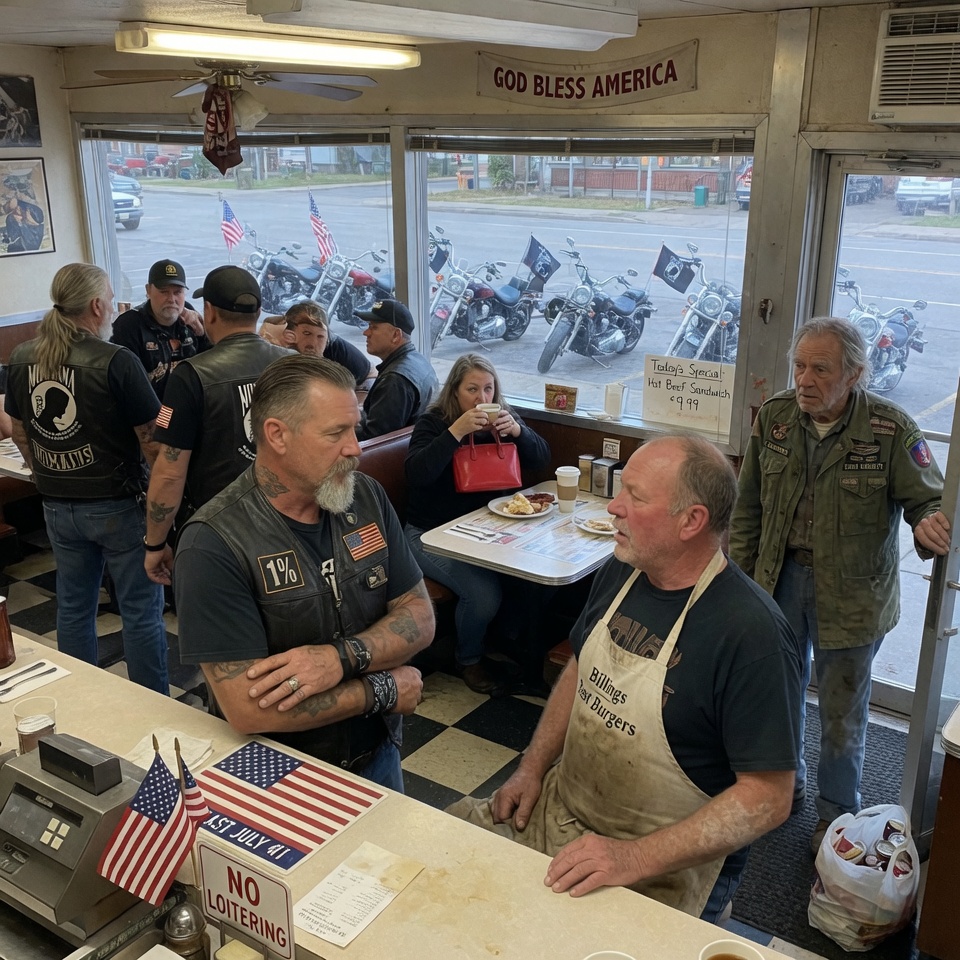
The wind outside the diner didn’t howl. It just pressed against the windows, a low and steady weight, like the whole town of Billings was holding its breath. The lunch rush had flatlined into a frozen tableau of half-raised coffee cups and unblinking stares. Inside, the air was thick with the scent of stale bacon grease and a tension so sharp you could feel it on your tongue.
The owner’s voice cut through it again, a jagged edge against the silence.
— “I’m not going to tell you again. Get him out of here, or I’m calling the police.”
He didn’t look at the old man cowering near the door. He looked at me, standing half a foot from his face, my worn leather vest suddenly feeling like armor. My brothers were a wall of silence at my back, blocking the weak Montana sun from the entrance.
— “And I’m not going to ask again,” I said, my voice a low rumble even I barely recognized. “He eats today.”
The owner’s lips were the color of old chalk. A tiny muscle in his jaw pulsed. He was a man used to being the loudest voice in a small room, and my quietness was dismantling him.
— “This is intimidation! You… you’re nothing but a bunch of thugs.”
He spat the word, but it felt hollow. A woman clutching a red purse at the counter flinched, her knuckles bone-white. I could hear a man whispering to his wife, “Don’t make eye contact, just don’t…”. Their fear was a living thing, a third presence in the conversation.
I didn’t raise a fist. I didn’t need to. My silence was a weapon more terrifying than any blade. I could feel the old man’s presence behind me, a fragile silhouette of trembling hands and a faded military jacket that smelled of rain and regret. He was the reason we were here, but they were all looking at me. They were looking at the monster they’d already created in their minds.
— “You think you can just stand there and… and judge me in my own place?” the owner stammered, his anger fraying into something desperate.
I could feel my pulse in my temples, a slow, steady drumbeat of a cold fury I’d kept buried for twenty years. He thought this was about a ten-dollar meal. He thought it was about control. I looked past him, out the window, to the silent line of bikes that stretched down the street like a funeral procession for his pride. My brothers hadn’t moved. They were just there. A reality he couldn’t shout away.
I took one single step back, creating a small pocket of space. The release of pressure was almost audible, a collective intake of breath. My eyes never left his.
Then, from that fragile space, a voice emerged behind me. Not a shout. Just a broken whisper, layered with decades of dust and desert sand.
— “Ricky…” the old man breathed the name like a prayer. “You… you were hit. The road was red… I kept saying your name. I kept saying, don’t you go, don’t you leave me here…”
The owner’s face went slack. The color didn’t just drain; it vanished, replaced by a sickly, waxy understanding. The fear in his eyes wasn’t of a brawl anymore. It was the terror of a man who had just realized he wasn’t the hero of this story, or even the villain. He was a backdrop in a reckoning he couldn’t comprehend.
I didn’t turn around. I just closed my eyes for a beat, the ghost of old shrapnel aching in my ribs. I was back on that blacktop, tasting the grit and my own blood, feeling my life seep out under a foreign sun. And I was back here, in this sterile diner, staring at a different kind of battlefield.
The woman with the red purse slowly unclenched her hands. The whispers stopped. The only sound was the quiet, broken sobs of a homeless veteran who had just been seen by the one life he’d managed to save, so many years ago. The room didn’t feel like a standoff anymore. It felt like a church. And I, the man they’d all pegged as the villain, was bowing my head under the weight of a debt that had no price.
The silence was no longer mine. It was ours. And into that sacred quiet, I heard the soft, hesitant shuffle of his worn boots on the linoleum, taking one unsteady step back toward a table he’d been told he didn’t deserve.
Part 2:The silence was no longer mine. It was ours. And into that sacred quiet, I heard the soft, hesitant shuffle of his worn boots on the linoleum, taking one unsteady step back toward a table he’d been told he didn’t deserve.
I turned slowly, letting my shoulders drop just a fraction. The tension that had been coiled in my spine for the last twenty minutes finally began to unwind. My brothers near the door remained motionless, a dark backdrop of leather and loyalty, but their eyes had softened. Even the gray-bearded biker, the one we called Preach, gave me a near-invisible nod—a small gesture that meant more than a standing ovation.
The old man hadn’t made it more than three feet. He stopped in the middle of the aisle between the counter and the booths, his head bowed but his eyes lifted just enough to find mine. His lips moved, but no words came. The name he’d whispered a moment ago still hung in the air like a fragment of a half-remembered dream. My name. The one I hadn’t heard spoken with that kind of broken familiarity since I was a bleeding rifleman on a road in the Helmand province.
I walked toward him, not the way I had approached the owner—tall, measured, intimidating—but like a man crossing a minefield. Carefully. Respectfully. Each step felt heavier than the last, because every face in that diner was watching, and I didn’t want a single one of them to mistake this moment for a performance.
He flinched as I drew closer. That small, involuntary jerk of the shoulders that you only see in men who’ve spent years expecting a blow instead of a hand. It twisted something deep in my chest.
“Sir,” I said, my voice breaking on the word like a kid talking to his grandfather. “It’s really you.”
He blinked several times, his rheumy eyes trying to focus. Up close, the years had carved canyons into his face. Deep lines branched out from the corners of his mouth, and a thin white scar cut a jagged path across his left eyebrow. He was thinner than I remembered—so much thinner—and the faded olive drab of his jacket hung on him like a shroud. But those eyes… the same pale blue that had stared into mine through a haze of dust and blood, ordering me to stay awake, to keep breathing, to not leave him there in that burning sand.
“You…” he rasped, his voice a dry creek bed. “You’re supposed to be…”
“Alive,” I finished for him. “Because of you.”
His brow furrowed deeper. He raised one trembling hand and touched the sleeve of my cut, his fingertips tracing the edge of a patch that read “VETERAN” in bold white letters. His lips pressed together, and I saw the first crack in the dam he’d built around himself. A shudder ran through his frame, and I caught his elbow before his knees could buckle.
“Easy,” I murmured. “I’ve got you.”
Someone behind me—the waitress, I think—gasped. A chair scraped against the floor. I didn’t look. My entire world had narrowed to the fragile human being clinging to my arm as if I were the only solid thing in a universe that had been spinning out of control for a very long time.
“I tried,” he whispered, the words tumbling out in a rush. “I tried to find you after… after they sent me back. But there were so many names, so many casualties… they told me you were probably dead.”
“I almost was.” I guided him gently toward the nearest booth, the same one he’d been thrown out of just minutes earlier. The vinyl seat crinkled as I helped him slide in. “But you didn’t let that happen.”
The waitress appeared at my elbow, a glass of water clutched in her still-shaking hand. She set it down without a word, her eyes glistening. I gave her a nod of thanks, and she retreated a respectful distance, hovering like a guardian angel uncertain of her welcome.
I sat down across from him, the table a narrow barrier between two men who had last seen each other on the worst day of both our lives. The diner’s fluorescent lights hummed overhead. Outside, the muffled rumble of idling engines was a constant reminder that this story wasn’t just about the two of us. It was about every person who had ever been told they didn’t belong.
“What’s your name?” I asked, though I knew it. I wanted him to say it, to claim his own identity in a place that had tried to strip it away.
He swallowed with difficulty, then lifted his chin a fraction. “Thomas… Thomas Kincaid. Everyone used to call me Tommy. Back when…”
He didn’t finish the sentence. He didn’t need to. Back when he had a life. Back when the world made sense. Back before the war chewed him up and spat him out into streets that pretended not to see him.
“Tommy Kincaid,” I repeated, letting the syllables fill the room. I wanted every person in that diner to hear his name. I wanted it seared into their memories, so they’d never forget the man they’d been pretending didn’t exist. “My name is Rick Morrison. But you called me Ricky, back then. In the Humvee.”
His eyes lit up with a flicker of recognition, and then the dam broke. Tears spilled over his lower lids, tracking clean lines through the grime on his cheeks. He didn’t bother to wipe them away.
“Ricky,” he breathed, the name an exhale of decades-old fear and love. “You were just a kid. Twenty-two years old, scared to death, bleeding everywhere… and I kept yelling at you, saying if you died on me I’d kick your behind all the way back to Texas.”
A huff of something like a laugh escaped me. “You did. You yelled so much I decided dying wasn’t worth the scolding.”
That earned a weak smile, and for a single second, the years peeled back like old wallpaper, and I saw the man he’d been before the weight of the world had crushed his shoulders. A gunnery sergeant with a voice like gravel and a heart too big for his chest. The kind of man who’d drag a bleeding private out of a burning vehicle while bullets snapped the air like angry hornets.
The memory came flooding back, unbidden and merciless.
Afghanistan, 2004. A supply convoy moving through rocky terrain. The sun hanging low in a white-hot sky. I was a gunner, standing in the turret of the lead Humvee, my hands numb on the .50 cal despite the heat. The road ahead was a ribbon of dust and danger. We’d been on edge for hours, every rock and shadow a potential threat. Then the world erupted.
The IED had been buried deep, so deep the metal detectors missed it. The explosion didn’t make a sound—not at first. It was just a great invisible fist that lifted the vehicle and slammed it down on its side, metal shrieking, my body thrown like a ragdoll against the interior. I remember smoke, the taste of copper, and a screaming that might have been mine. My leg was crushed, my arm shredded by shrapnel, and blood—so much blood—poured out of me in a rhythm that felt unnervingly calm.
I couldn’t move. The turret had collapsed around me, and I was pinned, watching the world tilt sideways through a cracked window. That’s when the shooting started. AK-47 fire peppered the wreckage, and I knew—I knew with absolute certainty—that I was going to die in that flipped metal coffin.
But then a hand grabbed the collar of my flak jacket and pulled. And a voice cut through the chaos like a blade through fog.
“You are not dying here, Marine! You hear me? You are not dying in this godforsaken desert!”
It was Gunnery Sergeant Kincaid. He’d been in the vehicle behind mine, and when the ambush started, he didn’t stay behind cover. He ran straight into the kill zone, ignoring the bullets, the fire, the secondary explosions that threatened to cook off our own ammunition. He ripped the crumpled door off its hinges with his bare hands—I still don’t know how—and dragged me out inch by agonizing inch. I was screaming, begging him to leave me, to save himself. He ignored every word.
He threw me over his shoulder in a fireman’s carry and sprinted for the nearest defilade. The entire time, he kept talking, kept ordering me to stay awake, kept promising me that I’d see Texas again, that I’d eat the best barbecue of my life, that I’d fall in love and have kids and grow old—all the things he said he’d do if I just… kept… breathing.
The Army medic who patched me up later told me I’d flatlined twice before the medevac arrived. Both times, Kincaid had performed CPR in the back of a bouncing Humvee while still bleeding from his own shrapnel wounds. By the time we reached the field hospital, my heart was beating, and his uniform was soaked in both our blood.
I owed him everything. Everything.
And I never saw him again.
Until now.
The diner’s silent audience had stopped pretending not to listen. The man with the red-faced wife had lowered his phone. The woman with the purse no longer clutched it for safety; she held her hand over her mouth. Even the owner stood frozen behind the counter, his arms hanging uselessly at his sides. The fury that had driven him minutes ago had evaporated, leaving behind a hollow shell of a man who was only just beginning to understand the magnitude of his ignorance.
Tommy hadn’t touched his water. He just stared at me like I was a ghost, his lips moving soundlessly. I realized he was trying to ask a question, but the words wouldn’t come. So I answered the question he couldn’t form.
“I made it,” I said softly. “Three surgeries, a lot of metal pins, and a medical discharge. But I made it. And I’ve been looking for you ever since.”
He shook his head slowly, as if denying the reality in front of him. “Why? Why would you look for me?”
“Because you saved my life, Tommy.” I leaned forward, placing both hands on the table between us. “And because when a man gives you a second chance, you spend the rest of your life trying to deserve it. I tried to find you. I called every VA office, every veterans’ organization, every contact I could think of. But you’d disappeared. The records showed you were discharged not long after that day—medical reasons, they said. But after that… nothing.”
Tommy lowered his head. “After the Corps kicked me out, I… I didn’t handle it well. The things I saw over there… they didn’t stay over there. They came home with me. My wife left. I lost my job. Lost my house. Then I just… drifted. I didn’t want anyone to find me.”
His voice had dropped to barely a whisper. “I didn’t think I deserved to be found.”
The confession hit the room like a physical blow. I saw several people turn away, unable to meet his eyes. The waitress stood completely still, a coffee pot trembling in her grip.
“You’re wrong,” I said, keeping my voice steady. “You deserved to be found. You deserved to be honored. And I’m going to spend the rest of my life making sure you never doubt that again.”
Tommy looked up at me, fresh tears mingling with the old tracks. “Ricky…”
“No,” I interrupted gently. “No arguments. You saved my life. Now let me save yours.”
The sentence hung in the air, heavy and irrevocable. I hadn’t planned those words. They just came, rising from a place inside me that had been waiting twenty years to speak them. And once they were out, I felt a lightness I hadn’t known I’d been missing.
Behind me, I heard the door chime open again. I didn’t turn, but I felt a shift in the atmosphere as Preach stepped forward. His boots were soft on the linoleum, and when he reached the booth, he didn’t stand over us. He lowered himself onto one knee beside the table, bringing his weathered face level with Tommy’s.
Preach was older than me by a decade, a Desert Storm vet who’d seen his own share of chaos. His real name was Marcus, but everyone called him Preach because he had a way of turning ordinary moments into sermons. Right now, though, he didn’t preach. He just looked at Tommy with a depth of understanding that needed no translation.
“Gunnery Sergeant Kincaid,” he said, his deep voice rumbling like distant thunder. “On behalf of the Black Mountain Riders, I’d like to apologize for not finding you sooner. We’ve been searching for the man who saved our brother’s life for years. We had a network—other clubs, shelters, street teams—and we kept missing you. That shame is ours to carry.”
Tommy stared at him, bewildered. “You… your whole club was looking for me?”
“Every one of us,” Preach confirmed. He gestured toward the door with a tilt of his head. “Out there, there are forty-three men and women who would not exist—not in the same way—if not for Rick. He’s our road captain. He’s patched up half of us after accidents, talked the other half out of doing something stupid, and reminded us all what brotherhood really means. The life you gave him rippled outward and touched all of us. We owe you a debt that can’t be paid. But we’re sure as heck going to try.”
A sob tore from Tommy’s throat, and he buried his face in his hands. His shoulders heaved with the force of a grief that had been stored up for decades. Preach reached out and laid a heavy hand on the back of his neck, not restraining him, just grounding him.
Around us, the diner began to move again, but differently. A young couple in the corner booth whispered urgently to each other, then the woman stood up, walked over hesitantly, and placed a folded napkin on the table’s edge. Inside, I glimpsed a $20 bill. She didn’t say anything, just met my eyes with an apology written all over her face and retreated.
The man who’d been ready to walk out earlier—the one who’d been so eager to avoid involvement—stepped forward next. He cleared his throat awkwardly. “I, uh… I’d like to cover his meal. Whatever he wants. For as long as he wants.” He shoved a hand through his hair. “I should’ve said something before. I should’ve…”
“We all should have,” the waitress cut in, her voice fierce and trembling at the same time. She set the coffee pot down with a decisive clunk. “I’m Sarah. I’ve worked here four years, and I’ve never once stood up to him—” she jabbed a finger toward the owner, who flinched as if struck, “—when he kicked someone out. I just kept my head down and poured coffee. Not today. Today, I’m serving this gentleman, and if anyone has a problem with it, they can take it up with me.”
A ragged cheer broke out from somewhere near the back. Someone clapped. The sound was hesitant at first, then grew louder. It wasn’t the applause of a crowd watching a performance. It was the release of a pressure that had been building for years, the collective exhalation of people who’d been given permission to do the right thing.
Tommy lifted his head from his hands, his eyes red-rimmed but dry now. He looked around the diner, at the faces that had once been turned away from him, and he seemed confused by the sudden shift in attention. But beneath the confusion, I caught a glimmer of something I hadn’t seen yet: hope.
“I don’t understand,” he said quietly. “All of this… just for an old man who can’t pay his own way?”
“It’s not about money,” Sarah said, stepping closer. She set a fresh mug in front of him, steam curling upward, and poured the coffee herself. “It’s about a man who gave everything and got nothing back. And it’s about the rest of us, who had the chance to do something and didn’t. You don’t owe us a thing, Mr. Kincaid. But we owe you.”
The owner hadn’t moved from behind the counter. His face was a mask of something I couldn’t quite read—shame, maybe, or the dawning horror of seeing yourself through the eyes of others. He opened his mouth once, closed it, opened it again. Finally, he stepped out from behind his fortress of laminated menus and cash register, and walked toward our table with the stiff-legged gait of a man approaching his own execution.
He stopped a few feet away, his hands clasped in front of him like a penitent schoolboy. His voice, when he finally found it, was nothing like the arrogant bark from before. It was small and cracked and very, very afraid.
“I’m sorry,” he said, the words dropping into the quiet like stones into a pond. “I was wrong. I was… I was a complete and utter jerk. I didn’t know. That’s not an excuse—I know it’s not—but I need to say it. I didn’t know who he was, and even if he wasn’t anyone… I should’ve served him anyway. I should’ve been a better man.”
He swallowed hard, his Adam’s apple bobbing with the effort. “I’ve been so worried about my business, about people taking advantage, that I forgot why I opened this diner in the first place. My old man—he was a veteran too. He’d be ashamed of me right now.”
Tommy looked at the owner for a long moment. I held my breath, unsure what the old man would do. He had every right to refuse the apology, to spit in the owner’s face, to walk out and never look back. The anger simmered in my own chest on his behalf, and I knew my brothers felt it too. Preach’s hand had tightened ever so slightly on Tommy’s shoulder.
But Tommy just sighed. It was a sound that carried decades of weariness, but also something else: a quiet, unshakeable dignity that hardship hadn’t managed to strip away.
“I don’t hold grudges,” Tommy said, his voice steadier now. “I’ve been homeless a long time. I know how people look at me. I’ve gotten used to it. It’s not your fault—not just yours, anyway. We’re all so scared of being hurt that we forget to see the person in front of us. I’m not angry. I’m just… tired.”
The owner’s shoulders sagged with relief, but he didn’t look happy. He looked like a man who’d just glimpsed the depth of his own failures and wasn’t sure he’d ever climb out. “If you’ll let me,” he said, his voice uneven, “I want to make things right. You’ll never pay for a meal here again. And if you need a job, I could use someone with your… with your integrity. I know it’s not much, but it’s a start.”
Sarah snorted. “About time, Gary.”
The owner—Gary—winced. “Yeah. About time.”
Tommy considered the offer. I could see the wheels turning behind his tired eyes, the cautious calculation of a man who’d learned never to trust kindness at face value. Then he glanced at me, as if seeking permission, or validation, or maybe just reassurance that this wasn’t all some elaborate dream he’d wake up from in a cold alley.
I gave him the smallest nod. Whatever he chose, I’d back it.
“I’ll think about it,” Tommy said finally. “But first… can I just… eat?”
A collective exhale swept through the diner. Sarah practically leaped into action, grabbing her order pad with an enthusiasm that bordered on comical. “Absolutely, sir. What can I get you?”
Tommy looked down at the menu she’d placed in front of him, and his hands trembled as he traced the laminated surface. He wasn’t used to being given choices. For years, his meals had been whatever he could scavenge or whatever a shelter handed him. The simple act of choosing felt monumental.
“The soup?” he asked, his voice almost childlike. “And maybe… maybe a burger. I haven’t had a real burger in a long time.”
“You’re getting the deluxe,” Sarah declared, scribbling furiously. “With bacon, extra cheese, and a side of onion rings. And the soup to start. And pie for dessert. On the house.”
“I said I’d pay,” the young man from earlier protested, stepping forward again with his $20 bill.
“Put your money away, sweetheart,” Sarah told him, not unkindly. “This one’s on the house. Gary’s house. He’s buying.”
Gary didn’t argue. In fact, he nodded vigorously, as if agreeing to a penance he’d been craving. “Anything he wants. Everything he wants. Just… please.”
The tension that had once filled the diner had transformed into something else entirely. It was still thick—the air practically vibrated with emotion—but it was no longer the sharp, dangerous kind that made people want to flee. It was a weight of collective humanity, of shared realization, of a community rediscovering its own soul in real time.
I slid out of the booth to give Tommy space. He needed to eat, to breathe, to exist in a world that had suddenly decided to acknowledge him. But before I could step away, his hand shot out and grabbed my wrist with surprising strength.
“Stay,” he said. “Please. I don’t want to be alone right now.”
I froze mid-step, then lowered myself back onto the vinyl seat. “I’m not going anywhere, Tommy.”
Preach rose from his knee and gave my shoulder a squeeze. “I’ll check on the brothers outside. Let them know what’s happening. They need to hear it.”
I nodded my thanks, and Preach walked toward the door with the same measured calm he’d carried in. The moment he opened it, a gust of cold Montana air swirled in, carrying with it the scent of exhaust and leather. I caught a glimpse of the line of bikes still parked outside, their riders standing beside them in a silent vigil. None of them had moved. None of them had gotten impatient. They’d been waiting for a sign, and Preach would give it to them.
The door swung shut, and the warmth of the diner settled back over us like a blanket.
Sarah returned with the soup almost immediately—somebody had already been heating it, probably hoping this moment would come. She set it down with a reverence that was usually reserved for altar offerings, and the fragrant steam curled up around Tommy’s face. He inhaled deeply, his eyes closing for just a second, and I saw the faintest hint of a smile.
“Smells like my mother’s kitchen,” he murmured. “She used to make chicken noodle from scratch. Every Sunday. I haven’t thought about that in years.”
“Eat,” Sarah said, her voice softer than before. “Take your time.”
Tommy picked up the spoon with the same care a painter might use to choose a brush. He blew on the first spoonful, a habit that had been ingrained in him long before the war, before the streets, before the world told him he wasn’t worth the air he breathed. He put it in his mouth, and his entire body seemed to exhale.
“Good?” I asked.
“Perfect,” he whispered.
The diner slowly resumed a muted version of its normal rhythm. People returned to their meals, but the conversations were quieter now, more thoughtful. The young couple who’d left the $20 were talking in low tones, their hands intertwined on the tabletop. The man who’d offered to cover Tommy’s meal had sat back down but kept glancing our way, as if to reassure himself that this was real.
Gary stood behind the counter, wiping the same spot over and over with a rag while staring at nothing. He looked like a man who’d just had a mirror held up to the ugliest parts of himself, and he didn’t know what to do with the reflection.
I didn’t rush Tommy. He ate his soup in slow, methodical spoonfuls, pausing occasionally to close his eyes and savor the warmth. When the burger arrived—a towering monument of beef, cheese, and crispy bacon, surrounded by a halo of golden onion rings—he stared at it like it was the most beautiful thing he’d ever seen. His fingers hovered just above the bun before he finally picked it up and took a bite.
A small sound escaped him. Not a word, just a noise—a deep, primal, satisfied sound that seemed to come from a place much older than language. It was the sound of a man who had been hungry for so long that he’d forgotten what fullness felt like.
I didn’t eat. I wasn’t hungry. My stomach was a knot of emotions too tangled to accept anything else. Instead, I watched him, cataloguing every detail of his appearance: the frayed cuffs of his jacket, the dirt under his fingernails, the way his gray hair stuck up in the back. I’d dreamed of this moment for years—finding the man who’d saved me, looking him in the eye, and saying thank you. But in my dreams, he’d been strong and proud and whole. The reality was a broken, exhausted veteran who’d been ground down by a system that had no use for him after he’d finished bleeding for it.
That thought lit a fire in my chest. A cold, steady flame of righteous anger that I’d learn to channel into something productive.
“Tommy,” I said, once he’d demolished half the burger and seemed to be slowing down. “When you’re done here, I want to take you somewhere. My place. It’s not much—a converted garage with a loft—but there’s a spare room. A shower. Clean clothes. And a job, if you want it. I own a repair shop. Nothing fancy, just fixing people’s cars and bikes. But I could use someone with your kind of discipline.”
He put the burger down slowly and wiped his mouth with the back of his hand. For a long time, he just looked at me, and I saw the war playing out in his eyes. The part of him that wanted to accept help, and the part of him that had been taught—by years of rejection and contempt—that accepting help was the first step toward being hurt again.
“Ricky,” he said, “you don’t owe me anything. I did what any Marine would’ve done. You don’t have to—”
“I’m not doing this because I have to,” I interrupted, leaning forward. “I’m doing this because I’ve had twenty years to think about what you did, and I realized something. You didn’t just save my body that day. You saved my future. I found a woman. Got married. We have two kids—a boy and a girl. The boy’s about to graduate high school. The girl wants to be a doctor. None of that exists without you. Every laugh, every bedtime story, every scraped knee I kissed better… you gave that to me. So don’t tell me I don’t owe you. I owe you everything that came after.”
The words cracked something open inside him. He didn’t cry this time—his tears had been spent for the moment—but he did slump back against the booth, his face slack with wonder. “Two kids,” he echoed. “You have two kids.”
“And a wife who’s been hearing about the mysterious Gunnery Sergeant Kincaid for our entire marriage. She’s going to lose her mind when I bring you home.”
He laughed. It was a rusty, unused sound, like a gate that hadn’t been opened in years, but it was a laugh. The first one I’d heard from him. It was short and followed by a cough, but it counted.
“I don’t even know what to say,” he admitted.
“Say yes.”
He looked at me, then past me, out the window where the line of bikes still stood. He could see them now—Preach must have passed along the word, because some of the riders had removed their helmets and were looking toward the diner with expressions that were unexpectedly gentle. One of them, a woman with braided gray hair and a patch that read “DOC,” even raised a hand in a wave. She was our medic, a former Army nurse who’d served in Desert Storm and saved more club members than I could count. She’d been the one who first helped me trace Tommy’s last known whereabouts.
“They’re all here for me?” Tommy asked, his voice faint with disbelief.
“Every last one,” I confirmed. “You think I rode in here alone? My brothers and sisters have been helping me search for you for years. They wanted to be here when I finally found you. They wanted to see the man who made our road captain possible.”
He shook his head slowly. “I don’t deserve this.”
“That’s the thing about grace, Tommy. None of us deserve it. We just get it anyway.”
Sarah appeared at the table again, this time with a slice of apple pie that was still warm from the oven, a scoop of vanilla ice cream melting slowly over the flaky crust. She set it down with a flourish.
“Dessert,” she announced. “And, um…” She hesitated, then reached into her apron pocket and pulled out a folded piece of paper. “This is my number. I don’t mean anything by it—I’m not hitting on you or anything. But if you ever need someone to talk to, or a ride to the VA, or just… whatever. I’m here.”
Tommy took the paper, holding it like it was made of glass. “Thank you, ma’am. That’s awfully kind.”
Sarah blushed and retreated, and I watched her go with a new appreciation. There were good people in this world. Lots of them. They just sometimes needed someone to go first, to show them that kindness wasn’t a weakness.
The pie disappeared in record time. Tommy ate it with the focused determination of a man who hadn’t tasted dessert in a decade. When he was done, he leaned back and patted his stomach with a sigh of deep contentment.
“I think that’s the best meal I’ve ever had,” he said. “And I once ate at a five-star restaurant back in ’92. Some general’s retirement party. This blew it out of the water.”
“Everything tastes better when you’re not hungry,” I said. “But also, that apple pie is famous in Billings. You’ll get used to it.”
He raised an eyebrow. “You really mean it, don’t you? The room, the job… all of it.”
“Every word.”
“I might be trouble,” he warned. “I’ve got… issues. Night terrors. I drink too much when I have the money. I’m not the man I used to be.”
“Neither am I,” I replied. “I’ve got pins in my leg and I wake up screaming some nights too. We’ll manage. That’s what the club is for. We take care of our own.”
Tommy took a deep breath, the kind you take before jumping off a cliff into unknown water. Then he nodded, once, decisively. “Okay. Yes. I’ll come with you.”
The knot in my chest unfurled. I hadn’t realized how terrified I’d been that he’d refuse. But he’d said yes. The old Marine in him was still there, buried under the debris of a hard life, but willing to rise.
“Good,” I said, my voice rougher than I intended. “Let’s go home.”
I helped him out of the booth, and this time when he stood, he wasn’t hunched and defeated. He was still thin and unsteady, but there was a new set to his shoulders. A hint of the Gunnery Sergeant Kincaid who had once faced enemy fire without flinching.
The diner fell silent as we made our way toward the door. Every face turned to watch, and I saw a range of emotions painted across them: admiration, shame, hope, grief, and something that might have been relief. Relief that, for once, a tragedy had been interrupted before it could reach its inevitable end.
Gary stepped forward just as we reached the door, blocking our path for a moment. His face was pale, but his eyes were earnest.
“Mr. Kincaid,” he said, his voice cracking. “I know I don’t deserve to ask you for anything. But if you ever come back here—and I hope you do—I’ll treat you like family. I swear it on my father’s grave.”
Tommy looked at the owner for a long moment. The silence stretched uncomfortably. Then, to everyone’s surprise, Tommy reached out and patted Gary on the shoulder. Just a light touch, barely there, but it felt monumental.
“I’ll hold you to that,” Tommy said. “And maybe next time, you’ll think twice before turning away someone who’s down on their luck. You never know who they might be.”
Gary’s eyes glistened, and he nodded rapidly. “I will. I promise.”
With that, I pushed open the door, and the cold Montana air hit us like a wall. But it wasn’t unwelcoming. It was crisp and clean and smelled faintly of pine and distant rain. Outside, the line of bikers had formed a corridor from the diner entrance to my bike—the blacked-out Harley with the veteran’s memorial decal on the tank. Every rider stood at attention, not a military formation, but something close. Something solemn.
As we stepped out, they didn’t cheer. That wasn’t their way. Instead, one by one, they removed their helmets and placed their hands over their hearts. A silent salute. Preach stood at the far end of the line, his own hand over his heart, his eyes fixed on Tommy with an intensity that would have been unnerving if it weren’t so reverent.
Tommy stopped walking. He stared at the line of bikers, at the faces that were weathered and scarred and covered in ink, and for a moment I thought he might break down again. But he didn’t. He straightened his spine, squared his shoulders, and walked forward with the same deliberate pace he must have used when approaching a fallen comrade on the battlefield.
He stopped at each rider, looking them in the eye, nodding once. It was an inspection, I realized. A review of the troops. And even though these men and women were strangers, they met his gaze with the respect due a senior NCO. A few of them murmured things I couldn’t hear, but I saw Tommy’s expression soften each time.
When he reached Preach, the two old warriors faced each other for a long moment. Then Preach extended his hand, and Tommy shook it with a grip that was far stronger than it had any right to be.
“Welcome to the family, Gunnery Sergeant,” Preach said.
“Thank you,” Tommy replied, his voice thick. “Thank you for finding me.”
“Thank Rick,” Preach said, nodding in my direction. “He never gave up on you.”
Tommy turned to look at me, and the expression on his face was worth more than every medal the Corps had ever pinned to my chest.
We walked the rest of the line together until we reached my bike. I swung a leg over the seat and gestured for Tommy to climb on behind me. He did so with the awkward caution of someone who hadn’t been on a motorcycle in decades, but once he settled in, his hands gripping my vest, he let out a small, surprised laugh.
“Fast?” he asked.
“Fast enough to feel alive,” I said. “Ready?”
“Ready.”
I fired up the engine, and the familiar rumble filled the air. One by one, the other bikes joined in, their engines forming a symphony of low-throated power. I looked back at the diner and saw faces pressed against the glass, watching. Sarah had come outside with her apron still on, her hand raised in farewell. Gary stood in the doorway, his expression unreadable, but something in the way he held himself suggested a man who had just been humbled in the best possible way.
I pulled out onto the street, and the whole procession followed in a single-file line that stretched for blocks. The effect was surreal—dozens of bikers, all riding at a respectful pace, escorting one old man on the back of a road captain’s Harley. Cars pulled over to let us pass. People on the sidewalks stopped and stared, phones out, capturing a moment they couldn’t quite understand but recognized as important.
The ride home took twenty minutes, and in that time, I felt Tommy’s grip on my vest gradually relax. He was letting go of something—maybe the years of tension, maybe the fear, maybe the loneliness that had been his only companion for far too long. By the time we pulled into the gravel driveway of Morrison’s Repair Shop, I could feel him breathing easier.
The shop was a sprawling compound of corrugated metal and asphalt, with a small house attached to one side. A sign above the main bay read “MORRISON’S GARAGE – FAMILY OWNED SINCE 2015.” My wife, Jenna, was waiting on the porch, her arms wrapped around herself against the cold. When she saw us pull in, her hand flew to her mouth.
I killed the engine and dismounted, then helped Tommy off the bike. His legs wobbled for a second, but he steadied himself quickly. Jenna walked toward us, her eyes wide and glistening.
“This is him?” she asked, her voice barely a whisper.
“This is him,” I confirmed. “Jenna, meet Gunnery Sergeant Tommy Kincaid. Tommy, this is my wife, Jenna.”
Jenna didn’t shake his hand. She pulled him into a hug instead, wrapping her arms around his thin frame with the ferocity of a woman who’d heard his story a hundred times and had longed to thank him every single one. Tommy stiffened in surprise, then slowly, hesitantly, hugged her back.
“Thank you,” Jenna whispered into his shoulder. “Thank you for bringing my husband home.”
It was the same thing I’d said, and the same phrase Preach had used. Bringing someone home. It seemed that, after twenty years, Tommy had finally come home too.
The rest of the club filed in behind us, parking in neat rows and cutting their engines one by one. The silence that followed wasn’t empty. It was full of meaning, of history, of promises kept and new ones being made.
Preach approached with Doc at his side, and the rest of the club formed a loose semicircle around us. For a moment, no one spoke. Then Preach’s voice rumbled out, quiet but commanding.
“We never got to give you a proper welcome, Gunnery Sergeant. So we’re doing it now.” He reached into his cut and pulled out a folded patch, extending it toward Tommy. “This is an honorary membership patch for the Black Mountain Riders. It doesn’t come with responsibilities unless you want them, but it comes with every right we can give you. Brotherhood. Protection. A place to belong. You’re one of us now, whether you like it or not.”
Tommy took the patch with trembling fingers, staring at the embroidered design: a black mountain silhouetted against a rising sun, surrounded by the club’s name. He ran his thumb over the stitching, and I saw his composure crack one more time. But this time, he didn’t sob. He just let the tears fall silently, a quiet rain of release.
“I don’t know what to say,” he managed.
“You don’t have to say anything,” Doc said, stepping forward. Her voice was brisk but kind, the voice of someone who’d seen too much pain to be fazed by tears. “But you do have to let me check your vitals. You’re too skinny and I’m betting your blood pressure is through the roof. Medical bay is in the clubhouse. We’ll get you sorted.”
Tommy blinked. “You have a medical bay?”
“Technically it’s a renovated supply closet, but it’s got everything we need,” Doc replied with a shrug. “I patch these idiots up after bar fights and road rash. Might be nice to have a patient who isn’t bleeding for once.”
A ripple of laughter ran through the group, and the tension dissolved. The club members began to disperse, some heading inside, others drifting toward the fire pit that Preach had built in the yard. A few of them clapped Tommy on the shoulder as they passed, offering quiet words of welcome.
Jenna took Tommy’s arm gently. “Come on inside. I’ve got the guest room all made up. Fresh sheets, clean towels, and a closet full of clothes I guessed might fit you. We can adjust whatever you need.”
Tommy looked from Jenna to me to the patch in his hands, and for the first time since I’d laid eyes on him through the diner window, the lost, hunted expression in his eyes began to fade. It was replaced by something tentative, something that looked almost like peace.
“I don’t know how to repay any of this,” he said, his voice still rough.
“You already did,” I told him. “Twenty years ago, on a road outside Kandahar. Now it’s our turn.”
He nodded slowly, and let Jenna lead him inside.
I stood in the yard for a moment longer, watching the sun dip toward the mountains. The sky was streaked with pink and gold, and the air smelled like pine and possibility. Preach came up beside me, holding two beers. He handed one to me without a word, and we stood there in companionable silence.
“You did it,” he said eventually. “Twenty years of searching, and you finally found him.”
“We found him,” I corrected. “Couldn’t have done it without the club.”
“You could’ve,” Preach said, taking a swig of his beer. “But you didn’t have to. That’s the point.”
I thought about that for a while. About all the times I’d almost given up—dead ends at VA offices, tips that led nowhere, sightings that turned out to be false. About the nights I’d lain awake, wondering if Tommy Kincaid was still alive, and if he knew that the kid he’d saved had turned into a man who’d never stopped being grateful.
And now he was here. In my house. About to sleep in a real bed for the first time in who knew how long.
I tipped my bottle toward Preach’s. “To unfinished business.”
“To new beginnings,” he corrected, and clinked his bottle against mine.
We drank as the night crept in, and somewhere inside the house, I heard the sound of my kids shouting excitedly as Jenna introduced Tommy. My son’s voice, deep and teenage-curious. My daughter’s, bright and full of questions. And then, softer than the rest, Tommy’s voice—still unsteady, but answering them. Telling them things I’d only ever imagined hearing from his lips.
I closed my eyes and let the sound wash over me.
After a few minutes, Jenna appeared at the door and beckoned me inside. Her cheeks were flushed, and her eyes were bright with unshed tears.
“He’s in the guest room,” she said. “I showed him the shower and he almost cried again. Said it was the first hot water he’d had in six months. I put some of your old sweatpants and a T-shirt on the bed for him.”
“How’s he doing?” I asked.
“Tired. Overwhelmed. But… happy, I think. He keeps looking at the door like he expects someone to show up and take it all away.”
“That’ll take time.”
“I know. But he’s safe now. That’s what matters.”
I pulled her into a hug, burying my face in her hair. She smelled like lavender and home, and I felt the last of the day’s tension drain out of me.
“Thank you for being okay with this,” I murmured. “I know I didn’t exactly warn you.”
“Rick,” she said, pulling back to look me in the eye, “you’ve been telling me about this man since our first date. When you called from the diner and said you’d found him, I didn’t even hesitate. I started making up the guest room before you hung up. This is your mission, baby. It always has been. I’m just glad I get to be part of it.”
I kissed her forehead and let her lead me inside. The house was warm and full of the smell of the casserole she’d put in the oven earlier. My kids were sitting at the kitchen table, their homework abandoned, firing questions at Tommy, who sat across from them with a mug of coffee cradled in both hands.
“—and then what happened?” my daughter, Lily, was asking, her elbows on the table, her eyes wide.
“Well,” Tommy said, “the medic told me later that your dad’s heart stopped twice in the helicopter. They had to use the paddles on him right there in mid-air. I remember thinking, ‘This kid better not die on me now, because I did not just run through a hail of bullets for nothing.’”
“You ran through bullets?” my son, Jake, demanded. “Like, actual bullets?”
“He did,” I said, stepping into the kitchen. “I was there. Not that I could see much, but I heard them. And I heard him shouting at me to stay awake.”
Tommy looked up at me, and for a second, the weight of the story passed between us like a secret handshake. Then he shrugged, the ghost of a grin tugging at the corner of his mouth.
“I was louder back then,” he admitted. “More to say.”
“You’ve still got plenty to say,” I told him. “And we’ve got all the time in the world to hear it.”
Dinner was a loud, chaotic affair. Jenna’s casserole was devoured in record time, and Tommy ate two helpings, plus three slices of buttered bread. My kids kept him talking through the whole meal, plying him with questions about the Marine Corps, about the war, about what it was like to ride on the back of a Harley. He answered them all with a patience that suggested he’d once been very good at his job—the kind of leader who didn’t just command, but also taught.
At one point, Lily asked him if he’d ever been scared.
“All the time,” Tommy said without hesitation. “Anyone who tells you they weren’t scared is either lying or crazy. But being brave isn’t about not being scared. It’s about doing what needs to be done anyway.”
Lily absorbed that with the solemnity of a twelve-year-old who’d just been handed a piece of real wisdom. “Like when Dad found you.”
Tommy looked at me, and something flickered in his expression. “Your dad’s one of the bravest men I ever met. But yeah. Like that.”
Later, after the kids had gone to bed and Jenna had retired to our room, I found Tommy sitting on the porch, wrapped in one of my old jackets, staring up at the stars. The night was cold and clear, the kind of night where the Milky Way was visible as a faint river of light spanning the sky.
I sat down in the chair next to him, a blanket draped over my arm. I handed it to him, and he wrapped it around his shoulders gratefully.
“Can’t remember the last time I saw the stars like this,” he said. “In the city, there’s too much light. You forget what the sky really looks like.”
“I grew up out here,” I said. “Never got used to city lights. Too bright. Too busy.”
He nodded slowly, his gaze still fixed upward. “I used to know the constellations. My granddad taught me when I was a boy. Orion, Cassiopeia, the Big Dipper… I could point them all out. It’s all still up there, I guess. I just forgot how to look.”
We sat in silence for a while, the stars wheeling slowly overhead. I thought about all the nights he must have spent on the streets, under those same stars, invisible to the world. And I thought about how a chance encounter in a diner had led to this—a man under a blanket on my porch, finally seen.
“Tommy,” I said eventually, “can I ask you something?”
“You can ask me anything, Ricky.”
“Why didn’t you reach out? After you got out, after things went bad. There are resources. There are people who would’ve helped. Why did you just… disappear?”
He was quiet for a long moment. When he finally spoke, his voice was soft and distant, like he was talking more to the stars than to me.
“Shame,” he said. “That’s the short answer. I was a gunnery sergeant. I had medals. I had respect. And then I came home, and nothing made sense anymore. The nightmares wouldn’t stop. I couldn’t hold a job because I’d start panicking over nothing—a car backfiring, a kid shouting, anything. My wife tried to help, but I pushed her away. Told myself I was protecting her from me. After she left, I didn’t see the point in trying. I just… let go.”
He paused, his breath misting in the cold air. “I was ashamed of what I’d become. Ashamed that the man who saved a private in Afghanistan couldn’t even save himself. And the longer I stayed hidden, the harder it got to imagine coming back. So I just… didn’t.”
“You’re here now,” I said.
“Because you dragged me here,” he countered, but there was no accusation in his voice. Only a kind of weary gratitude.
“You let me drag you,” I pointed out. “You could’ve said no. You could’ve walked away the minute you recognized me. But you didn’t.”
He considered that, tilting his head. “I guess I was too tired to run anymore.”
“Good. Because I’m too stubborn to let you.”
A small laugh escaped him, the same rusty sound from earlier. “You always were stubborn. I remember that. Even when you were bleeding out, you kept trying to tell me to save the others first. Like I was going to listen to a private.”
“I was a corporal, actually.”
He squinted at me. “You sure? I could’ve sworn you were a private.”
“Promoted two weeks before the ambush. You yelled at me for not telling you sooner.”
He blinked, then laughed again, longer this time. “I did, didn’t I? Good Lord, I yelled at you about everything.”
“You yelled because you cared. I figured that out pretty quickly.”
The laughter faded, and a comfortable silence settled between us. The stars kept turning, and somewhere in the distance, an owl hooted.
“What happens now?” Tommy asked finally.
“Whatever you want. You can stay here as long as you need. Work at the shop if you want—I’ll teach you the basics. If you’d rather not, that’s fine too. The club will help you get back on your feet. There’s a VA counselor who works with us, a good man named Henderson. He helped me after my discharge. He can help you too.”
“And if I mess up? If I fall back into old habits?”
“Then we’ll catch you,” I said simply. “That’s what family does.”
He turned to look at me, his face half-lit by the glow spilling from the kitchen window. “You really mean that, don’t you? This isn’t just… charity.”
“Tommy, I spent twenty years looking for you. If this were charity, I’d have given up after the first year. This is something else. This is honor. This is duty. This is a debt I’m finally able to repay.”
He shook his head slowly, not in denial but in wonder. “I never thought of it as a debt. I was just doing my job.”
“And I’m just doing mine.”
The week that followed was a blur of adjustment and small miracles. Tommy slept for nearly fourteen hours that first night, and when he woke, he said it was the first time in years he hadn’t dreamed of gunfire. Doc conducted a thorough medical exam and pronounced him malnourished but otherwise stable—though she prescribed a regimen of vitamins and regular meals that Jenna immediately took charge of enforcing.
The club members cycled through the shop in a steady stream, each one finding an excuse to introduce themselves to Tommy and offer some small kindness. One brought a pair of sturdy work boots in his size. Another showed up with a vintage Marine Corps flag that had been her father’s. Preach himself arrived on the third day with a leather vest—not a full cut, but a simple riding vest with the club’s patch sewn onto the back. Tommy put it on and didn’t take it off for the rest of the day.
The kids adored him. Jake, who’d been talking about enlisting after graduation, peppered Tommy with questions about boot camp and life in the Corps. Lily, quieter and more observant, simply sat with him while he drank his coffee, asking occasional questions about his life before the war. He told them both stories I’d never heard—about growing up on a farm in Iowa, about his grandfather who’d served in Korea, about the day he met his ex-wife at a county fair. The stories came slowly at first, then faster, as if speaking them aloud was loosening some inner knot.
The promise Gary made at the diner didn’t evaporate. Two days after Tommy moved in, Gary showed up at the shop with a paper bag full of fresh pies and an apology that was almost painful in its sincerity. He repeated his job offer, and Tommy—after a long conversation with me and Jenna—accepted, on the condition that it be part-time and that he not be treated any differently than other employees. Gary agreed so fast I thought his head might fly off.
Sarah, the waitress, became a regular visitor too. She’d stop by after her shifts with leftovers from the diner and a knack for making Tommy smile. Their friendship bloomed in the quiet, unassuming way that some of the best relationships do—over shared coffee and stories about terrible customers and dreams that had been put on hold. I had a feeling that dynamic would continue to evolve, though I kept that thought to myself.
The most significant change, though, was invisible. It happened inside Tommy. The stooped, trembling man I’d found in the diner was slowly straightening out. Not all at once, and not without setbacks—there were still nightmares, still moments when he’d go quiet and distant—but inch by inch, he was returning to himself. Or maybe discovering a new version of himself, one shaped by survival as much as by service.
One evening, about a month after his arrival, I found him in the garage, staring at the motorcycle I’d been restoring—a vintage Indian Scout that I’d picked up from a junkyard and was slowly bringing back to life. He had a wrench in his hand and an expression of intense concentration.
“You know how to work on bikes?” I asked, surprised.
“I used to,” he said, not looking up. “Before the Corps. My dad had an old Triumph. We rebuilt it together when I was sixteen. Thought maybe I’d give it a try again.”
I pulled up a stool and handed him a socket wrench. “Knock yourself out. The carburetor’s been giving me trouble.”
He grunted and got to work. Within an hour, the carburetor was disassembled, cleaned, and put back together with a precision that impressed even me. Tommy Kincaid, it turned out, had a gift.
That became his routine—mornings at the diner, afternoons in the garage, evenings on the porch with the family. He started attending AA meetings at the local church, driven there by Sarah or one of the club members. He gained weight. The hollows in his cheeks began to fill out. He laughed more often, and when he did, it didn’t sound so rusty anymore.
On the day he earned his first paycheck from the diner, he came home with a bouquet of flowers for Jenna and a case of beer for me. He stood in the living room, holding them out like they were treasures, and his hands were steady.
“I wanted to thank you,” he said, his voice thick but controlled. “For everything. I know I already said it, but… this is different. This is the first money I’ve earned in three years. I wanted to spend it on something that mattered.”
Jenna took the flowers with tears in her eyes and hugged him so hard he coughed. I clapped him on the back and told him he didn’t need to buy my gratitude—but I took the beer anyway.
That night, after Jenna and the kids had gone to bed, Tommy and I sat on the porch as we’d done so many times before. The spring chill had given way to the first hints of summer warmth, and the fireflies were beginning to appear, blinking in and out of the tall grass.
“I’ve been thinking,” Tommy said.
“Dangerous habit.”
He smirked. “About what you told me. On the day you found me. You said I didn’t just save your body—I saved your future.”
“I meant it.”
“I know you did. And I’ve been thinking about all the things that came from that. Your wife. Your kids. Your shop. This life. And I realized… I never let myself think about the future before. Not since I got out. It was always just surviving one day at a time. But now I’m starting to think maybe I could have a future too. A small one. Quiet. But something.”
“What kind of future?” I asked.
He took a long breath. “I think maybe I’d like to help people. Other vets, I mean. The ones who are still out there, like I was. The ones nobody sees. I don’t know how, exactly, but I’ve been talking to Preach and Doc, and they said the club does a lot of outreach. Food drives. Shelter visits. That kind of thing. I thought maybe I could be part of that.”
I felt a swell of pride so strong it almost choked me. “Tommy, that’s a hell of an idea. And if anyone can reach those guys, it’s you. You’ve been where they are. You know what it’s like.”
“I do,” he said quietly. “And I think maybe that’s why I survived. Not just to save you, but to save others. To use what I went through to help someone else get out of the hole. It sounds crazy, I know—”
“It doesn’t sound crazy,” I interrupted. “It sounds like purpose. And purpose is the thing that keeps us going. It’s what kept me going all those years I was searching for you.”
He looked at me, and in the dim light of the porch, I saw the old gunnery sergeant clearly for the first time. Not the broken man from the diner, not the haunted veteran, but the leader. The fighter. The man who’d dragged a dying private through fire and refused to let go.
“You really think I can do it?” he asked.
“I know you can.”
He nodded, and something settled in his expression. A resolve that hadn’t been there before. A direction that had been missing for twenty years.
We sat in silence after that, watching the fireflies, listening to the crickets. Somewhere down the road, a dog barked. The world was peaceful, and so were we.
The next morning, Tommy asked Preach if he could address the club. Preach, who’d been waiting for this moment since the day we found him, agreed without hesitation. He called a meeting that evening in the clubhouse—a converted barn behind the shop that served as our gathering place. Every member showed up, filling the space with leather and denim and the quiet hum of anticipation.
Tommy stood in front of them, his honorary patch on his vest, his hands clasped behind his back. He looked nervous, but he didn’t look afraid. I stood off to the side with Jenna and the kids, who’d been invited as special guests.
“I’m not good at speeches,” Tommy began, his voice carrying through the barn. “Never was. That was always Preach’s job. I’m just a gunnery sergeant who’s been through a lot of rough years. But I want to say a few things. First—thank you. For finding me. For bringing me here. For giving me a chance when I’d given up on myself. I didn’t think I deserved a second life. You showed me I was wrong.”
He paused, scanning the faces in front of him. I saw more than one person wipe at their eyes.
“Second, I want to tell you what I told Rick last night. I want to help. I want to be part of the work this club does for other veterans. I know what it’s like to be lost, and I know what it’s like to be found. If I can help even one person make that journey, then maybe all the years I spent on the streets weren’t wasted. Maybe they were preparation.”
Preach stepped forward, his arms crossed over his chest. “You want to officially join the outreach program?”
“I do,” Tommy said. “If you’ll have me.”
Preach’s stern face broke into a rare, genuine smile. “Gunnery Sergeant Kincaid, we’d be honored.” He extended his hand, and Tommy shook it, and the barn erupted into cheers.
The celebration that followed was the kind of thing I’d come to love about the Black Mountain Riders—music, food, laughter, and the kind of easy camaraderie that only exists among people who’ve chosen each other as family. Tommy was at the center of it all, no longer a rescued stray but a full member of the pack. Sarah showed up halfway through with a tray of brownies, and I noticed the way Tommy’s face lit up when he saw her. I noticed the way she lingered by his side for the rest of the evening, too.
Later, as the party wound down and the kids were half-asleep on a hay bale, I found myself alone with Preach near the bonfire.
“He’s going to be all right,” Preach said, watching the flames. “Took him long enough, but he’s going to be all right.”
“I know,” I said. “Took us long enough to find him, too.”
“Everything in its own time.” Preach swirled the contents of his cup. “You ever think about how different things would’ve been if you hadn’t stopped at that diner?”
“Every day,” I admitted. “We were just passing through. I almost decided to skip it—there’s a burger joint two exits before that we usually hit. But something told me to stop. Call it intuition, or fate, or whatever. I just felt like I needed to be there.”
“And you were,” Preach said. “Right place, right time. Or maybe the right place finally caught up with you.”
I let that settle into my bones. There were things in life that couldn’t be explained by logic or luck. The connection between me and Tommy Kincaid was one of them. It spanned two decades, crossed continents, and weathered the worst kinds of storms. And now, here we were—two old Marines sitting around a fire, surrounded by people who’d become a family, looking at a future that finally made sense.
Months passed. The seasons turned, and the Montana summer gave way to a golden autumn. Tommy became a fixture in the community—the old veteran who worked mornings at Gary’s Diner and afternoons in Morrison’s Garage, who volunteered at the VA outreach center and told his story to anyone who needed to hear it. The local paper even ran a piece about him: “From Homeless to Hero: How a Diner Encounter Changed Everything.” He hated the attention but tolerated it because Doc told him it would inspire others to seek help.
The club’s outreach program grew under his influence. Tommy had a gift for connecting with the hardest cases—the vets who wouldn’t talk to counselors or accept help from anyone. He’d sit with them on park benches, share a cigarette, and say nothing at all until they were ready. And when they were, he’d tell them his own story—not the sanitized version, but the raw, ugly truth of what it felt like to hit rock bottom and stay there for years. And then he’d tell them how he got out. Because of one person who refused to give up on him.
He always pointed to me when he told that part, and I always deflected. It wasn’t false modesty—I genuinely believed that anyone would have done what I did if they’d been in my place. But Preach told me I was wrong. “Most people would’ve given up after the first year,” he said. “You didn’t. That’s what makes you the heart of this club, Rick. That stubborn, relentless heart.”
I didn’t think of myself as a heart. I thought of myself as a man who owed a debt. But maybe those two things were the same.
One evening in late September, Tommy and I rode out to the ridge that overlooked the town. It was a spot I’d discovered years ago, a place where the road ended and the sky began. You could see the whole valley from up there, the lights of Billings twinkling in the distance, the mountains a dark silhouette against the stars.
We parked our bikes and sat on the guardrail, looking out at the view. The air was crisp, edged with the first bite of autumn. Tommy had a thermos of coffee that Sarah had packed for him—she’d taken to doing things like that, small gestures that spoke of a deepening bond neither of them was quite ready to name.
“I ever tell you what I said to you in the Humvee?” Tommy asked, pouring himself a cup.
“You said a lot of things. Yelled most of them.”
“Yeah, but there was one thing. After the medic took over, when they were flying you out. I was sitting in the bird, covered in your blood, and I made you a promise. I said, ‘If you make it through this, I’m going to make sure you have a good life.’ I’m not sure I even knew what that meant at the time. I just… I needed to say it.”
I turned to look at him. His profile was illuminated by the faint glow of the valley lights, his expression distant but peaceful.
“You kept that promise,” I said. “You dragged me out of that wreck and you kept my heart beating until the medics got there. That was the start of my second life.”
“And then I disappeared,” he said, his voice heavy.
“And then you came back.”
He was quiet for a moment. Then he nodded. “Yeah. I came back.”
We drank our coffee and watched the stars come out, one by one. Somewhere below us, a train horn sounded, long and mournful and somehow beautiful.
“You know,” Tommy said eventually, “when I was on the streets, I used to think about you sometimes. I’d wonder if you were alive, if you were okay. And I’d tell myself that if I ever saw you again, I’d apologize for not being the man you remembered. For being so broken.”
“You don’t have to apologize for that.”
“I know. But I wanted to. And then, when I saw you in that diner—when I realized it was you—I was so ashamed I almost ran. The only reason I didn’t was because my legs wouldn’t move.”
“I’m glad they didn’t.”
“Me too.” He took a sip of coffee. “You gave me my life back, Rick. I know you say it was the other way around, but you did. And I’m going to spend whatever’s left of it making sure you don’t regret it.”
I put my hand on his shoulder. “I could never regret it. Finding you wasn’t the end of a mission. It was the beginning of one.”
He looked at me, his eyes clear and steady. “Then let’s keep going. Together.”
“Together,” I agreed.
We stayed on the ridge until the thermos was empty and the cold had crept into our bones. Then we rode home, side by side, the rumble of our engines echoing across the valley like a promise.
And in the years that followed, that promise held. Tommy Kincaid became a cornerstone of the Black Mountain Riders’ outreach program, a man who’d been lost and found and who dedicated his remaining years to helping others make the same journey. The diner—once a symbol of rejection—became a regular stop for the club, and Gary eventually put a plaque on the booth where Tommy had sat that day: “Reserved for Heroes.” Sarah and Tommy never officially announced a relationship, but they didn’t need to. Everyone could see it in the way they looked at each other.
As for me, I kept running the garage and riding with my brothers and sisters. My kids grew up and went off to college—Jake to study engineering, Lily to pursue pre-med—but they came home often, and when they did, the first person they greeted after their parents was always “Uncle Tommy.” He’d become part of the Morrison family, the way the club had become part of him.
I never stopped being grateful. Every time I saw Tommy laugh, or fix an engine, or sit with a struggling veteran, I remembered the day I almost died in the desert and the man who refused to let it happen. And I understood, with a clarity that only deepened over time, that some debts aren’t meant to be repaid. They’re meant to be carried forward, transformed into something that benefits everyone they touch.
The story of what happened in that diner spread far beyond Billings. It was shared on social media, picked up by local news, and eventually became one of those viral moments that people point to as proof that kindness still exists in the world. But for those of us who lived it, it wasn’t about the headlines or the attention. It was about a simple, immutable truth: every person matters. No matter how broken, how forgotten, how invisible they seem. There’s always someone out there who remembers them. Who’s looking for them. Who owes them a debt that can never fully be paid—but can always be honored.
And if you’re lucky, if you’re stubborn enough, if you never give up—you might just find them. And when you do, you might find yourself in the process.
That’s the thing about saving someone. You think you’re doing it for them, but in the end, they save you right back. That’s what Tommy Kincaid did for me. And every day, in quiet and unspoken ways, I tried to do the same for him.
One morning, a few years after the diner incident, I woke up to find Tommy already in the garage, working on the old Indian Scout that had become his personal project. He’d restored it to near-mint condition—gleaming chrome, fresh paint, engine purring like a contented cat. He was wiping down the handlebars with a soft cloth, humming a tune I didn’t recognize.
“Morning,” I said, leaning against the workbench.
“Morning,” he replied, not looking up. “I’ve got a surprise.”
“Oh yeah?”
He gestured toward the bike. “Finished her last night. Took her for a test ride around the block. She’s ready.”
“That’s beautiful, Tommy. You did an incredible job.”
“She’s yours,” he said.
I blinked. “What?”
“The bike. It’s yours. I rebuilt it for you.” He finally looked up, and his expression was earnest, almost shy. “I know it’s not a new Harley or anything, but I wanted to give you something. Something I made. To say thank you. For everything.”
I stared at him, then at the bike, then back at him. The Scout was breathtaking. But more than that, it was a symbol—of the time he’d spent, the skill he’d recovered, the love he’d poured into every bolt and weld. It was a piece of himself, given freely to the man who’d brought him back from the brink.
“Tommy…” I started, but my voice caught.
“Don’t get all emotional on me,” he said, though his own eyes were suspiciously bright. “Just take the damn bike.”
I laughed, and he laughed, and we stood there in the garage, two old Marines with grease on our hands and tears in our eyes, and it felt like the closing of a circle that had started on a dusty road in Afghanistan twenty years before.
I took the bike. And every time I rode it, I thought of him. Of the journey we’d both taken. Of the truth that had changed everything: that beneath all the armor and ink and tough exteriors, we were just two men who’d been broken by the same war and mended by the same stubborn refusal to give up on each other.
That’s the story. The one I’ll tell my grandkids. The one that will outlive me, outlive Tommy, outlive the diner and the club and maybe even the town itself. It’s a story about what happens when you stop looking away and start paying attention. When you refuse to let someone disappear. When you turn a debt into a purpose and a purpose into a life.
And if you take anything from it, take this: the next time you see someone on the street, someone the world has decided not to see, think about what they might be carrying. Who they might have saved. What story they might be living that you’ve never bothered to ask about. Because everyone you meet has been someone’s hero, or could be. And all it takes to change a life is one person willing to remember that.
I know, because I was that person. And so was Tommy Kincaid. And as long as we’re both breathing, we’ll keep reminding each other—and anyone else who’ll listen—that the only thing stronger than the forces that break us is the love that puts us back together.