I only knew that the roar of that engine sounded nothing like being left behind.
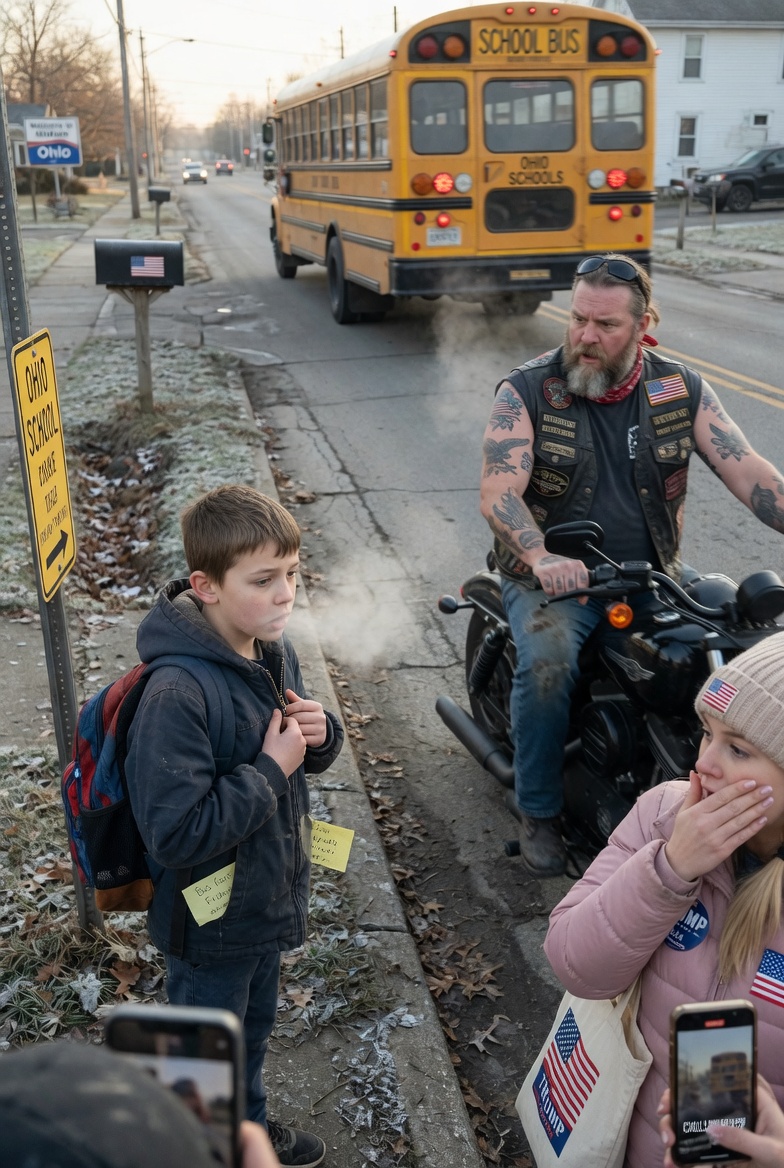
The motorcycle disappeared around the corner, the sound folding into the cold morning like it had never been there at all. I stood frozen on that cracked sidewalk, breath still puffing out in little clouds, my hand still pressed over the broken zipper of my jacket. The woman who had gasped was now talking into her phone, her voice high and tight.
— I don’t know, he just took off after the school bus! A big guy on a motorcycle, tattoos, leather vest. Yes, I’m serious. He looked angry.
Another voice, a man this time, shouting from a pickup truck stopped at the intersection.
— Did anyone get the plate number? Somebody call 911!
My heart hammered against my ribs so hard I thought it might crack through. This was all wrong. The biker had asked me a question. He’d looked at me with something that wasn’t anger—it was something else, something I couldn’t name. But now the whole neighborhood was twisting it into something ugly, and my stomach knotted up because maybe, maybe I had just watched a man drive off to do something terrible, and it was my fault.
I tried to swallow, but my throat felt like sandpaper. My phone buzzed in my pocket, and I nearly dropped it pulling it out. The screen lit up with my mom’s picture—her tired smile, the one she wore after double shifts at the diner, the one that said she was still fighting even when her feet ached and her tips were low.
— Mom?
— Ethan! Baby, are you okay? Where are you?
Her voice cracked right through me. I could hear the panic shaking in her words, the way she was trying to sound calm but wasn’t.
— I’m still at the stop. The bus left without me. Mom, a man on a motorcycle, he—
— I know, honey. He called me. His name is Ray. He said he saw you get kicked off and he’s going to make sure that bus doesn’t leave you stranded. He told me to come get you, to meet him where the bus stops next. Are you safe right now? Is there anyone with you?
The relief that washed over me was so sudden my knees nearly buckled. He called my mom. He wasn’t chasing the bus to hurt anyone. He was chasing it to help me.
— I’m okay, I’m by the curb. There are some people here, but they think he’s—
— I don’t care what they think. Stay right there. I’m two minutes away. Don’t move.
The line went dead, and I stared at the phone, my fingers numb. The woman on her own phone was still talking, her words spilling out too fast for me to catch. The man in the pickup truck hadn’t moved; he was watching me now, squinting.
— Hey, kid. You know that guy?
I shook my head.
— He just asked why I wasn’t on the bus.
The man’s mouth pressed into a thin line. He looked toward the empty road, then back at me, then at his phone. He didn’t dial. He just sat there, engine idling, like he was waiting to see how the morning would end.
The cold crept deeper into my bones. My ears started to ache. I thought about my classroom, the warm hum of the heater, the way Mrs. Patterson would write the date on the whiteboard in green marker. I thought about how I was going to be late again, and how being late meant standing in the office while the secretary called my mom, and how my mom would have to leave work early, and how leaving work early meant less money, and less money meant the electricity might get shut off again, and—
Tires screeched around the corner.
A rust-spotted sedan bounced up to the curb, and my mom was out of the driver’s seat before the car even stopped rocking. Her hair was pulled back in a messy ponytail, strands flying loose, and her jacket was only half-zipped, just like mine. She ran to me and dropped to her knees on the wet concrete, grabbing my shoulders, pulling me into a hug so tight I could feel her heartbeat against my chest.
— I’m sorry, I’m so sorry, I should’ve paid the bus fee, I told them I’d pay Friday, I told them—
Her voice broke into pieces, and I wrapped my arms around her neck and held on. She smelled like dish soap and coffee, the way she always did after the breakfast shift.
— It’s okay, Mom. I’m not hurt. The biker guy, Ray, he went after the bus.
She pulled back, cupping my face with both hands, her thumbs wiping at my cheeks even though I hadn’t realized I’d started crying.
— We’re going to go find him. He said to meet at the intersection by the hardware store. That’s where the bus has to stop for the light. Get in the car.
I climbed into the passenger seat, the upholstery torn and patched with duct tape, and she threw the car into gear. As we pulled away, I saw the woman on the phone staring after us, her mouth half-open. The man in the pickup finally drove off, shaking his head.
The streets blurred past. My mom gripped the steering wheel like she was holding onto the edge of a cliff.
— That man, Ray, he called me from your phone. He saw you standing there and he didn’t even hesitate. He asked if I knew you’d been left. I said no, and he said, ‘I’m going to stop that bus. Meet me at Main and Third.’ Then he hung up. I didn’t know what to think, Ethan. I was so scared.
— He looked at me, Mom. Right at me. Like I mattered.
She didn’t answer. Her jaw tightened, and she pressed the gas a little harder.
We turned onto Main Street and there it was.
The yellow school bus sat motionless in the right lane, its red flashers blinking, a patrol car angled behind it with lights swirling blue and red. And in front of the bus, a line of motorcycles—five, six, seven of them—parked in a neat curve along the curb. Riders stood beside their bikes, arms crossed or hands in pockets, watching. No one was yelling. No one was fighting. The whole scene was quiet, like a held breath.
Mom pulled over half a block away and killed the engine.
— Stay in the car.
— But Mom—
— Ethan, please.
I watched her walk toward the flashing lights, her work sneakers slapping the pavement. I cracked the window and the cold air carried voices to me, thin but clear.
The bus driver was standing in the open door, arms folded, face red even from a distance.
— I followed protocol! The kid didn’t have a pass. I don’t make the rules, I just enforce them. You think I wanted to leave him? You think I’m some kind of monster?
The biker—Ray—stood a few feet away, helmet under one arm, tattoos dark against his skin in the pale light. He wasn’t shouting. His voice was low and steady, the kind of voice you had to lean in to hear.
— I didn’t call you a monster. I’m saying there’s a kid alone on a road with no sidewalk, and it’s twenty-eight degrees. Protocol shouldn’t mean leaving a ten-year-old in danger.
— That’s not my call. The school district—
— Then whose call is it?
The officer, a tall man with gray at his temples and a nameplate that read OFFICER MARTINEZ, raised a hand to both of them.
— Alright, enough. I’ve got the full picture now. Sir— he turned to Ray —you called the boy’s mother before you followed the bus?
— Yes, sir. I showed you the call log. And the text. She’s on her way.
— And you— Officer Martinez looked at the bus driver —you radioed dispatch that you were being followed by a ‘suspicious motorcyclist.’ Did you observe any threatening behavior?
The driver hesitated.
— He was behind me. For three blocks. He didn’t signal, he didn’t—
— Did he brandish a weapon? Try to board the bus? Make any verbal threats?
Silence.
— No.
Officer Martinez exhaled, a long plume of breath in the cold.
— Then here’s what’s going to happen. The boy is going to get on this bus, and you’re going to take him to school. After that, you can file whatever report you want with the district, but right now, we’re dealing with a child’s safety, not paperwork.
The driver’s face tightened.
— I could get written up.
— And I could cite you for endangering a minor by leaving him on an unlit roadway without a sidewalk. Your choice.
I saw my mom stop at the edge of the scene, her hands clenched at her sides. She didn’t speak. She just stood there, watching, and I knew she was trying to hold herself together. Ray noticed her and gave a small nod. That tiny gesture, that acknowledgment, made something loosen in my chest.
The driver stared at the ground for a long moment. The kids inside the bus were all pressed against the windows, little smudges of color and curiosity. Some of them were pointing. One boy, a fifth-grader named Marcus who lived two streets over, caught my eye through the window and raised his hand in a half-wave. I didn’t wave back. I couldn’t move.
Finally, the driver stepped aside.
— Fine. Get him on.
Officer Martinez turned toward my mom.
— Ma’am, is your son here?
She looked back at the car, and I saw her mouth my name. I didn’t wait for her to call me. I pushed open the door and walked toward the bus, my shoes scraping the asphalt, my backpack suddenly heavier than it had ever been. The riders watched me pass. One of them, a woman with silver streaks in her dark hair and a patch on her vest that read ‘SAFETY MARSHAL,’ smiled at me, gentle.
— You’re brave, kiddo, she said. Not a lot of grown-ups would’ve stayed that calm.
I didn’t feel brave. I felt small, and cold, and tired. But I nodded.
Ray turned as I approached. Up close, he looked younger than I’d thought—maybe thirty, with lines around his eyes that suggested he smiled more than he frowned. He knelt down so his face was level with mine.
— You did good, Ethan. You didn’t panic. You stayed where it was safe. That matters.
— You chased the bus, I said, my voice barely above a whisper.
— I chased the bus, he agreed. Because someone had to.
— They thought you were going to hurt people.
— I know. They were wrong. People see a tattooed guy on a bike and they write a story in their heads before they know the first thing about him. But that’s not your problem to carry. You understand?
I nodded again, even though I wasn’t sure I did.
He stood up and gestured toward the bus steps.
— Go on. You’ve got school. And tell your teacher you’ve got a hell of a story for show-and-tell.
A tiny laugh bubbled up from somewhere inside me, surprising both of us. My mom came over and took my hand, and together we walked to the bus door. The driver wouldn’t look at us. He just stared straight ahead, his knuckles white on the steering wheel.
— Thank you, my mom said to him anyway. Her voice was quiet but steady. She wasn’t thanking him for letting me on. She was thanking him for finally doing the right thing.
The doors hissed shut behind me, and I walked down the aisle. The seats felt like a tunnel of eyes. Marcus slid over and patted the empty space beside him. I sat down, and the bus rumbled back to life.
As we pulled away, I twisted around to look out the back window. Ray was still standing there, helmet in hand, watching. The other riders were mounting their bikes, engines starting one by one. Officer Martinez had gotten back in his patrol car, lights off now. The whole scene was already dissolving into the ordinary flow of the morning, the way ripples flatten out after a stone drops into water.
But I knew it wouldn’t flatten out for me.
Marcus nudged my arm.
— Dude. Was that really a motorcycle gang?
— They weren’t a gang. They were safety marshals.
— What’s a safety marshal?
I opened my mouth to explain, but I didn’t have the words yet. So I just said, — People who help.
The bus rolled on, and for a few minutes, nobody talked to me. The hum of the engine, the squeak of the seats, the low murmur of kids chatting—these sounds had been part of my every morning for years. But today they felt different. Sharper. Like I could hear every layer of noise separately, the way you hear rain hitting different parts of a roof.
Mrs. Patterson was at the classroom door when I walked in, twenty minutes late. She had her attendance clipboard in one hand and a dry-erase marker in the other, and when she saw me, her eyebrows drew together.
— Ethan, you’re late. Is everything okay?
I thought about the cracked sidewalk, the cold, the roar of the motorcycle, the flashing lights. I thought about Ray kneeling down and telling me I did good. I thought about my mom’s shaking hands and the way she’d said thank you to a driver who didn’t deserve it.
— I had a hard morning, I said. But I’m okay now.
She studied me for a second, then nodded.
— If you want to talk about it, I’m here.
I took my seat by the window. Outside, the sun was finally breaking through the clouds, pale and watery. I could still feel the cold in my bones, but it was fading.
The morning dragged on. Math, reading, science. I couldn’t focus. My mind kept drifting back to the intersection, the line of motorcycles, the officer’s voice cutting through the cold. I kept seeing Ray’s face, the way he’d looked at me like I was worth stopping for.
At lunch, Marcus sat across from me with his tray of chicken nuggets and tater tots.
— So, spill it. What happened this morning? Everyone’s talking about it. Some kids said the bus got hijacked.
— It didn’t get hijacked.
— Then what?
I pushed a tater tot around with my fork. I didn’t know how to tell the story. It was too big, too tangled. But Marcus was looking at me with his eyebrows raised, waiting, and so I started.
— The bus driver kicked me off because I didn’t have a pass. My mom was supposed to pay Friday, but she couldn’t. So I was standing there, and this guy on a motorcycle stopped. He asked me what happened, and when I told him, he just… went after the bus. To make them let me on.
Marcus’s mouth fell open.
— He chased the bus? Like, a high-speed chase?
— Not really high-speed. But he followed it until the light. Then the cops came, and his friends came, and my mom came, and they made the driver let me back on.
— Wait, his friends? How many?
— Like six or seven. All on motorcycles.
— That’s insane.
— It was, I admitted. But it wasn’t like the movies. It was quiet. Everybody was just… standing there. Talking. Figuring it out.
Marcus chewed a nugget slowly, thinking.
— So this guy, he didn’t even know you?
— No.
— And he just decided to help?
— Yeah.
— Why?
That was the question. Why did a stranger stop his bike, call my mom, follow a school bus, and stand in the cold with his hands up while a police officer questioned him? Why did his friends show up without being asked, lining the curb like a quiet wall?
I didn’t have an answer. Not yet.
The rest of the school day passed in a blur. At 3:15, the final bell rang, and I walked out to the bus loop with my backpack bouncing against my shoulders. The same yellow bus was waiting, the same driver behind the wheel. This time, when I climbed aboard, he looked at me. Not with anger. Not with annoyance. Just… looked. His eyes were tired, rimmed with red, and I wondered if he’d been thinking about the morning as much as I had.
— Have a seat, he said.
No “pass.” No “rules.” Just three words, heavy as stones.
I sat behind Marcus this time. As the bus pulled out of the lot, I watched the driver’s hands on the wheel. They weren’t gripping it white-knuckled anymore. They were just holding it, the way you hold something you’ve held a thousand times.
When we reached my stop, the doors opened and I stepped down onto the familiar cracked sidewalk. The cold had mellowed into a cool afternoon, the kind where you can finally unzip your jacket. I started walking toward my apartment complex, past the dumpster enclosure and the row of mailboxes with half the names faded off.
And there, parked in the visitor spot next to a rusted sedan that wasn’t my mom’s, was a motorcycle.
Ray was leaning against the seat, arms crossed, the same leather vest with the same worn patches. He wasn’t wearing a helmet this time, and I could see the full shape of his face—the sharp jaw, the slight crook in his nose that looked like it had been broken once and never quite set right. He raised a hand when he saw me.
— Hey, Ethan. Your mom said it was okay if I stopped by. Wanted to check on you.
I walked up to him, and I realized I wasn’t afraid. I wasn’t even nervous. I was curious.
— Why did you do it?
He tilted his head, like the question was unexpected but welcome.
— Do what?
— Stop. Chase the bus. All of it. You didn’t know me.
Ray was quiet for a moment. He looked down at his boots, scuffed and dusty, then back up at the sky where the clouds were starting to turn pink at the edges.
— When I was about your age, I got left behind a lot. Not by a bus. By people. Teachers, caseworkers, relatives who said they’d show up and didn’t. I know what it feels like to stand somewhere and watch the world move on without you. It gets inside you. Makes you think you don’t matter.
He paused, and I saw something flicker behind his eyes, something old and sharp.
— I was riding to work this morning, and I saw you there. This skinny kid with a busted zipper, holding his backpack like a shield. And I saw that bus driving away, and I thought, no. Not this kid. Not today. Not if I can do something about it.
— But people thought you were dangerous. They were going to call the police.
— They did call the police. And that’s okay. The police showed up, they listened, they figured it out. That’s the system working the way it’s supposed to. But it only worked because someone was willing to say, ‘Hey, this isn’t right.’ You understand? You have to speak up. Even if people misunderstand. Even if they write a story about you that isn’t true.
I thought about the woman with the phone, the man in the pickup truck. They had written a story about Ray before they knew a single real thing. A scary biker chasing a school bus. It had all the drama, all the tension, all the wrong details.
— How do you not get mad? I asked. When people think bad things about you, and they’re not true?
Ray smiled, a little lopsided.
— Oh, I get mad. I get real mad. But then I remember: their fear isn’t about me. It’s about what they don’t understand. And I can either spend my life being angry about that, or I can spend it showing them who I really am. Today, I got to show them. That’s worth more than being mad.
My mom’s car pulled into the lot then, and she stepped out with a grocery bag in one arm and her work apron still tied around her waist. She saw Ray and stopped, her posture stiffening for just a second before recognition softened her face.
— You’re him, she said. Ray, right?
— Yes, ma’am. Ray Castillo.
She walked up to him, shifted the grocery bag to her other hip, and held out her hand. He took it, and she didn’t let go right away.
— I don’t know how to thank you. I’ve been replaying this morning over and over. If you hadn’t called, if you hadn’t stopped— She swallowed hard. — That road is so dangerous. He could’ve tried to walk. He could’ve—
— But he didn’t, Ray said. He stayed put. Smart kid.
My mom nodded, blinking fast. Then she did something that surprised me. She asked him to stay for dinner.
— It’s just spaghetti and jar sauce, nothing fancy. But I’d like to hear more. About you, about those other riders. I feel like I need to understand what happened this morning.
Ray hesitated. I could see him weighing it, the way adults do when they’re not sure if they’re imposing.
— I don’t want to be a bother.
— You’re not a bother, my mom said, and her voice was firm now, the voice she used when she wasn’t going to argue. You’re the reason my son is safe. Please.
Ray looked at me. I nodded.
— Spaghetti’s good, I said. Mom puts extra garlic.
He laughed, a real laugh that crinkled the corners of his eyes.
— Well, when you put it that way.
We walked up the concrete stairs to our apartment, number 3B with the peeling number sticker and the welcome mat that said ‘HOME’ in faded letters. Inside, my mom headed straight for the tiny kitchen and started boiling water. Ray sat down on the couch, which sagged in the middle, and I sat on the floor across from him, my back against the coffee table.
— The other riders, I said. Who were they?
— They’re part of my association. Guardian Riders. We do charity escorts, toy runs, funeral processions for veterans, that sort of thing. But we also have a safety response network. If someone in the community calls about a kid in trouble, we respond. Quietly. No lights, no sirens, no drama. Just presence.
— Like this morning.
— Exactly like this morning. I sent a group text after I called your mom. Didn’t know if I’d need backup. Didn’t know how the driver would react. I just knew I didn’t want to be alone if things got complicated.
My mom paused at the stove, a wooden spoon in her hand.
— How did you know it wouldn’t turn violent?
Ray leaned forward, elbows on his knees.
— I didn’t. That’s the honest answer. I’ve been in situations that went sideways before. But I’ve learned that most people aren’t looking for a fight. They’re looking for someone to hear them. The driver was following rules. The officer was following procedure. I just had to make sure the rule didn’t hurt a kid. So I kept my hands visible, kept my voice low, and waited for the facts to catch up with the fear.
I tried to picture it: Ray standing in the cold with police lights flashing, everyone’s phones out, the whole neighborhood watching. I couldn’t imagine being that calm. My heart was pounding just thinking about it.
— Weren’t you scared?
— Terrified, Ray said. But being scared doesn’t mean you don’t act. It means you act scared. You do it anyway.
My mom brought over three bowls of spaghetti, the steam curling up toward the ceiling. We ate in the living room, balancing the bowls on our laps. The apartment was small—one bedroom, a pullout couch for me, a bathroom with a faucet that dripped—but tonight it felt warm. Full.
Between bites, Ray told us more. About growing up in a group home in Cleveland, aging out of the system at eighteen, bouncing between jobs and couches until a mechanic named Sal took him in and taught him to fix bikes. About the first time he rode in a charity escort, how the line of motorcycles stretched for half a mile, and how the families they were helping stood on the sidewalks and waved.
— That was the first time I felt like I belonged to something good, he said. Not something cool. Something good.
— Is that why you became a safety marshal? I asked.
— Partly. The other part is what I told you before. I don’t want any kid to feel the way I felt. Invisible. Like nobody cares if they’re standing on a dangerous road.
My mom set her fork down. Her eyes were wet again, but she wasn’t crying. She was just looking at Ray with this expression I’d never seen before—gratitude, maybe, but also something harder. Recognition.
— You know, she said, I work two jobs. Sometimes three. I do my best. But mornings like today, when the bus fee isn’t paid and the rent is late and the car is making that noise again—I feel like I’m drowning. And I worry Ethan sees it. I worry he thinks it’s his fault.
— It’s not his fault, Ray said. It’s not your fault either. Life is just hard sometimes. The only thing that makes it easier is people showing up.
He looked at me then, his dark eyes steady.
— You hear that, Ethan? You’re not the reason things are hard. You’re the reason your mom gets up in the morning and fights. That’s a big difference.
I didn’t say anything. My throat was too tight. But I nodded, and I think he understood.
After dinner, Ray helped me with my math homework. It was fractions, which I hated, but he had this way of explaining them with motorcycle parts—a half-tank of gas, a quarter-mile of road—that made them suddenly make sense. My mom sat at the kitchen table, paying bills with a calculator and a frown, but every few minutes she looked up and watched us, and her frown would ease a little.
When it was time for Ray to leave, the three of us stood by the door. The apartment hallway was quiet, the fluorescent light buzzing overhead. Ray pulled something from his vest pocket and pressed it into my hand.
It was a patch. Round, about the size of a coaster, with a shield embroidered on it and the words ‘GUARDIAN RIDERS — YOU ARE NOT ALONE.’
— This is for you, Ray said. Not because you need to join anything. Just to remember. Someone’s always watching out, even when you can’t see them.
I ran my thumb over the stitching, the threads rough and real.
— Thank you, I said. For everything.
Ray crouched down again, the same way he had at the intersection.
— You’re going to have more hard mornings, Ethan. That’s just life. But every time you get through one, you’re building something. Call it grit. Call it strength. Call it proof that you can survive things. And one day, you’re going to be the person who stops for someone else. That’s how this works. We pass it on.
He stood up, shook my mom’s hand one more time, and walked down the stairs. The motorcycle engine rumbled to life outside, then faded into the night.
My mom closed the door and leaned her forehead against it for a long moment. When she turned around, her face was tired but peaceful, the way the sky looks after a storm.
— That man is something else, she said.
— Yeah, I agreed. He is.
I slept on the pullout couch that night with the patch on the pillow beside me. The apartment creaked and settled, the radiator hissed, and somewhere upstairs a neighbor played music too loud. But I wasn’t listening to any of that. I was thinking about the morning, the cold, the roar of the engine. I was thinking about a line of motorcycles curving around a yellow bus. I was thinking about a police officer who listened, and riders who showed up without fanfare, and a driver who finally opened the door.
Mostly, I was thinking about Ray’s voice: You have to speak up. Even if people misunderstand. Even if they write a story about you that isn’t true.
I didn’t know then how much those words would stick. I didn’t know that they would become a kind of compass, pointing me toward something I’d spend years learning to understand.
But even that night, in the dark, with the patch resting beside me, I could feel something shifting. A door opening. A question forming.
What would I do, the next time I saw someone standing alone?
The next morning, I was awake before the alarm. I pulled on my jeans and my jacket—the same one with the broken zipper—and I walked to the bus stop in the early gray light. The sidewalk was still cracked. The air was still cold. But something was different, and it took me a minute to figure out what it was.
I wasn’t dreading the bus. I wasn’t bracing for the driver’s flat stare or the way some kids would look through me like I wasn’t there.
I was looking forward to it.
Not because I thought everything would be perfect now. But because I knew, down in my bones, that if something went wrong, I could handle it. I had evidence. Proof. A patch in my backpack and a memory in my head of a man who stopped.
The bus pulled up. The doors opened. The driver was the same man, but his face was different this morning—less pinched, less guarded. He glanced at me and gave the smallest nod. Not a smile. Not an apology. But an acknowledgment. I took it.
I walked down the aisle and slid into the seat beside Marcus, who was already talking before I even got my backpack off.
— Okay, so I told my dad about what happened yesterday, and he said he saw the whole thing on Facebook. Someone posted a video. You’re famous, dude.
— I’m not famous. I just got left behind.
— Yeah, but the biker guy? People are calling him a hero. The video has like fifty thousand views.
I blinked. Fifty thousand views. The woman with the phone, the man in the pickup truck, all those people who thought they were watching something dangerous—they had captured it. Posted it. And now the whole town, maybe the whole country, was seeing what really happened.
— What are they saying? I asked.
Marcus pulled out his phone and scrolled.
— Some people are saying the bus driver should be fired. Some people are saying the school district needs to change its policy. And a lot of people are saying that biker is proof that there are still good people in the world.
I thought about Ray leaning against his bike, saying that most people aren’t looking for a fight. They’re looking for someone to hear them. The video was proof that people were listening. Not just to the bus driver or the police, but to the quiet truth underneath the drama: a kid had been left on a road, and a stranger had refused to look away.
— There’s one more thing, Marcus said, his voice getting serious. The bus driver. My dad said he gave an interview to the local news last night.
— What did he say?
— He said he was sorry. He said he was just following the rules, but he realized rules don’t mean anything if they put a kid in danger. He said he’s going to talk to the school board about changing the policy.
I stared out the window at the gray sky and the bare trees and the houses sliding past. The driver was talking to the school board. He was going to try to change things. Not because anyone forced him to, but because something had cracked open inside him. Because a biker had stood in the cold and said, This isn’t right.
The bus rolled on, and I felt something settle into place. It wasn’t happiness, exactly. It was more like relief. The kind of relief you feel when you realize that one hard moment doesn’t have to define everything. It can be the start of something else. Something better.
At school, Mrs. Patterson pulled me aside before class started.
— Ethan, I heard about what happened yesterday. I want you to know, if you ever need to talk to someone—a counselor, a teacher, me—you just say the word. You’re not alone in this.
— I know, I said. And I wasn’t just being polite. I really did know.
During recess, a few kids crowded around me, asking questions. Some of them had seen the video. Some had heard from their parents. A girl named Kayla, who usually sat in the back of the bus and never talked to anyone, came up to me with her hands in her pockets.
— My mom lost her job last month, she said quietly. We’re behind on everything. I was scared I was going to get kicked off the bus too. But after what happened with you, my mom called the school, and they worked out a payment plan. She said they were really understanding.
— That’s good, I said. Really good.
Kayla smiled, just a little, and walked away. And I realized that Ray’s actions hadn’t just changed my morning. They had rippled out, touching people I didn’t even know. The school district, the bus company, other families. One man’s decision to stop had started a chain reaction that was still unfolding.
After school, I found Ray’s patch in my backpack and pinned it to the inside flap, where I could see it every time I unzipped the main compartment. I didn’t want to wear it on my jacket—it felt too private for that, too sacred. But I wanted it close.
My mom came home late that night, her feet dragging, her uniform smelling like fryer oil. She collapsed onto the couch and I brought her a glass of water and the leftover spaghetti. She ate slowly, staring at the wall.
— I talked to my boss today, she said. About switching to the day shift. It pays a little less, but I’d be home in the evenings. For homework and stuff.
— You don’t have to do that, I said. I’m fine on my own.
She looked at me with those tired eyes, and I saw something shift in them—a new kind of determination.
— I know you’re fine. You’re the most fine kid I’ve ever met. But I want to be here, Ethan. I want to be the one who stops. Do you understand?
I understood. She had watched a stranger do for her son what she couldn’t do that morning, and it had lit a fire in her. Not guilt. Not shame. A fire.
— I’d like that, I said. You being home.
She smiled, and for a second she looked ten years younger.
That night, I lay on the pullout couch and thought about all the ways people show up. Ray on his motorcycle. My mom rearranging her whole schedule. The bus driver talking to the school board. Kayla’s mom getting a payment plan. Marcus telling the story so many times he could probably recite it in his sleep. The woman with the phone, who had posted the video not to shame anyone but to show the world that sometimes things work out.
I thought about the patch in my backpack: YOU ARE NOT ALONE.
And I realized it wasn’t just a nice phrase. It was a promise. A promise that somewhere out there, at any given moment, someone was paying attention. Someone was willing to act. Someone was riding toward trouble with their hands visible and their heart open.
I closed my eyes and let that promise carry me into sleep.
The days that followed were strange in the best way. The story kept spreading. A local news station did a segment on Ray and the Guardian Riders, interviewing people at the association’s headquarters—a converted garage on the edge of town where they repaired bikes and packed care packages for families in need. They showed pictures of toy runs and charity rides, rows of motorcycles with teddy bears strapped to the back seats. They showed Ray standing by his bike, the same leather vest, the same steady eyes.
— We’re not heroes, he said into the camera. We’re just people who decided to care.
The reporter asked him about the moment he saw me on the sidewalk.
— I saw a kid who needed someone, Ray said. That’s it. I didn’t think about policies or politics. I thought about a cold morning and a long road and a child who deserved better.
My mom watched the segment on her phone while we ate breakfast. When it ended, she set the phone down and looked at me.
— He’s right, you know. You did deserve better. You’ve always deserved better.
— So do you, I said.
She didn’t argue. She just nodded, and that nod felt like a new chapter starting.
A week after the incident, a letter arrived at our apartment. It was from the school district, typed on official letterhead, and it said that due to recent community feedback, the district was implementing a temporary grace period for bus fees. No child would be denied transportation if their payment was late. A formal policy review was underway.
My mom read the letter three times, her lips moving silently. Then she folded it carefully and put it on the refrigerator with a magnet shaped like a sunflower.
— This happened because of you, she said.
— It happened because of Ray. And Officer Martinez. And the riders. And everyone who watched that video and got mad.
— It happened because you didn’t disappear, she said. You stood there, and you let yourself be seen. That matters.
I thought about the morning on the sidewalk, the way I’d felt invisible. I thought about the bus pulling away, the cold seeping through my jacket, the shame burning hot in my stomach. I hadn’t felt brave. I hadn’t felt seen. But looking back, I realized my mom was right. By not running, by not hiding, by telling Ray the truth when he asked, I had set something in motion.
Being seen is terrifying. But it’s also the first step toward being helped.
The following Saturday, my mom and I went to the Guardian Riders’ open house. It was held in the converted garage, which they called The Nest. Strings of lights hung from the rafters, and the walls were covered with photographs—smiling kids, veterans in wheelchairs, families holding signs that said ‘THANK YOU.’ There was a table with coffee and donuts, and a corner where kids could sit on a motorcycle and pretend to ride.
Ray spotted us as soon as we walked in. He was wearing his vest over a flannel shirt, and he had a wrench in one hand, like he’d been working on a bike when we arrived.
— Ethan! Mrs. Foster! Welcome. I’m glad you came.
He introduced us to the other riders. There was Sal, the mechanic who had taught Ray everything, a burly man with a white beard and hands like leather. There was Diane, the woman with the silver-streaked hair who had smiled at me on the morning of the chase. There was Marcus’s dad, who had apparently joined the association after watching the video and realizing he wanted to be part of something good.
— Your story woke a lot of people up, Diane told me. We’ve had more volunteer applications this week than we had all of last year. All because a ten-year-old boy stood on a sidewalk and refused to disappear.
— I didn’t do anything, I said.
— You survived, she said. Sometimes that’s the bravest thing of all.
Sal took me around the garage and showed me the bikes. He explained the difference between a cruiser and a sport bike, showed me how to check the oil, let me press the button that made the headlight flare to life. I’d never been that close to a motorcycle before. The chrome was cold under my fingers, the leather seat worn smooth.
— You want to ride one someday? Sal asked.
— Maybe, I said. But not to chase buses.
He laughed, a big booming sound that echoed off the metal walls.
— Fair enough, kid. Fair enough.
Before we left, Ray pulled me aside one more time.
— I meant what I said that first night. You’re going to be the one who stops someday. Maybe not on a motorcycle. Maybe just by listening, or speaking up, or standing beside someone who’s alone. But you’ll know when the moment comes. And you’ll be ready.
— How do you know? I asked.
— Because you already know what it feels like to be left behind. People who know that feeling, the ones who don’t let it harden them—they’re the ones who change things. You’ve got that in you, Ethan. I saw it the moment I stopped.
I didn’t know what to say. So I just hugged him. It was awkward, the way hugs with almost-strangers usually are, but he hugged me back, and for a second I felt like I was wrapped in something solid and warm and unshakeable.
On the drive home, my mom was quiet for a long time. Then, as we turned onto our street, she spoke.
— I was so scared that morning. Not just because of the road. Because I thought I’d failed you. I thought not being able to pay the bus fee meant I was a bad mother. But watching you today, talking to those people, seeing how much they respect you… I realized something.
— What?
— Failing isn’t the same as falling short. Falling short means you’re trying and not quite reaching. Failing means you stop trying. And I’ve never stopped trying. Neither have you.
She reached over and squeezed my hand, and I squeezed back.
— We’re going to be okay, she said.
— I know, I said.
And I did.
The winter passed. The bus policy changed permanently—no child would ever be denied a ride for late payment, period. The Guardian Riders started a scholarship fund for kids in the district who wanted to learn a trade. Ray got his picture in the paper, and then he went right back to fixing bikes and riding safety escorts, because fame wasn’t the point.
I turned eleven that spring. For my birthday, Ray gave me a small toolkit—real wrenches and screwdrivers, not toys—and a card that said, For when you’re ready to build something. I kept it under my bed, next to the patch.
Middle school came, then high school. I grew taller, my voice dropped, and the broken zipper jacket got replaced by a new one that actually closed. But I never forgot the cold morning when a stranger stopped. I never forgot the line of motorcycles, the flashing police lights, the driver’s reluctant nod. I never forgot Ray’s words: You have to speak up, even if people misunderstand.
In my junior year, I joined the school’s peer mentoring program. I sat with kids who ate lunch alone. I walked new students to their classes. I noticed the ones who stood by themselves at bus stops, their shoulders hunched against the wind.
One morning, I saw a sixth-grader shivering on a corner with no gloves, her hands red and raw. I gave her my spare pair and told her to keep them. She looked at me the way I must have looked at Ray all those years ago—surprised, grateful, a little bit in awe.
— Why are you helping me? she asked.
— Because someone helped me once, I said. And now it’s my turn.
She put on the gloves and smiled, and I watched her board the bus with her head held a little higher.
The cycle continued.
Years later, when I was twenty-two and working as a mechanic in a garage not unlike The Nest, I got a call from Ray. His voice was older now, a little rougher, but still steady.
— The association is doing a charity ride next weekend. Toy run for the children’s hospital. I could use a co-pilot. You interested?
I looked down at my hands, calloused and grease-stained, and then at the toolkit still sitting on my shelf.
— Pick me up at ten? I said.
— I’ll be there.
I hung up the phone and smiled. Outside, the sun was rising, pale and watery, just like it had on that cold Ohio morning. The roads were clear, the air was crisp, and somewhere out there, a kid was waiting for someone to notice them.
I was ready.
Being protected doesn’t always look gentle at first—but it always leaves you safer than before. And being the one who protects? That feeling never gets old.