WHOLE STORY:
The lock clicked into place like a bullet chambering. The sound ricocheted off the marble floors and porcelain vases, settling into the space between heartbeats.
My mother’s confident smirk was starting to fray at the edges.
“You want to handle this legally?” I had asked.
Now I had to. There was no going back.
“James,” my mother said, her voice dropping into that condescending tone she used when she thought I was being dramatic. “Let’s not do anything rash. You’re upset. I understand. You came home and saw something you didn’t understand.”
“I saw my wife bleeding on the floor.”
“She was having a moment. The nurse was helping her ground herself.”
“By letting her scrub her skin off with bleach?”
I didn’t yell. Yelling would have been easy. Yelling would have meant I was losing control.
I was perfectly, terrifyingly in control.
Margaret the nurse stood up. She was tall, broad-shouldered, with the cold eyes of someone who enjoyed power. “Mr. Carter, I have been a maternity nurse for fifteen years. I have dealt with dozens of hormonal mothers. Your wife has an attachment disorder. She needs structure. Discipline.”
“Discipline,” I repeated. “You used that word before. What exactly does discipline look like to you, Margaret?”
She hesitated.
My mother jumped in. “James, let’s sit down and talk about this like adults. Eliza is upstairs. She’s fine. A little shaken, but fine. You’re making a mountain out of a molehill.”
“I’m making a police report out of an assault.”
“You wouldn’t.”
I pulled out my phone. Not to call the police. Not yet.
To show them.
“This house has seventeen cameras. You knew that. I installed them after the last nanny quit. Do you remember why she quit, Mother?”
My mother’s face went pale.
“She quit because she said you were impossible to work for. She said you had a way of making people feel small. I didn’t believe her. I told her she was being sensitive.”
“James—”
“I was wrong.”
I opened the app on my phone. The security footage was backed up to the cloud. Every room. Every conversation.
“Let’s watch,” I said softly. “Let’s see what discipline looks like.”
Margaret grabbed her purse. “I’m not staying for this. You’re clearly unhinged.”
“Sit down.”
“You can’t keep me here.”
“This is my house. My security system is recording this conversation right now. You walk out that door, and I will tell the police you fled the scene of a crime against a pregnant woman. You think they won’t find you? You think I won’t find you?”
She sat down.
My mother looked at me with something I had never seen before. Fear.
Not fear of the police.
Fear of losing control.
“James, I did this for you. For the family. Eliza is sweet, but she is weak. She would have ruined you. She would have ruined the Carter name. I did what any mother would do.”
“Any mother would torture her daughter-in-law?”
“I didn’t torture her! I gave her structure! She needed to learn her place!”
“Her place?”
“In this family! You were blinded by love! You couldn’t see that she was manipulating you! She came from nothing, James. Nothing. She latched onto you because you were a safety net. She doesn’t love you. She loves what you provide.”
The words hung in the air like poison gas.
“You truly believe that,” I said, shaking my head. “You actually believe the lies you tell yourself.”
“I am trying to save you!”
“You are trying to control me. You have been trying to control me my entire life. And I let you. Because I thought you loved me. But this… this isn’t love. Love doesn’t make someone bleed.”
I walked to the window. Outside, the manicured lawn stretched toward the old oak tree where I had played as a child. The tree my father had planted.
“Dad would have hated you for this.”
“Don’t you dare bring your father into this.”
“He loved Eliza. He welcomed her. He said she brought light back into this house. And you resented her for it. Because you couldn’t stand that someone else made me happy.”
My mother stood up, her composure finally cracking. “Your father was a fool! He was soft! And he made you soft!”
“No,” I said quietly. “He made me kind. There is a difference.”
I pressed a button on my phone.
A video began to play.
It was from three days ago.
Eliza was sitting on the couch, her hands folded in her lap. Margaret was standing over her.
“You are not doing enough,” Margaret said. “You sleep too much. You eat too much. You are lazy.”
“I’m tired,” Eliza whispered. “The baby keeps me up.”
“Excuses. Your husband works hard. He deserves a wife who is strong. Not a weak, sniveling girl who can’t even keep a house.”
“I try.”
“Try harder.”
My mother sat back down, her hands trembling.
The video continued.
“You are disgusting,” Margaret said. “The way you eat. The way you walk. The way you cry. You are disgusting.”
Eliza started to cry.
“Stop crying. You are pathetic.”
“I’m sorry.”
“Sorry isn’t good enough. Go to the kitchen. Get the bleach. Scrub the floors until you feel clean.”
“Please. I’m tired.”
“I wasn’t asking.”
My mother reached for my arm.
I pulled away.
“I didn’t know she would take it that far,” my mother whispered.
“You hired her. You told her Eliza was difficult. You gave her permission to break her.”
“I wanted to help her adjust!”
“You wanted to destroy her. And you almost succeeded.”
I stopped the video.
“The police will have this. They will have all of it. The texts you sent Margaret. The payments you made. The instructions you gave.”
“You can’t do that to your own mother.”
“You did this to my wife. My pregnant wife. The mother of my child.”
“I am your mother!”
“You are a stranger to me.”
I called the police.
My mother started crying. Real tears. But I had learned the difference between real tears and performance tears.
Margaret sat in silence, her face hard.
“You’re making a mistake,” Margaret said. “I have recordings too. I have recordings of your wife. Her breakdowns. Her threats. I can make her look insane.”
“You can try.”
“I will. I will tell them she was unstable. That she attacked me. That I was defending myself.”
“And the video?”
“What video? You have video of me yelling at her. That’s not abuse. That’s tough love. I have video of her scratching herself. I have video of her threatening to hurt the baby.”
My blood ran cold.
“What are you talking about?”
Margaret smiled.
“Your wife didn’t just scrub her arms. She has hurt herself before. And I have proof. I made sure of it.”
I looked at the phone in my hand.
The video was damning for Margaret.
But Margaret had her own evidence.
This was going to be a war.
And in war, there are no clean winners.
The police arrived fifteen minutes later.
They separated us. They took statements. They looked at the videos.
The officer in charge, a woman with kind eyes and a hard voice, pulled me aside.
“Mr. Carter, this is complicated.”
“How is it complicated? She was abusing my wife.”
“Your wife has a history of self-harm. There are videos of her cutting herself. There are videos of her saying she doesn’t want the baby.”
“Those were coerced! They manipulated her into saying that!”
“Maybe. But in court, it looks different. The nurse has a lawyer. She’s already lawyered up. And your mother has the best legal team in the state.”
“So what are you saying?”
“I’m saying that if we arrest them tonight, your wife will be dragged through a very public trial. Her mental health will be questioned. Her fitness as a mother will be questioned. Everything she has ever done will be put under a microscope.”
I closed my eyes.
I thought about Eliza.
About how fragile she was.
About how she flinched when I touched her.
About how she whispered “please don’t be upset” while her skin was raw and bleeding.
She couldn’t survive a trial.
Not like this.
“What do you recommend?”
The officer looked at me. “I recommend you get her into a safe place. A hospital. A therapist. Build a record that she is the victim, not the perpetrator. And then… we go after them properly.”
It was the right advice.
But it tasted like ash in my mouth.
I wanted them arrested tonight.
I wanted them in handcuffs.
I wanted the world to know what they did.
But if I did that, Eliza would be the one on trial.
And I couldn’t let that happen.
I walked back into the living room.
My mother was standing by the window, her back straight.
Margaret was on her phone, probably texting her lawyer.
“Get out,” I said.
My mother turned. “What?”
“Get out of my house.”
“I thought you were calling the police.”
“I did. They are not arresting you tonight.”
Relief. Then satisfaction.
My mother smiled.
“I told you, James. You can’t fight your family.”
“No,” I said. “But I can wait.”
I walked to the door and opened it.
“Leave. Both of you. If you step foot on this property again, I will have you arrested for trespassing. And I will release every video I have to the press.”
“You wouldn’t dare.”
“Try me.”
My mother walked past me, her heels clicking on the marble.
Margaret followed.
At the door, my mother paused.
“You are making a mistake, James.”
“The only mistake I made was trusting you.”
She left.
The door closed.
And I was alone.
I stood in the hallway for a long moment.
The roses were still on the floor.
White petals scattered like tears.
I picked them up.
They were crushed.
Broken.
But still beautiful.
I walked upstairs.
Eliza was sitting on the bed, wrapped in my coat.
Chloe was beside her, holding her hand.
“They’re gone,” I said.
Eliza looked at me.
“For how long?”
“I don’t know.”
She started to cry.
Not loud.
Not dramatic.
Just tears.
Quiet.
Broken.
I sat beside her and held her.
“I am so sorry,” I said.
“You didn’t do this.”
“I let them in.”
“You didn’t know.”
“I should have known.”
She pulled back and looked at me.
“You came home. You saw. You stopped them. That is more than anyone has ever done for me.”
I kissed her forehead.
“I will never let them touch you again.”
She nodded.
But I saw the doubt in her eyes.
She had been let down too many times.
Trust was not going to come easily.
And that was my fault.
The next morning, I called a lawyer.
Not the family lawyer.
A pitbull.
A woman named Sarah Chen who specialized in high-conflict divorces and family abuse cases.
“You have a video of the abuse?” she asked.
“Yes.”
“Does she have a video of your wife hurting herself?”
“Yes.”
“Then we have a problem.”
“I know.”
“But we can fix it.”
“How?”
“We get your wife into treatment. We document everything. We build a case that she was the victim of long-term psychological abuse. We make them look like the monsters they are.”
“Is that going to be hard?”
Sarah looked at me.
“Your mother is a Carter. She has money. She has connections. She has a narrative.”
“So do I.”
“What narrative?”
“The truth.”
Sarah smiled.
“That’s a good start.”
The next few weeks were hell.
Eliza started therapy.
Every day.
Sometimes twice a day.
She talked about her childhood.
About being abandoned.
About being told she was worthless.
About believing it.
Margaret and my mother had found the cracks in her foundation and pried them open.
“They knew exactly what to say,” Eliza told me one night. “They knew how to break me.”
“You’re not broken.”
“I feel broken.”
“You’re healing. That’s different.”
She looked at me.
“What if I can’t be a good mother?”
“You are already a good mother. You are fighting for our baby. That is the most important job.”
“I’m scared.”
“I know.”
“What if they win?”
“They won’t.”
“How do you know?”
“Because I will burn everything down before I let them take you.”
She believed me.
I could see it in her eyes.
For the first time in weeks, she believed me.
The baby was born on a stormy night in October.
The power went out twice.
The hospital staff was amazing.
Eliza was terrified.
Not of the pain.
Of the silence.
Of being alone.
I held her hand.
“I’m here,” I said. “I’m not going anywhere.”
“Promise?”
“Promise.”
Our son was born at 2:14 AM.
He was strong.
Loud.
Alive.
We named him Liam.
When I held him for the first time, I cried.
Not because I was happy.
Because I was terrified.
Terrified of the world.
Terrified of my family.
Terrified of failing him.
But when I looked at Eliza, holding him against her chest, I felt something else.
Hope.
“We did it,” she whispered.
“We did it.”
“They said I couldn’t be a good mother.”
“They were wrong.”
“They said I would ruin him.”
“They were projecting.”
“They said I didn’t deserve love.”
I kissed her forehead.
“They were liars.”
Liam grew.
He was healthy.
He was happy.
He smiled at Eliza like she was the sun.
And slowly, she started to believe.
Believe that she was enough.
Believe that she was loved.
Believe that she was safe.
The trial came eight months later.
My mother and Margaret were charged with assault, criminal coercion, and reckless endangerment of a pregnant woman.
Margaret tried to flip.
She tried to say my mother was the mastermind.
My mother tried to blame Margaret.
They turned on each other.
It was ugly.
It was public.
It was everything I never wanted.
But it was necessary.
The jury deliberated for three days.
When they came back, the verdict was unanimous.
Guilty.
My mother was sentenced to three years.
Margaret to two.
I sat in the courtroom and watched them be led away in handcuffs.
My mother looked at me.
“I did it for you,” she said.
I said nothing.
Because there was nothing left to say.
We drove home in silence.
Eliza was holding Liam.
He was sleeping.
“It’s over,” she said.
“It’s over.”
“I feel like I can breathe again.”
“Good.”
She looked at me.
“Thank you.”
“For what?”
“For believing me. For fighting for me. For not letting them win.”
I reached over and took her hand.
“You are the strongest person I have ever known.”
She smiled.
“I’m just a girl who survived.”
“That’s all anyone can do.”
Liam woke up.
He looked at Eliza.
He smiled.
And she laughed.
A real laugh.
The kind I hadn’t heard in years.
And in that moment, I knew.
We were going to be okay.
A year later, I found her in the nursery.
Sunlight on her face.
Liam asleep in her arms.
She looked up at me.
And smiled.
Not afraid.
Not small.
Not broken.
Just… whole.
“What are you thinking about?” I asked.
“About how she said I was nothing. And how I became everything.”
“You always were everything.”
When Liam woke up, he immediately reached for her.
“Mama.”
He said it clear as day.
Her breath hitched.
She looked at me, eyes wide.
“Did you hear that?”
“I heard it. He knows who his safe place is.”
“Mommy,” he said again, grabbing her hair.
She pulled him close.
And I finally understood.
They tried to convince her that softness was weakness.
But they were wrong.
Because it takes unimaginable strength to stay kind.
After surviving cruelty.
And my wife, the woman who scrubbed her own skin raw to please monsters, was the strongest person I had ever known.
I walked over and wrapped my arms around her.
“I love you, Eliza Carter.”
“I love you too, James.”
“Thank you for locking the door.”
“Thank you for surviving long enough for me to do it.”
We sat there, the three of us.
A family.
Whole.
Healing.
Together.
And I knew.
This was what I had been fighting for.
This was what they had tried to destroy.
And this was what we built.
From the ashes of cruelty.
A life made of love.
—
TITLE:
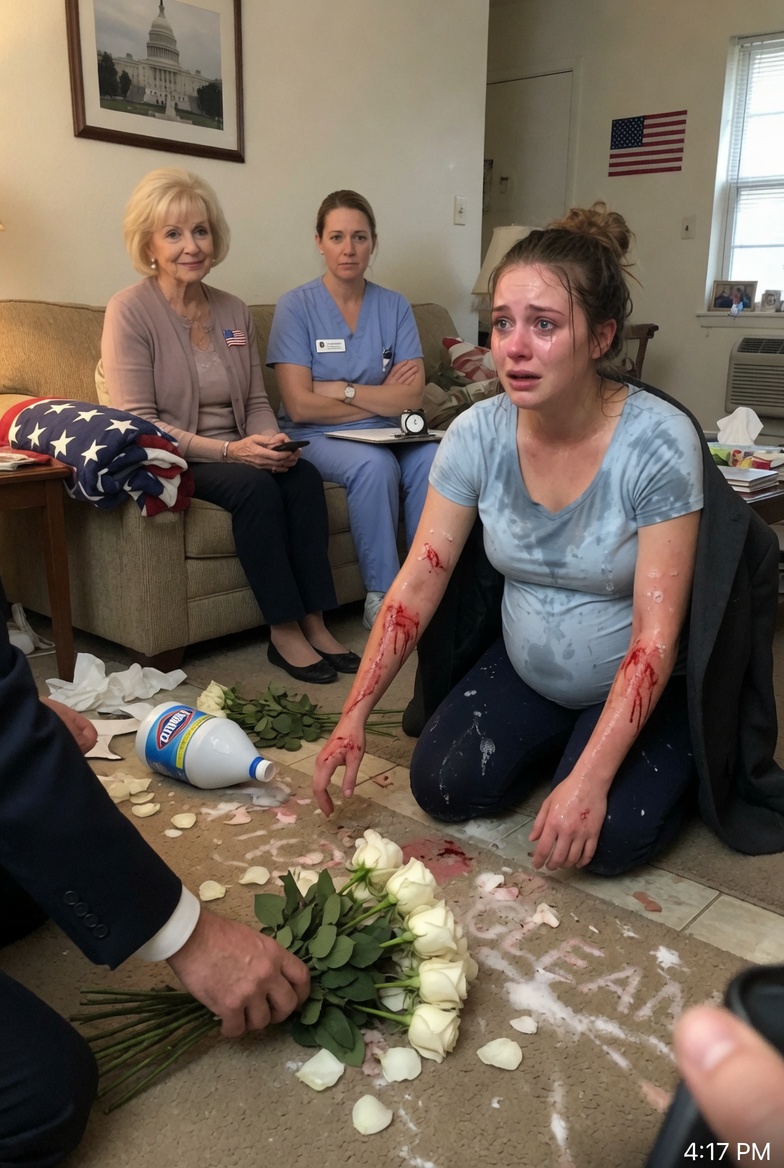
I came home with white roses for my pregnant wife. Instead, I found her on her knees, scrubbing her bleeding arms with bleach. My mother and a hired nurse watched and laughed. I didn’t yell. I just quietly locked the door.
The nursery was quiet now, the late afternoon sun slanting through the windows in golden ribbons. Liam had fallen back asleep in Eliza’s arms, his tiny fingers curled around her thumb. I stood in the doorway, watching them, and for a moment I let myself believe the war was truly over.
But wars leave scars. And scars have a way of aching when the weather changes.
It happened three nights later.
I woke to the sound of breathing. Not the steady rhythm of sleep, but something ragged. Panicked. I reached for Eliza in the dark and found her side of the bed empty. The sheets were cold.
My heart stopped.
I threw off the covers and ran. The bathroom door was closed, a sliver of light beneath it. I pressed my ear to the wood and heard her whispering.
“Please. Please, I’m trying. I’m trying to be clean.”
I opened the door.
She was on the floor, kneeling, her hands empty. No bleach. No rag. She was just rocking back and forth, her eyes fixed on the white tile, her lips moving in a loop I couldn’t hear.
“Eliza.”
She didn’t respond.
I knelt beside her, slow, like approaching a wounded animal. “Eliza, it’s me. It’s James. You’re home. You’re safe.”
Her eyes snapped to mine, but they didn’t see me. Not at first. They were still trapped in the living room, still kneeling on that marble floor, still hearing Margaret’s voice telling her she was disgusting.
“You’re not there,” I said softly. “You’re in our bathroom. Liam is asleep in the nursery. It’s 3 AM. You’re safe.”
She blinked. Once. Twice. Then her body sagged and she fell into my arms, sobbing with the force of a wave breaking.
“I saw her face,” she whispered. “I closed my eyes and I saw her face, and I could smell the bleach. I could smell it, James. I can still smell it.”
“It’s not real,” I said, holding her tighter. “The smell isn’t real. It’s a memory.”
“It feels real.”
“I know.”
I helped her up. She was shaking so hard I had to half-carry her back to bed. I wrapped her in my coat—the same coat I had put around her that day—and held her until her breathing slowed.
“Does this ever go away?” she asked.
I didn’t know the answer. I wanted to say yes. I wanted to promise her that time would erase every echo of cruelty. But I had learned that honesty mattered more than comfort.
“It gets quieter,” I said. “It takes up less space. But I think it’s always going to be there, in some corner. The trick is learning to turn your back on it.”
“How?”
“By filling the house with louder things. Liam’s laugh. Your voice. The sound of the coffee maker in the morning. We make so much noise that the past can’t be heard.”
She was quiet for a long moment. Then she said, “Can we plant something tomorrow? A tree. Something that grows.”
“Anything you want.”
She fell asleep in my arms, her hand resting on my chest. I stayed awake, watching the shadows on the ceiling, and made a decision.
The next morning, I let her sleep in. I fed Liam, changed him, and called the therapist to schedule an emergency session. Then I drove to the florist.
I bought white roses.
Not because I was trying to recreate the past. Because I wanted to reclaim it.
When I came home, Eliza was sitting at the kitchen table, a mug of tea between her hands. She looked tired but present. She saw the roses and froze.
Her eyes went wide for a second—a flash of the old fear. I saw her shoulders tighten. But then she took a breath. And another. And slowly, deliberately, she reached out and touched a petal.
“They’re beautiful,” she said.
“I bought them for you. Not as an apology. As a reminder.”
“A reminder of what?”
“That the first time I brought them home, I was too late. This time, I’m early. And I’ll keep bringing them until the only thing you feel when you see them is love.”
She took the bouquet and buried her face in the petals. When she looked up, there were tears in her eyes, but she was smiling.
“You’re crazy,” she said.
“I’m determined.”
“Same thing.”
We laughed. It was a small sound, fragile, but real.
The therapy session that afternoon was hard. Eliza talked about the nightmare in detail. She talked about the smell, the sound of Margaret’s voice, the cold of the marble. She talked about the moment she woke up and didn’t know where she was.
The therapist, Dr. Patel, listened with quiet focus. Then she asked a question that made the air in the room shift.
“Eliza, when you woke up and thought you were back there, what did you want to happen?”
Eliza hesitated. “I wanted James to come.”
“And he did.”
“Yes.”
“What does that tell you?”
Eliza looked at me. I reached over and took her hand.
“It tells me,” she said slowly, “that my brain is still learning that I’m safe. But I am safe. Even when I don’t feel it, I am.”
Dr. Patel nodded. “That’s a powerful realization. The next time you have a nightmare, try to remember that. Not to stop the fear, but to hold on to the truth alongside it.”
That night, we planted the tree.
It was a small dogwood, barely five feet tall, with fragile roots wrapped in burlap. We dug the hole together, taking turns with the shovel. Liam sat on a blanket nearby, chewing on a plastic spade.
The ground was hard. We hit rocks. We sweated. But we kept going.
“This is heavy,” Eliza said, wiping her forehead.
“Everything worth building is.”
She paused, leaning on the shovel. “Do you think we planted it deep enough?”
I looked at the hole. “Deep enough to weather any storm.”
We lowered the tree into the earth, filled the hole, and watered it. Eliza stood back, her hands covered in soil, and looked at it like it was a monument.
“It’s going to take years to grow,” she said.
“So will we.”
Liam started babbling, pointing at the tree with sticky fingers. “Ba-ba!”
Eliza laughed. “That’s right, baby. Tree.”
“Ba-ba,” he insisted.
I crouched down and lifted him onto my shoulders. He grabbed my hair and tugged.
“One day,” I said, “you’re going to climb this tree.”
He pulled my hair harder.
“Ow. Okay, maybe not today.”
Eliza came over and kissed my cheek. “Thank you.”
“For what?”
“For not giving up. For locking the door. For planting trees.”
“Thank you for staying.”
She looked at the tree, then at Liam, then at me. “Where else would I go?”
We walked inside as the sun set, the dogwood casting a long shadow across the lawn. It was small. It was fragile. But it was alive.
And so were we.
The next week, a letter arrived.
I saw the return address before I opened it—a law firm I recognized. My mother’s lawyers.
Eliza was in the kitchen, making Liam’s lunch. I slipped the envelope into my pocket and didn’t open it until she went upstairs for his nap.
I sat in the study, alone, and read the words.
They asked for a meeting. They wanted to discuss “reconciliation.” They mentioned my mother’s upcoming parole hearing and suggested that a family statement of support could influence the board.
I crumpled the letter and threw it in the trash.
Then I took it out, smoothed it flat, and read it again.
Because I knew this wouldn’t be the last time they tried.
And I knew I had to be ready.
The war had ended. But the aftershocks were still coming.
That evening, I told Eliza about the letter.
She didn’t flinch. She didn’t cry. She just nodded, her face calm.
“What do you want to do?” she asked.
“Nothing. I’m not going to support her. I’m not going to meet with her. I’m going to let the parole board make their decision without my interference.”
“Is that enough?”
“It has to be.”
She set down her fork and looked at me with steady eyes. “James, I need you to hear me. Whatever they try—letters, phone calls, lawyers—we face it together. I’m not that girl on the floor anymore. I’m not afraid of her. Or your mother. Or anything they can say.”
“I know.”
“Promise me you’ll tell me before you make any decisions.”
“I promise.”
“Promise me you won’t try to protect me by shutting me out.”
I reached across the table and took her hand. “I promise.”
She smiled. “Then we’re good.”
Liam banged his spoon against his high chair tray. “Ba-ba!” he demanded.
Eliza laughed. “He wants more tree.”
“He wants more everything.”
She stood up and kissed the top of his head. “That’s my boy.”
And in that moment, with the kitchen warm and the dogwood visible through the window, I felt something I hadn’t felt in a long time.
Not peace. Not yet.
But a quiet certainty that whatever came next, we would face it.
Together.
The sun set. The stars came out. And for the first time in months, I slept through the night without waking once.
I woke the next morning to the sound of Liam’s laughter drifting up the stairs. It was a sound that had become rare in recent weeks, and it stopped me mid-step as I swung my legs out of bed. I paused, listening. Eliza was talking to him in that soft, playful voice she used when she thought no one was watching. “Where is your nose? There it is! Boop!”
I smiled and padded down the hallway. The bathroom door was open, and I caught a glimpse of myself in the mirror. I looked different. Lighter. The shadows under my eyes had faded, and for the first time in months, I didn’t see the weight of that day in my reflection.
I found them in the nursery. Liam was in his crib, standing up, holding the rails. He grinned when he saw me, showing off four tiny teeth. “Da-da!”
“He’s been practicing,” Eliza said, her voice warm.
“He’s perfect.” I crossed the room and kissed her forehead. “You slept.”
“I did. You too.”
“First time in a long time.”
She nodded, her hand resting on Liam’s back. “It felt good.”
We stood there for a moment, the three of us, in the quiet morning light. The dogwood tree was visible through the window, its leaves shimmering in the breeze. It had survived the night. So had we.
But the stillness was fragile. I knew that. And the other shoe was about to drop.
It happened two hours later.
I was in the study, going through emails, when my phone buzzed. Sarah Chen’s name lit up the screen. I answered immediately.
“James, I have news.”
“Good or bad?”
“Complicated. Your mother’s parole hearing has been scheduled. Three weeks from today.”
I leaned back in my chair, staring at the ceiling. “So soon?”
“She’s eligible for early release due to good behavior. The board is considering it. They’ve asked for victim impact statements. You and Eliza have the right to submit one, or appear in person.”
“And if we do?”
“It could influence the decision. But it also means facing her again. I need to know what you want to do.”
I was quiet for a long moment. “I need to talk to Eliza.”
“Do that. But don’t take too long. The deadline for submissions is next Friday.”
I ended the call and sat in the silence. The house felt too quiet. Liam was napping. Eliza was probably reading in the living room. I didn’t want to bring this into our morning. But I had to.
I found her on the couch, a book open in her lap, but her eyes were on the window. She turned when I walked in, and she must have seen something on my face, because her expression shifted immediately.
“What happened?”
I sat down beside her and told her.
She listened without interrupting. When I finished, she was quiet, her fingers tracing the spine of her book.
“Three weeks,” she said finally.
“Yes.”
“You want to go?”
“I want to do whatever you need. If you want to submit a statement, we do. If you want to appear, we do. If you want to ignore it, we ignore it. I’ll support you either way.”
She set the book down and looked at me. “I thought I was done with her. I thought when the verdict came down, that was it. But it’s not, is it? It’s never going to be over until I face her.”
“You don’t have to face her. We can write a letter and move on.”
“But will it really move on? Or will it just be another thing I push down?”
She was right. I knew it even as I wished she weren’t.
“Can we talk to Dr. Patel about it?” she asked.
“Of course.”
We scheduled an emergency session for that afternoon. The whole way there, Eliza was silent, her hand gripping mine. I could feel her pulse through her fingers.
Dr. Patel listened to the situation with her usual calm. When Eliza finished explaining, she leaned forward.
“This is an opportunity, Eliza. But it’s also a risk. Facing your abuser can be empowering, but it can also trigger trauma. The key is preparation. You need to be grounded in your own strength before you step into that room.”
“I don’t know if I’m strong enough.”
“You’ve survived her twice already. Once when she abused you, and once when you testified. You have more strength than you think.”
Eliza was quiet. Then she asked, “If I write a statement, will you help me? I don’t want to just say what I think they want to hear. I want it to be real.”
“I’ll help you,” I said.
Over the next week, Eliza worked on her statement. She wrote and rewrote it half a dozen times. Sometimes she would read parts aloud to me, her voice shaking. Other times she would crumple the paper and start over.
“It’s not right,” she said one night, frustrated. “It sounds like a victim statement, not a survivor statement.”
“What’s the difference?”
She considered the question. “A victim statement says ‘this is what they did to me.’ A survivor statement says ‘this is what I became in spite of them.’ I want to say the second one.”
“That’s exactly what you’ll say.”
She finally finished it on a Thursday night. She read it to me in bed, her voice steady, her eyes clear.
It was powerful. It was honest. It was hers.
“I want to read it in person,” she said when she finished.
“Are you sure?”
“I need her to see me. Not the broken girl on the floor. The woman I am now.”
I took her hand. “Then we’ll do it together.”
The morning of the hearing, Eliza was calm in a way that unnerved me. She dressed in a simple navy dress, her hair pulled back. She looked professional, composed. But I knew the storm inside.
We left Liam with Chloe, who had been a rock through all of this. She hugged Eliza at the door and whispered something in her ear. Eliza nodded, her jaw tight.
The drive to the courthouse was silent. The rain was falling in sheets, washing the streets clean. I parked and turned off the engine.
“Ready?” I asked.
She took a deep breath. “Ready.”
We walked through the metal detectors, past the guards, into the hearing room. It was small, paneled in dark wood. A table for the board sat at the front. To the left, a chair for the inmate.
And there she was.
My mother.
She looked older than I remembered. Her hair had grayed, and there were deep lines around her eyes. But when she saw us, her expression hardened into something familiar. Defiance.
I felt Eliza tense beside me. I put my hand on the small of her back.
“We’ve got this,” I whispered.
She nodded.
The hearing began. The board read the case summary. They asked my mother questions about her behavior in prison. She answered in a measured, respectful tone. She talked about taking classes, about finding religion, about remorse.
I saw Eliza’s hand gripping the armrest.
When it was time for victim statements, the board called her name.
Eliza stood. She walked to the podium, placed her statement on the lectern, and looked at the board. Not at my mother.
She began to read.
“The day I met Eleanor Carter, I believed I was meeting a second mother. I believed she would welcome me into her family. Instead, she systematically dismantled my sense of self. She hired a woman to break me with words and bleach. She watched me bleed on the floor and called it discipline.”
Her voice didn’t waver.
“But I am not here to tell you what she did. I am here to tell you what I did. I survived. I had a son. I built a home. I learned to trust again. And I am standing here, whole, not in spite of what she did, but because I refuse to let her define me.”
She paused.
“I don’t know if she has remorse. That’s between her and whatever she believes in. But I know that I have peace. And I am not afraid of her anymore.”
She folded her paper and sat down.
The room was silent.
My mother was crying.
But I didn’t care.
The board thanked Eliza and said they would deliberate.
We walked out into the rain.
Eliza was shaking.
I wrapped my arm around her.
“Are you okay?”
She looked up at me, her eyes wet.
“I did it.”
“You did it.”
“I’m not afraid.”
“I know.”
We stood in the rain, letting it wash over us.
The decision wouldn’t come for a week.
But in that moment, it didn’t matter.
She had faced her.
And she had won.
That night, we ordered pizza and ate it on the living room floor with Liam. He threw cheese on the rug. Eliza laughed.
Chloe called to check in. Sarah texted that the hearing had gone well.
And for the first time, I believed we were really free.
But the next morning, I found a letter in the mailbox. No return address. Inside, a single line of text.
“Tell your wife to watch her back. —M.”
I hid the letter from Eliza.
But I couldn’t hide the dread that settled in my chest.
Some wars don’t end with a verdict.
Some wars only change shape.
And I had a feeling this one was far from over.
I kept the letter folded in my pocket for three days. Every time Eliza left the room, I felt my heart rate spike. I checked the windows twice before bed. I installed a new security camera facing the driveway without telling her.
She noticed.
“You’ve been jumpy,” she said on the third evening, as I was locking the door for the fourth time. “What’s wrong?”
“Nothing.”
“James. I know that face. That’s the face you make when you’re trying to protect me from something.”
I hesitated. Then I pulled the letter from my pocket and handed it to her.
She read it. Her expression didn’t change.
“Margaret,” she said.
“It has to be.”
“She’s out.”
“I don’t know. The letter has no postmark. Someone dropped it off.”
Eliza folded the letter carefully and set it on the table. “We knew this might happen. She threatened us at the trial. She said she’d make us pay.”
“I’m not letting her near you or Liam.”
“You can’t control what she does. Only how we respond.”
I wanted to argue. But she was right.
We called Sarah the next morning. She confirmed that Margaret had been released two weeks ago due to good behavior. She was on probation, but there were no restrictions on her movements as long as she stayed out of trouble.
“This letter is a threat,” Sarah said. “But it’s vague. We can report it to her parole officer, but it might not be enough to violate her.”
“Do what you can.”
“I will. And James—keep your head on a swivel.”
The words stayed with me.
That night, I couldn’t sleep. I lay in bed, watching the shadows shift on the ceiling, listening for sounds that didn’t belong. Eliza was asleep beside me, her hand resting on my chest. Liam was in the nursery down the hall.
I heard it at 2:14 AM.
A creak.
Not the house settling. I knew those sounds. This was different. It came from the back door.
I slid out of bed, my heart pounding. I grabbed the baseball bat I kept in the corner of the closet—a gift from Chloe after the trial. I crept down the stairs, my bare feet silent on the wood.
The kitchen was dark. The back door was closed.
But the lock was scratched.
Fresh scratches.
Someone had tried to get in.
I didn’t sleep the rest of the night. I sat in the living room with the lights off, watching the windows, the bat across my knees.
In the morning, I called a security company and had them install motion sensor lights and a reinforced deadbolt. I didn’t tell Eliza about the scratches. I told myself I was protecting her.
But she knew.
She always knew.
“We need to talk about this,” she said, watching the installer work. “You can’t carry this alone.”
“I’m not carrying it alone. I’m carrying it so you don’t have to.”
“That’s not how marriage works.”
I stopped and looked at her. She was standing in the doorway, Liam on her hip, her eyes steady.
“James, I spent years being afraid in silence. I’m not doing that anymore. And I’m not letting you do it either.”
“I’m just trying to keep you safe.”
“I know. But you can’t lock the world out. You can only face it.”
She was right.
I told her about the scratches.
She didn’t flinch.
“Then we report it. And we live our lives. We don’t give her the power to make us prisoners in our own home.”
That afternoon, we filed a police report. The officer took pictures of the door and the letter. He said they would increase patrols in the area.
It wasn’t a guarantee.
But it was something.
That evening, we put Liam to bed and sat on the back porch, looking at the dogwood tree. It was taller now, its branches spreading wide.
“Remember when we planted this?” Eliza asked.
“I remember.”
“I was so scared that day. I didn’t think I would ever feel safe again.”
“And now?”
She leaned into me. “I still get scared. But I also know I can survive it. Whatever comes.”
I wrapped my arm around her.
“We’ll face it together,” I said.
She kissed my cheek.
“Together.”
The next morning, there was a new letter on the doorstep.
This one was different.
It was addressed to Eliza.
And inside, there was a single photograph.
A picture of Liam.
Taken through the nursery window.