By late afternoon, the driveway had become quiet.
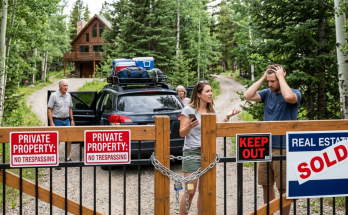
The officers had finished their initial work at the property.
They had documented the damage to the entrance and collected copies of the relevant papers.
They had also taken statements about the attempt to enter the manor.
Marcus made arrangements to preserve the evidence and provide it to the financial investigators handling the broader concerns.
My father and Nathan were not permitted to move into the house.
The locksmith returned his equipment to his van.
I watched him close the rear doors.
He paused before leaving and looked toward the entrance.
I wondered what he thought of the entire morning.
He had come to open a lock.
Instead, he had found himself involved in a dispute over a property that the people hiring him had no demonstrated right to occupy.
I was grateful that he had cooperated.
I was also angry that I had needed police officers and an attorney to establish something so basic.
The house was mine.
I hadn't invited my family to live there.
That should have been enough.
But in my family, my decisions had rarely been treated as final when they interfered with what someone else wanted.
Nathan stood beside the car.
He looked exhausted.
The confidence he had displayed earlier was gone.
He had stopped arguing about the suitcases.
He had stopped demanding that the door be opened.
When he finally lifted the luggage into the vehicle, he did it without looking at me.
Dad was still speaking with someone near the driveway.
His expression was stiff.
Every so often, he glanced toward the house.
I knew that look.
He was still calculating.
Still trying to understand how he had lost control of a situation he believed he had already arranged.
At one point, he looked directly at me.
I expected him to shout.
He didn't.
That silence unsettled me more than I wanted to admit.
I had spent years measuring his moods.
A quiet father could be more dangerous to my peace than an angry one.
Because anger usually ended in an argument.
Silence meant he was deciding what to do next.
Eventually, he and Nathan moved farther away.
But Mom stayed.
She stood near the driveway for almost twenty minutes.
I watched her through the glass beside the entrance.
She kept adjusting her handbag.
Looking at the door.
Looking down.
Then looking back again.
I could have walked away.
I should probably have gone upstairs and rested.
Instead, I waited.
Part of me still wanted to know whether she would finally say something that mattered.
Eventually, she approached.
I opened the door enough to speak to her.
Her face was pale.
"Could I come in for a little while?"
I shook my head.
"No, Mom."
She looked wounded.
"Elena."
I waited.
"I'm your mother."
I knew she expected those words to change my answer.
They had worked before.
When I was young, being reminded that she was my mother usually meant I had to stop asking questions.
If she hurt my feelings, I was expected to understand.
If she disappointed me, I was expected to forgive.
If Dad was unfair, I was expected to keep the peace.
And if Nathan received something I didn't, I was expected to be happy for him.
But standing inside the manor, I realized that being someone's mother wasn't the same as protecting them.
"I know who you are," I said.
Her eyes filled.
"Then why are you shutting me out?"
I looked at her for a long moment.
I hadn't intended to discuss my childhood that afternoon.
I was tired.
My door had been damaged.
My father had tried to take control of my property.
The police had questioned people on my driveway.
I wanted the day to end.
But something in her question made me think of the scarf.
The old one.
The one she had given me when I was eleven because nobody had prepared a proper Christmas present.
"Do you remember the Christmas when I was eleven?" I asked.
She blinked.
"What about it?"
"The scarf."
Her face changed.
I watched recognition move through her expression.
She knew.
After all these years, she knew exactly which Christmas I meant.
"You remember it," I said.
She looked away.
"I remember the scarf."
I rested my hand on the doorframe.
"You gave me something from your own things because there wasn't a gift for me under the tree."
She was silent.
"Then you told the relatives I was being ungrateful."
Her mouth tightened.
"It was a stressful time."
I felt a familiar sadness.
Even now, she had an explanation ready.
I nodded.
"For you, maybe."
She looked up.
"I was trying to keep everything together."
"I was eleven, Mom."
She began crying.
I watched the tears gather.
For most of my life, seeing her cry made me stop.
I would soften my voice.
I would apologize for upsetting her.
I would tell her that I understood.
Sometimes I would even comfort her after she had hurt me.
That afternoon, I didn't.
I waited.
There was another Christmas I wanted to ask her about.
I had tried not to think about it for years.
The one when my parents went skiing.
I remembered waking up and realizing the house was unusually quiet.
There were no voices in the kitchen.
No movement upstairs.
No sound from Nathan's room.
I walked through the hallway.
The house was empty.
I found that my family had already left.
I hadn't been told when they were going.
I hadn't been included in the departure.
I was left to look after the cat.
I remember pouring food into its bowl.
Then standing near the kitchen counter, trying to decide what to do with the rest of the day.
I wasn't angry at first.
I was confused.
I kept thinking there had been a misunderstanding.
Maybe they had left early and planned to call.
Maybe I had forgotten a conversation.
Maybe there was some explanation that made sense.
Later, I watched a Christmas video they had recorded.
My father was smiling.
Nathan looked happy.
People were talking around them.
And Dad explained my absence by saying I hadn't wanted to come.
I remember stopping the video.
Then starting it again.
I wanted to be certain I had heard him correctly.
He was telling people I had chosen to stay behind.
But nobody had asked me.
I told Mom about that memory now.
Her tears came faster.
"Please, Elena."
I kept my voice steady.
"Do you remember leaving without telling me?"
She wiped her face.
"We handled that badly."
"Did Dad tell people I refused to go?"
She looked down.
I waited.
"Did he?"
She nodded.
I felt a strange heaviness in my chest.
I had known what happened.
I had remembered it clearly.
But hearing her admit it still hurt.
Because it meant I hadn't misunderstood.
There hadn't been some forgotten conversation.
There hadn't been a reasonable explanation hidden somewhere.
They had excluded me.
Then they had made it sound like my decision.
I thought about every holiday I spent trying to convince myself I didn't care.
Every time someone asked why I wasn't with my family.
Every occasion when I said I preferred being alone.
Sometimes that was true.
But often, it was easier than admitting I hadn't been invited.
And my mother had known.
"You both let people believe things about me that weren't true," I said.
She closed her eyes.
"We made some terrible choices."
I nodded.
"Yes."
For a moment, neither of us spoke.
The courtyard lights were beginning to glow.
The stone walls around the entrance held the last warmth of the afternoon.
I had imagined this house filled with people.
Artists.
Friends.
People who needed somewhere safe to begin again.
Instead, I was standing at its entrance explaining to my mother why being forgotten had hurt.
There was one question I had avoided for most of my life.
I was afraid of asking it.
Not because I didn't know what the answer might be.
Because I thought hearing it would confirm something I had spent years trying to disprove.
I looked at Mom.
"Did you love Nathan more than me?"
She seemed surprised.
Her mouth opened.
Then closed.
I waited.
She looked toward the driveway.
Then back at me.
No answer came.
I felt tears gathering in my own eyes.
I hated that.
I was a grown woman.
I had built a successful business.
I owned a beautiful house.
I had people who respected my work.
And there I was, still waiting for my mother to say she had loved me as much as my brother.
Finally, she spoke.
"You never seemed to need as much help."
I stared at her.
She continued quietly.
"You were always able to take care of yourself."
I wanted to ask whether she had any idea how I became that way.
Whether she understood what happened to a child who learned that asking for attention usually ended in disappointment.
Whether she had ever noticed me standing silently beside the Christmas tree.
But I didn't say all of that.
I was tired of explaining childhood to the person who had been there.
"Being capable didn't mean I didn't need you," I said.
She looked at me.
For one brief moment, I thought she understood.
Her expression softened.
Her shoulders lowered.
She seemed about to say something.
I waited.
Then she asked whether I could help Dad keep the company from collapsing.
I didn't answer immediately.
I looked at her face.
The tears.
The worry.
The familiar expression of someone asking me to understand that the family's circumstances were difficult.
She had just acknowledged that she and Dad had hurt me.
She had just heard me explain how lonely I had been.
And somehow, we were back to my father's needs.
I felt something inside me become still.
Not anger.
Not hatred.
Just the end of an expectation I had carried for too long.
"No, Mom."
She reached toward the door.
"Elena, please."
I stepped backward.
"I can't keep doing this."
Her hand remained lifted.
I closed the entrance.
Slowly.
I didn't want the sound of a slammed door.
I didn't need another scene that could be described later as proof of my temper.
I turned the lock.
Then I stood with my forehead resting against the wood.
I could hear faint movement outside.
A car door closing.
An engine starting.
Then the courtyard became quiet again.
I stayed there for a while.
Eventually, I walked toward the library.
Marcus was waiting.
The fire had been lit.
The room smelled faintly of polished wood.
There were papers on the table, but the journalists had already left.
They had agreed to contact us before publishing material that might expose private financial information.
I was grateful for that.
I wanted the truth established.
I didn't want every detail of my personal finances turned into public entertainment.
Marcus looked up as I entered.
"How are you doing?"
I sat across from him.
"I don't know."
He nodded.
For a few moments, he said nothing.
I appreciated that.
People sometimes tried to make me feel better too quickly.
They told me to focus on my success.
They reminded me that I didn't need my parents.
They said I should be proud.
But none of those things changed the fact that my mother had stood outside my house and asked me to help the man who had tried to take it.
Marcus pulled the black binder closer.
"There's something else we need to discuss."
I looked at the stack of papers.
I thought we had already uncovered everything important.
The false lease.
The questionable medical report.
The loan guarantees.
The transactions involving Nathan.
The company accounts.
I couldn't imagine what else there might be.
Marcus opened another section.
Inside were older records.
Account statements.
Correspondence.
Documents connected to my father's business.
He placed a page in front of me.
At the top was my name.
Below it were several transactions I didn't recognize.
I moved my eyes down the amounts.
Some were small.
Others were much larger.
The records involved accounts that my father had represented as connected to me.
I looked at the total.
Two hundred eighty-six thousand four hundred dollars.
For a moment, I thought I had misunderstood what I was reading.
I pointed to the number.
"What does this represent?"
Marcus folded his hands.
"Financial obligations and payments associated with accounts your father connected to your identity."
I turned the page.
There was an account I had never opened.
Then another.
One appeared connected to payments on my parents' mortgage.
Another involved Nathan's business expenses.
A third had received money from Voss Development Group.
I looked at Marcus.
"Can they actually hold me responsible for all this?"
"We're contesting those obligations. The documents need to be examined carefully."
I leaned back.
I wanted to ask how a father could do something like that to his daughter.
But I had already asked myself too many versions of that question.
So I kept reading.
Near the back of the section was another agreement.
The date caught my attention.
It had been prepared eleven months earlier.
I read the heading.
It involved a private investment company and a proposed financial restructuring.
The property identified as potential collateral was my Sedona manor.
I read the date again.
Something was wrong.
At the time the agreement had been prepared, I hadn't completed the purchase of the property.
I looked up.
"Marcus, this was before I owned the house."
He nodded.
"Yes."
I stared at the page.
My father had been discussing my home as potential security for his business before the property was even legally mine.
I asked how he could have known what I intended to buy.
Marcus said someone appeared to have provided information about the purchase.
He was still investigating where that information had come from.
I turned the document over.
Then I noticed the signature on behalf of Voss Development Group.
Nathan.
I held the page closer.
My younger brother had signed the preliminary arrangement.
The same brother who had arrived with a metal bar and luggage.
The same brother who insisted he only needed a temporary place to stay.
The same brother who had acted as though my refusal was unreasonable.
Attached to the agreement was an email from him.
It explained the importance of establishing occupancy at the property.
Nathan believed that once the family could claim to be living there, removing them would become a prolonged legal problem.
I read the email again.
Then I set it down.
For most of the day, I had tried to understand whether Nathan was simply following Dad's orders.
The document made that explanation harder to accept.
He hadn't merely accompanied my father to the house.
He had taken part in planning how to use it.
Marcus watched me.
"We've also heard from the lender. They're prepared to provide the original records connected to the submissions."
I looked at him.
"Will that help establish who created the documents?"
"It should give investigators more to examine."
I nodded.
There was nothing else I could say.
Outside the library windows, darkness had settled over the desert.
The Christmas lights around the courtyard were glowing.
I had bought the manor because I wanted to create something different.
A place where art mattered.
Where people could work without being mocked.
Where nobody had to prove they deserved to be included.
And now, before the project had even been completed, my family had tried to turn it into an answer to their financial problems.
That evening, I stayed in the library long after Marcus left.
I looked at the old papers on my desk.
I thought about Nathan's signature.
My father's email.
My mother's tears.
And the years I had spent assuming that my family's neglect was simply a failure to remember me.
The following morning, a message arrived from a number I didn't recognize.
It included a photograph.
I opened it.
The picture showed an old Christmas card.
My name was written on the envelope.
The date was from eleven years earlier.
Inside, in handwriting I recognized immediately, my father had written that he was proud of me.
I sat very still.
I had never received that card.
A second message explained that my father had claimed to deliver it himself.
According to the sender, that claim was false.
Then another message appeared.
The person said there was a reason my family had spent so many years keeping me at a distance.
He wanted to meet before Christmas.
I read the name at the bottom.
Daniel Voss.
My father's older brother.
I felt my heart begin to pound.
When I was twelve, Dad had told me Uncle Daniel was gone.
I had believed he was dead.
Now someone using his name was telling me he was alive.
And he knew something about my family that I had never been allowed to learn.
Click here to continue reading: PART 5: I Learned My Uncle Had Been Alive All Along, and the Christmas Card He Sent Exposed a Lie My Father Had Kept for Years
My Father Arrived at My Sedona Manor Expecting Me to Surrender the Keys, but He Had No Idea Who Was Already Inside
Part 4 of 15