I used to think my father would remember me if I became successful enough.
That was the mistake I carried into adulthood.
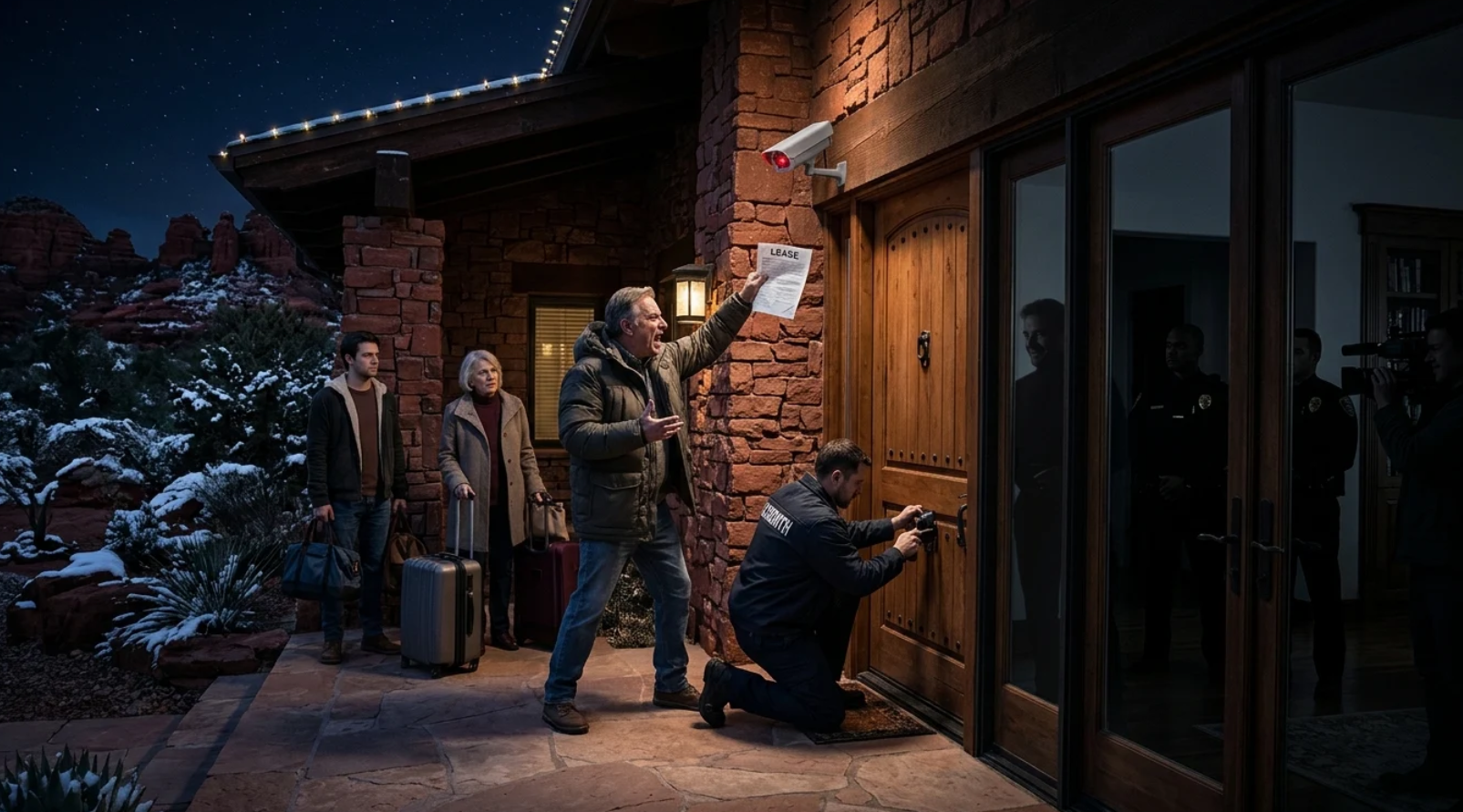
I was standing inside my house in Sedona when I heard him raise his voice outside the front entrance.
He wasn’t asking whether I was home.
He was telling someone to open my door.
I looked through the security monitor and saw my father standing beside my younger brother, Nathan.
My mother was a few steps behind them.
There were two suitcases near the porch.
And a man I didn’t recognize was kneeling beside the lock.
He had a toolbox open.
Nathan was holding a metal bar.
I stood there for several seconds, watching the screen.
My father hadn’t called to ask permission.
He hadn’t sent a message explaining that he was coming.
He had simply arrived with people who were prepared to get inside.
I should have been surprised.
Part of me was.
But another part of me had spent more than thirty years learning exactly what happened when my father wanted something.
He expected everyone else to move.
And when they didn’t, he found a reason to blame them.
I pressed the button beside the monitor.
“Dad, get away from my door.”
He looked toward the camera.
For a moment, he seemed startled.
Then his expression hardened.
“Elena, open up. We need to discuss something.”
“You can discuss it from there.”
Nathan stepped into view.
“Don’t make this harder than it needs to be.”
I looked at the tool in his hand.
That was almost funny.
My brother had arrived at my property carrying something that could damage the door, and he was speaking as if I were causing the trouble.
I told him to put it down.
He ignored me.
The man beside the lock stopped working and looked toward my father.
“Is she the owner?”
Dad answered before I could.
“She’s my daughter. We have permission to be here.”
I felt something cold settle in my stomach.
Permission.
He was using the word as though my existence gave him authority over everything I owned.
The property was worth approximately three million dollars.
I had bought it with money earned through years of creative work and careful business decisions.
It wasn’t a family inheritance.
It wasn’t something my father had helped purchase.
It wasn’t connected to his development company.
But standing on my porch that morning, he behaved as if all those distinctions were temporary inconveniences.
I turned away from the monitor.
Inside the library, Marcus Hale was arranging papers across the long wooden table.
He was my attorney.
He had known for several weeks that this confrontation might happen.
When I entered, he looked up.
“Are they here?”
I nodded.
“All three.”
He closed the black binder in front of him.
“And the locksmith?”
“He’s working on the entrance.”
Marcus stood.
“Then we should have the officers come forward.”
I glanced toward the dining room.
Two journalists were waiting there.
One was Rebecca Sloan, an investigative reporter with the Arizona Ledger.
They had arrived earlier, after Marcus explained that my family might attempt to enter the property using documents we believed were fraudulent.
I hadn’t invited them because I wanted attention.
I had invited them because I knew what happened when nobody else heard my father’s version of events.
His version became the truth.
Mine became an accusation.
And eventually I was expected to apologize for disagreeing with him.
I had lived through that process more times than I could count.
I wasn’t willing to repeat it inside my own home.
Outside, something struck the door.
The sound carried through the entrance hall.
Wood against metal.
Then another impact.
I flinched before I could stop myself.
Marcus noticed.
“You don’t have to stand near the door.”
“I know.”
But I walked toward it anyway.
I had spent too many years leaving rooms when my father became angry.
This time, I wanted to be present.
I wanted him to see me when he discovered that his usual methods wouldn’t work.
Before opening the door, I looked at the small Christmas decoration hanging beside the staircase.
It was a wooden bird painted blue.
I had made it from an old drawing.
The original had been created when I was eight.
For years, I had forgotten about that picture.
I didn’t know then that it would become one of the most important objects in my life.
At that moment, it was simply something I had hung in a home I was trying to make my own.
A home my father had decided he could take.
I was old enough to understand that the conflict wasn’t really about the lock.
It was about the fact that I had built something he couldn’t control.
And he couldn’t accept it.
When I opened the entrance door, I kept one hand against the frame.
Dad immediately moved forward.
I held my position.
“Don’t come inside.”
He stopped.
Behind him, Nathan looked irritated.
Mom stood near the luggage, holding her handbag with both hands.
She looked worried.
I had learned not to confuse that expression with concern for me.
Sometimes it only meant she was afraid my father would become embarrassed.
“Elena,” Dad said, “we’ve already explained the arrangement.”
“No. You’ve announced what you intend to do.”
He gave a sharp breath.
“There’s no reason to be unpleasant.”
I looked past him at the damaged wood beside the lock.
“You brought someone to force my door.”
The locksmith straightened up.
He looked from me to my father.
“Sir, you told me this was a tenant-access issue.”
Nathan stepped closer.
“It is.”
I shook my head.
“Neither of you lives here.”
Dad reached inside his coat and removed a folded document.
“We have an agreement.”
He held it up.
I didn’t take it.
I already knew what it said.
Marcus had obtained a copy before that morning.
The document claimed that my family had a right to occupy part of my property.
It presented the arrangement as something I had accepted.
My supposed signature appeared near the bottom.
But I had never signed it.
And I had never agreed to let them move in.
I looked at my father.
“Where did you get that?”
He gave me the same expression he used when I was a child asking questions at the dinner table.
As though the answer was too complicated for me.
“From the people handling the business.”
“What business?”
He hesitated.
Only briefly.
But I noticed.
“Family business.”
Those two words had excused more cruelty in my life than almost anything else.
Family business meant my father could decide.
Family business meant Nathan could benefit.
Family business meant my mother would ask me not to argue.
And it usually meant I would pay for something I hadn’t chosen.
I looked at the luggage again.
Two large suitcases.
Nathan had already removed one from the trunk of the car.
He hadn’t come to ask a question.
He had come expecting to stay.
“Take your things and leave,” I said.
Dad’s face darkened.
“You’re embarrassing yourself.”
That sentence brought back a Christmas morning I had spent years trying not to remember.
I was eleven.
Nathan was younger, and the living room had been crowded with gifts.
His presents were stacked beside the tree.
Some were wrapped in bright paper.
Others were too large to fit beneath the branches.
I remembered the sound of him tearing the paper.
I remembered Dad kneeling beside him, helping him open a box.
And I remembered searching for my name.
There wasn’t anything.
I stood near the sofa while Nathan celebrated another gift.
Mom noticed me looking.
She disappeared into the bedroom.
A little later, she returned with a scarf.
It had already belonged to her.
She folded it, wrapped it quickly, and handed it to me.
“Merry Christmas, sweetheart.”
I looked at the scarf.
I knew where it had come from.
I had seen it around her neck the week before.
But I said thank you.
I was eleven, and I was still trying to make things easier for everyone.
Later, when relatives asked why I hadn’t seemed excited about Christmas, Mom told them I had been difficult about my presents.
Plural.
Presents.
I remembered standing beside the kitchen counter, listening to her explanation.
I wanted to correct her.
I didn’t.
My father was nearby.
And I knew he wouldn’t appreciate it.
That was one of the first times I understood that my family could neglect me and then make my reaction look like the problem.
It wasn’t the last.
Christmas after Christmas, the same pattern returned in different forms.
Sometimes my parents forgot to include me.
Sometimes they made plans without mentioning them.
Sometimes they offered an excuse so casual that I wondered whether they had even tried to make it believable.
And somehow, I always ended up feeling ashamed for caring.
I worked hard to stop caring.
I told people Christmas wasn’t important to me.
I volunteered for extra work when I could.
I stayed busy.
I made certain I didn’t have to explain why nobody had invited me home.
But I always noticed the date.
I always knew when December twenty-fifth arrived.
And somewhere inside me, a small part of that eleven-year-old girl still wondered whether her father would remember.
Now he was standing outside my three-million-dollar house.
He hadn’t forgotten my address.
He hadn’t forgotten how much the property was worth.
He hadn’t forgotten to bring paperwork.
He had even arranged someone to open the door.
I looked him in the eye.
“You remember plenty when you want something.”
He frowned.
“What is that supposed to mean?”
“It means you’re leaving.”
Nathan made a frustrated sound.
“Elena, we’re not doing this all day.”
He stepped toward the entrance again.
Before I could respond, Marcus appeared beside me.
He was carrying the black binder.
My father’s attention shifted immediately.
“Who is this?”
Marcus stopped at the doorway.
“My name is Marcus Hale.”
Dad looked irritated.
“Do I know you?”
“No.”
“Then this doesn’t concern you.”
Marcus glanced toward the paper in Dad’s hand.
“I’m the attorney representing the owner.”
My father pointed at me.
“That’s my daughter.”
Marcus remained calm.
“That doesn’t give you authority to enter her property.”
Dad lifted the document.
“We have a signed agreement.”
Marcus looked at it.
“Then there are several things you need to explain.”
He opened the binder.
The pages inside were neatly organized.
Marcus had spent weeks collecting them.
Copies of signatures.
Property records.
Financial statements.
Emails.
Medical documents.
Information from the lender.
All the things my father had assumed I would never know enough to examine.
I watched Dad’s expression change as Marcus turned the first page.
The confidence remained.
But something had shifted beneath it.
For the first time that morning, he was looking at someone he couldn’t simply order to be quiet.
Marcus pointed to the document.
“Before anyone attempts to enter this house, we need to address the validity of what you’re holding.”
Dad gave a short laugh.
“It’s a legal agreement.”
“That’s what it claims to be.”
Nathan moved closer.
“What exactly are you accusing us of?”
Marcus raised his eyes.
“I’m asking why the paperwork contains information that cannot be verified.”
The locksmith stepped away from the door.
I saw him glance toward his van.
He no longer looked comfortable.
And my father, who had arrived expecting to move into my home, suddenly had to explain the papers he had brought.
I knew then that the morning would not end the way he had planned.
Click here to continue reading: PART 2: The Agreement My Father Used to Claim My Home Contained Three Details That Exposed How Far My Family Had Gone
My Father Arrived at My Sedona Manor Expecting Me to Surrender the Keys, but He Had No Idea Who Was Already Inside
Part 1 of 15