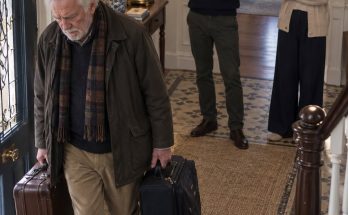
I arrived at Martin Reeves's office that afternoon carrying the same blue folder.
I had almost left it at home.
Then I remembered how much confusion had come from people talking about documents they hadn't bothered to read.
I wanted everything available.
The deed.
The mortgage paperwork.
The sponsorship agreement.
The payment confirmations.
And Grandpa's letter.
I held the folder against my side as I entered.
Martin was waiting for me.
He looked to be in his late sixties.
His hair was silver.
His manner was calm.
He didn't have the hurried expression I had grown used to seeing on people involved in the dispute.
He shook my hand.
"Silus. I'm glad you came."
I thanked him.
He led me into his office.
A thick folder was already resting on the desk.
I noticed it immediately.
There were several documents inside, separated into sections.
Martin saw me looking.
"Your grandfather was careful about keeping records."
I smiled faintly.
"That sounds like him."
Martin sat across from me.
For a moment, he studied my face.
Then he spoke.
"Harrison talked about you often."
I looked down.
I hadn't expected that sentence to affect me so much.
I missed Grandpa every day in small ways.
Sometimes it was the kitchen doorway.
Sometimes it was an old repair he had taught me to do.
Sometimes it was the empty space on the porch where he used to sit.
But hearing another person speak about him made the loss feel fresh again.
I nodded.
"I miss him."
Martin's expression softened.
"I know."
He didn't rush to fill the silence.
I appreciated that.
At my parents' house, silence had usually meant someone was waiting for me to give in.
Here, it simply meant I had a moment to collect myself.
Martin opened the folder.
He explained that he had represented Grandpa for many years.
Nearly two decades.
They had worked together on property matters and financial arrangements.
Over time, Grandpa had become increasingly concerned about making his intentions clear.
Not because he wanted his family to fight.
Because he understood that disagreements could arise if people treated informal promises as legal authority.
I thought about the six-to-one vote.
Grandpa had been right to worry.
Martin turned to the first set of records.
They concerned the emergency account.
I recognized the account number.
It was the same one that appeared on the payment confirmations connected to Preston's project.
I placed my own copy beside Martin's records.
He checked the details.
Then he nodded.
"Yes. That's the account."
I leaned forward.
"What exactly was Dad allowed to do with it?"
Martin folded his hands.
He explained that Grandpa had established the fund for genuine family emergencies.
Its purpose was to provide assistance when circumstances justified using the money.
There were conditions attached.
Withdrawals needed to follow the account's governing instructions.
The administrator could not simply treat the money as personal property.
I listened carefully.
Martin showed me the relevant documents.
I read through them slowly.
Some of the language was formal.
He explained the important sections in ordinary terms.
My father had been entrusted with managing the account.
That responsibility did not make the money his.
It also did not give him unrestricted authority to distribute funds whenever a relative presented a promising business idea.
I looked up.
"Even if Dad believed Preston needed the money?"
Martin nodded.
"Believing someone needs help is not the same as satisfying the conditions governing the fund."
I sat back.
That distinction seemed painfully obvious now.
But my family had ignored similar distinctions for years.
Preston wanted something.
My parents believed he needed encouragement.
Someone found a way to provide it.
And nobody asked enough questions.
The emergency account had followed the same pattern.
Except this time, the money had belonged to a fund Grandpa created for a specific purpose.
I looked at the records again.
"What happens if the money was used without authorization?"
Martin answered carefully.
He explained that the transactions would need to be reviewed.
The people responsible would have to account for the withdrawals.
Any amounts improperly taken would need to be restored.
He didn't pretend the process was simple.
He also didn't encourage me to confront Preston on my own.
He wanted the facts examined properly.
I appreciated his caution.
After the family meeting, part of me had wanted everything resolved immediately.
I wanted someone to tell me that Preston could never interfere with my house again.
I wanted the money issue settled.
I wanted my parents to understand what they had done.
But Martin spoke like someone who knew that real problems were not repaired simply because everyone finally admitted they existed.
Documents mattered.
The terms mattered.
The records mattered.
I looked at the statement showing the twenty-eight thousand dollars.
Dad had permitted access to the account because he believed Preston was facing eviction and urgent debts.
The transactions showed money going toward advertising, production, furniture, and renovation planning.
Those were not the expenses Grandpa had intended the fund to cover.
I could see that clearly.
Martin continued explaining the account's purpose.
Then he removed another sheet.
"This is something your grandfather wrote specifically for my attention."
I took it carefully.
It was handwritten.
I recognized the familiar shape of Grandpa's letters.
Martin allowed me to read it myself.
Grandpa had instructed him to pay particular attention if Preston ever requested financial help using the family's name.
He wanted the original purpose of the emergency fund protected.
He acknowledged that he loved Preston.
But he did not want money repeatedly used to rescue him from choices he refused to change.
Then Grandpa mentioned me.
He did not want me made responsible for my brother's debts or business failures.
He believed I had worked too hard to have my future placed at risk for someone else's decisions.
I stopped reading.
My eyes had filled with tears.
I looked toward the window.
For a moment, I couldn't speak.
I remembered how often Mom had told me Preston was struggling.
How often Dad had said that I was in a better position to help.
How many times I had been made to feel guilty because my life was more stable.
I had started to believe stability was something I owed to everyone else.
Grandpa had seen the unfairness in that.
He had seen it before the family vote.
Before Oak and Haven.
Before Preston tried to take Pine Ridge.
I looked down at the handwriting.
There were no grand declarations.
No complicated explanation of why I deserved more than my brother.
Just a simple insistence that I should not have to carry the consequences of decisions I hadn't made.
I wiped my eyes.
Martin waited.
He didn't ask whether I was all right.
He didn't try to hurry me.
I was grateful.
After a while, I spoke.
"He really knew what was happening in our family."
Martin nodded.
"He paid attention."
I looked at the note again.
Grandpa had always been observant.
When I visited, he noticed if I looked tired.
He noticed when I was worried about money.
He noticed if I tried to avoid talking about something.
He rarely forced me to explain.
Sometimes he simply brought me a cup of coffee and sat nearby.
I had thought of those moments as ordinary kindness.
Now I understood how much he had seen.
Martin closed one section of the folder.
"There's something else Harrison asked me to keep."
He reached into a separate envelope.
Then he handed it to me.
My name was written across the front.
I recognized Grandpa's handwriting again.
I carefully opened it.
Inside was a photograph.
I slid it out.
For a moment, I forgot where I was.
The photograph showed Grandpa sitting on the front porch at Pine Ridge.
I was beside him.
About twelve years old.
I remembered that age.
I remembered the porch.
And I remembered how Grandpa used to smile when somebody pointed a camera toward us.
He never seemed completely comfortable being photographed.
But in this picture, he looked happy.
I turned the photograph over.
There was another message.
Grandpa had written that the house would inevitably change as the years passed.
What he wanted me to remember was that the people who shared their lives inside it were what made it meaningful.
I read the words twice.
Then a third time.
I thought about Preston's renovation instructions.
He had wanted the old doorway removed because the pencil marks didn't fit his preferred appearance.
He had wanted furniture cleared away so the house could become a clean background for promotional photographs.
Grandpa had understood something different.
The marks were not damage.
The old things were not obstacles.
They were evidence that people had lived there.
That they had grown.
That they had loved one another.
I looked at the picture.
Grandpa's hand rested near my shoulder.
I was smiling.
I hadn't known how much that ordinary afternoon would matter to me one day.
A tear fell onto my hand.
I moved the photograph carefully away from it.
Martin remained quiet.
After a while, I placed the picture on the desk.
"I wish I could tell him what's happened."
Martin looked at me kindly.
"I think he knew you would take the responsibility seriously."
I swallowed.
"I tried."
"I know."
We sat in silence.
Then I asked the question that had been troubling me since the family meeting.
"What should I do now?"
Martin didn't answer immediately.
He looked through the records.
Then he explained that my first priority should be protecting my property.
The deed established ownership.
I needed to preserve the documents showing that I had not authorized Preston's activities.
The correspondence with Oak and Haven mattered.
So did the instructions about furniture removal, access, and the proposed lock change.
He advised me not to sign anything simply to satisfy family pressure.
That last part made me almost smile.
My family had spent weeks treating signatures as details that could be handled after everyone agreed about what I should do.
Martin made clear that they were not details.
They were decisions with consequences.
I listened.
He also recommended that the emergency account be examined independently.
The records needed to establish exactly how much money had been taken and whether the withdrawals complied with Grandpa's instructions.
I nodded.
The twenty-eight thousand dollars had become more than a family argument.
It was an amount that needed to be explained.
And if the money had been used improperly, it needed to be repaid.
Martin advised me to have an independent attorney review the documents and guide me on any steps involving Preston's representations and the unauthorized use of the fund.
He wanted me to have advice focused on my own interests.
I understood.
My family had spent too long making decisions collectively when the consequences fell almost entirely on me.
I wasn't going to repeat that mistake.
I agreed to follow his recommendation.
Martin gathered the records.
He arranged copies for me to keep.
I placed them in my blue folder.
The photograph went into a separate protective sleeve with Grandpa's letter.
I didn't want the edges bent.
I didn't want the handwriting damaged.
Small things.
But they mattered.
Before I left, Martin looked at me.
"Silus, your grandfather wanted you to understand that protecting what belongs to you is not the same as abandoning your family."
I sat with those words for a moment.
That was exactly what I had struggled to believe.
Every time I refused Preston, I felt as though I were doing something cruel.
Every boundary made me wonder whether I was becoming selfish.
Yet I hadn't asked Preston to suffer.
I hadn't wanted him humiliated.
I simply wanted the house I had bought to remain mine.
I stood and shook Martin's hand.
"Thank you."
He nodded.
"Take care of yourself."
Outside, I walked slowly toward my car.
The afternoon was bright.
I placed the blue folder on the passenger seat.
Then I took out the photograph again.
Twelve-year-old me was grinning beside Grandpa.
Neither of us had known what the future would bring.
We hadn't known about the mortgage.
Or the renovations.
Or the family meeting.
But I could see something in that picture that I had forgotten.
I had been happy at Pine Ridge long before it became valuable.
Before anyone thought of it as a luxury property.
Before Preston imagined it as a business opportunity.
It had been my grandfather's home.
And a place where I felt welcome.
I put the photograph away.
Then I started the car.
I had practical things to do.
I needed to protect the house.
I needed to keep my documents organized.
And I needed to make sure the financial problems were handled through the proper process.
For the first time in weeks, I knew what my next steps would be.
I no longer needed to argue until my family understood me.
I needed to act on the facts.
Over the next few days, I followed through on Martin's advice.
I kept copies of the property records.
I preserved the messages concerning Preston's project.
I made sure the questions about the emergency account were directed toward the people responsible for reviewing it.
I also made a decision about my home.
Pine Ridge would not become part of Preston's promotional campaign.
Not for a share of the money.
Not as a temporary favor.
Not to make my parents feel better.
I had already refused.
Now I was prepared to defend that refusal properly.
Three days after my meeting with Martin, Oak and Haven contacted me again.
Their legal department wanted to meet.
I agreed.
The next stage of the dispute would no longer take place around my parents' coffee table.
It would take place with the company Preston had convinced that Pine Ridge belonged to him.
And this time, I would be speaking as the documented owner.
Click here to continue reading: PART 7: Oak and Haven Showed Me What Preston Had Promised in Writing, Then His Public Video Made the Dispute Impossible to Hide
Six Members of My Family Decided My Brother Deserved My House More Than I Did, Until I Placed One Document on the Table
Part 6 of 15