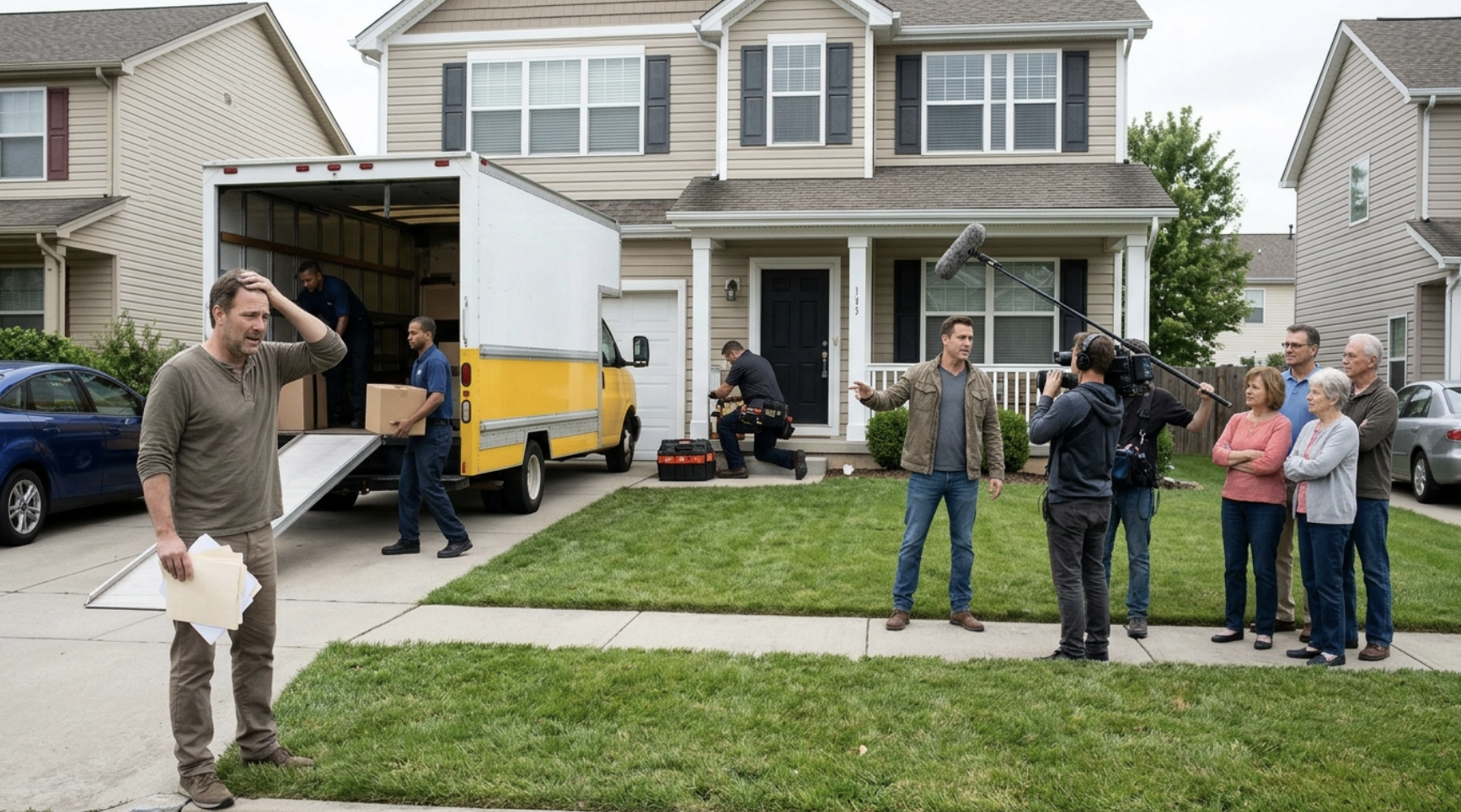
I used to believe that working hard and treating people fairly would eventually earn me my family’s respect.
I was wrong.
I learned that sitting in my parents’ living room, surrounded by people who thought they could decide what happened to my home.
Six people had voted against me.
Six members of my own family had decided that my brother Preston should have the house I had purchased and spent four years restoring.
I was the seventh person.
The only one who disagreed.
I still remembered the way they had looked at me after that vote.
As though I were being difficult.
As though refusing to surrender my own property were something I needed to apologize for.
That evening, I had brought a blue folder with me.
It rested on my knees while Preston stood near the coffee table, trying to explain why everything he had done was perfectly reasonable.
My father sat with his arms folded.
My mother kept twisting a tissue between her fingers.
Aunt Darlene watched me with the expression she usually wore when she thought a family argument had gone on long enough.
They were expecting another discussion.
Another opportunity to convince me that Preston needed help more than I needed my house.
But I hadn’t come to negotiate.
I had come with evidence.
I opened the blue folder and removed a sheet of paper.
Then I placed it where everyone could see it.
Preston glanced down.
His expression changed so quickly that I almost missed it.
Just a brief tightening around his mouth.
Then he looked away.
I noticed.
For years, I had been the kind of person who noticed things and then convinced himself they probably meant nothing.
I wasn’t going to do that anymore.
Aunt Darlene leaned toward the table.
“What’s that supposed to be?”
I kept my hand on the paper.
“Instructions Preston sent to the people he hired.”
My father uncrossed one arm.
“Hired for what?”
I looked at Preston.
“Maybe you should explain it.”
He gave a short laugh.
“Silus, you’re making this sound much worse than it was.”
I had heard that sentence before.
Not always in those exact words.
But the meaning never changed.
Whenever Preston did something he shouldn’t, everyone was supposed to focus on his intentions.
Whenever I objected, everyone focused on my reaction.
I looked down at the page.
This time, I wanted them to hear the actual instructions.
The document had been prepared for Oak and Haven, the company involved in Preston’s planned renovation sponsorship.
It described what their delivery crew was supposed to do when they arrived at Pine Ridge.
My home.
Not Preston’s.
Mine.
I began reading the instructions aloud.
The crew had been told to clear the property of furniture and personal possessions.
Anything not specifically designated for the planned filming was supposed to be taken away.
There was no mention of asking me which belongings mattered.
No instruction to separate valuable possessions from ordinary household items.
No acknowledgment that someone actually lived in the house.
Just an order to remove everything.
I stopped reading.
My mother looked at me.
“Everything?”
I nodded.
“That’s what it says.”
Preston shifted his weight.
“Those are normal instructions for a major renovation.”
I kept my eyes on the paper.
“Then you won’t mind if I finish.”
He didn’t answer.
I continued.
The next section explained that I would not be at the property when the delivery took place.
If anyone challenged the workers, they were to explain that ownership had been passed to Preston through a private arrangement within the family.
Once access was established, the existing locks were to be replaced.
I lowered the page.
The room had become quiet.
Even the small movements stopped.
Nobody was folding tissues.
Nobody was interrupting.
I could hear the faint sound of traffic outside my parents’ house.
I looked at my brother.
“Why would you tell strangers that I no longer owned my house?”
Preston pressed his fingers against his forehead.
“You’re leaving out important details.”
“Which details?”
“The arrangement was still being worked out.”
I waited.
He looked toward our father.
“Dad knows what we discussed.”
I turned to Dad.
“Did I ever agree to transfer my house?”
Dad didn’t answer right away.
That hesitation hurt more than I expected.
It was a simple question.
There was a right answer.
And everyone in that room knew what it was.
I had never agreed to give Preston my property.
I had never promised him ownership.
I hadn’t signed a single document allowing him to use it.
Still, my family had spent weeks acting as though my refusal were merely an obstacle they needed to overcome.
Dad finally looked at Preston.
“Did you tell the company the transfer was finished?”
Preston spread his hands.
“They needed confirmation before scheduling anything.”
“That’s not what I asked,” Dad said.
My brother’s jaw tightened.
I had seen that look all my life.
It usually meant he was about to become angry enough that everyone would abandon the original question.
I wasn’t going to let that happen.
I picked up the document again.
“There’s another instruction.”
Preston looked toward me sharply.
“Silus.”
I turned the page.
Near the bottom, he had included a specific request about the kitchen.
He wanted the old doorway replaced before filming began.
Not repaired.
Not refinished.
Removed.
His explanation was that the marks on the wood looked too old-fashioned for the new design.
I read the instruction slowly.
Then I set the page down.
For several seconds, I couldn’t speak.
I had been angry about the moving truck.
I had been frightened when people arrived at my house acting as though they had permission to enter.
The locksmith had made my stomach turn.
The planned filming had seemed almost unbelievable.
But that one instruction about the doorway reached somewhere deeper.
It was only a wooden frame.
That’s what someone unfamiliar with my family might have seen.
A narrow section of aging wood beside the kitchen entrance.
Its finish wasn’t perfectly smooth.
There were scratches near the bottom.
And along one edge, faint pencil lines appeared at different heights.
Some had dates beside them.
Some had numbers.
A few were crooked.
To Preston, those marks were ugly.
To me, they were part of my childhood.
Grandpa Harrison had started recording my height when I was three years old.
Every year, he would call me into the kitchen.
Sometimes I was still wearing my school clothes.
Sometimes I had been running around outside.
He would tell me to stand with my heels against the frame.
Then he would place something flat across the top of my head and make another small mark.
I always tried to stand taller.
He always noticed.
“Feet down, Silus.”
I would laugh.
He would make the mark anyway.
As I got older, the lines moved higher.
The dates changed.
The kitchen stayed mostly the same.
Grandpa grew older.
I became a teenager.
Then an adult.
Yet he kept making those marks.
Even when I was old enough to find the whole tradition a little embarrassing, I still stood against that doorway for him.
I understood why later.
It wasn’t really about my height.
It was his way of keeping track of our years together.
When his health began failing, the tradition became harder.
He couldn’t remain standing for long.
Some days, walking from the bedroom to the kitchen exhausted him.
He needed something to hold.
But he didn’t want to stop.
The final mark came when I turned twenty-one.
I remembered that afternoon clearly.
Grandpa had leaned against me while we made our way to the kitchen.
His hand rested on my shoulder.
I could feel how little strength he had left.
He insisted on holding the pencil himself.
The line was slightly uneven.
He looked at it for a long moment.
Then he smiled.
“Now you’ve got something to remind you how much you’ve grown.”
I had laughed softly.
“You’re making it sound like you’re finished measuring me.”
He had given my shoulder a gentle squeeze.
“One day, you’ll have to do your own measuring.”
I hadn’t known what to say.
So I had said nothing.
Looking back, I wished I had held on to that moment longer.
Years later, when I began restoring Pine Ridge, that doorframe was one of the few things I refused to alter.
I repaired damaged walls around it.
I replaced worn materials elsewhere.
I refinished the oak flooring.
I worked on the fireplace.
But I protected those pencil marks.
Whenever contractors or workers needed access to the kitchen, I made sure they understood that the old frame had to remain.
It wasn’t negotiable.
And now my brother had casually instructed a renovation crew to tear it out.
Without asking.
Without even mentioning it to me.
He hadn’t seen a lifetime of memories.
He had seen something that might look unattractive in a promotional video.
I looked across the table.
“Do you understand which doorway you’re talking about?”
Preston looked annoyed.
“The kitchen one.”
“The one Grandpa used every year.”
He shrugged.
“I know which one you mean.”
“Then you knew about the markings.”
He sighed.
“Silus, those little lines aren’t the entire house.”
I felt something tighten in my chest.
Aunt Darlene looked from him to me.
My mother lifted a hand toward her mouth.
I kept my voice quiet.
“They matter to me.”
Preston shook his head.
“And that’s exactly the problem. You turn every little thing into something nobody else is allowed to touch.”
I stared at him.
He continued.
“The place needs a proper update. You’re holding on to old stuff because you can’t imagine doing anything different.”
I wanted to tell him how many nights I had spent repairing that property.
I wanted to remind him how badly the steps had deteriorated before I fixed them.
How much work the heating system had needed.
How carefully I had budgeted every improvement.
But then I realized something.
He already knew.
He knew I had worked for that house.
He knew I had purchased it.
He knew Grandpa had trusted me to care for it.
None of that had stopped him.
I looked down at the document again.
Preston had written his instructions as if I were no longer part of the property at all.
There was no place for my decisions.
No place for my belongings.
No place for my grandfather’s memories.
He had already imagined the house empty.
Ready for his furniture.
Ready for his cameras.
Ready for an audience to admire what he claimed to have achieved.
The thought made me feel strangely cold.
My father finally spoke.
“Preston, why would you arrange to replace the locks?”
Preston turned toward him.
“Because a renovation project needs controlled access.”
“Without Silus being there?”
“We weren’t going to get anything done if he kept saying no.”
There it was.
The truth, in one careless sentence.
He had treated my refusal as a problem to get around.
Not a decision to respect.
I leaned forward.
“You understand that saying no was my right?”
Preston gave me a hard look.
“You’ve made that pretty clear.”
“No. I don’t think I have.”
I tapped the page.
“Because if you understood it, none of these instructions would exist.”
Mom began speaking softly.
“Maybe we should all calm down and discuss what Preston intended.”
I looked at her.
I knew she wanted peace.
I also knew what peace usually meant in our family.
It meant I was supposed to stop asking questions.
It meant Preston could explain himself until everyone felt sorry for him.
And then we would all act as though the problem had been resolved.
But my house wasn’t an argument that could disappear after dinner.
If those workers had followed the instructions, I might have returned to different locks and an empty home.
I might have found Grandpa’s doorway in a pile of debris.
That possibility had consequences no apology could undo.
I turned back to Preston.
“Did you tell the crew to remove the doorway because you knew I’d never give permission?”
He didn’t answer.
I waited.
He looked toward the window.
I had my answer.
For years, I had thought Preston was jealous of the house because it was valuable.
The land.
The rooms.
The improvements.
The fact that Pine Ridge had become something beautiful after years of work.
But sitting there, I saw another part of it.
He wanted to stand in that house and let people believe it represented his success.
He wanted the photographs.
The sponsorship.
The admiration.
He wanted to be praised for something he hadn’t built.
And he seemed willing to erase whatever didn’t fit the picture.
Even Grandpa’s pencil marks.
I reached for my blue folder again.
The first page had shown what Preston planned to do to my home.
The next documents showed why.
I removed a stapled agreement and laid it beside the instructions.
Then I looked directly at my brother.
“Now we need to talk about the money.”
Click here to continue reading: PART 2: My Brother Promised a Company My Home Was Already His, and the Contract Revealed How Far He Had Gone Behind My Back
Six Members of My Family Decided My Brother Deserved My House More Than I Did, Until I Placed One Document on the Table
Part 1 of 15