Part 1 – The Call That Changed Everything
The moment my eight-year-old daughter called me, I knew something was terribly wrong—but I never imagined the danger was coming from someone inside our own family.
It was 3:17 on a Thursday afternoon. I had just wrapped up a budget meeting in downtown Indianapolis and was walking out of the conference room when my phone lit up with the name “Emma.” My daughter rarely called me during school hours unless something was important, so I answered immediately, already smiling before I even spoke.
The smile disappeared the instant I heard her voice.
“Mom…” she whispered between strained breaths. “I… can’t… breathe…”
Every muscle in my body went rigid.
“Emma? Honey, stay with me. Where’s your inhaler?”
Silence lingered for a second before another shaky breath reached my ear.
“Grandma… took it…”
For a brief moment, my mind refused to process what she’d said.
Emma had lived with asthma for years. Her rescue inhaler wasn’t optional. It wasn’t something adults could take away as punishment or use to prove a point. It was prescribed because, without it, an asthma attack could quickly become dangerous.
I grabbed my purse and hurried toward the elevator.
“Where’s Grandma right now?”
“In the kitchen…”
“And why did she take your inhaler?”
“She said… I was disrespectful.”
My heart slammed against my ribs.
I switched the call to speaker while practically running across the hallway.
“Put Grandma on the phone for me.”
I heard footsteps, then the phone changed hands.
“Rachel?” my mother-in-law answered with complete calm. “Everything’s under control.”
“Where is Emma’s inhaler?”
“I put it away.”
“You need to give it back to her. Right now.”
“I will when she learns some manners.”
My grip tightened around my phone.
“Elaine, she’s having trouble breathing.”
“Oh, she’ll be fine,” she replied dismissively. “Children exaggerate everything these days.”
“No,” I said, struggling to stay calm. “She has asthma.”
“And she also needs discipline.”
The elevator doors opened. Several people glanced at me as I stepped inside, my hands trembling.
“You took prescribed medication away from a child who can’t breathe properly?”
“I took away a privilege.”
“It’s not a privilege. It’s medical equipment.”
She sighed as though I were the unreasonable one.
“You young parents panic over everything. Daniel survived my parenting just fine.”
Her words made my stomach twist.
My husband had spent years trying to recover from the way he’d grown up. He still apologized when he hadn’t done anything wrong. He still became quiet whenever his mother used that cold, disappointed tone.
I knew exactly where those habits had come from.
“Elaine,” I said carefully, “listen to me.”
“I’m listening.”
“Stay exactly where you are.”
A short pause.
“Why?”
“Because I’m calling 911.”
The confidence disappeared from her voice almost instantly.
“Rachel, don’t be ridiculous.”
“I’m not.”
“You are seriously going to involve the police over this?”
“If my daughter is struggling to breathe because someone deliberately kept her medication from her, absolutely.”
“You’ll embarrass this entire family.”
“I don’t care.”
I ended the call before she could say another word.
The emergency dispatcher stayed on the line while I drove home with my hazard lights flashing. Every traffic light felt endless. Every passing second seemed to stretch into an hour.
By the time I pulled into our neighborhood, an ambulance and two police vehicles had already arrived.
Elaine stood confidently on the front porch with her arms folded, calmly explaining to one of the officers that everything had been blown out of proportion.
“It’s just a misunderstanding,” she insisted. “The little girl was throwing a tantrum.”
Then the front door opened.
A paramedic stepped outside carrying Emma.
My daughter’s face looked frighteningly pale. She clutched a breathing mask tightly against her mouth while struggling to steady each breath. Even from several yards away, I could hear the wheezing.
I rushed toward her.
“It’s okay, sweetheart,” I whispered, brushing her hair away from her forehead. “Mom’s here.”
She reached for my hand without saying a word.
Behind me, Elaine shook her head.
“See?” she muttered. “She’s already feeling better.”
I turned slowly to face her.
For the first time in my life, I looked at my mother-in-law and realized she genuinely believed she had done nothing wrong.
That frightened me far more than anything she had said.
At the hospital, Emma responded well after receiving treatment, and her breathing gradually became stable. Even so, every time she drifted asleep, one small hand searched anxiously across the blanket, almost as if she were still looking for the inhaler that should never have been taken away in the first place.
About twenty minutes later, Daniel rushed into the room.
His tie hung loose around his neck, his hair was a mess, and the color had completely drained from his face.
The moment he saw Emma lying in the hospital bed with oxygen tubing resting beneath her nose, he stopped walking.
“Hey, Bug…” he whispered.
Emma managed a tiny smile.
“Daddy…”
He crossed the room immediately, kissed her forehead, then held both of her hands without saying another word.
Only after she settled back against her pillow did I quietly tell him everything.
Not a softened version.
Not the version that would spare his feelings.
Every word Elaine had said.
When I repeated, “She can have her inhaler after she learns some respect,” Daniel closed his eyes.
For several long seconds, he didn’t speak.
When he finally looked up again, something inside him had changed.
“Where is Mom now?” he asked quietly.
“Still at the house. The officers are there.”
“And Child Protective Services?”
“They’ve already been notified.”
He didn’t question my decision.
He didn’t tell me I had overreacted.
He didn’t defend his mother.
Instead, he looked back at Emma and gently squeezed her hand.
“Grandma isn’t going to watch you anymore,” he said softly. “Not ever again.”
Emma blinked back tears.
“Am I in trouble?”
Daniel’s expression crumbled.
“No, sweetheart,” he answered immediately. “None of this is your fault.”
As I watched him comfort our daughter, I realized something.
The real confrontation with Elaine hadn’t even begun.
Part 2 – The Door Closed for Good
Officer Maria Hernandez arrived at the hospital later that evening to take our statements. She spoke gently with Emma, giving her all the time she needed and never rushing her through a single answer.
Piece by piece, my daughter explained exactly what had happened.
After playing in the backyard, she felt the familiar tightness in her chest and asked for her rescue inhaler. My mother-in-law told her she was pretending to get attention. When Emma reminded her that I had taught her to use the inhaler whenever her breathing became difficult, Grandma called her disrespectful, took the inhaler out of her backpack, and placed it on top of a tall kitchen cabinet.
Emma tried to reach it by climbing onto a chair.
Instead of helping her, Elaine pulled the chair away and told her she wouldn’t get her medicine until she apologized.
“What did you do then?” Officer Hernandez asked softly.
“I called Mommy…”
“How?”
“My tablet.”
Emma explained that she had locked herself inside the downstairs bathroom because she was afraid her grandmother would take the tablet away too. Hearing that nearly brought me to tears. I silently thanked Daniel for insisting months earlier that Emma memorize my number and learn how to call me from every device in the house.
The doctor decided to keep Emma overnight for observation.
Daniel went home with Officer Hernandez to collect her pajamas, favorite stuffed rabbit, and her asthma medication.
When he returned, I immediately noticed something was wrong.
His face looked almost as pale as it had when he first arrived at the hospital.
“She’s already trying to change the story,” he said quietly.
I wasn’t surprised.
“What is she saying now?”
“That you manipulated Emma… that you’ve always wanted to turn our daughter against her… and that this entire situation was staged so you could push her out of the family.”
I stared at our sleeping daughter.
Her breathing was finally steady.
Machines hummed softly around the room.
“I almost lost my child today,” I whispered.
Daniel took my hand.
“I know.”
“And this isn’t something anyone gets to explain away.”
He nodded once.
“No,” he said. “Not anymore.”
The following morning, we discovered just how determined Elaine was to rewrite reality.
Before breakfast, she had already called Daniel more than a dozen times.
When he ignored every call, she began sending long text messages.
When those received no response, she started emailing.
Then she contacted my parents.
She messaged Daniel’s relatives.
She even reached out to neighbors who barely knew our family.
Every version of her story was different.
To friends from church, she claimed she was an elderly grandmother being falsely accused by an emotional daughter-in-law.
To extended family, she insisted she had simply tried to teach a child respect and was now being punished for having traditional values.
To my mother, she wrote that I had always been jealous of the close relationship she shared with Emma.
My mother forwarded the message to me with only one sentence.
“Would you like me to answer politely… or honestly?”
For the first time since everything happened, I almost smiled.
The feeling disappeared the moment we returned home.
From the outside, nothing had changed.
Our white two-story house looked exactly as it always had.
The maple tree still shaded the front yard.
The porch swing still moved gently in the afternoon breeze.
But inside…
Everything felt different.
The kitchen chair Emma had dragged across the tile floor still sat beneath the cabinet.
Daniel stood there without speaking for nearly a minute.
Then he opened the cabinet, removed Emma’s inhaler, and placed it into a brand-new emergency medical kit the hospital staff had helped us assemble.
Inside were her inhaler, spacer, written asthma action plan, emergency contacts, pediatrician’s information, and printed instructions explaining exactly what to do during an asthma attack.
We made multiple copies.
One stayed in the kitchen.
One went into Emma’s backpack.
Another was delivered to her school nurse.
Without saying a word, Daniel walked into the garage.
A few minutes later he came back carrying a toolbox.
I watched silently as he removed every exterior lock from our home.
He installed new deadbolts one by one.
Each turn of the screwdriver sounded like another chapter of our lives closing forever.
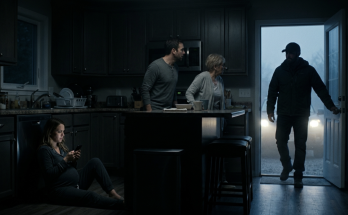
Around lunchtime, someone pounded on the front door.
Not knocked.
Pounded.
“Daniel!”
Elaine’s voice echoed through the hallway.
“Open this door immediately!”
Emma froze at the dining table.
Her purple crayon stopped halfway across the page.
Daniel stood up.
I gently touched his arm.
“You don’t have to.”
He looked at me calmly.
“Yes,” he said. “I do.”
He unlocked the door but left the security chain in place.
Elaine stood outside wearing oversized sunglasses and perfectly styled silver hair. Everything about her appearance suggested she expected to regain control the moment the door opened.
Then she noticed the new lock.
“You changed it?”
“Yes.”
Her expression hardened.
“This is Rachel’s idea.”
Daniel didn’t hesitate.
“No.”
“It was mine.”
She looked past him toward me.
“So this is what you’ve been working toward all along? Turning my own son against me?”
Before I could respond, Daniel spoke.
“Don’t talk to my wife like that.”
Elaine laughed bitterly.
“Listen to yourself. She has completely brainwashed you.”
“No,” Daniel answered evenly.
“I’m thinking like Emma’s father.”
For the first time, she seemed caught off guard.
She quickly recovered.
“You’re acting as if the child was in real danger.”
Daniel’s voice remained calm.
“You intentionally refused to return prescribed medication while she couldn’t breathe.”
“I was teaching discipline.”
“No.”
“You were putting my daughter at risk.”
Elaine shook her head.
“I raised you.”
Daniel looked directly into her eyes.
“I remember.”
Silence filled the porch.
“I remember standing outside for hours because I forgot to say ‘ma’am.’”
“I remember going without dinner because you thought I’d been disrespectful.”
“I remember apologizing for things I didn’t even do because arguing only made everything worse.”
Elaine’s face turned bright red.
“That’s ridiculous.”
“No.”
“It’s the truth.”
“You were impossible to raise.”
“I was a child.”
From behind us came a tiny voice.
“Daddy?”
Daniel immediately turned around.
His entire expression softened.
“I’m right here, Bug.”
Elaine tried one last time.
“Emma… sweetheart… tell them Grandma never wanted to hurt you.”
Emma slowly backed away until she was standing behind me.
She didn’t answer.
She didn’t move.
She simply held tighter to the small medical pouch clipped to her backpack.
Daniel looked at his mother for one final moment.
Then he quietly closed the door.
The pounding started again almost immediately.
So did the shouting.
I called Officer Hernandez.
When the police arrived a short time later, Elaine had moved from pleading to making threats.
She promised lawsuits.
She claimed she would report us to Child Protective Services.
She insisted Daniel was mentally unstable and that I was controlling every decision he made.
Officer Hernandez listened patiently.
When Elaine refused to calm down, the officer issued her a formal trespassing warning and instructed her to leave the property immediately while the investigation remained active.
Before getting into her car, Elaine pointed directly at me.
“You’re destroying this family.”
I stepped onto the porch.
“No,” I replied calmly.
“You made your choice the moment you decided my daughter didn’t deserve access to her medication.”
For once…
Elaine had nothing to say.
She drove away without another word.
Watching her disappear down the street, I wanted to believe the nightmare was finally over.
I couldn’t have been more wrong.
Within forty-eight hours, prosecutors had reviewed the evidence—and what happened next would change our family forever.

Part 3 – The Lesson We Chose to Leave Behind
The investigation moved much faster than any of us expected.
The hospital records confirmed that Emma had arrived in acute respiratory distress. The 911 recording captured the panic in her voice as she struggled to speak. The paramedics documented her condition the moment they reached our home, and Officer Maria Hernandez’s report carefully matched every detail Emma had shared.
There was more.
Because my car automatically synchronized recent hands-free calls, part of my conversation with Elaine had been saved. Investigators were able to hear her admit that she had intentionally taken Emma’s inhaler because she believed the child needed to “learn some respect.”
Daniel also recovered the inhaler exactly where Emma had described—in the cabinet above the stove, completely out of her reach.
Every piece of evidence pointed to the same conclusion.
The district attorney decided to move forward with charges for child endangerment.
Elaine wasn’t taken into custody immediately. She had no previous criminal history, so the case followed the normal legal process through hearings, attorneys, and court appearances. However, the judge issued an immediate order prohibiting her from having unsupervised contact with Emma.
Several weeks later, that order became even stricter.
Unless Daniel and I jointly requested otherwise, Elaine would have no contact with our daughter at all.
We never made that request.
Surprisingly, the legal proceedings weren’t the hardest part of the experience.
Helping Emma heal emotionally proved far more difficult.
For weeks after returning home, bedtime became filled with quiet questions.
“If kids make mistakes… can grown-ups take away their medicine?”
“No, sweetheart.”
“What if I’m rude?”
“No.”
“What if I yell?”
“No.”
“What if I forget to say I’m sorry?”
I pulled her close every single time.
“Medicine isn’t something you earn. Your health isn’t a reward for good behavior. If your body needs help, you get help. Always.”
Sometimes she accepted the answer and drifted to sleep.
Sometimes she cried.
Sometimes Daniel sat beside her bed long after she had fallen asleep, staring silently at the floor.
One evening I found him sitting there in the dark.
Without looking up, he quietly said, “She asked me if Grandma still loves her.”
“What did you tell her?”
“I told her that grown-ups are responsible for their own choices… and that none of those choices are Emma’s fault.”
I reached for his hand.
“That was exactly what she needed to hear.”
His eyes filled with tears.
“I should have protected her sooner.”
“You didn’t know this would happen.”
He shook his head.
“I knew who my mother was.”
For a long moment neither of us spoke.
Then I reminded him of something he had spent years forgetting.
“You grew up surviving her.”
I squeezed his hand.
“Now you’re protecting your daughter from the same experience.”
He nodded slowly.
For the first time since everything happened, some of the weight on his shoulders seemed to lift.
Life gradually found a new rhythm.
Without unexpected visits…
Without criticism over every parenting decision…
Without tense Sunday dinners where Daniel carefully measured every word before speaking…
Our home became peaceful.
Emma changed too.
She still had asthma.
There were still regular appointments with her pediatrician, pollen alerts in the spring, and occasional flare-ups during cold weather.
But something else changed.
She stopped being afraid.
She no longer hid whenever someone knocked on the front door.
She stopped asking whether Grandma was coming over.
Instead, she became remarkably confident about managing her own health.
One afternoon at school, a substitute teacher told her she could wait until recess before visiting the nurse.
Emma calmly stood up and replied,
“My asthma plan says I need to go now.”
The teacher apologized immediately.
Later that afternoon, the school nurse called me.
“I just wanted you to know your daughter handled that situation perfectly,” she said proudly. “She spoke up for herself exactly the way we teach children to do.”
After hanging up, I sat in my car and cried.
Not because I was sad.
Because I realized how far she’d come.
Daniel changed as well.
Healing wasn’t dramatic.
It didn’t happen overnight.
He began meeting regularly with a therapist.
He stopped responding to Elaine’s messages.
Eventually he blocked every phone number and email address she used to contact him.
When relatives repeated Elaine’s version of events, he calmly corrected them.
“My mother didn’t accidentally misplace Emma’s inhaler,” he would say. “She deliberately kept it away while my daughter was having trouble breathing.”
Some people tried to excuse her intentions.
Daniel always answered the same way.
“Intentions don’t erase consequences.”
Then he would come home, help Emma with homework, pack her asthma supplies for soccer practice, or surprise her by making pancakes for dinner simply because she asked.
He chose our family in countless ordinary ways.
Six months later, the final court hearing arrived.
Elaine accepted a plea agreement that included probation, mandatory parenting and anger-management classes, community service, and a continuing no-contact order involving Emma.
Outside the courthouse, she waited near the steps.
She looked smaller than I remembered.
Older somehow.
As Daniel walked past holding Emma’s hand, Elaine called his name.
“So this is it?”
He stopped.
“I hope you’re happy,” she said bitterly. “Your daughter is growing up without a grandmother.”
Daniel looked at Emma.
Then back at his mother.
His voice was calm.
“My daughter is growing up safe.”
Elaine opened her mouth but couldn’t find the words.
Then she looked directly at Emma.
For the first time since everything began, my daughter didn’t hide behind either of us.
She stood confidently beside her father.
“My medicine belongs to me,” she said quietly. “No one gets to take it away.”
Elaine stared at her for several seconds.
Emma simply turned around and kept walking.
That was the last time they ever saw each other.
A year later, our backyard was filled with purple balloons, birthday decorations, and children laughing beneath the old maple tree.
Emma raced across the lawn with her friends until she felt the familiar tightness in her chest.
She jogged over to me, smiling.
“Mom, can I use my inhaler before I go back?”
“Of course.”
She used it confidently, clipped it back into the small medical pouch attached to her backpack, and immediately ran back to join the game.
Daniel stood beside me watching her.
“She’s incredibly brave,” he said.
I smiled.
“She shouldn’t have needed to be.”
“No,” he agreed softly.
“But she’ll always know something important.”
Across the yard, Emma laughed so hard she nearly fell into the sprinkler while her favorite stuffed rabbit sat on a lawn chair wearing a tiny birthday hat.
The afternoon breeze gently rustled the leaves of the maple tree.
There was no dramatic reconciliation.
No emotional speech that erased years of pain.
No miracle ending that repaired every broken relationship.
There was simply the life we chose to protect.
New locks on the doors.
Healthy boundaries that stayed in place.
Emergency medicine always within reach.
And a little girl who knew that whenever she said she needed help, the people who loved her would believe her without hesitation.
In the end, that became the lesson our family carried forward.
Not obedience.
Not fear.
Not silence.
But this:
Every child deserves to feel safe.
Every child deserves to be heard.
And whenever Emma said she couldn’t breathe, someone would always be there to help.
THE END