
Part 1: The Blizzard and the Discovery
I used to believe that safety was a permanent foundation, something you built once and lived inside forever. I thought the walls of my daughter’s life were secure, protected by the quiet respectability of her suburban home. I was entirely wrong. The near-destruction of my family didn’t arrive with a sudden, roaring collapse; it revealed itself through a single, terrified whisper of a six-year-old boy cutting through the static of a midnight storm.
My grandson Noah was six years old, and he never called me unless my daughter, Claire, helped him navigate the phone. So when my phone rang at exactly 9:43 on a freezing Friday night, my instincts flared. I pressed answer, and instead of his usual cheerful babble, a small, shaking voice whispered into my ear: “Grandpa, I’m scared. Please help me.”
Before he could even finish the sentence, I was already grabbing my heavy winter coat.
Outside, a brutal winter blizzard slammed against the windows of my house in Vermont like handfuls of gravel. The backroads leading to Claire’s house were nearly invisible under the whiteout conditions, but adrenaline overrode caution. I threw my truck into gear, gripping the steering wheel with white knuckles while my headlights fought a losing battle against the driving snow.
“Noah?” I said, keeping him on speakerphone as I navigated the slick, black ice. “Where’s your mom? Put Mommy on the phone.”
A soft, ragged sniffle came through the speaker. “She’s not waking up, Grandpa… Daddy said I was bad. He locked me down in the basement.”
My heart dropped into a cold, dark abyss.
“Listen to me, buddy,” I said, forcing my voice to remain steady despite the absolute panic clawing at my throat. “Stay exactly where you are. Do not move. Grandpa is coming.”
Before I could say more, the line went completely dead.
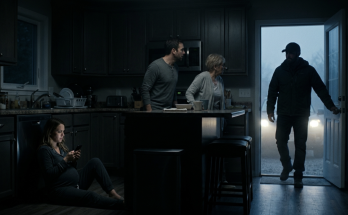
I dialed Claire’s number twelve times in a row. No answer. I dialed my son-in-law, Mark. It went straight to voicemail. By the time I finally pulled into their driveway, my hands were entirely numb despite the truck’s blasting heater. The house was completely dark; the porch light was off. No tire tracks showed in the fresh snow except for one solitary set, already half-covered by the drifting blizzard.
I marched up the steps and pounded heavily on the front door.
When the door finally opened, Mark only cracked it a few inches. He was wearing jeans and a gray sweatshirt, his hair wet as if he had just stepped out of the shower. But what caught my eye immediately under the dim hallway light was a fresh, angry red scratch running down the side of his neck.
“Richard?” he said, blinking slowly, his eyes vacant and distant. “What the hell are you doing here in this weather?”
“Where is Noah?” I demanded, stepping closer.
“He’s asleep,” Mark replied smoothly, a practiced lie rolling off his tongue. “Stop making things up and go home.”
“He called me, Mark.”
Mark’s jaw tightened, his posture shifting instantly into something defensive. “Kids have nightmares, Richard. It’s a storm.”
“Move out of my way.”
Instead, he stepped directly into the center of the doorway, blocking the entry with his broad shoulder. “Claire is sick, and Noah is perfectly fine. Go home before you get yourself killed on these invisible roads.”
But right then, from somewhere deep inside the silent house, a muffled, heavy thump echoed.
Then another.
I didn’t argue further; I shoved my weight past him. Mark lunged forward, grabbing my arm with a crushing grip. “You don’t just come into my house like this!” he snarled.
I twisted my arm free with a sudden burst of strength and moved rapidly down the dark hallway. The air inside smelled completely wrong—a toxic mix of harsh bleach, heavy whiskey, and something faint and metallic. Near the base of the stairs, Claire’s designer purse lay spilled across the floor, its contents scattered, and her phone lay beside it, the screen shattered into a web of broken glass.
“Noah!” I shouted into the darkness.
A tiny, muffled voice cried out from beneath the floorboards. “Grandpa! I’m down here!”
Mark charged at me from behind, but thirty years of working physical jobs meant I was faster than he anticipated. I slammed my shoulder back into his chest, throwing him off balance, and reached the basement door. A heavy wooden dining chair had been tightly wedged under the brass doorknob, locking it from the outside.
When I violently yanked the chair aside and threw the door open, a wave of freezing, stagnant air rolled up from the dark abyss below.
I looked down the wooden steps, and my breath caught in my throat.
Noah was sitting huddled on the bare concrete floor in his pajamas, barefoot, hugging his knees to his chest to stay warm. Right beside him, Claire lay completely motionless at the bottom of the stairs, one arm bent unnaturally beneath her body.
And on the concrete wall directly behind them, written in harsh, bold black marker, were the words: “HE LEARNS WHEN HE’S ALONE.”
Part 2: The Kitchen Battle and the Legal Move
For one endless second, the entire world became completely silent, save for the sound of Noah’s quiet, terrified crying at the bottom of the stairs. Then, before I could process the scene, Mark hit me from behind with the full force of his weight.
My shoulder smashed violently against the heavy basement doorframe, and a sharp, blinding pain flashed straight across my ribs. I lunged forward, narrowly grabbing the wooden railing to keep myself from tumbling down the steep steps onto my daughter. Mark cursed, his fingers clawing at my heavy winter jacket to pull me back, but I kicked backward blindly with all my might, catching him hard across the shin. He stumbled backward into the kitchen, swearing through clenched teeth.
“Noah, don’t move! Stay right there!” I shouted down into the darkness.
With shaking, numb fingers, I pulled my phone from my pocket and immediately dialed 911. Mark saw the glowing screen from the kitchen and his eyes went wild with panic; he rushed me again like a trapped animal.
“You don’t know what happened here, old man!” he snarled, his voice raw and shaking. “Claire fell. She tripped during an argument. The kid was hysterical, and I was just handling it!”
“By wedging a chair and locking a six-year-old in a freezing basement?” I yelled back, my voice booming with a protector’s rage.
His face completely hardened, losing any trace of human empathy. “He lies. He’s a liar, just like his mother.”
Right then, the emergency dispatcher’s voice came through the line. I didn’t waste a single breath; I shouted their suburban address into the phone and barked, “Child trapped, woman unconscious, violent man in the house!”
Before I could finish, Mark lunged forward and slapped the phone violently from my hand. The device skidded across the cold kitchen tile, landing somewhere near the counter, though the line remained open and connected.
From down in the dark basement, Noah heard the commotion and screamed, “Grandpa!”
That desperate cry put thirty years of strength back into my old legs. I drove my elbow hard into Mark’s stomach, using all my body weight to shove him back against the refrigerator. The violent impact sent colorful kitchen magnets and school photos scattering across the floor. One particular photo landed faceup right near the toe of my winter boot: it was a picture of Noah grinning proudly with his missing front teeth, Claire’s loving arms wrapped tightly around him, and Mark standing right beside them, his hand gripping Claire’s shoulder just a little too tight.
Mark recovered from the blow quicker than I hoped, his eyes darting to a half-open kitchen drawer. I saw his hand reach inside, his fingers wrapping around the handle of a large utility knife.
Instinct overrode everything. I grabbed the nearest heavy object I could find—a seasoned cast-iron skillet sitting on the stovetop—and swung it with all my might, slamming it directly into his wrist. The heavy knife clattered harmlessly across the tile floor. Mark roared out in agony, immediately clutching his swelling arm.
“You old bastard,” he wheezed, his face twisting in pain.
“Stay down,” I warned, keeping the skillet raised.
But he didn’t listen. Driven by pure rage and the terrifying realization that he was ruined, he came at me again. We crashed violently into the dining room table, our combined weight shattering a wooden chair beneath us. My injured ribs screamed in agony. He was younger, stronger, and completely desperate, but I held one massive advantage: I wasn’t fighting to win a match. I was fighting to reach my family.
Suddenly, the faint, wailing sound of emergency sirens cut through the heavy howling of the blizzard outside.
Mark froze, his expression shifting instantly from blind rage to cold calculation. Knowing his time was up, he bolted for the back door, tearing it open and vanishing into the whiteout storm.
I didn’t chase him into the cold. I dropped the skillet and ran straight down the basement steps to the concrete floor. Claire was breathing—her respirations were shallow but steady—and a small trail of blood had dried near her hairline. The moment I reached the bottom, Noah crawled into my arms so hard he nearly knocked me over, his small skin completely icy to the touch.
“I tried to wake Mommy,” he sobbed into my neck, his little body trembling violently. “Daddy got mad because I spilled a glass of water. He said I needed to learn a lesson. He turned the lights off.”
I wrapped my heavy winter coat tightly around his shivering shoulders. “You did the right thing calling me, Noah. You are so brave.”
“I used Mommy’s old phone,” he whispered, wiping his nose. “The one she hid at the bottom of the laundry basket.”
Within minutes, two local deputies burst through the front door, followed closely by paramedics. Mark didn’t make it far in the blizzard; his pickup truck had slid off the slick driveway into a massive snowbank behind the property. The police found him half a mile down the road, shivering in his house slippers, his wrist heavily swollen and his clothes completely soaked from falling into a frozen ditch.
At the county hospital, as the storm finally began to clear, Claire woke up near dawn. Her very first words weren’t about her own pain or the monitor beeping beside her.
“Where’s Noah?” she whispered frantically.
I held her hand tightly, squeezing it. “He’s safe, Claire. He’s upstairs with me.”
She closed her eyes, and a slow, heavy tear slid into her hair, carrying months of hidden terror with it.
But as the days went on, we learned that physical safety was not the same thing as true peace. By noon, county detectives were in the room asking painful questions. By evening, Child Protective Services had arrived to open a formal file. And by Monday morning, Mark’s high-priced defense attorney was already calling the local papers, spinning the entire nightmare as “a tragic domestic misunderstanding aggravated by severe weather, isolation stress, and alcohol.”
That was the exact moment I realized the nightmare hadn’t actually ended in that dark basement. It had simply moved from the cold concrete into a polished, wood-paneled courtroom.
The first time I saw Mark after that horrific night, he was sitting in the courthouse hallway wearing a tailored navy suit and a crisp white shirt, his injured wrist wrapped neatly in a medical brace. He looked absolutely nothing like the desperate, wild-eyed man who had blocked my path during the blizzard. He looked calm, respectable, and almost offended to be associated with the charges.
Claire sat right beside me on the hard bench, her hands gripping Noah’s small backpack. Her physical injuries had healed, but the deep emotional bruising behind her eyes had not. She kept glancing toward the heavy double doors of the courtroom as if they might open and swallow her alive.
Noah wasn’t forced to sit in the hall. A court victim advocate had taken him to a child-friendly waiting room filled with books, toys, and a golden therapy dog named Jasper. Still, every few minutes, Claire would turn to me, her voice trembling, “Dad, can someone please check on him?”
I understood her terror completely. Since that night in the basement, Noah couldn’t tolerate closed doors. He slept with a glowing flashlight tucked firmly under his pillow. Whenever the old house furnace clicked on with a loud thud at night, he would run silently to Claire’s bed without making a sound. He had learned to be completely quiet when he was afraid, and that realization broke something inside me every single time I thought about it.
Inside the courtroom, Mark’s attorney stood before the judge and spoke in a smooth, practiced baritone.
“My client completely denies intentionally harming his wife or his child, Your Honor,” the lawyer declared smoothly. “Mrs. Bennett unfortunately lost her footing and fell during a heated domestic argument. Mr. Bennett admits he panicked due to the severity of the storm, but he maintains he placed the child downstairs temporarily for his own safety after the child became entirely uncontrollable.”
Claire flinched violently at the word “uncontrollable.”
I leaned over, placing a hand on her trembling shoulder. “Just breathe, Claire. Let them talk.”
The state prosecutor rose next. Her name was Dana Whitcomb, and she had the sharp, steady voice of someone who did not waste a single syllable on high-society theatrics.
“Your Honor, the state has extensive medical records, the recorded 911 dispatch tape, the child’s official forensic interview, and a wealth of photographs from the scene,” Dana said, her voice cutting through the courtroom coldness. “The defendant intentionally locked a terrified six-year-old child in an unheated, dark basement while the child’s mother lay severely injured and unconscious at the bottom of the stairs. He then used physical force to prevent a family member from rendering aid, and actively fled the scene when law enforcement arrived.”
Mark sat perfectly still, staring straight ahead at the judge’s bench without a single trace of emotion.
The judge didn’t hesitate. He ordered an immediate temporary criminal order of protection, continued the criminal case to a formal trial, and granted Claire temporary sole legal custody. Mark’s face twitched only once, a small muscle jumping in his cheek, when he heard the judge pronounce the final words: “Supervised visitation is hereby suspended pending further forensic investigation.”
Outside the heavy doors, Claire finally exhaled a breath she felt she’d been holding for days.
But Mark and his family were far from finished. Over the next month, the psychological warfare began. Mark’s mother left desperate, weeping voicemails on Claire’s phone, accusing her of ruining her son’s career and life. His brother sent angry messages, claiming she was brainwashing Noah against his own father. One of Mark’s close coworkers even posted a lengthy statement online, claiming that “a good, hardworking man was being systematically destroyed by exaggeration and family drama.”
The pressure was suffocating, and Claire wanted nothing more than to disappear from the state entirely.
“He’ll make everyone believe him, Dad,” she told me one evening at my kitchen table, her head in her hands. Noah was fast asleep upstairs in my guest room, surrounded by a mountain of stuffed animals we had bought him in a burst of helpless, protective love.
“No, Claire,” I said, my voice firm and unyielding. “He won’t.”
“How can you be so sure?”
“Because men like Mark always count on everyone else being too tired, too frightened, or too broken to keep records.”
I had spent my entire career working as a licensed building inspector. If there was one thing I believed in down to my core, it was documentation. Cracked foundations, faulty hidden wiring, leaking roofs—everything left a permanent trace if you knew exactly where to look.
And so, we began to look.
Part 3: The Broken Foundation and the Dawn of Peace
Claire started digging through her digital footprint and found a hidden cloud folder she had maintained in secret for years. Inside were photos she had taken during her darkest moments: faint bruises on her upper arm, a splintered bedroom doorframe, and Noah’s smashed tablet from the day Mark accused him of “ignoring instructions.” She also uncovered emails she had written to herself—structured exactly like diary entries, each meticulously dated and time-stamped. She had never sent them to anyone, but some primal instinct had warned her that she would need proof one day.
Next, we reached out to the neighborhood. At first, people hesitated, wanting to avoid domestic drama. But once the ice broke, the truth poured out. Mrs. Albright from next door admitted she had frequently heard Mark shouting late at night. A retired mail carrier remembered seeing Claire outside in freezing weather without a coat the previous winter, crying silently beside the garage. Noah’s kindergarten teacher provided a formal statement detailing how the boy had recently become withdrawn, flinching at loud male voices and once whispering, “Daddy says I make Mommy sad.”
But the foundation of Mark’s defense didn’t just crack; it completely shattered when a forensic technician examined Claire’s broken phone.
Buried in the memory card was an audio recording. Claire had managed to trigger the voice recorder during the argument right before her fall. The file was only four minutes long, but it stripped away every single one of Mark’s lies.
Mark’s voice was crystal clear through the static: “You think your father will save you? You think anyone believes you over me?”
Claire’s voice followed, breathless and shaking: “Mark, Noah is watching.”
“Good,” he replied coldly. “Maybe he’ll learn what happens when people disobey.”
Then came the sound of Noah crying, Claire screaming “Don’t touch him,” a violent struggle, a heavy crash, and Mark breathing heavily. After that, his voice returned, lower and completely devoid of remorse: “Now look what you made me do.”
When Dana Whitcomb played that tape in a pretrial hearing, the room went dead silent. Mark’s high-priced attorney stopped using the word “misunderstanding” entirely. Three weeks later, facing the absolute certainty of a lengthy prison sentence, Mark accepted a plea deal. He pleaded guilty to domestic assault, child endangerment, unlawful restraint, and obstruction of justice. The judge sentenced him to prison, followed by long-term probation, mandated domestic violence intervention, and permanent protective orders.
At the sentencing hearing, Claire chose to stand at the podium. Her hands clasped the wooden edges so tightly her knuckles turned white, and I sat directly behind her, ready to catch her if her knees gave out. But she stood tall.
“For years,” she said, her voice echoing through the courtroom, “I thought protecting my son meant keeping the house calm. I thought if I spoke softly enough, agreed fast enough, and apologized enough, then Noah would be safe. I was wrong. Silence did not protect him; it only taught him to be afraid alone.”
Mark kept his eyes locked firmly on the defense table.
“My son called his grandfather because he believed someone would come,” Claire continued, her voice breaking but filled with immense power. “I am grateful he still believed that. I am grateful my father answered. I am grateful we are alive. I do not want revenge. I want distance, time, and a home where a locked door means privacy, not punishment.”
Noah never had to step foot in that courtroom, which was our greatest mercy.
Healing didn’t arrive like a sudden sunrise; it came slowly, like snow melting from shaded ground. For weeks, everything still felt frozen and raw, but slowly, patches of green began to show. Claire rented a small, sunny house two towns over—close enough for me to visit every day, but far enough away that the streets didn’t carry Mark’s shadow.
I went over to help her install heavy-duty locks, brighter porch lights, and a modern security camera system. Noah watched me work with intense, grave concentration.
“Grandpa,” he asked, holding a screwdriver that was twice the size of his small hand, “are locks good or bad?”
I stopped tightening the steel strike plate and knelt down to his level. “They’re just tools, buddy. It depends entirely on who uses them and why.”
He thought about that for a long moment. “So this lock keeps bad people out?”
“Yes, it does,” I promised him.
“And I can always open it?”
“Always.”
That answer seemed to satisfy his burdened mind. He started seeing a child therapist every Tuesday. In the beginning, his drawings were heartbreaking: a dark house, steep stairs, a solid black square for the basement, and three stick figures. I was always the tall figure standing outside the house in a big blue coat. But as the weeks turned into months, the drawings began to change. The basement grew smaller, the windows grew massive, and Jasper, the golden therapy dog, appeared in almost every picture. By the time spring arrived, Noah was laughing out loud again without immediately looking around the room to see if laughter was allowed.
One Saturday in April, he asked to have a sleepover at my place. Claire packed his pajamas, his dinosaur toothbrush, and the flashlight he still carried everywhere. That night, we made breakfast pancakes for dinner because he declared that breakfast food tasted infinitely better after dark.
At bedtime, he paused right outside the guest room door. “Grandpa? Can the door stay open?”
“As wide as you want it, buddy,” I replied.
He climbed into bed, and I tucked the heavy blanket securely under his chin.
“Grandpa?” he whispered into the dim light.
“Yeah, buddy?”
“When I called you that night, did you know I was really scared?”
I sat down gently on the edge of the mattress. “I did, Noah. Because your voice sounded exactly the way your mom’s voice used to sound when she was little and had a bad dream.”
He frowned slightly. “Mommy was scared when she was little?”
“Sometimes,” I admitted softly.
“Did you help her?”
“I tried my best.”
He was quiet for a long moment, staring up at the ceiling. Then he whispered, “You helped me better.”
The words landed with a gentle warmth, but they cut deep into my chest anyway. I brushed his hair back from his forehead, looking at the innocence we had fought so hard to protect. “I’m just sorry I didn’t know sooner, Noah.”
Noah reached his small hand out from under the blanket and gently touched my sleeve. “You came when I called.”
That was all he needed from me. He didn’t need perfection, and he didn’t need me to possess the magical power to erase the past. He just needed the absolute truth that when he reached out his hand into the dark, someone would reach back and pull him into the light.
A few months later, Claire invited me to Noah’s elementary school play. He was cast as a tree—he didn’t have any speaking lines, just a proud stance on stage with large cardboard leaves taped to a bright green sweatshirt. He stood perfectly still between two other trees, looking incredibly serious and proud, while a line of first-graders dressed as rabbits completely forgot the words to their song.
Claire sat next to me, laughing until tears streamed down her face.
This time, the tears didn’t frighten Noah. He looked out into the audience, saw her radiant smile through the tears, and flashed a brilliant, missing-tooth grin right back at her.
After the play wrapped up, we went to a local parlor for ice cream. Noah ordered chocolate with a mountain of rainbow sprinkles, while Claire ordered vanilla, barely eating a bite because her eyes were locked on him. She was memorizing the moment, collecting proof that her son was still here, still whole, and still becoming himself.
Outside, the cool evening air smelled faintly of fresh rain and pavement. Noah ran ahead of us toward the parking lot, then suddenly skidded to a halt and turned back around.
“Grandpa! Race me to the truck!”
I placed a hand over my ribs, which still ached slightly whenever the Vermont weather changed. “You’ll beat me, Noah.”
“I know!” he shouted, absolutely delighted.
So I ran badly—slowly, dramatically, swinging my arms wide. He practically flew across the sidewalk, laughing so hard he nearly tripped over his own sneakers. Claire called out for him to be careful, but her voice was light, airy, and entirely free of fear.
He reached the truck first, throwing both of his small arms triumphantly into the air.
“I win!” he cheered.
“Yes,” I said, catching my breath and smiling as I unlocked the doors. “You win, buddy.”
And for the first time since that terrifying night in the blizzard, I believed it completely. Noah had won something far greater than a race, and something a man like Mark could never understand. He had possessed the immense bravery to ask for help, he had been believed, and together, we had survived.