
“That Dress Looks Like a Cheap Imitation.” My Future Mother-in-Law Mocked My Wedding Gown—Until She Turned the Collar and Realized My Family Had Been Hiding a Story More Powerful Than Her Entire Social Circle
Part One: The Moment the Room Went Silent
“Are you really planning to wear that in front of the Waverly family?”
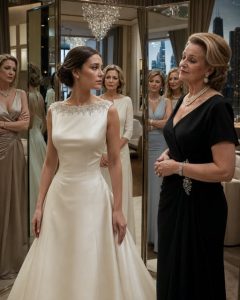
Camille Waverly’s voice was soft enough to sound polite, but every word landed with the careful cruelty of a pin pressed into skin. She stood beneath the crystal chandelier in the private fitting room of Atelier Beaumont, one manicured hand resting against her pearl necklace while the other held a glass of sparkling water she had not touched. Around her sat three of her closest friends, women whose names appeared in charity brochures, museum donor lists, and society columns. They wore silk coats, diamond earrings, and the sort of expressions people wear when they are enjoying a spectacle they can later describe over lunch.
I stood in front of the three-way mirror wearing the wedding dress my mother had given me only forty-eight hours earlier.
The gown was simple by the standards of the room. It was not covered in dramatic lace or layered in enough tulle to fill a ballroom. It was made of ivory silk that followed the shape of my body without trying to turn me into someone else. The sleeves rested gently off my shoulders. A narrow line of hand-sewn beads traced the collarbone. The train was soft and elegant, long enough to whisper across the floor but not long enough to demand attention. I had never worn anything so beautiful, and when I first put it on at home, I had cried before I even looked in the mirror.
Not because it was expensive.
Not because it was rare.
Because it felt like me.
That was apparently the problem.
Camille’s friend, Maribel Hayes, tilted her head and studied the dress with an exaggerated look of sympathy. “It has potential,” she said. “Though the fabric does look a little… uncertain.”
Another woman, Genevra Cole, gave a small laugh behind her hand. “Maybe it’s one of those custom pieces people order online and hope for the best.”
Camille smiled faintly. “I’m sure Cora did what she could. Not everyone grows up understanding the difference between something inspired by couture and something actually made with quality.”
The room became quiet.
My fiancé, Lucas Waverly, was supposed to meet us later for dinner. He was not there to hear his mother speak about me as if I were a disappointing table centerpiece. My own mother, Maren Bennett, stood near the fitting room curtain, calm and still. My mother had always been gentle, but she was not weak. She had a way of remaining quiet that made impatient people reveal more than they intended.
I looked at myself in the mirror again.
I could have argued.
I could have asked Camille why she believed money gave her the right to humiliate people.
I could have reminded her that I had spent eight years teaching children how to read, how to believe in themselves, and how to stop being ashamed when other people told them they were not good enough.
Instead, I smiled.
“I love it,” I said.
Camille’s eyes narrowed slightly.
“You love it?” she repeated.
“Yes.”
“But Cora,” she said, using my name the way someone might speak to a child who had chosen the wrong crayon, “your wedding photographs will be seen by people who know fashion. The Waverlys have traditions. We have a certain standard. I only want to protect you from feeling embarrassed later.”
The truth was that Camille did not care whether I felt embarrassed.
She cared whether she felt embarrassed.
I was a kindergarten teacher from a small Midwestern town. My father ran a modest repair shop for years before he retired. My mother coordinated literacy programs at the local library. I did not belong to a country club. I did not grow up skiing in Switzerland or attending summer galas in Nantucket. I did not own a closet full of designer bags or know the correct wine to order when the menu came without prices.
And ever since Lucas proposed to me, Camille had treated those facts as evidence that I was a temporary mistake in her son’s otherwise carefully curated life.
She had never said she disliked me.
Camille was too refined for honesty.
Instead, she offered “guidance.”
She reminded me that Waverly weddings were not casual events.
She suggested that I take etiquette lessons before the reception.
She asked whether my parents would be comfortable meeting certain guests.
She once sent me a list of recommended hair stylists because she was concerned that my “natural look” might be difficult to photograph under ballroom lighting.
Every insult came wrapped in a ribbon.
Every smile had a hidden blade.
But this dress had been my mother’s gift, and I was tired of apologizing for things that had never needed apology.
Camille walked closer.
“May I?” she asked, reaching toward the collar.
I hesitated.
Then I nodded.
Her fingers touched the delicate edge of the fabric. She turned the collar slightly, searching for the label with the confidence of someone expecting proof of her own superiority. I watched her face as she found it.
At first, nothing changed.
Then her fingers stopped moving.
Her breath caught.
The color slowly disappeared from her cheeks.
Maribel leaned forward. “What is it?”
Camille did not answer.
Her eyes remained fixed on the small embroidered label sewn into the inner collar.
The room became so quiet I could hear the faint hum of the air-conditioning system.
Camille’s hand began to tremble.
“This…” she whispered. “This cannot be real.”
I looked at my reflection in the mirror.
Then I looked at her.
“It is real,” I said quietly.
Genevra stood up from her chair. “What does it say?”
Camille swallowed.
Her voice was barely audible.
“Valenti Archive. One of One.”
The women stared at one another.
Everyone in that room knew the name Valenti.
House Valenti was not simply a fashion label. It was a legend. For nearly forty years, Valenti gowns had appeared on actresses at film festivals, royalty at charity balls, and women whose wedding photographs were printed in magazines. Their designs were known for their quiet luxury, their hand-finished silk, and their impossibly long waiting lists.
Camille had once mentioned House Valenti during a lunch meeting, saying that only “serious families” had the patience and connections to secure a piece from their private archive.
Now she was holding one in her hands.
And it belonged to me.

Part Two: The Girl Camille Never Bothered to Know
The first time I met Lucas Waverly, he was sitting on the floor of a children’s hospital wearing a cardboard dinosaur mask.
It was not the kind of image people usually associated with him.
Lucas was a corporate attorney at one of the largest firms in Chicago. He wore dark suits, spoke calmly in rooms full of intimidating people, and had the kind of last name that made restaurant managers suddenly find open tables. He came from a family that valued tradition almost as much as it valued being seen valuing tradition.
But that afternoon, he was sitting cross-legged in a pediatric activity room, reading a storybook to a group of children while doing ridiculous voices for every character. A six-year-old boy named Mason had refused to leave his mother’s side for almost an hour. He was frightened, tired, and overwhelmed by the machines and strangers around him.
Lucas did not push.
He simply lowered himself to the floor, placed a stuffed dinosaur near Mason’s shoe, and began reading in the most dramatic dinosaur voice I had ever heard.
Mason laughed.
Then he sat down.
Then he listened.
I watched Lucas from across the room and thought, That man is either very kind or very strange.
He was both.
After the event ended, he came over and asked me about the tiny dinosaur earrings I wore every day. I told him they were a gift from one of my students, who had insisted that every teacher needed “bravery earrings.” Lucas smiled and said, “I think you wear them well.”
We started talking after that.
At first, it was coffee near my school.
Then long walks after work.
Then Sunday mornings at a small bakery where he always ordered something too sweet and pretended he did not regret it.
Lucas did not make me feel like a project. He did not treat my ordinary life like something charming but temporary. He asked questions about my classroom. He listened when I told him about the child who had learned to read after months of struggling. He helped me paint bookshelves during a school fundraiser. He met my parents and spent an entire afternoon repairing my father’s old radio with him, even though neither of them knew exactly what they were doing.
When he proposed two years later on a quiet walking trail near the lake, I said yes before he finished asking.
His grandmother’s ring sat on my finger.
The sky was pink.
Lucas laughed when I started crying.
Then he cried too.
It should have been perfect.
But within hours, Camille Waverly had turned the announcement into a strategy meeting.
“We need to begin planning immediately,” she said over dinner the next week. “There are expectations. There are family obligations. There are traditions.”
I smiled politely.
Lucas reached under the table and squeezed my hand.
Camille looked at me over the rim of her wineglass.
“Of course, Cora will need some guidance,” she added.
My father, who had spent most of the evening listening quietly, glanced at me.
“What kind of guidance?” he asked.
Camille smiled.
“Oh, nothing dramatic. It is simply that Lucas’s world can be unfamiliar at first. The guest list, the venues, the social calendar. It takes time to understand how things are done.”
My mother said nothing.
But I saw her fingers tighten slightly around her napkin.
That was the beginning.
Wedding planning became a polite war.
Camille wanted a ballroom with gold ceilings and a guest list that included people Lucas barely knew.
I wanted a garden ceremony with warm lights, simple flowers, and enough room for my students’ families to attend if they wished.
Camille wanted a twelve-course dinner.
I wanted food that people would actually eat.
Camille wanted a famous photographer who charged more than my parents’ first house had cost.
I wanted the woman who had photographed my sister’s engagement party because she made everyone laugh and never made anyone feel awkward.
Every conversation with Camille ended the same way.
She would smile.
She would say, “Of course, it is your wedding.”
Then she would find a way to make it clear that she did not believe I had the qualifications to decide anything.
Lucas tried to defend me, but at first he did it gently.
“Mom just gets stressed,” he would say.
“She wants everything to go well.”
“She does not always realize how she sounds.”
Those sentences became small cracks in my trust.
Because even when Lucas meant well, he was still asking me to absorb the impact of his mother’s behavior so he would not have to confront it fully.
I loved him.
But I began to understand that love did not mean pretending problems were not real.
The dress became Camille’s favorite battlefield.
“Waverly brides have always gone to Atelier Beaumont,” she announced one Sunday morning at brunch. “It is tradition.”
“I already have a dress,” I told her.
Camille paused.
“You do?”
“Yes.”
“From where?”
“My mother gave it to me.”
Her eyes softened in a way that was somehow more insulting than open cruelty.
“Oh,” she said. “How sentimental.”
“It is.”
She looked at Lucas.
“Perhaps we should still have Cora try on some options. There is no harm in comparison.”
Lucas looked at me.
I knew he wanted me to say no.
I also knew he wanted to avoid another argument.
So I agreed.
That was how I ended up standing in Atelier Beaumont while Camille’s friends examined my dress as if it were evidence of a crime.
They did not know that my mother had received the gown in a long, narrow box wrapped in deep blue paper.
They did not know that when she opened it, she sat silently for almost ten minutes before calling me.
They did not know that the woman who had created it had whispered to my mother, “This belongs to your daughter.”
And they certainly did not know that my family history contained more than they had ever bothered to ask.
Part Three: The Woman Behind the Label
Camille was still staring at the label when the doorbell rang.
We were not at my house.
We were not at a family dinner.
We were in the private fitting room of Atelier Beaumont, surrounded by mirrors, expensive perfume, and women who had spent most of the afternoon explaining why I was not enough.
The salon manager entered quietly and whispered something to one of the assistants. The assistant’s face changed. She glanced toward Camille, then toward my mother.
“Maren,” the manager said softly, “she is here.”
My mother smiled.
It was the first time that day I saw her look nervous.
Not frightened.
Not uncertain.
Just emotional.
A few seconds later, the curtain at the entrance opened, and a woman stepped into the room.
She was in her late sixties, tall and elegant, with silver hair swept neatly away from her face. She wore a dark green coat, simple gold earrings, and no visible sign that she was one of the most powerful women in fashion.
But Camille recognized her instantly.
Everyone did.
“Alessandra Valenti,” Camille whispered.
The founder of House Valenti looked at my mother first.
Not at the dress.
Not at Camille.
Not at the wealthy women sitting in stunned silence.
At my mother.
“Maren,” Alessandra said warmly.
My mother’s eyes filled with tears.
“Alessandra.”
They embraced.
Not like acquaintances.
Not like old business contacts.
Like people who had carried pieces of each other’s lives for decades.
Camille stood frozen beside the mirror.
Maribel looked as though she had forgotten how to blink.
Genevra quietly lowered her phone, which she had clearly been preparing to use for some private gossip group.
Alessandra stepped back and looked at me.
“So this is Cora,” she said.
I nodded, suddenly unsure what to do with my hands.
She smiled.
“You have your mother’s eyes.”
Camille recovered just enough to speak.
“I am sorry,” she said carefully. “How do you know Maren?”
Alessandra looked at her.
Then she looked at my mother.
My mother gave the smallest nod.
Alessandra turned back to Camille.
“Maren Bennett was my first partner,” she said.
The words landed heavily.
Camille’s mouth opened.
No sound came out.
Alessandra continued.
“Before House Valenti had a showroom, before it had investors, before anyone cared what we were doing, there were two young women in a basement studio with three sewing machines, a borrowed ironing board, and an unreasonable belief that beauty could be made by hand.”
My mother looked down.
I had never seen that expression on her face before.
It was not embarrassment.
It was memory.
“My mother,” I said quietly, “was your business partner?”
Alessandra smiled.
“Your mother was more than that. She was the person who taught me how to make something that felt alive.”
Camille looked from my mother to me.
“I do not understand,” she said.
My mother took a slow breath.
Then, for the first time in my life, she told the story she had kept almost completely hidden.
When she was twenty-three, she had moved to New York with one suitcase, a scholarship to a design institute, and a stubborn belief that she could build a life through skill rather than connections. She met Alessandra in a tiny fabric market in the garment district. Alessandra had ideas. My mother had technical brilliance. Alessandra could imagine a dress. My mother knew how to make it move.
They began working together in a rented basement near Chelsea.
They created gowns for local performers, gallery openings, small weddings, and clients who had no idea they were wearing the beginning of something historic.
The first Valenti collection, the collection that later became famous for its quiet hand-beading and silk structure, had been built from patterns my mother designed.
My mother created the signature collar technique.
She created the delicate beadwork that followed the neckline instead of covering it.
She created the “floating seam,” a method that made the fabric fall softly without needing heavy shaping beneath it.
For three years, she and Alessandra worked side by side.
Then my mother’s father became ill.
My grandfather had raised her alone after my grandmother died. He ran a small hardware store in Indiana and never asked her to come home. But when his health began to fail, my mother chose to leave New York.
She sold her share of the business for almost nothing.
Not because she did not believe in it.
But because she wanted to spend time with the man who had taught her how to use tools, how to fix broken things, and how to keep promises.
She returned home.
She cared for him.
She met my father.
She built another life.
“I thought I had walked away from fashion forever,” my mother said softly. “But I never walked away from creating. I just stopped doing it for people who needed to know my name.”
Alessandra reached for her hand.
“And I never forgot who helped me begin.”
The dress I was wearing was not a random Valenti gown.
It was an archival piece designed specifically for me.
The silk had been woven in Italy.
The beadwork had been completed by hand.
The collar contained the original floating-seam technique my mother had invented decades earlier.
And inside the label, beneath the Valenti name, was a line embroidered in tiny gold letters:
For Maren’s daughter, with gratitude for the first stitch.
Camille read the words slowly.
Then she looked at my mother again.
But something in her face had changed.
For years, she had believed that she could measure people by the signals she understood: names, neighborhoods, labels, schools, memberships, jewelry, invitations.
Now she was standing in front of a woman she had dismissed as ordinary.
A woman who had once helped shape one of the fashion houses Camille admired most.
My mother had not lied about her past.
She had simply never needed to perform it.
And Camille had mistaken privacy for insignificance.
Part Four: The Truth That Was Bigger Than the Dress
No one spoke for several seconds.
The room seemed too bright.
The mirrors reflected everyone from too many angles: Camille with one hand still pressed against the collar of my dress, Alessandra standing beside my mother, Maribel and Genevra staring at the floor, and me in the center of it all, wearing a gown that suddenly carried more history than I had ever imagined.
Camille finally released the fabric.
“I had no idea,” she said.
My mother’s expression remained calm.
“No,” she replied. “You did not.”
Camille looked uncomfortable, and for the first time, I understood that discomfort was not the same as accountability.
She was embarrassed because she had been wrong.
But being wrong did not automatically mean she understood why.
“I hope you know,” Camille said carefully, “that I never meant to imply your family lacked value.”
The sentence was almost impressive in its refusal to apologize.
I could see Lucas in my mind, gently trying to translate her behavior into something less harmful.
I could imagine him saying that she did not mean it that way.
But I had reached the point where I no longer wanted people to explain cruelty to me.
I wanted them to stop.
“You did imply it,” I said.
Camille looked at me.
My voice did not rise.
I did not need it to.
“You implied that because my parents did not belong to your social circle, they could not have taste, history, ability, or dignity. You assumed that because I teach kindergarten and come from a small town, I should be grateful for your approval.”
Camille’s face tightened.
“I was only trying to make sure you felt comfortable.”
“No,” I said. “You were trying to make sure I looked acceptable beside your son.”
The room went still again.
Alessandra glanced at my mother, but neither of them interrupted.
Camille’s friends shifted uncomfortably.
Maribel tried to smile.
“You know, weddings are emotional,” she said weakly. “We all say things we do not mean sometimes.”
I looked at her.
“Do you often tell people they do not belong in a room and then call it emotion?”
She looked down.
Camille inhaled slowly.
Then, to my surprise, she sat down.
Not gracefully.
Not theatrically.
She simply seemed to lose some of the stiffness that had kept her upright for years.
“I was raised to believe that appearances mattered,” she said quietly.
My mother said nothing.
Camille continued.
“I was raised to believe that if people saw weakness, they would use it against you. My father owned a small tire shop outside Milwaukee. My mother cleaned houses. When I met Lucas’s father, I spent years learning how to hide where I came from.”
Her voice trembled slightly.
“I changed the way I dressed. The way I spoke. The way I ate. I learned the names of wines I could not afford. I learned what fork to use. I learned how to make people think I had always belonged.”
I stared at her.
Camille had never spoken about her childhood.
To everyone who knew her, she had always been Camille Waverly: polished, powerful, graceful, untouchable.
But suddenly, I could see a younger version of her.
A girl standing outside a world that looked beautiful from a distance.
A girl deciding that she would do anything to enter it.
And perhaps, somewhere along the way, she had become so afraid of being exposed as ordinary that she began punishing anyone who reminded her of where she started.
My mother finally spoke.
“There is no shame in becoming someone new,” she said gently. “The shame is in believing you must destroy others to prove you have changed.”
Camille’s eyes filled with tears.
She looked at me.
“I judged you,” she said.
“Yes.”
“I was cruel.”
“Yes.”
“I am sorry.”
The words were not perfect.
They did not erase anything.
But they were the first honest thing she had said to me in months.
I looked down at the dress.
Then I looked back at her.
“I accept that you are sorry,” I said. “But I need you to understand something. I am not marrying Lucas to become part of your world. I am marrying him because we are building our own.”
Camille nodded slowly.
“I understand.”
But I was not sure she did.
Not yet.
Understanding takes time.
It takes more than embarrassment.
It takes change.
Part Five: The Wedding That Refused to Become a Performance
Lucas arrived at my parents’ house that evening after I told him everything.
He came in through the kitchen door, still wearing his suit from work, his face tense with worry. My mother was sitting at the table with my father, and Alessandra had joined us for tea. The whole room felt surreal. One of the most famous designers in the world was sitting in my parents’ kitchen beside a basket of mismatched napkins, drinking chamomile tea from a chipped mug that said World’s Best Librarian.
Lucas looked at me first.
“Are you okay?”
That question mattered more than he knew.
I nodded.
“I am now.”
He walked over and took my hands.
Then I told him what happened at Atelier Beaumont.
I told him what Camille said.
I told him about the label.
I told him about my mother’s history.
I told him about the apology.
Lucas listened without interrupting.
When I finished, he sat down across from me and rubbed both hands over his face.
“I should have stopped this earlier,” he said.
I did not answer immediately.
“I kept telling myself she would come around,” he continued. “I kept trying to keep the peace. But all I really did was ask you to carry the weight of her behavior.”
I looked at him.
“You did.”
“I know.”
His eyes were wet.
“I am sorry, Cora.”
There was no defense in his voice.
No explanation.
No attempt to make Camille’s behavior smaller.
Just regret.
That was the first moment I felt like we might be able to build something stronger than the family system he had grown up inside.
“I do not need you to fight every battle for me,” I said. “But I need you to stand beside me when someone treats me badly.”
“I will,” he said. “From now on, I will.”
The next day, Lucas called Camille.
I was not on the call.
I did not want to be.
But afterward, he told me that he had said something his mother had probably never heard from him before.
“You do not get to decide whether Cora belongs in this family,” he told her. “You do not get to test her, embarrass her, or make her feel grateful for your approval. If you cannot treat her with respect, you will not be involved in our wedding.”
Camille was silent for a long time.
Then she asked if I had put him up to it.
Lucas told her no.
“She does not need to,” he said. “She has been patient with you for far too long.”
Wedding planning changed after that.
Not instantly.
Not magically.
Camille did not become warm overnight. She still had opinions about napkin colors, flower arrangements, and whether my father’s choice of suit was “too rustic” for the venue. But whenever she crossed the line, Lucas spoke.
And each time he did, I felt something inside me settle.
We chose the garden venue I wanted.
It was not a ballroom.
It was not a hotel rooftop.
It was a restored botanical conservatory with glass walls, climbing roses, string lights, and room for children to run safely along the paths after dinner.
We served food from local restaurants we loved.
My father chose the music for the cocktail hour.
My students made small paper flowers that decorated the welcome table.
My mother wore a soft blue dress Alessandra had altered for her, but she also wore the tiny gold watch my grandfather had given her when she graduated from design school.
Alessandra stayed in town for the final fitting.
She helped me adjust the veil.
She did not give me advice about social standing.
She told me to breathe.
“That is the problem with weddings,” she said. “Everyone is looking at the bride, and nobody remembers that she is a person.”
The night before the wedding, my mother and I sat together in the bedroom of my childhood home.
The dress hung from the closet door.
Outside, my father was trying to fix a string of patio lights and muttering under his breath.
I looked at my mother.
“Why did you never tell me about any of it?”
She smiled.
“Because I did not want you to think you had to become someone impressive.”
“Mom, you helped create one of the most famous fashion houses in the world.”
“I helped create dresses,” she said. “That is different.”
“It is still incredible.”
She looked at the gown.
Then back at me.
“I wanted you to know that you can build a meaningful life without making it loud. You can have talent and not advertise it. You can have history and not use it to make other people feel small. You can be extraordinary and still choose an ordinary Tuesday with people you love.”
I began to cry.
My mother reached for my hand.
“Cora,” she said softly, “you never needed that dress to prove you were worthy. It is beautiful because it carries love. Not because of the label.”
The next afternoon, I walked down the aisle toward Lucas beneath a ceiling of warm glass and light.
He cried before I reached him.
So did I.
Camille sat in the front row.
She wore a dark green dress that Alessandra had selected for her—not flashy, not overly formal, but elegant in a way that made her look softer than I had ever seen her.
When the ceremony ended, Camille came to me.
For a second, I was nervous.
Then she took my hands.
“You look beautiful,” she said.
Not perfect.
Not appropriate.
Not Waverly enough.
Beautiful.
I believed she meant it.
Part Six: The Secret Camille Had Spent Her Life Hiding
For the first few months after the wedding, Camille was careful.
Careful in the way someone is careful after stepping too close to the edge of something dangerous.
She asked before offering advice.
She sent me recipes without attaching a lecture about presentation.
She came to visit my classroom during a family literacy event and sat on a tiny plastic chair while six-year-olds explained their drawings to her.
At first, she looked terrified.
Then a little girl named Amaya handed Camille a picture of a purple dinosaur wearing a crown.
“This is you,” Amaya said.
Camille looked at the picture.
“Why does she have a crown?” she asked.
“Because she is fancy,” Amaya replied.
Camille laughed.
A real laugh.
Not a polite social laugh.
It surprised both of us.
But change is rarely a straight line.
There were still difficult moments.
At a holiday dinner, one of Camille’s old friends made a comment about “people who are not used to formal events.”
Camille did not laugh.
She looked at the woman and said, “That is an unkind thing to say.”
The woman blinked.
Camille continued, “You should try to be more careful.”
It was a small moment.
But I noticed.
A few months later, Camille invited my mother and me to tea.
The invitation was unusual. Camille usually hosted events with flowers, staff, silver trays, and enough food for twenty people. But this message was simple.
Would you and Maren come by Sunday afternoon? Just the three of us.
When we arrived, she had set the table on the back patio.
No servants.
No guests.
No performance.
Just tea, lemon cake, and a vase of wildflowers that looked like she had picked them herself.
Camille sat across from us, turning her cup slowly between her hands.
“I have been thinking,” she said.
My mother waited.
I waited too.
Camille looked at me.
“When I saw that label in the dress, I was ashamed,” she admitted. “Not because I was wrong about the gown. I was ashamed because I realized how easily I had dismissed your family.”
I said nothing.
She continued.
“I thought I was protecting my son from embarrassment. But the truth is, I was protecting myself from being reminded of who I used to be.”
My mother’s face softened.
Camille looked down at her tea.
“My father did own a tire shop. My mother did clean houses. I worked in a department store after school. I did not grow up with money. I did not grow up knowing which things mattered to people like the Waverlys.”
She laughed quietly, but there was sadness in it.
“When I married Lucas’s father, I thought I had escaped my old life. I spent years trying to make sure nobody could ever look at me and know where I came from. I became good at it. Too good.”
She looked at me.
“When Lucas brought you home, I saw someone who was comfortable with things I had spent my whole life running from. You were kind without being submissive. You were ordinary without being ashamed. You had a family that loved you without needing to impress anyone. And I hated how much that made me feel like I had lost something.”
The honesty of it took my breath away.
For the first time, I did not see Camille as a villain.
I saw her as a woman who had built herself into a fortress because she was terrified of being judged.
But fortresses keep people out.
Even the ones we love.
“I understand why you were afraid,” I said quietly. “But fear does not give you permission to hurt people.”
“I know,” she said.
“And I cannot promise that everything will be easy.”
“I do not expect you to.”
“But I can promise that I will be honest with you.”
Camille nodded.
“That is more than I deserve.”
My mother reached across the table and covered Camille’s hand with hers.
“We all change,” she said. “The important thing is whether we let that change make us gentler or harder.”
Camille looked at her for a long moment.
Then she whispered, “I would like to become gentler.”
It was not an apology meant for an audience.
It was not a grand gesture.
It was simply a woman admitting that she wanted to be better than she had been.
And sometimes, that is where healing begins.
Part Seven: What the Dress Could Never Teach Her
A year after our wedding, I found out I was pregnant.
The test sat on the bathroom counter while I stared at it for almost ten minutes, afraid to breathe too loudly in case the result disappeared.
When Lucas came home, I was sitting on the edge of the bed with the test in my hands.
He looked at my face and immediately sat beside me.
“What happened?”
I handed it to him.
He stared.
Then he looked at me.
Then he laughed once, a stunned and beautiful sound.
“We are having a baby?”
“We are having a baby.”
He pulled me into his arms so tightly that I started crying.
He started crying too.
The next day, we told my parents.
My father shouted so loudly that the neighbors probably heard.
My mother cried quietly and hugged me for a long time.
Then we told Camille.
I expected her to be excited.
I did not expect her to cry.
She looked at the ultrasound photo, pressed one hand against her mouth, and whispered, “Oh, Cora.”
Then she hugged me.
Not carefully.
Not politely.
She hugged me like family.
“I promise,” she said softly, “this child will always know that they are loved for who they are.”
Lucas stood behind her, stunned.
Later, in the car, he looked at me and said, “Did my mother just say something emotionally healthy?”
I laughed.
“She did.”
During my pregnancy, Camille changed in small ways that mattered more than dramatic speeches.
She brought me soup when I was sick without commenting on the state of my kitchen.
She asked about my doctor appointments without trying to control them.
She attended one of my school events and spent nearly an hour helping children make paper crowns.
She even kept the purple dinosaur drawing Amaya had made for her in a frame on her desk.
When our daughter, Mila, was born, Camille held her with tears in her eyes.
“She is perfect,” she whispered.
My mother stood beside her.
For a moment, the two women looked at each other across Mila’s tiny sleeping face.
One had once helped create beauty without needing credit.
The other had spent a lifetime believing beauty was proof of worth.
Now both were looking at a child who did not care about names, labels, money, or social circles.
Mila only cared about warmth.
Safety.
Arms that held her.
Love that stayed.
One afternoon, when Mila was almost two, she found the wedding dress in the back of my closet.
She dragged the garment bag into the hallway and asked, “Mama, princess dress?”
I laughed.
“Yes, sweetheart. Princess dress.”
She touched the silk carefully.
“Is it magic?”
I looked at the dress.
I thought about Camille turning the collar.
I thought about my mother’s hands.
I thought about Alessandra’s gratitude.
I thought about the way one piece of fabric had exposed years of judgment and fear.
“It is not magic,” I told Mila. “But it has a story.”
“What story?”
I lifted her into my arms.
“It is a story about people learning that you cannot tell someone’s worth by what they wear.”
Mila thought about that.
Then she nodded seriously.
“Everybody worth lots?”
“Yes,” I said. “Everybody.”
Part Eight: The Lesson That Outlived the Label
Three years after the wedding, the Waverly family hosted their annual foundation gala.
It was the kind of event Camille once loved more than anything: ballroom lights, silent auctions, camera flashes, wealthy donors, speeches about generosity, and tables decorated so carefully they looked afraid of being touched.
But that year, something was different.
The gala was raising money for public school libraries and arts programs.
It had been Camille’s idea.
She had insisted that the foundation support early childhood literacy, classroom supplies, and creative programs for children whose schools had been ignored for too long.
At one point during the evening, Maribel Hayes approached Camille with a glass of champagne.
“I must say,” she said, “I never expected you to become so passionate about public education.”
Camille smiled politely.
“I am passionate about children having opportunities.”
Maribel tilted her head.
“Well, of course. Though I imagine some families do not understand how to make the most of those opportunities.”
The old Camille would have laughed.
The old Camille would have agreed.
The old Camille would have found a way to make herself feel safer by making someone else feel smaller.
But Camille looked at Maribel calmly.
“That is an unkind thing to say.”
Maribel blinked.
Camille continued.
“Children do not choose the circumstances they are born into. Adults do. And adults should know better than to turn privilege into a personality.”
Across the room, I stood beside Lucas with Mila on my hip.
I watched Camille walk away from Maribel.
She did not look back.
Lucas looked at me.
“Did you hear that?”
“I did.”
“My mother is terrifying.”
“She has always been terrifying,” I said. “Now she is using it for good.”
Later that night, after the guests left, Camille helped me stack chairs in the ballroom.
The staff had offered to do it, but she insisted.
Mila had fallen asleep in Lucas’s arms near the exit.
The room was quiet now.
The chandeliers had been dimmed.
The flowers were beginning to droop.
Camille placed another chair on the stack and looked at me.
“I used to think worth came from presentation,” she said.
I waited.
“From being admired. From looking like you belonged. From never allowing anyone to see the parts of you that were ordinary.”
She looked toward Mila.
“Now I think worth is what you protect in other people. Especially when it would be easier not to.”
My throat tightened.
“That is a good lesson,” I said.
Camille smiled faintly.
“Your mother taught me.”
“She did.”
“And you did too.”
I thought about the first day she saw me in the dress.
I thought about the way she had tried to make me ashamed.
I thought about the label that made her face go white.
The truth was, the label had never changed who I was.
It had only forced Camille to see what had always been there.
My mother’s strength.
My family’s history.
My own dignity.
But even without the label, even without the famous designer, even without the silk or the beadwork or the archive story, I would still have been enough.
That was the lesson I wanted Mila to grow up knowing.
You do not become valuable because someone important recognizes you.
You were valuable before they looked.
Final Lesson
True worth is not sewn into a label, inherited through a famous last name, or measured by the kind of room people invite you into. A person’s value is revealed in the way they treat others when they believe no one important is watching. Camille spent years hiding her own humble past because she thought acceptance required perfection. In doing so, she became the kind of person who judged others for the very things she once feared being judged for herself.
Cora’s strength was not in proving that she came from an impressive family. Her strength was in refusing to feel ashamed before anyone knew the truth. The designer label did not make her worthy; it only exposed Camille’s prejudice. The most powerful transformation in the story was not the dress reveal. It was Camille learning that she did not need to protect her social image by making other people feel small.
The lesson is simple: never underestimate quiet people, modest families, or those who do not feel the need to announce their achievements. Some of the strongest, most talented, and most extraordinary people in the world are not trying to impress anyone. They are simply living with dignity, kindness, and truth.