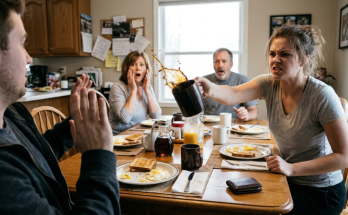

The fork fell before anyone understood which lie had finally broken at my Christmas Eve table.
It struck the edge of Rebecca’s plate with a clean little sound, too sharp for a room that had been full of warm mole, cinnamon coffee, and the soft hum of an old radio playing holiday songs from the kitchen windowsill. My son Tadeo froze with his own fork halfway to his mouth. Across from him, his wife turned the color of flour, all the brightness draining from her face at once.
I had only meant to say thank you.
That was all.
The mole had gone around the table once. The pork was tender enough, though I had stretched the sauce thinner than I liked because pecans had gotten expensive and I was down to the last small envelope of dried chiles in the pantry. I had set out my good embroidered tablecloth, the one my sister brought from El Paso years ago, and placed the little ceramic Virgin on the sideboard beside a sprig of plastic poinsettias I reused every December.
It was not a fancy dinner, but it was mine.
So when Tadeo smiled after taking his first bite, I reached across the table and touched his hand.
“Thank you, mijo,” I said. “For the hundred dollars. It helped me buy everything for tonight.”
His smile disappeared so quickly it seemed to fold inward.
“What hundred dollars?”
I thought he had not heard me.
“The deposit,” I said, my hand still resting on the tablecloth. “Last week. The one you always send.”
He stared at me.
“Mamá,” he said slowly, “I didn’t send you a hundred dollars.”
The room changed.
Not loudly. Not all at once. It was more like the air tightened around the four corners of the table. The old heater clicked in the hallway. Outside, wind moved through the dry bougainvillea against the porch railing. The little spoon in Rebecca’s coffee trembled once, though her hand was no longer touching it.
Tadeo reached for his phone.
“I sent you a thousand every month,” he said, his voice careful now. “Since May. And last week I sent five thousand extra for the roof and the plumbing.”
My hands went cold on the tablecloth.
“Five thousand?”
His eyes moved from me to Rebecca.
“Yes,” he said. “Five thousand. For the roof. For the pipes. For everything you said needed fixing.”
I looked down at the plate in front of me.
At the pork I had seasoned with the last of what I had.
At the cloth napkins I had washed by hand because the machine had been making a grinding noise for two months.
At the glass of water I had poured for Rebecca in the good tumbler without a chip.
“No, hijo,” I said. “I never received that.”
Tadeo was already typing. The glow of his phone lit the lower half of his face, making him look younger and older at the same time. He scrolled with his thumb, faster at first, then slower, as if the screen had turned dangerous in his hand.
“Here,” he said. “November. One thousand. October. One thousand. September. One thousand.”
He swallowed.
“And last Thursday. Five thousand.”
He turned the phone toward me.
The numbers were there, bright and undeniable.
But the destination account was not mine.
I had never been good with phones. I could call, answer, take pictures of my rosebush when it bloomed, and send Tadeo little voice messages when typing felt like too much. Online banking had always made me nervous. Too many buttons. Too many passwords. Too much trust placed into glowing rectangles that could erase a person’s peace with one wrong tap.
So when Rebecca offered to “help” set things up, I thanked her.
That was the worst part. I thanked her.
She had married Tadeo three years earlier in a garden venue outside Austin, all white chairs and eucalyptus garlands and tiny candles in glass jars. She was beautiful in a crisp, organized way, the kind of woman who carried a planner and remembered everyone’s coffee order. She called me Mom for the first six months. She told me she wanted to make Tadeo’s life easier. She spoke about budgets, investments, and “building a future” with the calm confidence of someone who had never patched a leaking kitchen pipe with duct tape at midnight.
At first, I believed she was good for him.
Tadeo was my only child. His father, Gabriel, passed when Tadeo was seventeen, leaving me with a house, a son about to graduate, and a mortgage payment that arrived every month like a test. I cleaned offices at night, watched two neighbor kids after school, sold tamales from my porch every December, and told myself tired was not the same as finished. Tadeo saw more than I wanted him to see. He grew up fast, too fast, and when he got his first real job with a logistics company, he promised me things would be easier.
“I’m going to take care of the house,” he said.
I told him no.
He did it anyway.
Or I thought he did.
Every month, a hundred dollars appeared in my checking account with a note that said From Tadeo. Enough for groceries if I stretched it. Enough for medicine if I skipped meat that week. Enough to keep me from asking questions I did not want to ask because mothers are proud in quiet, foolish ways.
Now he was staring at a bank screen that said the money had gone somewhere else.
His jaw tightened.
“Rebecca,” he said.
She flinched at his tone.
For a moment, she did not look like the smooth, composed woman who had walked into my house an hour earlier carrying a bakery box and a purse that cost more than my oven. She looked like someone caught in a doorway she had planned to close behind her.
“What is this account?” Tadeo asked.
Rebecca reached for her water glass, lifted it halfway, then set it down without drinking.
“It’s not what you think.”
Those words rarely introduce anything good.
Tadeo turned the phone fully toward her.
“The destination name says Rebecca Solis.”
Solis.
Her maiden name.
The name she used for her boutique consulting invoices and side accounts and whatever else she managed with that bright little laptop she always carried.
I sat very still.
Not because I felt calm.
Because old women learn, after enough disappointment, that if you move too quickly, your body may tell the truth before your mouth is ready.
Rebecca pressed her lips together.
“I was managing it,” she said.
Tadeo blinked once.
“Managing my mother’s money.”
“Our money,” she said too quickly. “Household planning, Tadeo. You asked me to help her.”
“I asked you to help her set up online access.”
“And I did.”
“You opened an account in your name.”
“It was easier that way.”
He stared at her as if she had spoken a language he did not recognize.
The little radio in the kitchen switched to an old ranchera. I stood to turn it off, but my knees did not cooperate. So the song kept playing softly beneath the silence, a man singing about love and distance while my son’s marriage sat unraveling between the rice and the beans.
“You told me she was fine,” Tadeo said.
“She said she was fine,” Rebecca answered, looking at me for the first time that night.
Not with guilt.
With calculation.
“She always says she’s fine.”
My chest tightened.
That part was true, and it was the cruelest tool she could have picked up.
I did say I was fine.
When the roof leaked over the hallway, I put a mixing bowl beneath the drip and told Tadeo it was only a little spot. When the water heater went out, I heated water on the stove and told him the plumber was coming soon. When the electric bill ran higher after the cold snap, I borrowed from Mrs. Chela next door and told my son I had already handled it.
I did not lie because I wanted distance.
I lied because I did not want my child to hear need in my voice.
Rebecca knew that.
She had built a bridge from my pride to her convenience and walked across it every month.
Tadeo lowered the phone to the table. His fingers remained wrapped around it so tightly the knuckles showed pale.
“How much did you send her?”
Rebecca looked away.
“Rebecca.”
“I made sure she had enough.”
“How much?”
She exhaled, annoyed now, because shame was beginning to turn into defense.
“A hundred a month.”
The words landed harder than a shout.
Tadeo slowly pushed his chair back. The legs scraped against the worn kitchen floor, the same floor I had been meaning to replace since the corner by the sink started softening after last year’s rains.
“A hundred,” he repeated.
“She doesn’t need a thousand dollars a month,” Rebecca said. “She lives alone. She barely goes anywhere. You were sending way too much, and honestly, Tadeo, we’ve been trying to save for a bigger place.”
He looked at her then, really looked, and I saw something in his face change beyond anger. It was recognition. The painful kind. The kind that does not ask what happened because it has already begun to understand how long it has been happening.
“You made my mother live short,” he said quietly, “so you could feel ahead.”
Rebecca’s mouth opened, then closed.
She had no answer that could survive the room.
I wanted to say something. I wanted to smooth it over, the way mothers do when the plates are still full and the night is supposed to be sacred. I wanted to tell Tadeo not to ruin Christmas Eve, not to let money become a knife, not to look at his wife with that kind of final distance in his eyes.
But my hands stayed folded over the tablecloth.
They had patches of bleach on them from scrubbing the bathroom floor that morning.
Tadeo saw them.
His eyes dropped to my hands, then moved around the kitchen with a new kind of attention. He saw the tape around the cabinet handle. The burner on the stove that only worked if I pressed the knob twice and whispered a prayer to Saint Jude, half joking, half not. The ceiling stain I had tried to cover with a little paint left over from the shed. The thin cardigan hanging over the chair because the heater took too long to warm the back rooms.
I watched the last year rearrange itself in his mind.
Birthdays I said I was too tired to host.
Doctor appointments I rescheduled.
The same brown sweater in every photo.
The porch step that dipped when he arrived, that he promised to fix “next time.”
He had sent money to prevent all of that.
And I had lived as if he had not.
A soft knock came at the door.
No one moved.
The knock came again, gentler this time.
I knew who it was before I opened my mouth.
“Come in, Chela,” I called, though my voice sounded far away.
Mrs. Chela Hernández opened the door with her hip, carrying a tres leches cake covered in foil. She wore her red Christmas sweater with flour on both sleeves and a worry line between her eyebrows that deepened the second she saw us. She looked at Rebecca standing rigid near the sideboard, at Tadeo holding his phone, then at me.
“I can come back,” she said.
“No,” Tadeo said, too quickly. Then softer, “Please stay, Mrs. Chela.”
She hesitated.
He stepped toward her, phone still in his hand.
“Has my mother asked you for help?”
My stomach turned.
“Tadeo,” I said.
He did not look at me.
Mrs. Chela’s eyes filled with the kind of pity I had spent years trying to avoid.
“She asked for a little last month,” she said. “For medicine. She said the pension deposit was late.”
Tadeo closed his eyes.
“And last winter,” Mrs. Chela added, voice lowering, “I covered the light bill once. She said she would pay me back after New Year’s.”
Rebecca made a small sound, almost a laugh, but brittle.
“This is getting ridiculous.”
Tadeo opened his eyes.
No one at that table mistook his calm for softness anymore.
He looked at Rebecca.
“Give me the keys.”
Her brows drew together. “What?”
“To the lockbox. The account paperwork. The car. Everything connected to the house money.”
“You’re not thinking clearly.”
“I am thinking clearly for the first time tonight.”
“Tadeo, don’t do this in front of people.”
He glanced around the room.
“My mother borrowed money for medicine while I was sending enough to fix her roof.”
Rebecca’s eyes hardened.
“She didn’t ask you because she likes acting helpless.”
The room went completely still.
Even Mrs. Chela stopped breathing for a second.
Tadeo stepped to the front door and opened it.
Cold air slipped inside, carrying the smell of wet pavement and winter dirt. The Christmas lights from the porch reflected faintly in the glass of the picture frame beside the door, the one that held Gabriel’s photograph from our twenty-fifth anniversary. In the picture, my husband had his arm around me and a grin like he had just gotten away with something sweet.
“This night is over,” Tadeo said.
Rebecca stared at him.
“You’re asking me to leave on Christmas Eve?”
He did not raise his voice.
“You touched what was meant for my mother. You let her struggle while telling me everything was handled. There is no conversation that fixes that tonight.”
She looked at me then.
Maybe she expected me to save her. Maybe she thought I would choose peace again and call it forgiveness. But I had lived under the weight of too much borrowed peace. I had made soup from packets when my son believed I had a full pantry. I had smiled into the phone while rain found the hallway wall. I had protected everyone’s feelings until my own life became something people stepped around.
So I said nothing.
Rebecca grabbed her coat from the hook. Her hands shook as she pushed her arms into the sleeves.
“This isn’t over,” she said.
Tadeo held the door.
“No,” he replied. “It’s finally begun.”
She left without the cake, without her purse at first, then came back for it with her eyes lowered and her mouth pressed tight. The door closed behind her harder than necessary. The little framed Virgin on the wall trembled but did not fall.
For a while, none of us spoke.
Mrs. Chela set the tres leches cake on the counter with both hands, as if placing something fragile in a room that had become unfamiliar.
“I’ll go,” she whispered.
I reached for her wrist.
“Stay for coffee.”
Her eyes softened.
So she stayed.
The three of us sat at the table while the mole cooled and the coffee went lukewarm. Tadeo did not eat. He kept scrolling through his phone, opening statements, checking transfer dates, comparing account numbers. Every month was there. May through December. Perfectly timed. Perfectly misdirected. Each one meant to protect me, each one arriving somewhere else.
“I should have checked,” he said.
I looked at my son.
His face looked younger in grief. Not broken, but stripped of the confidence adulthood gives men when they think love can be outsourced to a monthly deposit.
“I should have told you,” I answered.
“No.”
“Yes,” I said. “I should have.”
He shook his head.
“Mamá, you didn’t know.”
“I knew enough to know I needed help.”
His eyes filled, but he held the tears back the way Gabriel used to, by looking at the ceiling and pretending the light was bothering him.
“Why didn’t you say something?”
I could have given him a complicated answer. Pride. Habit. Fear of becoming a burden. The strange loneliness of aging in a house your child thinks is being cared for because someone tells him it is. But the truth was simpler and more painful.
“Because mothers like to believe their children remember without being reminded.”
That was the sentence that undid him.
He put his hand over mine on the table, carefully, as if my fingers might break. I let him. For the first time in months, I did not pretend my hand was warm.
The next morning smelled like wet earth and reheated coffee.
I woke early because old routines do not know a family has changed. I turned on the stove, pressed the stubborn knob twice, and lit the burner on the third try. The kitchen was quiet. No Rebecca’s voice bouncing off the walls. No forced brightness. No conversation shaped around what would keep everyone comfortable.
Tadeo had slept on the couch.
He came into the kitchen with his laptop tucked under one arm and two coffees from the gas station on South Flores in the other hand.
“I couldn’t sleep,” he said.
“I know.”
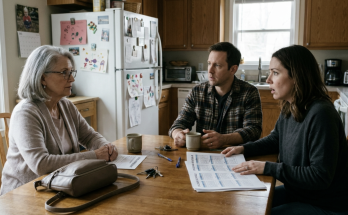
He set the coffees down and opened the laptop at the table. The screen lit up with bank pages, password prompts, account names, transfer histories. He had already spoken to the bank’s fraud department, though he used softer words when he told me. A review. A correction. A formal account change.
“I can move it all today,” he said. “Everything she touched. Every dollar that was meant for you.”
I watched his fingers hover over the keys.
Then I put my hand on his wrist.
“No.”
He looked up, confused.
“Mamá, it’s yours.”
“I know.”
“Then let me fix it.”
I smiled a little.
That was my boy. Still looking for the wrench. The receipt. The number to call. The way to make the damage smaller by moving quickly.
“I don’t need it all at once,” I said. “I need the roof before the spring rains. I need the floor by the sink fixed. And maybe an oven that turns on without negotiations.”
He let out a short laugh that was almost a sob.
“It’s your money.”
“Yes,” I said. “So I get to decide what healing looks like.”
He closed the laptop halfway.
The room felt different after that.
Not repaired.
But open.
Two weeks later, the roofers arrived at seven in the morning with tool belts, coffee cups, and boots that left neat mud prints along the walkway. The sound of work filled the house: ladders, hammers, men calling measurements to one another, shingles sliding into place. For years, every rain had made me listen for the first drip. That day, I stood on the porch in my old sweater and listened to a problem leaving my life one nail at a time.
Tadeo stood beside me, hands in his jacket pockets.
“You should have had this last summer,” he said.
“Yes.”
He looked at me, surprised I did not soften it.
I was done protecting him from every consequence of not seeing.
The plumbing came next. Then the soft kitchen floor. Then a heater that hummed with a dignity so gentle I almost cried the first night the back bedroom stayed warm without me stuffing towels under the door. Tadeo paid the contractors directly from the corrected account, but every receipt came to my email and my mailbox. My name. My decisions. My house.
He came every other Sunday after that.
At first, he came with guilt in his shoulders and a list in his pocket. A loose hinge. A porch rail. A flickering light in the laundry room. He wanted repairs because repairs had edges. You could touch them. Finish them. Stand back and say there, that part is better now.
But grief between a mother and son is not like a loose hinge.
It takes longer.
So sometimes I let him fix things. Sometimes I made him sit.
We drank coffee on the porch while kids rode bikes down the block and Mrs. Chela watered the stubborn little pots by her steps. He asked about my prescriptions. I told him. He asked if I needed groceries. I said yes when I did. That small yes felt heavier than any apology.
One Sunday, he brought mole in a pot and announced that he had followed my recipe.
He had not.
It was too salty, the potatoes had nearly disappeared, and the meat had gone dry at the edges. I ate every bite like it was gold. Not because it was good, but because he stayed at the table while I ate it. He did not check his phone. He did not rush through the meal. He asked where I kept the dish towels and dried the plates without waiting for applause.
We did not talk about Rebecca.
Not at first.
There are names that need to cool before they can be held.
What I knew was that she had gone to her sister’s apartment in Houston. Tadeo spoke to a counselor, then a lawyer, then the bank again. He did not give me every detail, and I did not ask for every bruise in his marriage. Some lessons belong to the person who paid for them. But once, while changing the filter in the new heater, he said quietly, “I keep thinking about how she always said she was handling things.”
I handed him the screwdriver.
“Handling is not the same as caring.”
He nodded, and that was enough.
The envelope came on a Thursday.
Plain white. No decoration. Nothing that warned me my life was about to feel more like mine.
I opened it by the window where the afternoon sun fell across my repaired floor. Inside was a confirmation letter from the bank.
Account holder updated.
Direct deposits confirmed.
No secondary authorization.
My name appeared three times.
Elena Morales.
Not through anyone else. Not managed. Not redirected. Not made small by somebody’s opinion of what I needed.
Mine.
I read the letter once. Then again. Then a third time because certain truths have to be witnessed repeatedly before they can settle in the body.
I folded it carefully and placed it in the drawer beside Gabriel’s wedding ring, the one Tadeo used to spin on the table when he was little and pretend it was a spaceship. I stood there with my hand on the drawer pull for a long moment, feeling the years behind me and the quiet ahead of me.
When neighbors asked about Rebecca, I did not tell the story.
Not because I was protecting her.
Because not every truth needs to be turned into neighborhood weather.
“She went back to Houston,” I said.
That was enough.
Spring arrived with light on the new porch boards and a radio I bought at the flea market, the kind with a round dial that takes its time finding the station. I named my little plant Maggie because Mrs. Chela said old women should not name plants and I said that was exactly why I would. I bought a new quilt, not expensive, soft blue and cream, and draped it over my chair by the window where Tadeo had moved it one afternoon.
“Better light here,” he said.
He was right.
The house no longer groaned in the same places. Maybe because the wood had been repaired. Maybe because I was breathing differently. Maybe homes remember when people stop treating them like burdens.
One evening, Tadeo arrived with fresh bolillos and a bag of oranges.
We ate quietly at the kitchen table. I made the mole this time. He took one bite, closed his eyes, and said, “Okay. I deserved that.”
I laughed.
A real laugh.
It startled both of us.
After dinner, he washed the dishes while I dried. He moved carefully, as if still afraid of breaking something between us. Before he left, he paused in the front doorway with his keys in his hand.
The porch light cast a warm circle around him. Behind him, the neighborhood was settling into evening: a dog barking somewhere, a car passing slowly, Mrs. Chela’s wind chime tapping in the breeze.
Tadeo looked at me for a long time.
Then he leaned down and kissed my forehead.
“I see you now, Mamá,” he said.
No speech could have done more.
I nodded because if I spoke too quickly, everything inside me might spill out at once.
After he drove away, I closed the door gently. No anger in my chest. No knot in my throat. No old fear that asking for help would cost me my dignity.
The heater hummed softly.
The radio murmured from the kitchen.
On the stove, there was enough mole left for tomorrow.
And for the first time in years, I sat at my table with a full plate in front of me, a full name on my account, and no one in the room looking past me.