
“Then you’ll have to accept the consequences,” my mother said, and the calm in her voice hurt more than if she had shouted.
For a moment, I stood in my apartment kitchen with my phone pressed to my ear, watching the blue numbers on the microwave clock blink 9:17 p.m., as if the whole room had suddenly become too bright and too still. On the counter in front of me were ivory place cards, half-finished ribbon bundles, and a printed seating chart with my parents’ names near the front, exactly where I had imagined them since I was a little girl. I looked at those names while my mother waited for me to understand what she meant.
“What consequences?” I asked.
She exhaled through her nose, not tired, not sad, just final.
“Your father and I won’t be attending the wedding.”
I remember gripping the edge of the counter so hard the corner of the laminate pressed a pale line into my palm. Outside the window, traffic moved along the wet street below, red taillights dragging through the rain like streaks of paint. Somewhere in the building, a neighbor’s dog barked once and then went quiet. The world continued with its ordinary little sounds, but inside me, something fell silent.
“You’re serious,” I said.
“Completely.”
“Because I won’t move my wedding?”
“Because you are choosing yourself before your family,” she replied.
There it was. The sentence my family had been building toward for weeks, maybe years, polished smooth enough to sound like principle. I could hear my father’s voice inside it. I could hear my sister Vanessa’s wounded sigh. I could hear every holiday dinner where I had been expected to make room, step aside, understand, adjust, smile.
“My wedding is in four weeks,” I said. “Mom, we sent the invitations. The venue is paid for. The photographer, the florist, the caterer—”
“Those are details, Melissa.”
Details.
A year of saving, planning, calling vendors during lunch breaks, comparing prices at midnight, choosing flowers that would not swallow our budget, printing menus on my own because it mattered to me that the tables looked beautiful without pretending we were richer than we were. A year of Daniel and me putting off vacations, skipping new furniture, eating too many frozen dinners because the wedding fund came first. Details.
“This is my wedding,” I whispered.
“And your sister needs our support.”
I almost laughed, but my throat closed around it. Vanessa’s support had become the sun around which every person in my family was expected to orbit. Her dreams were always emergencies. Her feelings were always weather systems everyone else had to prepare for. If Vanessa was disappointed, the whole family rearranged itself until she could smile again.
I was thirty-one years old, standing in my kitchen with a seating chart on the counter, and I felt fourteen.
“Mom,” I said slowly, “Vanessa booked a wellness retreat in Bali on the same weekend as my wedding. She chose those dates after she knew mine.”
“She says the retreat schedule is limited.”
“The retreat is a vacation.”
“It’s important to her.”
“So is getting married important to me.”
There was a pause. Not a soft pause. Not the kind that makes space for understanding. It was the pause of someone waiting for a child to stop arguing.
“Then you’ve made your choice,” my mother said.
Before I could answer, the line went dead.
I stood there for a long time after she hung up. My phone screen dimmed, then went black. The apartment smelled faintly of printer ink and coffee. Daniel had gone downstairs to move his car before street cleaning, and the quiet felt too wide without him in it. I stared at my parents’ names on the seating chart until the letters blurred.
Robert Hale. Patricia Hale.
Two names I had written carefully in the first row.
Two seats they had decided to leave empty.
At first, when my family asked me to change the date, I honestly thought it was a joke. Not a funny joke, exactly, but the kind of absurd request relatives make before realizing how ridiculous they sound. My fiancé, Daniel Mercer, and I had been engaged for sixteen months. We lived in a modest one-bedroom apartment outside Portland, in a neighborhood where people walked their dogs in rain jackets and every coffee shop had at least one man typing a screenplay in the corner. We were not flashy people. Daniel worked in logistics for a regional grocery chain, and I managed client accounts for a dental software company. Our life was practical, steady, warm in the ways that mattered.
We had saved for years because neither of us wanted to begin married life buried under bills. We wanted a wedding that felt beautiful but honest. No ice sculpture. No champagne tower. No orchestra. Just a bright July ceremony in a renovated garden hall with big windows, pale wood floors, wildflower arrangements, string lights over the patio, and enough food that no one left hungry. We chose rosemary chicken and herb potatoes because Daniel’s grandmother loved rosemary. We chose lemon cake because I hated fondant. We chose July 18 because it was the date the venue had open, because the weather would likely be kind, and because it gave our out-of-town guests enough time to plan.
By the time Vanessa made her announcement, everything had been decided.
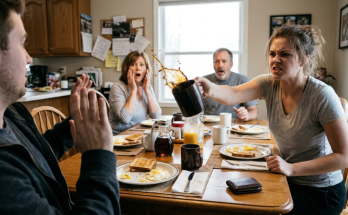
The dinner where it began took place at my parents’ house on a Sunday evening in early spring. My mother had made pot roast because my father liked tradition and believed Sunday dinner should smell like onions, gravy, and something that had been cooking for four hours. The dining room looked the same as it had through most of my childhood: dark cherry table, glass-front cabinet, framed family photos arranged with almost mathematical care. In nearly every photo, Vanessa was in the center.
That was not an exaggeration. There she was at eight, missing front tooth, holding a trophy from a dance recital. There she was at sixteen, in a white dress before prom, my parents standing on either side of her like guards at a museum exhibit. There she was at twenty-two, graduating from a private college my parents helped pay for, smiling under a blue sky. I was in some of the pictures too, usually at the edge, usually leaning in.
Vanessa was four years younger than me and had always been the kind of person adults described as magnetic. She had glossy dark hair, a bright laugh, and an effortless talent for making her problems sound poetic. If she quit a job, it was because her spirit needed freedom. If she ended a relationship, it was because she had outgrown someone’s energy. If she spent too much money, she was investing in her future self. My parents never seemed to hear how carefully she turned ordinary choices into noble ones.
That night, she arrived twenty minutes late wearing wide-leg linen pants, gold hoops, and a white sweater that looked too expensive to be casual. She kissed my mother on both cheeks, hugged my father around the neck, then dropped into her chair with the glowing expression of someone waiting for applause.
“I need everyone to keep July open,” she said, reaching for her water glass as if she were about to make a toast. “I finally got into the Bali retreat I told you about.”
My mother nearly clapped. “Oh, honey, that’s wonderful.”
My father leaned back with a proud smile. “That’s the one with the meditation coach?”
“And nutrition workshops,” Vanessa said. “And ocean healing sessions. It’s going to be transformative.”
Daniel, sitting beside me, lowered his eyes to his plate. He was polite enough not to say anything, but I felt his knee touch mine under the table, a tiny private signal. We had heard about Vanessa’s retreat phase for months. Before that it had been pottery. Before that, cold-water therapy. Before that, a six-week business course she never finished but still referenced as if it had made her an entrepreneur.
I did not mind. People were allowed to change interests. People were allowed to chase meaning, even in places with infinity pools. I only smiled and said, “That sounds exciting.”
Vanessa beamed, then tilted her head. “Wait, Melissa, what day is your wedding again?”
The table changed.
It was subtle, but I felt it. My mother’s fork paused halfway to her plate. My father stopped chewing. Daniel’s knee pressed a little more firmly against mine.
“July 18,” I said.
Vanessa blinked. Her smile thinned. “That’s the same weekend.”
“Is it?”
“I’ll be in Bali.”
I waited for her to say she was sorry. I waited for her to say she had forgotten, or that maybe she would see if her flight could change, or that she would celebrate with us before she left. Instead she looked at me as if I had placed my wedding in the path of her destiny.
“You’ll have to move it,” she said.
I let out a small laugh because my brain needed her to be kidding.
“I can’t move an entire wedding because you booked a retreat.”
“It’s not a retreat like that,” she said quickly. “It’s not just some trip. It’s spiritual work.”
“Call it whatever you want,” I replied, keeping my voice light because I did not want to start a fight over pot roast. “The date is set.”
My mother put her fork down.
“Melissa,” she said, using the careful tone she reserved for moments when she believed I was being difficult. “Your sister is asking for understanding.”
“Understanding?”
“Yes. She has been planning this for months.”
I stared at her.
“I’ve been planning my wedding for over a year.”
My father wiped his mouth with a napkin. “A wedding date can be changed.”
Daniel’s eyebrows rose. “Not easily, sir.”
My father turned to him as if he had forgotten Daniel was there. He liked Daniel, generally, the way people like someone who is useful and does not challenge them. “Nothing is impossible when family is involved.”
“The venue has been booked since last August,” Daniel said. “The deposits are paid. The invitations are out.”
“The money isn’t the most important thing,” my father said.
That sentence landed with a weight I could not explain to anyone who had not grown up in my family. Money was never the most important thing when I was the one losing it. When Vanessa needed help covering rent after leaving a job she called “emotionally misaligned,” money became compassion. When she needed a last-minute flight to a friend’s birthday in Miami because she was “lonely,” money became support. When I asked my parents if they could contribute to the wedding as they had once promised, money became complicated.
Daniel’s hand found mine under the table.
“I’m not moving it,” I said.
The room went cold.
Vanessa leaned back, hurt blooming across her face with astonishing speed. “Wow.”
“Vanessa—”
“No, it’s fine,” she said, though her voice trembled in that practiced way that always made my mother turn toward her. “I just thought you’d want your sister there.”
“I do want you there.”
“Clearly not enough.”
My mother reached for Vanessa’s hand. My father’s jaw tightened. Daniel looked down at his plate, not because he was weak, but because he knew if he spoke again, the dinner would split open completely.
I tried to explain the contracts. I tried to explain the timing. I tried to explain that this was not about choosing a retreat over a wedding or a wedding over a retreat. It was about the fact that the wedding existed first. It had been circled on calendars, printed on invitations, spoken about at Thanksgiving, Christmas, birthdays. Vanessa had known.
But in my family, facts often became rude when they did not favor Vanessa.
By dessert, my mother had grown quiet. My father spoke mostly to Daniel about highway construction. Vanessa answered in short, wounded phrases. When Daniel and I left, my mother hugged me with stiff arms and whispered, “I hope you think about what really matters.”
In the car, I sat with my hands folded over my purse and watched the porch light shrink behind us.
Daniel drove three blocks before he said, “That was insane.”
I laughed once, but it came out wrong. “I know.”
“No, Melissa. I mean actually insane.”
I pressed my forehead against the cool window. “They’ll calm down.”
He did not answer right away. Rain tapped softly on the windshield. The wipers moved back and forth with a tired little squeak.
“I hope so,” he said.
They did not calm down.
Over the next few weeks, my family turned my wedding date into a moral referendum. My mother called first, always beginning with ordinary questions about work or groceries before circling back to Vanessa. She would say things like, “I just don’t understand why this has to be so hard,” or, “Your sister is very hurt,” or, “Sometimes marriage means learning to compromise before you even get there.”
My father preferred shorter conversations. He called during his commute, his Bluetooth crackling as if even technology wanted distance from him, and said, “You’re making this bigger than it needs to be.”
“I’m not the one asking someone to move a wedding,” I told him.
“You’re being rigid.”
“I’m being realistic.”
“You’re being proud.”
That word began appearing everywhere.
Proud. Selfish. Stubborn. Unkind.
Vanessa posted vague quotes on her social media about people who only supported you when your dreams did not inconvenience them. She uploaded a photo of a sunset and wrote, “Sometimes the people closest to you reveal the most.” My cousins liked it. One aunt commented with a heart. Another wrote, “Protect your peace, beautiful girl.”
I stared at the post during my lunch break with a plastic fork in my hand and a salad I no longer wanted. Around me, coworkers talked about summer vacations and softball leagues. Someone at the next table laughed too loudly at a meme. My phone felt hot in my palm.
Daniel told me to mute her.
“I can’t,” I said. “If I mute her, I won’t know what she’s saying.”
“That might be the point.”
But I kept looking, the way people press a bruise just to prove it still hurts.
Soon the pressure spread. My Aunt Linda called and said she hoped I wasn’t letting wedding stress turn me into someone I wasn’t. My cousin Beth texted, “Couldn’t you just do a small ceremony on the eighteenth and the big party later?” A family friend I had known since childhood sent a long message about how sisters were more important than parties. Not one of them asked what moving the wedding would cost. Not one of them asked how Daniel felt. Not one of them asked why Vanessa had booked travel over a date she already knew.
They had all received the version of the story where I was choosing a venue over family.
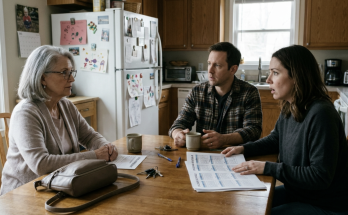
One evening, Daniel and I sat at our kitchen table with a folder full of contracts spread between us. The florist agreement. The catering invoice. The venue balance. The photographer’s schedule. The DJ’s confirmation. Every page carried a date, a signature, a number. Proof that our wedding was not an idea we could fold up and put in a drawer.
Daniel had printed everything because he believed paper made people behave more reasonably.
“I’ll talk to them,” he said.
I looked up. “No.”
“Melissa.”
“No. It’ll make it worse.”
“How much worse can it get?”
I almost answered, but I saw the concern in his face and stopped. Daniel had grown up in a family that argued loudly and forgave quickly. His mother could disagree with him about politics, pie recipes, and car insurance in the same afternoon, then send him home with leftovers and kiss his cheek. He did not understand the soft machinery of my family, where anger moved through silence and affection was withheld like a thermostat turned down degree by degree.
“They’ll think I sent you,” I said.
“Maybe they should know someone is standing with you.”
I reached across the table and touched his hand. “You already are.”
The next night, during a video call my mother insisted would “clear the air,” Daniel finally spoke. My parents sat together on their beige living room couch, my father with his arms crossed, my mother angled toward the camera with a tissue in her hand though she had not been crying. Vanessa joined from her apartment, her background carefully arranged with a plant, a candle, and a framed print that said BREATHE.
For twenty minutes, they circled the same point.
Move the date.
Move the date.
Move the date.
Finally, Daniel leaned into the frame.
“Do you understand how unreasonable this is?” he asked, his voice level. “We’re talking about our wedding.”
My father replied without missing a beat. “And we’re talking about family.”
“That’s exactly why you should support her,” Daniel said.
Vanessa’s eyes widened as if he had thrown a glass of water. My mother’s mouth pressed into a line.
“This doesn’t concern you in the same way,” my father said.
Daniel’s face changed.
“I’m the groom,” he said. “It concerns me.”
The call ended less than a minute later.
After that, my mother stopped answering my casual texts. My father canceled the family barbecue planned for Memorial Day, claiming he had too much yard work, though Vanessa posted pictures from their patio that same afternoon. Vanessa’s posts grew sharper. She never used my name, but she did not need to.
“Some people mistake control for love,” she wrote.
That one nearly made me throw my phone across the room.
Because it was almost true, just pointed in the wrong direction.
By mid-June, I had begun waking at three in the morning with my chest tight and my mind racing through impossible alternatives. Could we move the ceremony but keep the reception? Could we hold a second dinner later? Could we somehow make everyone happy without losing thousands of dollars and the little piece of myself I had finally claimed?
Each time, I ended up opening the wedding binder. It was white with gold corners, a gift from Clara, my best friend and maid of honor. Inside were tabs labeled Venue, Guests, Payments, Vows, Music, Flowers. It was ridiculous how much comfort that binder gave me. There, in clean plastic sleeves, was reality. Receipts. Emails. Signed agreements. A timeline. The world my family kept trying to blur into a matter of attitude became clear again under the lamp on my desk.
I was not being cruel.
I was not being unreasonable.
I was a woman trying to get married on the date she had chosen before her sister chose to be elsewhere.
A month before the wedding, my mother made the call that changed everything.
“Is this your final decision?” she asked.
I was folding laundry on the couch, matching Daniel’s socks from a pile that seemed to reproduce in the dryer. The television was on mute. A commercial for patio furniture flashed silently across the screen.
“Yes,” I said. “It is.”
“Then you’ll have to accept the consequences.”
Those consequences began immediately.
First, my parents withdrew the small contribution they had promised for the reception. They had never offered an extravagant amount, but it mattered. It covered the cake, the shuttle from the hotel, and part of the bar package. My father sent a short email to Daniel and me with the subject line Financial Update. The body was only four sentences long. Due to recent circumstances, we can no longer participate in funding an event that disregards family unity. We trust you will make the necessary adjustments. We hope this becomes an opportunity for reflection. Dad.
I read it twice, then handed the laptop to Daniel.
He did not say anything for a full minute.
Then he stood, walked to the sink, poured a glass of water, drank half of it, and said, “Okay.”
“Okay?”
“We’ll cover it.”
“How?”
“We’ll make it work.”
His calm steadied me and frightened me at the same time. We did make it work. We cut the late-night snack table. We changed the bar package. Daniel took two extra weekend shifts helping coordinate inventory for a warehouse transition. I sold the designer shoes I had bought on clearance and convinced myself the simple heels from Nordstrom Rack were more comfortable anyway.
Then vendors began calling with strange questions.
The florist called first, her voice careful. “Melissa, I just wanted to confirm you and Daniel still want the July eighteenth delivery.”
“Of course,” I said. “Why?”
“Well, I received a message suggesting there might be a date change.”
My stomach dipped.
“From who?”
She hesitated. “A family member.”
The caterer called two days later. Then the shuttle company. Then the venue coordinator, a kind woman named Erin who had handled nervous brides for fifteen years and could hear panic through email punctuation.
“I’m sure it’s nothing,” Erin said gently, “but someone called asking about cancellation policies and whether deposits could be transferred.”
I sat in my car outside Target, the engine off, a roll of ribbon and a pack of thank-you cards on the passenger seat. The afternoon sun beat through the windshield. A cart rattled across the parking lot.
“Who called?” I asked.
“I shouldn’t give names without knowing the situation,” Erin said. “But I can tell you they identified themselves as immediate family.”
I closed my eyes.
That night, Daniel created a folder on his laptop called Wedding Documentation. Into it went screenshots, emails, vendor notes, payment receipts, call summaries. He was not dramatic about it. He did not make speeches. He simply started preserving the truth.
“I don’t want this to become a bigger thing,” I said, watching him save another PDF.
“It already is a bigger thing,” he replied. “I’m just making sure they don’t get to rewrite it.”
I did not know then how important that folder would become.
Two weeks before the wedding, I learned my parents had persuaded other relatives not to attend. Aunt Linda canceled first, claiming a “prior commitment” that had not existed when she RSVP’d yes. Cousin Beth followed. Then two family friends. Then my father’s sister, who left a voicemail saying, “We think it’s best not to reward this kind of division.”
Reward.
As if attending my wedding were a treat I had failed to earn.
The guest list changed day by day. Empty seats appeared like bruises on the seating chart. I would erase a name, shift a table, move a cousin from one side to another, then sit back and wonder how a celebration could feel so much like a test.
Clara came over three nights before the wedding with Thai takeout and a bottle of sparkling cider because she knew I loved bubbles but hated how wine made me sleepy. She found me on the floor, surrounded by place cards.
“Nope,” she said, setting the food down. “We are not letting Patricia Hale ruin pad see ew.”
I laughed for the first time in days.
Clara had known me since freshman year of college, when she found me crying in a dorm laundry room because someone had moved my wet clothes onto a dusty folding table. She had curly red hair, blunt opinions, and the rare ability to make kindness feel like a command.
She sat cross-legged beside me and picked up a place card.
“Who’s this?”
“My cousin Aaron.”
“Is he coming?”
“No.”
She tossed it into a paper grocery bag labeled NOT ATTENDING.
“And this?”
“Aunt Linda.”
“Goodbye, Linda.”
Into the bag.
One by one, we removed the names of people who had decided my compliance mattered more than my joy. Clara did not make it sad. She made it practical. By midnight, the seating chart looked cleaner. Smaller, but cleaner.
Daniel came home near one in the morning, exhausted, tie loosened, carrying a grocery bag with mint chocolate chip ice cream because he said weddings required emergency dairy. He stood in the doorway and looked at the two of us on the floor.
“Should I ask?”
“We’re editing,” Clara said.
Daniel’s eyes softened when he saw the bag of discarded place cards. “How are you doing?”
I looked at the new chart. His family filled three tables. Our friends filled six. My coworkers, neighbors, Clara’s parents, Daniel’s grandmother, people who had chosen to come without demanding I shrink first. The front row on my side still had empty spaces where my parents should have been, but the room around those spaces no longer looked like absence. It looked like proof.
“I’m getting there,” I said.
The morning of my wedding arrived bright and humid, with the kind of high July sky that promises heat before breakfast. I woke after maybe three hours of sleep to the sound of my phone buzzing against the nightstand. For one foolish second, my heart leapt. I thought it might be my mother. I thought maybe she had changed her mind in the quiet of the morning, maybe she would say, We’re coming, honey. We love you. We got lost in our own pride, and we’re sorry.
But the messages were from relatives.
So sorry, unable to make it today.
Wishing you well from afar.
Hope today brings reflection.
One simply said, Take care.
I sat up in bed and held the phone in both hands. The apartment was soft with early light. My wedding dress hung from the closet door in its garment bag, a white shape waiting patiently for me to become brave enough to wear it.
A message from Daniel arrived at 7:12.
Today we get married. That is the only thing that matters. I love you.
I pressed the phone to my chest and breathed.
At the hotel, the bridal suite smelled of hairspray, coffee, and lilies. Clara moved through the room with a clipboard, redirecting every question before it reached me. My stylist curled my hair into loose waves and pinned a pearl comb above my ear. The makeup artist asked if I wanted waterproof mascara, and before I could answer, Clara said, “Absolutely.”
My bridesmaids tried to keep the mood light. Someone played a playlist of early 2000s pop. Someone else unwrapped pastries. Every now and then, I caught my reflection in the mirror and barely recognized the woman looking back. Not because of the makeup or the dress, but because she looked calm.
Then my phone lit up on the vanity.
Vanessa had posted a story.
I did not open it. Not then.
Clara saw my face and turned the phone over.
“No,” she said.
“But—”
“No.”
So I let the screen stay dark.
When we arrived at the venue, the garden hall was glowing. Sunlight poured through the tall windows and landed in warm squares on the floor. White chairs faced an arch of greenery and pale flowers. Through the open patio doors, I could see the lawn, the string lights waiting for evening, the bar set beneath a striped awning. It was exactly what Daniel and I had imagined.
Almost.
My eyes went to the front row.
My parents’ seats were empty.
There are absences that simply take up space, and there are absences that speak. Those two chairs spoke loudly. My mother should have been sitting with a tissue folded in her hand. My father should have been stiff in his navy suit, pretending not to be emotional. Instead, there were two white chairs with small sprigs of rosemary tied to the backs, beautiful and untouched.
For one second, pain rose so sharply I thought I might turn around.
Then Clara squeezed my hand.
“Look at Daniel,” she whispered.
I did.
He stood at the end of the aisle in a charcoal suit, his shoulders straight, his eyes already wet. When he saw me, his face changed in a way that made the room fall away. Not dramatically. Not like a movie where music swells and everyone disappears. More like coming home after driving through fog. There he was. Steady. Mine.
I walked toward him.
With every step, the empty chairs lost a little power.
Daniel took my hands when I reached him. His thumb brushed over my knuckles, once, twice, grounding me. The officiant began, and the ceremony unfolded in a blur of sunlight, vows, laughter, and the small ordinary miracle of saying yes in front of people who came to witness it.
When Daniel read his vows, his voice shook only once.
“Melissa,” he said, “I promise to build a home where you never have to earn love by disappearing.”
A sound moved through the guests, soft and emotional. I saw Clara wipe her cheek. Daniel’s grandmother pressed a hand to her heart. I nearly lost my breath.
When it was my turn, I unfolded the paper I had rewritten four times and looked at him.
“Daniel, I spent a long time thinking love meant keeping the peace,” I said. “Then you showed me love could be peaceful without asking me to be small.”
He closed his eyes for a second.
We exchanged rings. We kissed. The room erupted in applause. For that one bright moment, I felt joy so pure it seemed impossible anything could touch it.
The reception began with music, iced tea, and the clinking chaos of guests finding their tables. The empty seats were less visible now, swallowed by conversation and movement. Dinner was served. The rosemary chicken was perfect. Daniel’s grandmother declared the potatoes “worth marrying for.” Clara gave a toast that made everyone laugh and then cry within ninety seconds, which was exactly her talent.
I began to believe we had survived it.
Then phones started lighting up.
At first, I noticed only a few people glancing down. A bridesmaid at table four frowned at her screen. One of Daniel’s cousins leaned toward his wife and whispered. Near the bar, two guests looked at me, then quickly away. A strange current passed through the room.
Clara appeared at my side.
Her face told me before her mouth did.
“Melissa,” she said quietly. “You need to see this.”
She handed me her phone.
Vanessa had posted a carousel of photos from Bali. In the first, she stood in a white linen dress by an infinity pool, one hand raised in a delicate wave. In another, she held a green drink beside two women in matching robes. There was a shot of the ocean, a plate of fruit, a sunset staged so beautifully it seemed almost artificial. My parents appeared in the final photo, smiling on either side of her, my mother in oversized sunglasses, my father holding a coconut with a little paper umbrella.
The caption read:
Some people need to learn humility. Sometimes losing family support is the only way to grow.
My chest went cold.
Below it, my mother had commented with three hearts.
My father had shared the post and added: Decisions have consequences.
For a few seconds, I could not hear the room. I saw the comments multiplying, the familiar names appearing. Cousins. Family friends. People who had once hugged me in church basements and at graduation parties. Some wrote vague supportive lines. Some asked what happened. Some made guesses. The story my family had shaped for weeks had been released into the open, timed perfectly for my wedding reception.
It was not enough that they stayed away.
They wanted their absence to have an audience.
I handed the phone back to Clara because my hands had started to shake. She looked ready to cross an ocean on foot.
“Don’t,” I said.
“I didn’t say anything.”
“You were thinking loudly.”
Daniel, who had been speaking with his uncle near the head table, noticed my expression and came over. “What happened?”
Clara hesitated.
I did not. “Vanessa posted.”
Daniel held out his hand. Clara gave him the phone.
I watched him read. At first, his face went still. Then something moved in his jaw. He scrolled once, twice, saw my father’s share, saw the comments, saw the timing. When he handed the phone back, he looked at me with an expression I had never seen before. Not anger exactly. Not surprise. Something clearer.
He took my hand.
“I’m sorry,” he said.
That undid me more than the post had. My eyes filled, and I looked down because I refused to cry over Vanessa’s poolside wisdom while wearing the dress I had fought so hard to stand in.
“I just wanted today,” I whispered. “That’s all.”
Daniel’s thumb moved across my wedding band. Then he looked toward the DJ booth, where the microphone rested on its stand.
“Danny,” I said softly.
He looked back at me.
“What are you doing?”
He leaned down and kissed my forehead. “Telling the truth.”
Before I could stop him, he crossed the dance floor.
The DJ, a young guy with a trimmed beard and a floral tie, looked surprised when Daniel asked for the microphone, but handed it over. The music faded. Conversations slowed. Forks lowered. Two hundred faces turned toward my husband.
My husband.
The word steadied me.
Daniel stood beneath the string lights with the microphone in his hand, his suit jacket open, his posture calm. He was not a man who liked attention. He hated birthday songs in restaurants. He avoided being in the center of group photos. But in that moment, he looked as if he had been placed exactly where he needed to be.
“Good evening, everyone,” he said.
A few guests smiled, expecting another toast.
Daniel glanced at me, and the smile faded from several faces.
“I know some of you have seen posts circulating tonight,” he continued.
The room changed. The silence sharpened. People looked down at their phones, then back up. Clara moved to stand beside me, close enough that her shoulder touched mine.
Daniel took a breath.
“I wasn’t planning to speak about this today,” he said. “Melissa asked for one thing from this wedding. Not perfection. Not luxury. Not a room full of people pretending everything was fine. She asked for peace.”
My throat tightened.
“For more than a year, she planned this day carefully. She worked overtime, compared prices, signed contracts, made deposits, and tried to create a celebration where everyone would feel welcome. Our date was set long before anyone else made travel plans. That is not opinion. That is not family drama. That is a calendar.”
A small ripple moved through the room. Someone near the back murmured, “Exactly.”
Daniel continued, his voice steady.
“Over the last few months, Melissa was asked again and again to give up this day because her sister chose to be somewhere else. When she said no, she was called selfish. She was told she was dividing the family. She was told love meant surrendering something she had every right to keep.”
My eyes burned. Across the room, Daniel’s mother covered her mouth with one hand.
“And tonight,” Daniel said, “while Melissa was trying to enjoy her wedding reception, posts were made suggesting that the empty chairs in this room are proof of her failure.”
The silence became absolute.
He turned slightly, as if addressing not only the guests before him but the people who had chosen to be absent and loud at the same time.
“They are not proof of her failure,” he said. “They are proof of her courage.”
A sound moved through the room, not applause yet, but breath. Recognition. The collective shift of people understanding that something private had been made public, and that Daniel was refusing to let the wrong version stand.
He reached into the inside pocket of his suit jacket and pulled out a folded document.
I stared at it.
I had seen that fold before. Daniel had printed and carried pieces of our wedding folder for days, though I had not known he brought anything with him to the reception.
“There’s something else people should know,” he said.
My stomach tightened, not from fear, but from the sudden awareness that the room was about to tilt.
“Three weeks ago, Melissa’s parents withdrew the contribution they had promised for this wedding. That was their choice, and we accepted it privately. We adjusted. We paid what needed to be paid. We did not announce it, and Melissa did not complain.”
Several guests looked at me with surprise. I kept my hands folded in my lap.
“But that wasn’t all,” Daniel said. “After that, multiple vendors received messages or calls suggesting our wedding might be canceled or moved. The florist. The caterer. The venue. The shuttle company.”
A low wave of disbelief spread through the room.
I felt Clara stiffen beside me. “They did what?” she whispered.
Daniel unfolded the paper.
“I have copies of the messages. We have the emails. We have the call notes. We have the dates.”
My heart pounded.
He did not read private words aloud. He did not humiliate anyone by name beyond what truth required. He simply held up the document, and somehow that was more powerful. It was not gossip. It was not emotion. It was evidence.
A printed email. A vendor note. A timeline.
The room had been full of whispers minutes earlier. Now it was full of stillness.
“This was never about one weekend,” Daniel said. “It was never about Bali. It was never about family unity. It was about whether Melissa could be pressured into giving up her own life every time someone else demanded it.”
He looked at me again.
I wanted to disappear and stand taller at the same time.
“I watched my wife handle this with more grace than most people would have managed,” he said. “I watched her cry over people who should have protected her joy. I watched her rewrite a seating chart because relatives she loved decided her obedience mattered more than her happiness. And I watched her walk down that aisle anyway.”
The first clap came from Daniel’s grandmother.
It was sharp, clear, and fearless.
Then Clara joined. Then Daniel’s uncle. Then my coworkers. Then the sound gathered until the whole room seemed to rise around me. People stood. Chairs scraped back. Applause filled the hall, not wild or performative, but strong enough to reach every empty seat and make it meaningless.
I put both hands over my mouth and cried.
Not the quiet tears I had been swallowing for weeks, but the kind that come when your body realizes it no longer has to hold the whole weight alone. Clara wrapped an arm around me. Daniel stood across the room with the microphone lowered, his eyes shining, and for the first time in months, I felt seen by more than one person.
When the applause faded, Daniel lifted the microphone one last time.
“So tonight,” he said, “I’m asking everyone here to do one thing. Celebrate with us. Not because everything is perfect. Because love showed up.”
That time, the applause came with laughter and tears and a release so complete the room seemed to exhale.
The DJ, who had been watching with wet eyes, put on our reception playlist again. The first song that came through the speakers was warmer than before. People stood from their tables and came to me one by one, not to ask for details, not to dig for gossip, but to hug me. Daniel’s mother held my face in both hands and said, “You deserved better, sweetheart.” His father, a quiet man who usually spoke in weather updates and baseball scores, squeezed my shoulder and said, “You’ve got family here.”
Even some people from my side came over, embarrassed and pale. A cousin who had attended despite pressure hugged me and whispered, “I didn’t know they contacted vendors.” A family friend shook her head and said, “That was wrong. I’m sorry.”
I believed some of them.
Not all, but some.
Later, when Daniel and I finally had a moment alone outside on the patio, the sun had dropped behind the trees and the string lights glowed above us. The air smelled of cut grass and lemon cake. Through the windows, I could see our guests dancing, laughing, leaning over tables with coffee cups and half-eaten slices of cake. The empty seats were still in there, but they no longer felt like wounds. They looked like places where the wrong people had revealed themselves.
Daniel loosened his tie and leaned against the railing beside me.
“Was that too much?” he asked.
I turned to him.
His face was suddenly uncertain, and it almost made me laugh. This man had just stood in front of two hundred people and calmly dismantled months of family pressure, and now he was worried he had overstepped.
I touched his cheek.
“No,” I said. “It was exactly enough.”
He closed his eyes briefly and leaned into my hand.
“I didn’t want them to take today from you,” he said.
“They didn’t.”
He looked toward the hall.
“No,” he said softly. “They didn’t.”
We went back inside for our first dance, which was no longer first because the schedule had dissolved beautifully after Daniel’s speech. The DJ announced us with a grin, and the guests formed a loose circle around the dance floor. Daniel took me into his arms as the opening notes of our song played. I had chosen it months before, imagining something romantic and simple. I had not imagined dancing to it after my family’s version of me had been corrected in front of everyone who mattered.
Halfway through the song, I saw my phone light up on the head table.
Once.
Twice.
Again.
I did not reach for it.
Daniel noticed and smiled.
“Popular tonight,” he said.
“Not available,” I answered.
He laughed, and I rested my head against his chest.
By the time the cake was cut, my phone had dozens of notifications. Clara checked only the necessary ones, the way a good maid of honor becomes part assistant, part shield, part security system made of lipstick and loyalty. She told me quietly that several relatives had deleted their comments. One cousin had posted, “There’s more to every story.” Aunt Linda had texted three paragraphs beginning with, “I may not have had all the facts.” My father’s shared post was still up, but the comments beneath it had changed tone. People were asking questions he did not want to answer.
Vanessa posted nothing else.
That gave me a satisfaction I did not feel guilty for.
The next morning, Daniel and I woke in the hotel suite with sunlight leaking around blackout curtains and my wedding dress draped over a chair like a sleeping cloud. My hair still had pins in it. Daniel’s jacket was on the floor. Someone had sent up a tray of breakfast we barely remembered ordering. For several minutes, we lay there in the quiet, married and exhausted, listening to the hum of the air conditioner.
Then I checked my phone.
There were missed calls from my mother.
Four from my father.
Two from Vanessa.
A text from my mother read: We need to talk.
Another: What happened last night was very hurtful.
A third: Your father is extremely upset.
I stared at that one for a long time.
Your father is extremely upset.
Not, We hurt you.
Not, We are sorry.
Not, We should never have tried to turn your wedding into a lesson.
Just the old center of gravity returning. His discomfort. Their image. Their need to manage the emotional weather.
Daniel, still half-asleep beside me, opened one eye.
“Everything okay?”
I showed him the screen.
He read it, then handed the phone back.
“You don’t have to answer.”
It sounded simple. Obvious. Revolutionary.
“I don’t?”
“No.”
I looked at the messages again. My whole life, a message from my mother had felt like a summons. A disappointed text from my father could rearrange my entire day. Even when I disagreed with them, I responded. I explained. I softened. I tried to make them understand me because some childlike part of me believed that if I found the perfect words, they would finally see me clearly.
But Daniel had already done something powerful the night before.
He had told the truth without begging anyone to approve of it.
I turned my phone face down on the nightstand.
“Breakfast?” I asked.
Daniel smiled.
“Marriage is already improving you.”
For two days, we ignored the calls.
We spent the first part of our honeymoon on the Oregon coast because we could not afford Italy and because I loved gray beaches more than postcards anyway. We rented a small cabin near Cannon Beach with a fireplace, a blue sofa, and a deck that faced wind-bent trees. The ocean was cold, loud, and honest. We walked in hoodies with coffee from paper cups. We ate clam chowder from a place with fogged windows. We bought a magnet shaped like a lighthouse because Daniel said every marriage needed one ugly souvenir.
On the third evening, while rain tapped on the cabin roof, I finally listened to my mother’s voicemail.
Her voice was tight.
“Melissa, this has gone far enough. Your father and I are being contacted by people who think we tried to interfere with your wedding. I don’t know what Daniel thought he was accomplishing, but airing family matters in public was unnecessary. Vanessa is devastated. She feels attacked. We expect a conversation when you return.”
I played it once.
Only once.
Then I deleted it.
Daniel, sitting across from me with a paperback open on his knee, watched without speaking.
“I thought it would feel worse,” I said.
“How does it feel?”
I considered that.
“Clean.”
The word surprised me. But it was true. Deleting the voicemail did not feel cruel. It felt like clearing smoke from a room.
When we returned home a week later, there was a cream-colored envelope waiting in our mailbox. My name was written in my mother’s careful cursive. No return address, though I knew the handwriting as well as I knew my own.
Inside was a letter.
Dear Melissa,
Your father and I have had time to reflect on the events surrounding your wedding. While we regret that feelings were hurt, we also believe you need to understand how painful your choices were for this family. Vanessa’s retreat was deeply meaningful to her, and your refusal to consider anyone else’s needs created division at a time when we should have been united.
Daniel’s speech was inappropriate and humiliating. Family matters should remain private. The fact that he chose to present documents in front of guests has caused lasting harm.
We hope marriage helps you mature and see that compromise is necessary in adult relationships. We are willing to meet and move forward when you are ready to acknowledge your part.
Love,
Mom
I read it at the kitchen table where, weeks earlier, I had cried over the seating chart. Daniel stood by the sink, watching my face.
“Do you want me to read it?” he asked.
I handed it to him.
He read in silence. By the end, his expression had become very still.
“They regret that feelings were hurt,” he said.
“Yes.”
“That’s impressive.”
“Don’t laugh.”
“I’m not laughing. I’m admiring the architecture.”
Despite myself, I smiled.
But the smile faded quickly. Because beneath the absurd wording was something painful. They still did not understand. Or worse, they understood perfectly and chose the version that protected them. In my mother’s letter, my refusal was the injury. Daniel’s truth was the humiliation. Their empty seats, the vendor calls, the public post, the comments about consequences—all of that dissolved into “feelings were hurt.”
I took the letter back and placed it beside the wedding binder.
Then I opened Daniel’s documentation folder.
Not because I planned to send anything. Not because I wanted to continue the conflict. I opened it because I needed to remind myself of reality one more time.
There were the vendor emails. The florist’s note confirming a family member had suggested a date change. The venue coordinator’s message about cancellation questions. My father’s financial withdrawal email. Screenshots of Vanessa’s post, my parents’ comments, the timing. A screenshot of my mother’s text from weeks earlier: Your sister deserves support too.
I printed everything.
Then I placed the pages in a manila envelope and wrote on the front: For when I forget.
Daniel watched me seal it.
“You sure?”
“I’m not sending it,” I said. “It’s for me.”
He nodded, understanding immediately.
For the next month, I did not answer my parents.
At first, the silence felt unnatural. My thumb would hover over my mother’s name. I would draft replies in my head while brushing my teeth. I would imagine conversations where I explained myself so calmly, so beautifully, that my mother’s eyes filled with remorse and my father admitted he had been wrong.
But real life is rarely healed by perfect speeches.
Real life changes in smaller ways.
It changed when Sunday came and I did not drive to my parents’ house out of guilt. It changed when Vanessa posted a picture from Bali with a caption about “moving forward from negative energy,” and I did not click. It changed when Aunt Linda texted asking whether “things had settled,” and I replied, “I’m taking space right now,” without adding three apologetic paragraphs.
Space became a room I could breathe in.
Daniel and I built our married life quietly. We bought a small table for the balcony and ate dinner outside when the weather allowed. We opened a joint savings account for a house we did not yet know how to afford. We argued once about whether a bookshelf could be assembled without reading the instructions, then laughed so hard when it leaned left that we named it Patricia and kept it anyway.
Peace did not arrive dramatically. It arrived in routines. Coffee brewed before work. Grocery lists written on the fridge. Daniel’s socks still multiplying in the dryer. Clara coming over on Fridays with takeout. Wedding photos arriving in an online gallery that I opened with a trembling hand.
The photos were beautiful.
There was one of me walking down the aisle, eyes locked on Daniel, empty chairs blurred behind me. One of Daniel holding the microphone, the folded document visible in his hand. One of Clara standing beside me, fierce and tearful. One of Daniel and me dancing under string lights, my head against his chest, his hand spread protectively across my back.
And then there was one I did not expect.
It had been taken during the applause after Daniel’s speech. I was sitting at the head table, crying, one hand over my mouth. Around me, people were standing, clapping, turning toward me with faces full of warmth. Behind them, near the front, my parents’ empty chairs were visible.
Not accusing anymore.
Just empty.
I saved that photo to a folder called Proof of Love.
In September, my parents showed up at our apartment.
They did not call first. They simply appeared on a Saturday afternoon while Daniel and I were painting the living room a soft green that looked more confident on the sample card than it did on our walls. I opened the door with paint on my forearm and an old T-shirt tied at the waist.
My mother stood in the hallway wearing pressed jeans and a cream cardigan. My father stood beside her, hands in his pockets, face set in the expression he used when returning something at a store. Between them was a reusable grocery bag from the fancy market near their house.
“Hi,” my mother said.
I did not move aside.
“Hi.”
Her eyes flicked past me into the apartment. “We brought a few things. Some muffins from that bakery you like.”
I used to love those muffins. Blueberry lemon, sugared tops, wrapped in brown paper. When I was in college, my mother brought them during exams. When I got my first apartment, she brought them on move-in day. Food had always been one of the ways she stepped around apologies.
“That’s kind,” I said. “But this isn’t a good time.”
My father’s jaw tightened. “Melissa, don’t do this in the hallway.”
The old command in his voice touched the old reflex in me. Let them in. Smooth it over. Be reasonable. Don’t make neighbors uncomfortable.
Then Daniel appeared behind me, paint roller in hand.
“Everything okay?” he asked.
My father looked at him, and I saw the moment he remembered the reception. The microphone. The document. The applause that had not gone his way.
“We’re here to speak with our daughter,” my father said.
Daniel did not step forward. He did not argue. He simply stood beside me.
My mother’s eyes softened in a way that once would have undone me.
“Melissa, honey,” she said, “we can’t keep going like this.”
I looked at her carefully. She seemed smaller than I remembered, though maybe I had become larger inside my own life.
“What exactly do you want to talk about?” I asked.
My mother glanced at my father.
“We want to move forward.”
“What does that mean?”
“It means we stop punishing each other.”
I almost smiled. “I’m not punishing you.”
“You won’t answer our calls.”
“That’s a boundary.”
My father made a low sound of frustration. “This is exactly what I mean. You’ve picked up all these therapy words and now you think you can shut out your family.”
Daniel’s grip tightened on the paint roller, but he stayed quiet.
I opened the door a few inches wider, not inviting them in, just allowing the hallway light to fall more fully between us.
“You chose not to come to my wedding,” I said. “You encouraged other people not to come. You contacted vendors. Then you shared a post during my reception implying I deserved to be abandoned. Those were choices. I’m living differently because of them.”
My mother flinched at the word abandoned.
“We never abandoned you.”
I held her gaze.
“You left your seats empty on purpose.”
The hallway went silent.
Somewhere behind me, a drop of paint fell from Daniel’s roller onto the protective sheet with a soft tap.
My father looked away first.
My mother adjusted the grocery bag handle on her wrist. “We were trying to make a point.”
“You did.”
Her eyes filled then, and for a moment, I saw not the woman who had withheld affection like discipline, but my mother. The woman who taught me to make pancakes. The woman who braided my hair too tightly before school pictures. The woman I had wanted in the front row so badly I had left her seat there even after she told me she would not come.
“I don’t know how we got here,” she whispered.
I did.
But I no longer needed to explain it all at once.
“We got here one choice at a time,” I said.
My father cleared his throat. “So what do you want from us?”
There was the question.
Not warm. Not humble. But real enough to answer.
“I want you to stop pretending this happened because I wouldn’t move the wedding,” I said. “I want you to understand that love is not support only when I obey. I want you to apologize without explaining why I made you do it.”
My mother looked down.
My father said nothing.
The silence stretched long enough to answer for them.
I nodded once.
“Then we’re not ready.”
My mother’s face tightened. “Melissa—”
“I hope someday we are,” I said. “But not today.”
Then I closed the door.
My hands shook afterward. Daniel set the paint roller down and pulled me into his arms. I pressed my face against his shirt and breathed in the sharp smell of paint and detergent.
“You okay?” he asked.
“No.”
He kissed the top of my head.
“But I will be,” I said.
And I was.
Not immediately. Not perfectly. Healing from a family pattern is not like walking out of a room and shutting the door behind you. It follows you. It hides in holidays, birthdays, unexpected songs, recipes, old photos. It asks whether you were too harsh. It whispers that maybe love requires endless chances, even from people who spend those chances asking you to disappear.
But each time I doubted myself, I opened the manila envelope.
For when I forget.
There was the proof. Not to keep me angry. To keep me honest.
By Thanksgiving, Daniel and I decided not to travel. We hosted Clara, Daniel’s parents, his grandmother, and two friends who also had complicated families and excellent pie skills. Our apartment was too small, so we moved the coffee table into the bedroom and borrowed folding chairs from a neighbor. The turkey finished thirty minutes late. The gravy was lumpy. The bookshelf named Patricia leaned in the corner under the weight of cookbooks and stubbornness.
It was one of the happiest holidays of my life.
At dinner, Daniel’s grandmother lifted her glass of sparkling cider.
“To the family that shows up,” she said.
Everyone raised their glasses.
I thought it would hurt. Instead, it settled something.
That night, after everyone left and the apartment smelled like butter, cinnamon, and dish soap, I found a text from Vanessa.
It had arrived at 9:43 p.m.
I know things got messy, it said. I hope you’re happy.
No apology. No accountability. Just a small fishing line cast into the quiet.
I stared at it for a moment, then typed back:
I am.
I did not add anything else.
She did not respond.
Months passed.
In the spring, Daniel and I moved to a new city for his promotion. Not across the country, but far enough that my parents could not appear at our door with muffins and unfinished sentences. We found a townhouse with a narrow porch, a maple tree out front, and a kitchen big enough for the wedding binder to retire into a drawer. Clara cried when we left, then made me promise we would FaceTime during bad reality shows. Daniel’s parents helped us load the truck. My father sent no message. My mother sent one: Safe travels.
I replied, Thank you.
That was all.
Our new city had wide streets, farmers markets, and a coffee shop where the barista remembered Daniel’s order after three visits. I started a new position with my company, remote but with better clients. Daniel came home each evening looking tired and proud. We bought a couch that did not sag. We planted herbs in terracotta pots. We learned which grocery store had the good peaches.
Sometimes I missed my family so sharply it surprised me.
I missed the idea of them, maybe. Or the moments that had been real inside the pattern. My mother laughing while flour dusted her cheek at Christmas. My father teaching me to check tire pressure before long drives. Vanessa at ten years old crawling into my bed during a thunderstorm because she was scared and I was the only person she wanted.
Pain is complicated that way. People can hurt you and still be part of your earliest memories. Choosing distance does not erase love. It only admits that love without safety can become a room with no air.
One afternoon in late June, almost a year after the wedding, a package arrived with no note. Inside was a framed photo.
My wedding.
The picture of me and Daniel dancing under the string lights.
For a moment, I thought my mother had sent it as some kind of gesture. Then I saw the small card tucked behind the frame.
Melissa,
I found this in my camera roll and thought you should have it printed. I’m sorry I didn’t understand sooner. You looked loved that night. You were loved. I should have said that then.
Aunt Linda
I sat on the floor beside the open box and read the card three times.
It was not everything. It did not fix the empty seats. It did not rewrite the comments or recover the peace stolen from those weeks before the wedding. But it was something my family rarely gave freely.
A clear sentence.
An apology without a hook in it.
I placed the framed photo on the mantel.
That evening, Daniel came home and found me standing in front of it.
“Good?” he asked.
“Good,” I said.
He slid an arm around my waist.
In the photo, we were smiling with our eyes closed, caught in the middle of a song, surrounded by warm lights and people who had chosen us without conditions. You could not see the empty chairs from that angle. You could not see the post, the comments, the folder of evidence, the months of pressure. You could only see a bride and groom holding each other as if the world had narrowed to music and breath.
But I knew the rest.
I knew what it cost to get to that dance floor.
I knew who had tried to turn love into leverage.
I knew who had stood up with a folded document in his hand and returned the truth to the room.
Nearly a year after the wedding, my mother finally called and left a different kind of voicemail.
Her voice was quieter than I had ever heard it.
“Melissa,” she said, “I’ve been thinking about what you said in the hallway. About our seats. About how we made a point. I don’t know if this is enough, but I need to say it. We should have been there. I should have been there. I am sorry.”
She paused.
No explanation came.
No mention of Vanessa’s feelings.
No sentence beginning with but.
Just breathing, then the rest.
“I don’t expect you to call back right away. I just wanted you to have an apology that didn’t ask anything from you.”
The voicemail ended.
I stood in my kitchen, in a different city, with basil growing on the windowsill and Daniel humming badly in the next room while assembling a lamp. My phone rested in my hand, warm from my palm. Outside, children rode bikes along the sidewalk, their laughter rising through the open window.
I cried then.
Not because everything was fixed.
Because something had finally been named.
I did not call back that day. Or the next. I saved the voicemail, then went for a walk with Daniel under trees bright with summer leaves. I told him what she had said. He listened, holding my hand, and did not tell me what to do.
A week later, I sent my mother a message.
Thank you for saying that. I’m not ready for everything, but I’m willing to start with coffee.
We met at a café halfway between our towns, a place with exposed brick walls and small glass vases on each table. My mother arrived early. I saw her through the window before she saw me, sitting with both hands around a paper cup, looking not like the judge of my choices but like a woman who had spent a year meeting consequences she could not control.
When I sat across from her, she did not reach for me right away.
That mattered.
“Hi, honey,” she said.
“Hi, Mom.”
For a while, we talked about safe things. The drive. The weather. My new job. Daniel’s promotion. She asked about our townhouse and smiled when I told her about the leaning bookshelf we had named Patricia. Then the conversation thinned, and we both knew where it had to go.
She looked down at her coffee.
“I thought if we didn’t come,” she said, “you would change your mind. Or at least understand how serious we were.”
“I did understand,” I said. “That was the problem.”
Her eyes lifted.
“I’m sorry,” she said again. “For not coming. For making Vanessa’s choice more important than yours. For letting your father and me turn your wedding into a test.”
I swallowed.
“Thank you.”
She nodded, tears gathering but not falling. “Your father isn’t where I am yet.”
“I know.”
“And Vanessa…” She stopped, choosing her words with more care than I was used to seeing from her. “Vanessa is still Vanessa.”
A small laugh escaped me. My mother smiled sadly.
“I’m not asking you to pretend,” she said. “I’m not asking you to come back the way things were.”
Good, I thought.
Because I could not.
The girl who tried to earn fairness by being easy had not survived those empty chairs. The woman sitting in the café had loved, lost, chosen, broken, steadied, and learned the strange relief of not begging to be understood by people committed to misunderstanding her.
“I don’t want things the way they were,” I said.
My mother nodded.
“I know.”
Coffee did not fix us. One apology did not rebuild a family. But it opened a small, honest door, and for the first time, my mother did not try to push me through it faster than I was ready to walk.
My father took longer.
Vanessa never apologized. Not really. Months later, she sent a message that said, “I’m sorry you felt unsupported,” which Clara said should be printed and placed in a museum of almost-apologies. I did not answer it. Some doors stay closed because peace lives on your side of them.
But my mother and I began again, carefully. We met for coffee once a month. She learned not to mention Vanessa as a bridge. I learned that forgiveness, if it came, did not require handing back the keys to my life. Daniel supported me without steering me. On our first anniversary, he and I returned to the garden hall for dinner because the venue had opened a small restaurant on the property. The string lights were still there. The lawn still sloped toward the trees. The room looked smaller without the pressure of that day, gentler, almost innocent.
After dinner, we walked past the hall where our reception had been held. Another wedding was being set up inside, with peach flowers and gold chairs. A young coordinator hurried by holding a clipboard. Somewhere, a cake waited. Somewhere, a bride was probably worrying about the weather or her lipstick or whether the speeches would run too long.
Daniel squeezed my hand.
“Do you ever wish it had been different?” he asked.
I watched the staff arrange chairs in perfect rows.
“Yes,” I said. “But not because I’m ashamed of what happened.”
“Why then?”
“Because every bride deserves to look at the front row and see the people who raised her.”
Daniel said nothing. He knew better than to soften the truth too quickly.
Then I smiled.
“But I also think every woman deserves to find out who will stand when those seats are empty.”
He looked at me, his expression warm.
“And?”
“And I did.”
That night, back home, I opened the wedding binder for the first time in months. Not the documentation folder. Not the manila envelope. The wedding binder with its gold corners and old tabs. Venue. Guests. Payments. Vows. Music. Flowers.
Inside the back pocket, I found a place card I thought Clara had thrown away.
Patricia Hale.
My mother’s name in my own handwriting.
I held it for a long moment.
Then I took out a pen and wrote the date on the back. Not the wedding date, but that day’s date, one year later. Beneath it, I wrote: I can love her without losing myself.
I placed the card back in the pocket, closed the binder, and slid it onto the shelf.
The story people told about my wedding changed over time. At first, in my extended family, it was whispered as a scandal. Then it became a cautionary tale, though no one could agree who it warned against. Later, after enough truth had circulated and enough people had quietly admitted what they knew, it became something simpler.
Melissa didn’t move the date.
That was the part everyone remembered.
Some said it like criticism. Some said it with admiration. I learned not to care which.
Because the truth was bigger than a date.
I did not move the boundary.
I did not move the joy I had built with the man who loved me.
I did not move aside so someone else could stand, once again, in the center of my life.
On the day of my wedding, my family left empty chairs in the front row to teach me what my happiness was worth to them. By the end of the night, those chairs had taught me something else entirely.
They taught me that absence can reveal the shape of love as clearly as presence.
They taught me that proof matters when people try to rename harm as concern.
They taught me that a calm voice can be cruel, a folded document can be powerful, and a room can change the moment one person decides to tell the truth.
Most of all, they taught me that the people who truly love you do not make you choose between your happiness and their approval.
They show up.
And if they cannot, they do not punish you for walking forward without them.
I still remember the exact sound of the applause after Daniel’s speech. Not because it was loud, though it was. Not because it embarrassed my parents, though I am sure it did. I remember it because it was the first time in my life that a room full of people did not ask me to understand everyone else before myself.
They simply saw me.
A bride in a white dress.
A woman with shaking hands.
A daughter grieving two empty seats.
A wife beginning a new life.
And for once, that was enough.