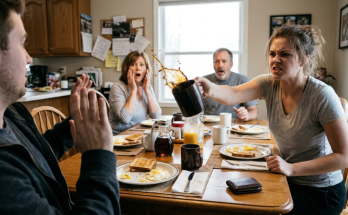
At 4:50 in the morning, my son stood on my front porch with a heavy demolition hammer in his hands and told me the house I had built with my own body now belonged to him.
His voice cut through the dark like a storm rolling over our quiet street in San Antonio, sharp enough to wake the neighbor’s dogs and hard enough to rattle the glass beside the front door. I stood barefoot on the other side of the entryway, one hand pressed against the wall my wife had painted twenty-six years earlier, listening to the deadbolt tremble beneath each hit of his fist.
“Dad,” Emiliano shouted, “open the door. This house is mine now.”
My heart beat so loudly I could hear it in my ears.
Three days earlier, I had changed every lock in the house. Front door. Back door. Garage entry. Side gate. The locksmith, a young man with kind eyes and a tool bag covered in dust, kept glancing at me as he worked, as if he wanted to ask why a man my age was replacing locks on a home that looked full of family pictures.
I did not tell him the truth.
I told him my keys had gone missing.
That was easier than saying I had become afraid of my own son.
My name is Federico Castillo. I am fifty-three years old, though some mornings my knees feel older from thirty years in construction. I spent my life under Texas sun, lifting lumber, mixing concrete, framing houses, climbing ladders before sunrise, and coming home with drywall dust in the creases of my hands. I built apartment walls, church additions, kitchen remodels, backyard decks, school repairs, and more roofs than I can count.
But the only house that ever mattered to me was the one Emiliano was now trying to claim.
I built it with Mariela.
My wife.
My heart.
My Mariela.
We met at a summer festival when I was twenty-three and she was twenty-one. She wore a white cotton dress with blue embroidery at the sleeves, and she had a laugh that made people turn before they knew why. She was carrying a paper plate with tamales, trying to keep her hair from blowing into her face, and I remember thinking, before I even knew her name, that I wanted to be the man who made her laugh like that every day.
We married one year later in a small church with painted wooden pews and a reception in her aunt’s backyard. We had no money for a band, so her cousins brought speakers. We had no money for a honeymoon, so we drove to Corpus Christi for two nights and ate tacos from a gas station at the beach. Mariela said it was perfect because we were together and because the ocean did not charge admission.
From the beginning, we dreamed about a house.
Not a big one. Not fancy. Just ours.
“I want a garden,” she would say when we drove past empty lots. “Not just grass. Flowers. Color. Something that tells the world people are loved here.”
“I’ll build you the walls,” I told her. “You fill them with light.”
We saved for five years.
I worked double shifts. I took weekend jobs. I repaired fences after storms and poured patios for people who argued over every dollar while I smiled and thought of the envelope hidden in our bedroom dresser. Mariela worked at a dental office and clipped grocery coupons with the seriousness of a banker managing national funds. Every Friday night, after dinner, we sat at our tiny kitchen table with a notebook and counted what we could put toward the land.
When we finally bought the lot on the edge of the city, Mariela cried.
Not loudly.
She stood in the dry grass, one hand over her mouth, looking at the empty piece of ground as if she could already see our life standing there.
I broke ground myself.
Every wall carried part of me. My hands set the framing. My shoulders lifted the doors. My back paid for the roof. Friends from job sites came on Sundays to help, and Mariela fed everyone chicken, rice, beans, lemonade, anything she could stretch into a meal. She chose soft yellow for the kitchen, pale green for the hallway, white trim because she said it made a house feel awake. She planted roses near the walkway and jasmine by the back fence because she believed every home should greet you with a smell.
The first night we slept there, the house still echoed.
We had a mattress on the floor, two folding chairs, one lamp, and a refrigerator full of leftovers from people who loved us.
Mariela stood in the empty living room and ran her hand along the wall.
“We did it,” she whispered.
I wrapped my arms around her from behind.
“Yes,” I said. “We did.”
Two years later, Emiliano was born.
I remember the first time I held him. He was tiny, red-faced, furious at the world, his fists curled like he was already prepared to argue his way through life. Mariela, exhausted and radiant in the hospital bed, watched me cry over that little boy.
“He is perfect,” I said.
“He is ours,” she whispered.
For a while, our life was everything we had asked God for.
Emiliano grew up running through the hallway in socks, sliding across the tile while Mariela warned him he would fall and I laughed until she gave me that look wives give husbands who encourage chaos. I taught him to ride a bike in the driveway while Mariela filmed from the porch. He fell, scraped his knee, cried into my shirt, then got back on because his mother clapped and told him he was brave.
He was smart. Funny. Energetic. The kind of child who could charm a neighbor into giving him cookies and then convince me he needed ice cream too because “Mrs. Lopez started dessert.”
But he had a strong temper.
When he wanted something, he wanted it immediately. If we said no, the house changed. He slammed doors. Threw toys into corners. Screamed until his throat cracked. I tried to be firm, but Mariela’s heart was soft where Emiliano was concerned.
“He’s little,” she would say. “He’ll learn.”
I wanted to believe her.
So I let small things pass.
Then bigger things.
At school, teachers called. He talked back. Pushed rules until they bent. Needed to win every argument. I grounded him, then shortened the grounding when Mariela said he looked sad. I took away video games, then gave them back when he apologized with tears that seemed real enough. I told myself discipline was a bridge we would build slowly.
Years passed.
The bridge never held.
When Emiliano was sixteen, Mariela got sick.
At first, it was fatigue. Then pain. Then weight loss that no one could explain with stress or age. The doctor’s office smelled like hand sanitizer and old magazines the day we heard the word no family ever wants to hear. Advanced. Aggressive. Treatment options. Time.
Time became something we measured differently after that.
Not in years. In appointments. Lab results. Medication schedules. Mornings she could eat toast. Afternoons she could sit in the garden. Nights when she slept. Nights when she did not.
I watched the strongest woman I knew grow smaller inside blankets. I watched her lose her hair, then apologize to me for leaving strands on the pillow as if she had done something wrong. I watched her smile at Emiliano whenever he came into the room, even when he stayed only a few minutes, even when he kept looking at his phone because seeing her weak made him uncomfortable.
“Be patient with him,” she told me once, her voice thin from exhaustion. “He doesn’t know how to be scared.”
“He knows how to be selfish,” I said, and hated myself the second the words left my mouth.
Mariela touched my hand.
“He is our son. Promise me you will take care of him.”
I could not refuse her anything.
So I promised.
Mariela died at home on a cold November morning, in the bed we had bought with our first real savings, with me on one side and Emiliano on the other. Her last words were soft enough that I had to lean close.
“Love each other,” she whispered.
Then the room became a place I did not recognize.
For months, I moved through the house like a man walking underwater. I made coffee and forgot to drink it. I stood in the garden and stared at the roses she had planted. I opened her closet once and closed it again because the smell of her lavender soap nearly brought me to my knees.
I had promised to care for Emiliano, and that promise became the rope I held onto.
But grief did not make him kinder.
Three months after the funeral, I found him in Mariela’s room going through her drawers.
Her jewelry box was open on the bed. Perfume bottles, scarves, old letters, and photographs were spread around him like things from an estate sale. He was holding a small gold bracelet I had given her on our tenth anniversary.
“What are you doing?” I asked.
He did not look ashamed.
“I need money.”
My voice broke. “That was your mother’s.”
“She’s gone, Dad.”
The sentence landed harder than any shout could have.
I took the bracelet from his hand and told him to leave the room. He called me old, sentimental, dramatic. He said I was clinging to objects because I could not accept reality. We argued until both of us were shaking. He slammed the door on his way out.
I should have drawn a line then.
I did not.
Because he was my son.
Because he was Mariela’s son.
Because I had promised.
After that, the years became a slow surrender disguised as love.
Emiliano dropped out of community college. Then he drifted from job to job. He borrowed money for a certification course he never took, a business idea that never opened, a rent deposit for an apartment he never moved into. When I asked questions, he looked wounded.
“After everything we went through with Mom, this is how you treat me?”
That was his favorite sentence.
And I let it work.
He came home late. Brought people I did not trust into the house. Men who leaned against my kitchen island with muddy shoes and looked at Mariela’s garden like it was a place to drop empty bottles. I told them they were not welcome. Emiliano laughed in front of them.
“You don’t get to control everything, Dad.”
“This is my house.”
“For now,” he said.
For now.
I still remember that dinner. We were eating caldo in the kitchen, the same soup Mariela used to make when someone was sick. Emiliano was twenty-four, wearing a leather jacket I knew he had not paid for.
“One day this is mine anyway,” he said, casual as if discussing weather. “I’m your only child.”
I set my spoon down.
“I am fifty-three years old.”
“You know what I mean.”
“No,” I said. “I do not think I do.”
He shrugged. “You built it. Good. Now it’s family property.”
Family property.
The house I had built beam by beam. The house where Mariela’s hands had chosen the colors, planted the flowers, folded baby blankets, held birthday cakes, and eventually clutched my fingers while she fought to stay alive. To him, it had become an asset.
Six months before that morning at the door, Emiliano served me papers.
He did not hand them to me himself. A courier delivered them in a large envelope while I was repairing the side fence. Inside was a petition asking the court to compel transfer of the property, dressed up in language about family inheritance, future security, and my supposed inability to manage a home alone.
I sat at the kitchen table with the papers spread in front of me and felt the room tilt.
He was not asking anymore.
He was documenting his entitlement.
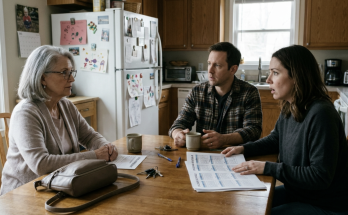
I hired an attorney named Paul Medina, a practical man with kind eyes and a wall full of framed certificates. He read the petition, took off his glasses, and sighed.
“Mr. Castillo, legally, this is weak.”
“Weak?”
“The house is yours. Title is in your name. No one can force you to give it away because they expect to inherit someday.”
I nodded, but he did not smile.
“However,” Paul said, “your son sounds desperate. Weak legal claims do not always mean low risk. Please be careful.”
Careful.
I tried.
I changed habits. Kept copies of property records in a safe deposit box instead of the bedroom safe. Stopped leaving mail where Emiliano could see it. Told the neighbors to call me if they saw strangers near the side gate.
Then, two weeks before the morning everything changed, I woke up to a sound in the hallway.
A soft metal scrape.
The sound of someone trying to open the locked room where I kept old records and Mariela’s letters.
I stepped into the hallway and found Emiliano crouched near the door with a screwdriver in his hand.
“What are you doing?”
He stood too fast.
“I need those papers.”
“No.”
“You’re making this harder than it needs to be.”
“You are trying to take my home.”
“Our home,” he snapped.
He moved past me toward the door, and when I blocked him, he shoved through with enough force that I stumbled against the wall. The impact was not the worst part. The worst part was his face afterward. For one second, he looked down at me without recognition, breathing hard, fists clenched, as if I were not his father but an obstacle.
Then something in him flickered.
He stepped back.
He left without saying sorry.
The next morning, I changed every lock.
For three days, he disappeared.
But his messages did not.
Dad, open the door.
You can’t keep me out of my own house.
Don’t play with me.
You’ll regret this.
I did not answer.
On the third night, I saw him parked outside in a dark pickup with two men I recognized from the garden gatherings. They sat there for nearly half an hour, pointing toward the house, talking, looking at the windows. One of them walked along the sidewalk slowly, studying the side gate.
When they finally left, I checked every window. I set my phone on the coffee table. I dragged a wooden chair near the front entry, not to block the door, but because I knew I would be too tired to stand if morning came like I feared.
I lay on the sofa fully dressed.
I did not sleep.
At 4:50, Emiliano began shouting.
“Dad, open this door.”
I stood in the foyer, looking at the wood grain Mariela had once polished with lemon oil because she loved the way it smelled.
“Go home,” I called.
“This is my home.”
“No, Emiliano. Not like this.”
He struck the door with his fist.
Once. Twice. Three times.
Then silence.
For a moment, I thought maybe he had finally walked away.
Then I heard metal scraping concrete.
I moved to the side window and lifted the curtain just enough to see the porch.
Emiliano returned holding a heavy demolition hammer, the kind used to break old tile or drive stakes through hard ground. He carried it over one shoulder. His face was wet, whether from sweat or tears or the damp morning air, I could not tell.
“Today,” he said, voice rough. “Today I come in.”
He raised the tool.
And behind me, in the dark quiet of the hallway, I felt Mariela.
Not like a ghost in a story. Not a shape or a shadow. A warmth. A presence. A memory so strong it seemed to stand with one hand on my shoulder.
Let him see.
That is what I heard.
Soft.
Certain.
Let him see.
For three days, I had been preparing the house without fully understanding why.
After I changed the locks, I went into the attic looking for an old reinforcement bar and found a cedar storage box tucked behind insulation and Christmas decorations. It was Mariela’s. I knew from the ribbon tied around the lid, a blue ribbon from Emiliano’s first birthday party.
Inside were photographs.
Hundreds of them.
Photographs of Mariela pregnant, standing in the unfinished frame of the house with one hand on her belly. Photographs of Emiliano as a newborn, wrapped in a blue blanket. His first steps near the back door. His fifth birthday with frosting on his nose. His first bike. A family picnic. A school play. A crooked homemade Mother’s Day card.
But beneath the photos were letters.
Pages and pages in Mariela’s handwriting, some steady, some shaky from the illness near the end. She had written dates, captions, memories, thoughts for Emiliano. Not for me. Not exactly. For him. For the man she feared he might become if grief and entitlement swallowed the boy she loved.
The last envelope had my name.
Federico, if the day comes when our son forgets what this house is, show him.
I spent those three days hanging the photographs.
Not in frames. Not perfectly. With painter’s tape, string, pins, whatever I had. I turned the living room, hallway, and dining room into a timeline of our family. Under each photo, I copied Mariela’s words onto cards because I wanted Emiliano to see them clearly.
I did not know if he would come.
I only knew, somehow, that the house was waiting.
Now he stood outside with a demolition hammer raised over the door his mother had painted red because she said every home needed a little courage.
Let him see.
My hand moved to the lock.
The deadbolt turned.
The door opened.
Emiliano froze on the porch, the heavy tool suspended in both hands. His eyes widened. His jaw loosened. The cold morning air moved past him into the entryway, carrying the smell of wet concrete and cut grass.
He expected fear.
He expected anger.
He expected a fight over property.
Instead, he saw his mother.
The hammer slipped from his hands and landed on the porch with a dull metallic thud.
The whole house glowed with her.
Every wall was covered in photographs. The timeline began near the front entry: Mariela young, laughing beside an empty lot; Mariela holding blueprints upside down and pretending to supervise construction; Mariela pregnant in the half-built living room. Emiliano’s first hospital photo. Me holding him with a face so terrified and proud I barely recognized myself. Mariela kissing his tiny forehead.
Emiliano stepped inside like a man entering a church after years of forgetting how to pray.
I moved aside and said nothing.
He stopped at the first card.
March 10. Today I met my son. I did not know a heart could become larger in one second. Federico cried when he held him. I have never loved them both more.
Emiliano lifted one trembling hand toward the photo, then let it fall.
He walked forward.
At age five, he sat on my shoulders in the backyard while Mariela held a garden hose and laughed. Beneath it, her note read: Emiliano’s laugh is my favorite sound in the world. When he laughs, the house feels complete.
Another photo. Emiliano at seven, missing two front teeth, hugging Mariela around the waist.
Today he told me, “When I grow up, I’ll take care of you, Mom.” I believe him. I will always believe in the good inside my boy.
His breathing changed.
He kept walking.
The timeline shifted.
Mariela in a headscarf, thinner now. Emiliano sitting beside her hospital bed, phone in his hand, face turned away. I remembered that day. I remembered telling him to put the phone down. I remembered his irritation, the way he said he could not just sit there doing nothing.
The card beneath it said: Emiliano visited today. He stayed twenty minutes. I know it is hard for him to see me this way. I forgive him. Still, I wish he knew how much I needed his hand in mine.
Emiliano covered his mouth.
“No,” he whispered.
He moved faster now, as if outrunning the words would change them.
Another picture. Mariela in our bedroom, eyes sunken but still bright.
The doctor says time is shorter now. I am not afraid for myself. I am afraid for Federico being alone. I am afraid Emiliano will forget who he is under all that anger. My son is not bad. He is lost. I pray he finds his way before he hurts the person who loves him most.
The sound that came from Emiliano then was not a sob yet. It was something smaller, something cracking.
He reached the final wall.
The largest photo hung alone in the center.
Mariela in her last days, propped against pillows in our bed. I was on one side, holding her hand. Emiliano was on the other, younger, uncomfortable, looking away from the camera because he did not know how to look at death.
Beneath it was her final letter.
My two loves.
Federico, you built this house with your hands, but you made it a home with your heart. This house is yours. You earned it. You protected us with it. Do not let anyone turn your love into guilt.
Emiliano, my son, I love you more than any words I can leave behind. I see anger in you that scares me. I see pain you do not know how to carry. Please do not let that pain make you cruel. Do not take from your father the home he built for us. If you ever try, you will not be taking a property. You will be taking his heart.
This house was built with love, not money. Remember that. Honor your father. Honor the boy you used to be. Honor me by becoming better than your worst day.
I will love you always.
Your Mom.
Emiliano fell to his knees.
Not dramatically. Not like someone performing regret. His body simply gave out beneath the weight of what he had finally allowed himself to see.
“Mom,” he said.
Then again.
“Mom.”
I stood a few feet away with tears running down my face, but I did not go to him yet.
Some grief has to land without rescue.
He bent forward until his forehead nearly touched the floor and cried the way I had cried after Mariela’s funeral, not with dignity, not quietly, but as if something long sealed inside him had finally broken open.
“I’m sorry,” he kept saying. “I’m sorry. I’m sorry.”
The sun began to rise slowly beyond the windows, turning the edges of the photographs gold.
After a long time, he looked up at me.
His face was destroyed by tears.
“When did you do this?”
“Your mother did it,” I said. “I only followed her instructions.”
He stared at the wall.
“I didn’t know.”
“You knew enough,” I said softly. “You chose not to look.”
That hurt him, but it needed to.
He nodded.
“I became someone else.”
“Yes.”
“I tried to take her house from you.”
“Our house,” I corrected. “Not because you own it. Because you were loved here.”
He pressed both hands over his face.
“What do I do?”
It was the first honest question he had asked me in years.
I sat down on the floor across from him because my knees were hurting and because, for the first time in a long time, I was not afraid of being lower than my son.
“You start by getting up,” I said. “Then you help your father up because I am too old to sit on tile this long.”
He laughed through tears.
A broken little laugh.
But real.
We stood together.
In the kitchen, I made coffee the way Mariela used to, strong enough to make you reconsider your choices. Emiliano sat in the chair he used as a boy, both hands around the mug, staring at the steam.
“You need help,” I said.
“I know.”
“Real help. Therapy. A support group if you need it. No more people coming here who treat this house like a place to use.”
He nodded.
“I owe money,” he said.
“How much?”
He looked ashamed.
“About twelve thousand dollars.”
That number was not small for him, but it was not the house. It was not worth destroying a family. It was a fire that could be put out with work, discipline, and humility.
“We will handle it,” I said. “But not as a gift.”
He looked up.
“As a loan. No interest. You pay what you can from honest work. And the house stays in my name while I live. When I am gone, we will see who you have become.”
“I don’t want the house,” he whispered. “Not like that.”
“Good.”
“I want my father.”
I looked at him then and saw, beneath the beard and the anger and the years of bad choices, a glimpse of the boy Mariela had written about. Not restored. Not fixed. But still there.
I reached across the table.
He took my hand.
“Then we begin again,” I said. “From zero.”
It has been six months since that morning.
Emiliano kept his word. Not perfectly. No real healing is perfect. He started therapy with a counselor who specializes in grief and family conflict. The first sessions left him exhausted. He told me once he cried so hard in the parking lot afterward that he could not drive for twenty minutes.
He cut ties with the men who had been pressuring him. That was not easy. There were uncomfortable calls. Messages. A few tense weeks. We handled it through proper legal channels and with support from people who knew how to keep boundaries clear. He found work with a construction company, which feels like one of Mariela’s quiet jokes. My son now comes home with dust on his boots and respect in his shoulders.
Every two weeks, he pays me something.
Sometimes twenty dollars. Sometimes a hundred. Sometimes nothing but an explanation and a plan.
The amount matters less than the act.
The photographs are still on the walls.
At first I thought I would take them down, but Emiliano asked me not to. He says he needs them. He says they remind him of the person he promised his mother he would become. He comes over three nights a week now. Sometimes we eat dinner. Sometimes we sit in the garden and do not speak. He has replanted Mariela’s jasmine by the back fence and added red roses near the walkway.
“Mom said jasmine smells like hope,” he told me last week.
“She did,” I said.
A month ago, we went to Mariela’s grave together for the first time since the funeral. Emiliano knelt in front of her headstone with a bouquet of jasmine in his hands and talked to her for nearly an hour. He told her about therapy, about work, about the debt, about the morning he saw her words on the wall. He promised her he would spend the rest of his life becoming someone she could be proud of.
I cried beside him.
Not because everything was fixed.
Because something living had finally pushed through the ruin.
I still sit in the living room every night before bed. The house is quiet again, but not empty the way it used to be. Mariela’s photographs catch the lamplight. Her handwriting holds the walls together better than nails. Some nights, I speak to her the way I always have.
“He is trying,” I tell her.
And in the soft silence that follows, with jasmine drifting in through the open window and the red door locked gently for the night, I feel the answer I need.
Keep building.