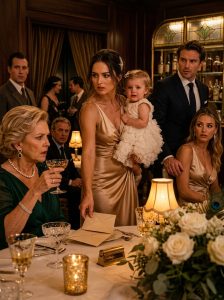
“Although I must say something,” she continued in that sweet voice she used to open wounds without dirtying her hands. “The Aranda family has had brown eyes for five generations. My husband, my sons, my parents, my grandparents… everyone. And suddenly this child appears with such blue eyes.”
The room changed.
It was not immediate scandal.
It was worse.
A pause.
A shift.
A current of curiosity, judgment, and elegant cruelty.
Lucía stopped clapping and pressed her little face into my neck, confused by the sudden sharpness in the air. Babies do not understand words like paternity, betrayal, reputation, or inheritance. But they understand rooms. They know when something stops feeling safe.
Rodrigo stood near his mother.
And his hand rested on the back of Paulina Mier’s chair.
That detail stayed with me more than the flowers, the cake, or the photographer near the dessert table.
My husband’s hand on the chair of the woman his mother had always wanted for him.
Teresa looked at me with fake gentleness.
“Daniela, no one is angry. We’re family. We simply think it would be better to know who Lucía’s real father is.”
Someone gave a nervous little laugh.
Another relative pretended to cough.
My daughter began to cry.
And Teresa thought she had won.
She expected me to tremble. She expected me to beg Rodrigo to defend me. She expected tears, denial, chaos—a scene she could later use to say,
“See? She was always unstable.”
But I kissed my daughter’s hair.
I breathed.
And I smiled.
Because inside my bag, under wipes, a pacifier, emergency cookies, and lipstick I had not even had time to use, there was a sealed envelope with a laboratory letterhead.
And beneath that envelope, there was another one.
Teresa knew nothing about the second envelope.
That was her mistake.
My name is Daniela Salgado. I am thirty-two years old. I grew up in a small apartment in Narvarte with a mother who worked in hospital administration and a father who handled logistics for a transportation company. We did not have a vacation house, oil portraits, club memberships, or a last name that opened doors.
We had stability.
My mother ironed her blouses on Sundays. My father repaired the car himself and taught me how to change a tire before teaching me how to drive. Birthdays meant bakery cake, soda, cousins running through the hallway, and chairs borrowed from neighbors.
I was never ashamed of that.
They tried to teach me shame later.
When I first met Teresa Aranda, the first thing she looked at was my shoes.
Rodrigo had taken me to dinner at his parents’ house in Las Lomas, a huge silent home with a perfect garden and paintings that seemed to glare at anyone not born into that world. Before we entered, he squeezed my hand.
“My mom can be intense, but she doesn’t mean badly.”
Years later, I understood that “she doesn’t mean badly” is what men say when they grew up so close to cruelty they can no longer recognize it.
Teresa opened the door in cream clothes and pearls.
“Daniela,” she said, stretching my name as if testing whether it belonged in her house.
During dinner, she asked what my parents did before asking anything about me. When I answered, she smiled with polished pity.
“Such hardworking people.”
In her language, that meant poor, but acceptable.
Rodrigo laughed quickly, trying to soften it.
I smiled because I wanted to be liked.
That was how it began.
Teresa insulted softly. Rodrigo translated beautifully. I swallowed gracefully. Everyone called it harmony.
The woman Teresa had always wanted for Rodrigo was Paulina Mier. No one said it directly at first, because in that family, cruelty wore gloves. But Paulina appeared at every meal as a comparison.
“Paulina just closed a real estate project in Mérida.”
“Paulina comes from such a solid family.”
“Paulina has admirable discipline.”
When I was eight months pregnant, swollen and uncomfortable, Teresa said,
“Paulina does Pilates every day. Her body awareness is impressive.”
I sat there with Lucía kicking my ribs.
Later, Rodrigo told me,
“Don’t take it personally. My mom just has high standards.”
But they were not standards.
They were contempt dressed in expensive perfume.
When Lucía was born, I thought maybe something would change. Rodrigo cried when the nurse placed her in his arms. He touched her cheek and whispered,
“She’s perfect.”
For one hour, I believed him.
Then Teresa came to the hospital room four days later. She kissed Rodrigo first, then leaned over the crib.
Lucía was asleep in a pink blanket.
Teresa stared at her too long.
“She has blue eyes,” she said.
“All newborns have light eyes, Mom,” Rodrigo replied.
“Yes,” Teresa said. “But these are very blue.”
I was exhausted, sore, hormonal, still bleeding, with stitches burning and a baby depending on me for everything.
“She’s four days old,” I said.
Teresa smiled at me.
And that was when the cold began.
Not all at once. Women like her do not work that way. First came comments. Then silences. Then Rodrigo coming home late.
Tuesdays and Thursdays.
Then Fridays.
Then any day.
He began looking at me differently. Not with anger, but with assessment, as if I were a questionable investment.
When I asked what was wrong, he said,
“Nothing.”
When I said he felt far away, he replied,
“Daniela, please don’t make everything emotional.”
I had just had a baby.
Everything was emotional.
The first proof came on a rainy afternoon. My phone died just as I needed to call the pediatrician about Lucía’s rash. Rodrigo’s phone was in the kitchen while he showered upstairs. I picked it up only to make the call.
The screen lit up.
A message from Teresa:
“Think carefully, Rodrigo. Five generations of brown eyes. This cannot be ignored.”
My hands went numb.
I opened the conversation.
Some people will say I should not have done it. That I should have asked. That I invaded his privacy.
Those people have never felt the floor shift beneath their marriage.
Teresa had been writing to him for weeks.
“Where did those eyes come from?”
“Don’t let love blind you.”
“Paulina would never put you in this position.”
“A private test can be done discreetly.”
“There are options.”
And Rodrigo had never defended me.
He never said, “Mom, stop.”
He never said, “Daniela would never betray me.”
He replied,
“I’ve thought about it.”
“Don’t push yet.”
“Let me see.”
Let me see.
My husband had doubted our daughter, not because of anything I had done, but because his mother decided a recessive gene mattered more than five years of love.
The second proof came three weeks later when Rodrigo left his laptop open in the kitchen. People who underestimate you get careless. They think silence means ignorance.
The email subject read:
“Birthday structure.”
It was a thread between Teresa and Paulina.
I read it in four minutes.
When I finished, I was sitting on the kitchen floor with Lucía asleep nearby.
It was not suspicion.
It was a plan.
Phase one: plant doubts about paternity.
Phase two: bring Rodrigo and Paulina closer in public.
Phase three: use Lucía’s first birthday as a stage. Make an accusation under the mask of “family concern.” Humiliate me in front of witnesses.
Phase four: Rodrigo would file for divorce. Teresa’s lawyer was already prepared. The asset division had to leave me with as little as possible.
In one email, Teresa wrote,
“A new beginning. It was time.”
I stayed on the floor for eleven minutes.
Then I stood.
I made coffee.
I fed Lucía when she woke.
And I began preparing my way out.
The first person I called was not my mother.
It was a lawyer.
Attorney Patricia Robles listened without interrupting as I told her about the messages, the emails, Paulina, the birthday, and the suspicion.
When I finished, she said,
“Daniela, you need documentation, not emotion. Emotion is real, but documents work in court.”
That sentence became my anchor.
Documentation, not emotion.
I ordered a certified private paternity test.
Result: 99.998%.
Rodrigo was Lucía’s biological father.
I cried when I saw it—not because I had doubted, but because truth on paper carries a different weight.
You can touch it.
You can place it on a table in front of people who tried to negotiate with reality.
I preserved messages, emails, photos, schedules, and transfers. Patricia investigated further and found something worse. Teresa had opened an account using Rodrigo’s information from old family documents. From that account, she had paid a divorce lawyer and made monthly payments to Paulina labeled as “consulting” and “event support.”
People like Teresa do not write, “I am paying you to help destroy my son’s marriage.”
But numbers tell stories.
For three months, I smiled.
I went to dinners. I answered messages. I let Teresa organize the party. I let her believe I knew nothing.
On the outside, I looked like a tired mother trying to adjust.
Inside, I was building the door out of the trap before it closed.
And now, at my daughter’s birthday, Teresa had just delivered her perfect line.
“It would be better to know who Lucía’s real father is.”
I reached into my bag.
I pulled out the first envelope.
Holding Lucía in my arms, I walked toward Teresa.
My heels clicked across the polished floor.
I placed the envelope in front of her.
PART 2
“If we’re going to talk about secrets,” I said, “open this.”
Teresa stared at the envelope as if it might bite her.
Rodrigo stepped forward first.
“Daniela, don’t do this here.”
I looked at him over Lucía’s soft curls.
“Here is exactly where your mother wanted it.”
The room went still.
Teresa’s fingers tightened around her champagne flute. “If you have something to say, say it like an adult.”
“No,” I said. “You wanted documents. Open it.”
For several seconds, she refused.
Then Paulina gave a small laugh from her chair.
“Maybe we should all see it. If Daniela is so confident.”
That was her mistake.
Teresa opened the envelope.
Her smile lasted only three seconds.
Then her face changed.
Rodrigo took the paper from her trembling hand, and his eyes moved across the certified report.
Lucía Aranda.
Biological father: Rodrigo Aranda.
Probability: 99.998%.
The silence became brutal.
Someone whispered, “Dios mío.”
Rodrigo looked at Lucía, then at me, his face breaking with shame.
“Daniela…”
I stepped back before he could touch my arm.
“No. You don’t get to look wounded. You let them question your daughter while you stood beside another woman.”
His mouth opened.
Nothing came out.
Teresa recovered first, because pride often survives longer than decency.
“A test proves biology,” she said coldly. “It does not prove character.”
I smiled.
“You’re right. That’s what the second envelope is for.”
Paulina’s glass froze halfway to her lips.
From the back of the room, Attorney Patricia Robles entered in a dark suit, carrying a leather folder.
“Mrs. Aranda,” she said calmly, “I recommend you stop speaking.”
Teresa went pale.
Patricia placed copies across the table.
Emails.
Bank transfers.
Screenshots.
The birthday plan.
Payments labeled “consulting” and “event support.”
Rodrigo picked up the email titled Birthday structure.
His hands began to shake.
“You planned this?”
Teresa lifted her chin. “I planned to save you from a mistake.”
I held my crying daughter closer.
“No. You planned to erase us.”
Then Patricia handed Rodrigo the final document.
My divorce petition.
Filed that morning.
With full custody requested.
And attached evidence of conspiracy, fraud, and emotional abuse.
Rodrigo looked at me like a man watching his life collapse.
But the real shock came when Paulina suddenly stood and whispered, “Teresa, you promised he’d never see the adoption papers.”