I used to believe my parents were helping me.
That was the first lie I had to stop believing.
The second was that I owed them something for every year I had lived beneath their roof.
I was twenty-one when I started working full-time in accounting.
I still lived at home.
Not because I wanted to stay forever.
I had plans.
A small apartment. A kitchen of my own. Somewhere I could come home after work without wondering who was going to criticize me.
But my father, Richard Carter, had a way of making independence sound like a foolish decision.
“You have no idea how expensive the real world is, Olivia.”
He said that whenever I mentioned moving.
My mother, Linda, usually agreed.
She would stand beside him, folding her arms as though the two of them had already settled the matter.
“We’re giving you a chance to save money. Most girls would appreciate that.”
I did appreciate having somewhere to live.
That was why I paid them.
Every month, I handed over almost half my salary.
Some months, more.
My father called it my contribution to the household.
My mother called it the responsible thing to do.
I called it rent, although nobody had ever given me a written agreement.
The amount changed whenever something went wrong.
A high electricity bill.
A broken appliance.
An unexpected repair.
Somehow, those problems became my problems.
I remember one winter evening when the washing machine stopped working.
My mother stood in the laundry room with a basket against her hip.
She looked at me as though I had broken the machine myself.
“We can’t afford another expense right now.”
I had been saving for an apartment deposit.
I used most of those savings to replace it.
My mother thanked me once.
The following week, she complained that I hadn’t bought a more expensive model.
I said nothing.
That was something I was good at.
Saying nothing.
My brother Jake had a different relationship with our parents.
Jake owned a small business.
At least, that was how everyone described it.
He was the ambitious one.
The businessman.
The son who was going places.
Whenever his company struggled, my parents explained that success required sacrifice.
They never seemed to mean Jake’s sacrifice.
His suppliers needed payment.
His equipment needed replacing.
His business required more money than he had available.
And every time, somebody looked in my direction.
“You have a steady paycheck,” my father would remind me.
Jake didn’t need to ask directly.
He could complain about a problem over dinner, and by the time the plates were cleared, my mother would be telling me why helping him was important.
I sometimes gave him money.
Sometimes I refused.
When I refused, the atmosphere in the house changed.
My mother became quiet.
My father stopped asking about my day.
Jake would laugh and say he understood.
Then he would mention how difficult it was to run a business while other people enjoyed guaranteed salaries.
I started feeling guilty for earning my own money.
Looking back, that should have frightened me.
Instead, I worked harder.
I believed that if I proved myself useful enough, my family would eventually treat me like an adult.
I didn’t understand that usefulness was exactly what they wanted from me.
There was also my younger sister, Emma.
Emma was different from Jake.
She could be kind.
She could also be terribly quiet when kindness required her to disagree with our parents.
She was preparing for her wedding when everything began falling apart.
At the time, I didn’t know how deeply that wedding was connected to my own finances.
I only knew that another family expense had somehow become part of everyone’s conversations.
My mother loved discussing the arrangements.
The venue.
The flowers.
The photographs.
She spoke about the wedding with the same pride she reserved for Jake’s company.
When I mentioned how much I was saving to leave, she stopped smiling.
“You’re always thinking about yourself lately.”
I remember staring at her.
I had paid the heating bill that month.
I had bought groceries twice that week.
My own winter coat had a broken zipper I kept meaning to replace.
Yet I was selfish for wanting a home of my own.
I stopped discussing my plans.
Instead, I quietly searched for apartments after work.
I checked prices during lunch breaks.
I calculated deposits, utility bills and transportation costs.
Numbers were comforting to me.
They either worked or they didn’t.
At home, the rules always changed.
Sometimes, late at night, I thought about my grandmother.
She had been the only person who never made me feel like my existence created a debt.
When I was sixteen, we had a Saturday habit.
We went to a small bakery and shared a cinnamon roll.
She ordered two coffees and let me talk.
Mostly, I talked about school.
Sometimes about work.
Sometimes about the kind of life I wanted.
I once told her I liked accounting because figures couldn’t pretend to be something they weren’t.
She smiled at that.
Then she told me to be careful about letting other people control money that belonged to me.
I thought she was teaching me to be sensible.
I didn’t know how much that conversation would matter later.
After she died, my father handled the family paperwork.
He told me there had been money set aside for my education.
He said it had already been used for college expenses.
I believed him.
Why wouldn’t I?
He was my father.
He understood financial documents better than I did at the time.
At least, that was what he wanted me to think.
Years passed.
I finished my education and began building a career.
Still, I never seemed to have enough savings to leave.
Every time I got close, another family emergency appeared.
Jake needed assistance.
A household bill had increased.
My parents had fallen behind on something.
I paid because I believed responsible daughters helped their families.
Then I would open my savings account and wonder why working so hard never seemed to change my life.
The day I finally told them I was moving out, my father was sitting at the dining table.
My mother was nearby.
Jake was there too.
I had already arranged somewhere to live.
I had chosen not to discuss it until my decision was final.
That was the first time I had done something important without asking their permission.
“I’ve found an apartment,” I said.
My father looked up.
“What?”
“I’m moving out.”
He placed his cup on the table.
“Since when?”
“I’ve been planning it for a while.”
My mother stared at me.
“You made this decision without speaking to us?”
I didn’t understand why I needed their approval.
But I knew better than to say that aloud.
“I’ve worked out the expenses. I can manage.”
My father gave a small, unpleasant laugh.
“You think paying a few bills makes you independent?”
I reminded him that I had been contributing for years.
His expression hardened.
“That’s what adults do when they’re allowed to live in somebody else’s house.”
Somebody else’s house.
I remember those words clearly.
He said them with such certainty.
As though every payment I had made was a favor he had permitted me to perform.
My mother asked whether I intended to abandon them when they needed help.
I said moving out didn’t mean abandoning anyone.
Jake leaned back in his chair.
“Good luck surviving without Mom and Dad.”
He was smiling.
I didn’t smile back.
For once, I didn’t argue.
I went upstairs and continued packing.
My father came to my bedroom doorway later that evening.
He looked at the boxes.
Then he looked at me.
“You’re making a mistake.”
“I don’t think I am.”
“You’ll understand when you’re paying for everything yourself.”
I looked at the neatly folded clothes on my bed.
I already paid for almost everything I used.
I paid for things I didn’t use.
But I didn’t say that.
He stood there for another moment.
Then he left.
The following days were miserable.
My mother barely spoke to me unless she needed something.
Jake made jokes whenever he saw another packed box.
My father repeatedly asked how long it would take before I came begging to return.
I tried not to react.
I told myself they were upset about the change.
Families said cruel things during disagreements.
That was the explanation I kept giving myself.
Then moving day came.
I carried my belongings downstairs.
There were more boxes than I expected.
Books.
Clothes.
Old photographs.
A few kitchen items I had bought myself.
The final box was especially heavy.
I remember setting it down near the front door and flexing my fingers.
My mother was standing in the hallway.
She watched me without offering to help.
Then she said the word that stayed with me long after I left.
“Parasite.”
I looked at her.
“What did you say?”
She didn’t look embarrassed.
She looked angry.
“You’ve lived here all these years, and now you’re walking out as though you’ve done something wonderful.”
I told her I had paid my share.
She shook her head.
“You have no idea what we’ve done for you.”
My father appeared behind her.
He didn’t ask her to stop.
He didn’t defend me.
Instead, he told me I would understand my mistake soon enough.
I picked up the box.
My hands were shaking.
Not because it was heavy.
Because I had spent years waiting for one of them to say they were proud of me.
And all I received was an insult.
Outside, I loaded the last of my belongings.
I could hear voices from inside the house.
I didn’t know that Jake had been taking photographs.
I didn’t know he would turn my departure into something the extended family could laugh about.
I only knew I needed to leave before I said something I couldn’t take back.
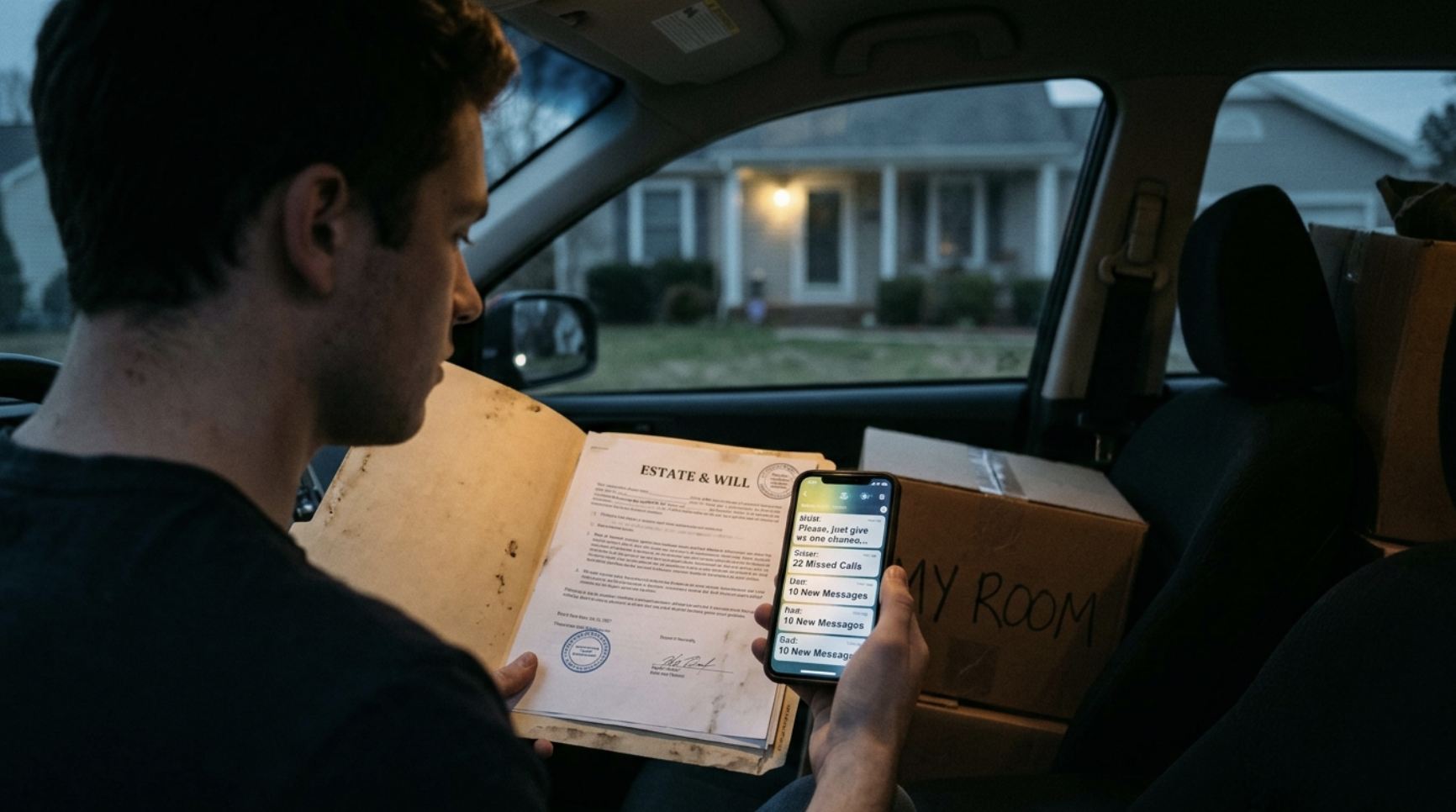
I closed the car door.
For several seconds, I sat behind the steering wheel.
I watched the house through the windshield.
It was the place where I had grown up.
The place where I had celebrated birthdays.
The place where my grandmother had once visited and made me feel safe.
It was also the place where I had learned to apologize for having needs.
I started the engine.
Nobody came outside.
Nobody waved.
Nobody asked whether I would be safe.
I drove away.
At first, I felt relieved.
Then I cried.
I cried at a traffic light.
I cried while carrying my boxes into the apartment.
I cried when I opened the refrigerator and saw there was nothing inside.
But that evening, something happened that I had never experienced before.
I sat alone in my own room.
Nobody questioned how much electricity I was using.
Nobody asked me to pay for Jake’s latest problem.
Nobody told me that I was a disappointment.
The silence felt strange.
I didn’t know whether I liked it yet.
Then I opened my phone.
Jake had posted about me.
There was a photograph of my departure.
The caption made it clear that the family considered my leaving a victory.
Relatives had joined in.
They treated the situation like a celebration.
A hundred and twenty-three people were part of that humiliation.
People who had known me since childhood.
People who had accepted my help.
People who had never once asked how much I contributed to the house.
I read their comments.
Some called me ungrateful.
Others praised my parents for being patient.
One suggested I would soon discover how difficult life was without my family supporting me.
I wanted to answer every one of them.
I wanted to list the bills.
The groceries.
The washing machine.
The years of salary contributions.
I wanted somebody to understand.
Instead, I put the phone facedown.
I was exhausted.
I had already spent too much of my life defending myself.
That night, I made a decision.
I wasn’t going to return simply because they expected me to fail.
I wasn’t going to continue paying for problems that didn’t belong to me.
And I wasn’t going to let their opinions determine whether I deserved a peaceful life.
I believed that leaving the house was the difficult part.
I had no idea what was waiting inside the financial records connected to my name.
The next stage of my life would begin with documents.
Not family photographs.
Not apologies.
Documents.
And the numbers inside them would make me question nearly everything I thought I knew about my parents.
Source: dramausa.com
Click here to continue reading: PART 2: After My Brother Celebrated My Departure, I Discovered Financial Accounts That Suggested My Family Had Been Using My Identity
My Family Called Me a Burden for Leaving, but the Money I Had Given Them Was Only the Beginning
Part 1 of 20