I used to think the worst thing my brother had done was convince our parents that I had ruined my future.
I was wrong.
By the time I understood how far Julian had gone, I had already spent four hours trying to keep him alive.
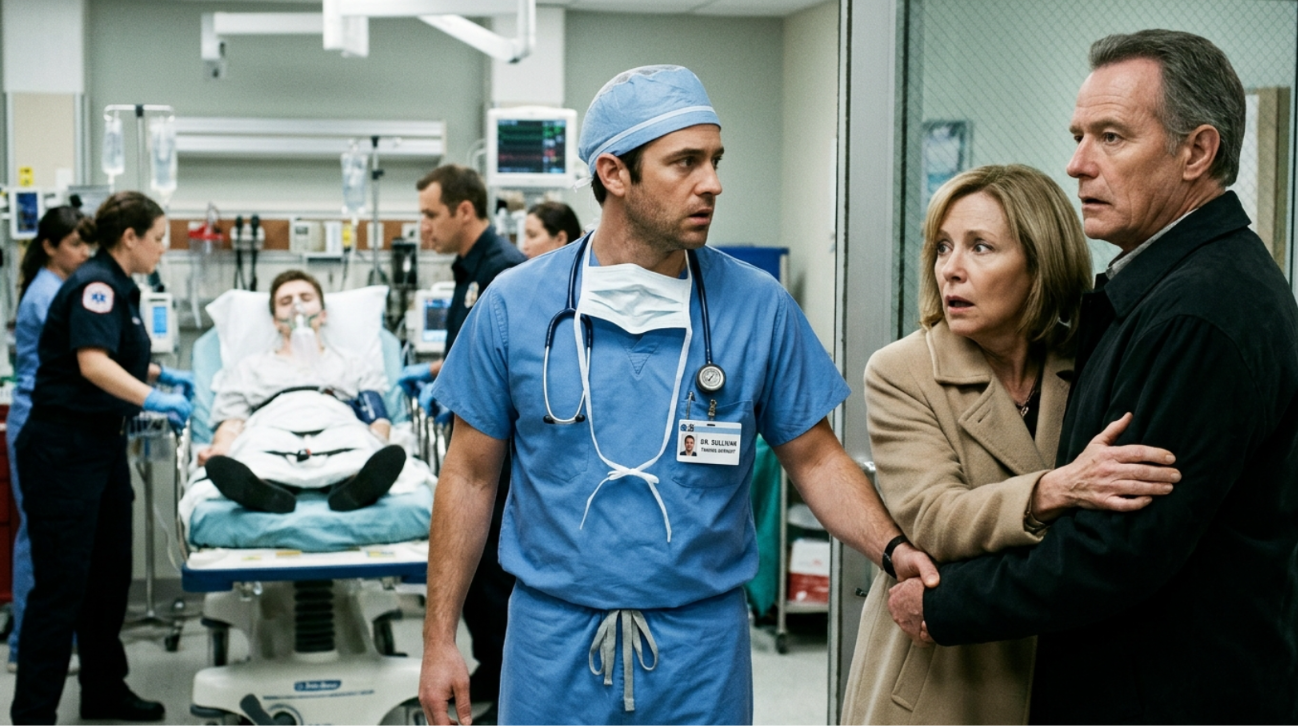
And my parents were standing in a hospital corridor, looking at me as though I had returned from the dead.
My name is Arthur Vance.
I’m a trauma surgeon.
Five years earlier, my family had decided I was a medical school dropout who couldn’t be trusted to tell the truth.
They had believed my older brother.
They hadn’t believed me.
That was how we lost each other.
Or at least, that was what I thought had happened.
The night everything came apart, I was wearing a white coat with my hospital identification clipped to the front.
My father kept staring at it.
My mother had a crumpled tissue pressed against her lips.
Neither seemed to know what to say.
I almost wished they would stay silent.
Then my mother asked why I hadn’t told them I had become a doctor.
I glanced at the badge.
My name was printed clearly beneath my photograph.
Arthur Vance, MD.
I had worked for years to earn those letters.
Now they were the only evidence my parents appeared willing to accept.
“I did tell you.”
My father moved closer.
“Arthur, we were given different information.”
I looked at him.
“By Julian.”
He didn’t deny it.
My mother began talking about how they had been frightened for me.
How they had believed I was struggling.
How they hadn’t understood what was happening.
I let her speak.
I had imagined this conversation so many times that I knew exactly what I wanted to say.
But standing there, I discovered that rehearsing pain was not the same as facing it.
“You knew Sarah was sick,” I said.
My mother’s expression changed.
Sarah had been the reason I temporarily stepped away from my training.
She was dying, and I had needed to be with her.
The university had approved my leave.
I hadn’t quit.
I hadn’t been expelled.
I hadn’t abandoned my education.
I had asked for time to care for someone I loved.
I had explained that to my family more than once.
But Julian had given them another story.
He claimed I had left medical school because I was irresponsible.
Then he made it worse.
He told them I was using drugs.
He claimed I was unstable.
He said I had stopped caring about my responsibilities.
And somehow, his version became the truth in our house.
My mother looked down at her hands.
“We believed you needed help.”
I felt my jaw tighten.
“I needed help when Sarah was dying.”
She lifted her eyes.
“I called from her hospital room,” I continued. “I explained what the university had approved. I told you I was coming back.”
My father rubbed his forehead.
I remembered the conversation clearly.
My mother had accused me of bringing shame on the family.
My father had told me to stay away until I could admit what I had supposedly done.
Those words had followed me for five years.
I could still remember where I was sitting when I heard them.
A plastic chair beside Sarah’s hospital bed.
The room had smelled of disinfectant.
Her bracelet was loose around her wrist.
She had been too exhausted to follow the conversation.
I had ended the call before she could see me cry.
Then I had sat beside her and pretended everything was fine.
My father looked uncomfortable when I reminded him.
“I don’t recall saying those exact things.”
“I haven’t forgotten them.”
He stopped arguing.
That silence hurt more than I expected.
For years, I had wanted him to remember.
I had wanted him to understand what one conversation had done to me.
Now he was standing a few feet away, unable to look directly at my face.
My mother asked whether I had any proof of what I was telling them.
I almost laughed.
Proof.
That was what they wanted now.
I had spent years trying to give them exactly that.
I reached into my coat and took out my phone.
There was a folder I rarely opened.
I had kept it because I needed something solid to hold on to when I began questioning my own memories.
It contained photographs of Sarah.
A picture of us sitting outside the oncology center.
A photograph of her hospital bracelet.
And messages.
So many messages.
Some had been sent before my parents stopped answering.
Others had been written after I realized they might never respond.
I opened the oldest one I could find.
It was from the night before Sarah died.
I had explained that her condition was deteriorating.
I had admitted I was frightened.
I had told them I still had university approval and would return to my studies.
I had begged them to stop trusting everything Julian said about me.
My mother read the screen.
Her lips moved silently.
Then she covered her face.
I scrolled to another message.
I had told them about completing an important stage of my medical education.
Another message announced that I had been accepted into a trauma surgery residency.
Then I showed them one I had sent on my wedding morning.
I had told them about Clara.
I had described her as the woman I wanted to spend my life with.
I had said how much I wished my family could be present.
My father stared at the screen for a long time.
I wondered whether he was remembering the day he had decided not to answer.
Or whether he was simply discovering how much had happened without him.
My mother reached toward my phone.
I moved it away.
“Arthur, please.”
I shook my head.
I didn’t want her touching those messages.
Not yet.
They were evidence of years when I had reached for my parents and received nothing.
I had written them while grieving.
While studying.
While working shifts that left me too tired to eat.
While building a marriage.
I had wanted them to know that I was still their son.
Now they were looking at my professional badge as though my career made me worthy of listening to.
That realization made me angry.
“I needed you when I didn’t have anything impressive to show you.”
My mother cried harder.
I continued.
“I needed you when I was living in a small apartment and worrying about whether I’d finish school. I needed you when Sarah was dying.”
My voice became uneven.
“That’s when being my parents mattered.”
My father tried to explain what Julian had told them.
The drugs.
The supposed instability.
The claim that I had abandoned my responsibilities.
I listened until he finished.
Then I asked a question.
“Did Julian ever show you an official letter from the university?”
My father looked down.
“Did he show you anything proving I had withdrawn?”
He shook his head.
“Did either of you call me and ask what was happening?”
Neither answered.
I had been waiting five years for that silence.
And when it finally came, it didn’t make me feel better.
It made me feel tired.
Julian had always been different around our parents.
He knew what they wanted to hear.
He understood when to sound worried and when to sound disappointed.
I had trusted him because he was my brother.
They had trusted him because they wanted to.
I didn’t know which part hurt more.
A nurse appeared at the far end of the corridor.
“Dr. Vance?”
I turned toward her immediately.
She told me the patient was beginning to wake.
I thanked her.
My mother stepped forward.
She wanted to know whether she could see Julian.
I explained that he was still under intensive care and needed to be evaluated.
She begged me to let her through.
I watched her face.
The fear was genuine.
She was terrified of losing her son.
I understood that fear.
I had spent four hours fighting to make sure she didn’t lose him.
But I also remembered how little concern she had shown when I was losing Sarah.
My mother said Julian was her child.
I nodded.
Of course he was.
That had never been in doubt.
Then I returned to work.
I didn’t turn around when my father called my name.
I had done everything a surgeon was supposed to do for Julian.
I had stabilized him.
I had made the decisions necessary to keep him alive.
The rest of my responsibilities were still waiting.
The hospital didn’t stop because my family had suddenly reappeared.
There were scans to review.
Orders to confirm.
Staff members who needed answers.
And a patient whose recovery was still uncertain.
I tried to concentrate.
For a little while, the familiar routine helped.
I understood monitors.
I understood injuries.
I understood the consequences of waiting too long to act.
I did not understand how the same two people who had raised me could stand in front of me after five years and say they had only been worried.
Two hours later, I was reviewing Julian’s imaging when my phone vibrated.
It was Clara.
She asked whether I was all right.
I had left home before she woke that morning.
She hadn’t known what kind of night I was walking into.
I stared at her message.
Then I told her Julian had been brought into the emergency department after a car accident.
I added that I had operated on him.
Her response appeared almost immediately.
She wanted to know whether I meant my brother.
I confirmed it.
A moment later, she called.
I answered from a quiet part of the department.
“Arthur, is he going to survive?”
“He’s stable at the moment.”
I heard her exhale.
Then I told her my parents were there too.
Clara went silent.
“Did they know it was you?”
“They do now.”
She asked what had happened.
I told her about the corridor.
The badge.
My mother’s questions.
My father’s excuses.
I told her I had shown them the messages they never answered.
Clara listened.
She didn’t interrupt to tell me that I should be grateful.
She didn’t say my parents deserved another chance simply because they were upset.
When I finished, she spoke quietly.
“You’re not required to make peace with them tonight.”
I closed my eyes.
I hadn’t realized how badly I needed someone to say that.
She reminded me that I could be angry and still feel hurt.
That I didn’t have to choose one emotion.
I admitted that I wanted to speak with Julian.
I didn’t know what I expected.
An apology.
An explanation.
Maybe another lie.
Clara told me not to force myself into a conversation before I was ready.
I promised I would be careful.
Then we hung up.
I stood there with the phone in my hand.
A few minutes earlier, I had been furious with my parents.
Now I was thinking about Julian.
My older brother.
The man who had convinced them I was a failure.
The man whose life had been in my hands.
I knew what he had said about me.
I knew what it had cost.
But I didn’t yet understand why he had worked so hard to keep the lie alive.
I returned to the intensive care unit.
Julian was awake when I entered.
His face was swollen.
His left arm had been secured to prevent movement.
He had recently been taken off the breathing tube, and speaking clearly was difficult.
I stopped beside the bed.
For a moment, he looked at me without recognition.
Then his eyes widened.
“Arthur?”
I nodded.
He seemed to be trying to understand why I was standing there in hospital clothes.
I checked the monitor.
His vital signs were stable.
I reminded him not to strain himself.
He ignored that.
“Was it you?”
I looked at him.
“Did you operate on me?”
“Yes.”
Tears gathered in his eyes.
I adjusted the blanket while explaining that the procedure had gone as planned.
He still had serious injuries.
Recovery would take time.
He needed to listen to the intensive care team.
Julian stared at me.
Then he asked whether our parents had arrived.
I told him they were waiting nearby.
His expression changed.
He closed his eyes.
I thought he was exhausted.
Then a tear ran down the side of his face.
“Arthur.”
I leaned closer.
“Don’t let them explain everything for me.”
I frowned.
“What are you talking about?”
He looked toward the door.
Then he looked back at me.
His breathing was shallow.
“I need to tell you what I really did.”
I pulled the chair beside his bed closer.
I thought he was finally going to admit he had lied about medical school.
I had no idea that was only the beginning.
Click here to continue reading: PART 2: My Injured Brother Finally Admitted What He Had Done With My Letters, and I Learned That Five Years of Silence Had Been Deliberate
I Spent Five Years Believing My Parents Had Abandoned Me, Until One Night at the Hospital Forced Us Into the Same Room
Part 1 of 15