I had replied, “Of course. Just let me know when you’re finished with it.”
Then there was another message from three months later.
Dad: “We’re going to need it a little longer. Hope that’s okay.”
Me: “That’s fine. Just take care of it.”
The officer read everything carefully.
“Based on the documents and messages you’ve provided, this appears to be a civil disagreement over a vehicle you own, not a stolen vehicle. We’ll document your statement and follow up with the reporting party.”
I nodded.
“That’s fine.”
The younger officer looked toward my daughter.
“Everything okay here?”
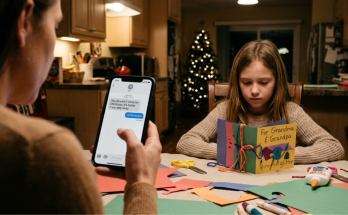
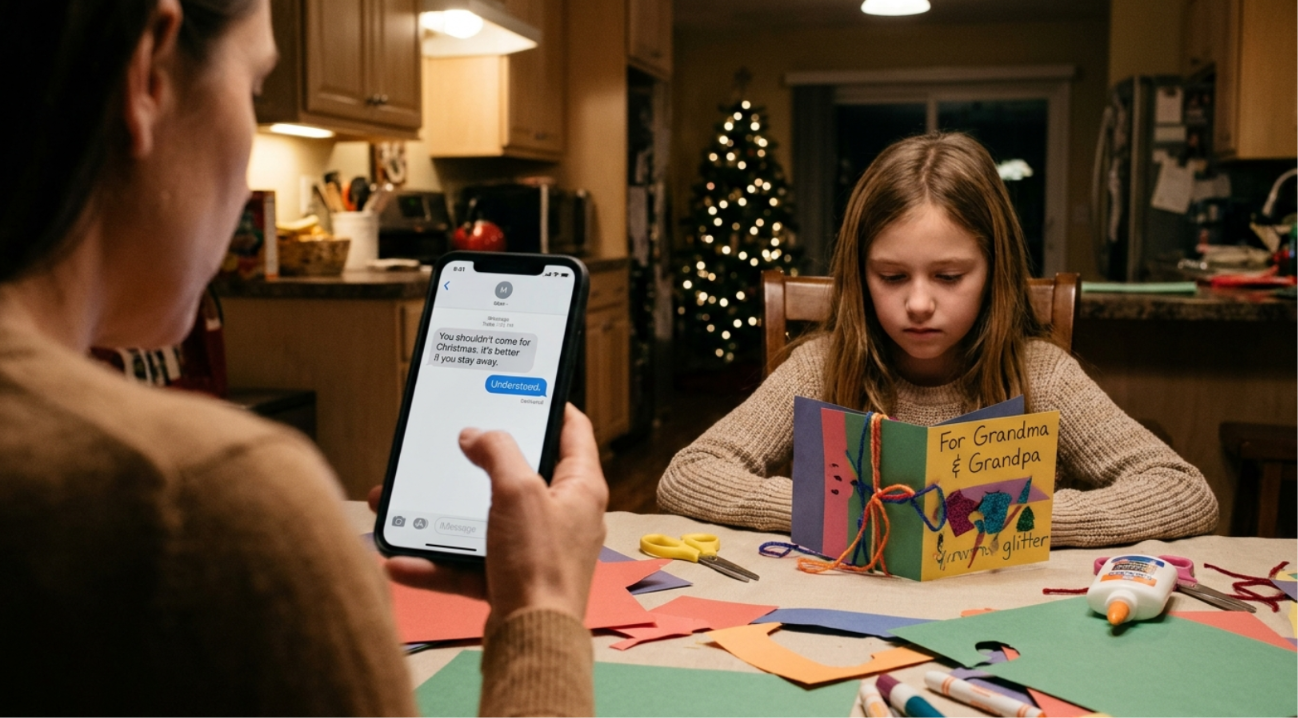
Before I could answer, she spoke quietly.
“Did my grandma call the police because my mom took back her own car?”
Nobody said anything for a moment.
The older officer crouched slightly so he was closer to her eye level.
“Sometimes adults disagree about things, sweetheart. But you haven’t done anything wrong.”
She nodded.
Then she asked something that made my chest tighten.
“Is Grandma still mad because I was going to come for Christmas?”
The officer glanced at me.
I swallowed.
“That’s a family matter,” I said gently. “But you’re not in trouble, honey.”
The officers finished their paperwork and left.
I locked the door.
My daughter went straight to her bedroom.
I followed her a few minutes later and found her sitting on the edge of her bed, holding the broken wooden box.
She had taken the gold stars off the lid and placed them in a small pile beside her.
“Mom?”
“Yes, sweetheart?”
“Did Grandma really not want me there?”
I sat beside her.
I could have invented an excuse. I could have told her Grandma was tired, confused, or having a bad day.
But children know when adults are lying to protect someone.
So I chose my words carefully.
“Grandma sent a message that was unkind. And it wasn’t your fault.”
“Maybe my cousins don’t like me.”
“That isn’t something you caused, either.”
She looked down at the broken lid.
“I just wanted to give her something.”
I wrapped my arms around her.
“I know.”
For several minutes, neither of us spoke.
Then she whispered, “Can we keep the stars?”
I smiled.
“Of course. We can put them on something else.”
She nodded and placed the stars in a little envelope.
That night, after she went to bed, I sat at the kitchen table and opened my banking app.
I had a habit of checking my accounts every Sunday. That evening, I started reviewing something else.
The family expenses.
For almost two years, I had been helping my parents financially.
It had started small.
Dad needed help with a utility bill.
Mom needed money for a dental appointment.
Their refrigerator stopped working.
Then came the property tax payment.
Then the insurance renewal.
Then the monthly prescription expenses.
I had never kept a strict record because they were my parents.
I had also been paying their family phone plan.
Three lines.
My parents and my sister.
My sister had told me she was going through a difficult period after her divorce, so I added her number when she asked for help.
I had also been paying the annual premium on a small life insurance policy my father had taken out years earlier, because he said he couldn’t manage the payment anymore.
And then there was the biggest expense.
My parents’ mortgage.
Not the entire mortgage, but a substantial portion of it.
Dad had retired earlier than expected, and Mom had explained that their savings were running low.
I had agreed to help temporarily.
That temporary arrangement had continued for fourteen months.
I opened the payment history.
The numbers were bigger than I remembered.
Much bigger.
I leaned back in my chair.
For years, I had convinced myself that helping family meant never asking questions.
But somewhere along the way, my help had become an expectation.
Nobody said thank you anymore.
Nobody asked whether I could afford it.
They simply assumed I would continue.
And when my ten-year-old daughter became inconvenient to their Christmas plans, they had no hesitation about excluding her.
I opened the family group chat.
There were pictures from previous Christmas celebrations.
My mother holding my sister’s youngest child.
My father sitting beside my sister’s children as they opened presents.
My daughter was in some of the photographs, but usually standing at the edge.
In one picture, she was sitting alone on the stairs while everyone else gathered around the Christmas tree.
I remembered that day.
She had been waiting for her grandmother to finish taking pictures with her cousins.
I had told her to be patient.
I had told her that Grandma would get to her eventually.
Looking at that photograph now, I wondered how many times I had asked my daughter to be patient with people who had never made an effort to include her.
At 11:47 p.m., my phone rang.
Mom.
I let it ring twice before answering.
“Barbara! What is going on?”
Her voice was sharp.
“Hello, Mom.”
“Don’t hello me. Your father is furious. The police came to our house and said you have the title. Why didn’t you tell us you were taking the vehicle?”
“I did tell you. I told you I needed it back.”
“When?”
“On the day you told my daughter she wasn’t welcome for Christmas.”
There was a pause.
“That has nothing to do with the car.”
“It has everything to do with the fact that you suddenly remembered my existence when you needed something.”
“Don’t be dramatic.”
I closed my eyes.
“Mom, you sent a message directly to a ten-year-old child telling her she shouldn’t come for Christmas.”
“Your sister’s children have been having a hard time.”
“And my daughter hasn’t?”
“That’s different.”
“How?”
“Because your daughter doesn’t live here. She doesn’t understand the situation.”
I stared at the wall.
“She’s ten, Mom. She understands perfectly well when someone tells her she isn’t wanted.”
My mother sighed.
“Barbara, you’re making this into something much bigger than it is. Your sister just wanted one peaceful Christmas.”
“And apparently, my daughter was the problem.”
“Don’t twist my words.”
“I’m not twisting anything. I’m repeating what you wrote.”
Then she said something that made me realize how little she understood what she had done.
“Besides, you always make everything about your daughter since your husband died.”
I went completely still.
My husband, Daniel, had been gone for two years.
He had been the person who made sure our daughter never felt alone, even when life became difficult.
After his death, I had tried to maintain relationships with my family because I wanted my daughter to have grandparents, aunts, and cousins.
I had made excuses for their behavior.
I had swallowed comments that should never have been made.
But hearing my mother use Daniel’s death as an argument against me was something I couldn’t ignore.
“Don’t ever use my husband’s death against me again.”
“Barbara—”
“Good night, Mom.”
I ended the call.
For the first time in a long time, I didn’t feel guilty.
I felt clear.
The next morning, I began making changes.
First, I contacted the insurance company and removed my parents from the authorized driver list.
Then I called the phone provider and arranged to transfer my sister’s line into her own account.
I also contacted the bank to cancel the automatic payments I had been making toward my parents’ mortgage.
I didn’t touch their accounts.
I didn’t interfere with their property.
I simply stopped paying bills that were not legally mine.
I kept records of every change.
I also sent Dad one message.
“Since you have your own transportation arrangements to make now, please do not use my vehicle again. The title, registration, and insurance are in my name. I have provided the police with the necessary documentation.”
His response came immediately.
“You have no idea what you’re doing. Your mother is crying.”
I didn’t respond.
At noon, Stacy came over.
She brought coffee and a box of pastries.
She had been my closest friend since college, and she had known Daniel almost as long as I had.
She listened while I explained everything.
When I finished, she shook her head.
“Barbara, how much have you actually been giving them?”
“I don’t know exactly.”
“Have you ever added it up?”
“Not until last night.”
She looked at me.
“And?”
I opened the spreadsheet I had started.
She read the numbers.
Then she slowly put down her coffee.
“Barbara…”
“What?”
“Do you realize how much this is?”
I nodded.
“I do now.”
She scrolled down.
“You’re paying part of their mortgage, their utilities, their phone bills, and other expenses?”
“Yes.”
“And your sister’s phone?”
“Yes.”
“Why?”
I looked toward the living room, where my daughter was coloring.
“Because I thought that’s what family did.”
Stacy shook her head.
“Family doesn’t mean one person carries everyone while her own child gets treated like an outsider.”
I didn’t answer.
She reached across the table and squeezed my hand.
“You don’t have to make a decision about forgiving anyone today. But you need to stop confusing love with unlimited access to your life.”
I knew she was right.
What I didn’t know was that my mother had already started telling people her own version of the story.
By the afternoon, my phone was filling with messages.
An aunt asked why I had embarrassed my parents.
A cousin said Christmas was supposed to be about forgiveness.
My sister sent a long paragraph accusing me of using money to control everyone.
I read it twice.
Then I noticed something.
She had written:
“You knew Mom and Dad depended on that SUV. You knew they couldn’t afford another vehicle. You waited until the worst possible time to take it away.”
I replied:
“They borrowed my vehicle. They did not own it.”
She responded almost instantly.
“You’ve changed since Daniel died.”
That sentence appeared again and again in messages from different relatives.
It was as if my family had decided that grieving had made me difficult, and that any boundary I set was proof that something was wrong with me.
I put the phone down.
My daughter walked into the kitchen.
“Mom, can I ask something?”
“Of course.”
“Are we still going to have Christmas?”
I looked at her.
“Yes, sweetheart.”
“Just us?”
I smiled.
“Just us, and anyone who makes us feel welcome.”
She thought about that for a moment.
Then she ran upstairs.
A few minutes later, she came back holding a piece of paper.
It was a drawing of a Christmas tree.
There were two people underneath it.
One tall woman and one little girl.
Above them, she had written:
“OUR CHRISTMAS.”
I put the drawing on the refrigerator.
And for the first time that week, I felt excited about the holiday.
But my family wasn’t finished.
Three days later, on December 23, my father appeared at my front door.
He wasn’t alone.
My mother stood behind him, holding a large handbag.
My sister was sitting in her car at the curb.
I opened the door but didn’t invite them inside.
Dad looked exhausted.
“Barbara, we need to talk.”
“About what?”
“Your mother and I have been discussing everything. We think this has gone too far.”
I waited.
He looked past me into the house.
“Can we come in?”
“Not right now.”
Mom stepped forward.
“Don’t be ridiculous. We’re your parents.”
“And I’m your daughter. Apparently, that didn’t matter when you decided my child wasn’t welcome.”
Mom’s expression hardened.
“Must you keep bringing that up?”
“Yes. Because nobody has apologized.”
Dad rubbed his forehead.
“Fine. We’re sorry about the message. Can we move on now?”
I looked at him.
“Did you apologize because you hurt her, or because you lost the car?”
He didn’t answer.
Mom crossed her arms.
“Barbara, we have a problem.”
I almost laughed.
Of course they did.
“The mortgage payment is due next week,” she continued. “Your father thought you were going to keep helping us through the winter.”
“I never promised that.”
“You said you would help us.”
“I said I would help temporarily. I have helped for fourteen months.”
Dad stepped forward.
“We’re not asking you to pay everything. Just continue until we get back on our feet.”
I looked at my mother.
“Did you ask my daughter to stay away because you couldn’t afford to have another grandchild at Christmas?”
“Don’t be absurd.”
“Then why?”
My mother looked away.
For a moment, I thought she might finally tell the truth.
Instead, she said, “Your sister’s children were expecting certain presents. They were already upset about sharing the holiday. We didn’t want another argument.”
I stared at her.
“So you chose to make a ten-year-old feel unwanted rather than tell your other grandchildren that everyone deserves to be included.”
“You’re taking this too personally.”
I took a breath.
“She’s my daughter. Of course I’m taking it personally.”
Dad looked toward the street.
“Can we please discuss the financial situation?”
“No.”
His face changed.
“What do you mean, no?”
“I mean I’m not discussing money until we discuss what happened to my daughter.”
Mom shook her head.
“You’re holding the entire family hostage over one message.”
“No, Mom. I’m finally refusing to let the entire family hold me hostage over money.”
Silence filled the doorway.
Then my sister got out of the car.
She walked toward us carrying a folder.
“Barbara, this is ridiculous. We all know you can afford to help them. Why are you pretending this is some huge sacrifice?”
I looked at her.
“Because it is my money.”
She opened the folder.
“Mom and Dad have expenses. The mortgage, insurance, utilities. They need stability.”
I glanced at the papers.
Then I noticed something.
It was a printed copy of a financial worksheet.
My sister had highlighted several amounts.
One of them was a monthly payment labeled FAMILY SUPPORT.
I looked more closely.
The number was exactly the amount I had been transferring to my parents every month.
“Where did you get this?”
She hesitated.
“Mom gave it to me.”
“Why?”
“Because we were trying to figure out the household budget.”
I looked at my mother.
“Why is my financial contribution listed as guaranteed income?”
Mom frowned.
“Because you’ve been helping us.”
“Helping isn’t the same as promising to pay forever.”
My sister suddenly became irritated.
“Well, if you’re stopping, someone has to make up the difference.”
I stared at her.
“Someone?”
She looked away.
“Never mind.”
But I had already understood.
They weren’t simply expecting me to help my parents.
They had been planning their household finances around my money without ever asking whether I intended to continue.
I folded the paper and handed it back.
“I’m done.”
Dad’s voice rose.
“Barbara, you can’t just walk away from your responsibilities!”
I looked directly at him.
“They’re your responsibilities, Dad. Not mine.”
He opened his mouth.
But before he could say anything, a small voice came from behind me.
“Grandpa?”
My daughter stood in the hallway.
She was holding the envelope containing the gold stars.
Dad turned.
For a moment, his expression softened.
“Hello, sweetheart.”
She looked at him, then at Grandma.
“I made something for Grandma.”
My mother glanced at the envelope.
“Oh.”
My daughter held it out.
“I saved the stars because the box broke. I thought maybe you could put them somewhere.”
Nobody moved.
Then my daughter added something that made even my sister look uncomfortable.
“But you don’t have to. I know you don’t want me at Christmas.”
My mother’s face changed.
“That’s not what I meant, darling.”
My daughter looked confused.
“But that’s what your message said.”
Mom reached out.
My daughter stepped back.
It was a small movement.
But it said more than any argument I could have made.
Dad looked at my mother.
For the first time, he seemed genuinely uncomfortable.
“Maybe we should go,” he said.
My sister turned toward him.
“We haven’t finished talking.”
“Not here,” he replied.
They walked down the driveway.
My mother looked back once.
I closed the door.
My daughter stood quietly for a moment.
Then she asked, “Can we still put the stars on our tree?”
I smiled.
“Absolutely.”
We spent the rest of the afternoon decorating.
She placed one gold star near the top of the tree and another beside a small photograph of Daniel.
When we finished, she stepped back.
“It’s beautiful,” she said.
And it was.
Not because it looked perfect.
But because nobody in that room had to earn the right to belong.
I thought that would be the end of the confrontation.
I was wrong.
At 9:12 that evening, my phone rang.
It was an unfamiliar number.
I answered cautiously.
“Hello?”
“Ms. Moore? This is Karen Mitchell. I’m a loan officer at the bank where your parents have their mortgage.”
I sat up.
“Is something wrong?”
“I hope not. I’m calling because your parents listed you as a financial supporter on a recent mortgage assistance application.”
My stomach tightened.
“What application?”
There was a pause.
“Your parents submitted documents requesting a modification to their mortgage payments. They included your name as someone who would continue making regular contributions toward their household expenses.”
I looked toward the Christmas tree.
“Did they include my bank statements?”
“Yes. We received several documents showing transfers from your account.”
“Did I sign anything?”
“That’s actually why I’m calling. There is a signature on one of the supporting documents that appears to authorize the bank to verify your income.”
I felt my hands go cold.
“I didn’t sign anything.”
Karen became quiet.
Then she said, “I thought that might be the case.”
I stood up.
“Can you tell me exactly what document you’re referring to?”
“I can explain what we received, but you’ll need to come into the branch with identification so we can review the file properly.”
“Was the application submitted recently?”
“Yes. Just last week.”
Last week.
Before the Christmas message.
Before I took back the SUV.
Before my parents had even admitted they were depending on my money.
I looked at my phone and opened the family group chat.
My sister had sent a photograph earlier that week.
It showed my parents sitting at their dining table with a pile of paperwork.
The caption read:
“Getting everything organized for the new year.”
I had thought nothing of it.
Now I wondered what else they had been organizing.
Karen continued.
“Ms. Moore, I don’t want to alarm you, but I recommend that you review the documents as soon as possible. If you did not authorize the use of your information, we need to document that.”
I thanked her and ended the call.
For several minutes, I sat without moving.
Then I opened my laptop.
I searched my email for the bank’s name.
There was a notification from six days earlier.
A document verification request.
I had ignored it because I thought it was another routine marketing email.
I clicked it.
A scanned document appeared.
My name was printed at the bottom.
And underneath it was a signature.
It looked almost exactly like mine.
Almost.
I zoomed in.
The first letter was wrong.
The final stroke was wrong.
And there was something else.
The document included a statement claiming that I had agreed to provide my parents with financial support for the next five years.
Five years.
I had never agreed to that.
I downloaded the document and saved a copy.
Then I printed it.
I was still staring at the signature when my phone vibrated.
A message from my sister appeared.
“Please don’t make things worse. Mom and Dad are already under enough stress. Whatever you find out, we can work it out privately.”
I read it twice.
She knew.
I didn’t know how much she knew, but she knew something.
I looked at the clock.
9:46 p.m.
I walked into my daughter’s bedroom.
She was asleep, her stuffed rabbit tucked beneath her arm.
I gently pulled the blanket over her shoulders.
Then I went back to the kitchen and placed the printed document inside the folder with my vehicle title.
The family had spent years assuming I would always rescue them.
They had mistaken my kindness for an obligation.
But this was different.
This wasn’t a forgotten favor or an unpaid bill.
Someone had used my name to make a financial commitment I had never agreed to.
And I was going to find out exactly who had done it.
The following morning, I would walk into that bank with every document I could find.
And if the signature on that application turned out to be what I suspected, Christmas would no longer be the biggest problem my family had to face.
The following morning, I woke up before sunrise.
My daughter was still asleep, so I made her breakfast, packed her a small lunch, and called Stacy.
She agreed to watch her while I went to the bank.
Before leaving, I kissed my daughter’s forehead.
“Mommy has something important to take care of. I’ll be back soon.”
She opened one eye.
“Are you going to Grandma’s?”
“No, sweetheart.”
“Good.”
I smiled, but that one word stayed with me all the way to the bank.
At 9:05 a.m., I walked into the branch carrying my folder.
Karen Mitchell was waiting for me.
She took me into a private office and placed a thick file on the desk.
“Before we begin,” she said, “I want you to know that we’ve temporarily paused the application because we couldn’t independently verify your authorization.”
I nodded.
“Thank you.”
She opened the file.
The first document was a mortgage assistance application.
The second was a financial support statement.
The third was a copy of my driver’s license.
I stared at it.
It was an old photocopy I had given my mother years earlier when she needed help completing some insurance paperwork.
I had never imagined she would use it for something like this.
Karen turned another page.
“Your parents listed you as a voluntary financial guarantor.”
I frowned.
“Guarantor?”
“Yes. The application indicates that you agreed to contribute $1,250 every month toward their housing expenses for the next five years.”
I felt my stomach tighten.
“That’s not true.”
“I understand. That’s why we haven’t proceeded.”
She pointed to the signature.
“Did you sign this?”
“No.”
“Did you authorize anyone to sign on your behalf?”
“No.”
Karen nodded.
“Then we need to document that formally.”
I took a breath.
“Can you tell me who submitted the application?”
She checked the file.
“Your father brought the paperwork into the branch. Your mother was listed as a supporting contact. There was also a letter attached explaining that your family had agreed to provide financial support.”
I looked at the final page.
There was another signature.
This one belonged to my sister.
She had written a statement confirming that I had agreed to help my parents.
I stared at it for a long time.
My sister hadn’t simply known about the financial arrangements.
She had helped present them as something permanent.
“Did my sister submit this?”
“She was listed as the person who prepared the supporting documents.”
I leaned back.
“Can I have copies of everything?”
“Certainly. We’ll also provide instructions for submitting a formal dispute.”
Karen paused.
“Ms. Moore, I recommend that you speak with an attorney before signing anything else.”
“I intend to.”
I left the bank with copies of the documents and a strange feeling of sadness.
Not because I had lost money.
Because my own family had been willing to put my name on something I had never agreed to.
That afternoon, I contacted an attorney named Michael Reynolds.
Stacy had recommended him several years earlier when she was dealing with a property dispute.
I explained everything.
He listened without interrupting.
When I finished, he said, “Barbara, we need to separate two issues. First, the vehicle. Second, the financial documents. The vehicle appears straightforward based on the title and your written loan arrangement. The financial application is more serious. We need to preserve the original records and determine whether anyone submitted a false authorization.”
“Could my parents be in trouble?”
“If someone knowingly used your identity or forged your signature, there may be legal consequences. But let’s establish the facts before drawing conclusions.”
I agreed.
He asked me to send him the bank documents.
Then he gave me another piece of advice.
“Don’t threaten anyone. Don’t delete messages. Don’t sign anything your family sends you. And don’t let anyone pressure you into handling this privately before we understand what happened.”
I promised.
For the next two days, I focused on my daughter.
We baked cookies.
We watched Christmas movies.
We made paper snowflakes and hung them in the windows.
She seemed happier than she had been in weeks.
But my family kept calling.
Dad left four voicemails.
Mom sent messages about how disappointed she was.
My sister alternated between anger and pleading.
Then, on Christmas Eve morning, Dad sent one message that was different.
“Your mother isn’t sleeping. We need to talk before this gets out of control. Please come over tonight.”
I showed it to Michael.
He advised me not to go alone and not to discuss the bank documents without him.
I decided to send one reply.
“I am willing to discuss the family situation when everyone is prepared to take responsibility. I will not discuss the bank application privately. My attorney is handling that matter.”
Dad replied:
“You’re bringing lawyers into a family disagreement?”
I didn’t answer.
A few hours later, something unexpected happened.
My aunt Patricia called.
She was my mother’s older sister, and unlike my parents, she had always treated my daughter kindly.
“Barbara, I need to ask you something.”
“Of course.”
“Did you really refuse to help your parents with their mortgage?”
I closed my eyes.
“Who told you that?”
“Your mother. She said you’ve suddenly stopped helping them and taken their vehicle away.”
I explained the situation.
I told her about the Christmas message, the car, and the bank application.
There was a long silence.
Then Patricia said, “Your mother told us something completely different.”
“What?”
“She said you had agreed to give your parents the SUV permanently, and that you suddenly took it back because your sister’s children didn’t want to share Christmas with your daughter.”
I almost couldn’t believe it.
“She said I gave them the car?”
“Yes. She said it was a gift.”
I looked at the folder on my table.
“That isn’t true.”
“I know. Your father called me last spring asking whether I could help him find a mechanic because he was borrowing your SUV. He specifically said it was yours.”
I let out a slow breath.
Patricia continued.
“There’s something else. Your sister has been telling people that your parents are financially supporting you.”
I frowned.
“What?”
“She said you were struggling after Daniel died and that your parents were helping with your expenses.”
I sat down.
It was almost funny.
I had been paying their bills, their mortgage contribution, and their phone plans.
Yet somehow, the story had become that they were supporting me.
“Why would she say that?”
“I don’t know, Barbara. But I think you need to hear something.”
“What?”
“Your mother called me last week. She asked whether I could lend them $8,000 because they were expecting a large financial problem in January.”
I went quiet.
“Did she explain why?”
“She said a family member had promised to help them, but that person was now refusing.”
I knew exactly who that family member was.
Me.
Patricia sighed.
“Barbara, I love your parents, but something isn’t right.”
“Thank you for telling me.”
Before hanging up, she said something I would remember for a long time.
“Don’t let anyone convince you that protecting your child is the same as destroying your family.”
That evening, my daughter and I prepared Christmas dinner.
It wasn’t fancy.
We made roast chicken, mashed potatoes, vegetables, and chocolate cake.
Stacy came over with her husband.
Patricia joined us later, bringing a small wrapped present for my daughter.
When my daughter opened it, she found a beautiful wooden jewelry box.
There was a little note inside.
“For the girl who makes every room brighter.”
My daughter smiled.
“Thank you, Aunt Patricia.”
Patricia hugged her.
Then she looked at me.
I could see tears in her eyes.
Nobody mentioned my mother.
Nobody asked why we weren’t at their house.
For the first time, Christmas felt peaceful.
After dinner, my daughter placed one of the saved gold stars on the wooden box Patricia had given her.
“Now it’s special,” she said.
Patricia smiled.
“Then we should keep it forever.”
I looked around the table.
And I realized something.
Family wasn’t necessarily the people who shared your last name.
Sometimes it was the people who noticed when a child was hurting and cared enough to do something about it.
But the biggest shock came two days later.
On December 27, Michael called.
“Barbara, I’ve reviewed the documents from the bank.”
“Okay.”
“I think we need to meet.”
I drove to his office that afternoon.
He had printed several pages and arranged them across his desk.
“There’s something unusual here,” he said.
He pointed to the financial support statement.
“The application says you agreed to provide $1,250 monthly for five years. But the attached bank records only show transfers from your account to your parents’ account. There is no signed agreement establishing that you accepted a five-year obligation.”
“I never did.”
“I believe you. But there’s another issue.”
He turned to the next page.
“This letter was submitted to explain your financial circumstances.”
I read it.
It described me as a widow with limited income who relied on her parents for financial assistance.
I looked up.
“That’s completely false.”
“I know.”
He placed another document beside it.
“This one is more concerning.”
It was a statement claiming that my parents had provided me with financial assistance totaling $42,000 over the previous two years.
I almost laughed.
They had not given me $42,000.
I had given them considerably more than that.
“Why would they do this?”
Michael folded his hands.
“The bank may have requested evidence that your parents had additional financial support. Someone appears to have tried to create a picture of a household where you were dependent on them and could therefore provide a stable financial commitment in return.”
I stared at the document.
“So they made it look like they were helping me so I could guarantee their mortgage?”
“That’s one possible explanation. We need the bank’s full records and a proper investigation.”
I felt sick.
Then Michael pointed to something at the bottom of the page.
“Look at the date.”
I leaned forward.
December 9.
That was more than a week before my mother sent the Christmas message.
The application had been submitted while they were still borrowing my SUV.
While I was still paying their bills.
While my daughter was making her grandmother a Christmas present.
They had already been arranging their finances around money they expected me to provide for five years.
And they hadn’t told me.
Michael continued.
“Have you ever given your sister access to your financial documents?”
“Not directly.”
“Has she ever helped you with paperwork?”
I thought for a moment.
Then I remembered.
Several months earlier, I had asked my sister to print some documents for me because my printer had stopped working.
I had emailed them to her.
One of those documents included a sample of my signature.
I looked at Michael.
“She may have had access to my signature.”
He nodded.
“That is something we should tell the bank.”
We submitted a formal written dispute.
The bank placed the application under review and confirmed that no loan modification or guarantee had been approved using my information.
Michael also advised me to report the suspected unauthorized use of my identity to the appropriate authorities.
I followed his advice.
I didn’t want revenge.
I wanted my name protected.
Three days later, my father called.
This time, I answered.
“Barbara, what have you done?”
I was standing in the kitchen, washing dishes.
“What are you talking about?”
“The bank has frozen the application. They want us to explain the documents.”
“Then you should explain them.”
“Your attorney is making this sound like fraud.”
“I didn’t create those documents, Dad.”
He went silent.
Then he said, “We were trying to keep the house.”
“I understand that.”
“You don’t understand anything. Your mother and I could lose everything.”
I put the plate down.
“Then you should have asked me for help honestly.”
“We thought you would agree.”
“Why?”
“Because you’re our daughter.”
I took a breath.
“And my daughter is your granddaughter. Yet you thought it was acceptable to tell her she wasn’t welcome for Christmas.”
Dad sighed.
“That was your mother’s decision.”
I stared at the phone.
“You’re her father. You were standing right there. You could have stopped it.”
He didn’t answer.
Then he said something I never expected.
“Your sister said the kids were getting upset whenever your daughter came around. She thought it would be easier if you stayed home.”
I felt my throat tighten.
“So everyone knew?”
“Barbara, I didn’t think it would hurt her that much.”
I closed my eyes.
“She’s ten years old, Dad. She made a present for Grandma. She spent the entire day decorating it because she thought Grandma would love it.”
“I know.”
“No, you don’t. Because if you did, you would have asked her how she felt before you asked me where the car was.”
He started crying.
I had never heard my father cry like that.
“Your mother is devastated.”
I didn’t soften.
“Then perhaps she should think about why.”
I ended the call.
For the next week, I heard nothing.
Then, on January 5, my mother sent me a long message.
It was the first time she had mentioned my daughter by name since Christmas.
“Barbara, I miss Emily. I hope she isn’t being taught to hate us. We made a mistake, but family should be able to forgive.”
I read it carefully.
Then I replied:
“Emily is not being taught to hate anyone. She is being taught that she deserves to be treated with kindness. If you want a relationship with her, you need to apologize to her directly, without excuses, and show through your actions that she matters.”
My mother didn’t respond.
Two days later, she arrived at my house.
Alone.
I opened the door.
She looked older than I remembered.
Her hair was untidy, and she was holding a small gift bag.
“Can I see Emily?”
“She’s doing homework.”
“Could I talk to her?”
I considered it.
Then I stepped aside.
Emily came downstairs a few minutes later.
She stopped when she saw her grandmother.
“Hello, Grandma.”
Mom’s eyes filled with tears.
“Hello, sweetheart.”
She placed the gift bag on the table.
“I brought you something.”
Emily didn’t reach for it.
My mother looked uncomfortable.
“I wanted to say I’m sorry about Christmas.”
Emily looked at her.
“Why didn’t you want me there?”
Mom opened her mouth.
Then closed it.
I watched her struggle.
Finally, she said, “I thought your cousins would be upset, and I made a selfish decision. I should never have sent you that message.”
Emily looked down.
“Did I do something wrong?”
“No, darling. You did absolutely nothing wrong.”
“Then why did you say it would be easier if I stayed away?”
My mother’s face crumpled.
“Because I was wrong.”
There was a long silence.
Then Emily asked, “Did you like my present?”
My mother started crying.
“I never saw it, sweetheart.”
Emily disappeared into the living room.
A moment later, she returned with the envelope of gold stars.
“I saved these.”
Mom covered her mouth.
“I wanted to give you the box, but I broke it because I thought you didn’t want it.”
My mother began sobbing.
I felt tears gathering in my own eyes, but I remained quiet.
This was not my apology to give.
It belonged to my daughter.
Mom knelt in front of her.
“Emily, I am so sorry. You should never have felt unwanted by me. I love you.”
Emily looked at her for a long time.
Then she asked, “Will you tell my cousins that I’m a real grandchild?”
My mother froze.
That question was the one nobody in our family had wanted to answer.
Finally, she nodded.
“Yes. I will.”
Emily didn’t hug her immediately.
She simply placed the envelope on the table.
“These are for you. But I don’t want to make another present until I know you want me there.”
My mother nodded through her tears.
“That’s fair.”
After my mother left, Emily came to sit beside me.
“Mom?”
“Yes?”
“Can Grandma come to our house sometimes?”
I kissed her forehead.
“That’s something we can decide slowly.”
She nodded.
And that was how we began.
Not with a dramatic reconciliation.
Not with everything suddenly becoming perfect.
Just one small step.
But the bank investigation was still ongoing.
In February, Michael informed me that the bank had completed its review.
They confirmed that the financial support statement had not been authorized by me.
The bank removed my name from the application and documented my dispute.
The matter involving the suspected forged signature was referred for further review.
My parents were required to submit corrected financial information and arrange their mortgage payments without counting on my money.
I also received confirmation that my identity documents had been flagged for additional verification.
My sister called me after hearing the news.
She sounded furious.
“Do you realize what you’ve done? Mom and Dad have to restructure everything now.”
“I know.”
“You could have just signed the paper.”
“No.”
“It was only to help them qualify.”
“Then why didn’t you ask me?”
She went quiet.
Finally, she said, “Because you would have said no.”
I leaned back in my chair.
At least she had finally told the truth.
“Yes,” I replied. “I would have said no to signing a five-year financial guarantee I never agreed to.”
She started crying.
“You’re making me look like a terrible person.”
I answered quietly.
“I’m not making you look like anything. I’m simply refusing to take responsibility for something I didn’t do.”
She hung up.
I didn’t call her back.
Over the following months, my parents made other arrangements.
They sold some expensive furniture, reduced their monthly expenses, and worked with the bank on a payment plan they could manage.
They eventually traded their financial situation for something more realistic.
It wasn’t easy.
But they survived.
And I learned something important.
Helping people should never require you to surrender your financial security, your dignity, or your child’s happiness.
By April, my mother had started visiting occasionally.
She brought groceries sometimes.
She called Emily on her birthday.
She attended a school art exhibition and stayed until the end.
But I established boundaries.
No more automatic payments.
No more shared financial responsibilities.
No more assuming that family members could use my documents or money without asking.
My father apologized too, although it took him longer.
One afternoon, he came to my house with a small wooden box.
It was beautifully made.
He had carved a little heart into the lid.
“I thought Emily might like this,” he said.
I looked at it.
“Did you make it?”
He nodded.
“Your grandfather taught me woodworking. I thought I’d try again.”
Emily came into the room.
“Is that for me?”
Dad smiled.
“If you want it.”
She opened the box.
Inside was a small silver star necklace.
Her eyes widened.
“It’s beautiful.”
Dad sat down beside her.
“I should have stood up for you at Christmas. I didn’t, and I’m sorry.”
Emily looked at him.
“Are you going to let me come next Christmas?”
Dad swallowed.
“Yes. If you’ll come.”
She thought for a moment.
“Only if nobody tells me I’m not a real grandchild.”
Dad’s eyes filled.
“Nobody will.”
I watched them.
I didn’t know whether everything would ever be the same.
Perhaps it shouldn’t be.
Some things change the way you see people permanently.
But I was willing to let time show me whether they could become better.
And then Christmas came around again.
This time, my mother called in November.
“Barbara, we’re planning Christmas dinner. We’d love to have you and Emily. Your sister and her children will be there, too.”
I didn’t immediately say yes.
I asked one question.
“Will Emily be welcomed?”
“Yes,” Mom answered. “And if anyone makes her feel otherwise, I’ll handle it.”
I considered her answer.
Then I said, “We’ll come for dinner, but we’ll drive separately.”
“Of course.”
On Christmas afternoon, Emily and I arrived at my parents’ house.
The tree was decorated.
The dining table was full.
My sister was there with her children.
For a moment, I worried that nothing had really changed.
Then my mother’s youngest grandchild ran toward Emily.
“Come see! Grandma put your name on the present table!”
Emily looked at me.
I nodded.
She ran inside.
On the table were several wrapped presents.
Every grandchild had one.
Emily found hers.
It was a small wooden craft set.
My mother approached her.
“I thought you might enjoy making another box.”
Emily smiled.
“Thank you, Grandma.”
It wasn’t a perfect Christmas.
My sister barely spoke to me.
My father seemed nervous.
There were awkward moments.
But nobody excluded Emily.
And when we sat down for dinner, my mother made an announcement.
“I want to say something before we eat.”
Everyone looked up.
“I made a mistake last year. I allowed my own worries and other people’s expectations to make me treat one of my grandchildren unfairly. That was wrong, and I am sorry.”
She looked directly at Emily.
“You belong here just as much as everyone else.”
Emily smiled.
Then she reached for her grandmother’s hand.
It wasn’t a magical solution to everything.
But it was a beginning.
Later that evening, as Emily and I drove home, she leaned against the window.
“Mom?”
“Yes, sweetheart?”
“Christmas was nice this year.”
I smiled.
“I’m glad.”
She was quiet for a moment.
Then she asked, “Do you think Grandma really changed?”
I thought about the question.
“I think she’s trying. But we’ll pay attention to what people do, not just what they say.”
Emily nodded.
Then she looked down at the little wooden box she had made during the afternoon.
This one had blue paint, silver stars, and a crooked heart.
She had decided to give it to her grandmother.
I glanced at it.
“That’s beautiful.”
She smiled.
“I made this one because I wanted to. Not because I had to.”
I reached over and squeezed her hand.
“That’s exactly how it should be.”
When we got home, I placed Daniel’s photograph on the living room shelf.
I stood there for a moment, looking at his smile.
I wished he could have seen how much our daughter had grown.
I wished he could have been there when she stood up for herself without even realizing how brave she was.
But I also knew he would have been proud of her.
I had spent years believing that keeping a family together meant sacrificing whatever was necessary.
I thought being a good daughter meant saying yes.
I thought being a good sister meant never making things uncomfortable.
And I thought being a good mother meant protecting my child from disappointment by making excuses for everyone else.
I was wrong.
Being a good mother sometimes means closing a door.
It means refusing to let people hurt your child simply because they share your last name.
It means teaching your children that love should never come with a price tag attached.
My parents once believed they couldn’t manage without my money, my vehicle, and my constant help.
My sister believed I would always step aside to make things easier for her.
They had all taken my kindness for granted.
But the greatest thing I took back that Christmas wasn’t an SUV.
It wasn’t money.
It wasn’t even control over my own life.
It was my daughter’s understanding of her own worth.
And that was worth more than anything I had ever given my family.
Because the little girl who once sat quietly holding a broken Christmas present had learned something important.
She didn’t need to beg anyone to make room for her.
She already belonged.
And from that day forward, I made sure she never forgot it.
I Thought My Parents Would Always Make Room for My Daughter, Until One Christmas Message Made Me Question Everything I Had Excused
I used to believe that being a good daughter meant helping my parents without expecting anything back.
I never thought that belief would leave my own child standing outside the family she loved.
My name is Barbara Moore.
I was a widow raising a ten-year-old daughter named Emily.
My husband, Daniel, had died two years earlier.
Before he died, I had never imagined how difficult ordinary family gatherings could become.
I thought grandparents loved their grandchildren equally.
I thought Christmas was one time of year when nobody had to wonder whether they belonged.
I was wrong about both things.
The first time I understood that something had changed, Emily was preparing a Christmas present for her grandmother.
It was a small wooden box.
Nothing expensive.
Nothing anyone would have noticed in a store window.
But Emily had spent hours working on it.
She had decorated the lid with little gold stars.
She kept checking the glue, pressing down the corners, and asking whether the stars looked straight.
I told her they looked lovely.
She smiled and went back to work.
I watched her from the kitchen.
She had Daniel’s habit of concentrating so hard that she forgot everything around her.
When he was alive, he would have sat beside her and helped.
He would have found a way to make even a crooked decoration look special.
I still missed those small moments.
The ones nobody photographs.
The ones that disappear before you realize they mattered.
Emily held up the box.
“Do you think Grandma will put something inside it?”
“I think she could.”
“Maybe her rings.”
“Maybe.”
Emily turned the box over in her hands.
“I want her to know I made it myself.”
I smiled.
“She’ll know.”
I believed that when I said it.
That was the part I would regret later.
I had spent so much time reassuring Emily that my family loved her that I had stopped checking whether their behavior supported what I was saying.
My sister had children of her own.
My parents were deeply involved in their lives.
They attended celebrations.
They helped with presents.
They made plans around their schedules.
I had always accepted that arrangement.
My sister’s children spent more time at my parents’ house.
Emily lived with me.
We had our own routines.
After Daniel died, I wanted Emily to stay close to the family.
I wanted her to have familiar people around her.
People who remembered her father.
People who could make the holidays feel normal again.
So I made an effort.
I called.
I visited.
I adjusted our schedules.
And when things felt uncomfortable, I explained them away.
Grandma was busy.
Grandpa was tired.
The cousins had already made plans.
There was always a reason.
I didn’t realize how often Emily was the person expected to understand.
Then the Christmas message arrived.
My mother had decided that Emily should not come to the family celebration.
The explanation was that my sister’s children were having a difficult time.
Apparently, having Emily there might upset them.
My mother thought it would be easier if my daughter stayed away.
Easier.
That word stayed with me.
My daughter was ten years old.
She had lost her father.
She had spent days making something for her grandmother.
And somehow her presence had become a problem that needed solving.
I looked at the message several times.
I wanted to believe I had misunderstood.
I wanted to call my mother and ask whether she had made a mistake.
But the words were clear.
She had sent the message directly to Emily.
Not to me.
To my child.
I could hardly believe that part.
If my mother had concerns about Christmas, she could have called me.
She could have explained whatever disagreement existed among the children.
She could have asked us to talk.
Instead, she had placed the rejection in front of a little girl.
Emily didn’t argue.
She didn’t demand an explanation.
She looked at the message, and I watched her face change.
That hurt more than anger would have.
“Mom?”
“Yes, honey?”
“Does Grandma not want me to come?”
I sat beside her.
I had answered difficult questions since Daniel died.
Questions about why people die.
Questions about whether a person can know how much we miss them.
Questions I sometimes couldn’t answer myself.
But this one was different.
An adult had created the hurt.
An adult who should have known better.
I told Emily that she had done nothing wrong.
I told her the grown-ups would have to answer for their own decisions.
She lowered her eyes.
“Okay.”
One word.
No argument.
I hated how quickly she accepted it.
I wanted her to be angry.
I wanted her to know she deserved better.
Instead, she looked toward the wooden box on the table.
I could see what she was thinking.
There was no Christmas visit.
There would be no moment when she handed Grandma the present.
I tried to reach for her hand.
She pulled it gently into her lap.
“Can I go upstairs?”
“Of course.”
I watched her leave.
Then I stayed at the table with the message still open on my phone.
I read it again.
I tried to imagine Daniel hearing those words.
He had always been careful about the way adults treated Emily.
He never expected people to be perfect.
But he believed a child should never have to compete for a place in her own family.
I had forgotten how firmly he believed that.
Or maybe I had been too tired to remember.
After losing him, keeping my family close had felt important.
I thought I was preserving something for Emily.
Looking back, I was sometimes preserving relationships that made her feel small.
That realization embarrassed me.
I was her mother.
I should have noticed sooner.
That day, I decided we would not spend Christmas begging anyone to include us.
And I began thinking about something else.
My SUV.
My parents had been using it for a long time.
At first, they had asked to borrow it.
I had agreed.
It seemed like a simple way to help.
I remembered the messages clearly.
When they first asked, I had told them they could use it and return it when they were finished.
Three months later, my father had contacted me again.
They still needed the vehicle.
He wanted to keep it longer.
I had agreed again.
I hadn’t written a contract.
I hadn’t demanded rent.
They were my parents.
The SUV remained registered to me.
The title was in my name.
I paid the insurance.
It had never been a gift.
I had simply allowed them to use something I owned because I trusted them to respect that arrangement.
That trust had felt ordinary at the time.
The same way helping with a bill felt ordinary.
The same way saying yes felt ordinary.
I had built a habit of making life easier for them.
And somewhere along the way, it had become difficult for me to see the difference between helping and being expected to provide.
When my mother rejected Emily, I asked for the SUV back.
I knew my parents depended on it.
I knew the timing would upset them.
But I also knew I had a right to use my own vehicle.
My decision wasn’t about punishing them for having financial problems.
I was tired of being treated as someone whose possessions were available whenever the family wanted them.
I was tired of hearing that Emily needed to understand while everyone else got what they wanted.
My parents did not accept my decision calmly.
They behaved as though the SUV belonged to them because they had been using it.
That was when I learned something about long favors.
If they continue long enough, some people stop remembering that they were favors.
I retrieved my SUV.
I had the title and registration to prove I owned it.
I thought that would settle the disagreement.
Instead, my parents contacted the police.
When officers came to my house, I almost couldn’t believe what was happening.
Emily was home.
The SUV was mine.
Yet I was standing in my own living room explaining why I had taken back a vehicle I had purchased and maintained.
I showed the officers my documentation.
The title.
The registration.
The insurance information.
Then I opened the old messages.
I found the first conversation where my father had asked to borrow the SUV.
I showed the officers my response.
I had told him he could use it until he no longer needed it.
Then I showed them the later exchange.
My father had asked for more time.
I had given it to him.
The older officer read each message without interrupting.
I waited.
I could hear Emily moving quietly behind me.
Finally, the officer looked up.
“From what you’ve shown us, this is a disagreement about a borrowed vehicle. You’re the registered owner, and these messages support that.”
I nodded.
He explained that they would record my statement and contact the people who had made the report.
He didn’t treat me like someone who had stolen anything.
I felt relieved.
But relief wasn’t the same as peace.
I had never expected my parents to involve the police over something they knew belonged to me.
The younger officer looked toward Emily.
“Are you doing all right?”
She hesitated.
Then she asked him whether Grandma had called the police because I had taken my own car home.
The room became quiet.
I felt ashamed.
Not because I had done anything wrong.
Because my child had been pulled into another adult disagreement.
The older officer bent slightly to speak to her.
He explained that adults sometimes had conflicts over property and that none of it was her responsibility.
Emily nodded.
Then she asked about Christmas.
“Is Grandma angry because I wanted to come?”
I felt my throat tighten.
The officer glanced at me.
I knew he couldn’t answer.
Neither could I.
Not in a way that would make sense to her.
I told Emily that she was not in trouble and that the decisions Grandma made belonged to Grandma.
She looked down at the floor.
The officers completed their notes.
They told me they would follow up with my parents.
Then they left.
I closed the front door.
The house became quiet.
For a while, I stood with one hand resting on the lock.
I had spent years trying to prevent family disagreements.
Now the police had been in my living room.
And my daughter was wondering whether she had caused it.
I went upstairs.
Emily was in her bedroom.
She sat on the edge of the bed with the little wooden box in her lap.
The lid was broken.
The gold stars had been removed.
They lay beside her on the blanket.
I stood in the doorway.
She looked up.
“Mom?”
“Yes?”
“Did Grandma really mean it?”
I went over and sat beside her.
I wanted to tell her no.
I wanted to invent an explanation that would make her grandmother seem kinder.
But I had already spent too much time making excuses.
So I told her the truth as gently as I could.
“Grandma made a hurtful choice. You didn’t cause it.”
Emily touched one of the stars.
“Maybe my cousins don’t like having me there.”
“That doesn’t mean there’s anything wrong with you.”
She looked at the broken box.
“I thought Grandma would want my present.”
I put my arm around her.
“I know you did.”
She leaned against me.
Neither of us spoke for a while.
Then she picked up a gold star.
“Can I save these?”
“Yes, sweetheart.”
“Even though the box is broken?”
“Especially then.”
She found a small envelope.
One by one, she placed the stars inside.
She pressed the flap closed.
Then she set it carefully on her bedside table.
I looked at that envelope for a long time.
A few hours earlier, those stars had been part of a gift made with love.
Now they were the pieces Emily had managed to save.
I didn’t know what would happen with my parents.
I didn’t know whether they would apologize.
But I knew I couldn’t keep teaching my daughter to accept being pushed aside.
That evening, after she went to sleep, I walked into the kitchen.
I opened my laptop.
Then I signed into my bank account.
I had decided to examine every financial favor I had been doing for my family.
I expected the numbers to make me uncomfortable.
I didn’t expect them to change the way I understood the past two years.
Click here to continue reading: PART 2: When I Finally Counted the Bills I Had Quietly Paid for My Family, I Realized My Daughter Had Been Giving Up More Than Money
My Mom Told My 10-Year-Old Daughter to Stay Away From Christmas—So I Took Back My SUV and Stopped Paying Their Bills, Until Their Fake Financial Agreement Exposed Everything.
Part 1 of 15