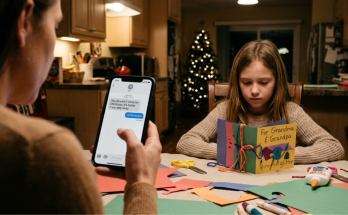
I read my mother's message on January 5.
Then I read it again.
She said she missed Emily.
She hoped I wasn't teaching my daughter to hate her grandparents.
She admitted that mistakes had been made.
Then she reminded me that families should forgive one another.
I stared at the screen.
There it was again.
Forgiveness.
My mother had used the word before.
Other relatives had used it.
It always seemed to appear when someone wanted me to stop talking about what happened.
But forgiveness didn't change the original message.
It didn't erase the broken wooden box.
It didn't make Emily forget that her grandmother had asked her not to come for Christmas.
I set my phone down.
I needed to think before answering.
My mother wasn't wrong to want a relationship with her granddaughter.
I wanted that too.
I had wanted it for years.
That was why I kept arranging visits.
Why I encouraged Emily to call.
Why I made excuses when my parents gave more attention to my sister's children.
I didn't want Emily to grow up without grandparents.
She had already lost Daniel.
I knew how much she missed her father.
But I was beginning to understand that a relationship wasn't automatically healthy just because the people were related.
A grandparent could love a child and still hurt her.
A parent could want reconciliation without accepting responsibility.
And a child could miss someone while also feeling afraid of being rejected again.
I had to remember all of that.
I opened my mother's message.
Then I wrote a reply.
I told her Emily wasn't being taught to hate anyone.
I wasn't telling her to reject her grandparents.
I wasn't asking her to carry my anger.
I was teaching her that she deserved kindness.
Then I explained what my mother needed to do.
If she wanted to rebuild her relationship with Emily, she needed to apologize directly.
No blaming the cousins.
No excuses about Christmas being stressful.
No suggestions that Emily had misunderstood.
She needed to acknowledge what she had done.
And after that, she needed to show through her behavior that Emily mattered.
I read the message before sending it.
Then I pressed send.
My mother didn't respond.
I checked my phone once later that day.
Nothing.
The next morning, still nothing.
I wasn't surprised.
My mother had never been comfortable admitting she was wrong.
She could apologize for making someone upset.
But she usually wanted the other person to accept part of the blame.
This situation didn't allow that.
Emily was ten.
She had done nothing wrong.
I wasn't going to ask her to apologize for feeling hurt.
Two days after my mother's message, someone knocked on the front door.
I wasn't expecting visitors.
I looked through the window.
My mother stood on the porch.
Alone.
There was no sign of Dad.
No car with my sister waiting inside.
Mom was holding a small gift bag.
I opened the door.
For a moment, neither of us spoke.
She looked tired.
Her hair wasn't arranged the way she usually liked it.
Her face seemed older.
I wondered how much of that was worry about the mortgage.
How much was anger.
And how much, if any, came from understanding what she had done to Emily.
I stepped into the doorway.
"Hello, Mom."
She looked at me.
"Is Emily home?"
"She's doing homework."
Mom nodded.
Then she asked if she could speak with her.
I hesitated.
I didn't want to put Emily in another situation where an adult expected her to make everything comfortable.
I also didn't want to deny her the opportunity to hear a real apology.
I looked at the gift bag.
Then at my mother.
"Are you here to apologize?"
She lowered her eyes.
"Yes."
I studied her for a moment.
Then I stepped aside.
I told her Emily was upstairs.
I asked her to wait in the living room.
She went inside.
I walked to the stairs.
I called Emily.
She came down a few minutes later.
She stopped when she saw Grandma.
Her expression changed immediately.
She didn't look frightened.
But she wasn't excited either.
She stood near the bottom of the stairs.
"Hi, Grandma."
My mother's eyes filled.
"Hello, sweetheart."
Mom held up the gift bag.
"I brought you something."
Emily looked at it.
She didn't move.
I stayed nearby.
I wanted my daughter to know I wasn't leaving her alone with a conversation she hadn't asked for.
My mother placed the bag on the table.
Then she said she wanted to apologize for Christmas.
Emily looked at her.
I could see she was trying to understand.
"Why didn't you want me to come?"
Mom opened her mouth.
Then she stopped.
I watched her struggle.
For a moment, I thought she would return to the same explanation.
Your cousins were upset.
Things were difficult.
We thought it would be easier.
I had heard those words before.
Emily had heard enough of them too.
But my mother didn't say them immediately.
She looked down.
Then she admitted that she had been thinking about my sister's children.
She had worried they would become upset.
She had chosen to keep Emily away instead of dealing with their feelings.
Mom said it was selfish.
She said she should never have sent that message.
I felt something loosen inside me.
Not forgiveness.
Not yet.
But at least she was beginning to name what she had done.
Emily stood quietly.
Then she asked another question.
"Was I bad?"
My mother shook her head.
"No, honey."
Emily didn't look satisfied.
"Then why was it easier if I stayed home?"
I looked at my mother.
There was no answer that could make the decision kind.
There was no way to explain it without admitting that Emily had been treated unfairly.
Mom began crying.
She told Emily that she had made the wrong choice.
She said the problem had not been anything Emily did.
I watched my daughter.
She looked down at her hands.
I wanted to reach for her.
But I waited.
This was her conversation.
Her grandmother had hurt her.
And her grandmother needed to hear what that meant.
After a moment, Emily looked up.
"Did you like my present?"
My mother seemed confused.
She said she hadn't seen it.
Emily nodded slowly.
Then she went into the living room.
I watched her walk toward the Christmas decorations.
She returned holding the small envelope.
The saved gold stars were inside.
She held it carefully.
"I kept these."
Mom looked at the envelope.
Emily explained that she had made a wooden box.
She had decorated it for Grandma.
But after reading the Christmas message, the box had broken.
She had saved the stars because she didn't want to throw everything away.
My mother covered her mouth.
Then she began sobbing.
I felt tears in my own eyes.
I remembered finding Emily on her bed with the broken lid in her lap.
I remembered how she had asked whether Grandma really didn't want her.
I remembered wanting to give her an answer that wouldn't hurt.
Now my mother was seeing part of what her decision had caused.
I didn't try to comfort her.
I didn't tell Emily to hug her.
I didn't ask anyone to move on.
I simply stood there.
Mom lowered herself in front of Emily.
She looked into her face.
Then she apologized again.
She told her that no child should feel unwanted by her grandmother.
She said she loved her.
She said she was sorry for making Emily believe otherwise.
Emily listened.
Her face was serious.
She didn't immediately step forward.
Then she asked something I hadn't expected.
"Will you tell my cousins I'm really your grandchild too?"
My mother froze.
I felt my chest tighten.
I looked at Emily.
She hadn't told me she was carrying that question.
Not directly.
But it explained so much.
The photograph of her alone on the stairs.
The way she waited for attention.
The message excluding her from Christmas.
The fear that her cousins didn't like her.
Somewhere along the way, Emily had started wondering whether she belonged to her own family in the same way they did.
I felt sick.
My mother looked at me briefly.
I didn't speak.
She needed to answer Emily.
Not me.
Emily waited.
Finally, Mom nodded.
She said she would make sure her cousins understood that Emily was every bit as much her grandchild as they were.
I watched Emily's face.
She seemed to consider the answer.
Then she placed the envelope on the table.
"These are for you."
My mother reached toward it.
Emily continued.
She said she didn't want to make another present until she knew Grandma wanted her there.
I looked away for a moment.
There was no anger in the sentence.
No attempt to punish.
Emily was simply explaining what she needed before trusting her grandmother again.
My mother nodded.
She said that was fair.
Then she thanked her for the stars.
The gift bag remained on the table.
Emily hadn't asked to open it.
I didn't encourage her.
The gift wasn't what mattered.
I was glad my mother had finally apologized.
But I didn't want a present to become a substitute for changed behavior.
Mom stayed only a little longer.
She didn't ask me about the mortgage.
She didn't mention the bank.
She didn't accuse me of bringing a lawyer into the family.
For once, the conversation remained about Emily.
I was grateful for that.
Before leaving, Mom looked at her granddaughter again.
She said she loved her.
Emily nodded.
Then my mother left.
I closed the door.
I stood there for a moment.
My hands were shaking slightly.
I hadn't expected the conversation to affect me so strongly.
I had prepared myself for excuses.
I had prepared myself for anger.
I had prepared myself to ask my mother to leave if she began blaming Emily.
Instead, she had apologized.
Not perfectly.
Not in a way that erased the past.
But she had acknowledged the harm.
I went into the living room.
Emily was sitting on the couch.
I sat beside her.
For a while, neither of us spoke.
Then she leaned against me.
"Mom?"
"Yes?"
"Can Grandma visit us sometimes?"
I looked at her.
I wanted to say yes.
I also wanted to protect her from being hurt again.
So I told her we could decide slowly.
We didn't have to make a permanent decision that day.
We could see how Grandma behaved.
Emily nodded.
She seemed comfortable with that.
Then she rested her head on my shoulder.
I kissed the top of her hair.
I felt proud of her.
She had asked difficult questions.
She had listened.
She had told her grandmother what she needed.
And she hadn't pretended everything was fine just to make an adult feel better.
I wished I had learned to do that when I was ten.
Instead, I had spent much of my life believing that keeping people happy was my responsibility.
I didn't want Emily to inherit that habit.
That evening, I thought about my mother's apology.
I wanted to believe she meant it.
I wanted to believe the next family gathering would be different.
But I knew that one conversation couldn't undo years of unequal treatment.
Trust would have to return through ordinary actions.
A phone call.
A visit.
A kind word.
A willingness to include Emily without being reminded.
I was prepared to notice those things.
I was also prepared to notice if nothing changed.
That was the difference.
Before Christmas, I had tried to preserve relationships by overlooking the parts that hurt.
Now I was willing to let those relationships become whatever people's actions showed they could be.
I looked toward the tree.
Daniel's photograph was still there.
The gold star beside it had stayed in place.
I smiled faintly.
He would have understood why I was being careful.
He wouldn't have expected me to shut everyone out forever.
But he wouldn't have wanted Emily to be pushed aside again.
I knew that much.
The next few days were quieter.
My mother didn't suddenly begin visiting every afternoon.
I didn't invite everyone over to celebrate a reconciliation.
Emily continued going to school.
I continued managing our household.
The wooden jewelry box remained on her dresser.
The blue envelope was no longer there.
She had given it to Grandma.
That was her choice.
I respected it.
Meanwhile, the financial investigation continued.
Michael kept me informed.
The bank was reviewing the disputed application.
There were questions about the authorization.
Questions about the supporting statements.
Questions about information that had been submitted in my name.
I had already provided the documents I possessed.
I had reported the suspected unauthorized use of my identity.
Now I had to allow the review to proceed.
I didn't enjoy waiting.
I worried about what would happen if the bank accepted my family's version of events.
Then I reminded myself that I had records.
Actual transfers.
Actual ownership documents.
Actual messages.
I didn't need to rely on my parents' memories or my sister's explanations.
I had evidence.
That thought helped.
In February, Michael contacted me with an update.
The bank had completed its review.
I listened carefully as he explained what they had confirmed.
My authorization had not been established.
The disputed financial support statement was not valid as a commitment from me.
And my name would no longer be used in my parents' mortgage assistance application.
I closed my eyes.
For the first time since Karen Mitchell called, I felt genuine relief.
The bank had not approved the five-year guarantee.
My name was being removed from the application.
But there were still consequences for the paperwork that had been submitted.
And my parents would now have to face their financial situation without relying on me.
Click here to continue reading: PART 8: The Bank Removed My Name From Their Mortgage Application, and My Sister Finally Admitted Why Nobody Had Asked for My Permission
My Mom Told My 10-Year-Old Daughter to Stay Away From Christmas—So I Took Back My SUV and Stopped Paying Their Bills, Until Their Fake Financial Agreement Exposed Everything.
Part 7 of 15