
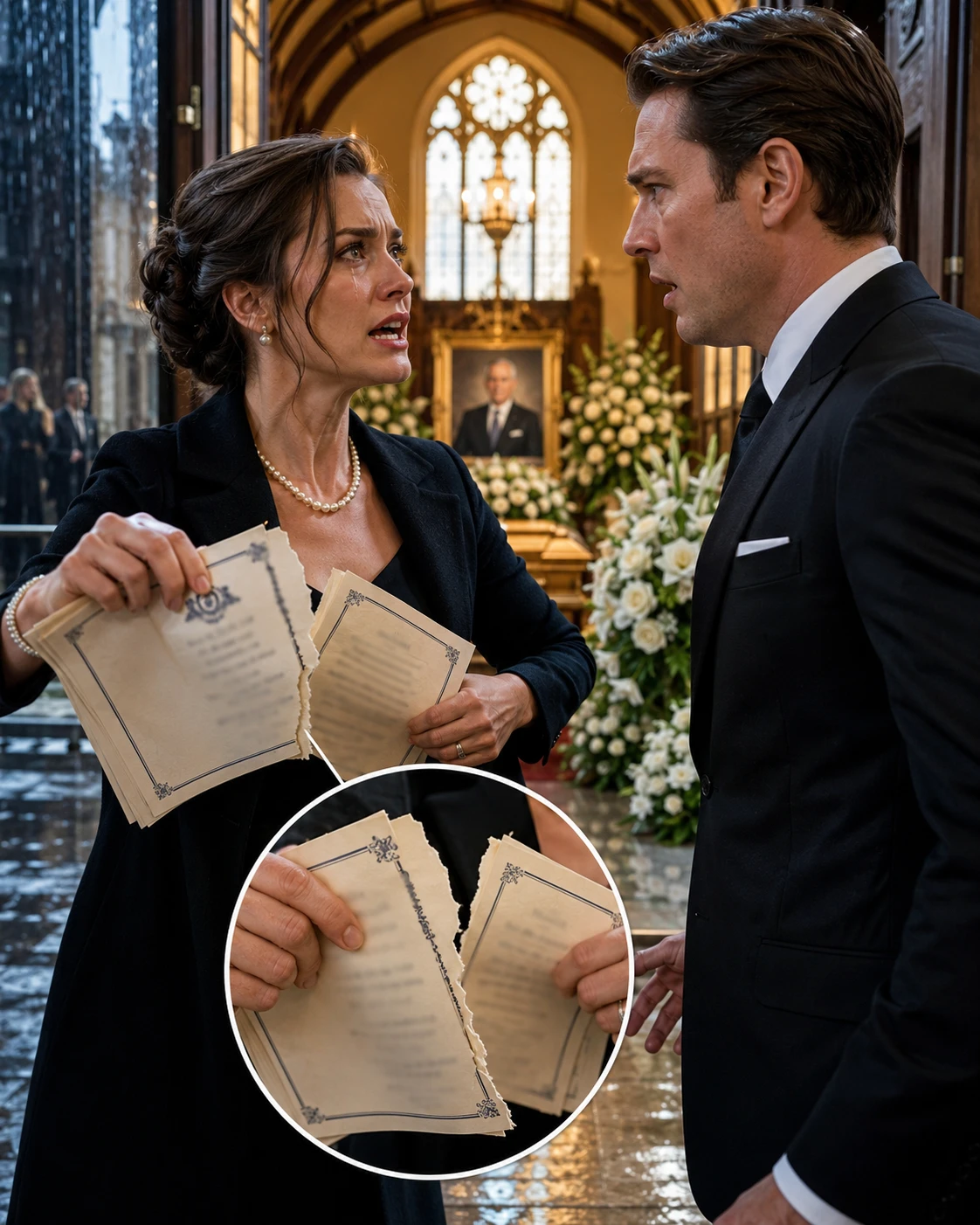
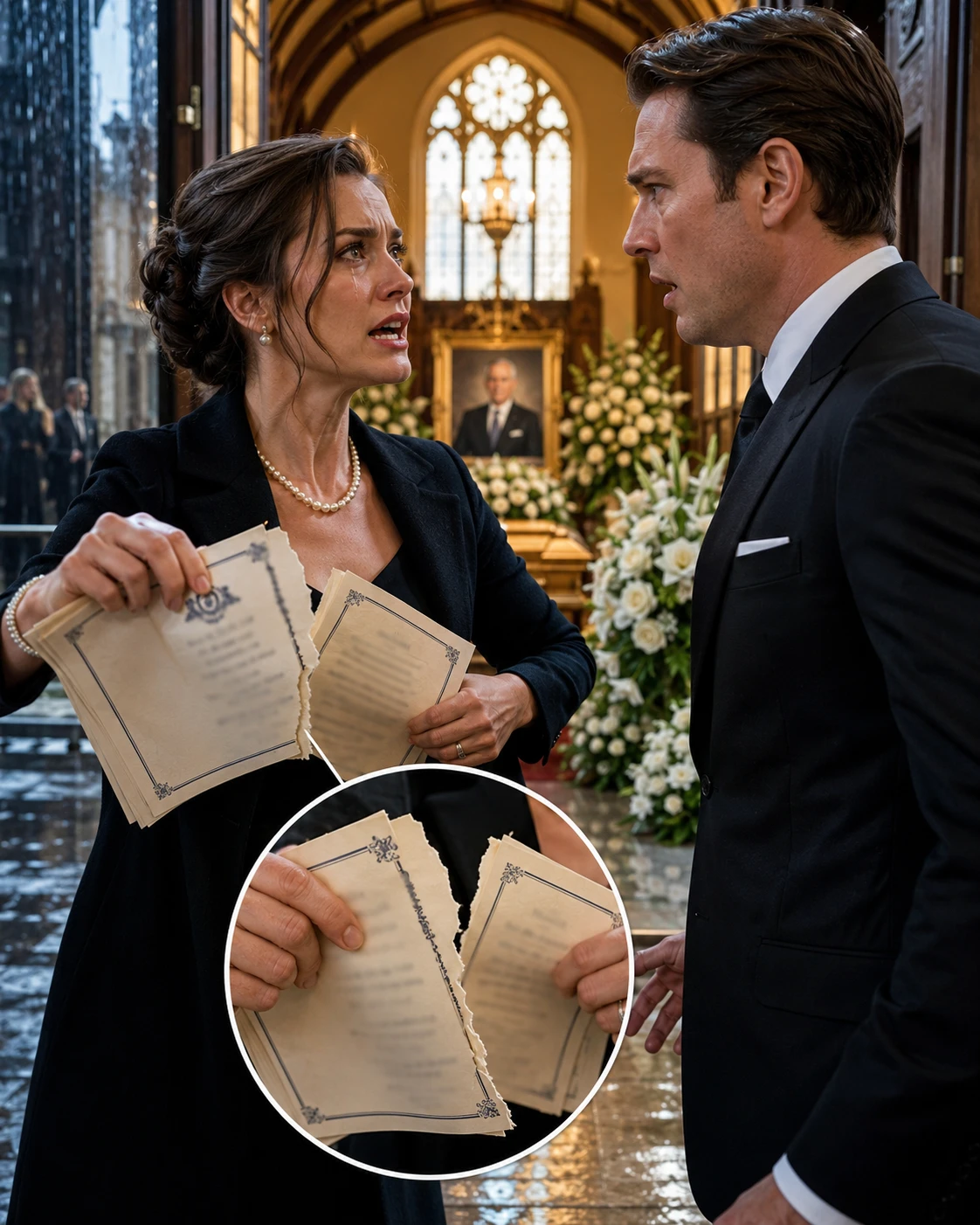
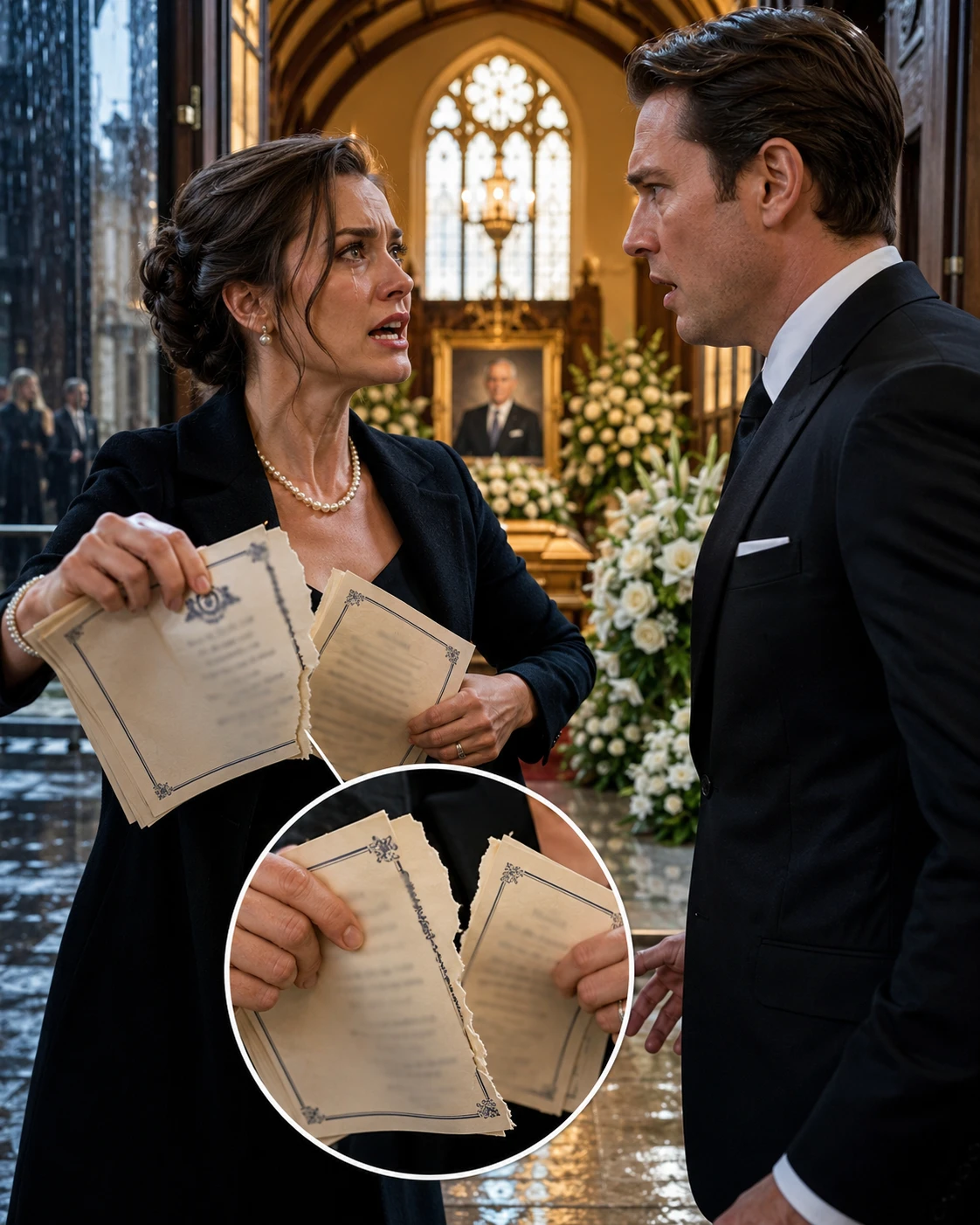
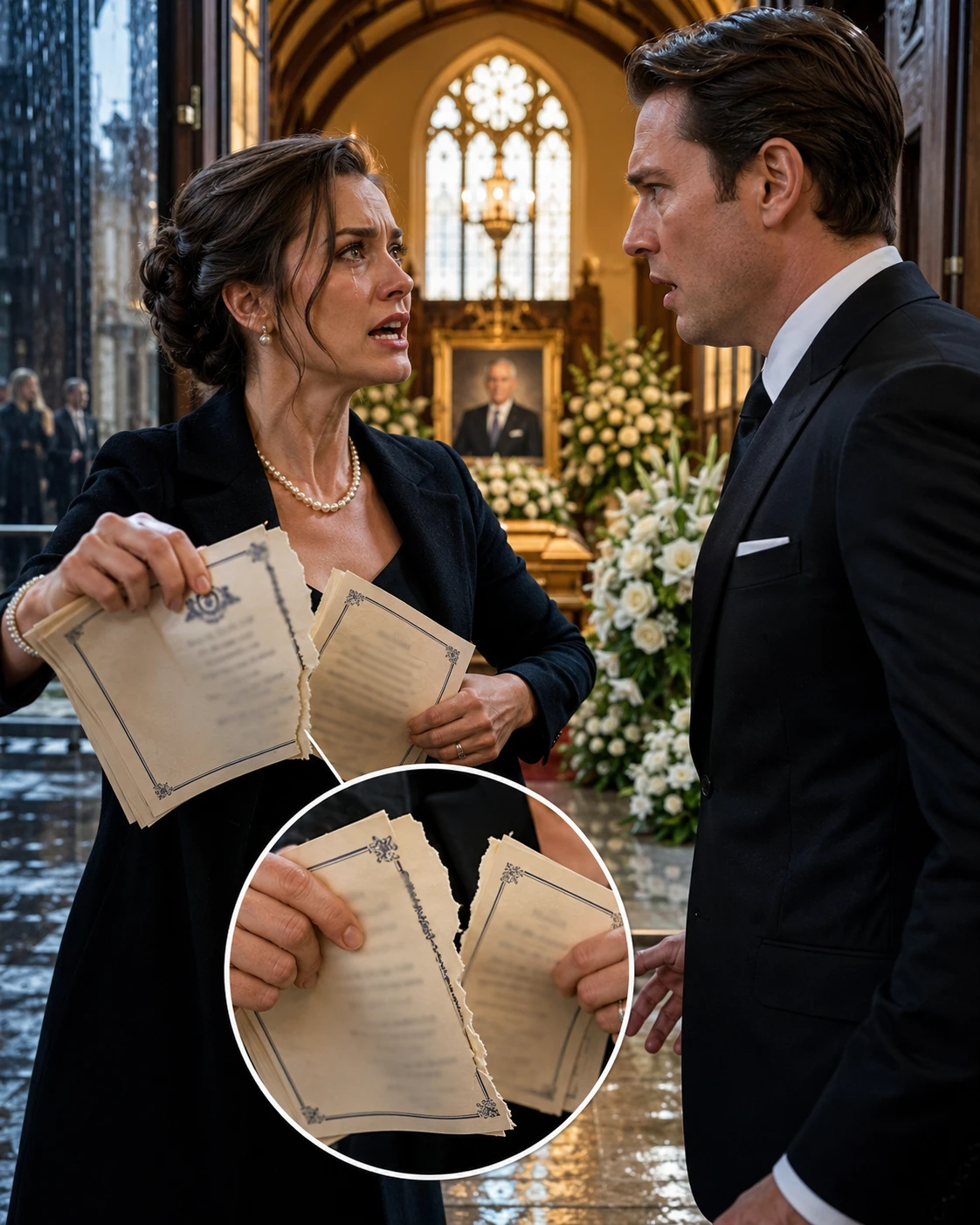
My husband printed his mistress’s name in my father’s funeral program as family.
I saw it seven minutes before the service, beneath the dim gold light of St. James Chapel in Charleston, where the air smelled of lilies, rain, and old money. My father’s portrait stood at the front of the aisle, framed in black velvet and white roses, his silver hair combed back the way he wore it at every charity gala.
And there she was.
Not in the pews.
Not hiding in the back.
Not pretending to be a colleague or a friend.
Her name sat beneath mine in the funeral program, printed in elegant navy script on cream linen paper.
Amelia Whitaker Westmore — Daughter
Grant Westmore — Son-in-law
Savannah Bell — Family
Family.
The word struck harder than death.
Savannah Bell, my husband’s mistress, had been given a place on paper beside my grief. A place beside the man who had raised me, protected me, and told me two weeks before he died, with tubes in his nose and fury still alive in his eyes, “Do not let that man make you small.”
I looked up from the program.
Grant was standing beside the entrance table in his custom black Tom Ford suit, handsome in the polished, cruel way that made strangers trust him and women forgive him before he apologized. Savannah stood three feet behind him in a black silk dress, her diamonds delicate, her face lowered into an expression of practiced sorrow.
She looked like grief had dressed her.
Grant stepped close and whispered, “Don’t make a scene, Amelia. It’s too late to reprint.”
I stared at the program again.
At her name.
At my father’s funeral.
At the lie pressed into expensive paper.
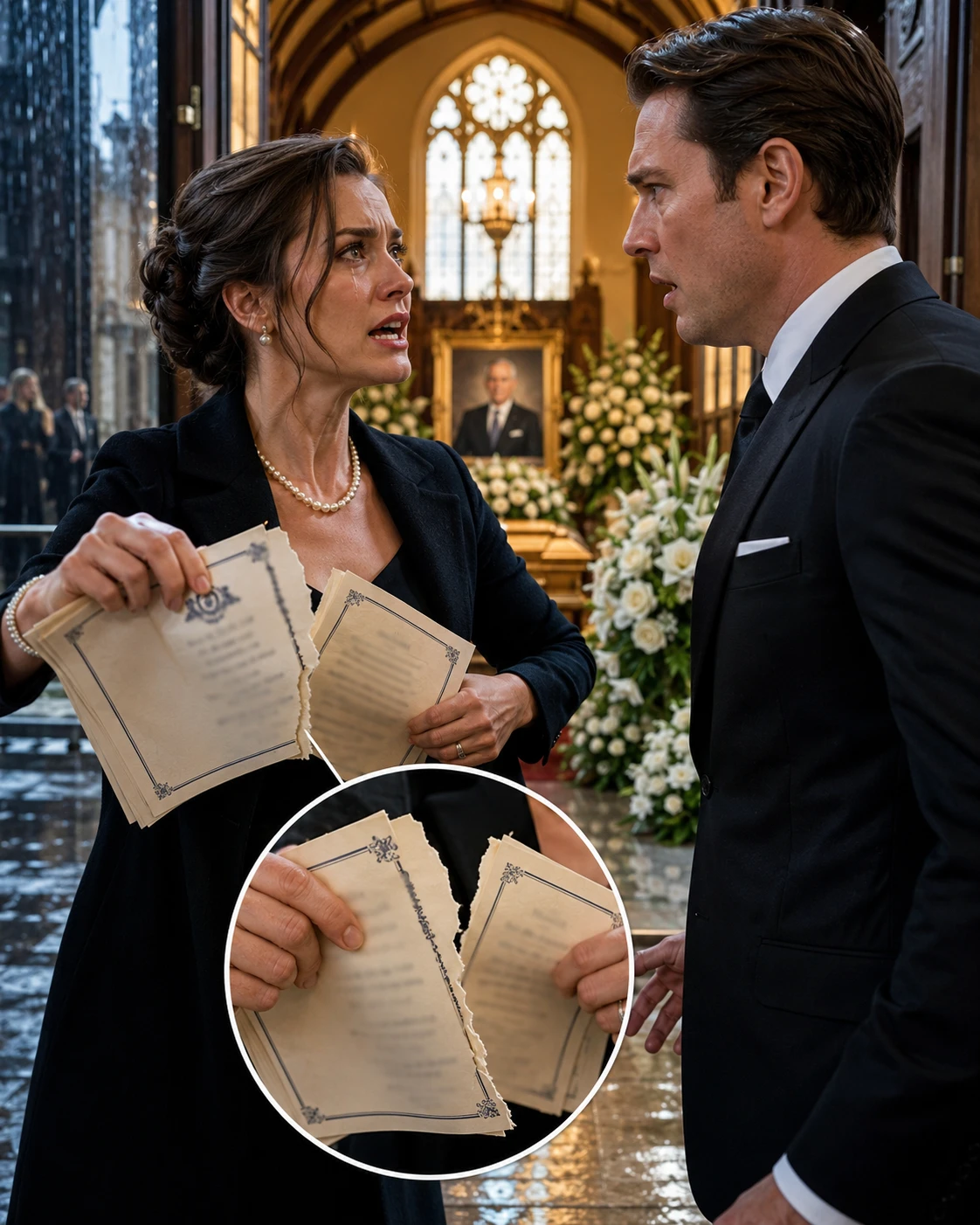
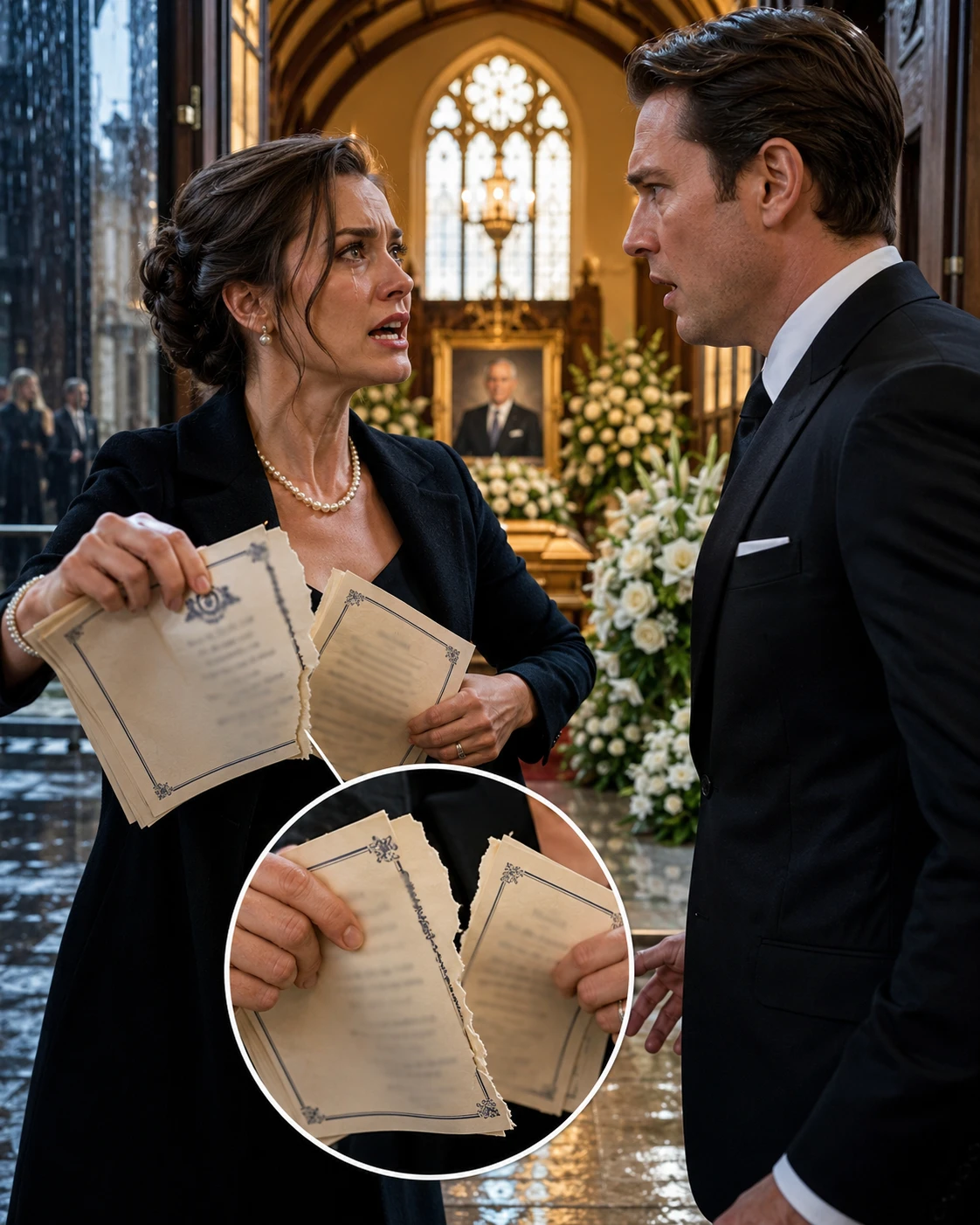
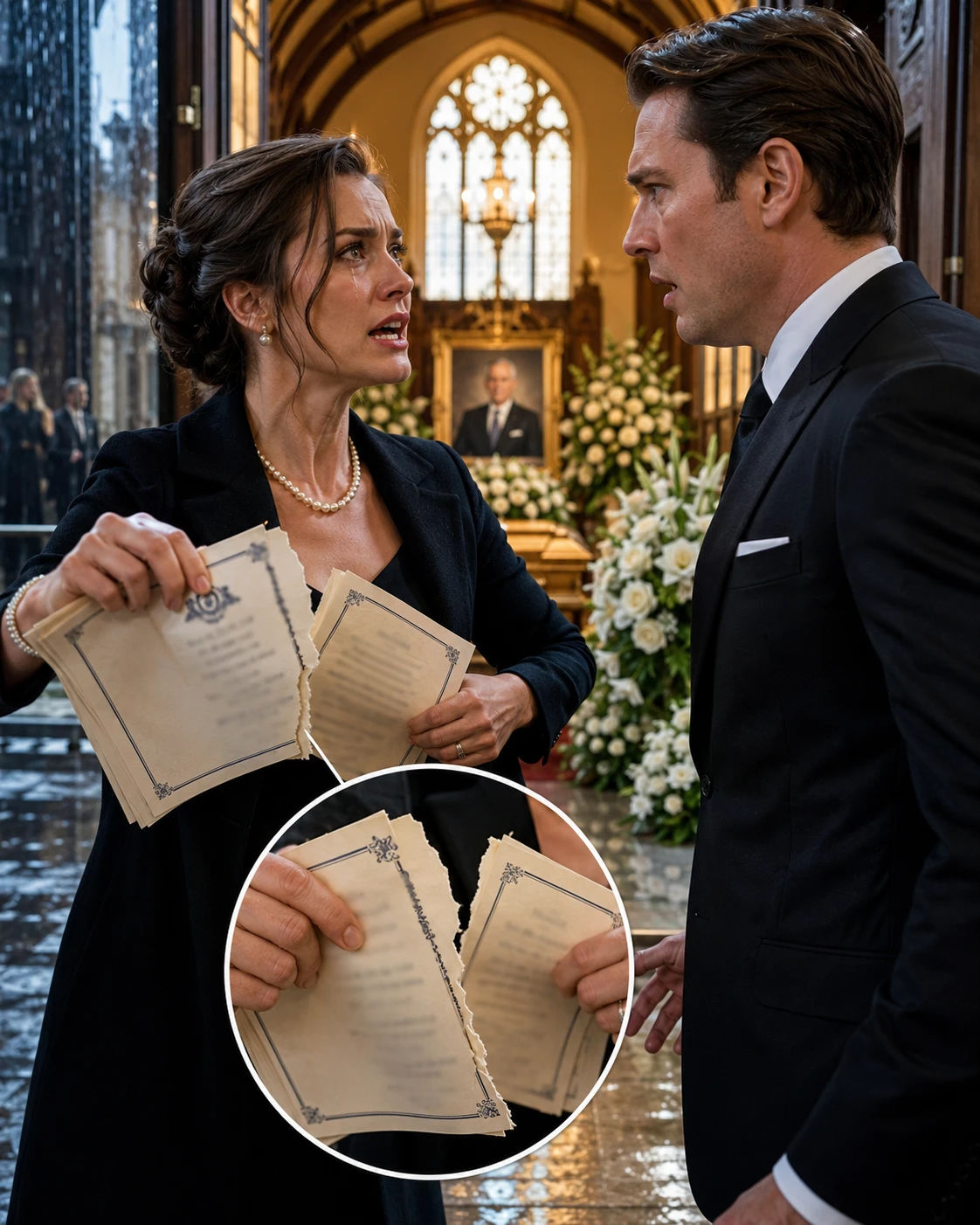
Then I gathered every program from the entrance table into my arms.
Every last one.
Grant’s face drained of color.
Savannah’s lips parted.
And I said, loud enough for the first pew to turn around, “Not too late to tell the truth.”
CHAPTER 1 — THE WOMAN THEY EXPECTED TO CRY QUIETLY
People think funerals are for the dead.
They are not.
Funerals are for the living, and the living always reveal themselves when they think grief has made you too weak to notice.
My father, Charles Whitaker, had built half the luxury hotels along the Carolina coast and donated enough money to hospitals, schools, museums, and political campaigns that people spoke his name with a lowered voice, as if wealth itself were a church. But at home, he was still the man who burned pancakes every Sunday, wore the same old navy bathrobe until the sleeves frayed, and left handwritten notes in the pockets of my winter coats.
His final note had been folded inside my black cashmere coat the morning I left for the hospital.
For the day you need to remember who you are.
That was all it said.
At the time, I thought he meant death. I thought he knew his body was failing and wanted to give me one last piece of fatherly comfort.
Now, standing at the chapel entrance with seventy-three funeral programs clutched against my chest, I understood he had meant something else.
He had meant Grant.
My marriage to Grant Westmore had looked perfect from the outside because Grant was a master architect of appearances. He built a life the way other men built houses, with marble surfaces, hidden wiring, locked rooms, and no evidence of rot until the ceiling collapsed.
We lived in a historic mansion south of Broad Street, hosted dinners for senators, donated to ballet foundations, and smiled at each other across candlelit tables while strangers whispered that we were Charleston royalty.
But behind the limestone columns and antique mirrors, Grant had spent years training me to apologize for breathing too loudly.
At first, it was subtle.
“Don’t wear that red dress, sweetheart. It draws the wrong kind of attention.”
“Maybe let me answer the financial questions. You get emotional with numbers.”
“Your father spoils you. It makes people think you can’t stand on your own.”
Then came the colder things.
The missed anniversaries.
The perfume on his shirts.
The locked phone.
The way he called me unstable whenever I asked a question he did not want to answer.
Savannah Bell arrived in our life as his “branding consultant,” a twenty-eight-year-old blonde with a Nashville accent, a degree from Vanderbilt, and a social media presence curated to look effortless. She had soft curls, sharp eyes, and the kind of smile that made older women say she was charming and younger women move their purses closer.
At first, she called me “Mrs. Westmore” with sugar in her voice.
Then “Amelia.”
Then nothing at all.
I found out about them six months before my father died, though I suspect my father knew before I did. He always saw people clearly. That was his gift and his curse.
One night at Roper Hospital, while Grant was supposedly in Atlanta for a real estate conference, my father looked at me from his bed and said, “He is waiting for me to die.”
I tried to laugh because the alternative was to break.
“Daddy, that’s a horrible thing to say.”
“No,” he whispered. “It is a horrible thing to do.”
I lowered the blanket over his hands. The skin was thin, bruised from IVs, but his grip was still strong when he caught my wrist.
“Your mother left you pearls,” he said. “I left you teeth.”
I did not understand then.
The chapel doors opened behind me, and the first wave of guests entered from the rain. Women in black designer dresses, men in dark suits and polished shoes, old friends of my father, business rivals pretending to mourn, board members, trustees, cousins from Atlanta, ladies from the garden club, the mayor, two former governors, and my father’s personal barber, who was crying harder than any of them.
They reached for programs.
I held them tighter.
Grant moved fast, his hand closing around my elbow.
“Amelia,” he said through his teeth, smiling for the guests, “you’re overwhelmed. Give me those.”
His fingers dug into my arm.
There was a time I would have obeyed simply to avoid embarrassment.
That time had died before my father did.
I pulled my arm away.
“Do not touch me.”
The words landed between us like broken glass.
A woman near the guest book froze with her pen in the air. My aunt Celeste, draped in black chiffon and suspicion, turned her head slowly from the front pew.
Grant’s smile trembled.
Savannah stepped forward, her eyes shining. “Amelia, I know this is a difficult day—”
I laughed.
It was not a loud laugh. It was worse. It was soft, stunned, almost tender.
“You know this is a difficult day?”
Savannah swallowed.
“Savannah,” I said, “my father met you once. Once. At a Christmas benefit where you spilled champagne on his shoes and called him Mr. Westbrook.”
A ripple moved through the entryway.
Grant leaned in again. “Enough.”
But I was looking at the program, at the clean cruelty of it.
Savannah Bell — Family.
Not guest.
Not friend.
Family.
My father, who had never invited her to Thanksgiving. My father, who had banned Grant from his hospital room the week before he died. My father, who had gripped my hand with the force of a man trying to pull me out of a burning house.
I turned to the guests.
“For anyone who hasn’t seen the program yet, there’s been a correction.”
Grant’s face hardened.
“Amelia.”
I lifted one program and tore it cleanly in half.
The sound cracked through the chapel like a gunshot.
A few people gasped.
Savannah flinched as if I had struck her.
I tore another.
Then another.
White linen paper fluttered down onto the marble floor like ruined snow.
Grant caught my wrist. “You are humiliating yourself.”
“No,” I said. “I’m done being useful to your lies.”
And for the first time in years, I saw it.
Fear.
Not grief. Not anger. Not annoyance.
Fear.
My husband, who could charm bankers and bully judges and silence me with one look across a dinner table, was afraid.
That should have warned me the funeral program was only the surface.
It did not.
Not yet.
CHAPTER 2 — THE NAME THAT DID NOT BELONG
The service began twenty-two minutes late.
That may not sound like much unless you understand people like the Whitakers and the Westmores. In our world, lateness is either incompetence or a declaration of war.
Mine was the second.
I had the ushers collect the remaining programs from purses and pews. I watched Savannah try to keep hers folded beneath her clutch until Aunt Celeste, who had never liked Grant and considered subtlety a disease, extended one black-gloved hand.
“Give it here, sweetheart.”
Savannah hesitated.
Celeste smiled in a way that could cut silk.
“Unless you plan to read from it at the altar.”
Savannah handed it over.
By then, the whispering had grown legs. It ran through the chapel, up the aisle, across the pews, from pearl earring to silver cufflink.
Did you see the name?
Who is Savannah Bell?
Isn’t that Grant’s consultant?
Family?
Oh, Amelia, poor thing.
Poor thing.
How I had hated those words.
For years, I had been “poor Amelia” in rooms where people knew too much and said too little. Poor Amelia, whose husband was ambitious. Poor Amelia, whose father still controlled the family foundation. Poor Amelia, who had not had children after eight years of marriage. Poor Amelia, who smiled beautifully while Grant placed his hand on the small of her back and steered her away from conversations that mattered.
Poor Amelia had buried herself in silence.
But she was not in that chapel anymore.
I sat in the front pew alone.
Grant tried to sit beside me.
I placed my black clutch on the seat.
He stared down at it.
The chapel was full enough that everyone saw.
Aunt Celeste coughed into her hand. I suspected she was hiding a smile.
Grant sat on the other side of the aisle beside his mother, Eleanor Westmore, who looked as if she had been carved from old ivory and disappointment. Savannah sat two rows behind him, between two women who immediately turned their knees away from her.
Small punishments can be exquisite.
The minister, Reverend Thomas Avery, began with a prayer. His voice was warm, steady, and careful. He had known my father for thirty years and had once found him asleep in the church kitchen after a hurricane, surrounded by volunteers and empty coffee cups.
“We gather today,” he said, “to honor the life of Charles Edward Whitaker, beloved father, friend, builder, servant, and man of uncommon conviction.”
Conviction.
The word nearly undid me.
Because the truth was, I had not come to the chapel intending to expose anyone.
I had come to survive.
I had come wearing my mother’s pearls and my father’s favorite black coat. I had come with trembling hands and an empty stomach. I had come prepared to listen to hymns, accept condolences, and place a white rose on my father’s casket without collapsing.
I had even prepared myself to stand beside Grant.
Not because he deserved it.
Because I was tired.
Grief makes every task feel like carrying furniture underwater.
Then I saw her name.
And grief became fire.
The first speaker was the mayor. He spoke of my father’s generosity, his hotels, his scholarships, his stubborn refusal to put his name on hospital wings he had paid for. Then came a former employee who had started as a bellman and now managed three properties. Then my cousin Rebecca, who told a story about my father teaching her to drive a boat and screaming “Reverse is also a direction!” while she crashed into a dock.
People laughed through tears.
I did too.
For a moment, the chapel softened.
Then Grant stood.
I turned my head.
He had not been listed as a speaker.
Reverend Avery looked surprised, then uncomfortable. Grant walked to the podium with the smooth confidence of a man who believed microphones belonged to him.
He placed both hands on either side of the lectern.
“My father-in-law,” he began, “was a complicated man.”
The air changed.
Aunt Celeste sat upright.
My spine went cold.
Grant looked out at the crowd, his expression solemn, handsome, controlled.
“He was generous, yes. Brilliant, certainly. But those of us close to him also knew he could be… difficult. Protective to a fault. Suspicious of outsiders. At times, even unkind to those who only wanted to support this family.”
His eyes flicked to Savannah.
It was brief.
It was enough.
I understood then what he was doing.
He was not grieving my father.
He was editing him.
In front of everyone.
He was turning Charles Whitaker, a man who had loved me ferociously, into an obstacle. A controlling old patriarch. A bitter gatekeeper. And by doing so, he was making room for himself, for Savannah, for whatever story he intended to tell next.
Grant continued.
“In his final months, Charles struggled with trust. He questioned loyalties. He questioned intentions. He even questioned the people standing closest to him.”
My hands curled around the edge of the pew.
“He did not always see,” Grant said, “that family can come in unexpected forms.”
Savannah lowered her head beautifully.
The audacity was almost elegant.
Almost.
Grant looked at me then, with a warning buried beneath the sadness in his eyes.
“And I hope today, in his memory, we can choose forgiveness over division.”
There it was.
The trap.
If I spoke, I was divisive.
If I stayed silent, his lie became the room’s memory.
That is how men like Grant win. Not by shouting. By placing women in positions where dignity looks like surrender.
The chapel waited.
Grant stepped down from the podium.
He expected me to remain seated.
Instead, I rose.
The sound of my heels against the stone floor was the only sound in the chapel.
Grant froze halfway down the aisle.
“Amelia,” he whispered.
I passed him.
Reverend Avery watched me with kind, worried eyes.
I touched his arm gently. “May I?”
He stepped aside.
I stood at the podium and looked at the faces before me. I saw pity. Curiosity. Alarm. Satisfaction. I saw Savannah, pale beneath her makeup. I saw Grant, rigid with fury. I saw my father’s portrait over the casket, his blue eyes bright even in a photograph.
“My father was complicated,” I said.
My voice did not shake.
“He hated cheap coffee, pretentious wine descriptions, and men who used the word loyalty when they meant obedience.”
A murmur passed through the chapel.
“He was protective. That part is true. He protected his employees from layoffs during the recession. He protected this church when the roof collapsed. He protected my mother’s memory after she died. And in his final months, he tried very hard to protect me.”
Grant’s jaw tightened.
I opened my clutch and removed a folded sheet of paper.
Not a speech.
A letter.
The final letter my father’s attorney had given me that morning, sealed in a cream envelope with my name written in my father’s unsteady hand.
I had not opened it before the service. I had been afraid.
Now I unfolded it.
“My father asked that this be read only if someone attempted to speak falsely about his family.”
The room went still.
Grant took one step forward.
I read.
“My dearest Amelia, if this letter is being read, then I was right about the character of the people trying to stand too close to my coffin.”
A sound moved through the chapel. Half gasp, half laugh.
Savannah’s face turned white.
I continued.
“I have made mistakes in my life, but doubting my daughter was never one of them. She is not fragile. She is not foolish. She is not confused. She has been made lonely in rooms where she deserved to be loved.”
My throat tightened.
I forced the words out.
“To anyone who has mistaken her grace for weakness, I leave you this warning: the Whitaker name was not built on silence. It was built on memory. And we remember everything.”
By the time I finished, my tears had fallen onto the paper.
But I was not ashamed of them.
Some tears are not surrender. Some are evidence.
I looked up.
Grant was staring at the letter as if it were alive.
And in that instant, I realized something else.
He had known about it.
Or feared it.
Because his eyes were not shocked.
They were calculating.
CHAPTER 3 — WHAT MY FATHER LEFT BEHIND
After the burial, the reception was held at The Whitaker House, my father’s private club on King Street, a mansion converted into a members-only refuge for people who liked their bourbon older than their interns and their scandals handled discreetly.
Crystal chandeliers. Black marble fireplaces. Oil paintings. White orchids. A pianist playing soft jazz in the corner. Silver trays of smoked salmon, deviled quail eggs, and miniature crab cakes moving through the room as if grief required catering.
It was exactly the kind of place Grant loved.
Elegant. Expensive. Full of witnesses too polite to scream.
I stood beside my father’s portrait near the fireplace and accepted condolences until the words blurred together.
So sorry for your loss.
He was a great man.
Your father changed my life.
You look just like your mother.
Grant kept his distance at first. He stood near the bar with his mother and two men from the board of Whitaker Holdings, speaking in low tones. Savannah hovered near the French doors leading to the courtyard, isolated but not defeated. Her humiliation had made her sharper. She watched me the way a fox watches a henhouse after discovering the dogs are asleep.
But the dogs were not asleep.
They were just old, Southern, and wearing pearls.
Aunt Celeste appeared at my side with a glass of champagne.
“I know it’s a funeral,” she said, handing it to me, “but some events require bubbles.”
“I’m not sure I can drink.”
“Then hold it. It makes you look less available for nonsense.”
I almost smiled.
She leaned closer. “Your father changed the will.”
I looked at her.
“When?”
“Three weeks ago.”
My heart kicked.
“Celeste.”
“I wasn’t supposed to tell you until after the reading, but considering your husband just attempted a hostile takeover of your father’s funeral, I feel etiquette has been stretched to its natural limits.”
Across the room, Grant looked at us.
Celeste smiled at him over her champagne.
He did not smile back.
“What changed?” I asked.
Celeste’s expression softened.
“Everything.”
Before I could ask more, a man approached us. Tall, Black, silver at the temples, wearing a charcoal suit with a deep burgundy tie. Marcus Reed, my father’s attorney and oldest friend. He had been at every Christmas dinner of my childhood and had taught me poker at thirteen, which my father called irresponsible until Marcus reminded him I had already learned from the housekeepers.
“Amelia,” Marcus said gently. “There’s a matter we need to discuss privately.”
Grant materialized like a shadow.
“Anything involving Amelia involves me,” he said.
Marcus looked at him with the calm of a man who had billed billionaires by the hour and feared none of them.
“Not anymore.”
The words were quiet.
The room heard them anyway.
Grant’s smile went cold. “Excuse me?”
Marcus reached into his jacket and removed a document.
“Charles revoked your power of attorney over Amelia’s investment trust six days before his final hospitalization. He also removed you from all advisory positions connected to Whitaker Holdings, the Whitaker Foundation, and any subsidiary entities.”
The floor seemed to tilt.
I turned to Grant.
“You had power of attorney over my investment trust?”
He looked at me as if I had asked the wrong question in public.
“It was administrative.”
Marcus’s voice sharpened. “It was predatory.”
A board member near the bar slowly set down his drink.
Grant laughed once. “This is absurd.”
“No,” Marcus said. “Printing your mistress’s name as family in a funeral program was absurd. This is legal.”
Savannah made a small sound near the French doors.
Mistress.
The word had finally entered the room without perfume on it.
Grant’s eyes flashed. “Careful, Marcus.”
“I am being careful. That is why I am speaking in front of witnesses.”
The reception had gone silent. Even the pianist stopped playing, fingers suspended above the keys.
Marcus turned to me.
“Your father discovered multiple attempts to redirect assets from your trust through shell entities tied to Westmore Development. He believed Grant intended to pressure you into signing further documents after the funeral, while you were emotionally vulnerable.”
My champagne glass trembled in my hand.
Not because I was weak.
Because rage has a physical weight.
I looked at Grant and saw the past eight years rearrange themselves.
The documents he told me were routine.
The meetings he said would bore me.
The accountant who stopped returning my calls.
The way Grant insisted grief made me confused whenever I asked about money.
“You tried to steal from me,” I said.
Grant stepped closer. “I protected what you were too overwhelmed to manage.”
“Protected it for whom?”
He said nothing.
But his eyes betrayed him.
For Savannah. For himself. For the new life he thought he could build once my father was gone and I was too broken to resist.
Savannah spoke then, her voice thin.
“Grant, what is he talking about?”
It was almost funny.
The mistress had just discovered she was not a queen.
She was a line item.
Grant turned toward her. “Not now.”
That was all it took.
Not now.
Two words, and Savannah Bell understood the hierarchy of her own scandal.
I was not the only woman Grant had lied to. I was simply the one he had married for access.
Marcus lowered his voice.
“Amelia, your father left instructions for the will reading to occur tonight. Here. He anticipated resistance.”
Aunt Celeste sipped her champagne. “Charlie always did enjoy timing.”
Grant’s mother approached, her pearls glowing against her black dress.
“Marcus,” Eleanor Westmore said, “perhaps this conversation could be handled with more discretion.”
Marcus looked at her.
“Discretion is how your son got this far.”
Eleanor stiffened.
For a moment, I almost pitied her. She had spent her life polishing the Westmore name until it shone, only to discover the dirt had been inside the silver all along.
Almost.
Grant reached for my hand.
I stepped back.
His face changed. The mask slipped just enough for me to see the man beneath it. Not charming. Not sophisticated. Not wounded.
Angry.
“You are embarrassing yourself,” he said softly.
There it was again.
The old spell.
The sentence he used whenever I neared the truth.
But the room had changed. Or maybe I had.
“No, Grant,” I said. “I think I’m embarrassing you.”
A camera flash went off.
Everyone turned.
Near the archway stood a young woman in a black blazer, phone in hand, eyes wide with the thrill of being present at the exact moment a private scandal became public property.
I recognized her vaguely. A lifestyle reporter from Charleston Social. She covered galas, weddings, restaurant openings.
And now, apparently, funerals.
Grant saw the phone and paled.
“Delete that,” he snapped.
The reporter took one step back.
I looked at her.
“Don’t.”
Grant turned on me. “Amelia.”
I raised my voice.
“Record all of it.”
A rustle moved through the room as phones appeared like tiny black mirrors.
Savannah covered her mouth.
Eleanor whispered, “My God.”
Marcus looked at me carefully, as if measuring whether I understood what I had just done.
I did.
For eight years, Grant controlled every room by deciding what could be said inside it.
So I opened the walls.
CHAPTER 4 — THE WILL, THE VIDEO, AND THE WOMAN IN BLACK SILK
The will reading took place in the club’s private library, but by then half the reception had become an audience and the other half had become a broadcast team.
Within forty minutes, the first clip had hit Facebook.
By the time Marcus gathered the family and board members into the library, the video title had already mutated across social media.
HUSBAND PUTS MISTRESS IN WIFE’S FATHER’S FUNERAL PROGRAM — WIFE RESPONDS
Southern Heiress Exposes Husband at Funeral
Charleston Funeral Scandal: “Not Too Late to Tell the Truth”
I did not care.
Or maybe I cared in a new way.
There is a kind of humiliation that destroys you because it happens in secret. You replay it alone, in bathrooms, in cars, in bed beside the person who caused it. But public humiliation, when the truth is finally yours, can become something else.
A courtroom.
The library smelled of leather, cedar, and old cigars. Rain tapped against the windows. My father’s chair sat empty behind the desk, a high-backed oxblood leather throne worn smooth at the arms.
I sat in it.
No one commented.
Grant stood by the fireplace. Savannah sat on the edge of a chair near the door, looking smaller without an audience to perform for. Eleanor remained standing, spine rigid. Aunt Celeste took the chair nearest me and looked delighted in the grave way only Southern women can when justice finally arrives wearing heels.
Marcus opened a leather folder.
“Charles Edward Whitaker executed his final will and testament on May 21st,” he began.
My father had died on June 6th.
Seventeen days.
For seventeen days, Grant had smiled at me, handed me tissues, kissed my forehead, and told me he would “handle everything.”
I wondered how many times he had looked at me and imagined me signing away my life.
Marcus continued through the formalities. Properties. Charitable bequests. Scholarships. Gifts to employees. Trusts for long-serving staff. Donations to the hospital.
Then he paused.
“To my son-in-law, Grant Westmore,” Marcus read.
Grant lifted his chin.
I felt everyone inhale.
“I leave the cufflinks he admired at Thanksgiving three years ago, when he believed I was too deaf to hear him tell my daughter they would be his soon enough.”
Aunt Celeste made a sound that might have been a cough or a prayer.
Marcus reached into a small box and placed the cufflinks on the desk.
They were gold, engraved with my father’s initials.
CW.
Grant’s face turned crimson.
“And,” Marcus continued, “I leave him the following advice: a man who marries for money should be certain the money likes him back.”
Silence.
Then someone laughed.
It was one of the board members, a man named Peter Langford who had feared my father for thirty years and loved him for twenty-nine.
Once Peter laughed, others followed. Not loudly. Not crudely. But enough.
Grant’s humiliation bloomed dark and vivid across his face.
Savannah stared at the floor.
Marcus turned the page.
“To Savannah Bell,” he read.
She jerked upright.
Grant looked at Marcus sharply.
I went still.
My father had left something to Savannah?
Marcus’s voice remained even.
“To Miss Bell, whose ambition exceeded her research, I leave one dollar, so she may never say the Whitaker family gave her nothing.”
Aunt Celeste whispered, “Charlie, you magnificent devil.”
Savannah’s eyes filled with tears.
For a moment, I felt the faintest pull of pity. Then I remembered her name in my father’s funeral program. Her black silk dress. Her attempt to stand beside my grief and call it belonging.
Marcus read on.
“I also leave her the knowledge that the apartment at 88 Leonard Street in Tribeca, where she has been residing, is owned not by Grant Westmore, as he apparently claimed, but by Whitaker Holdings. Her occupancy agreement expires at midnight.”
Savannah stood so quickly her chair scraped the floor.
“What?”
Grant closed his eyes.
There it was.
Another lie.
Savannah turned toward him, tears spilling now for reasons that had nothing to do with my father.
“You said it was yours.”
Grant’s voice was low. “Sit down.”
“No.” Her voice cracked. “You said you bought it for us.”
The room shifted again.
For us.
Eleanor put one hand to her throat.
Savannah looked around, desperate, humiliated, cornered by the very luxury she had mistaken for love.
“He said he was leaving her,” she whispered. “He said after Charles died, everything would be clean. He said Amelia was unstable and the trust—”
Grant moved toward her.
“Savannah.”
But she was done.
Humiliation had made her reckless, and recklessness made her useful.
“He said she’d sign anything after the funeral,” Savannah said, pointing at me with a shaking hand. “He said grief turns rich women into children.”
The room went dead quiet.
I felt the words enter me and settle somewhere beyond pain.
Grief turns rich women into children.
That was what I had been to him.
Not wife.
Not partner.
Not person.
A temporary obstacle with a signature.
Marcus’s eyes sharpened. “Miss Bell, I advise you to stop speaking unless you have counsel.”
Savannah laughed through tears. “Counsel? I don’t even have an apartment.”
Grant grabbed her arm.
That was his mistake.
Because three phones were recording.
“Let go of her,” I said.
He did not.
I stood.
“Grant.”
He looked at me, and for one wild second, I saw the old expectation in his eyes. The certainty that I would manage the room for him. Smooth things over. Protect the reputation. Apologize for the discomfort his cruelty created.
Instead, I walked to him and removed his hand from Savannah’s arm.
Not violently.
Precisely.
Finger by finger.
Then I turned to Savannah.
“I don’t like you,” I said. “I may never like you. But you will not be handled in my father’s house.”
Her face crumpled.
That was the strange thing about power. Grant had tried to make us enemies because enemies cannot compare notes. But the moment we stood in the same truth, his control began to split.
Marcus cleared his throat.
“There is one final matter.”
He looked at me.
“Charles recorded a video.”
My breath stopped.
“What?”
“He made it the day he signed the will.”
Marcus pressed a button on a tablet and connected it to the library’s wall screen.
For a second, there was only a flicker of blue light.
Then my father appeared.
Thinner. Pale. Sitting in his hospital bed with a blanket over his lap. But his eyes were alive, fierce and amused.
The room disappeared.
I was a little girl again, running across the lawn at our summer house in Maine while he pretended not to catch me. I was sixteen, crying after my first heartbreak while he made hot chocolate at midnight. I was thirty-four, sitting beside his hospital bed pretending I was not terrified.
“Hello, Amelia,” he said on the screen.
I covered my mouth.
“If you are watching this, I am dead, which is inconvenient, because I had several people left to annoy.”
A small laugh broke through my tears.
My father smiled faintly.
“I need you to listen carefully. You were raised to be gracious. Your mother gave you that. But grace without boundaries is just a beautiful cage.”
Grant looked at the floor.
My father continued.
“I have watched Grant shrink you. I have watched him speak over you, isolate you, and teach you to doubt your instincts. That is not marriage. That is theft with flowers.”
Tears slipped down my cheeks.
“I should have said this sooner. I did not because I thought you needed to see it yourself. Fathers are arrogant that way. We believe we can protect our daughters from fire, forgetting they may need to learn they are fire.”
His eyes softened.
“So here is the truth. Whitaker Holdings is yours. Not in five years. Not when a board decides you are ready. Now.”
Grant’s head snapped up.
My breath left me.
Marcus had not told me this part.
My father went on.
“I have transferred controlling interest to the Amelia Whitaker Westmore Trust, with you as sole trustee upon my death. Marcus has the documents. The board has been informed. Anyone who objects may resign before dessert.”
Aunt Celeste whispered, “Oh, Charlie.”
My father looked directly into the camera.
“Grant, if you are in this room, and I suspect you are because men like you always attend the reading of wills, understand this: I knew. I knew about the accounts. I knew about the shell companies. I knew about Savannah Bell. I knew about the apartment. I knew about the divorce papers you planned to file after gaining access to Amelia’s trust.”
A sound escaped Eleanor.
Savannah sat down slowly.
Divorce papers.
Grant had not even planned to keep the marriage he was stealing from.
He had planned to gut it and leave.
My father’s voice hardened.
“I also knew about the funeral program.”
My blood chilled.
The room went completely still.
Grant whispered, “Impossible.”
On the screen, my father smiled.
It was not warm.
It was victorious.
“Grant, you bribed my assistant to send the final program proof to your office. Unfortunately for you, she has worked for me since 1989 and dislikes you more than chemotherapy.”
Aunt Celeste actually laughed out loud.
My father continued.
“She sent me your edits. Including Miss Bell’s name. Family. A bold word from a man who never understood the meaning of it.”
Grant’s face had gone gray.
My father turned his gaze back to the camera.
“Amelia, I could have stopped him. I almost did. But then I realized something. If I removed every knife before it reached you, you might never see who kept handing them over.”
I shook my head, crying openly now.
“I am sorry,” he said softly. “For the pain of today. For letting the trap close before the door opened. But I needed you to have witnesses. I needed you to have proof. And I needed you to remember that you are not the woman he trained. You are the woman we raised.”
The video blurred through my tears.
My father leaned closer to the camera.
“Take back your name. Take back your house. Take back your life. And Amelia?”
He smiled.
“Do it beautifully.”
The video ended.
No one moved.
Outside, thunder rolled over Charleston like a verdict.
CHAPTER 5 — THE REVENGE THAT WORE PEARLS
There are women who burn houses down.
There are women who walk away and never look back.
And then there are women raised by Southern mothers, educated in New England, underestimated by arrogant men, and dressed in couture at their father’s funeral.
We do not burn the house.
We change the locks, review the insurance, invite witnesses, and make sure the man who tried to steal it receives his personal belongings in labeled boxes.
By 7:13 p.m., Grant Westmore had been removed from every Whitaker board position.
By 7:41 p.m., Marcus had frozen all accounts connected to the suspicious transfers.
By 8:05 p.m., the first national outlet had called.
By 8:22 p.m., the clip of me saying “Not too late to tell the truth” had been viewed 2.8 million times.
By 9:00 p.m., Savannah Bell was sitting in my father’s library with mascara beneath her eyes, giving Marcus the names of two bankers, one accountant, and a private investigator Grant had hired to build a mental instability narrative against me.
That last part should have broken me.
It did not.
It clarified me.
Grant had not only planned to steal my money. He had planned to steal my credibility. He had collected moments of grief, exhaustion, anxiety, and loneliness, intending to arrange them into a portrait of madness.
A wife too emotional to manage her inheritance.
A daughter too fragile after her father’s death.
A woman whose husband had no choice but to step in.
Men like Grant do not simply betray you.
They prepare the world to applaud the betrayal.
At 9:30 p.m., he found me in the courtyard.
The rain had stopped, leaving the stones slick and shining under the garden lights. The air smelled of jasmine and wet earth. Guests had finally begun to leave, though many did so slowly, hungry for one last glimpse of the collapse.
I stood beneath the magnolia tree my father had planted when I was born. My black dress moved softly in the humid air. My mother’s pearls rested against my throat like a hand.
Grant approached without his jacket.
For the first time since I met him, he looked less than immaculate.
“Amelia,” he said.
I turned.
He held his hands open, palms up, the posture of innocence.
“We need to talk.”
“No,” I said. “You need a lawyer.”
His mouth tightened.
“After everything we’ve been through, you’re going to let your father destroy us from the grave?”
I almost admired the sentence.
The sheer architecture of it.
He had cheated. Lied. Stolen. Planned to discard me. Printed his mistress as family in my father’s funeral program. And still, somehow, he found a way to make my dead father the villain.
“You destroyed us,” I said. “Daddy just left good lighting.”
Grant stepped closer.
“I made mistakes.”
“You committed crimes.”
“I loved you.”
I looked at him then.
Really looked.
At the man I had married in a vineyard outside Napa beneath a canopy of white roses. At the man who had cried when I walked down the aisle. At the man who used to trace circles on my wrist when he thought I was asleep. At the man I had defended, excused, forgiven, and mourned while he was still standing beside me.
Maybe, in some damaged corner of himself, Grant had loved me.
But some love is only hunger wearing perfume.
“No,” I said. “You loved what my name opened for you.”
His face twisted.
“You think you can run Whitaker Holdings? You? Amelia, you don’t know the first thing about what your father built.”
I smiled.
Not because it was funny.
Because I had been waiting for the final mask to fall.
“Grant,” I said, “who do you think prepared the Asian expansion brief in 2018?”
He blinked.
“What?”
“Who do you think renegotiated the insurance portfolio after Hurricane Matthew? Who caught the overbilling on the Savannah restoration? Who recommended the Nashville acquisition you took credit for in front of the board?”
The color drained from his face.
“My father didn’t keep me away from the company because I was incapable. He kept me away from you because he knew you would try to use me to get in.”
Grant stared at me.
“For six years,” I said, “I worked quietly with Marcus and the executive team. I reviewed contracts from the breakfast room while you thought I was ordering flowers. I sat in on calls under my maiden name while you told people I had no head for business. The board knows. The CFO knows. My father knew.”
His jaw opened slightly.
There it was.
The identity reveal no one expected because Grant had spent years convincing everyone, including himself, that I was decorative.
I stepped closer.
“You mistook silence for stupidity. That was expensive.”
Behind him, near the courtyard doors, I saw two board members watching. Then Eleanor. Then Savannah. Then half the remaining guests.
Good.
Grant followed my gaze and realized we were not alone.
His voice dropped. “You set me up.”
“No,” I said. “You walked in wearing your own gasoline.”
His eyes darkened.
“I can ruin you.”
The old threat.
The final tool of a man losing power.
“With what?” I asked. “The videos? The financial records? The mistress you lied to? The assistant you bribed? The divorce papers you drafted before my father’s burial?”
His face changed at the word divorce.
I reached into my clutch and removed an envelope.
White. Heavy. Clean.
He recognized it before I handed it to him.
Because men like Grant always recognize paperwork when it becomes a weapon.
“You were going to serve me next week,” I said. “I’m serving you tonight.”
He took the envelope automatically.
His name was written across the front.
Grant Westmore.
Not husband.
Not family.
Just a name.
I continued.
“The Charleston house is mine. The New York apartment was never yours. Your access cards have been disabled. Your belongings will be delivered to your mother’s address tomorrow. Any attempt to enter my property will be handled by security and police.”
Eleanor flinched at the word police.
Grant tore open the envelope with shaking hands.
“You can’t do this.”
“I already did.”
His eyes scanned the first page.
“This is insane.”
“No,” I said. “This is what happens when the woman you buried in your story crawls out holding receipts.”
A voice behind us whispered, “Damn.”
Someone else murmured, “Is this live?”
Grant looked up sharply.
A young man near the doorway lowered his phone too late.
For one moment, I saw Grant understand the full shape of his defeat.
Not just legal.
Not just financial.
Narrative.
He had controlled the story for years.
Now America was watching him lose it.
He turned toward the guests.
“This is a private family matter.”
Aunt Celeste stepped into the courtyard, champagne in hand.
“Darling,” she said, “you put your mistress in the funeral program. Privacy left before the first hymn.”
The line went viral by midnight.
But in that moment, it was simply perfect.
Grant looked at Savannah, perhaps expecting loyalty.
She looked away.
Then he looked at his mother.
Eleanor stared at him as if he were a cracked antique she had paid too much for and could no longer display.
Finally, he looked at me.
For the first time, he did not see a wife.
He saw the woman my father had been trying to show him all along.
I did not raise my voice.
I did not throw champagne.
I did not slap him, though a younger, angrier version of me might have.
I simply held out my hand.
He frowned.
“What?”
“My father’s cufflinks.”
His hand moved unconsciously to his pocket.
The gold cufflinks were there. The ones Marcus had read aloud. The ones my father had left him as a joke sharpened into a blade.
“They were left to you,” I said. “But you admired them because you thought they meant inheritance. Since they don’t, I assume you don’t want the burden.”
His lips parted.
Around us, the courtyard waited.
Slowly, with a hatred so pure it almost glowed, Grant removed the cufflinks and placed them in my palm.
They were warm from his pocket.
I closed my fingers around them.
“Thank you,” I said.
It was the politest revenge I have ever committed.
He left through the side gate ten minutes later, escorted by security past the same reporters he had once invited to photograph our anniversary parties.
Savannah left shortly after, wrapped in a coat Aunt Celeste gave her because the night had turned cold and cruelty, even deserved cruelty, should have limits.
Before she got into her car, she turned to me.
“I’m sorry,” she said.
I believed that she was sorry for many things.
For being caught.
For being lied to.
For losing the apartment.
For discovering that a man who called her special had used the same voice to call me unstable.
Maybe, somewhere beneath all that, she was sorry for my father’s funeral program.
I nodded once.
It was not forgiveness.
It was punctuation.
By morning, the story had become unavoidable.
My phone filled with messages from women I had not spoken to in years.
Some were dramatic.
Girl, you are an icon.
Some were practical.
I know a forensic accountant.
Some were heartbreaking.
My husband did something like this to me after my mother died. I wish I had stood up.
That was the part I had not expected.
The internet loved the spectacle, of course. The mistress. The funeral. The will. The cufflinks. Aunt Celeste with champagne and a one-liner sharp enough to deserve its own agent.
But beneath the comments and shares, beneath the strangers calling me “Funeral Program Wife” and “The Widow’s Daughter,” there were women whispering their own names back to themselves.
Women who had been called unstable.
Ungrateful.
Difficult.
Overdramatic.
Women whose grief had been used against them.
Women who understood that sometimes the most dangerous thing you can do is refuse to keep a man’s secret.
A week later, I walked into the boardroom of Whitaker Holdings wearing a white suit.
Not black.
White.
The board stood when I entered.
Some out of respect.
Some out of fear.
Both were acceptable.
Peter Langford cleared his throat. “Amelia, your father always believed you’d sit at the head of this table.”
I placed my father’s cufflinks on the table in front of me.
“I know,” I said.
Then I took the chair.
There were lawsuits, of course.
There always are when rich men discover consequences.
Grant denied everything until the financial records became public in court filings. Then he claimed misunderstanding. Then bad advice. Then emotional distress. Then he stopped speaking altogether and let his attorneys do the sweating.
Savannah gave a deposition.
So did my father’s assistant, who arrived in pearls, orthopedic shoes, and a mood best described as lethal.
The bribed accountant cooperated.
The shell companies unraveled.
Grant’s development firm lost investors faster than champagne loses bubbles at a cheap wedding.
And me?
I learned how quiet a mansion can be when no one is lying in it.
At first, the silence frightened me.
I would wake at 2:00 a.m. reaching for a panic that was no longer required. I would stand in the kitchen and wait for criticism that did not come. I would choose a dress and hear Grant’s voice in my head, telling me it was too much.
Then I wore it anyway.
Healing, I discovered, is not always soft.
Sometimes healing is changing passwords.
Sometimes it is meeting with lawyers.
Sometimes it is crying on the floor beside your father’s old dog because the person you want to call is dead and the person you used to call was the danger.
Sometimes healing is laughing for the first time in weeks and realizing the sound belongs to you.
Three months after the funeral, Marcus called me into his office.
“There’s one more thing,” he said.
I stared at him. “If my father left another video, I’m suing the afterlife.”
Marcus smiled and slid a small envelope across the desk.
“Not a video.”
Inside was a key.
Small. Brass. Old.
Attached to it was a tag in my father’s handwriting.
For the day after the day you think you cannot survive.
I looked at Marcus.
He nodded toward the window. “Maine.”
The summer house.
I flew up the next morning.
The house sat on a bluff above the Atlantic, gray-shingled and stubborn against the wind. My father had bought it when I was five because my mother said Charleston summers made her feel like a steamed vegetable. After she died, he kept the house exactly as she left it, right down to the chipped blue mugs and the yellow raincoat by the back door.
I opened the front door with the brass key.
The air smelled of salt, pine, and dust.
For a while, I simply stood there.
Then I saw the envelope on the kitchen table.
Of course.
Amelia.
My hands shook as I opened it.
My father’s letter was short.
My brave girl,
I am sorry I will not see the woman you become after this.
But I know her.
I have known her since she was seven years old and told a grown man at the marina that he could not yell at his wife just because his boat was expensive.
You were never meant to be ornamental.
You were meant to be consequential.
Do not let betrayal make you cruel. Let it make you precise.
Do not let grief make you smaller. Let it make you honest.
And when you finally laugh again, do not feel guilty. The dead do not need your misery as proof of love.
Live loudly enough that I can hear you.
Daddy
I sat at the kitchen table and cried until the ocean blurred.
Then I made coffee in the chipped blue mug.
It was terrible coffee.
My father would have hated it.
I drank it anyway.
CONCLUSION — THE LIFE AFTER THE LIE
A year later, I returned to St. James Chapel.
Not for a funeral.
For a wedding.
My cousin Rebecca married a kind, nervous pediatric surgeon who cried before she even reached the altar. Aunt Celeste wore lavender and behaved for almost forty minutes, which we all considered her gift to the couple.
I sat near the front, sunlight pouring through the stained glass, my father’s cufflinks fastened to a ribbon inside my purse.
Not because I needed revenge anymore.
Because I liked remembering the day I became impossible to erase.
People still recognized me sometimes. In airports. Restaurants. Charity events. A woman once stopped me in the candle aisle at Target and whispered, “Not too late to tell the truth,” then hugged me like we had survived the same storm.
Maybe we had.
Grant moved to Miami after the divorce. Last I heard, he was consulting for a luxury condo project with more lawsuits than elevators. Savannah moved back to Nashville, deleted her old accounts, and started a small PR firm for women rebuilding after scandal. She sent me a handwritten apology six months after the funeral.
I did not answer.
But I kept it.
Not all forgiveness needs an audience. Not all closure requires a conversation.
As for me, I took back my maiden name.
Amelia Whitaker.
No hyphen. No borrowed ending.
I run Whitaker Holdings now. I make mistakes. I learn. I ask questions loudly. I fire men who interrupt women twice. The company is stronger than ever, though Peter Langford says my father’s ghost deserves partial credit for terrifying everyone into competence.
Some evenings, when the Charleston sky turns pink over the harbor, I sit on the balcony of the house Grant once thought he would own and read my father’s letters.
I miss him in ordinary ways now.
Not just in the great, dramatic ache of death.
I miss him when coffee is bad. When someone says “with all due respect” and means none. When I hear old jazz drifting from a restaurant doorway. When I sign a document and imagine him pretending not to be proud.
Grief has not left me.
It has become a room in my house.
I visit it. I dust it. I open the windows.
But I do not live there.
The funeral program is framed in my office.
Not the original with Savannah’s name. That one was torn to pieces on a marble floor, exactly where it belonged.
No, I framed the corrected version Marcus had printed afterward.
Charles Edward Whitaker
Beloved Father
Builder of Beautiful Things
Enemy of Cowards
Forever Family
People ask why I keep it.
I tell them the truth.
Because once, on the worst day of my life, someone added a lie to my grief and expected me to carry it politely.
Instead, I took every program from the entrance table.
I tore the lie in half.
And in front of everyone who thought I would cry quietly, I remembered my father’s final lesson.
It is never too late to tell the truth.
And it is never too late to become the woman they were afraid you already were.